Pumpkin Roll Dessert
Halloween is fast approaching, and pumpkins have flooded the markets. Around now, the price should be approaching rock bottom!
To make this recipe, you need a jelly-roll pan. It is like a cookie sheet, only the sides are just a little bit higher. You also need a clean cloth dishtowel.
You think you can’t do this, but you can. And once you have done it, a whole new and fabulous realm of desserts opens up before you. Chocolate with mint stuffing, Raspberry with blueberry stuffing – oh, the possibilities are endless.
It’s simpler than it looks. You will laugh when you have done your first, laugh at all your anxieties. Woooo Hoooooo, you did it!
Pumpkin Cheesecake Roll
This is a great Thanksgiving or Christmas dessert when you are sick of the same-old same-old desserts. Plus, one of these old fashioned rolled desserts always looks very elegant!
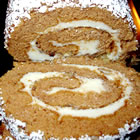
(Photo courtesy Allrecipes.com)
Cake:
Powdered sugar
3/4 cup flour
1/2 teaspoon baking powder
1/2 teaspoon baking soda
1/2 teaspoon cinnamon
1/2 teaspoon cloves
1/4 teaspoon salt
3 large eggs
1 cup granulated sugar
2/3 cup canned pumpkin
1 cup chopped walnuts
Filling:
1 package cream cheese
1 cup sifted powdered sugar
6 Tablespoons softened butter
1 teaspoon vanilla flavoring
Powdered sugar
Preheat oven to 375 degrees. Grease 15” x 10” jelly roll pan. Line with waxed paper, grease and flour paper (there is a reason!) Sprinkle a flat tea towel or dish cloth (flat woven, not terry cloth) with powdered sugar.
Combine flour, baking powder, baking soda, cinnamon, cloves and salt in small bowl. Beat eggs and sugar in a larger mixer bowl until thick. Beat in pumpkin, stir in the flour mixture. Spread evenly in prepared jelly roll pan, sprinkle with chopped nuts.
Bake 13 – 15 minutes or until top of cake springs back when touched. Immediately loosen and turn cake out of pan onto prepared tea-towel. Carefully peel off paper. Roll up cake and towel together, starting with narrow end. Cool on wire rack.
Beat cream cheese, powdered sugar, butter and vanilla in small mixer bowl until smooth. Carefully unroll cake, remove towel, and spread cream cheese mixture over cake. Roll cake back up again (it will want to be in the rolled position after cooling that way) Wrap in plastic wrap and refrigerate at least one hour.
Sprinkle with powdered sugar before serving.
Al Fresco in Kuwait
I have had several requests to know what we were eating when we eat in the open courtyard at the Mubarakiya. You Kuwaitis can skip this entry; to you this is not exciting or exotic. To my stateside, European and African readers, this is how it goes:
As soon as you are seated, the waiter brings a little charcoal stove to the table with a steaming hot pot of tea. There is a row of restaurants behind you, one of which has huge gold colored pots of tea brewing at all times. Our Kuwaiti friends tell us that the reason the tea is so strong is that they never wash the pots, just keep brewing tea in them. The tea is STRONG, served in tiny glasses on saucers, and is usually drunk with a good amount of sugar.
Then a plate of greens and onions arrive. The greens taste a lot like basil, very licorice-y, but they don’t look like basil.
You order. We don’t always have the same thing, but what you are seeing here is an order of shish ta-ook (chicken chunks, marinated and grilled, served on a skewer), fresh bread (comes with every order) tabouli ( a salad made mostly of chopped parsley and lemon), muttabel (a salad/dip made of roasted eggplant, tahina and olive oil), roasted lamb with rice, and a sauce made of okra, with a great big ball in it that is some kind of spice we don’t usually use, but enjoy in this sauce.
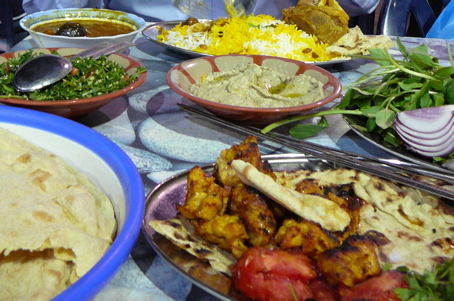
There are people at all the surrounding tables; usually one adult comes first, or maybe two, and tables get moved together or apart, depending on the size of the family coming. Then more women come drifting in, laden with shopping bags. They all greet one another and sit, and finally when the food comes, the children show up, eat a few bites, and then are up playing while the adults finish and drink their tea.
Adventure Man has a little black cat friend who likes the fatty pieces of the lamb he doesn’t eat. When he is finished with one offering, he will pat AM’s leg with his little paw, and AM will give him another piece. This is not a skinny, scrawney little cat, but a plump little cat with shiny fur. Guess he gets enough to eat!
At some point during your meal, you will hear the call to prayer, which we like even better now that we know that the muezzins (the ones who do the call to prayer) are all live, not recorded.
A lavish meal for four – more food than you can eat – with tea, and with excellent service, comes to around 8KD – around $30. How is that for a night on the town?
More Mubarakiya Art
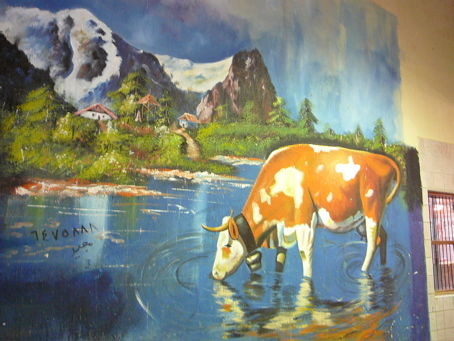
I think this is a total hoot! Along with the Pacific Coast scenery and fish, we have a Swiss Cow, with a bell, and Alpine scenery.
Here is one I love, a genuine Kuwaiti butcher – I love the glasses! Faces and hands are hard to do, and this artist caught his individuality. I wonder if he is still in one of the smaller meat market shops? Also note the bloodstains on the cutting table!

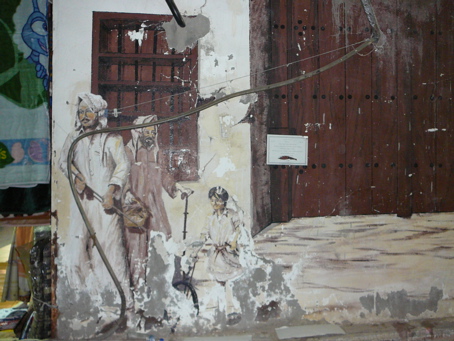
And here is a treasure, just outside the older section, near the date souk, badly damaged, and someone has strung a power cord across it, but one of the best pieces in the market. Love the colors, and look at the stone entry – the artist truly captured the feeling of stone. Look at the depths in the door and the window, the shadows and highlights. Look at the folds in the men’s thobes. This artist had some training.
Olive Oil Scandal Comment
This is a response to my recent post on The Olive Oil Scandal. I am so delighted when I get a thoughtful and enlightening response like this that I want to give it a separate entry so that it won’t be overlooked by all you bloggers with little time and short attention spans. 😉
It certainly is disgusting. One might note that, though, that none of the above named diluters of olive oil come from Spain, by far the largest producer and exporter of the product.
Currently, in fact, the Andalucian regional government (Andalucía, in which I am an olive grower, produces over 30% of the world’s olive oil) is currently funding a project intended to identify through mass spectometry analysis the molecular ‘signature’ of all the different regional denominations of extra virgin olive oil, enabling bottlers to include this information on barcode-like labels on every bottle marketed and against which the contents could be tested. The systematic adoption of this system, when it is completed, would go along way to protect consumers from the present situation, brought on partly through the fraudulent business practices of various Italian and American producers and sellers.
Also, considering that IOOC olive oil standards have no legal force in the United States, effectively permitting virgin or lampante oil to be sold as EVOO (but not diluted with other oils), the seemingly imminent adoption of international nomenclature by the USDA would be a very positive move. It can’t come soon enough.
Charles Butler’s website, The Olive Oil Gazette, is an absolutely fascinating resource, with all kinds of listings for Olive Oil sites and all kinds of olive oil information, including an article on October 21 about the proposal for the DNA “fingerprinting” of olive oil. Here is what it says about author Charles Butler McKay:
The Olive Oil Gazette is published in Cazorla, Jaén, Spain by Charles Butler Mackay, whose Spanish birth certificate states, correctly, that he was born in Toronto, Canada. Aside from editing this news source, he owns and oversees an olive plantation that has been in his family for a century and a half.
Thank you for your input!
Meanwhile, I don’t want to be sceptical. For a very good price, I found the below olive oil at the Sultan Center, and the lable says all the right things:
Cholesterol Free
Less than 1% acidity
Cold Pressed
It even has an expiration date
And it says it is a product of Syria. Because I am sceptical, I bought it because I thought it had a pretty label:

Gas Tank Mystery Solved
Thank you to my good e-mail friend for sharing this secret!
In and out of many countries, as you lug your bags to the car, do you make it a point to figure out which side of the car the gas tank is on? Or do you get to the service station and then realize that you don’t know?
I am one of those who forget, until it is time to gas up. I get to the gas station, and then when I go to fill the tank (yep, there are no friendly helpers there, so I have to do it myself) and often I have to back up or drive out and drive in again so I have the gas tank facing the pump.
There is a secret on your dashboard, one I never noticed and I bet you haven’t, either.
If you look at your gas gauge, you will see a small icon of a gas pump.
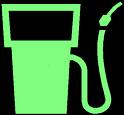
The handle of the gas pump will extend out on either the left or right side of the pump. If your tank is on the left, the handle will be on the left. If your tank is on the right, the handle will be on the right. It is that simple!
Am I the only one who didn’t know this secret?
UPDATE: On my car, this is NOT TRUE! On my car, the gas tank is on the opposite side of the car. My bad!
Fish Market Public Art
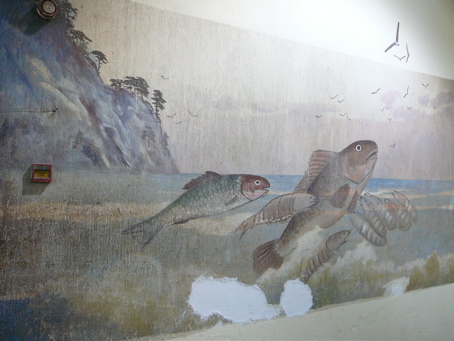
There are so many things I like about the Mubarakiya market. I believe it suffered enormous damage during the Iraqi invasion, and was substantially rebuilt. They did it nicely. The ceilings are high and spacious, and there are beautiful decorations in unlikely places. I found some Fish Market paintings I hadn’t photographed before.
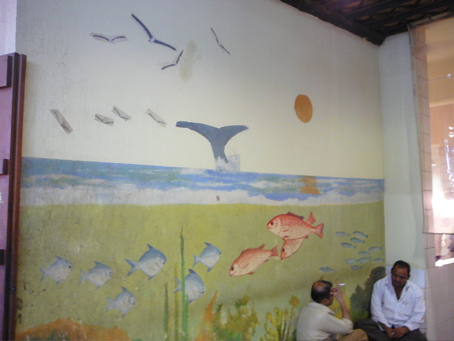
One thing is kind of funny – wouldn’t you think in Kuwait you would have dhows or showies, the Arab Gulf fishing boats? To me, this looks like the Oregon Coast, with the big boulders and rocky coastline! I am thinking those look like Pacific Coast fish, and isn’t that a whale with the seagulls? Are there whales in the Gulf?

I couldn’t take this one without the two guys taking a break, so I just included them – they ARE part of the Mubarikiya scenery:
Mubarakiya Evening
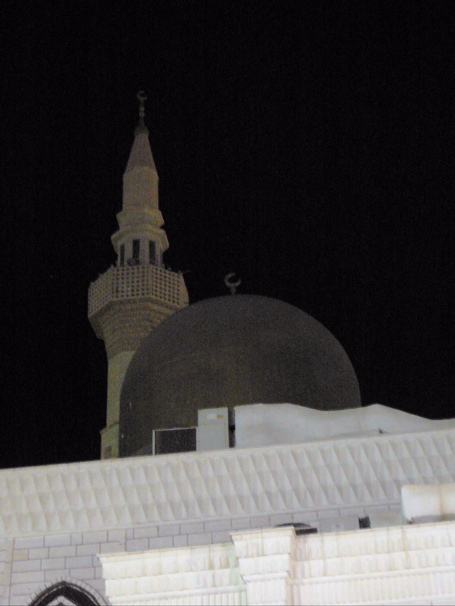
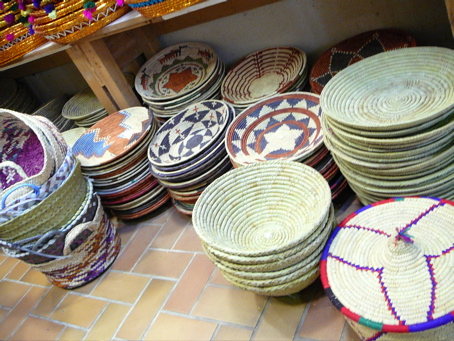
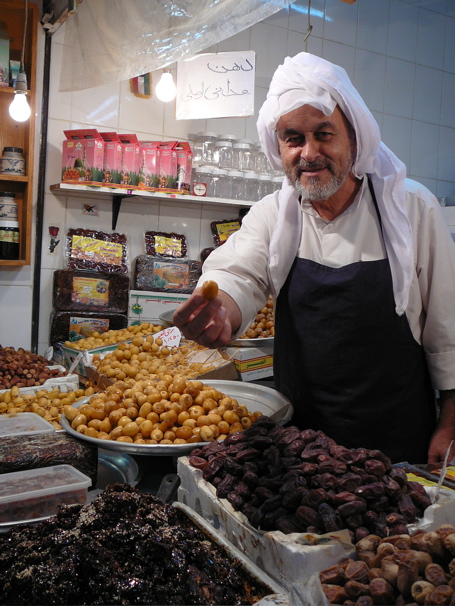
The weather has definitely cooled. We grab out friends and head for one of our very favorite places, the Mubarakiya market downtown, one of the few places still in existence with a flavor of old Kuwait.
We’ve visited in recent months, but the heat defeated us. Last night, our closest 4,000 friends were down there with us, shopping in the markets, having a bite to eat in the outdoor restaurant area (you can only tell which restaurants are which by the different colors of the chairs and tables) relaxing, visiting, just enjoying a beautiful mild weekend evening.
And it was beautful. We have eaten there in the heat, with cooling fans to keep things bearable, we have eaten there in the cold of winter, with little stoves on the table to keep the tea hot and to warm our hands (a little) but this night was utterly perfect. Warm enough, cool enough, and fresh, well prepared local food – it was a perfect evening.
Some new Mubarakiya photos:

WoooooHooooooo CO-OP!
It’s hot. It’s humid. I drive to the co-op for a few small things and holy smokes! I see a spot to park, and it’s near the door! I start to park, and I see the handicapped sign, so I go around again, and find another spot about a million miles away. It’s ok, the walk is good for me.
But as I pass the handicapped spots, a car drives in and out pops a perfectly non-handicapped young woman and her two non-handicapped, fully capable daughters!
If looks could kill!
I don’t want to waste a lot of my time on resentment, so I move on.
This week, here is what I see at the co-op:

Wooooo Hoooooooo! Handicapped spots RESERVED for those who have special needs! Blocked off, so as not to tempt the rest of us! Wooooo HOOOOOOOOO, way to go, Co-op!
The Olive Oil Scandal

A good friend gave me a subscription several years ago to The New Yorker, and at the time I didn’t know how lucky I was. First, I loved the cartoons. A couple magazines later, I got pulled in by some of their excellent travel and political writing. Later, the fiction issues pulled me in and introduced me to authors I had never read before. In no time at all, I was totally addicted.
Now, when The New Yorker arrives, Adventure Man and I fight to see who gets to read it first! Often he wins; he skims it. He knows I will take too long getting through it.
It was the New Yorker magazine who informed me about the great olive oil scandal.
I love olive oil. I only use other oils in baked goods, where the olive oil might give an odd taste, we use olive oil almost exclusively. Or so I thought.
In the August 13 Issue of the New Yorker, Tom Meuller starts like this:
On August 10, 1991, a rusty tanker called the Mazal I docked at the industrial port of Ordu, in Turkey, and pumped twenty-two hundred tons of hazelnut oil into its hold. The ship then embarked on a meandering voyage through the Mediterranean and the North Sea. By September 21st, when the Mazal II reached Barletta, a port in Puglia, in southern Italy, its cargo had become, on the ship’s official documents, Greek olive oil. It slipped through customs, possibly with the connivance of an official, was piped into tanker trucks, and was delivered to the refinery of Riolio, an Italian olive-oil produce based in Barletta. There it was sold—in some instances blended with real olive oil—to Riolio customers
Between August and November of 1991, the Mazal II and another tanker, the Katerina T., delivered nearly ten thousand tons of Turkish hazelnut oil and Argentinean sunflower-seed oil to Riolio, all identified as Greek olive oil.
Riolio’s owner, Domenico Ribatti, grew rich from the bogus oil, assembling substantial real-estate holdings, including a former department store in Bari. He bribed two officials, one with cash, the other with cartons of olive oil, and made trips to Rome, where he stayed at the Grand Hotel, and met with other unscrupulous olive-oil producers from Italy and abroad. As one of Italy’s leading importers of olive oil, Ribatti’s company was a member of ASSITOL, the country’s powerful olive-oil trade association, and Ribatti had enough clout in Rome to ask a favor—preferential treatment of an associate’s nephew, who was seeking admission to a military officers’ school—of a high-ranking official at the Finance Ministry, a fellow-pugliese.
However, by early 1992 Ribatti and his associates were under investigation by the Guardia di Finanza, the Finance Ministry’s military-police force. One officer, wearing a miniature video camera on his tie, posed as a waiter at a lunch hosted by Ribatti at the Grand Hotel. Others, eavesdropping on telephone calls among Riolio executives, heard the rustle of bribe money being counted out. During the next two years, the Guardia di Finanza team, working closely with agents of the European Union’s anti-fraud office, pieced together the details of Ribatti’s crime, identifying Swiss bank accounts and Caribbean shell companies that Ribatti had used to buy the ersatz olive oil.
The investigators discovered that seed and hazelnut oil had reached Riolio’s refinery by tanker truck and by train, as well as by ship, and they found stocks of hazelnut oil waiting in Rotterdam for delivery to Riolio and other olive-oil companies.
The investigators also discovered where Ribatti’s adulterated oil had gone: to some of the largest producers of Italian olive oil, among them Nestlé, Unilever, Bertolli, and Oleifici Fasanesi, who sold it to consumers as olive oil, and collected about twelve million dollars in E.U. subsidies intended to support the olive-oil industry. (These companies claimed that they had been swindled by Ribatti, and prosecutors were unable to prove complicity on their part.)
You can read this entire fascinating article here: Tom Meuller: Slippery BusinessGive yourself plenty of time. It is an article well worth reading.
There is another good reference here: The Great Olive Oil Scandal from PalestinianOliveOil.org
Investigators have gathered evidence indicating that the biggest olive oil brands in Italy — Bertolli, Sasso, and Cirio — have for years been systematically diluting their extra-virgin olive oil with cheap, highly-refined hazelnut oil imported from Turkey. [1]
A 1996 study by the FDA found that 96 percent of the olive oils they tested, while being labeled 100 percent olive oil, had been diluted with other oils. A study in Italy found that only 40 percent of the olive oil brands labeled “extra-virgin” actually met those standards. Italy produces 400,000 tons of olive oil for domestic consumption, but 750,000 tons are sold. The difference is made up with highly refined nut and seed oils. [2]
EVEN THE BIGGEST OF THEM WILL MISLEAD THE PUBLIC…
“In 1998, the New York law firm Rabin and Peckel, LLP, took on the olive oil labeling misnomer and filed a class action suit in the New York Supreme Court against Unilever, the English-Dutch manufacturer of Bertolli olive oil. The firm argued that Bertolli’s labels, which read “Imported from Italy,” did not meet full disclosure laws because, even though the oil had passed through Italian ports, most of it had originated in Tunisia, Turkey, Spain or Greece. “Bertolli olive oil is imported from Italy, but contains no measurable quantity of Italian oil,” according to court documents.”
Curezone lists manufacturers of adulterated olive oil and marketers of the same oil. It is disgusting. We pay high prices for junk-olive oil. From Curezone.com/forums
The Guilty
Below is a list of known adulterated brands and dishonest distributors with links to information about their cases.
Adulterated brands of extra virgin olive oil
with country of origin
Andy’s Pure Olive Oil (Italy)
Bertolli (Italy)
Castel Tiziano (Italy)
Cirio (Italy)
Cornelia (Italy)
Italico (Italy)
Ligaro (Italy)
Olivio (Greece)
Petrou Bros. Olive Oil (California)
Primi (Italy)
Regale (Italy)
Ricetta Antica (Italy)
Rubino (Italy)
San Paolo (Italy)
Sasso (Italy)
Terra Mia (Italy)
Distributors caught selling adulterated olive oil
Altapac Trading
AMT Fine Foods
Bella International Food Brokers
Cher-Mor Foods International
D&G Foods
Deluca Brothers International
Gestion Trorico Inc.
Itaical Trading
Kalamata Foods
Les Ailments MIA Food Distributing
Lonath International
Mario Sardo Sales, Inc.
Petrou Foods, Inc.
Rubino USA Inc.
Siena Foods Ltd.
Vernon Foods
So who do we trust? How do we know that we are getting a quality, unadulterated product? This is fraud in an international scale!
Accident Aftermath
This time the crunch was different. This time, the initial BLAM crunch was followed by a heart-sickening series of crunches. I was on the phone dialing 777 even before I got to the window.
They have lovely women working for emergency services now, women who can stay calm and switch languages easily. Just hearing her voice calms me down as I report the accident, tell them to send an ambulance. The upside down car door is flipping open, and people are running to help the victim out. It’s a woman, and she is beautiful. She is also bleeding, and once they get her out, she is very still, too still.
The traffic police call me back and I tell them where the accident is, but thank God the woman is still on the phone and when he doesn’t understand, she fills in efficiently and accurately.
It takes them 21 minutes to arrive. The traffic police send one car, and on a busy street, they all gather around the woman and stare. The MOI also send a car. Not one of these police set up any kind of traffic control, cars on both sides of the road are stopping, people come running, just to look.
The ambulances take 22 minutes. When they leave, there are no sirens. I don’t think she survived. The medics appeared knowledgeable and efficient.
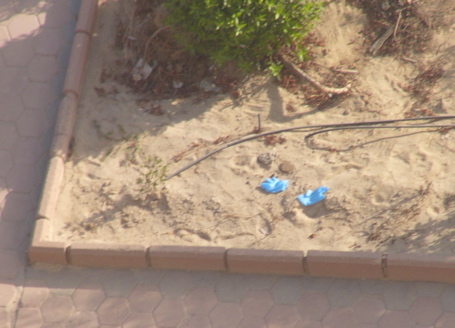
It’s the aftermath that bothers me now. On the ground, they left all the medical waste.

The last thing the medic did as he got into the ambulance was to throw his bloodied gloves on the ground:
And then . . .the traffic cops left! There are two wrecks on one of the busiest thoroughfares in town, and no protection from the next speeding car! The wrecks are in the fast lane!
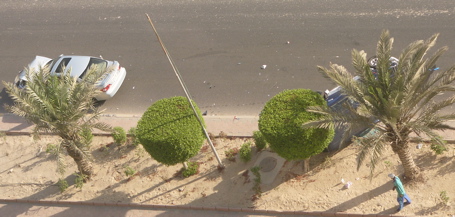
Don’t get me wrong. You know how I feel – police, ambulance medics, firemen – they are all heroes in my book. They risk their lives every day for the common good. The save lives, and they take pride in what they do.
They need a little training in accident management. When there is an accident, there needs to be a priority on getting there fast, and controlling the crowd, and routing traffic by efficiently. The medics need to pick up their waste.
There needs to be after-accident care, ensuring that someone stays until the wreckage is removed.
I had a house guest once who sat in my window and said “Oh my God. Oh my God! Oh! Oh! Oh!”
There are three separate u-turns we can see. Each one is another accident just waiting to happen. When the turn lanes back up, sometimes some people start honking, putting pressure on the lead person to make an unsafe turn. Please – resist the pressure. Take your time. Wait for a safe, truly safe interval.
Please, my friends, do one thing for me. Please, buckle your seat belts. And please, buckle up your children, put them in car-seats made to protect them, teach them from an early age to buckle-up, help it become so automatic they don’t even think about it.
Recent Comments
ExpatAlien on What Country am I Living … intlxpatr on Yellowstone: Old Faithful to C… Michelle on Yellowstone: Old Faithful to C… Cathy on No Grown-Ups in Charge intlxpatr on Waiting for Snow Wikipedia Donate Button

Amazina


Early Voting in Florida


 Here There and Everywhere