“And also many animals”
Today’s Old Testament reading is from Jonah, and my favorite line is the very last, “and also many animals.” That the creator cares for his entire creation, and loves us equally, without the artificial heirarchies and preferences we humans put into place:
Jonah 3:1-10,4:1-11
3The word of the Lord came to Jonah a second time, saying, 2‘Get up, go to Nineveh, that great city, and proclaim to it the message that I tell you.’ 3So Jonah set out and went to Nineveh, according to the word of the Lord. Now Nineveh was an exceedingly large city, a three days’ walk across. 4Jonah began to go into the city, going a day’s walk. And he cried out, ‘Forty days more, and Nineveh shall be overthrown!’ 5And the people of Nineveh believed God; they proclaimed a fast, and everyone, great and small, put on sackcloth.
6 When the news reached the king of Nineveh, he rose from his throne, removed his robe, covered himself with sackcloth, and sat in ashes.7Then he had a proclamation made in Nineveh: ‘By the decree of the king and his nobles: No human being or animal, no herd or flock, shall taste anything. They shall not feed, nor shall they drink water. 8Human beings and animals shall be covered with sackcloth, and they shall cry mightily to God. All shall turn from their evil ways and from the violence that is in their hands. 9Who knows? God may relent and change his mind; he may turn from his fierce anger, so that we do not perish.’
10 When God saw what they did, how they turned from their evil ways, God changed his mind about the calamity that he had said he would bring upon them; and he did not do it.
4But this was very displeasing to Jonah, and he became angry. 2He prayed to the Lord and said, ‘O Lord! Is not this what I said while I was still in my own country? That is why I fled to Tarshish at the beginning; for I knew that you are a gracious God and merciful, slow to anger, and abounding in steadfast love, and ready to relent from punishing. 3And now, O Lord, please take my life from me, for it is better for me to die than to live.’ 4And the Lord said, ‘Is it right for you to be angry?’ 5Then Jonah went out of the city and sat down east of the city, and made a booth for himself there. He sat under it in the shade, waiting to see what would become of the city.
6 The Lord God appointed a bush,* and made it come up over Jonah, to give shade over his head, to save him from his discomfort; so Jonah was very happy about the bush. 7But when dawn came up the next day, God appointed a worm that attacked the bush, so that it withered. 8When the sun rose, God prepared a sultry east wind, and the sun beat down on the head of Jonah so that he was faint and asked that he might die. He said, ‘It is better for me to die than to live.’
9 But God said to Jonah, ‘Is it right for you to be angry about the bush?’ And he said, ‘Yes, angry enough to die.’ 10Then the Lord said, ‘You are concerned about the bush, for which you did not labour and which you did not grow; it came into being in a night and perished in a night. 11And should I not be concerned about Nineveh, that great city, in which there are more than a hundred and twenty thousand people who do not know their right hand from their left, and also many animals?’
The End of an Era
“Mr. Adventureman, the papers you have ordered have come!” the manager of the Sultan Center would say, exultantly, to my clueless husband.

“I ordered papers?” he might croak.
“Sir! It is the coated paper for you to use in the microwave!”
“Aha! ” AdventureMan thinks, “my wife has ordered this.”
“Thank you so much!” he responds brightly to the store manager. “We will pick it up shortly!”
Raised with Alaskan frugality, storing for the future, letting nothing go to waste, never knowing when we will ever see (fill in the blank) again, I store my treasures, using them sparingly. Today, I smile ruefully as I use the last of the last roll of waxed paper from Kuwait.
I think microwave technology has improved. I don’t seem to use waxed paper to defend against food explosions as I once did. Or maybe I’ve just gotten smarter?
I’m not buying waxed paper – or a lot of things – the way I once did. I’ve never lived in one place for this long – a place where, if something runs out, I can get a replacement within an hour, or at worst, a couple days. It’s not like when taco chips completely disappeared from every restaurant in Doha for a month, or cream sold out in Tunis as the big Eid approached. The closest we’ve come to a shortage is during COVID, when people hoarded toilet paper for a short time. The lasting result is that my friends discovered the blessing of bidets.
Last month, I actually came close to running out of dish detergent. I have to laugh at myself; in my own funny way, I’m making progress.
What Could Possibly Go Wrong?

New York Times reports Trump Administration is said to have reached a broad nuclear deal with Saudi Arabia.
Alaska 2026: Homer and Love Languages
There are some books out that talk about Love Languages, and they mention five. I actually read the original book and almost threw it at the wall in frustration. It seems so obvious to me – there are thousands of love languages! We are all wired differently, and a successful pairing requires each person paying attention to the small things that matter to the other person.
No! Don’t bring me candy or expensive jewelry! I have particular – maybe peculiar! – tastes.
Love isn’t perfection, it’s abrasive, it rubs off our sharp spots and helps us become easier to live with. AdventureMan has learned a thing or two about me, things I didn’t even know. Keep me traveling. Keep exposing me to new ideas, new sights, sounds, and tastes. I thrive on exposure to new things.
Allow me to break the rules now and then, and eat those King Crab legs, so extravagantly beyond our normal budget. Unexpected kindness is always a love language.
(Aside, Jewel Kilcher, who sings the song with the refrain “In the end, only kindness matters,” was born in Homer. She is related to the Alaska: The Last Frontier Kilchers.)

And this.
It may not look romantic to you.
I have annoyed AdventureMan for years with my need to document, to stop at every gorgeous, irresistible view and take a photo. Sometimes I shoot through the windshield when stopping isn’t possible.
He cleans the windshield.
I don’t ask him; he thinks of it all by himself. He doesn’t do it for himself; he does it for me.
True Love. If you have the eyes to see. If it matters to you, you can see it. True Love.
You’ll have your own definition. True Love is what matters to YOU.
Mind Your Own Business!
This message from yesterday’s Lectionary Readings made me laugh because different cultures have such differences, even in my own country, the United States of America.
I grew up in the great Pacific Northwest, on an island in Alaska, surrounded by Scandinavian immigrants and Alaskan natives and pioneers from the “lower 48,” as we called the USA, which was then a territory and not yet a state. Neighbors relied on one another, and we were strongly interconnected, helping one another out in daily interactions, and in emergencies. We were close, and yet we were also insular – a curious child’s innocent inquiry (mine!) would be met with “Mind your own business.” It meant don’t ask questions. Give people their privacy. In truth, there were many people who had left the “lower 48” for good reasons, established new lives in the last frontier and did not want to be reminded of what kind of mess they might have left behind.
AdventureMan grew up in the deep South, a town of around 3,000 people where they joked that the population always remains the same – a new baby gets born, and a man leaves town.” When I come back from a meeting or a lunch with a friend, he has endless questions. When he meets my friends, he has questions. I tell him generalities, and he asks specifics, and I say something vague. I hurt his feelings when I don’t share all the details – in his culture, in his small town, everyone knew everything about everybody. No one had any secrets. People knew what you had done 50 years ago, and there was little room for changing anyones opinion of who you are now, how you might have changed. People regularly shared what they knew about one another.
We’ve been married decades, and we still push and pull on this issue – how much do we share? We both know there is not a right or wrong, just what feels right to him and what feels right to me, and we have to agree to disagree, and sometimes we can be very disagreeable!
This is what the Lectionary reading says:
Thessaalonians 4:10
But we urge you, beloved,* to do so more and more, 11to aspire to live quietly, to mind your own affairs, and to work with your hands, as we directed you, 12so that you may behave properly towards outsiders and be dependent on no one.
How does it work for you?
Rabbit Holes: Paul Samuelson, John Steinbeck and Anu Garg
It’s a rainy day in Pensacola, and Florida needs rain. The reservoirs are depleted, and a drought has been declared. As I go through my e-mail, I come to Anu Garg’s A Word a Day post. (Today’s word is “incubus”). I subscribed to his daily e-mail many years ago as I studied teaching English as an additional language.
Anu Garg is profound. He chooses wonderful words, words my foreign students adored. He also includes a quote at the end of each post. Today’s quote was from John Steinbeck.
A THOUGHT FOR TODAY:
The things we admire in men, kindness and generosity, openness, honesty, understanding and feeling are the concomitants of failure in our system. And those traits we detest, sharpness, greed, acquisitiveness, meanness, egotism and self-interest are the traits of success. And while men admire the quality of the first they love the produce of the second. -John Steinbeck, novelist, Nobel laureate (27 Feb 1902-1968)
And it just so happens that this coming month, my book club is looking at three Steinbeck novels; Tortilla Flats, Cannery Row, and The Moon is Down.
One thing leads to another. Tortilla Flats takes place on a hill above Monterey, California, where paisanos live.
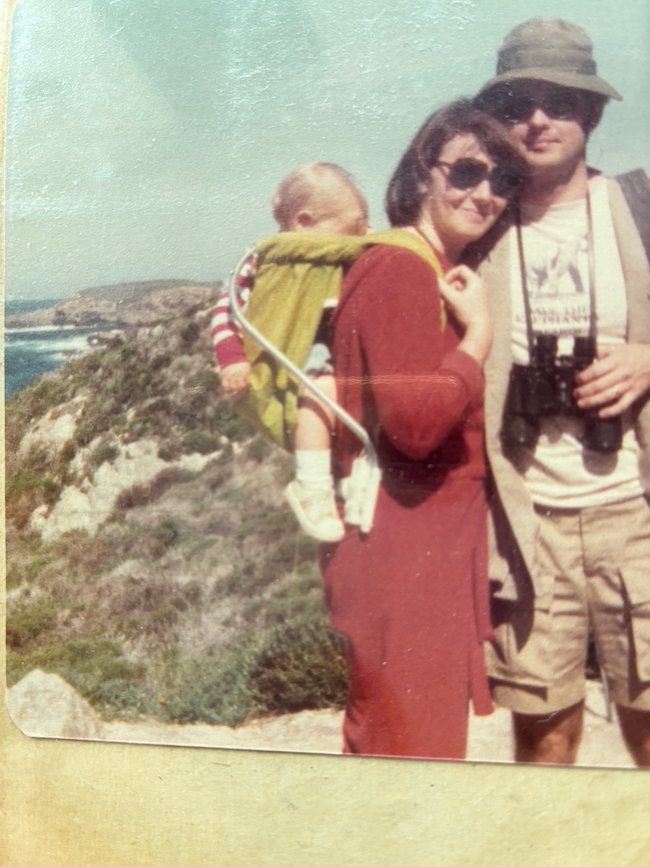
Of all the places I’ve lived, I have never loved a place the way I love Monterey, California. We lived on a hill above Monterey, above the old Del Monte Hotel, now the Naval Postgraduate School. The location sounds very suspiciously a lot like Tortilla Flats. The book bring back so many wonderful memories, particularly lying in bed at night and hearing the sounds of the sea lions barking down on the rocks, the gulls screeching, and the fog horn warning – we had a lot of fog.
And I remember Paul Samuelson, the author of the Economics textbook I used for an introductory economics class I took my freshman year in college. I never intended to like economics, but I found Samuelson readable – and even riveting. I remember one quote from his text: “Man does not always starve quietly” which had to do with his theories on economic development. Within that chapter, he also explains comparative economic deprivation.
This was a long time ago, so I am paraphrasing what I remember, and I might be getting it wrong. Samuelson talked about how once the most basic needs are met in a developing country, food, housing, clothing, jobs – you’d think everybody would be happy, but once people can stop scrabbling to survive, once they are stable, they start looking around and see someone who has more – and this is relative deprivation. The see someone with something they didn’t know they needed, and now they need this, too, to be happy.
So how does this relate to Steinbeck, and La Mesa Village, and Paul Samuelson?
My husband and I and our brand new little baby were leaving one military school and headed for schools in Monterey when he got a call from military housing in Monterey. It was such a nice, positive call when it started out, telling my husband about the lovely house we were to have with three bedrooms and a fireplace in La Mesa Village, and went on to give information about measurements and furniture and we were joyfully amazed. Our military housing had never been so fine, nor had any housing office called us and treated us so respectfully.
And suddenly everything changed. “Oh wait,” she said. “You’re not Navy?”
“No,” replied my husband, “I’m in the Army.”
“You’re not a Navy Captain?” she confirmed.
(silence as we looked in horror at one another)
“No,” my husband said shortly, the way you respond when a short-lived dream-come-true has just died.
“Oh. Well you’ll be in normal student housing then. Sir,” she added, respectfully, but all the pleasantness was gone.
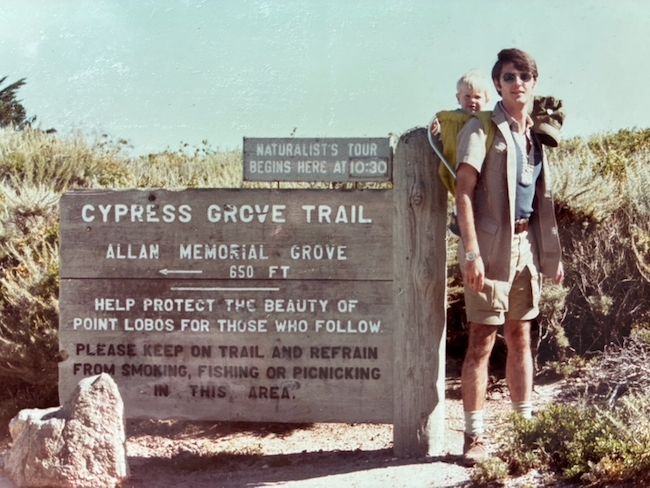
And that’s where my friend Paul Samuelson, the first Economist in the United States to be awarded the Nobel Prize (1970) comes in. How much do you remember from your college classes? As we accepted our student housing – not a beautiful 3 bedroom house with a fireplace, but a flat in a quad with two bedrooms and linoleom floors (no fireplace) I remembered the concept of relative deprivation. I had a roof over my head in Monterey, California, heaven on earth. I had a baby and good child care and great grocery stores; I attended the Naval Postgraduate School and the Defense Language School. On weekends, we hiked at Point Lobos, and we were happy. Happy, except for that occasional twinge of jealousy when we passed the houses higher on the hill with three bedrooms and a fireplace.
And when I felt that twinge, I smiled and thought of Paul Samuelson.
Oh! The People You’ll Meet! (Apologies to Dr. Seuss)
Under the category of Stranger in a Strange Land, things change. My generation revolted (and were sometimes revolting) and rioted and demonstrated against the VietNam War and for Equality, Diversity and Inclusion. We marched. We made documentaries. Oh, we were so idealistic.
AdventureMan, my husband, was a warrior from the beginning, and fought in that unpopular war. When he returned home, people were harassing returning soldiers, even spitting on them.
Emotions have calmed through the years, and many surviving fighters in that war, men and women, have had a tough time dealing with their participation in the war. We often see homeless veterans here in Pensacola; the homeless find Pensacola comfortable, and temperate. You can sleep rough most of the year.
My husband keeps his eye open for fellow vets. When he sees someone with a VietNam vet bumper sticker, or wearing a VietNam Vet bill cap, he’ll go over, shake hands, and swap old war stories. It can be a very moving moment for both parties involved. War-fighting is intense. There are things you don’t forget. There are things you do forget, and years later, they come back in dreams, not good dreams.
And there are also fraudsters out there. Some are well-meaning, well enough, or just oblivious. Some are trying to fake an experience they didn’t have.
We had a homeless man here in Pensacola we helped occasionally. When he told us he had also been in the military, AdventureMan started talking with him and soon started looking very confused. “He’s never been anywhere near being in the military,” he told me, “No one in the military forgets where they did their basic training or can’t remember where they were stationed.” Nothing makes a person mad like someone straight out lying.
Other times, it isn’t so manipulative, it is just ignorant. In the local Apple Market, AdventureMan shook a man’s hand and asked where he’d been in VietNam and the man just looked foolish and said, “It isn’t really my hat, a friend gave it to me.”
More recently, out at Peg Leg Pete’s on the beach, as we were leaving, AdventureMan stopped to talk with a man wearing a 7th Cav hat. But no, he had never been in the 7th Cav; he had been in the Navy, and he was a Cowboy Re-Enactor. He also looked sheepish.
People are tribal. The like association. Kids wear Nikes because they want to play basketball like Michael Jordan. Some people wear Florida State hats because they hope Florida State wins the big game, not because they have ever set foot on the Florida State campus. Or Hawaiaan shirts, or turquoise squash blossom jewelry, or Yosemite sweatshirts (me), because of the association. It’s just the way we are, expressing ourselves with tribes, aspirational or not.
It’s a bad idea to give an impression, knowingly, which may be easily discovered to be false. I had a friend once who found an old sorority pin in a thrift store and wore it as costume jewelry. I told her it was a bad idea, that sororities inspire deep loyalties, and wearing a pin to a sorority that you don’t belong to could damage your reputation. I think she chose to wear it ironically.
Living in Doha, where designer copies were cheap and plentiful, one of my Japanese friends told me that she would NEVER buy a copy; that people who know what details to look for would know you were a pretender. Once you got that reputation, you would always be known as a person who couldn’t afford the real thing. I listened and learned!
AdventureMan says, “Be careful what you wear because of the message that it sends. If you didn’t earn it, don’t wear it.” His Dad was a SeaBee, but he would never wear his Dad’s insignia. People may not be trying to fool people, but people will see what you are wearing and make assumptions.
The majority of people wearing military memorabilia actually have a legitimate connection to that unit, and greeting them results in truly wonderful moments of sharing and camaraderie.
Also – if you believe no women were serving in VietNam, you need to read Kristin Hannah’s book, The Women. Women served as nurses, medics and doctors, as Red Cross workers, and in administrative roles. Although not in combat, they served their country and were shot at, wounded, killed, hit by explosives, died in helicopter evacuations. They suffered PTSD and were treated as poorly as the other wounded vets that came out of that war.

Waiting for Snow
Lest you think I sit around between trips finding things to rant about, I will share my Saturday with you.
I am religious. I am a believer. LOL, here is where Catholics and Muslims have something in common – when I say “I am a believer” my Catholic friends think I am Catholic, and my Muslim friends think I am Muslim. Sooner or later we get it all figured out. I believe in a Great Creator, without whom nothing was created, and who is magnificent beyone our ability to understand. I believe he cares about us on an individual basis, and that he wants only good for all of us, whether we agree or not. I do not understand why he gave us all free will, and I know it would be a terrible world without it. I believe God is infinitely merciful.
So in the midst of some of the political horrors of January, I texted a friend and said “I need a meet-up.” We met up this morning at a local cafe and hashed out our lives, just normal stuff, families, husbands, children, and what we CAN do to make a difference. I have a friend from high school, and a friend from college, and friends from almost every post where we lived. We don’t always see one another, but when we need a good connection, we get on the phone – yeh, old school – and it’s like we’ve never been apart. When I need to re-balance, when my emotions are unmanageable, my friends help me recenter. Thanks be to God. At the cafe, I also saw another old friend, of a different political persuasion, and we were delighted to see one another, reminding me that our current differences are temporary, and mendable.

I arrived back home to the aroma of garlic and peppers sautéing; AdventureMan is making beans! We have been informed it MIGHT snow tonight, it is hovering just above and below freezing and a big pot of beans is a perfect hot weather meal.

Birds on the Bayou are chowing down, the fish must be running. We have pelicans plunging, an eagle chasing off a hawk, a cormorant and a heron.


Last year, almost this same time of year, we got several inches of snow. In previous years, I have seen a flake of snow here and there, but last year was a special confluence of factors – humidity, cold, polar vortex and a series of cold dry days in which the snow first fell, and then stuck around. It was like wiping away all the bad, a clean, clear new earth, few cars driving, lots of walking and lots of playing. Maybe we all need to play a little more. Pensacolians love a good snow, and it doesn’t stick around long enough to get old.

Our house is warm, we have a big pot of beans cooking, we have friends, I’ve recovered all my lost-for-a-very-short-time passwords and life is sweet. May you be equally blessed; may all your problems be little ones.
Delinquent and Begging Forgiveness
It is five p.m. Pensacola Time, this 30th day of December, and I am starting a new series of posts, a trip we took in August to the British Isles, ending in Bergen, Norway.

While I am still the same Intlxpatr you remember from back in 2006 – yes, almost 20 years ago, I have aged. I still feel the same on the inside, but there are hints even I cannot ignore. I have slowed down. I have given up things that might damage me, like skiing and ice skating, and walking too fast on slick surfaces. Like staying up late at night to finish a book. Like eating too late at night, and cooking for large crowds.
None of this happened quickly, and most of happened unconsciously. We used to joke about becoming “elderly” and we don’t joke about that anymore, or we joke about it differently, with more respect.
We still love to travel, but we travel differently, too. Today I started to plan a trip to the Big Bend National Park in Texas, and to some petroglyph sites north of there, and when I went to plot the map, I discovered it was 1100 miles. When we got to Pensacola, 15 years ago, we might do that in two days, like making a stop in Houston or Fredricksburg, but now, we don’t travel like that. We fly places, rent cars, spend more time in one location. As I looked at the map and the distances, my heart sank. We could do it – and we would pay a price. I sighed, and started looking at other options.
When we finished trips, I might give myself a month or so to sort through the photos and to integrate what I had seen and learned, and then I would start writing and not stop until I had finished up the trip, a day or two. This is the first year I have not written up any trips, and so I will start with this one, The British Isles.
It’s been on the books for three years. We like to plan. We like to research. We weren’t as excited about this trip as others (almost anything on the Mediterranean). It turned out to be one of the best cruises yet.
And there were differences. We had planned to take it easy – we didn’t. This trip was so packed with destinations, we were on the run every day. We booked ahead for early tours at our destinations, so there wasn’t a lot of sleeping in. I had books with me, but the only reading I got done was on the airplanes, going and coming back. There were days, I am embarrased to admit, when we woke up and had to check what day it was and which city, which country we were in. There is one day that I uploaded photos, ran short of time, thought I had saved them, carefully deleted from my camera and disk, then discovered I had lost two days worth of photos. Fortunately I had also taken some on my camera, and Adventureman to the rescue – he had taken some beautiful photos.
All I’m saying is that I am confronted by some realities I never dreamed would apply to me. Uncomfortable realities relating to energy levels, bone density, conditions that only applied to The Elderly. Oh. Wait.
So we are traveling a little differently now, maybe just a little slower, definitely lighter, expecting less of ourselves and truthfully, enjoying it more. AdventureMan told me tonight he has noticed over the years I am putting in less written content and more photos. Sadly, it’s because sometimes I can’t remember! Sometimes I just get tired of writing! But I am committing to sharing this trip with you, starting now.
The map at the top is the route we followed. We gave ourselves two days in London to adjust to the time change before joining the Viking Jupiter. I may be rueful about aging, and less compultive about posting, but we really loved our time on this voyage.
Morocco Malta and the Med: Cadiz, An Unexpected Thrill
Too early for sunrise, not yet in Cadiz, and not allowed out on the deck – maybe high winds?
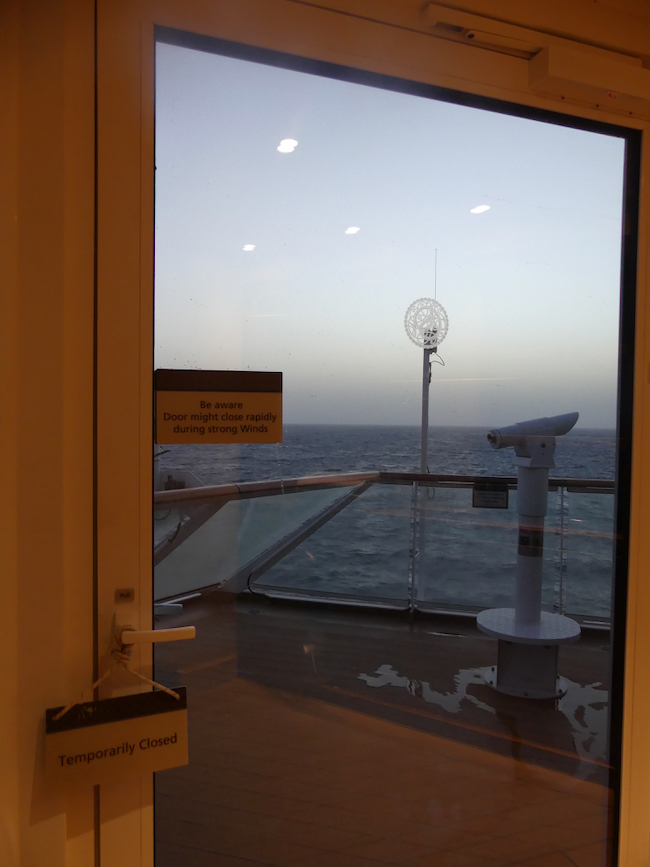

So this is the Explorer’s Lounge, where I hand out early in the morning, catching up with e-mails and Lectionary readings so I don’t wake AdventureMan.


I have a friend who brings me coffee and says “Madam! The sun is about to come up!” I can’t go outside, but shooting through the window works out. We are still not in Cadiz, plenty of time.


This yellowish haze is disturbing, and it is everywhere. Finally the sun sort of breaks through.

Shortly after breakfast, we approach Cadiz.




So here is the first unexpected blessing. This is the view from our stateroom:

This changes everything. We had booked a walking tour of Cadiz. We cancel it. We are so close we can visit everything on our own, at our own pace, and find a place for lunch.
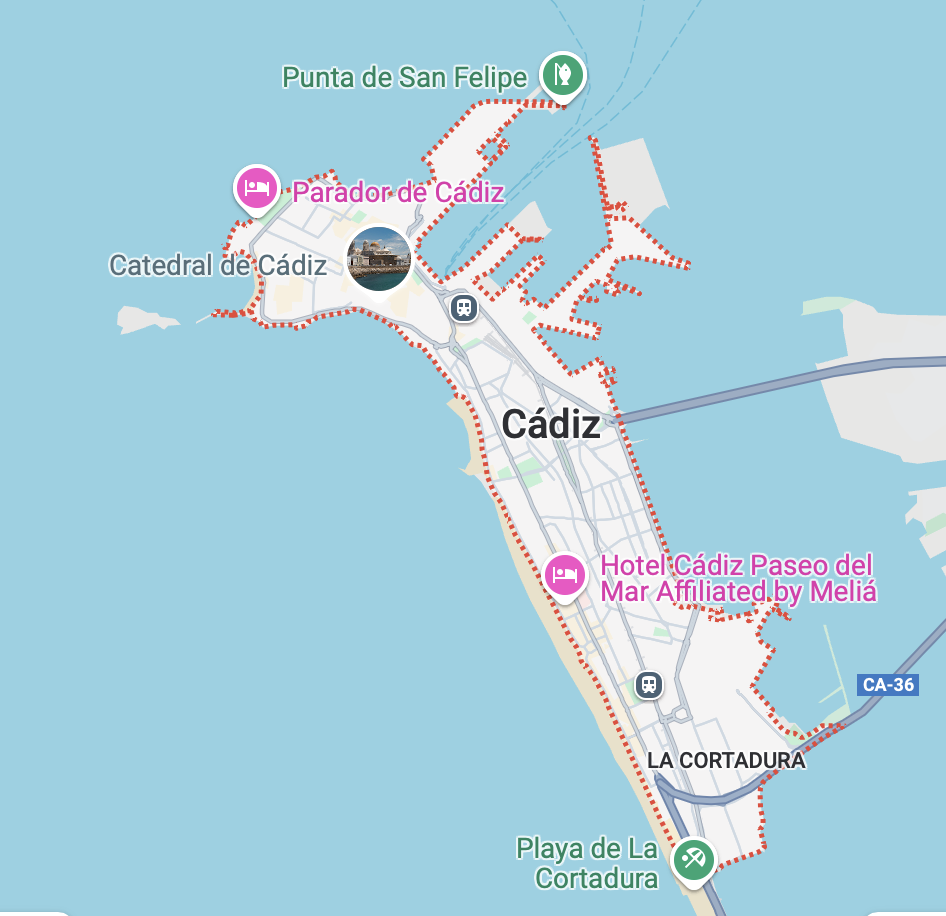
From Google Earth:
Cádiz is an ancient port city in the Andalucia region of southwestern Spain. The home of the Spanish Navy, the port boomed in the 16th-century as a base for exploration and trade. It has more than 100 watchtowers, including the iconic Torre Tavira, which was traditionally used for spotting ships. On the waterfront is the domed, 18th-century Cádiz Cathedral, featuring baroque and neoclassical elements.
And this is what Cadiz looks like – a narrow isthmus and a quick walk from one side to the other. We are docked in the port to the North east, facing the Cadiz Cathedral.
It is just the kind of place we love – great for walking, lots to see, and we can do this on our own!
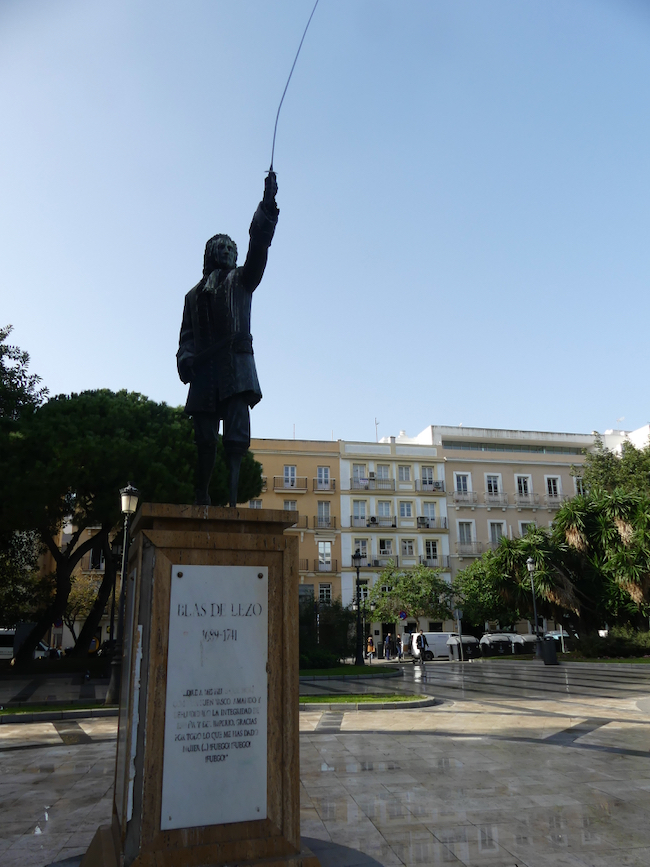
From Wikipedia: Admiral Blas de Lezo y Olavarrieta (3 February 1689 – 7 September 1741) was a Spanish navy officer best remembered for the Battle of Cartagena de Indias (1741), where Spanish imperialforces under his command decisively defeated a large British invasion fleet under Admiral Edward Vernon.
Throughout his naval career, Lezo sustained many severe wounds; he lost his left eye, left hand, complete mobility of the right arm, and had his left leg amputated in situ after being hit by the projectile of a cannon.[1] He perceived his wounds and physical limitations as medals, refusing to wear an eye patch to hide his blind eye. Wearing his past battles history on his flesh won the respect of his peers and soldiers.[2] Lezo used to say that the lack of a leg does not imply the lack of a brave heart. It is said that he sometimes recalled famous Dutch admiral Cornelis Jol, called “pegleg” because of his wooden prosthesis, as an example of a sailor who undertook great enterprises and achieved great renown, especially in piracy and privateering, despite his theoretical disability.[3]
Lezo’s defense of Cartagena de Indias against a vastly larger British fleet consolidated his legacy as one of the most heroic figures in the history of Spain. He is often recognized as one of the greatest strategists in naval history.[4][5]
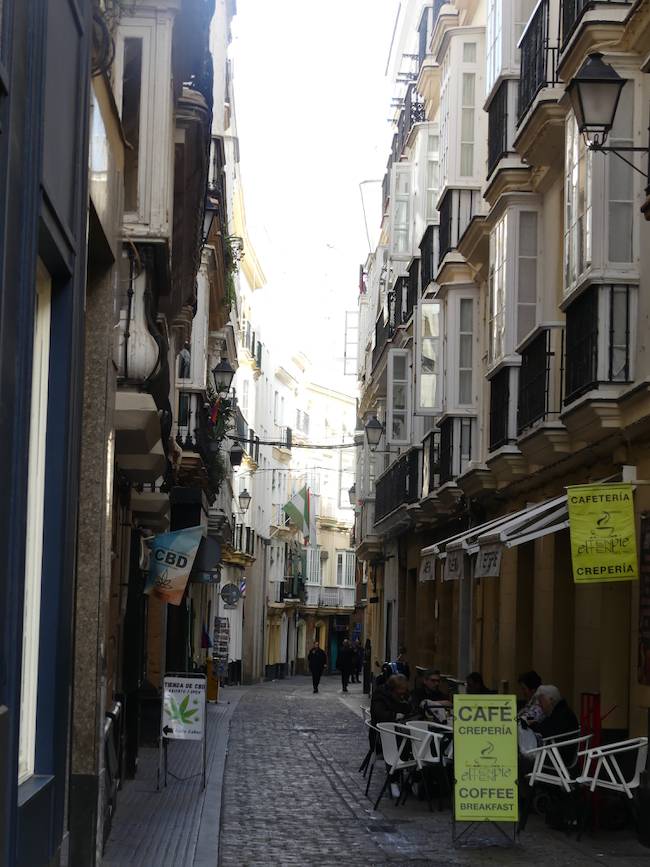
We really can’t get lost in Cadiz:


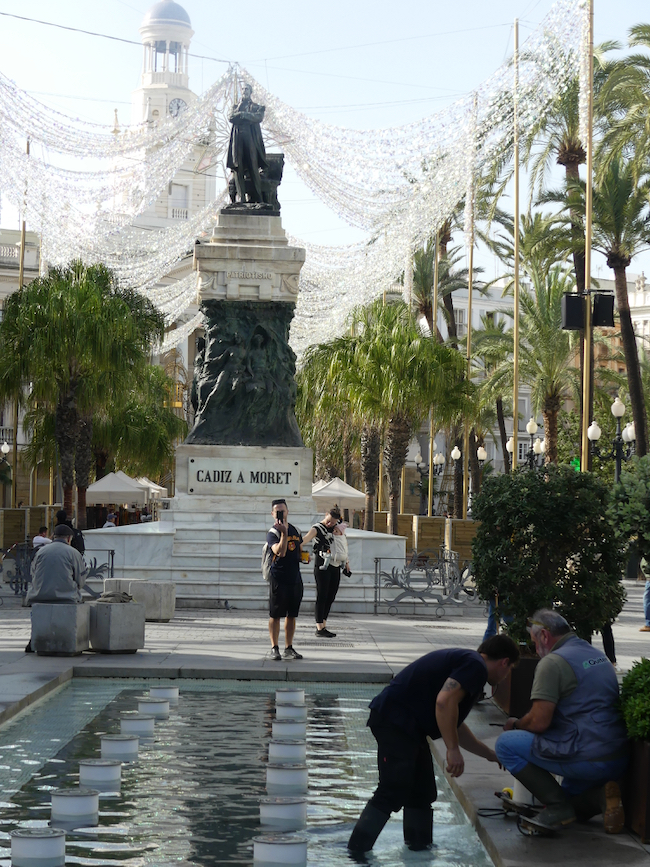
The Christmas Market going up:


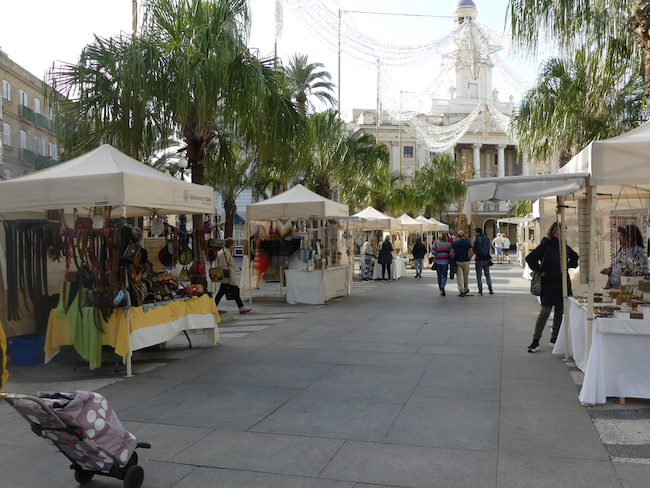

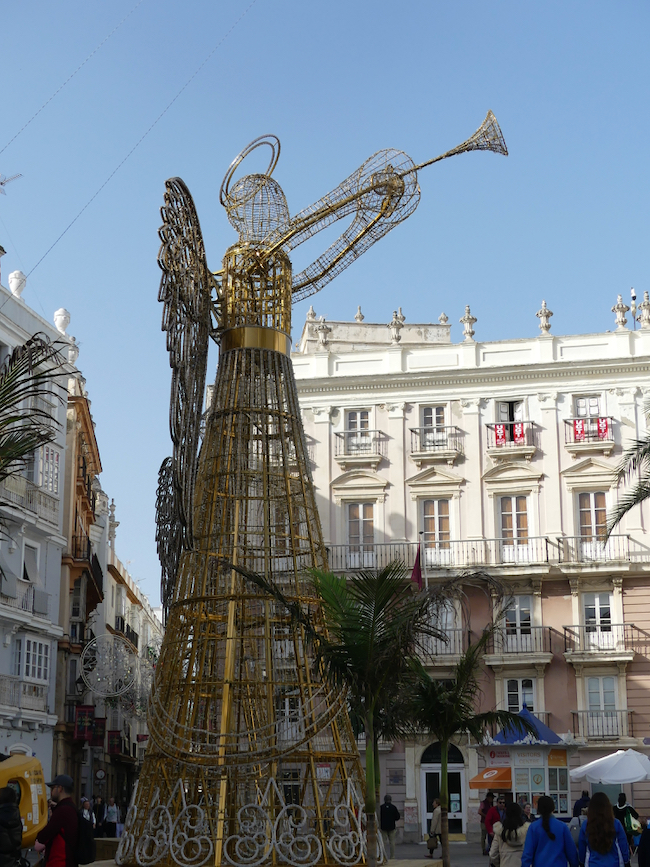


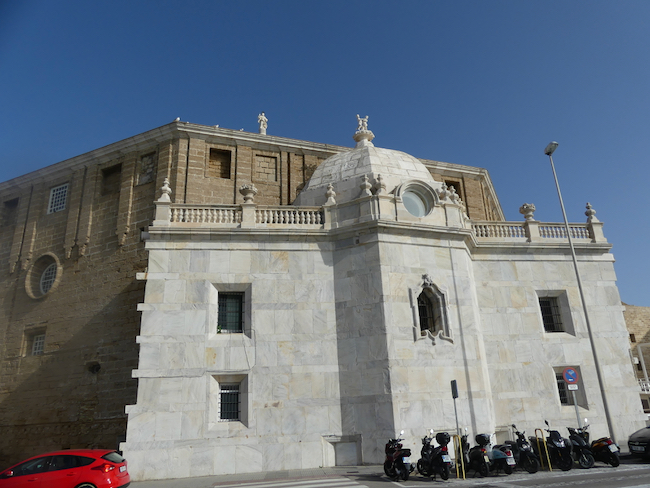

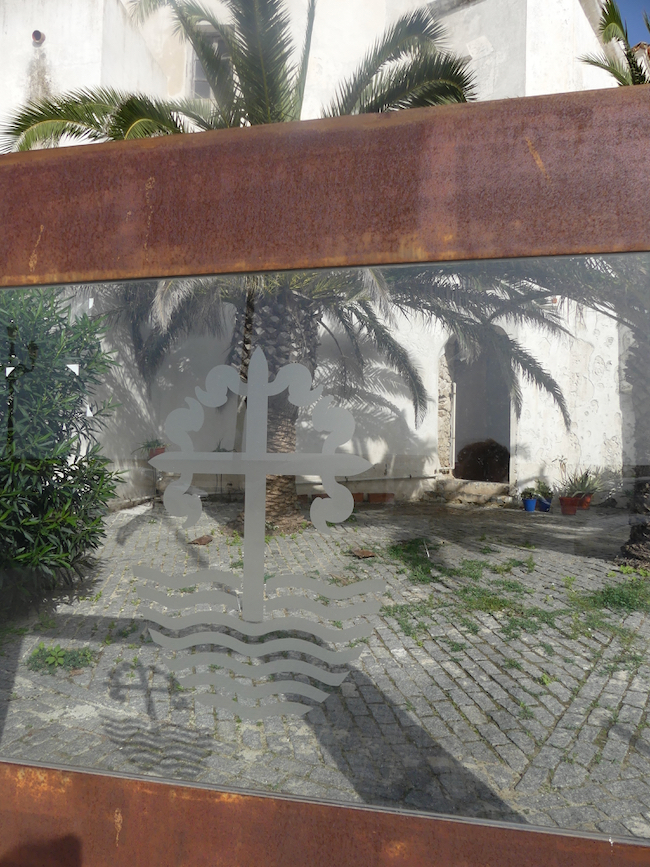
The Cadiz Mariner’s Church and mission

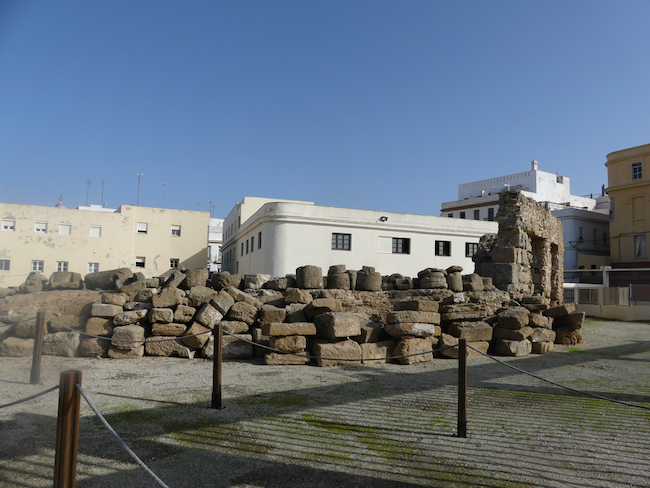
You would think below might be a church, or a mosque, but it is actually a private school for boys.


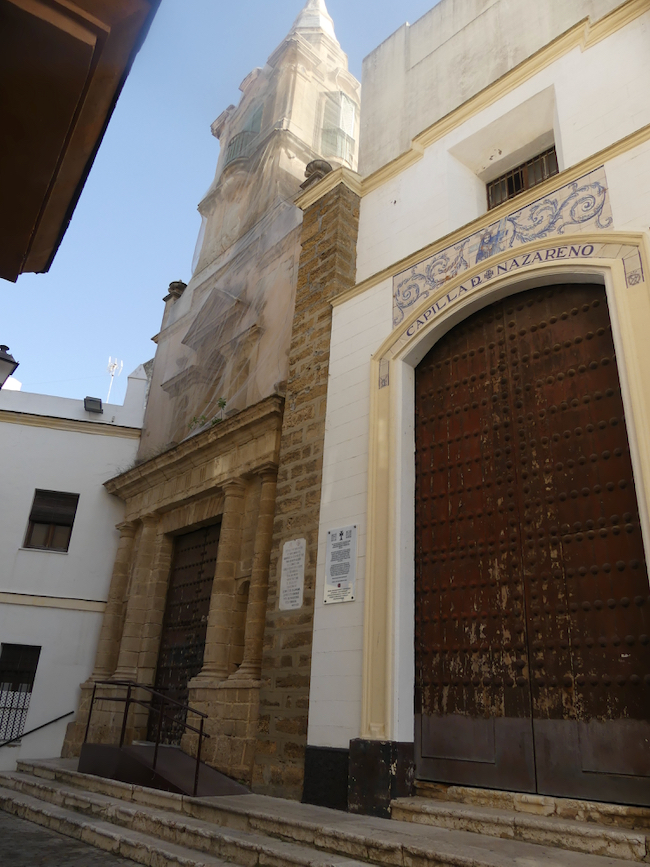




“To Sing is to Pray twice!”






We’ve learned something from our time in Barcelona searching for a hair brush (which, by the way, I had not lost. AdventureMan was right, it is a small brush and it was hiding in the bottom of my purse.) Now I’ve broken my hair clip, which keeps my hair out of my eyes and face while I am swimming or sleeping. It is totally broken, the wire snapped, it is useless. But as we pass this store below, I can hear the Barcelona hairdressers saying “China shop! China shop!”

China Shops are not always called China shop, but you can always tell from the outside because they are crammed with goods, and local people are inside buying what they need. I found a ton of hair clips, and I think I paid 79 pence (less than $1) for a hair clip. I hated to leave. They had a huge inventory of Christmas items, things I don’t need, thinks I can’t pack, but what if I never see them again? I only buy the hair clip, and am proud of myself, but with mixed feelings.
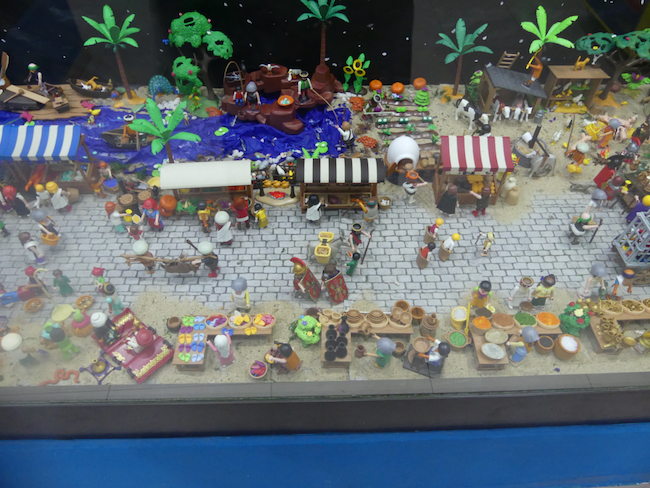
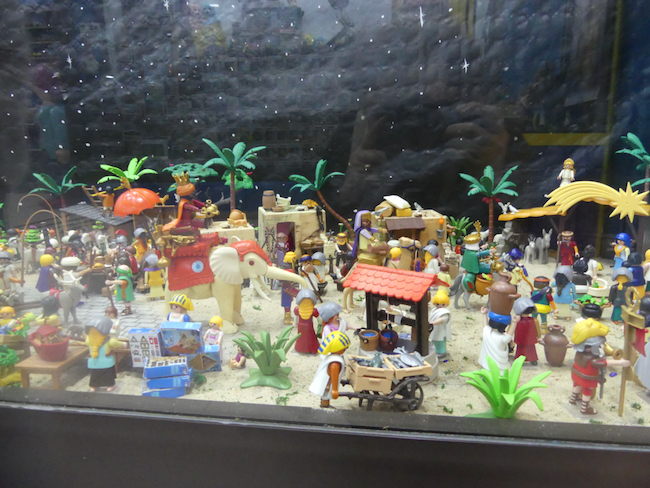
Then AdventureMan spots this store across the street with the most amazing display of PlayMobile figures. I was about to drift by, but he made me stop and pay attention, and I was blown away. If only I had little grandchildren and could justify buying them!

We’ve been hiking around Cadiz all morning, and we are ready to have lunch. We look and look for the right place – not too grand, not too stuffy, but with good local food. Finally, sigh, we settle for a place that is also full of Spanish tourists, so a tourist place, but Spanish tourists.
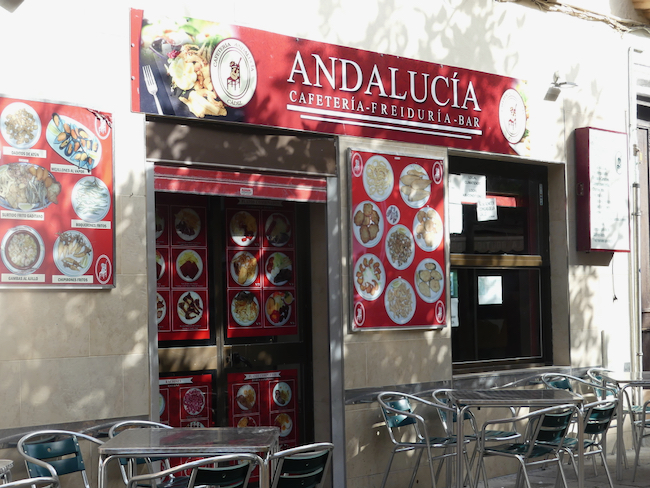
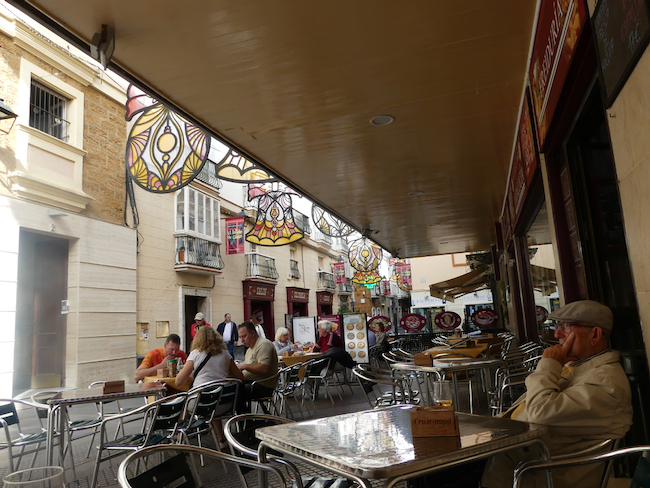
One funny thing happened here; a large group, maybe 12 mobility-impaired people and caretakers, came in, and a table was put together for all of them, and they got menus while one woman took her husband to the washroom. They kept not ordering. When the couple got back, they all got up and left.
We ordered tourist stuff – fish, grilled peppers, paella. It was good and we had a great time watching all the people pass by.


We have to be very careful not to catch this woman’s eye; she is soliciting tourists to buy hand made “African” bracelets, but what catches my eye is her headdress and clothing. When the police show up, she fades away quickly.

As we sit here eating lunch, we see group after group of Viking passengers pass by.
After we eat, we head up the street, only to discover our next blessing which is also a little disappointing, but oh well, it is what it is. Around the corner, if we had just gone a little bit further is the open market! It is colorful, and full of fresh beautiful vegetables, meats and seafood. AdventureMan needs to try some local sherry.

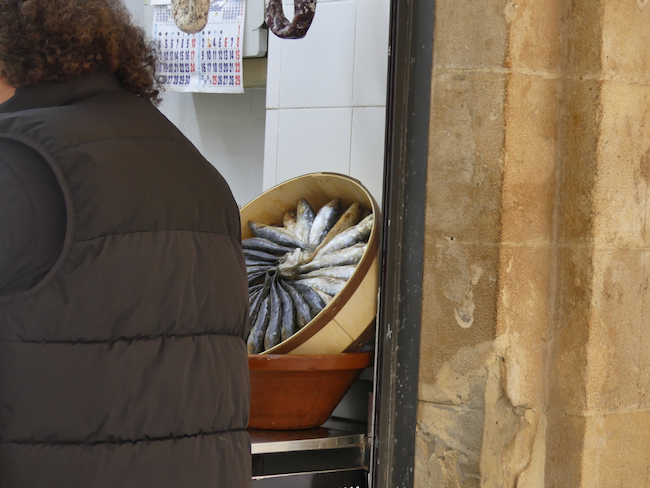


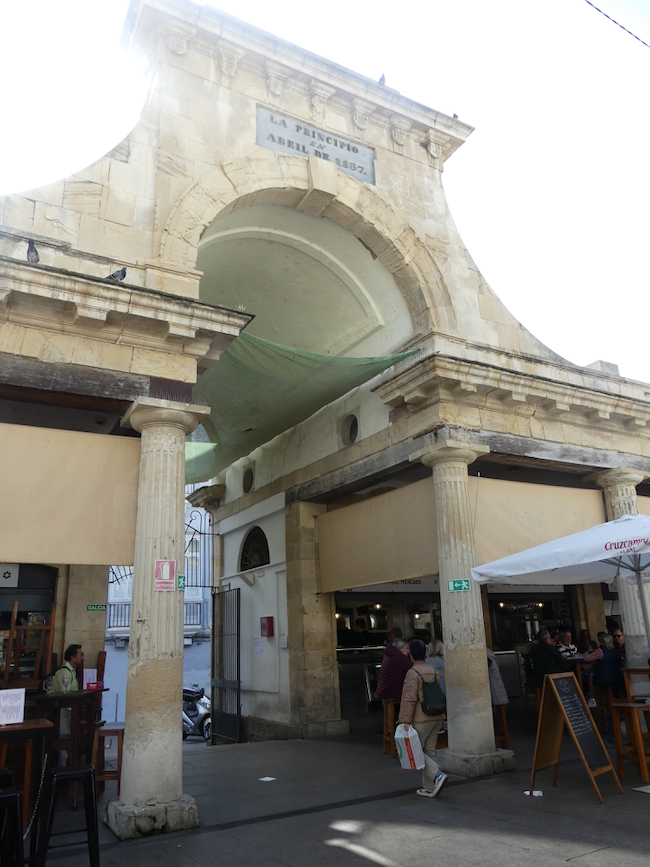

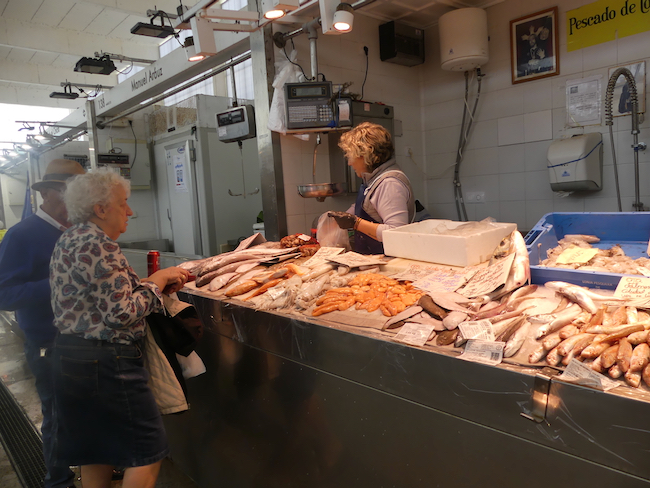
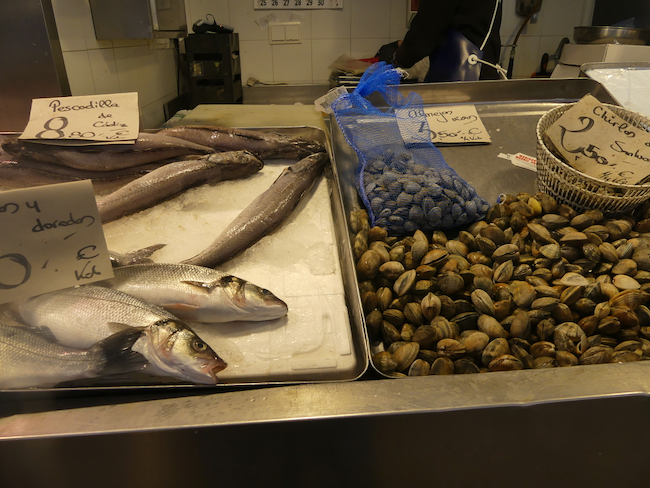

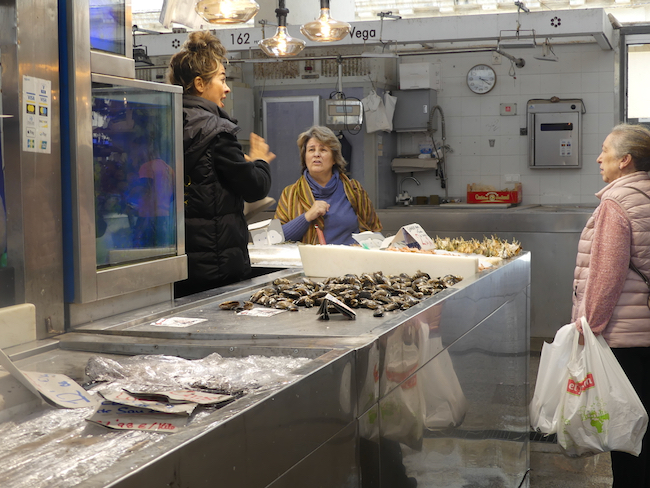


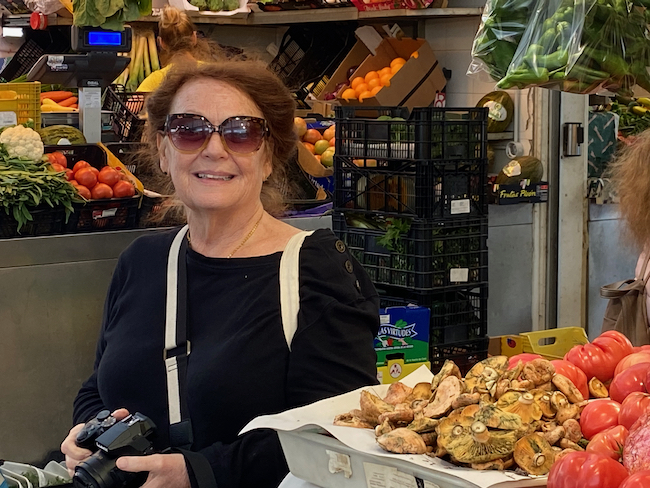
We leave the market, wandering our way back towards the ship. AdventureMan spotted an ice cream shop he wants to try. I got a very black chocolate ice cream, maybe the most chocolaty ice cream I had ever eaten. I think he can’t remember which he had, perhaps a cherry, but he says it “was all good. We had some good ice cream on that trip.”
We take our time heading back to the ship. Cadiz is so walkable, so much fun.
You can quickly go through the rest. I fell in love with our view and the sun setting behind the Cadiz Cathedral, our last thrill for the day in Cadiz before sail away.



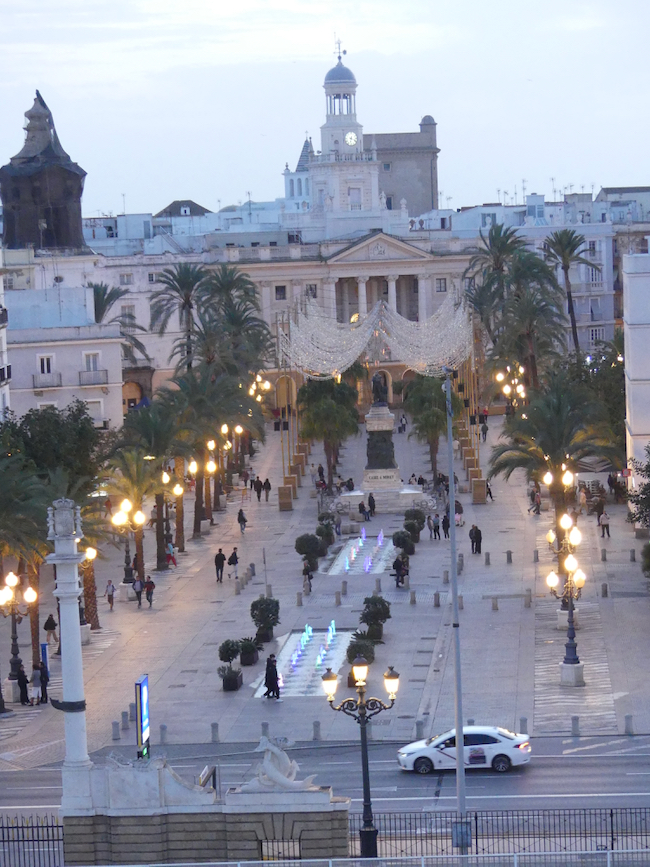


I think this is the night we eat in the ship’s Italian restaurant, Manfredi’s. We had reservations for another night but canceled them when we discovered it was French night at the World Cafe.
The food was pretty good. People compete for these reservations. Our perception is that we have equally good Italian food other places, often better.
We also have discovered this about ourselves – we like food, and we are both a little on the attention deficit side. Sitting for a long time in a restaurant being served makes us restless. We really like the World Cafe; many of the foods are the same ones served in the Dining Room and the specialty restaurants without the time-consuming service. We can also exercise control over the serving sizes and sample something we might like to try but might not like to eat. We like getting up and walking, and we like that if there is something we like a lot, we can go back and get a little bit more. The World Cafe works well for us.
Recent Comments
Kitchen on Isiais: Winding Down intlxpatr on Shampoo Ginger tigerbutterya0c5ff1d… on Shampoo Ginger intlxpatr on British Soldier Kidnapped, Esc… John on British Soldier Kidnapped, Esc… Wikipedia Donate Button

Amazina


Early Voting in Florida


