Stastical Pole Switch
I can put my finger (or arrow😄) on when it happened – the day my statistics swung wildly from primarily United States readers to primarily Chinese.
The jump is bizarre.




The last day, below, I had a majority US viewers:


My friends who have subscriptions have no problem accessing HT&E. I’m still accessed through Google and other search engines. The swing is so precise and so lopsided that I am at a loss to figure out what happened.
Here is the worst day of all, in the entire history of this blog.

Not a single Chinese view, except for Taiwan. And the lowest views in the history of the blog. Just weird.

Do We Want a Bonehead Military?
Interesting article from AP today about a military unit no longer creating, practicing, working with drones, at the direction of the current leadership.
A strong military relies on capability. Capability relies on adaptation, mastering new strategies (and equipment), as well as intent, and will. You can only go so far on physical strength; today’s military challenges require mental agility and a big picture of the kinds of ways wars will be fought in the future.
We have recently witnessed The Mouse that Roared, a small, smart country that has stymied a giant for six months. When you don’t listen to your most experienced advisors, this kind of situation happens. When you fire your most capable leaders because they have the courage to disagree with you, and you don’t like people disagreeing with you, these things happen.
Lawmakers ask Army to explain why it told a military unit to stop specializing in drone warfare

BY KONSTANTIN TOROPIN AND BEN FINLEY
Updated Wed, September 2, 2026 at 9:10 AM CDT
19
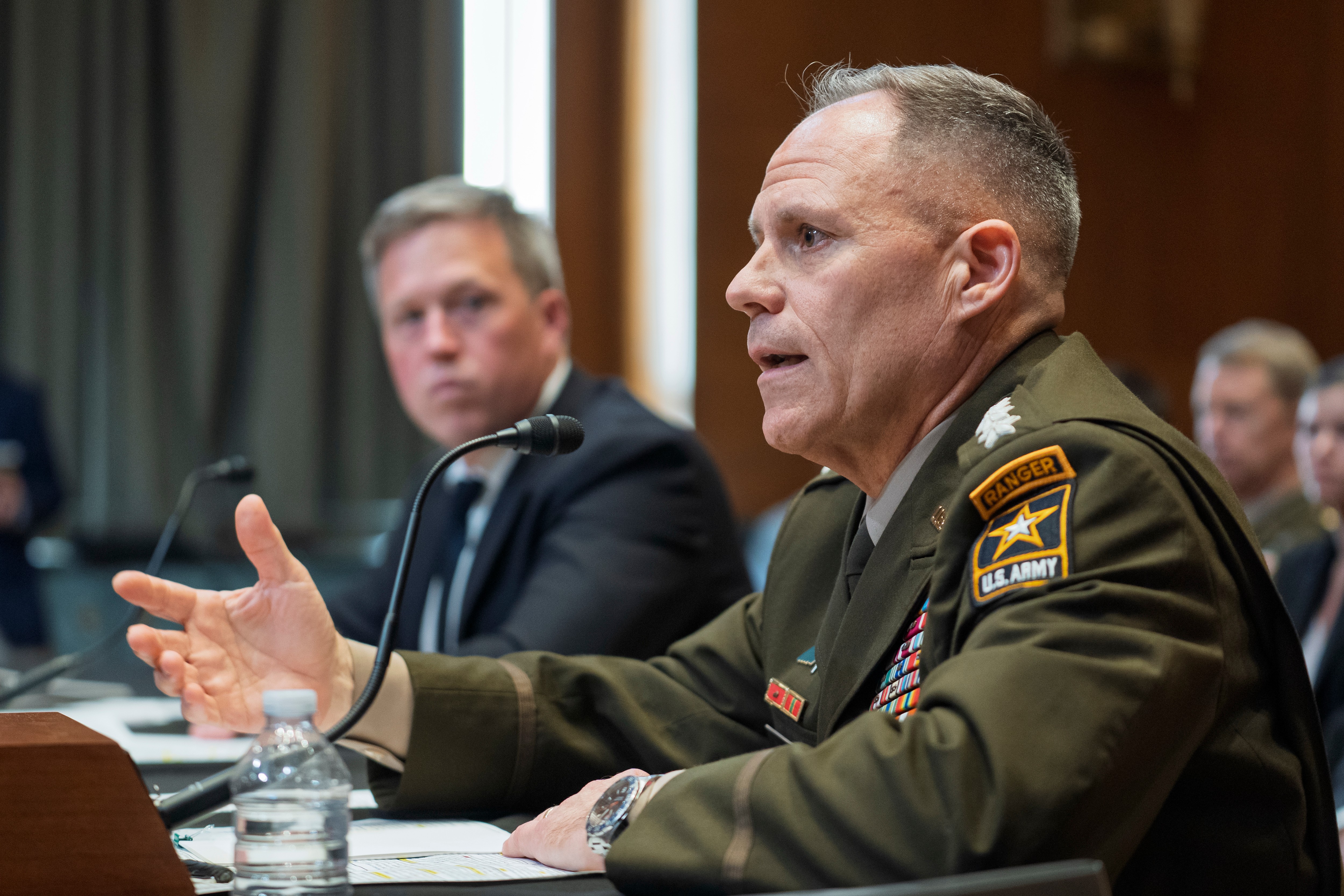
WASHINGTON (AP) — A bipartisan group of U.S. lawmakers is pressing the Army to explain why it told a unit based in Europe to stop specializing in drone warfare, an order that comes as the world’s battlefields rapidly evolveand military tactics increasingly rely on uncrewed systems to fight.
The 173rd Airborne Brigade was building its own drones and practicing the kind of warfare that Ukraine has pioneered against Russia and that Iran has fought against the U.S. — warfare that has killed and wounded American troops. The brigade of 600 soldiers was set up in November to be deployed anywhere that drones were needed.
“We have deep concerns that eliminating this specialized drone unit will limit our ability to learn from allies, particularly the Ukrainian Armed Forces, and hinder our efforts to modernize drone warfare at the speed necessary to compete on the modern battlefield,” the lawmakers said in a letter shared with The Associated Press.
It requests a briefing from the Army to explain its decision and was sent Tuesday to departing Army Secretary Dan Driscoll and Gen. Christopher LaNeve, the Army’s acting chief of staff. It was signed by Democratic Sen. Jeanne Shaheen of New Hampshire, Republican Sen. Thom Tillis of North Carolina, independent Sen. Angus King of Maine and Republican Rep. Mike Turner of Ohio.
“This specialized unit was a prudent response in a moment when the character of warfare is changing faster than a conventional formation’s ability to adapt,” the lawmakers say.
They said they were particularly keen to understand the data, analysis and process behind the change after less than a year of the drone unit being active. They also want to know if the decision was based on guidance from Pentagon leadership or made internally by the Army.
LaNeve, who is filling in as the Army’s top uniformed officer, recently ordered the battalion to refocus on its core mission of being an airborne infantry unit. The move followed Defense Secretary Pete Hegseth’s sudden ousting of the Army’s prior chief of staff, Gen. Randy George.
Integrating drones into the Army’s tactics was a major focus for George. Last year, he and Driscoll had rolled out what they called the Army Transformation Initiative, which pushed to add “modernized (unmanned aircraft systems) into formations.”
George, who became Army chief of staff under President Joe Biden, regularly spoke about the need to accelerate development of new drone systems and get them in the hands of regular soldiers, not just specialized units. Driscoll supported such efforts and focused on cutting the red tape for military contractors to quickly develop more drones.
After George was ousted by Hegseth without explanation in April, he was replaced by LaNeve. This week, Driscoll submitted his own resignation and later said on social media that Wednesday would be his final full day on the job. A reason for his departure was not publicly revealed, but he was an ally of George, and his tensions with Hegseth have been widely reported.
“We are supportive of the transformative initiatives the Army has taken under Secretary Driscoll’s leadership in this area and would like to see that momentum maintained even as uniformed leadership changes,” the lawmakers wrote.
___
Toropin reported from Nuremberg, Germany.
Trump and Mail In Voting
The man gave us all the information we needed to see this coming. He claimed he won the 2020 election, losing by over 8 million votes.
He was filmed telling a gathering of Evangelical Christians in the 2024 campaign that if they voted for him, they would never have to vote again. (Even then, it sounded ominous.)
Once elected, his first day in office, he fired the Election Oversight executives. Then, he fired everyone working for the federal government in his power who certified that he had lost the 2020 election to Joe Biden.
This man is corrupt. He has wrecked the guardrails that keep us from stepping over the lines of moral behavior. He has taken away penalties for law breaking. He has pardoned the very sort of people that he states he doesn’t want coming into our country.
But, most cynically of all, he works to deprive those of us who vote regularly, and vote by mail, of the very privilege he himself utilizes – voting by mail.
A selection of cartoon comments for your enjoyment:





British Isles: Kirkwall, Scara Brae – The Best Day of Our Trip?
We think this day was the best day of our trip. We think every day of this trip has been stellar, above expectations, because we expected both heat and rain, and have had neither. We have had glorious days and breathtaking experiences, and today was the best of the best.

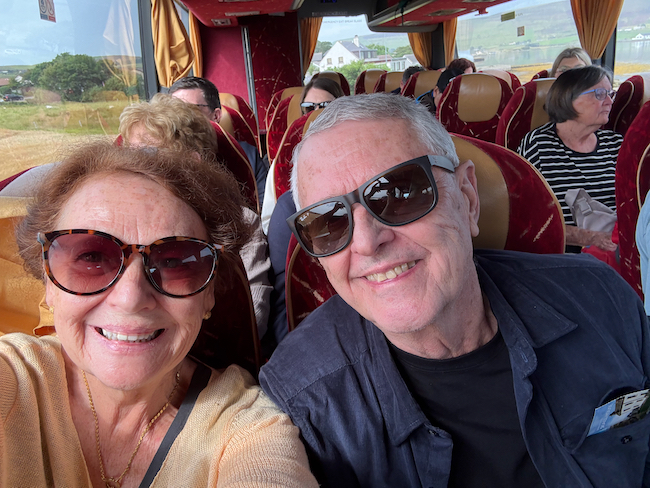
Thank you, AdventureMan, for helping me out with photos. I wish I had more.
We wanted to see two major geographical locations coming to Kirkwall, and we got to see them, and more.
One was Scapa Flow, a huge inland harbor, one of the largest inland harbors in the world. Vikings used it as a natural harbor for centuries. The British kept a fleet there in WWI, and the Germans scuttled their ships there after WWI rather than surrender the ships to the British.
A German U-boat came in after 1939 and sunk the Royal Oak, a British battleship, and over 800 people perished. Among them were 16 year old boys working on the ships with the Navy, causing such outrage in Britain that they no longer recruited 16 year olds.
For the British, the Scapa Flow is a memorial on the level of Pearl Harbor for the Americans. It’s a protected area.
Continuing on, we were able to see the Stone Circles of Brodgar and Stromness, These huge circles of stone pre-date Stonehenge by centuries.
And then we reach our goal, Scara Brae.

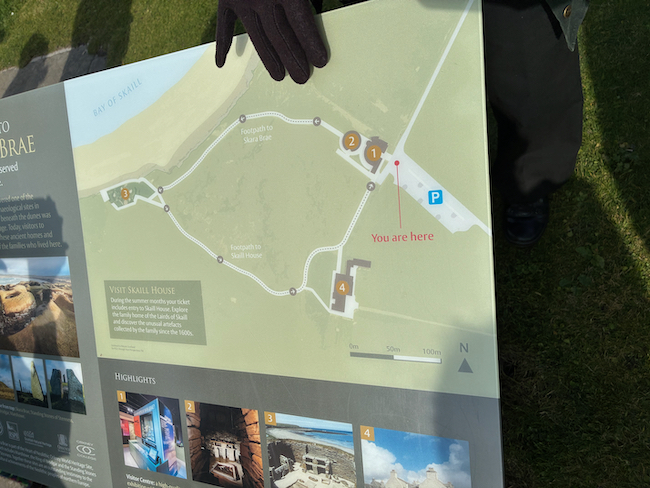
Scara Brae was discovered by accident when a huge storm uncovered stone dwellings buried by sand and soil, which were beginning to erode away. The dwellings are over 5,000 years old, created to shelter from wind and cold, to store goods, and to house families. There are areas created for food preparation, food storage and cooking, areas for sleeping, and a special area for crafting items like pottery and tools to make life easier.
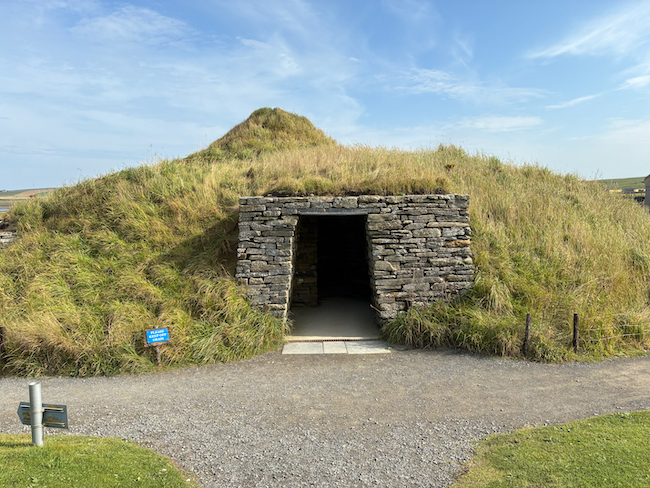
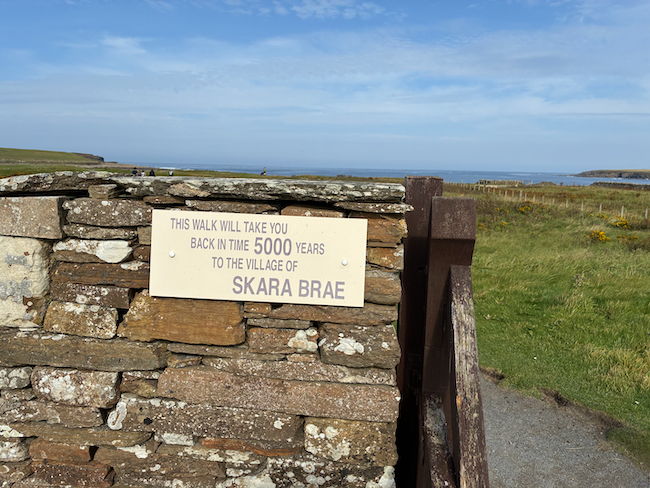
Many people today think we are smarter than earlier man, but when I look at the smart things these people created to make their lives livable, I believe they were every bit as smart as we are, and in some ways, smarter.
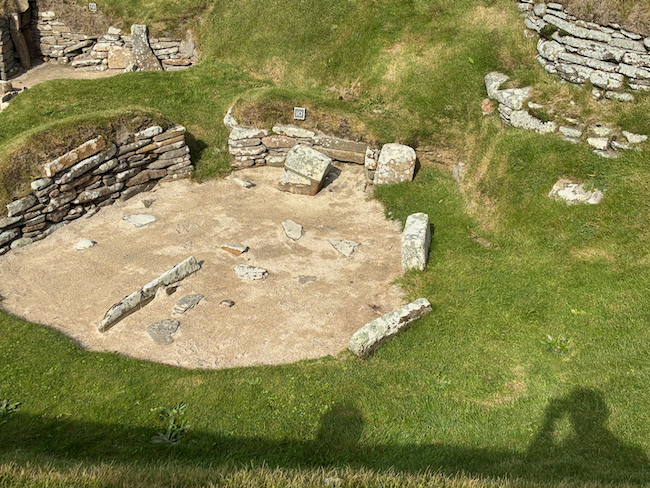
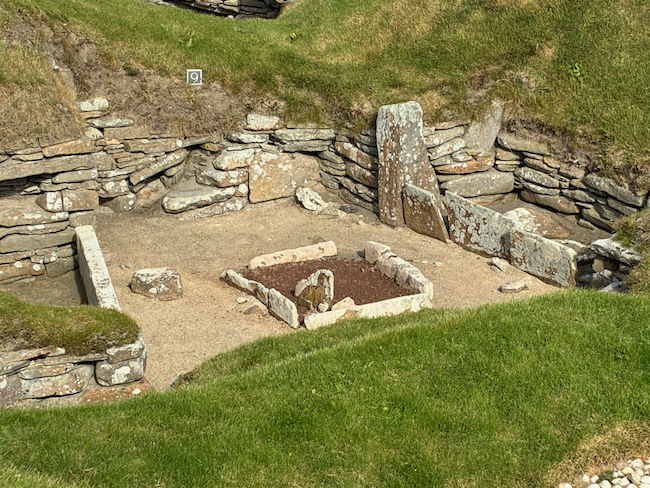
Look how closely these stones fit together to keep the earth out of their houses, fitted without mortar. Our archaeologist guide tells us there is no way to date a stone wall like this, that the inhabitants of the Orkneys build their walls the same way to this day, only now they also use mortar. Traditionally, they will put pointy flat stones on top, vertically, to discourage sheep and cattle from trying to get in (or out). In the museum there are artifacts – combs, needles, tools – which help date the findings.
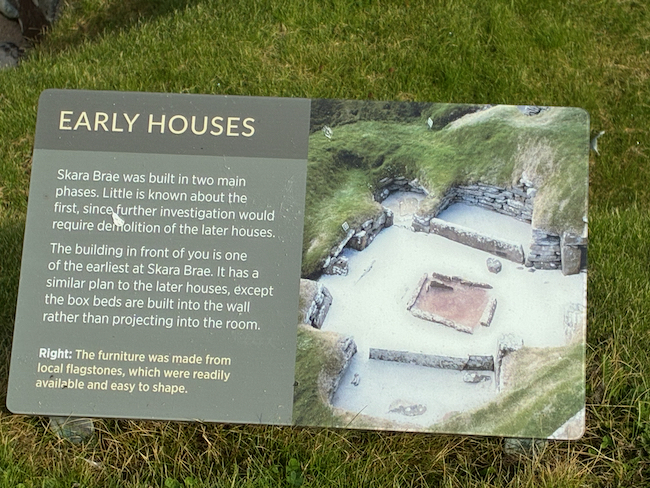
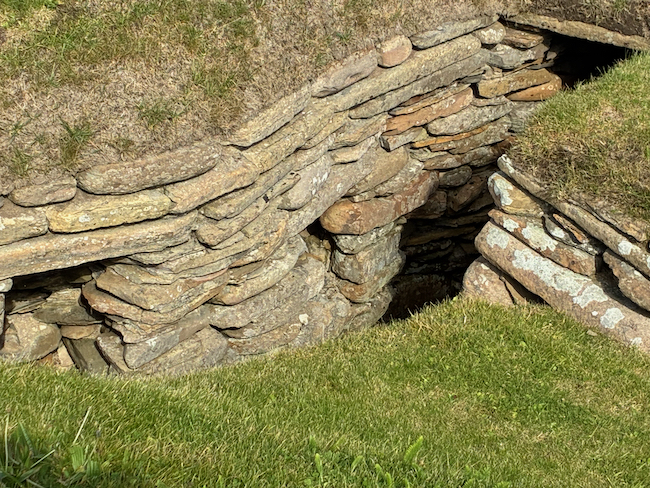
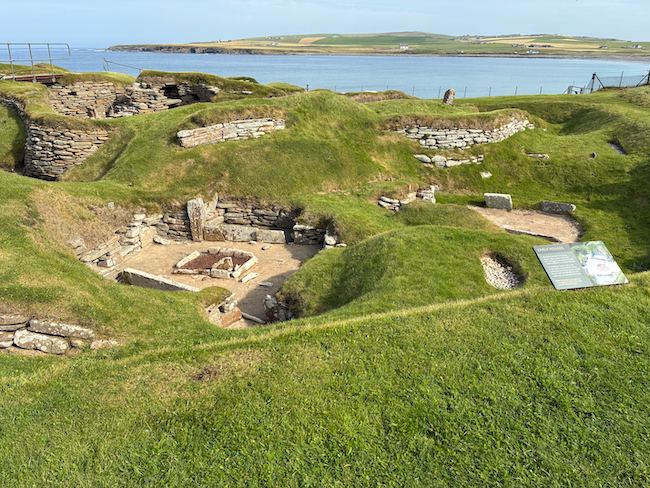
It is a beautiful location, by the sea. It was a thrilling visit.



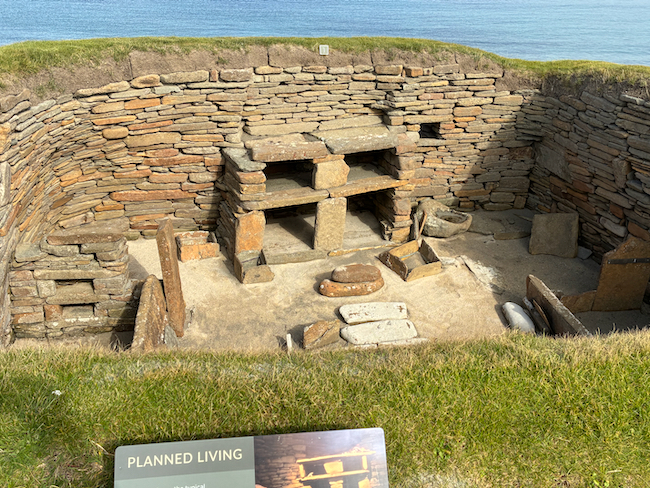

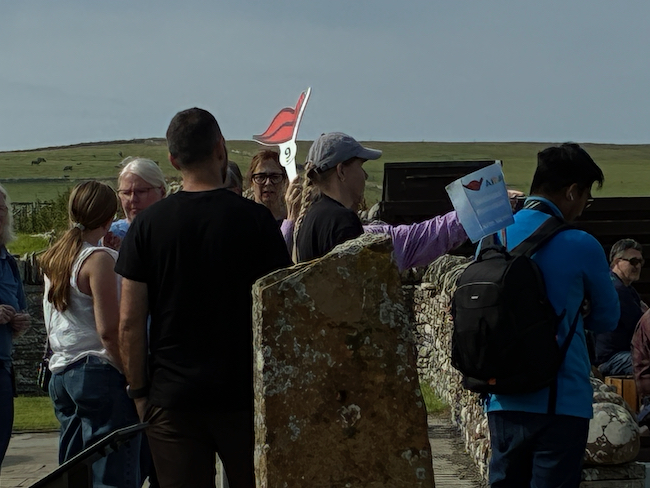
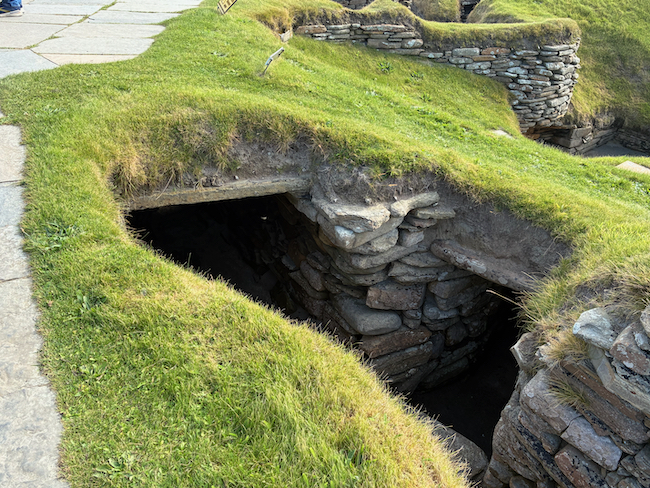
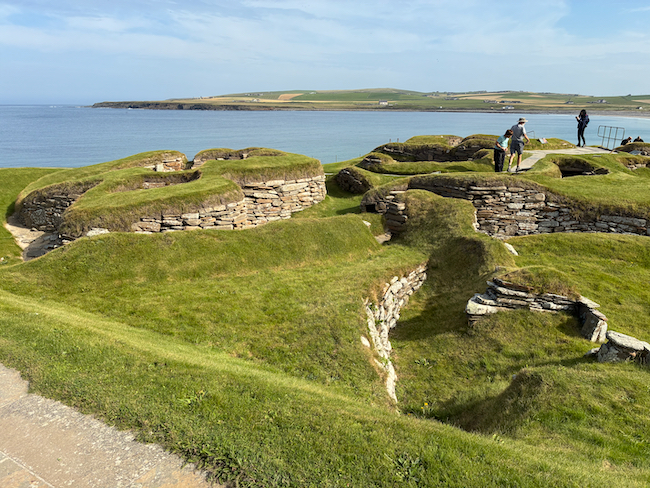
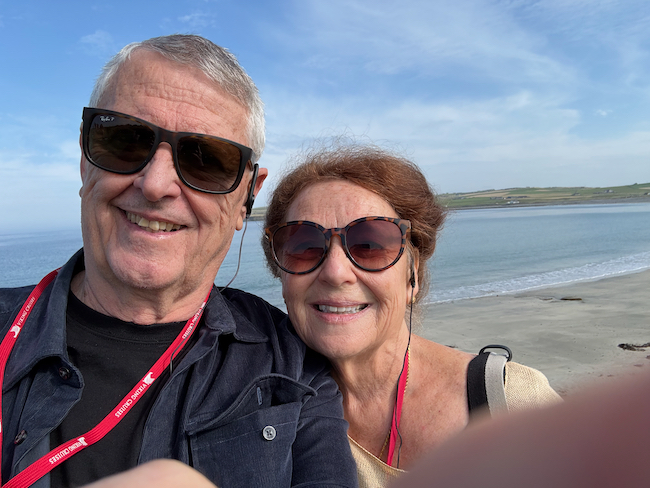

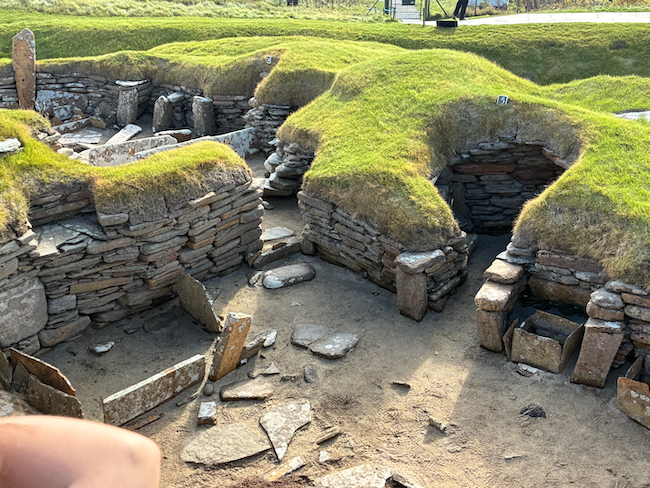
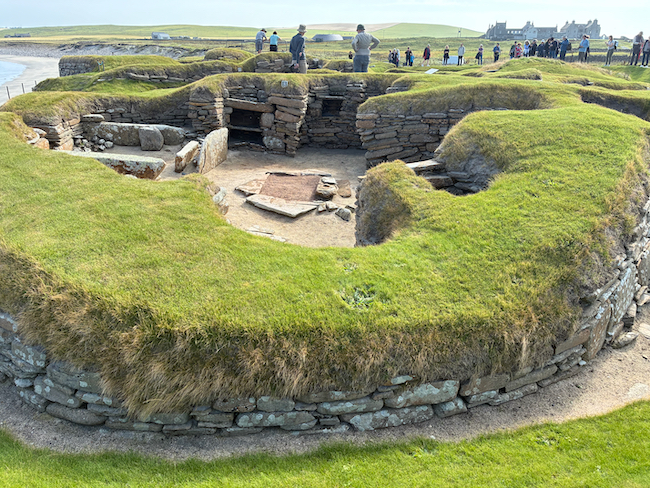
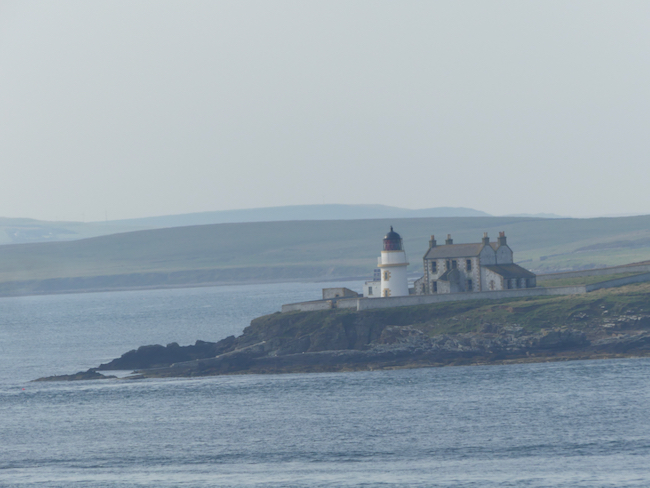

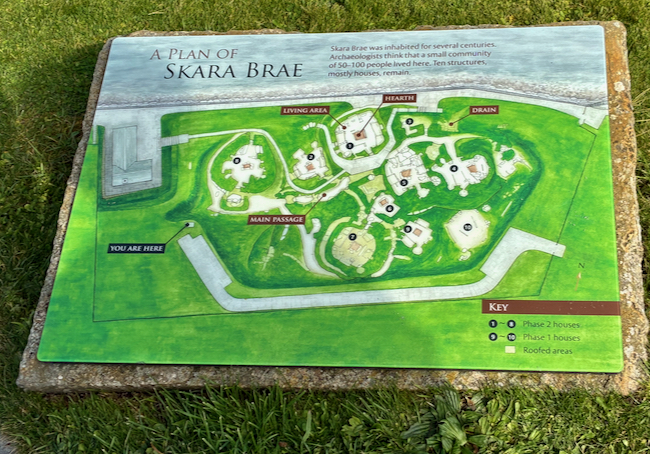
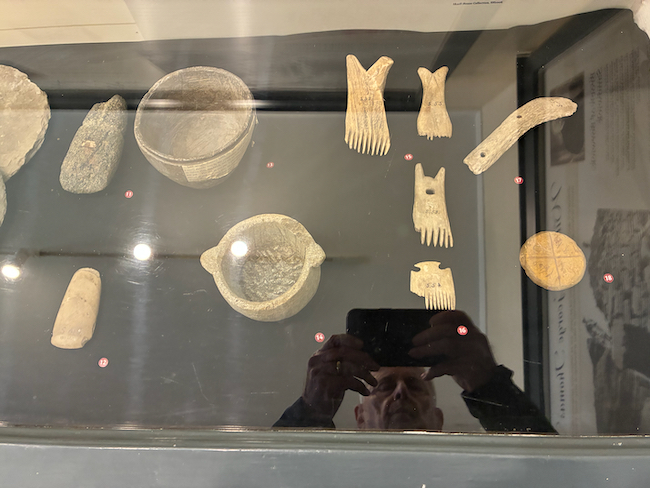
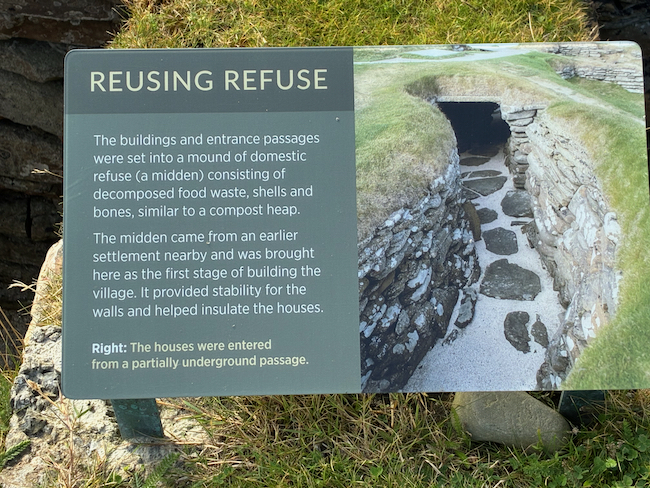
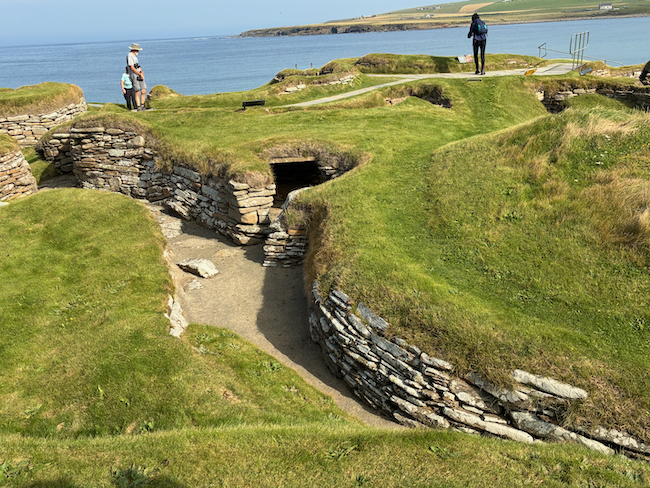
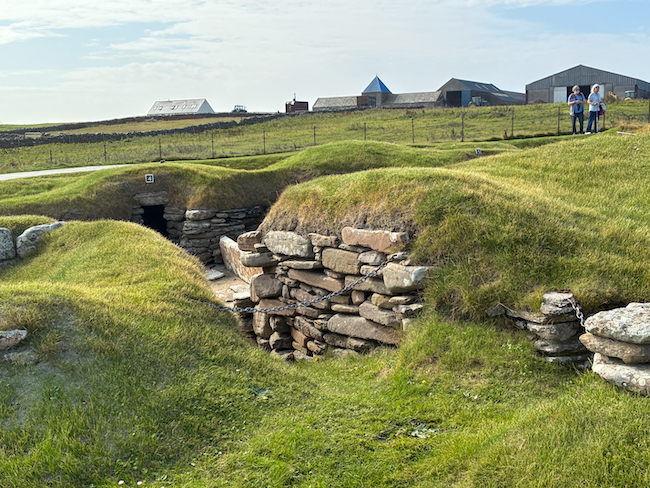
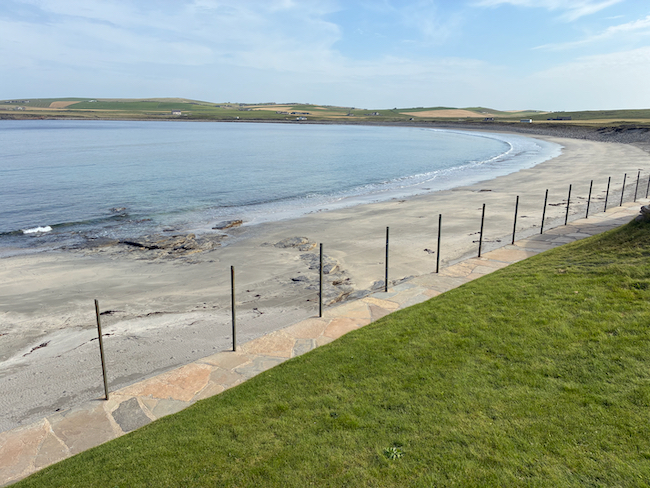

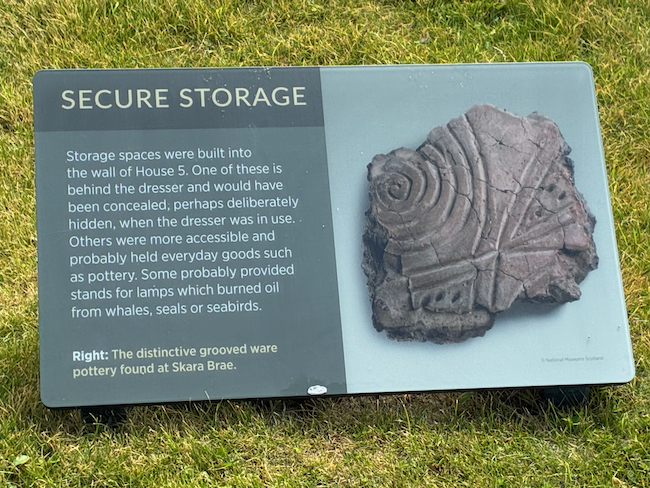


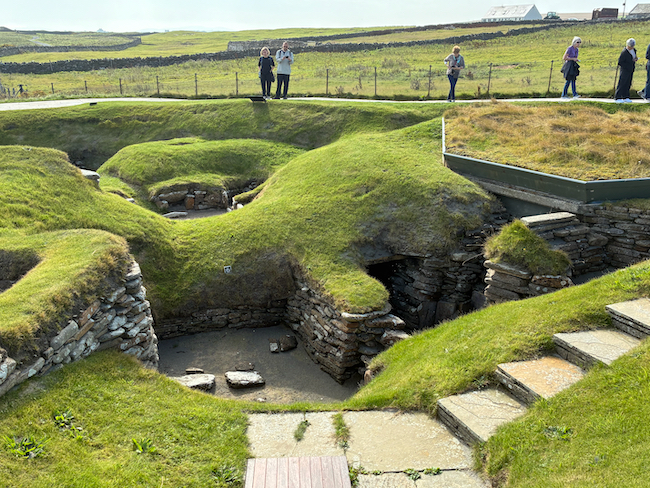
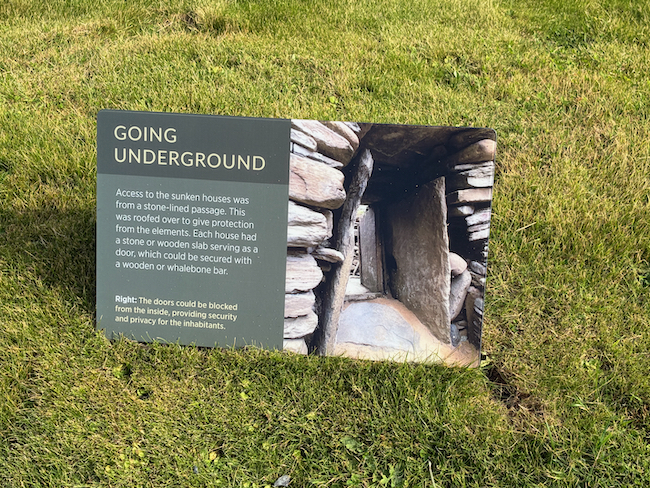
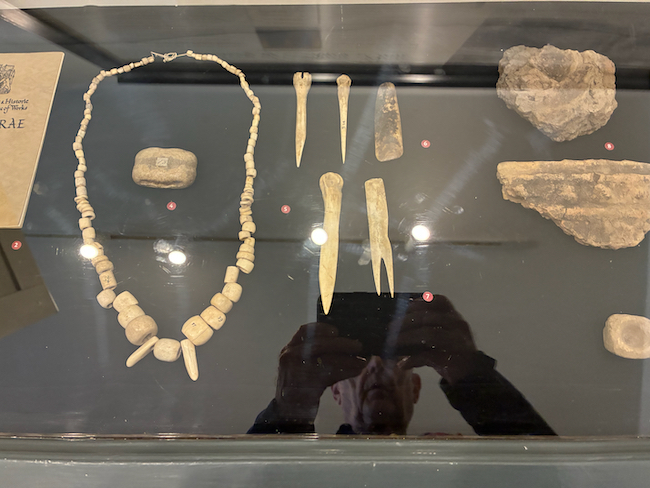


”Graham Watt, the 7th Laird of Breckness, who unearthed the world famous neolithic of Skara Brae in 1850 put in a seawall to forestall further erosion and archaeological experts have excavated several of the houses, although more exist still underground.” (I believe this quote came from a Scara Brae booklet, but I am not sure. 🤔)
On the way back, our bus drives slowly by a series of Neolithic marvels, the Stones of Stenness, the Ring of Brodgar and the tomb at Maeshowe. The bus isn’t allowed to stop because separate bus tours go to those sites (bureaucracy is international!)
(For a lot of fun, read Ann Cleeves newest book in the Shetland/Orkneys Inspector Perez series, The Killing Stones. It is better if you read all the Ann Cleeves Shetland series first, but I read this as a standalone and then started reading the Shetland series, and it worked just fine. )
“The Stones of Stenness are part of one of Europe’s richest archeological landscapes—the legacy of a Neolithic society that flourished between 3800 and 2200 B.C., after the introduction of agriculture but before the advent of metal tools. A mile to the northwest, on higher ground, is another mesmerizing assemblage of megaliths in open space: the Ring of Brodgar, a stone circle some three hundred and forty feet in diameter. To the east is the tomb at Maeshowe, where, beneath a grass-covered mound, Stenness-size slabs anchor a thirteen-foot-high chamber with a corbelled roof. Like Stonehenge and other Late Stone Age sites, Maeshowe has a solar alignment: on the midwinter solstice, the setting sun shines down the entrance passage. Together, these monuments, which are part of a UNESCO World Heritage complex called the Heart of Neolithic Orkney, seem to constitute a minimalist holy land.” (Another regrettably unsourced quote.)
Back in Kirkwall, we decided to have lunch and return to the boat later. We found an Italian restaurant and feasted on Caprese Salad; AdventureMan had a specialty Seafood pasta and I had Spaghetti Aglio Oglio. After lunch, we visited St. Magnus Cathedral, one of the oldest churches in the British Isles. There was a community flower show/competition – the sort of event I love. Groups and individuals created lavish floral displays around the church and won prizes for the best in several categories. It was magnificent and the cathedral was full of people! Then, to celebrate, we had ice cream at the famous Daily Scoop.
Kirkwall is a place to which we would happily return. There is so much more to see and learn.
If you think I am amazing because I remember all these details, you will be happy to know that I have forgotten much, but that I kept a daily journal that reminds me of the details of our daily life on board the ship and at our destinations. Honestly, now we have trouble remembering which day we were in which city.

We tendered back to the ship and enjoyed a deeply satisfying nap before meeting up with our friends for dinner.
The food on board Viking Jupiter is fantastic. It’s a great life, being a grown-up, having options. One night we can focus on salads and seafood, another night on soups or Chinese specialties, another night on roasted salmon and sides – we can choose what we want to eat, and we can choose how much. Viking makes little tiny desserts, maybe a quarter cup of chocolate mousse with a meringue star on top, or one small scoop of ice cream – or two very large scoops with toppings, whatever is your pleasure.
When we get back to our room, it is newly cleaned, every night, with fresh towels and clean sheets, all set up for a good night’s sleep.
It’s not like we live like this at home. We cook, we clean, we keep up the yard, we repair the house, we handle our grown-up responsibilities. For just this short time, it is so wonderful to be taken care of.
I have to give full credit to my husband for most of the Scara Brae photos. I also take full responsibility for the fact that there is a jumble of Scara Brae photos in the middle of this post in no order. Somehow they all got grouped and I can’t figure out how to ungroup them. I used to laugh at my elders who struggled with technology, and now karma is biting me in the butt, and once again I am humbled.
British Isles: Ullapool and What Day is This?
Our day started slowly, thank goodness. We are still sailing from Belfast to Ullapool, and we don’t expect to land until 1:00. Later we figure it out – at this time of year, there can be huge morning fogs. Most of the time it starts burning off around late morning. You can’t see much through the thick fog.


Some people are sleeping in, some are doing laundry. We have breakfast with our friends, then we hit the spa. We are ready to kick back. We are having a lot of fun, enjoying all the activity, and the truth is also – we are aging. We need to rest. I need time to process and integrate all the new sights I am seeing and cultural differences I am experiencing.

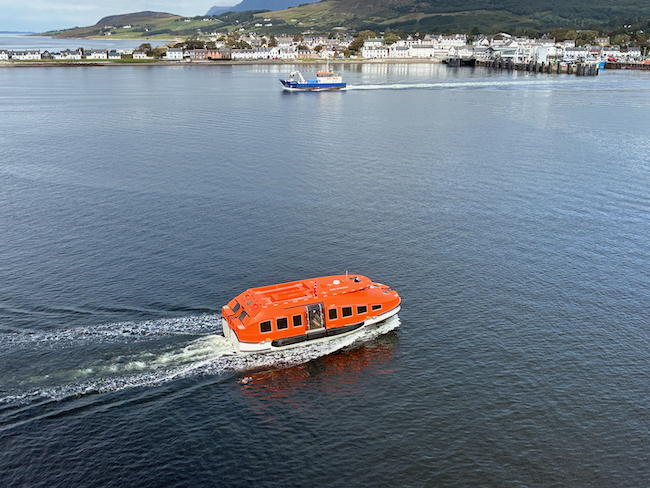
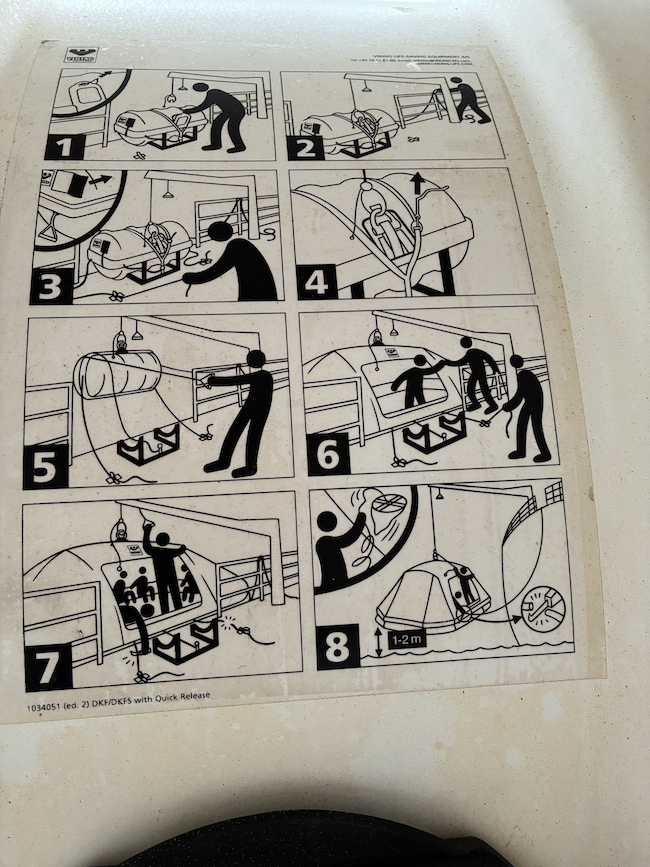
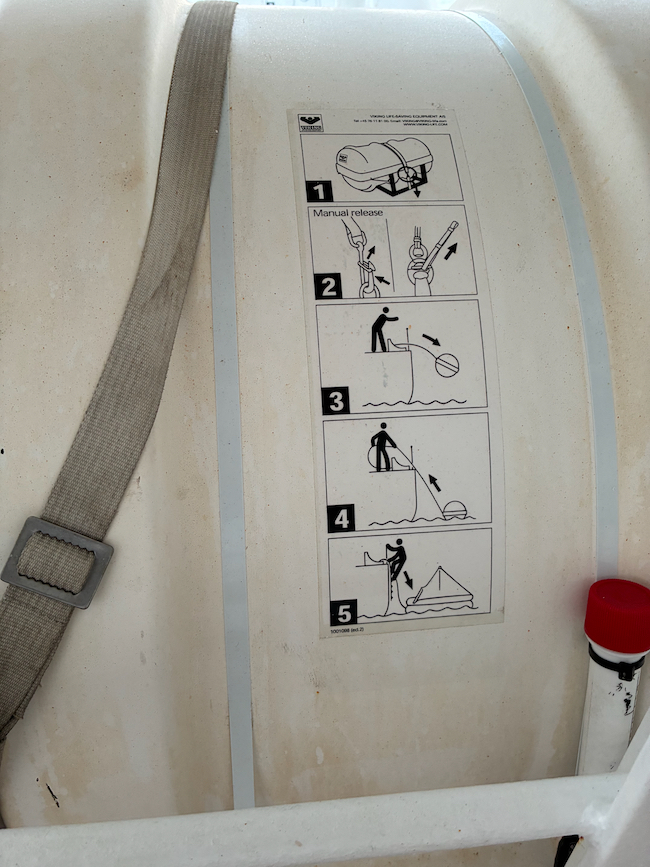
We are excited about our tour today, The Scenic Assynt. We tendered in, and boarded our bus. It got off to a surprising start. We were all aboard and the bus started. Two minutes into the trip, the air conditioning went off and the bus became stuffy very quickly. Formerly civil Viking tourists became rude, and shouted that we needed AC, but I think the driver needed the extra power to attack the hill heading out of the port. The bus rumbled and shuddered, and the guide was doing her best to soothe the savage beasts but was also on her phone to headquarters trying to get a back up bus and there wasn’t any.
It got better. The AC came back on, and we stopped at a geological reserve.
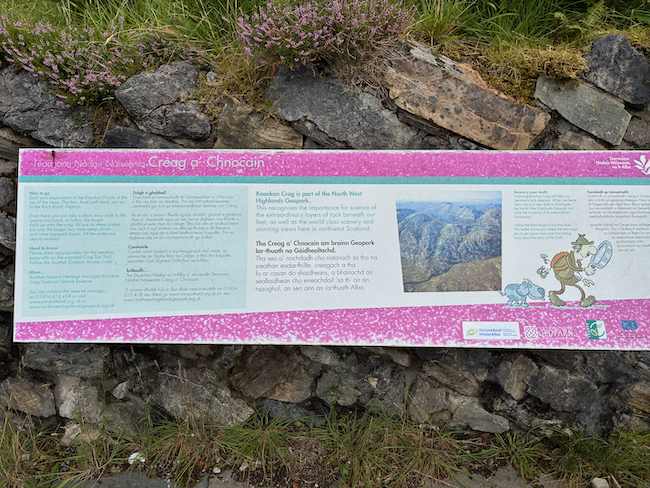
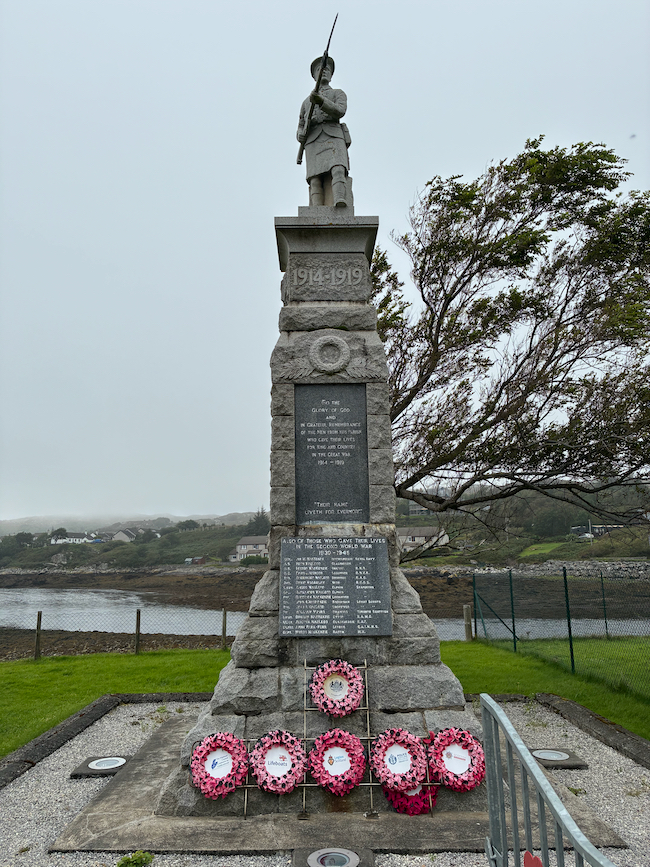
Here is where I have to make a sad confession. This reserve was wonderful. It had special stations to demonstrate how very old rock had extruded and somehow become above the much younger rock.
When I uploaded my photos, of this trip into the Assynt, and the next trip, in the Orkneys, I somehow didn’t save them to the desktop, and carefully deleted them from my camera and card.
Fortunately AdventureMan took some photos, and I had some on my phone, but sadly, the trips were both wonderful and I can’t show you how greatly wonderful they were. I am so sorry.
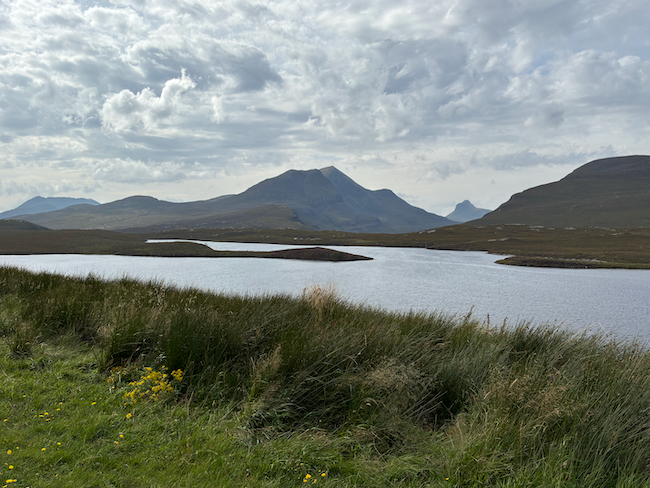
We also stopped by the ruins of an old castle en route to the small fishing village of Lochinver, very beautiful, very small, and I took a walk in the opposite direction of the others, and it was so QUIET.


One thing you don’t get on a cruise ship is a lot of quiet. Viking ships are quieter than most, but you get 900 people together, there’s going to be some noise. For the first time ever, we have a loudly quarreling, quarrelsome couple on one side of us. Fortunately, it is sporadic, not all the time.
With the fog rolling in to this small fishing village of Lochinver, it was so silent. It wasn’t even muffled, it was silent. My ears were ringing with the silence! I loved it!
I rely on my photos to tell the story, and without them, I can’t remember all that I saw. What I do remember is the warmth with which we were greeted at Ullapool, in the Scottish Highlands, that they truly made us feel appreciated. I remember thinking I would love to come back to Ullapool, so small, so isolated, with so few tourists. There were families, and hikers and people from many nations, but not the thousands that come in on the ships. We were the only ship in port this day.



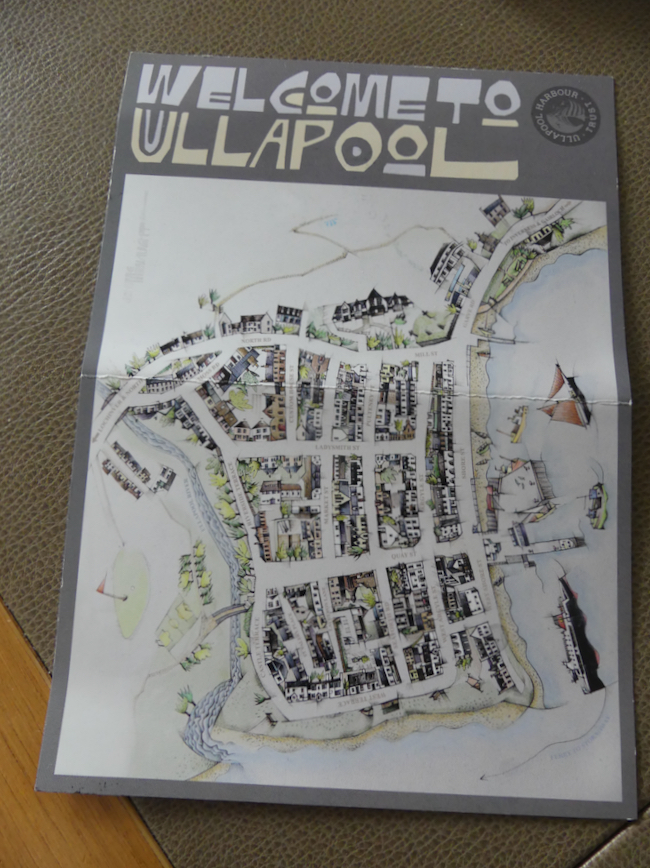
Much of the time is foggy in Ullapool, in August, and then there are times when the fog burns off. Then the fog comes back again, and then, just as the sun is setting, it might break through.

We have reservations this night at Manfredi’s, the ship’s Italian specialty restaurant, and are shown to a quiet table by the window in the back of the restaurant. We love it. Our waiters are kind and funny, and help us make great choices for dinner.
“NOOOO! Noooo! Not Guinea!”
I was calm when I started. I believe technologies are a benefit, and we just have to overcome our brief discomfort and steep learning curve and we will master new and useful skills.
Prayer helps.
AdventureMan asked if I had arranged for overseas calling plans while we are on vacation later this month.
“Ummm . . . not yet . . . but I intend to.”
(Rats! Now I have to do it!)
I tried going online, but it’s been years since I chose a password, and I can’t make it work for me, but there is a phone number, so I call it. I know it will be some kind of automated system, but I speak clearly, and I just grit my teeth and know I’ll get through it.
(I don’t.)
The automated system doesn’t seem to understand me. It asks for the countries where I will be traveling, and the dates. I give them. The automated voice gets the dates – even the YEAR! – wrong, and tells me he is setting up an international plan for Guinea.
I hate when this happens, and I especially hate it when AdventureMan is home, because I can hear him laughing from his office as I scream “NOOOOO!NOOOOO! NOT GUINEA! I WANT TO TALK TO A REAL PERSON! REAL PERSON!” The artificial intelligence totally misunderstands, wants me to confirm my upcoming trip to Guinea (NOOOOOOO!!) and finally I find the magic words “LIVE AGENT” and after 53 minutes with a live agent, Ken, (who I believe is in the Philippines and wants me to adopt him) sets AdventureMan and I up with a plan for both our phones.
When all is confirmed, I can see AdventureMan’s plan, but mine never shows up, necessitating a trip to the Verizon office where they are able to confirm that THEY an see plans on both lines, even if I can’t. And this time, for the right countries.
Or so I believe.
I want to be in Venice, too!

We are getting ready to take a journey to a whole new set of petroglyphs, so I have activated a new AirTag. I love these things. I am taking a checked bag this time, for a stop in Denver where I will initiate my niece’s twins into the art of quilting. Just basic stuff, rotary cutting and beginning piecing, and the idea of a quilt. I’ve had a lot of fun planning this, and I have a suitcase full of resources for their exploration.
The set-up is so easy that a technologically impaired elder can do it in under a minute. How cool is that?
So as I set up, I also checked on independent AirTag, the one that disappeared in Barcelona, traveled the Med, crossed the Atlantic, went up the Amazon and crossed back the Atlantic to Barcelona and is now in Venice. Venice! I love Venice. AdventureMan loves Venice. We find Venice endlessly interesting.
And the Villa del Geologia. Wow. I don’t think I even knew it existed. I love that this little AirTag has this fascinating life of its own.
We are taking our son and his family on a trip next year, and I think I will gift them AirTags, for their luggage, for their backpacks, maybe even for their kids. How handy it would be to be able to keep track of all the individuals traveling together as they scattered out in an airport! Of course, you have to get their consent, otherwise, as the instructions tell you, it would be stalking, and against the law.
Errant AirTag in Exotic Tortola

I’ve never spent any time in the Caribbean or Central or South America. As I recover from Christmas activities and transition into New Years and Mardi Gras (yes, in the South it is a Thing) my errant little AirTag is enjoying adventures I’ve never hazarded. I can only wonder where this little creature will go before I lose it completely?

Recent Comments
intlxpatr on Shampoo Ginger tigerbutterya0c5ff1d… on Shampoo Ginger intlxpatr on British Soldier Kidnapped, Esc… John on British Soldier Kidnapped, Esc… intlxpatr on British Soldier Kidnapped, Esc… Wikipedia Donate Button

Amazina


Early Voting in Florida


