Founder or Flounder?
“Ummm, errrr. . . .is her campaign foundering or floundering?” I asked my very-intelligent-almost-a-doctor friend and she matter of factly and crisply said that it could be either, her campaign may be gasping and dying like a fish out of water, or approaching failure.
Don’t you wish you knew all those things? I do. I have to look them up all the time.
Founder has a lot of meanings. The one I was looking for is in bold type:
founder
n 1: inflammation of the laminated tissue that attaches the hoof
to the foot of a horse [syn: {laminitis}]
2: a person who founds or establishes some institution; “George
Washington is the father of his country” [syn: {beginner},
{founding father}, {father}]
3: a worker who makes metal castings
v 1: fail utterly; collapse; “The project foundered” [syn: {fall through}, {fall flat}, {flop}]
2: sink below the surface
3: break down, literally or metaphorically; “The wall
collapsed”; “The business collapsed”; “The dam broke”;
“The roof collapsed”; “The wall gave in”; “The roof
finally gave under the weight of the ice” [syn: {collapse},
{fall in}, {cave in}, {give}, {give way}, {break}]
4: stumble and nearly fall; “the horses foundered”
Flounder also has a lot of meanings:
A fish with a flattened body adapted for life on the seafloor.
http://www.reefed.edu.au/glossary/f.html
i) A small edible flatfish, ii)any small flatfish of the family Pleuronectidae or Bothidaes.
http://www.mi.mun.ca/mi-net/terms/nautical.htm
from flounce and founder
encyclopedia.kids.net.au/page/li/List_of_portmanteaus
a flat, bony saltwater fish which lives in bays and coastal waters. They are carnivores eating shrimp, small fish and crabs and are eaten by larger fish. Flounder is considered a popular food fish for people. …
http://www.lakeland.k12.in.us/limabrighton/nctrip07/glossary.html
stagger: walk with great difficulty; “He staggered along in the heavy snow”
any of various European and non-European marine flatfish
behave awkwardly; have difficulties; “She is floundering in college”
wordnet.princeton.edu/perl/webwn
Flounder are flatfish that live in ocean waters ie., Northern Atlantic and waters along the east coast of the United States and Canada, and the Pacific Ocean, as well. The name “flounder” refers to several geographically and taxonomically distinct species. …
en.wikipedia.org/wiki/Flounder
Flounder is an Disney character that appeared in Disney’s The Little Mermaid. He is Ariel’s best friend. Ironically, he is not a flounder, but is more similar in appearance to a Regal Tang or similar fish.
en.wikipedia.org/wiki/Flounder (The Little Mermaid)
I guess I can use either floundering or foundering, but now that I think of it, floundering will always remind me of a big flat fish, so I think I will try to think of founder.
Cold February Morning Sunrise
It is a shivery 5°C/45° F in Kuwait this morning, made more shivery by a brisk wind that blows and makes all the flags along the roads, hanging from apartments, decorating villas, etc. flap dramatically in the wind. I am hoping that National Day and Liberation Day holidays will make the roads less travelled as I zoom around, but I have been warned to steer clear of the Gulf Road, where youngsters are spraying cars with colored spaghetti and foam.
No more sandstorm, thank God, although there still seems to be grit in the air; your face feels dry and covered with an invisible coating when you come inside.
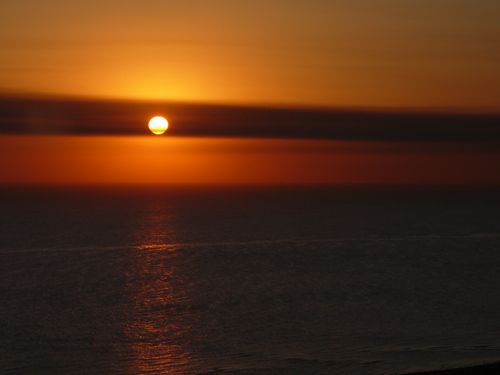
The sunrise this morning was beautiful – sharp, clear and, when I ran to get the camera, it was pink, but by the time I got back 15 seconds later, it had gone more orange:
How Decisions are Made in Kuwait
Here is the problem expats have in any country: you don’t know what you don’t know.
If you know you don’t know something, you can learn it. If you don’t know that you don’t know, there is this huge void in your understanding. Many times you can suspect there is a void, and if you ask, people will look at you like you are a little odd, and they will tell you there is no difference.
There IS a difference.
Working together with people of different nationalities, I have learned that some nationalities just forge on ahead and do things. Some nationalities use a more consultative process. Some nationalities expect to be told what to do and don’t do what they are not told to do.
In Friday’s Kuwait Times (February 21) is a column by Shamael Al-Sharikh, called The red, white, green and black. She talks about Kuwait National and Liberation Days, she talks about the shared heritage of all Kuwaitis (honestly, I would love to link you directly to this article but the website is still down) and then – I got a huge “AHA!” She talks about how decisions are made in Kuwait. I will quote a brief section, but I urge you all to find this column and read it in it’s entirety.
“. . . it has become painfully clear that there are nationals of this country who have no sense of belonging to it whatsoever.
However, the storm is about to subside. In a move that shows just how ready Kuwaitis are to mobilize for the sake of their national pride, a few diwaniyas in Kuwait signed a petition and sent it to the Takatul Shaabi political alliance at the National Assembly. It stated that unless MPs Adnan Abdulsamad and Ahmad Lari are asked to withdraw their membership from the Takatul Shaabi, none of it’s members will be welcome in Kuwait’s diwaniyas nor at weddings and funerals.
The move worked: the MPs have been asked to leave. . . the petitions included diwaniyas from all corners of the Kuwaiti society, both Sunni and Shiite, and it covered all sorts of ethnic backgrounds. . . I have never been more proud to support the red, white, green and black than I have now, and I am so proud to be a Kuwaiti.”
Not being welcome in diwaniyas, at weddings or at funerals is not something I would have considered political pressure. It matters here. It mattered enough that when diverse communities within Kuwait made the threat, it was effective. Who knew? Thanks to this column, I learned something I didn’t even know I didn’t know.
Keystone Cops
As you all have seen from US Crime tapes, this news story could happen anywhere, but it happened in Kuwait. I would love to see a video of this!
Kuwait Times, 21 Feb 2008
Drunken Man
The operations room received an anonymous call reporting that a drunken man had been dancing in the streets of Fehaheel and terrifying passersby. A police patrol rushed to the scene and managed to arrest the suspect, who initially resisted arrest.
However, after being cuffed and forced into the patrol vehicle for just a couple of seconds, he managed to step out and ran for dear life while police were busy putting some gear into the vehicle’s trunk. A wild goose chase ensued with police hot on his trail, while the man returned to the spot where the vehicle was parked, got in, stepped on the gas and sped to his freedom again. Police later tracked the vehicle that was dumped in a deserted area in Jleeb. A manhunt has been launched to arrest this man.
I commend the writer on the correct use of the plural “passersby.” Bravo.
Your challenge: how many cliche’s did this staff writer use to write this article?
5,000 Real Estate Deeds Missing
The Kuwait Times website seems to be down so I can’t link directly to them, but this is at the top of the crime news on yesterday’s page 5:
5,000 Real Estate Deeds Missing
Kuwait: An owner of a real estate office registered a complaint with the Khaitan police claiming that 5,000 real estate deeds were stolen from his office’s locked-up drawers. However, both the owner and the police were baffled because the thieves could have carried off furniture and other valuable items, but preferred to steal the deeds instead. The case was handed over to special detectives who immediately launched an investigation.
This seems to me like the deeds were the target of the break-in. Aren’t deeds registered somewhere? So like even if these paper copies are stolen, can’t they be replaced? What would somebody gain by stealing these deeds? Can they claim the properties? Can they claim the properties were transferred to them? Can they hid transfers that someone doesn’t want disclosed? This sounds like a great mystery to me!
While You Were Sleeping
It’s not that I’m that good, that obsessive, that I would get up every morning to photograph the sunrise. No, AdventureMan has to get to work, I have projects I am working on – AND there is the Qatteri Cat.
His little pea-brain doesn’t know it’s Friday morning. All he knows is that his food dish is empty. He goes around the house, pulling over the trash bins (they are small, they don’t make a lot of noise) and then he scratches at boxes and closets, thinking somewhere there might be food. I am guessing it goes back to some deep instinct, looking for food, from his street days.
I had forgotten to fill his dish last night.
I was so tired, I kept falling asleep over my latest Donna Leon book. Finally, around nine, I turned out my light. When the Qatteri can started sniffing around, pulling over trash cans, opening cupboards (what you hear is thump. thump. thumpthumpthump as he tries to paw it open) and scratching at boxes, I was mostly ready to get up, even though it wasn’t quite six.
Good thing! Cold, clear morning, no sand, not a cloud in the sky and just look at that sunrise:
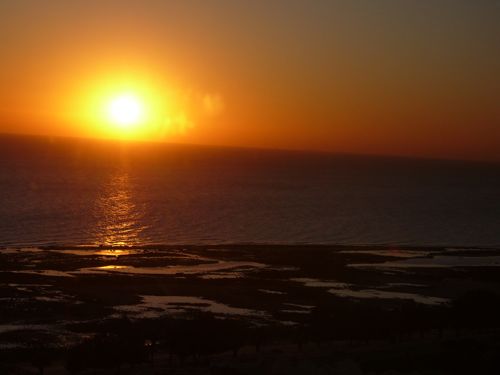
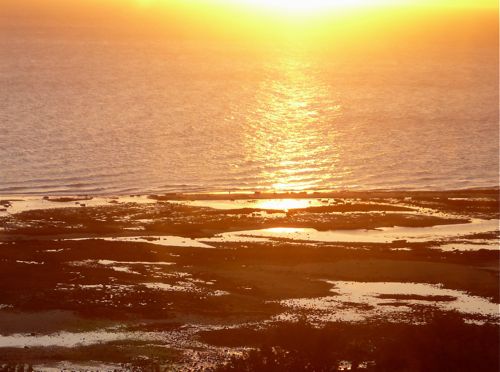
It is 46°F/8°C this morning. There is a wind, and it feels colder.
Sunrise 21 February 2008

This morning, the sand storm is gone, but there is still a very stiff breeze, keeping everything cool. It is 9°C / 48°F at 7:00 in the morning.
I don’t know if it has anything to do with the lunar eclipse, but as I got up – about an hour ago – I saw one of the lowest of all the low tides I have ever seen in Kuwait. I was tempted to go out on the beach and look for shells, but I don’t go on the beach alone, and I don’t have any dogs to protect me. The Qatteri cat has tried the leash – we call it ‘taking the cat for a drag,’ and he just isn’t fierce enough to protect me.
Kuwait has a LONG weekend! Friday and Saturday are the normal weekend, Monday and Tuesday are Liberation Day and Kuwait Day, so the government also declared Sunday to be a holiday, giving a nice 5 day break. The sandstorms have gone, at least for now, and it looks like it is shaping up to be a beautiful weekend.
Blonde Joke
A friend send this in the e-mails this morning and I can’t resist sharing it with you –
Two bowling teams, one of all Blondes and one of all Brunettes, charter a double-Decker bus for a weekend trip to Louisiana. The Brunette team rode on the bottom of the bus, and the Blonde team rode on the top level.
The Brunette team down below really whooped it up, having a great time, when one of them realized she hadn’t heard anything from the Blondes upstairs. She decided to go up and investigate.
When the Brunette reached the top, she found all the Blondes in fear, staring straight ahead at the road, clutching the seats in front of them with white knuckles. the brunette asked, ‘What the heck’s going on up here? We’re having a great time downstairs!’
One of the Blondes looked up at her, swallowed hard and whispered… ‘YEAH, BUT YOU’VE GOT A DRIVER!?!’
Aidan Hartley’s Zanzibar Chest

I started Zanzibar Chest in December, and could not get into it. It was interesting, but at first the tone was . . . I don’t know, maybe pompous? Something in the tone put me off, and yet I didn’t put it back on the bookshelves, nor did I give it away. It sat on my bed table while I attacked lesser works, more enjoyable fare. Then, one day, I just knew it was time to try it again, and this time, I could hardly put it down.
Born in Kenya, just before the rebellion, Aidan Hartley spent his life mostly in Africa. He skillfully interweaves three main story lines – the life of his mother and father, the life of his father’s best friend and his own life as a news correspondent.
This is not a joyful book. It is not inspirational. It is a tough, hard look at the people who cover the news, and the toll it takes on their lives. It is a story of drugs and alcohol to numb the pain of what they are observing, the comraderie of gallows humor and surviving the intensity of living through life-threatening moments together.
He covers some truly awful events. He covers the wars in Somalia, and in Rwanda. He covers Kosovo and Serbia. He is sent into some of the most dangerous and awful of places. He pays the price.
In his Zanzibar Chest, he takes us with him.
I will share a couple quotes with you, and if you are sensitive, please stop reading now. This book is not for you. It is almost not for me, except that sometimes I think we need to come face to face with just how awful reality can be to put our own lives right, to set appropriate priorities.
“I can’t put my finger on exactly how death smells. The stench of human putrefecation is different from that of all other animals. It moves us as instinctively as the cry of a newly born baby. It lies at one extreme end of the olfactory register. Blood from the injured and the dying smells coppery. After a cadaver’s a day old, you smell it before you see it. From the odor alone, I could tell how long a body had been dead and even, depending on whether brains or bowels had been opened up, where it had been hacked or shot. A body would quickly balloon up in the tropical heat, eyes and tongue swelling, flesh straining against clothes until the skin bursts and fluids spill from lesions. Flies would get in there and within three days the corpse might stink. It became a yellow mass of pupae cascading out of all orifices and the flesh literally undulated beneath the clothes. The tough bits of skin on the palms of their hands and the soles of their feet were the parts of the body that always rotted away last. As living people, these had been peasants who had walked without shoes and worked hard in the fields. A man who had been dead seven days reeks of boiling beans, guava fruit, glue, blown handkerchiefs, cloves and vinegar. After that he starts to dry out into a skeleton until he’s almost inoffensive . . .
The dead accompanied me long after Rwanda. It was months before I could order a plate of red meat served up in a restaurant. I smelled putrefaction in my mouth, or in my dirty socks, or as sweat on my body. I imagined what people I met would look like when dead. . . “
These guys all suffer from Post traumatic stress syndrome, they deaden themselves with drug and alcohol, and they are totally addicted to the adrenalin rush their job gives them. Living on adrenalin takes a huge toll – on their health, on their mental health, on their relationships, on their belief in goodness. They are the witnesses to the enormity of man’s inhumanity against one another.
In another quote, the author tells us:
“It was impossible for latecomers to comprehend the evil committed here but the British military top brass were still so scared of what their soldiers might see and what it would do to their minds that they sent a psychiatrist to accompany the forces to Rwanda. Bald Sam and I were amazed at that. We laughed about it. A shrink! It seemed extravagant. But the truth is that we stuck close to that man for days. We said it was all for a story, but really it was about us. The psychiatrist, whose name was Ian, told us his special area of interest was the minds of war correspondents. I could see Bald Sam squirming with happiness at all the attention, and I felt quite flattered myself. . . .
. . . for years I did endure some sort of payback. I have to try every day to prevent the poison that sits in my mind to spread outward and hurt the people I love. Sometimes I can’t stop it and I wonder if in some way the corruption will be passed on from me to my children.”
Toward the end of the book, the author tells us how hard it is to give up this adrenalin-news-junky life:
“Whenever I see a news headline to this day I half feel I should board the next flight into the heart of it. I’d love to get all charged up again and I could write the story with my eyes closed. I’m sure the sense that I’m missing out while others get in on a great story will never completely pass. . . The sight of people committing acts of unspeakable brutality against others fills a hole in some of us. The activity is made respectable by being paid a salary to do it, but there is a cost.”
This is not a book I really wanted to read, but it is a book I will never forget. Hartley doesn’t spare himself in the telling of this tale. He takes us with us and shows us all of it, and all of his own warts along with the tale. Would I recommend this book? Not for the sensitive, not for those who don’t want to look at the dark side. Between idyllic sequences on the beaches near Mombasa, in the hills of Kenya and Tanzania, in the dusty deserts of Yemen, there are some very intense and bloody moments. This is non-fiction, it is a documentary, it is a slice of the real life one man has seen, and that to which he has been witness. Read the book, and like him, you pay a price. You carry images in your head that you can’t forget, and a sorrow for our inability to solve our differences peaceably.
(Available in paperback from Amazon.com for $10.88. Disclosure: Yes, I own stock in Amazon.com.)
God Laughs
So I think I mentioned a couple of weeks ago that Lent was beginning and I was giving up all cursing in the car, as a kind of practicing some spiritual discipline kind of thing.
What I didn’t tell you was that I had this sneaky strategy all planned out – I had all kinds of projects lined up at home, and I didn’t really intend to be on the road much during Lent, and I thought that not putting myself in temptation would help do the trick.
I always get tripped up when I make those kinds of strategic decisions toward spiritual disciplines. Strategic and spiritual don’t always blend too well.
What happened is this – suddenly I have found myself on the road more than I ever thought. On the road every single day. Running from one thing to another. And not just my familiar treks either, but some challenging driving, new places, and with people in the car.
The pressure is on. The very worst day of all, I just had to give God a great big grin and thank him for the opportunity to really, really practice my spiritual discipline. The car is full of people, I am on a strange road, sand and dust are blowing everywhere, the competition for my road space are on their way home with their kids in the car, the highways are packed and people are hungry and all I can do is laugh, because I sure can’t curse.
Recent Comments
ExpatAlien on What Country am I Living … intlxpatr on Yellowstone: Old Faithful to C… Michelle on Yellowstone: Old Faithful to C… Cathy on No Grown-Ups in Charge intlxpatr on Waiting for Snow Wikipedia Donate Button

Amazina


Early Voting in Florida


 Here There and Everywhere