Sky Walk – I Couldn’t Do it
Today on Good Morning America, they hit the 3rd of America’s Seven Natural Wonders. It is the Grand Canyon, and they broadcast from the new skywalk that they built cantilevered out over the Canyon. It has a glass floor, and you walk out 4,000 feet above the bottom of the canyon.
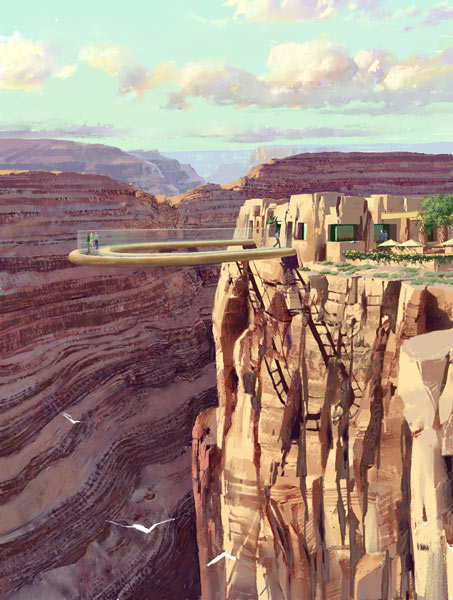
I almost threw up.
Just looking at it makes my blood pressure jump; my heart is beating fast and my palms start to sweat.
I have a mild case of fear-of-heights. (Acrophobia) I feel unbalanced looking down, I feel like I could fall right over.
AdventureMan, thank God, has the same sensitivity, so he doesn’t tease me. I know we will visit this skywalk one day, and I wonder if he will be able to force himself to walk out on it. I already know I won’t be doing it. It’s just too stressful for me. . . . Even watching it on Good Morning America, I feel all stressed out!
LOL Cat for Today
This one had me howling – it even looks like the Qatteri Cat, who thinks he wants to be outside . . . probably for the same reason. Poor QC vaguely remembers a time when he lived outside. He doesn’t remember the bad parts. 😦
Kuwait isn’t a good place for a cat who lives outside.

more cat pictures
NYT: In Democracy Kuwait Trusts, but Not Much
The New York Times had a full length article on the upcoming Kuwait election yesterday:
KUWAIT — In a vast, high-ceilinged tent, Ali al-Rashed sounded an anguished note as he delivered the first speech of his campaign for Parliament.
“Kuwait used to be No. 1 in the economy, in politics, in sports, in culture, in everything,” he said, his voice floating out in the warm evening air to hundreds of potential voters seated on white damask-lined chairs. “What happened?”
It is a question many people are asking as this tiny, oil-rich nation of 2.6 million people approaches its latest round of elections. And the unlikely answer being whispered around, both here and in neighboring countries on the Persian Gulf: too much democracy.
In a region where autocracy is the rule, Kuwait is a remarkable exception, with a powerful and truculent elected Parliament that sets the emir’s salary and is the nation’s sole source of legislation. Women gained the right to vote and run for office two years ago, and a popular movement won further electoral changes.
Despite those gains, Kuwait has been overshadowed by its dynamic neighbors — Dubai, Abu Dhabi and Qatar — where economies are booming under absolute monarchies. Efforts to overhaul Kuwait’s sclerotic welfare state have stalled in its fractious and divided Parliament, and scandals led the emir to dissolve the chamber last month for the second time in less than two years, forcing new elections.
All this has left many Kuwaitis deeply disenchanted with their 50-member elected legislature. The collapse of the Bush administration’s efforts to promote democracy in the region and the continuing chaos in Iraq, just to the north — once heralded as the birthplace of a new democratic model — have also contributed to a popular suspicion that democracy itself is one Western import that has not lived up to its advertising.
“People say democracy is just slowing us down, and that we’d be better off if we were more like Dubai,” said Waleed al-Sager, 24, who is advising his father’s campaign for Parliament.
Like many Kuwaitis, Mr. Sager quickly distanced himself from that view. But as the May 17 parliamentary elections approach, with near-constant coverage in a dozen new newspapers and on satellite television stations, candidates refer again and again to a “halat ihbaat” — state of frustration. His father, Mohammed al-Sager, a longtime member of Parliament, delivered his own opening campaign speech shortly after Mr. Rashed two weeks ago, and spent much of it urgently reminding his listeners of the need for an elected assembly.
“Some people have called for a permanent dissolution of Parliament,” he said, his face telecast on an enormous screen to a thick overflow crowd outside the tent. “But everywhere in the world — in Africa, in Palestine, in the old Soviet Union — people have turned to elections to solve their problems, not away from them. Whatever problems we have in our Parliament, we must remember that it is much better than no Parliament at all.”
One source of frustration has been the failure to reform Kuwait’s state-controlled economy. After the 2006 elections, many Kuwaitis were hoping for changes to cumbersome government rules that allow land to be allocated for business projects. Instead, the effort was blocked in Parliament. The slow pace of efforts to privatize the national airline and parts of the oil sector has also caused disappointment.
Many Kuwaitis also complain about government neglect of public hospitals and schools. Problems with the power grid caused brownouts last summer.
Although parts of Kuwait City were rebuilt after the Iraqi invasion of 1990, much of it looks faded and tatty, a striking contrast with the gleaming hyper-modernity of Dubai, Abu Dhabi and Qatar.
The current political malaise is especially striking because most Kuwaitis take pride in their nation’s relatively democratic traditions. The ruling Sabah family acquired its position not through conquest, but with an agreement among the coastal traders of the region in the mid-18th century. After Kuwait gained independence from the British in 1961, the emir approved a written Constitution that sharply limited his power in relation to Parliament.
The article is long – you can read the rest HERE.
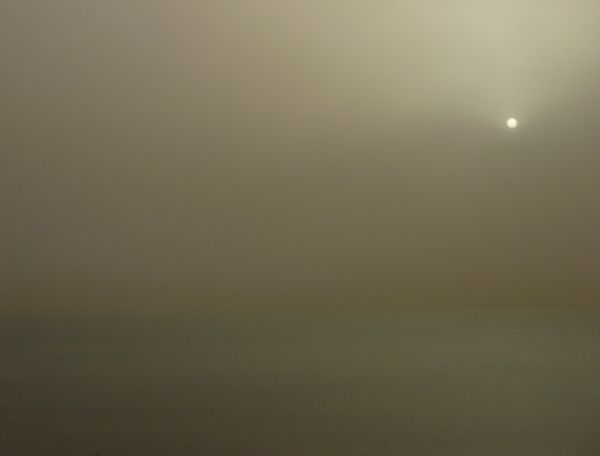
Indistinct Sunrise
The sunrise this morning is so pale that while you can see colors, they are all pale and impressionistic, hazy an indistinct:
Recent Comments
ExpatAlien on What Country am I Living … intlxpatr on Yellowstone: Old Faithful to C… Michelle on Yellowstone: Old Faithful to C… Cathy on No Grown-Ups in Charge intlxpatr on Waiting for Snow Wikipedia Donate Button

Amazina


Early Voting in Florida


 Here There and Everywhere