The Sunshine Vitamin
This is from The Washington Post and you can read the entire article by clicking on the blue type.
Vitamin D deficiency is, ironically, a serious issue for Middle Eastern women who stay out of the sun and who cover – wear abaya, hijab and niqab. The body makes Vitamin D from sunshine – which we have here in the Gulf in great abundance. Even exposing your skin for ten minutes a day in a secluded sunny spot will help your body create the Vitamin D it needs to build your bones and your system.
Some Seek Guidelines to Reflect Vitamin D’s Benefits
By Rob Stein
Washington Post Staff Writer
Friday, July 4, 2008; Page A01
A flurry of recent research indicating that Vitamin D may have a dizzying array of health benefits has reignited an intense debate over whether federal guidelines for the “sunshine vitamin” are outdated, leaving millions unnecessarily vulnerable to cancer, heart disease, diabetes and other ailments.
The studies have produced evidence that low levels of Vitamin D make men more likely to have heart attacks, breast and colon cancer victims less likely to survive, kidney disease victims more likely to die, and children more likely to develop diabetes. Two other studies suggested that higher Vitamin D levels reduce the risk of dying prematurely from any cause.
In response to these and earlier findings, several medical societies are considering new recommendations for a minimum daily Vitamin D intake, the American Medical Association recently called for the government to update its guidelines, and federal officials are planning to launch that effort.
But many leading experts caution that it remains premature for people to start taking large doses of Vitamin D. While the new research is provocative, experts argue that the benefits remain far from proven. Vitamin D can be toxic at high doses, and some studies suggest it could increase the risk for some health problems, experts say. No one knows what consequences might emerge from exposing millions of people to megadoses of the vitamin for long periods.
“The data are intriguing and serve as, no pun intended, food for further fruitful research,” said Mary Frances Picciano, at the Office of Dietary Supplements of the National Institutes of Health. “But beyond that, the data are just not solid enough to make any new recommendations. We have to be cautious.”
The current clash is the latest in a long, often unusually bitter debate. Some skeptics question whether funding by the tanning, milk and vitamin industries is biasing some advocates. Frustrated proponents accuse skeptics of clinging to outdated medical dogma.
“It feels kind of ridiculous working in this field sometimes,” said Reinhold Vieth, a professor of nutritional sciences and pathobiology at the University of Toronto. “Every week, I get interviewed about the next important publication about Vitamin D. But this field remains mired in the muck.”
Vieth is one of a small but vocal cadre of researchers pushing doctors and patients to stop waiting for new official guidelines. Physicians should routinely test their patients for Vitamin D deficiencies, and more people — especially African Americans — should take supplements and increase their exposure to the sun, they say.
“The bottom line is we now recognize that Vitamin D is important for health for both children and adults and may help prevent many serious chronic diseases,” said Michael F. Holick, a professor of medicine, physiology and biophysics at Boston University.
Scientists have long known that Vitamin D is a vital nutrient the skin produces when hit by ultraviolet light from sunlight and other sources. The amount of Vitamin D produced varies, depending on where the person lives, skin pigment, age and other factors. African Americans and other dark-skinned people, and anyone living in northern latitudes, make far less than other groups.
With people spending more time indoors surfing the Web, watching television, working at desk jobs, and covering up and using sunblock when they do venture outdoors, the amount of Vitamin D that people create in their bodies has been falling. Milk and a few other foods are fortified with Vitamin D, and it occurs naturally in others, such as fatty fish, but most people get very little through their diets.
“Humans evolved in equatorial Africa wearing no clothes,” said Robert P. Heaney, a leading Vitamin D researcher at Creighton University in Omaha. “Now we get much less direct sunlight, and so we don’t make nearly as much Vitamin D.”
How Hot is It?
Here is a photo of what it looks like this morning, not quite 7 in the ay-em:
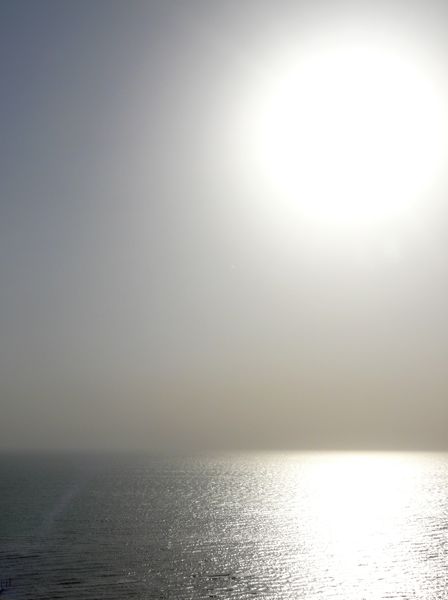
It’s hot. It is so hot that I will need to run to the grocery store any minute now, before it gets too hot. It is so hot, I don’t even sweat, the sweat evaporates right off my body. It is so hot that a crayon left lying on the ground will spontaneously dissolve:
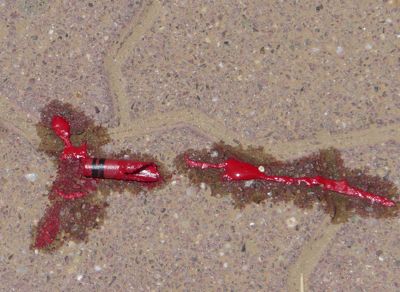
At 0730, it is 97°F / 36°C.
BBC 9-11 Third Tower
I am not much on conspiracy theories. This is on today’s BBC – a slow Saturday, I don’t imagine it will get a lot of attention.
9/11 third tower mystery ‘solved’ |
|
|
|
The final mystery of 9/11 will soon be solved, according to US experts investigating the collapse of the third tower at the World Trade Center.
The 47-storey third tower, known as Tower Seven, collapsed seven hours after the twin towers.
Investigators are expected to say ordinary fires on several different floors caused the collapse.
Conspiracy theorists have argued that the third tower was brought down in a controlled demolition.
Unlike the twin towers, Tower Seven was not hit by a plane.
The National Institute of Standards and Technology, based near Washington DC, is expected to conclude in its long-awaited report this month that ordinary fires caused the building to collapse.
That would make it the first and only steel skyscraper in the world to collapse because of fire.
The National Institute of Standards and Technology’s lead investigator, Dr Shyam Sunder, spoke to BBC Two’s “The Conspiracy Files”:
“Our working hypothesis now actually suggests that it was normal building fires that were growing and spreading throughout the multiple floors that may have caused the ultimate collapse of the buildings.”
‘Smoking gun’
However, a group of architects, engineers and scientists say the official explanation that fires caused the collapse is impossible. Architects and Engineers for 9/11 Truth argue there must have been a controlled demolition.
 |
The founder of the group, Richard Gage, says the collapse of the third tower is an obvious example of a controlled demolition using explosives.
“Building Seven is the smoking gun of 9/11… A sixth grader can look at this building falling at virtually freefall speed, symmetrically and smoothly, and see that it is not a natural process.
“Buildings that fall in natural processes fall to the path of least resistance”, says Gage, “they don’t go straight down through themselves.”
Conspiracy theories
There are a number of facts that have encouraged conspiracy theories about Tower Seven.
- Although its collapse potentially made architectural history, all of the thousands of tonnes of steel from the skyscraper were taken away to be melted down.
- The third tower was occupied by the Secret Service, the CIA, the Department of Defence and the Office of Emergency Management, which would co-ordinate any response to a disaster or a terrorist attack.
- The destruction of the third tower was never mentioned in the 9/11 Commission Report. The first official inquiry into Tower Seven by the Federal Emergency Management Agency was unable to be definitive about what caused its collapse.
- In May 2002 FEMA concluded that the building collapsed because intense fires had burned for hours, fed by thousands of gallons of diesel stored in the building. But it said this had “only a low probability of occurrence” and more work was needed.
But now nearly seven years after 9/11 the definitive official explanation of what happened to Tower Seven is finally about to be published in America.
The National Institute of Standards and Technology has spent more than two years investigating Tower Seven but lead investigator Dr Shyam Sunder rejects criticism that it has been slow.
My comment:
If you go to the BBC News Link (this if filed under Conspiracies) you can watch a video of the third tower going down. It looks pretty controlled to me, too.
Hot as . . .

Night before last, for the first time, I saw my husband’s temperature gizmo in the car register 50°C – and that was at 8 PM.
In Kuwait, if the temperature registers 50°C, work is supposed to cease. The official temperature gauges on buildings downtown never go above 49°C. But if the temperature outside is still 50°C at 8 at night, wouldn’t you think it would be higher during mid-day?
He had visitors in town the other day, visitors who were so fascinated with the heat that they took photos of his dashboard temperature gauge.
It is unbelievably hot.
Maitland and The Company of Liars: A novel of the plague
I had just finished The Swallows of Kabul and still had a long flight to go. Fortunately, I was in the Johannisburg airport, with it’s truly wonderful bookstore, and came across The Company of Liars: a novel of the plague. Well, it isn’t exactly a novel of the plague. The story opens in 1348, a year in which le morte bleu hit the British Isles, only later to be called the plague. The author captures the times, the filth, the lack of bathing, the superstitions, the ways of life.
The plot centers around a group who wanders through the island, just trying to stay alive. The spreading plague impacts on their wandering, but to call this a novel of the plague is just not accurate. The plague is the reason for the journey, but the journey is the center of the novel, not the plague.
Before I started reading the book, I read the Historical Notes in the back, and that is where I came across the most interesting information in the entire book:
The 1348 plague was only the latest in a series of disasters to hit Britain. The period between 1290 and 1348 had seen a rapid and drastic climate change which was so noticeable that the Pope ordered special prayers to be said daily in every church. Eyewitness accounts claimed that 1348 was a particularly bad year, for it rained every day from Midsummer’s Day to Christmas Day. Climate change brought about crop failure, liver fluke in sheep and murrain in cattle, as well as causing widespread flooding which virtually wiped out the salt industry on the east coast. This, combined with a population explosion, meant that as many people died from starvation as from the plague itself.
Interestingly, the book will not be released in the US until September 2008. The cover shown is nothing like the cover of the book I bought.
American issue cover:

Cover on book bought in Johannisburg:
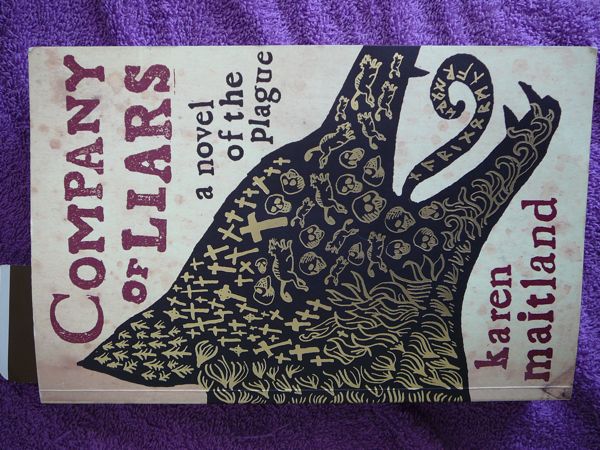
I like the cover of mine better.
Some reviewers call this book “enthralling” or “gripping.” I wans’t all that enthralled or gripped, but it did make good airplane reading. I learned a lot about the grim brutality of life in 1348, but as I told AdventureMan, this is more a book about a slice of time than a book with a great plot. The plot isn’t that great, it is the historical detail that is interesting, and fiction just makes it more easily absorbed. (my opinion)
Electricity Bills Certificate?
Back in May, we saw the following in the Kuwait Times:
“the Ministry of Electricity and Water (MEW) has decided to ask all expatriates before exiting the country – whether on holiday or permanently – to obtain a certificate of clearance from the ministry. The certificate is only valid for one month. If the expat doesn’t have it, he will be returning from the airport the same day . . . “
School is out, people have fled the heat in droves, even with the atrocious airline prices. Has anyone heard of this policy being implemented? I haven’t heard of anyone being halted from travelling because of an unpaid bill, nor did anyone look us up when we were departing on holiday.
Masumbe’s Wisdom By the Campfire
Every night before dinner in these camps is a time for gathering around the campfire, sharing stories, getting to know the fellow guests. At Tena Tena our third night, we are sitting with Msumbe, the assistant camp manager, and listening to him talk about Zambia.
Zambia is a peaceful nation, and it is a miracle. More than seventy different tribes, and that many different languages and dialects. Rich in natural resources, full of children hungry to learn, Zambia has placed a high priority in educating everyone in getting along with one another.
“So like when you come across another person, not from where you are from, you don’t start in with a lot of questions. First you ask ‘How is it where you are from?’ and then you listen. When you know where he is coming from, and how are things there, then you can ask better questions, and not offend someone.”
Hmmmm, I thought, good advice. Sometimes I feel a little shy, especially when there are large groups of “others” like South Africans, or British, and they have their own values, their own ways of communicating, different from ours.
Soon, I was sitting next to a British woman, and desperately trying to think of a way to get HER talking, so I could be listening, and that is exactly what I asked “Tell me what life is like where you are from?”
She looked at me like I was a little crazy and asked what I meant. I said that I knew her life was very different from mine, and I was interested to know what her daily life was like. So she started telling me she wasn’t very interesting really, but gave me some details, and actually, it WAS interesting. Once she got going, knowing I really was interested, I learned a whole lot!
One detail I will never forget is that she rides to the foxes every weekend in the fox hunting season, this very respectable woman, and that they all do, even if it is against the law. No matter what the weather, they ride, hour upon hour. She laughed and said they ride so long and so hard that her clothes become discolored from the saddle leather, and she comes home stained and filthy from her rides.
Now how would I ever have known all that without Masumbe’s good question? It’s like being given a key that opens many locks. You never know what treasures you will come upon, but you have this wonderful key. Thank you, Masumbe!
Tena Tena, RPS, Zambia 2008
We travel to Africa almost every year, but the Robin Pope Safari camps are the only ones we have ever visited more than once. After our first visit, I think in 2003, we went back for a Hiking with Robin Pope safari in 2005 and enjoyed every minute of it. When we first dreamed of taking our son and his wife to Africa with us, we thought we would do the Hemingway Safari with CCAfrica (it’s twelve parts but this link takes you to the first entry) but that takes 14 days, and LawAndOrder Man doesn’t get that much time off.
No problem, we know that the Robin Pope Safari Camps do it right. We know they will be totally WOWED. We set up some dates, and then when the Cupertino wedding comes up, we revise the dates, which means that we do the same trip we did the other two times, only backwards. This is fun! When you are booking a Robin Pope Safari, you need to book early, they fill up fast.
We love Tena Tena, the first camp we stayed at. Each couple has a very large tent, with furniture and books and oriental carpets. The bedcovers are kilim, the whole flavor is very fusion, like Zanzibar – African, Indian and Middle Eastern. There are only five tents, maximum of ten guests. We feel so at home.
During the day, each tent is totally open in the front to a large patio from which you can watch passing game. Our very first day in Tena Tena, just after lunch the elephants came through, and we watched, enchanted, from the porch. First AdventureMan went to our son’s tent to watch as they passed, and then all three came to our tent. My heart was so full of joy that I didn’t know whether to watch the elephants or to thank God for the sheer happiness I felt, all of us together and the miracle of elephants walking right past our door as we watched in wonder. I found a way to do both.
So here are some more photos of our time at Tena Tena:
The airplane we flew in on, and Mfuwe International Airport. Once a week or so, a flight comes in from Malawi, and so it is genuinely an International airport:

The South Luangua needs these small planes to get the visitors to their camps, so Robin and Jo Pope invested in their own airline, ProFlight.

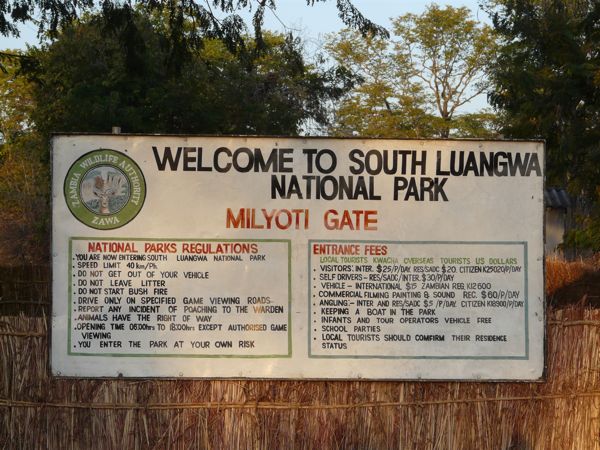
The guides at the Robin Pope Camps are so patient. I am absolutely ga-ga about the sky, seeing blue sky and clouds and a sunset. I get gorgeous sunrises in Kuwait, but I never see the sun set. The guide is patient when I ask him to stop to take a photo. While we are stopped – a hyena comes slinking along, totally ignoring us, crossing behind our vehicle.

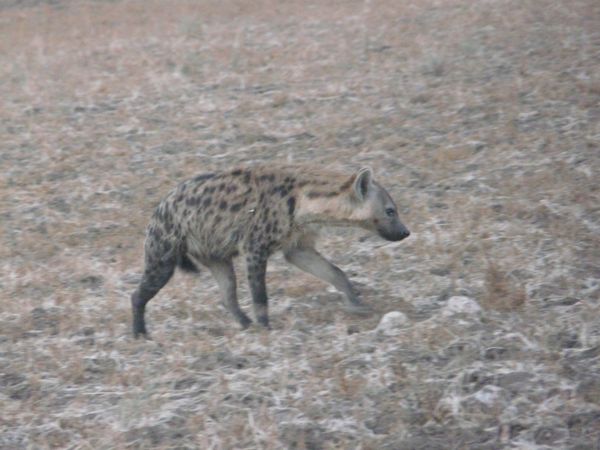
The next morning, it is up at 0530, out of the camp by six (not a vacation for people who want to sleep in!) LawAndOrder Man and EnviroGirl have been awake since three a.m. – jet lagging – and are bright and shiny!
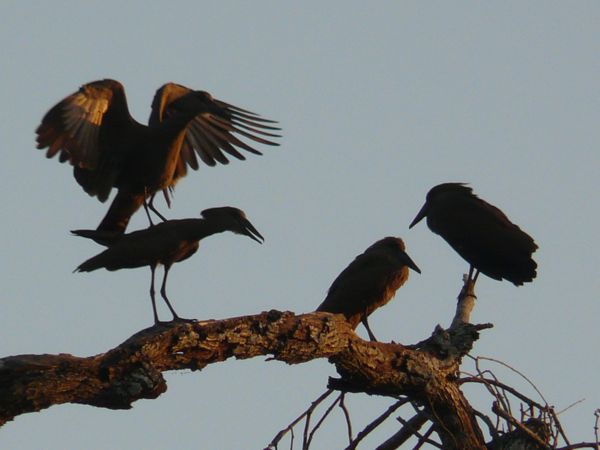
As we are watching the baboons wake up and take care of daily business, we see the most amazing fight – a set of four birds fighting over a tree top territory. One hops up on his partner’s back to scold and intimidate the other two into leaving:
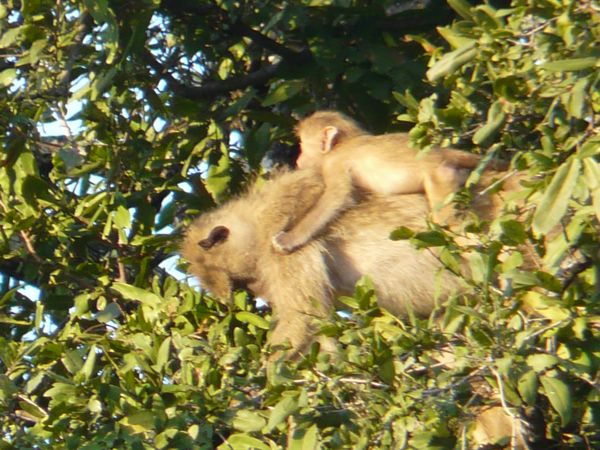
Back in Tena Tena, a delicious lunch – every meal is delicious – and just as we are finishing, there are elephants crossing the river to our side. What is cuter than a baby elephant?

The elephants crossed the river, then came foraging down past our tents:

I know you are all dying to see LawAndOrder Man and Enviro Girl – that’s them, watching the elephants on our tent front porch.
Our guide, Bertram, was amazing. He would ask us “what do you want to see?” and we would tell him, and he knew just where to find them. The first night drive, I said “We love seeing everything, but it would be a real thrill to see a leopard.”
We drove around, looking at all kinds of things, and then he said “over on your left is a hammerkopf – and a leopard.” And there she was, relaxed, soaking up a little sun before she hunted up something for the night’s dinner. She posed, she stretched, she changed positions and gave us plenty of time before she sauntered off. Wooo HOOOOOO! We had been to Africa three times before we ever saw a leopard, and here was one on their very first night of their very first safari. God is Good!

One of the best parts about Tena Tena is hearing hippos. There are hippos everywhere:

Thank you for being so patient with all my vacation stories and photos. I know, I know, I am turning into that boring old aunt who always shows up with photos! 😉
Disturbing Change
Late yesterday, I was online on AOL checking my e-mails. I often do, Law and Order Man comes online around that time in Pensacola and we can grab a quick chat.
Only Instant Messaging didn’t show up on my screen. I took care of business, and went on to other things. We don’t chat every day, just when we can.
Today, I noticed again – I don’t have AIM. I have a couple other ways to check in online, so I tried them. No AIM. Finally, I tried iChat, which also logs into AIM. It showed me logged in, it also showed no contacts.
My other AOL entry route didn’t show the Buddy Screen, even when I asked it to repeatedly.
I am hoping this is a little AOL glitch, temporary.
You don’t think Instant Messaging is being blocked in Kuwait, do you?
Mediterranean diet ‘cuts cancer’
While this is not new news, it is verification of what we know to be true – that using olive oil in place of other oils can reduce your risk of serious disease. From BBC Health News:
Mediterranean diet ‘cuts cancer’
A study of 26,000 Greek people found just using more olive oil alone cut the risk by 9%.
The diet, reports the British Journal of Cancer, also includes higher amounts of fruits, vegetables, cereals, and less red meat.
A separate study found adding broccoli to meals might help men vulnerable to prostate cancer cut their risk.
It shows there are a number of things you can do, and there is no one ‘superfood’ that can stop you developing the disease
The Mediterranean diet came under scrutiny after researchers noticed lower rates of illnesses such as heart disease in countries such as Spain and Greece.
They noticed that people living there generally ate more vegetables and fish, less red meat, cooked in olive oil and drank moderate amounts of alcohol.
The latest study is one of the largest yet to look at the potential impact on cancer of the various parts of this diet.
‘No superfood’
Researchers from Harvard University persuaded thousands of Greek people of various ages to record their food intake over an eight-year-period.
Broccoli may help ward off prostate cancer
Their adherence to the Mediterranean diet was ranked using a scoring system, and the group with the worst score compared with those who followed a couple of aspects of the diet, and those who followed it the most closely. The biggest effect they found – a 9% reduction in risk – was achieved simply by eating more “unsaturated” fats such as olive oil.
But just two changes – eating less red meat, and more peas, beans and lentils, cut the risk of cancer by 12%.
Dr Dimitrios Trichopoulos, who led the study, said: “Adjusting one’s overall dietary habits towards the traditional Mediterranean pattern had an important effect.”
Sara Hiom, from Cancer Research UK, said the research highlighted the importance of a healthy balanced diet.
“It shows there are a number of things you can do, and there is no one ‘superfood’ that can stop you developing the disease.”
Broccoli benefit
The other study suggesting that food had the power to prevent cancer came from the Institute of Food Research in Norwich.
Scientists compared the effects of adding 400 grams of broccoli or peas a week to the diet of men at high risk of prostate cancer – and in the case of broccoli found differences in the activity of genes in the prostate which other studies have linked to cancer.
Their findings raised the possibility that broccoli, or other “cruciferous” vegetables, such as cauliflower and Brussels sprouts, could help prevent or slow down the disease, particularly if the man had a particular gene variant – GSTM1.
Professor Richard Mithen, who led the research, published in the Public Library of Science journal, said: “Eating two or three portions of cruciferous vegetables per week, and maybe a few more if you lack the GSTM1 gene – should be encouraged.”
Professor Karol Sikora, medical director of CancerPartnersUK, said the study was the first time in a properly controlled clinical trial that broccoli had been shown to change the expression of specific genes in the prostate gland.
“Although the observation period was too short and the numbers too small to show that the incidence of cancer actually fell, it is the first clear demonstration that broccoli and presumably other cruciferous vegetables may well reduce cancer risk.”
Recent Comments
ExpatAlien on What Country am I Living … intlxpatr on Yellowstone: Old Faithful to C… Michelle on Yellowstone: Old Faithful to C… Cathy on No Grown-Ups in Charge intlxpatr on Waiting for Snow Wikipedia Donate Button

Amazina


Early Voting in Florida


 Here There and Everywhere