Blessing Friday Sunrise
So you might think it a curse to have to get up early on a Friday morning, but I started falling asleep around nine last night, and by 5:30 this morning, I had enough sleep. 🙂 The Qatteri Cat and I were just sitting, watching the necklace of fishing boats off the coast, their lights twinkling, watching the light change. There are too many sunrises this morning – it is the most glorious morning! Thank God for these amazing clouds!
This is “Not-the-Sunrise.” It is in the opposite direction from the sunrise; the sun can’t break through the clouds but there is this high pink reflection on far-away clouds:

This is the sun just beginning penetrate the low laying clouds on the horizon:

This is because it is so beautiful and I can’t stop myself, I love the outlining on the clouds:

This is because the birds flew in and how often does that happen at just the right time?

And this one – same day, same sunrise – is taken an hour later. Looks like a totally different day, doesn’t it?

Who would ever guess that this girl from the rainy Pacific Northwest would get such a thrill out of the return of rainclouds?
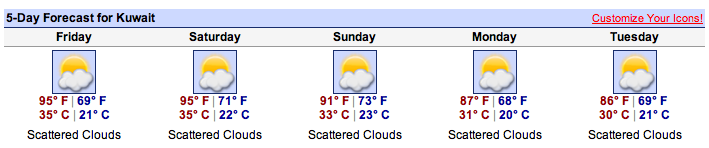
The five day forecast shows scattered clouds, lowering temperatures (Wooo HOOOOO!) but . . . where did the chance of rain go?
“Where You From?”
AdventureMan calls, full of chat, wanting to tell me what he is seeing at the airport. Normally, it’s a good time for a chat, but today, I’m having none of it.
“I just called the police again.” I told him.
(I can hear him thinking “Oh oh.”)
First I dialed the neighborhood police number, and nobody answered – again.
We have accidents in front of our house all the time. Sometimes I can see everyone with their phones out and I don’t call. This time, I called. No answer. I dialed 777. Thank God, they have WOMEN who answer, women who speak a little English, and I speak a little Arabic, and together we figure things out. They are smart, they are competent and they are sweetly polite, not officiously bureaucratic.
I tell her about the accident, tell her the neighborhood.
Two minutes later, my phone rings. He doesn’t speak English.
“Bolice?” I ask.
“Bolice” he affirms, and says my neighborhood.
I start telling him, in Arabic, the block, the street and the cross street. See? I’ve gotten so smart!
“Where you from?” he asks in amazement, and I can hear him grinning.
“I’m from (the neighborhood)” I answer.
He leaves the phone, and he is yelling and everyone is laughing in the background. Someone else comes.
“Where you from?” he asks. He just wants to hear me talk.
I tell him – in Arabic – the block, the street and tell him “CAR CRASH! TOO MUCH TRAFFIC. NEED BOLICE!” He is laughing. He calls someone else.
This guy speaks English.
“Car crash?” he asks.
“Yes!” I respond, glad to be on topic.
“Why you call me?” he asks.
(I didn’t call him. I called 777 {the emergency number here.} They called me!)
“Car crash.” I repeat. “Too many cars” (I say this in Arabic) Need BOLICE!”
He is laughing.
“Where you from?” he asks.
I say I am from the neighborhood.
“You in car?” he asks.
“No, I see from my house.”
“Come to station.” he says.
“No, BOLICE COME HERE!” I say, and tell him again the street, block and cross street – in Arabic.
He laughs and hangs up.
Forty five minutes later, traffic is still snarled up, no one is managing traffic, there are any number of near accidents as a result, and it is just a mess. No BOLICE.
For my non-Kuwaiti readers, the law in Kuwait is that when there is an accident, you cannot move your cars, not even out of the way, until the police have come. Until they come, everything stays as it is except for an ambulance can come and take away someone who is hurt.
CoeurCountry Sunsets
Everybody needs a friend like CoeurCountry. You think you have your day all figured out and she calls and has an idea, and all of a sudden, everything changes. Isn’t it fun when life is less predictable?
After a long day, she called just as I was stretching out to read the paper and maybe catch a little nap before AdventureMan comes home – not a big nap, just a tiny little one!
“Don’t you need to go shopping?” she asked, with a laugh in her voice. “Can I tempt you with a coffee?”
No, I didn’t need the temptation of a coffee, just jumping in the car and driving off with her is enough – we always have so much to talk about and never run out of topics.
And we did have coffee. 🙂
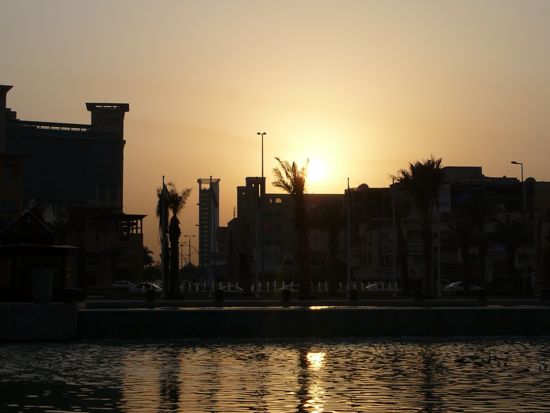
As we were finishing up our errands, she stopped and said “Look! There’s your sunset!”
And there it was. Too late for the contest, but definitely a Kuwait sunset worth shooting:
Al Kout Mall Sunset
And, as usual, we had “just one more thing” to do, and as she completed her errands, I shot one more sunset – no sun, but it is a sunset photo because I was there and I say so!

Mosque Sunset
So now you know something else about me. I may not always be able to make a deadline, but it is really, really hard for me to pass up a challenge. 🙂
Speaking of deadlines – have you voted in The Great Kuwait Sunset Challenge Poll? The deadline – Saturday – is fast approaching. I haven’t peeked at the results, which I will share with you on Sunday.

Sunrise, With Clouds!
Good Morning, Kuwait!
When I got up this morning, I could hardly believe my eyes – CLOUDS! Clouds and the sunrise, and errant rays everywhere, it was SO beautiful I couldn’t not share it with you:

We had such a paltry rainy season last year; Kuwait needs rain, needs rain desperately. There is a chance of rain on Sunday, but the humidity is high, and you can feel the rain drops getting ready to form – God willing.
Bridal Disaster: Fake or For Real?
When I saw this on The Fail Blog it caught me so by surprise that – I laughed. It has to be a bride’s worst nightmare. I get suspicious, however. I mean it LOOKS like a real wedding, but maybe this is all a set up. I’ve watched it a few times. I can’t make up my mind. What do you think?
I didn’t mean to be unkind by laughing, but I laughed so loud that AdventureMan had to come see. He can’t tell if it is real or faked, either.
I can’t begin to imagine – if this were real – what happens next?
Will Obama Win?
The polls have shown Obama pulling ahead and with a high probability of winning for several weeks now – but polls can be flawed. This piece, from The Wall Street Journal examines the pitfalls of the statistical measurements:
Are the Polls Accurate?
Reading them right is more art than science.
Can we trust the polls this year? That’s a question many people have been asking as we approach the end of this long, long presidential campaign. As a recovering pollster and continuing poll consumer, my answer is yes — with qualifications.
Martin Kozlowski
To start with, political polling is inherently imperfect. Academic pollsters say that to get a really random sample, you should go back to a designated respondent in a specific household time and again until you get a response. But political pollsters who must report results overnight have to take the respondents they can reach. So they weight the results of respondents in different groups to get a sample that approximates the whole population they’re sampling.
Another problem is the increasing number of cell phone-only households. Gallup and Pew have polled such households, and found their candidate preferences aren’t much different from those with landlines; and some pollsters have included cell-phone numbers in their samples. A third problem is that an increasing number of Americans refuse to be polled. We can’t know for sure if they’re different in some pertinent respects from those who are willing to answer questions.
Professional pollsters are seriously concerned about these issues. But this year especially, many who ask if we can trust the polls are usually concerned about something else: Can we trust the poll when one of the presidential candidates is black?
It is commonly said that the polls in the 1982 California and the 1989 Virginia gubernatorial races overstated the margin for the black Democrats who were running — Tom Bradley and Douglas Wilder. The theory to account for this is that some poll respondents in each case were unwilling to say they were voting for the white Republican.
Further Reading
Tom Bradley Didn’t Lose Because of Race – Voters rejected his liberal policies.
By Sal Russo 10/20/2008
It’s not clear that race was the issue. Recently pollster Lance Tarrance and political consultant Sal Russo, who worked for Bradley’s opponent George Deukmejian, have written (Mr. Tarrance in RealClearPolitics.com, and Mr. Russo on this page) that their polls got the election right and that public pollsters failed to take into account a successful Republican absentee voter drive. Blair Levin, a Democrat who worked for Bradley, has argued in the same vein in the New York Times. In Virginia, Douglas Wilder was running around 50% in the polls and his Republican opponent Marshall Coleman was well behind; yet Mr. Wilder won with 50.1% of the vote.
These may have been cases of the common phenomenon of the better-known candidate getting about the same percentage from voters as he did in polls, and the lesser-known candidate doing better with voters than he had in the polls. Some significant percentage of voters will pull the lever for the Republican (or the Democratic) candidate even if they didn’t know his name or much about him when they entered the voting booth. In any case, Harvard researcher Daniel Hopkins, after examining dozens of races involving black candidates, reported this year, at a meeting of the Society of Political Methodology, that he’d found no examples of the “Bradley Effect” since 1996.
And what about Barack Obama? In most of the presidential primaries, Sen. Obama received about the same percentage of the votes as he had in the most recent polls. The one notable exception was in New Hampshire, where Hillary Clinton’s tearful moment seems to have changed many votes in the last days.
Yet there was a curious anomaly: In most primaries Mr. Obama tended to receive higher percentages in exit polls than he did from the voters. What accounts for this discrepancy?
While there is no definitive answer, it’s worth noting that only about half of Americans approached to take the exit poll agree to do so (compared to 90% in Mexico and Russia). Thus it seems likely that Obama voters — more enthusiastic about their candidate than Clinton voters by most measures (like strength of support in poll questions) — were more willing to fill out the exit poll forms and drop them in the box.
What this suggests is that Mr. Obama will win about the same percentage of votes as he gets in the last rounds of polling before the election. That’s not bad news for his campaign, as the polls stand now. The realclearpolitics.com average of recent national polls, as I write, shows Mr. Obama leading John McCain by 50% to 45%.
If Mr. Obama gets the votes of any perceptible number of undecideds (or if any perceptible number of them don’t vote) he’ll win a popular vote majority, something only one Democratic nominee, Jimmy Carter, has done in the last 40 years.
In state polls, Mr. Obama is currently getting 50% or more in the realclearpolitics.com averages in states with 286 electoral votes, including four carried by George W. Bush — Colorado, Iowa, New Mexico and Virginia. He leads, with less than 50%, in five more Bush ’04 states with 78 electoral votes — Florida, Missouri, Nevada, North Carolina and Ohio. It’s certainly plausible, given the current state of opinion, that he would carry several if not all of them.
Of course, the balance of opinion could change, as it has several times in this campaign, and as it has in the past. Harry Truman was trailing Thomas E. Dewey by 5% in the last Gallup poll in 1948, conducted between Oct. 15 and 25 — the same margin by which Mr. Obama seems to be leading now. But on Nov. 2, 18 days after Gallup’s first interviews and eight days after its last, Truman ended up winning 50% to 45%. Gallup may well have gotten it right when in the field; opinion could just have changed.
We have no way of knowing, since George Gallup was just about the only public pollster back then, and he decided on the basis of his experience in the three preceding presidential elections that there was no point in testing opinion in the last week. Now we have a rich body of polling data, of varying reliability, available.
And we will have the exit poll, the partial results of which will be released to the media clients of the Edison/Mitofsky consortium at 5 p.m. on Election Day. These clients should, I believe, use the numbers cautiously for the following reasons.
First, the exit polls in the recent presidential elections have tended to show the Democrats doing better than they actually did, partly because of interviewer error. The late Warren Mitofsky, in his study of the 2004 exit poll, found that the largest errors came in precincts where the interviewers were female graduate students.
Second, the exit polls in almost all the primaries this year showed Mr. Obama doing better than he actually did. The same respondent bias — the greater willingness of Obama voters to be polled — which apparently occurred on primary days could also occur in the exit poll on Election Day, and in the phone polls of early and absentee voters that Edison/Mitofsky will conduct to supplement it.
The exit poll gives us, and future political scientists, a treasure trove of information about the voting behavior of subgroups of the electorate, and also some useful insight into the reasons why people voted as they did. And the current plethora of polls gives us a rich lode of information on what voters are thinking at each stage of the campaign. But political polls are imperfect instruments. Reading them right is less a science than an art. We can trust the polls, with qualifications. We will have a chance to verify as the election returns come in.
Mr. Barone, a senior writer at U.S. News & World Report and a resident fellow at the American Enterprise Institute, is co-author of “The Almanac of American Politics 2008” (National Journal Group). From 1974 to 1981 he was a vice president of Peter D. Hart Research Associates, a polling firm.
Eat Fast, Get Fat
This is from BBC Health News and it reminds me of all the times our parents told us to chew our food and eat more slowly! I hate to say it – they were right.
Speed of eating ‘key to obesity’
Slow down!
Wolfing down meals may be enough to nearly double a person’s risk of being overweight, Japanese research suggests.
Osaka University scientists looked at the eating habits of 3,000 people and reported their findings in the British Medical Journal.
Problems in signalling systems which tell the body when to stop eating may be partly responsible, said a UK nutrition expert.
He said deliberately slowing down at mealtimes might impact on weight.
The latest study looked at the relationship between eating speed, feelings of “fullness” and being overweight.
Just under half of the 3,000 volunteers told researchers they tended to eat quickly.
Compared with those who did not eat quickly, fast-eating men were 84% more likely to be overweight, and women were just over twice as likely.
Those, who, in addition to wolfing down their meals, tended to eat until they felt full, were more than three times more likely to be overweight.
Stomach signals
Professor Ian McDonald, from the University of Nottingham, said that there were a number of reasons why eating fast could be bad for your weight.
He said it could interfere with a signalling system which tells your brain to stop eating because your stomach is swelling up.
He said: “If you eat quickly you basically fill your stomach before your gastric feedback has a chance to start developing – you can overfill the thing.”
He said that rushing meals was a behaviour that might have been learned in infancy, and could be reversed, although this might not be easy.
“The old wives’ tale about chewing everything 20 times might be true – if you did take a bit more time eating, it could have an impact.”
‘Biological imperative
In an accompanying editorial, Australian researchers Dr Elizabeth Denney-Wilson and Dr Karen Campbell, said that a mechanism that helps make us fat today may, until relatively recently, have been an evolutionary advantage, helping us grab more food when resources were scarce.
They said that, if possible, children should be encouraged to eat slowly, and allowed to stop when they felt full up at mealtimes.
Dr Jason Halford, Director of the Kissileff Human Ingestive Behaviour Laboratory at the University of Liverpool, said that the way we eat was slowly being seen as a key area in obesity research, especially since the publication of studies highlighting a genetic variant linked to “feelings of fullness”.
His own work, recently published in the Journal of Psychopharmacology, found that anti-obesity drug sibutramine worked by slowing down the rate at which obese patients ate.
He said: “What the Japanese research shows is that individual differences in eating behaviour underlie over-consumption of food and are linked to obesity.
“Other research has found evidence of this in childhood, suggesting that it could be inherited or learned at a very early age.”
He said that there was no evidence yet that trying to slow down mealtimes for children would have an impact on future obesity rates.
I am also guessing that when we were out hunting for our food and gathering our food, we got a lot more exercise than we are getting today, and we burned more calories. We drank coffee black, without 1,000 hidden calories from flavorings and whipped cream. We walked, instead of jumping in our cars. . . Spent less time sitting at our computers, and more time moving around.
Rejected Suitor Rapes Kuwaiti Woman
Al Watan staff
KUWAIT: A young Kuwaiti woman has filed a case against a man who raped her after she rejected his marriage proposal. The woman explained that the young man who asked to marry her had been found out to be a liar. Among other things, he lied about his nationality, claiming to be Kuwaiti when he was not. He also claimed to have huge sums of money when in fact he was not as well off as he initially claimed. After being rejected, the man reportedly waited outside her house and kidnapped her as she walked towards her car. He then drove her to a remote area and raped her.
What incredible courage this young woman has going public. What backing she must have from her family. This is, unfortunately, not a rare occurance. What on earth are these men thinking? Is he trying to ruin her chances of marrying anyone else? Is this rape a punishment?
Bone Mountain by Eliot Pattison
Several times I started Bone Mountain and couldn’t get into it. I love Pattison’s books – they are mysteries, but his mysteries are more about the process of solving the puzzle than it is about the solution. The process is indirect – we travel around Tibet with Shan Tao Yun, Chinese, but who crossed the bureaucracy in his investigation of corruption and ended up exiled in a Tibetan prison camp (Water Touching Stone) where, under the very worst circumstances, he finds a new way of looking at life, as he gets to know and respect the Tibetan monks in prison for their beliefs.

This time, when I started the book, it was as if I had never picked it up before. I picked it up and couldn’t put it down. I kept finding passages I wanted to share – with you, with my other friends – this is an amazing book.
Shan and a a couple monks are on a mission to return a Tibetan relic to the valley from which the Chinese stole it, and are traveling with a group of sheep herders and salt gatherers to disguise themselves. The artifact gets stolen from them, but they continue on to the valley, discovering a hidden passage through the mountains, visiting a destroyed and partially rebuilt monastery, and learning about healing herbs and practices in Tibet, as we see medical practices in a whole new way.
One of the themes in each book has to do with the Chinese bureaucracy, harvesting Tibetan resources relentlessly, timber, minerals, etc. with no regard to the devastation their techniques leave behind, no regard for replenishment.
The other issue is the Chinese hijacking of the Bhuddist religion. The Chinese “re-educate” the monks, bringing Bhuddist thought into alignment with Chinese government goals. The new monasteries are no longer teaching true Bhuddist teachings, but are teaching corrupted and even heretical teachings. The true monks are roaming the country disguised as sheep herders, dung carriers, but are the true carriers of the teachings to the people. The bureaucracy grinds their teeth in frustration as the true monks continually slip through their fingers.
“Has this foreigner been gathering salt too?” he asked Lhandro in Tibetan.
“Just along to enjoy the fresh air,” Winslow quipped in Tibetan, and the monk stared at him, his eyes wide with wonder.
“An American who speaks Tibetan?” he exclaimed, and looked back with intense curiousity, at Lhandro and Shan, as though the news somehow changed his perspective on the party.
As you can imagine, I laughed out loud when I read that passage. We get that all the time, when my husband speaks Arabic and I can follow the conversation. We call it “the dog can talk!” look.
Avoiders. It was part of their particular gulag language, stemming from a teaching given in their barracks by an old monk, in his twenty fifth year of imprisonment, just before he died. Guns were avoiders, he said, and bombs and tanks and cannons. They allowed the users to avoid talking with their enemy, and allowed them to think they were right just because they had more powerful technology for killing. But those who could not speak with their enemies would always lose in the end, because eventually they lost not only the ability to talk with their enemy, but also with their inner deity. And losing the inner deity was the greatest sin of all, for without an inner deity, a man was an empty shell, nothing but a lower life-form.
Pattison hikes us through mountains and valleys, shows us medicinal plants, and talks about how it matters where and when and how they are mixed. We learn of the evil that exists in the best of us, and the good that exists in the worst of us. On our journey to solve a mystery, we gain a wealth of new understanding.
Available from Amazon.com for $10.17 plus shipping. (Yep, I disclose once again, I own stock in Amazon.com. 🙂 )
Recent Comments
ExpatAlien on What Country am I Living … intlxpatr on Yellowstone: Old Faithful to C… Michelle on Yellowstone: Old Faithful to C… Cathy on No Grown-Ups in Charge intlxpatr on Waiting for Snow Wikipedia Donate Button

Amazina


Early Voting in Florida


 Here There and Everywhere