Who Knew? Pumpkin Shortage, Pumpkin Pie
“Have you heard about the great pumpkin shortage?” asked my friend Grammy. I think I snorted. I thought she was kidding.
No. No, she was not kidding. Today I found this on AOL News where you can read the whole story by clicking on the blue type.
Pumpkin Shortage Means No Pie for Thanksgiving
Posted Nov 18th 2009 2:30PM by Susan Wagner
Planning on serving pumpkin pie next week for Thanksgiving? You might want to find a back up — maybe pecan pie, or some spicy gingerbread. What’s wrong with pumpkin pie? Nothing — except that there aren’t any pumpkins available this year.
Rainy conditions in the midwest this fall have washed out the pumpkin crop, leaving retailers at a loss for canned pie filling. This week, the LA Times reported that Nestlé, which controls 85% of the pumpkin crop for canning, was all out of pumpkins. The company issued a surprise apology, saying that the rain had destroyed the remains of an already-small crop. Nestlé plans to stop shipping canned pumpkin after Thanksgiving, and the company says that once this season’s supply is gone, there won’t be any more pumpkins available for canning until August 2010.
Don’t lose hope!
For one thing, here in Qatar, there doesn’t appear to be any shortage of pumpkin – or, well, squash. It tastes like pumpkin, but looks more like old fashioned pumpkins, not like the generic vanilla USA sugar pumpkin.
My beautiful French friend’s nose got that pinched French look when she heard about pumpkin pies made with canned pumpkin.
“Why would you do that?” she asked in genuine bewilderment. “All you have to do is to cook the pumpkin pieces until they are soft, then use them as you would canned pumpkin, except that it’s fresh, and has no added chemicals.”
HER pumpkin pie was out of this world, made with fresh pumpkins and her special spice mix:
2 tablespoon ground cinnamon
1 1/2 tablespoon ground ginger ( or1 tablespoon of grated fresh ginger)
1 teaspoon cloves
1 teaspoon mace (or ground nutmeg)
1 pinch anis seeds ground
1 cup dark brown sugar
Ground all the pieces together than add the sugar, keep it in a closed lid jar.
Her filling : 2 pounds fresh pumpkin flesh, steamed, mashed and cooled down, 1 cup of packed brown sugar, 3 eggs, 1 teaspoon of baking soda, half a cup of the spice mix.
Her pie was amazing. I would bake at 350F/180C for about an hour; it makes a big pie.
Corn Chowder
This used to be a recipe sent to me by Allrecipes.com, but I changed so much of it they probably wouldn’t recognize it. AdventureMan and I loved it! It’s great for winter days when the nights are getting longer, and the temperatures are dropping into the 80’s. Brrrrrrrrrr! 😉
Corn Chowder
Ingredients
• 1/2 cup diced bacon
• 4 medium potatoes, chopped into small cubes, maybe 1/2 – 3/4 inches
• 1 medium onion, chopped finely
• 2 cups water
• 3 cups frozen corn
• 1 teaspoon salt
• coarsely ground black pepper
• 2 cups light cream
1. Slice bacon across the top, so that you have lots of little bacon pieces, fry until cooked through. Save the grease (there is only like a tablespoon).
2. Mix potatoes and onion into the pot with the crumbled bacon and reserved drippings. Cook and stir 5 minutes. Pour in the water, and stir in corn. Season with salt and pepper. Bring to a boil, reduce heat to low, and cover pot. Simmer 20 minutes, stirring frequently, until potatoes are tender.
(You can prepare earlier in the day to this point, then add cream and heat just before serving)
3. Warm cream in a small saucepan until it bubbles. Remove from heat before it boils, and mix into the chowder just before serving.
FYI: How Long is a Generation?
So I get on a track and I can’t get off, like a little hamster running on the wheel. I got to thinking about generations, and how long ago is 10 generations and so I had to ask Google the question: How long is a generation? Don’t you love Google? They always have an answer.
Now I know something new. Now I will share it with you. This comes from Ancestry.com
Research Cornerstones: How Long Is a Generation? Science Provides an Answer
How Long Is a Generation?
By Donn Devine, CG, CGI
We often reckon the passage of time by generations, but just how long is a generation?
As a matter of common knowledge, we know that a generation averages about 25 years—from the birth of a parent to the birth of a child—although it varies case by case. We also generally accept that the length of a generation was closer to 20 years in earlier times when humans mated younger and life expectancies were shorter.
In genealogy, the length of a generation is used principally as a check on the credibility of evidence—too long a span between parent and child, especially in a maternal line, has been reason to go back and take a more careful look at whether the evidence found reflects reality or whether a generation has been omitted or data for two different individuals has been attributed to the same person. For that purpose, the 20- and 25-year averages have worked quite acceptably; birth dates too far out of line with the average are properly suspect.
But now, researchers are finding that facts differ from what we’ve always assumed—generations may actually be longer than estimates previously indicated.
Several recent studies show that male-line generations, from father to son, are longer on average than female-line generations, from mother to daughter. They show, too, that both are longer than the 25-year interval that conventional wisdom has assigned a generation. The male generation is at least a third longer; the female generation is about one-sixth longer.
As early as 1973, archaeologist Kenneth Weiss questioned the accepted 20- and 25-year generational intervals, finding from an analysis of prehistoric burial sites that 27 years was a more appropriate interval but recognizing that his conclusion could have been affected if community members who died away from the village were buried elsewhere.
Why Age Matters
In a more-recent study regarding generation length, sociologist Nancy Howell calculated average generational intervals among present-day members of the !Kung, contemporary hunter-gatherer people of Botswana and Namibia whose lifestyle is relatively similar to that of our pre-agricultural ancestors. The average age of mothers at the birth of their first child was 20 years and at the last birth 31, giving a mean of 25.5 years per female generation—considerably above the 20 years often attributed to primitive cultures. Fathers were six to 13 years older than mothers, giving a male generational interval of 31 to 38 years.
A separate study, conducted by population geneticists Marc Tremblay and Hélène Vézina, was based on 100 ascending Quebec genealogies. Researchers found a generational interval, based on the years between parents’ and children’s marriages, to average 31.7 years, and they determined that male generations averaged 35.0 years while female generations averaged 28.7 years.
Biological anthropologist Agnar Helgason and colleagues used the Icelandic deCODE genetics database to arrive at a female line interval of 28.12 years for the most recent generations and 28.72 years for the whole lineage length. Male line lineages showed a similar difference—31.13 years for the recent generations and 31.93 years overall. For a more mathematically appealing average, Helagason and fellow researchers recommended estimating female generational line intervals at 30 years and male generational intervals at 35 years, based on the Quebec and Iceland studies.
Calculating Ideas
What does this mean to the genealogist? When assigning dates to anthropologically common ancestors 50 or more generations in the past, using the “accepted” 20 or 25 years as a conversion factor can produce substantial underestimates of the time interval.
For my own purposes, however, given the imprecision of the various results and my own need for an estimate that lends itself to easy calculation, I decided that three generations per century (33 years each) for male lines and 3.5 generations per century (29 years each) for female lines, might work better when I needed to convert generations into years.
To check the accuracy of my values, I decided to compare the generational intervals from all-male or all-female ranges in my own family lines for the years 1700 to 2000. I was pleasantly surprised to see how closely the intervals agreed with the estimates I was using. For a total of 21 male-line generations among five lines, the average interval was close to 34 years per generation. For 19 female-line generations from four lines, the average was an exact 29 years per generation.
In genealogy, conclusions about relationships are subject to change whenever better evidence is discovered. Similarly, it’s the nature of the physical and biological sciences that current understandings are subject to change as more data becomes available and that data’s interpretation becomes more certain. So, for now, when genealogists want to convert generations to years and create probable date ranges, using an evidence-based generational interval—like Helagason’s 30 and 35 years or one that you’ve developed based on your own family history research—may be the best solution.
Donn Devine, CGSM, CGISM, a genealogical consultant from Wilmington, Delaware, is an attorney for the city and archivist of the Catholic Diocese of Wilmington. He is a former National Genealogical Society board member, currently chairs its Standards Committee, is a trustee of the Board for Certification of Genealogists, and is the administrator for Devine and Baldwin DNA surname projects.
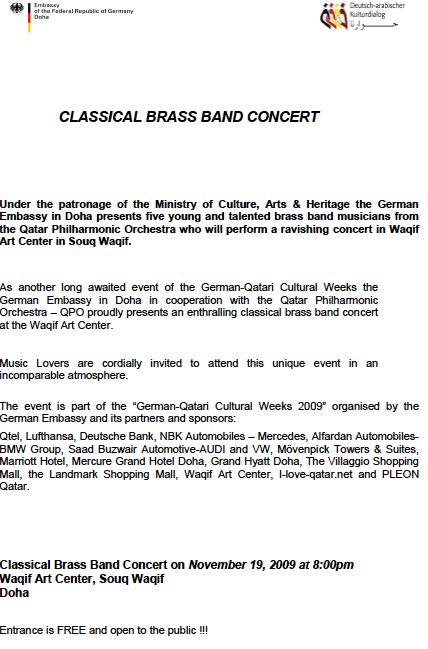
Brass Band Concert Tomorrow, Suq Al Waqif
Thanks, Grammy! If you have ever had an interest in exploring the Souqs, now is the time. The weather is perfect, nights are breezy and warm but not hot, there are a zillion good restaurants to choose from, AND tomorrow night is a very cool concert:
Only Ten Generations
We were talking about marriage prospects, and I mentioned one young man.
She hesitated, then told me “we don’t marry with this family.”
“Why not?” I asked her. “He’s handsome, and kind, and I am told that they are the richest family in Qatar.”
“They are Iranian,” she said shortly.
“Iranian?” I asked. “They are Qatteri! They have been here more than ten generations!”
She grinned at me.
“It’s not enough,” she said. “They are still Iranian.”
Breakfast in the Souks
“I need a hundred camel spoons,” my friend said, and since we all sort of think on the same track, no one looked at me like I was crazy when I said “let’s all meet for breakfast, shop when the souks open and leave.”
In fact, they didn’t look at me like I was crazy for two reasons. One was that we really sort of think alike, and meeting for breakfast is just the kind of thing we don’t do often, but it is a good time to grab some time together in lives that get very busy later in the day.
The second reason is that we are all introverts, and three of us were doing most of this arranging by e-mail. We’re not really phone chatters, although every now and then we will dial, but it tends to be the exception rather than the rule.
The weather is perfect. You would be amazed how lovely and peaceful the souks are early in the morning. There are customers in the restaurants, but it is a very laid back time of the day.
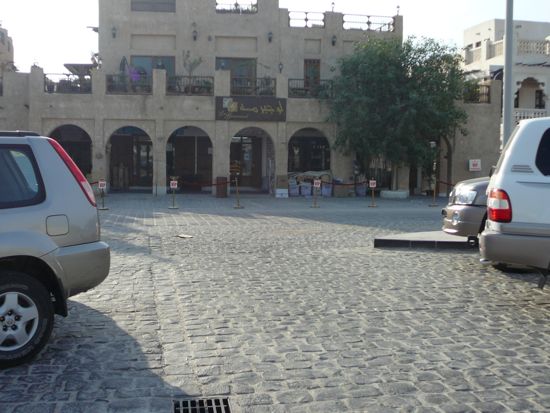
For a significant sum – I can’t remember how much, but I think I remember like 80 QR – you can park in VIP parking. Me, I was there an hour, and paid QR4 (just a little over a dollar) I just wanted you to see the difference from plain old everyday common folk parking and the VIP parking (above.) (Those signs in front of the stores straight ahead say VIP Parking, and at night they are roped off with red velvet ropes)
We find a shady table and order breakfast, across the street guys are into their early morning hubbly bubbly, there are people sweeping up to be sure everything is Disney-tidy, and it really is. As we are sipping at our coffee, the mounted police come by. Their horses are gorgeous, with high bushy tails and beautiful dressings in Qatar’s blood red and white colors.

What I like even better is the police-riders. They are handsomely dressed, and they ride like cowboys – look at that posture, the way real horsemen ride, with that cowboy slump and the weight firm in the saddle. The horses aren’t big horses, but they have beautiful bones. I wonder where they stable these horses in the souqs?
On to find the Yemeni Honey Man, relocated from Karabaa / Electricity Street. The police help us find him, hidden back next to a metal kitchen crafter, and we see he has other old customers who have also found him. His new shop is shiny and clean, with great shelves for displaying his beautiful baskets from the Asir.

“Big troubles” he says, and I know he is right, many people are being evacuated from that area while the Saudis and Yemenis have problems near the border. One of his customers communicates to us with gestures that in our new baskets, we must pack our jewelry in the bottom, then our abayas, and then food, oud or honey on top, so people won’t know where we are hiding our jewelry.
My Kuwaiti friend told me that in his memory, before oil, people kept all their clothes in baskets like this, folded neatly. They didn’t have a lot of clothes, he told me, and then there were other baskets specially woven to hold food stuffs, and to keep the insects off the food. Those baskets are not the same as these sturdy baskets, the more local Kuwait and Qatteri baskets are woven from palm fronds, I believe, and you can still find them in the more traditional stores at the Souq al Waqef, behind where the Bedouin women sell foods on Thursday night and sometimes on Fridays.
Mom’s Fruit Cake in Qatar
Life has gotten busy, and somehow November is here and I haven’t made my fruitcakes. I need to fix that! For those of you who think fruitcakes are a joke – my Mom’s fruitcake has a secret ingredient – chocolate. Even people who don’t like fruitcake love this fruitcake.
I am in Qatar – I have brandy. I have rum. No, I don’t drink hard liquor, but oh, they do make my fruitcakes tastier. Today, I will soak the raisins in brandy overnight, so they will be ready to go tomorrow!
I am reprinting this recipe for those of you who would like to give fruitcake a try.
Mom’s Fruit Cake
This is the original recipe. I remember cutting the dates and prunes with scissors when I was little; now you can buy dates and prunes without pits and chop them in the food processor – a piece of cake!
1 cup boiling water
1 cup sugar
1/2 cup lard or butter
1 T. cinnamon
1 t. cloves
3 Tablespoons chocolate powder
1/4 cup jelly
1 cup seeded raisins
1 cup chopped walnuts
1/2 cup candied citron
1/2 cup cut prunes
1/2 cup cut dates
Put all in a pan on stove and bring to a boil. Boil for three minutes. Let cool. Add:
2 cups flour
1 teaspoon baking soda
Flavor with lemon
Bake at 350° in loaf pans for one hour. Makes 2 normal bread loaf sized cakes.
My variations: I put in about three times the fruit, the difference primarily in the candied citron – I prefer using whole candied cherries, because they are so pretty when the loafs are cut. This recipe doubles, or quadruples with no problems.
Pans: Mom used to line all the pans with brown paper and grease the paper. I grease the pans, then dust with more of the chocolate powder. Use a good quality chocolate, not cocoa. When the cakes come out of the oven, let them cool for ten minutes, loosen them with a knife, then they will shake out easily. Let continue to cool until they are totally cool, then wrap in plastic wrap, with several layers, then foil, then seal in a sealable plastic bag. Let them age a couple months in a corner of your refrigerator. I make mine around Halloween, and serve the first one at Thanksgiving.
I never make these the same any two years in a row.
You know how raisins get all dried out and taste yucky in fruitcakes? The night before you intend to make the fruitcakes, take all the raisins you intend to use (depending on how many fruitcakes you intend to make) and put them in a glass container. Pour brandy over them, to cover. Microwave just to the boiling point. Let stand in the microwave overnight.
The next day, you can drain that brandy and use it in a stew or something, and in the meanwhile, you now have plump, juicy raisins to use in your fruitcake, and just a hint of brandy flavor. Yummmm!
Big Change; No Smoking
Sometimes change happens, and it happens so slowly or so subtly that you don’t really realize it has happened until something draws it to your attention.
Kuwait blogger Touche, one of my old virtual-blogging-buddies commented on a driving post, wondering about the baby steps it takes to change a mentality. The subject was driving, and I know he was right, I am writing “endlessly” about how annoyed I get by the lack of civility in driving here.
What I am not writing about, I noticed, is how annoying it is to be breathing other people’s smoke while I am eating.
Because it is not happening.
Who knew?
When we lived in Qatar before, people would sit right under the NO SMOKING signs and light up.
I saw things change in Kuwait. From the time we got there to the time we left, there were fewer and fewer times someone would light up in a restaurant.
Things CHANGED.
Expectations changed. I am guessing the smokers felt pressure, not just from the community, but also from family members. I don’t know if there are fewer smokers; I am inclined to think not, because I can see them smoking in their own cars. Hey – as long as I do not have to breathe their smoke, it’s fine with me, it’s their choice.
But the significant thing is – I didn’t believe it could ever change. And it did change, and it changed faster than I would have thought possible.
So I have hope for the driving issue. I think it starts with seat belts. I think if Mothers and wives start buckling up, and buckling up their children, that will be a first step. I think if there is an emphasis on driving manners, things could change. It’s a mind-shift before a behavior shift, an awareness of safety and an awareness of our interconnectedness. One thing I have seen in the Gulf is that parents raise their children to have good manners; manners are an important consideration also when considering a mate. If you take the driving problem as a manners problem, and emphasize the need for good manners on the road, maybe there is a possibility of change . . .
There is another area where I think change can happen – throwing things out the car window. If it becomes a commonly held value that throwing trash / cigarette butts / food wrappers out the window is bad behavior, I think it will stop. Maybe hand out car trash bags to raise awareness?
Have you seen the change in smoking? What I am noticing is that my dinners are no longer ruined by someone nearby lighting up. I don’t smell smoke in the malls. I don’t smell smoke in the airports. Pretty amazing, don’t you think?
Open Window
For the last few nights, AdventureMan and I have been sleeping without the air conditioner – it has cooled enough that we can do that.
This morning, for the first time, I have the window open in the upstairs lounge where I do my computer things first thing every morning.
When we lived in Kuwait, I missed the open windows. We lived on the tenth floor, and there were no screens. I couldn’t trust the Qatteri Cat not to jump out the window. He is smart in a lot of ways, but not so smart when it comes to windows and being ten stories up.
It is migration time, and our gardens are full of birds. I remember seeing flocks of parakeets, wild bright green parakeets one time, it totally thrilled my heart. Just being able to sit here with the windows open – it doesn’t take much to make me happy. 🙂

Real Age and Boost Your Immunities
A while back, there was a blogger, Fonzy, who was more here there and everywhere than . . . Here There and Everywhere. He found some of the most amazing resources, and Real Age was one of them.
I took the Real Age test, and got a shock; there were things I really needed to do to keep my health and fitness at peak. I hadn’t been doing them, thought I could slide. Real Age won’t let me.
Every week I get bulletins from them on new findings in health issues. They are always packed with valuable information. Here is one of the most recent ones:
Boost Your Natural Immunity
June 30, 2009 3:14 PM by Mehmet Oz, MD and Michael Roizen, MD
New flu strains. Antibiotic-resistant tuberculosis. Germs in and on the foods we buy in supermarkets and in restaurants. Flesh-eating bacteria. Feels like you’re in the midst of a scary twenty-first century germ invasion. And while you try your best to keep from meeting the nastiest bugs, there’s only so much you can do without living in a bubble. That means boosting your immune system matters more than ever.
And steps you take to boost your immunity may also protect you from the chronic diseases associated with aging. See, immune busters — everything from aging and stress to lack of sleep, too little exercise, and not-so-smart eating — can pull the plug on how well your white blood cells, natural killer cells, and chemical messengers can attack and destroy foreign invaders. Didn’t know you had an army of defenders, did you? Well, you do. And the very same actions that lessen their ability to fight off bugs also cause trouble by encouraging chronic inflammation — a hot-button health risk now linked with asthma, heart disease, diabetes, and even some types of cancer.
Keeping your own personal security force strong and disciplined is easy:
Feast on fin food. EPA (eicosapentaenoic acid), the essential omega-3 fatty acid found in fatty fish (and fish oil, of course), limits several cellular processes (involving dendritic cells and interleukin 12; aren’t you glad you asked?) associated with inflammation, so they can’t do their dirty work. Serve yourself salmon or trout at least twice a week, or get 2,000 milligrams of EPA plus DHA, another omega-3, from supplements daily. Don’t like the fishy taste or the size of the pill? Just get the DHA from pills made from algae — that’s where the fish get it.
See red or go nuts. Red wine, red grapes, and peanuts are great sources of resveratrol, a compound that protects against immune system aging and inflammation.
Learn the art of ahhhh. Your nervous system and your immune system are linked more closely than fraud and Bernard Madoff. Extreme stress reduces your natural killer cell count — one reason widows and widowers are more likely to get sick after the death of a spouse. Even periods of short stress (say, road rage) can boost levels of proinflammatory chemicals called cytokines. Set aside 10 minutes a day for relaxation, whether it’s meditation, intimacy, a walk, or the pure bliss of playing with your kids or grandkids. And learn some coping skills that help you talk your stress level down while you’re still in traffic or whatever situation gets on your nerves.
Tuck yourself in. Sleep deprivation torpedoes immunity and increases levels of proteins associated with inflammation. Stop shortchanging yourself and jump into the sack a half hour earlier tonight . . . and every night this week. Add another half hour next week, and keep going until you’re getting 7 1/2 to 8 hours of shuteye per night. Every night!
Take a walk today. Regular physical activity can help keep immunity where it should be. You don’t have to be a gym rat: When a group of overweight couch potatoes started exercising five times a week, they gained a definite cold-fighting edge over nonexercisers.
Pop some vitamin D. This vitamin can’t do its immunity-boosting job if you don’t get enough of it . . . which includes at least 30% to 40% of us. Since it’s difficult to get what you need from food alone, get 1,000 international units a day from a supplement if you’re younger than 60, 1,200 if you’re 60 or older.
Munch apples, broccoli, and red onions. All are bursting with quercetin, a flavonoid that shores up immunity, even when you’re fatigued. The fiber and antioxidants in these natural goodies also help reduce or mute inflammation instigators.
Think zinc. Go to the end of the alphabet for a mineral that supports immunity (it may also thwart cancer cells). You can get the zinc you need — 12 milligrams a day — from crab, oysters, pork, poultry, beans, cashews, and yogurt. Or find a good multivitamin with less than 15 milligrams. Too much of the stuff could stop other important minerals from doing their jobs.
Don’t forget classic “C.” This vitamin helps you produce more bullets to kill invading germs. Bell peppers are chock-full of vitamin C; other good C options include strawberries, cantaloupe, and broccoli. Or take 400 milligrams of vitamin C as a supplement three times a day.
Recent Comments
ExpatAlien on What Country am I Living … intlxpatr on Yellowstone: Old Faithful to C… Michelle on Yellowstone: Old Faithful to C… Cathy on No Grown-Ups in Charge intlxpatr on Waiting for Snow Wikipedia Donate Button

Amazina


Early Voting in Florida


 Here There and Everywhere