Nujood, Age 10 and Divorced, Supporting Family with Book Proceeds
This tiny little 10 year old girl, who knew she didn’t want to be married, and stuck to her guns, has had a life-long effect, changing the laws in Yemen so that a woman must now be 18 to marry. On the other hand, if the legal age before was age 15, how on earth was she allowed to marry at age 10?
Divorced Before Puberty: Former Child Bride
New Book
by Amy Hatch (Subscribe to Amy Hatch’s posts) Mar 5th 2010 10:30AM
From AOL News: Parenting

Divorced at age 10. Credit: Amazon
Nujood Ali walked into a Yemeni courtroom and asked to see a judge, because she wanted a divorce. This may seem like a common tale of marital dissolution, but Nujood Ali was just 10 years old when she defied the cultural traditions and walked out on the husband who was more than 20 years her senior.
Nujood, now 12, chronicles her journey from child bride to celebrated hero in her new autobiography, “I Am Nujood, Age 10 and Divorced.” Ghostwritten by French newspaper reporter Delphine Minoui, the book details how the young girl shocked citizens of her native Yemen after she walked out on her arranged marriage to a motorcycle delivery man. Nujood’s father married her off to the man for a dowry of $250, and for two months she begged her husband every day to return her to her family.
He refused, and so Nujood decided to take action. One afternoon, when her mother sent her on an errand, Nujood took a bus into the crowded capital city of Sanaa. She then hailed a taxi to the courthouse. Not knowing what else to do, she sat on a bench outside a courtroom all day, until a judge noticed her lingering in the empty hallway. He asked what she needed, and the girl said simply, “I came for a divorce.”
Now, two years later, the girl tells Nicholas D. Kristof of The New York Times that she is back in her home land and is supporting her family with the royalties from her book, which spent five weeks at the top of the bestseller list in France. Her brothers, who once criticized her for shaming their family, seem to have no problem with their sister now that Nujood is the family breadwinner, Kristof writes.
“They’re very nice to her now,” Khadija al-Salami, a filmmaker who mentors Nujood, tells the Times. “They treat her like a queen.”
Nujood’s story isn’t just one in which a single child takes a stand and changes her life. The preteen’s courage set off a domino effect in Yemen, where very young girls are routinely sold into marriage. Following Nujood’s successful divorce petition, two girls, ages 9 and 12, also filed to legally end their marriages. Her ordeal also prompted Yemen’s lawmakers to increase the age of consent for marriage from 15 to 18.
Nujood has been honored and feted by journalists in many countries, and, on a visit to Paris last year, even met with France’s Human Rights Minister, Rama Yada, and Urban Affairs Minister Fadela Amara, with whom she discussed the problem of child marriage.
What are Nujood’s feelings on marriage now? She tells Time magazine she “no longer thinks about marriage.”
Daiso No longer Allowed to Sell Toys in US due to Violations
From U.S. Consumer Product Safety Commission on AOL News: Wallet Pop
Daiso To Pay $2 Million Civil Penalty for Violations of Federal Safety Laws and Must Stop Importing Children’s Products and Toys Into U.S.
(Tue, 02 Mar 2010 22:40:00 GMT)
The U.S. Consumer Product Safety Commission (CPSC) announced today that Daiso Holding USA Inc., Daiso Seattle LLC, of Seattle, Wash. and Daiso California LLC, of Hayward, Calif. have agreed to pay a $2.05 million civil penalty and stop importing children’s products and toys into the United States. Due to alleged violations of federal safety laws, the company must now demonstrate to the Commission that it has sufficient knowledge of and is in compliance with CPSC safety standards and testing requirements.
I didn’t even know we had Daiso’s in the US, stores where you can find amazing things at very cheap prices. I know them from Qatar, where there is a Daiso at Hyatt Plaza, and I also think there is one in Kuwait.
5 Minute Chocolate-Cake-in-a-Mug
LOL, sent by a good friend who knows how I love chocolate. 🙂
5 MINUTE CHOCOLATE MUG CAKE
4 tablespoons flour
4 tablespoons sugar
2 tablespoons cocoa
1 egg
3 tablespoons milk
3 tablespoons oil
3 tablespoons chocolate chips (optional)
A small splash of vanilla extract
1 large coffee mug (MicroSafe)
Add dry ingredients to mug, and mix well. Add the egg and mix thoroughly.
Pour in the milk and oil and mix well..
Add the chocolate chips (if using) and vanilla extract, and mix again.
Put your mug in the microwave and cook for 3 minutes at 1000 watts.
The cake will rise over the top of the mug, but don’t be alarmed!
Allow to cool a little, and tip out onto a plate if desired.
EAT ! (this can serve 2 if you want to feel slightly more virtuous).
And why is this the most dangerous cake recipe in the world?
Because now we are all only 5 minutes away from chocolate cake at any time of the day or night!
Traditional Qatari Architecture Saves on A/C
If, like me, you have any interest in traditional Gulf architecture, and in understanding what works in Gulf countries – and what doesn’t – I urge you to visit a wonderful resource, John Lockerbie’s blog on a variety of things including Islamic design. Clicking on the blue type will take you to a menu with so many items you can get lost for hours. I discovered it one day when I needed information to help me identify the traditional boats, which I love. John’s blog has been a constant resource for me when I have questions about the things I see. . .
Traditional Qatari buildings save on air-conditioning
Web posted at: 3/2/2010 6:26:27
Source ::: The Peninsula
Doha: Buildings and places need to be designed and developed in a sustainable way to allow communities to be less reliant on air conditioning and cars. Sustainable design can lead to cost and energy efficiencies, enhanced lifestyles and a reduced impact on climate change.
This is the view of Tim Makower, partner at Doha-based architects Allies and Morrison, who will be presenting his thoughts and ideas at the Sustainability and the Built Environment Seminar tomorrow, which has been organised by the UK Trade & Invest section of the British Embassy in Doha.
“Air conditioning is not the only way to cool a building, especially in the more temperate months of the year. The Gulf faces extremely hot weather for three, arguably five, months of the year and during this time air conditioning is essential, but for the rest of the year, the weather is very pleasant and architects, engineers and developers should explore alternative ways to cool buildings during these months,” said Makower.
Allies and Morrison opened an office in Doha in summer 2009 and over the last three years has helped to develop the ‘Architectural Guidelines’ for the Dohaland’s 35 hectare development Musheireb, (formerly Heart of Doha).
It is also designing the Diwan Annexe and the National Archive buildings within the first development phase of Musheireb. Both buildings will be two of the first LEED Platinum buildings in Qatar.
Makower said far more air conditioning is used than necessary. He believes that by reducing the reliance on air conditioning there would be some clear benefits, including cost savings and being more eco-friendly due to lower energy consumption.
“We need to design places and buildings that allow people to respond to the climate and live in more harmony with the seasons. For instance, people should be provided with the choice to switch off their air conditioning and open a window during the winter months; for many people that is the most comfortable way to live,” Makower said.
“What could be better than being given greater choice, greater comfort and cost savings all in one go? We are designing homes and work places now which can be dramatically opened up on to external courtyards and balconies in good weather.”
Makower said this flexibility should also extend to the use of the car. He passionately believes that places should be designed to be pedestrian-friendly and that streets should be naturally cooled so that people can choose to walk to schools, shops, the mosque or to work during the cooler months, instead of having to use their cars and face traffic congestion.
“I don’t question the right to use air conditioning or a car, but I believe that we should design places and buildings that give people the choice to switch off their air-conditioning and leave their car in the garage,” he said. During his presentation, Makower will explain how using inventive solutions, which are often founded in traditional Qatari methods and building techniques, can naturally cool buildings.
For instance, buildings can be cooled by incorporating wind-catchers or using thick walls. They can also be positioned to capture the prevailing winds and sea breezes and be related to the sun’s path to create optimum shade.
This can be supported by architectural features such as projecting cornices, canopies, colonnades and screens, all of them traditional Qatari motifs. Re-introducing the traditional form of the narrow lane, or Sikkat, is another way to create shaded spaces with modern buildings.
“Over and above energy related issues, sustainability is about minimising waste and creating lasting places. Buildings and neighbourhoods should be built to last, while still allowing for the natural process of gradual change and regeneration rather than wholesale demolition. It is Dohaland’s intention to retain and maintain the Musheireb in the long term, and to ensure that it is built to last.”
The Sustainability and the Built Environment Seminar will be held at 8.30am on March 3 at the Diplomatic Club in Doha.
Qatar Initiates Solar Energy Plan
Woooo HOOOO, Qatar, for not depending on a non-renewable energy source, but continuing to develop strategies for survival into the future. And Qatar definitely has an abundance of solar power. But then again – so does Kuwait.
Qatar to tap solar power in a big way
Web posted at: 3/2/2010 6:29:33
Source ::: THE PENINSULA/ BY SATISH KANADY
DOHA: Qatar is all set to tap its abundance of solar power. Two leading international agencies yesterday announced their decision to partner with two Qatari entities to produce the green energy in the country.
SolarWorld AG, one of the world’s largest solar companies, will partner with Qatar Solar Technology (QST), in which Qatar Foundation (QF) has a major stake. Separately, the Institute of Technical Thermodynamics, German Aerospace Centre (DLR), will partner with the country’s ambitious Qatar National Food Security Programme (QNFSP).
Qatar Solar Technology marks the entry of QF into the solar energy sector. QF will have a 70 percent stake in QST, with SolarWorld holding 29 percent and Qatar Development Bank the remaining one percent.
The initial investment in QST is valued at over $500m, QF said.
Through the joint venture, solar grade polysilicon, the essential ingredient of solar panels, would be produced in the first phase.
QST will develop a new plant in Ras Laffan Industrial City, in the northeast of Qatar, which will be one of the first operational polysilicon plants in the region. The plant will produce well over 3,500 tonnes per annum of the material and will be designed with future expansion in mind, which will enable it to significantly increase production capacity.
You can read the rest of the article, including contributions by Texas A&M, by clicking HERE
Oh! Didn’t It Rain!
I love it that this YouTube version of Mahalia Jackson’s rendition of “Oh Didn’t It Rain!” starts out with photos in Wadi Rum in Jordan, a couple peeks at Petra, and as the camera backs off, the effects of wind and rain on the topography of the Wadi Rum area. We camped there for three nights, lo, these many years ago, going on camelback into the deeper parts of the canyon. It was unforgettable.
My trip back into Doha last night was unforgettable.
In what is usually the most mundane of flights, we found ourselves bumping up and down with lightning striking all around us, from about the halfway point all the way into Doha. I’ve never had a lot of faith in the aerodynamics that keeps airplanes up in the air, and seeing flashes of lightning all around me was a genuinely religious experience, LOL.

(From article on lightning strikes plane in Japan: According to a Scientific American article about lightning strikes and aircraft, its is “estimated that on average, each airplane in the U.S. commercial fleet is struck lightly by lightning more than once each year”. However, the article notes that the last crash directly attributed to a lightning strike occurred back in 1967 when the fuel tank exploded.)
At the airport, all the baggage handlers actually had on rain-gear, and on the way home, there were deep pools where drains have clogged. And, as AdventureMan said, when you live at sea level, just where is the water going to drain?
I am so thankful to be home. Home for the next scant three weeks, anyway, as I pack up all those boxes once again for what we think will be (one of) our last moves. Sorting, giving away, “can I live without this if I leave it behind?” “Will I regret it forever if I leave this behind?” “Is there someone who could give this a good home?”
I have two great avenues of disposal; my own church, where incoming church personnel can make use of household goods and not have to buy everything new, and my housekeeper’s church, where they cherish anything they get.
AIDs Rate in Some American Cities Higher Than African Rates
Part of the problem, from what I understand, is that people KNOW the risks, and choose to take them anyway. Part of the problem is the percentage of the population that spends time in prison . . .
Epidemic in Some US Cities Worse Than Global Hot Spots
From : AOL Health News
Katie Drummond
Contributor
(March 1) — Despite advances in prevention and treatment, rates of HIV/AIDS in some parts of the U.S. are higher than those in sub-Saharan Africa, say the authors of a recent study in The New England Journal of Medicine.
AIDS advocacy efforts in the U.S. have waned in recent years, after medical innovations helped sufferers live longer, minimized obvious symptoms and alleviated the widespread social panic that characterized the early spread of the disease.
Globally, though, the spread of AIDS has yet to be curtailed: 33 million people are afflicted, including two-thirds of those living in sub-Saharan Africa.
But what might come as a real surprise is news that rates across some parts of the U.S. have yet to decrease. In fact, they’re right up there with the prevalence of HIV/AIDS in global hot spots, where the health scourge continues largely unabated.
Rates of HIV among adults in Washington, D.C., for example, now exceed 1 in 30 — higher than reported rates in Ethiopia, Nigeria or Rwanda. In New York, rates are higher among blacks (1 in 40) and injection-drug users (1 in 8).
In urban areas across the country, 30 percent of men engaging in “sex with other men” are contracting HIV — compared with overall population rates of 7.8 percent in Kenya and 16.9 percent in South Africa.
Groups at a high risk of HIV infection have remained largely unchanged since the 1980s. So what happened to ongoing efforts at prevention and education, which were largely concentrated on those same demographics?
According to the essay’s authors, it’s a question of insular sexual networks rather than individual behaviors.
“Understanding the context and settings in which risk is increased may lead to more robust and effective preventive interventions,” the authors note. The idea hits on some touchy subjects, like the vulnerable demographics of black and Hispanic women, who are more likely to have multiple partners within one community because of the rates of incarceration among men in their social circles.
Those at high risk are also less likely to have access to health care, which means fewer opportunities to learn about or benefit from preventive interventions like HIV tests, anti-retroviral therapy or even condoms.
And AIDS remains an epidemic in the U.S. Low prevalence in most areas is outweighed by the startlingly high occurrence in others.
Potential solutions are nuanced and require out-of-the-box thinking, the essay notes. For example, the authors urge public health officials to shed ideological biases, like an unwillingness to consider needle exchange programs or safe sex in bathhouses. There’s also a need for better understanding of how one’s social circumstances affect HIV education, prevention and rates of infection.
That means everything from addressing the massive incarceration rates among black and Hispanic men to helping women who feel forced into commercial sex because of poverty or drug addiction.
Then there’s the question of how to help groups who have yet to respond to previous efforts. “Research is also needed to identify interventions that will persuade men who have sex with men to undergo HIV testing, facilitate their disclosure of their HIV status to sexual partners and promote negotiations for safer sexual practices,” the essay notes.
Of paramount importance, though, is to acknowledge that AIDS has not gone away. “The time has come,” the authors write, “to confront this largely forgotten and hidden epidemic.”
At the very least, health officials will have more money to take their prevention efforts out of the past and move them into the 21st century. Citing plans to develop “a national HIV/AIDS strategy,” the White House recently announced the first boost in HIV/AIDS investment in nearly a decade.
Waterfront Mission Pensacola
LOL, this is what a mother-son outing looks like in our family. Our son volunteered to take me shopping at the Waterfront Mission, a store like Goodwill or the Salvation Army or St. Vincent de Paul, second hand stores run by churches. I love these stores (and I donate to these stores!) because I can find treasures here to make new and usable once again, and when I spend my money here, I know it will go to help the homeless, help feed the poor, help heat a house for a person without the money for electricity, etc. These are worthy organizations, providing a great service to the community.
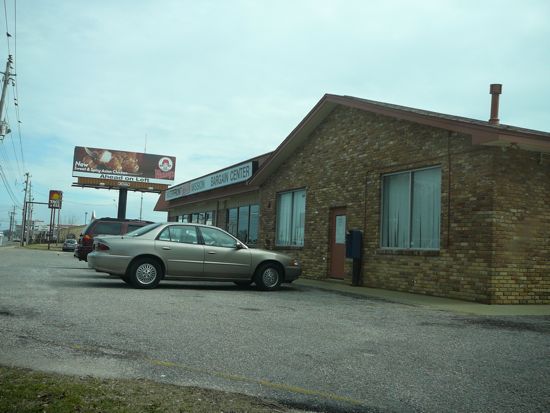
People get rid of perfectly good, usable furniture, because they want something fresh and new. This is good news for people like me – I took a class in furniture upholstery and discovered that it is something I love doing. Tearing off the old fabric and stuffing is GREAT therapy when you are annoyed or anxious about something, and good prayer time, too. Putting it all back together is just good fun. Many times there are pieces of wood that need to be stripped and/or refinished; at least in the pieces I like to renovate.
Wait! I’ll show you some of the potential treasures I found! I didn’t buy anything; haven’t got the house yet, but this field trip gave me inspiration for the future:


See what I mean? These pieces have potential!
For AdventureMan:
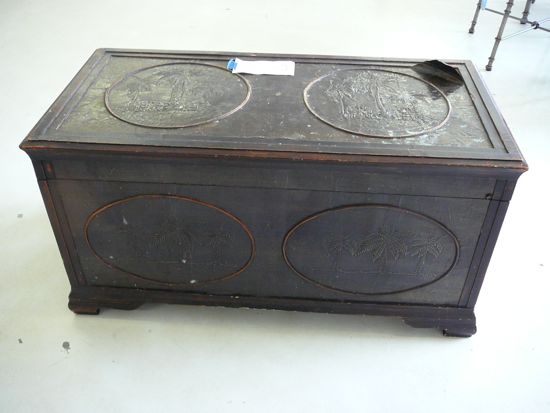
Here is a detail – how cool is that?

If you want your own massage table:

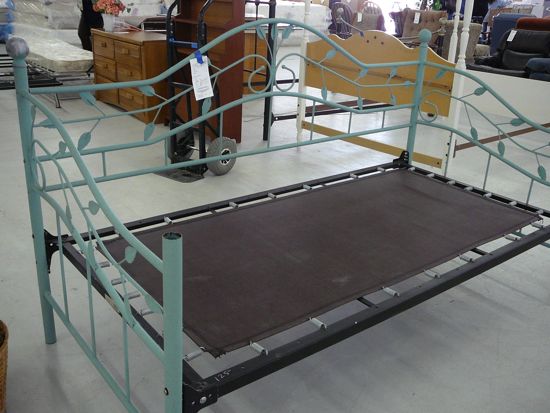
Someone spray painted this daybed a verdigris sort of green. It could be rescued, but it would be a lot of trouble . . .
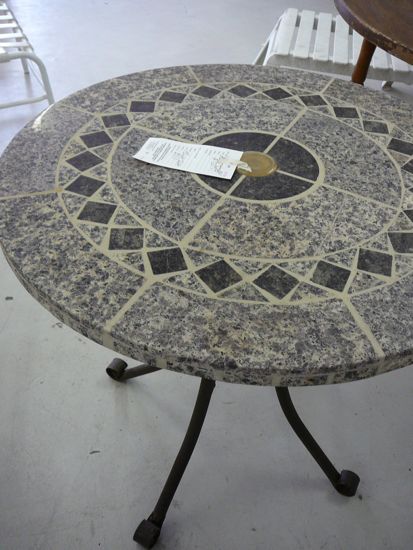
For your outdoor patio, there are two marble topped tables:
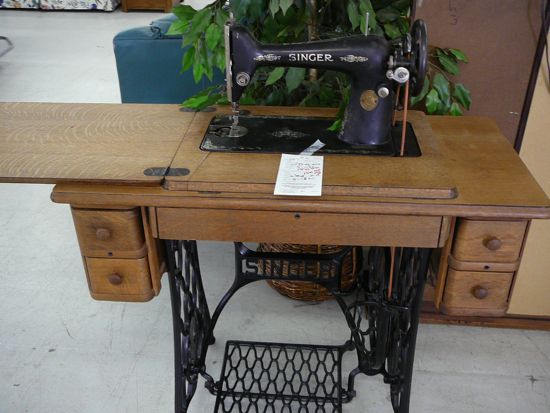
And for my collector friends, a real treasure – a SINGER treadle!
There were exquisite wedding dresses for sale – makes you wonder what happened to the marriage, that a bride would part with her wedding dress. Most of these are custom made; they are available at prices that would make them worth buying just to re-use the fabrics in a quilt or cushion or Christmas stocking:

There are things I would never buy used – like a mattress. But many pieces of furniture from older times are 100% solid wood, and better made than some of the furniture you find in stores, even expensive stores, worth the effort to rescue and rehabilitate. And, for people like me, the rehabilitation is part of the fun. 🙂 Thanks be to God for a husband and son and daughter (in-law) who support my peculiar habits!
Americans Sing for the Liberation of Kuwait
My sweet Kuwait friend sent me this today. It made me cry.
We all have memories of the invasion. I remember it well. We had just moved to Tampa, AdventureMan was working with CENTCOM. He had just brought his very old grandmother to visit with us, and the next day, Iraq invaded, and his grandmother and I didn’t see him again!
We have had a long history with Kuwait, longer than our time living there. Kuwait matters to us. This song makes me cry; the effects of this invasion linger on, resonating and affecting so many lives:
Recent Comments
intlxpatr on Yellowstone: Old Faithful to C… Michelle on Yellowstone: Old Faithful to C… Cathy on No Grown-Ups in Charge intlxpatr on Waiting for Snow intlxpatr on Waiting for Snow Wikipedia Donate Button

Amazina


Early Voting in Florida


 Here There and Everywhere