AdventureMan Loves Magnolia
I was oblivious. I didn’t even know what a magnolia tree looked like. But AdventureMan grew up in the South, and he has been pointing them out ever since we got here. We watched them as they formed their buds. And now – magnolias are blooming all over Pensacola!


Grafitti Bridge
Grafitti Bridge turned purple last week. The Run for Life (Cancer Survivors) had painted it purple and then had to put guards on it because the Oil Spill protesters wanted to paint it black.

You know how there are the rules, and then there are the way rules are enforced – or not? Grafitti is discouraged in Pensacola, but Grafitti bridge – a train bridge – is kind of exempt. The informal rule is that as long as the police don’t actually SEE you painting on the bridge, they won’t bother tracking you down. So the adventure is to do it in the middle of the night, with someone keeping watch so you don’t get caught in the act.
Pocket Park with a View
As we were winding our way home from lunch, we came across a tiny parking area – two cars worth – and a pocket park with a view to die for.
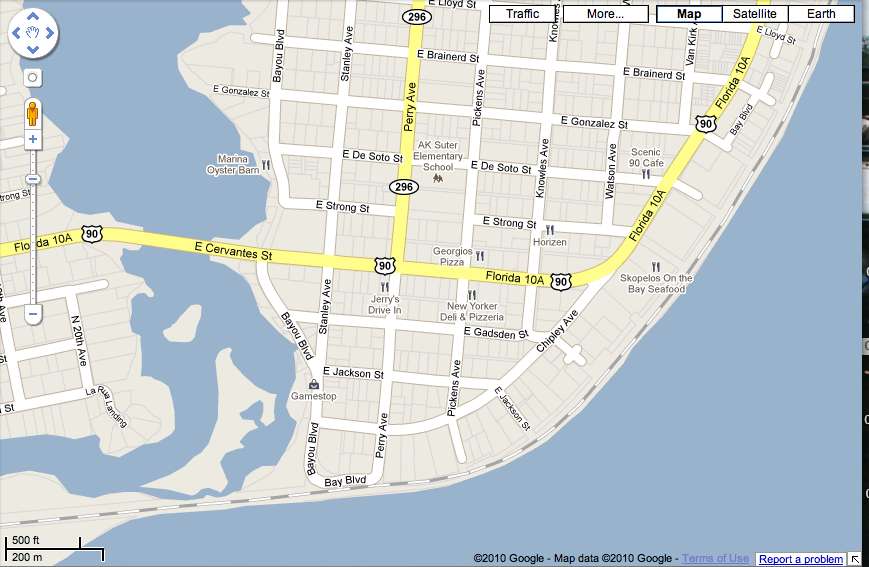
The park is about where it says Chipley Avenue, and has a view of the Garcon Point bridge; a perfect place to watch the sun rise, if you are a sunrise person, which . . .I am!


The park was donated by a gift from a woman who is memorialized in a tiny plaque in the park:
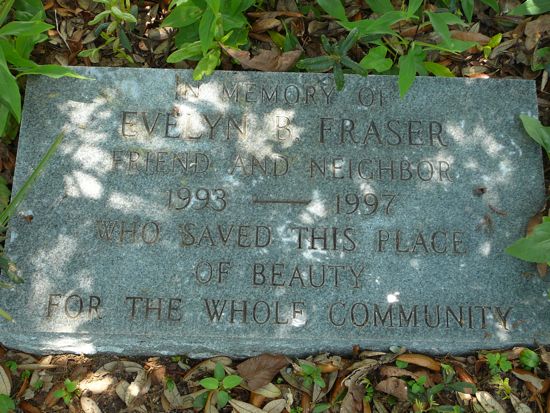
Isn’t that a beautiful legacy to leave behind when you depart this world?
The Mediterranean Plus In Pensacola
Woooo HOOOOOO on YOU, AdventureMan, you were RIGHT! (He always looks for his name, so might as well put it right up front for him 😉 )
We had visited an international grocery store to look for some particular spices, and AdventureMan spotted the Mediterranean Plus just around the corner. We thought they might be related . . . both have felafel and other “Mediterranean” specialties we have come to associate with the Middle East – hummus, tabouli, baba ghannoush, fattoush . . .
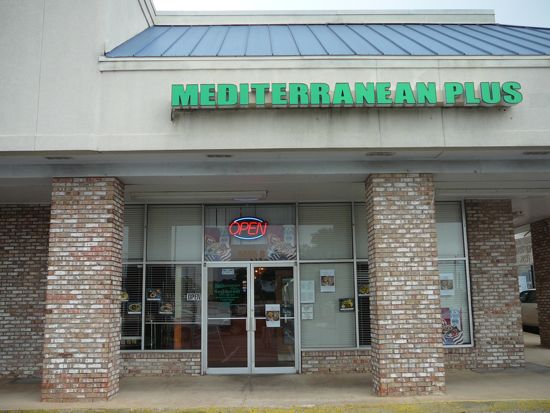
As we walked in, we knew we had come to the right place:

The menu was to die for – almost all the things we love. The owner is Jordanian, and, while there is no fattah for my early breakfast 🙂 he has a lot of other wonderful dishes to satisfy our ‘Mediterranean’ cravings. Once again, I apologize. Sometimes when the food shows up, I forget about photos until it is too late. I wish you could have seen this plate when it was prepared, it was beautiful. Even better, the baba ghannoush is lush and smokey, as good as any I have ever had in Kuwait and Qatar. The tabouli was just exactly right, the right blend of parsley and bulgar, exactly the right amount of lemon. Mumtaz.

I have been on a mission. I have a good friend who is down to the last of some Kuwait biriyani spices I had brought back as a guest gift a while back, and I was hoping to find more. I found biriyani spice AND I found Lebanese olive oil. I laughed when I saw Vimto:

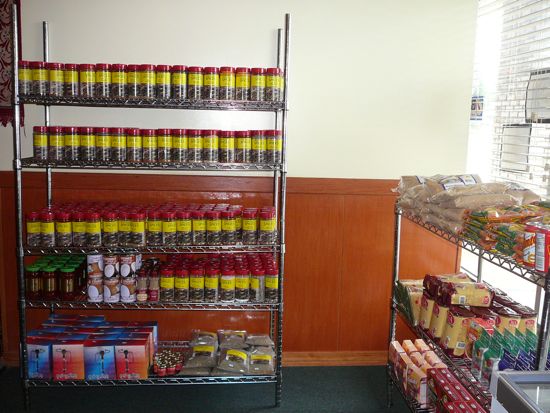




As AdventureMan talked with the owner, he discovered we actually had been in the restaurant before, in its previous location on Cervantes. This location has a lot more space for diners and for parking. We are thrilled to find it – the food is GOOD!
Mediterranean Plus
6895 N 9th Ave
Pensacola
850 469 9225
My Newest Friends
Welcome! Welcome!
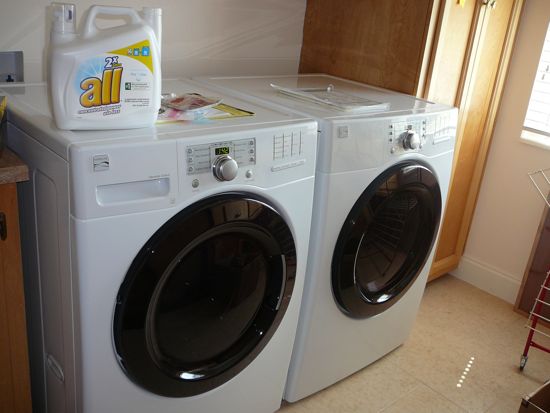
We ordered the washer and dryer almost a month ago, but because of a huge energy star promotion, there was a backlog, and it took forever to get them.
In the meantime, our household goods from storage – 12 years of storage – arrived, and almost everything we are keeping needs to be cleaned.
We had two old featherbeds from the former East Germany that had a little mildew on them. I almost threw them away, but I thought since I am going to throw them away, I might as well see if they could be saved. I put them in (one at a time; they are each too big to be put in together) on a cycle called “sanitize” and then dried them on high and . . . they came out perfect! Wooo HOOOO!
As you can see, even though I have done many loads, I still have a ways to go:

No, not the brass pot; it is not going in the washer. It needs to have a handle put back on, so it is waiting there with other low-priority projects for me to get around to it. 🙂 Isn’t this a great laundry room?
Stamping Our Hunger
We are still getting used to a lot of things about living once again in our own country, but one thing we know we love is the open hearted spirit of giving in the USA. Every week people are raising funds to help those in need, or to raise awareness of a health issue, etc.
This week, on Saturday, the mail carriers sponsored a food drive for the local food pantry. Early in the week, they delivered flyers and a sack to each house on their route, asking us for donations of food to be placed on the doorsteps on Saturday. They even mentioned foods and items most needed, so it was easy.

What I cannot imagine is how they got all the donations into one mail truck. I can imagine it was enormously successful. When I worked in fund raising, the first thing I learned is that people will give generously if you make it easy for them – that’s why when you get a request for donations, you get a form, a self-addressed envelope, and sometimes it even has a stamp on it.
So how much easier does it get than having a bag provided and just filling it? Putting it outside your own door, knowing it will be collected? God bless the men and women who had to trundle all those sacks out to the trucks, and then from the trucks to the food pantry! God bless the work of their hands!
By the way, when you are asked to give, here are some things that people who use food pantries often need:
rice
peanut butter
tuna fish
canned or powdered milk
disposable diapers
canned meats
And something most people don’t think of: dog food, cat food for the family pet
Rogation Days
AdventureMan and I love sleeping in a little on Tuesdays. This whole retirement thing is like being on vacation every day. No one says we HAVE to go to AquaAerobics, but it is such a great class, we want to go. This morning, however, it dawned grey and cloudy, not quite so cool . . . warmer, and more humid. I have my cup of coffee in my quilt room study, and AdventureMan is next door, in his office/study. It’s one reason we bought this house; we can have our own spaces and still be close enough to call back and forth.
As I am reading my morning devotions, I notice this is a “rogation” day. I have seen the term every now and then on the church calendar, but I haven’t a clue what it is, and today (!) I have the leisure to look it up. It is absolutely fascinating. This is from a website on church liturgies, traditions and prayers :
Rogation Days are an old religious custom which is now seldom observed in the Catholic Church, and many Catholics haven’t even heard of them. Episcopal parishes sometimes still observe them, and many people have them on a personal liturgical calendar.
Ok – so what are they?
The word “rogation” come from the Latin rogare, which means “to ask,” and the Rogation Days are four days set apart to bless the fields, and ask for God’s mercy on all of creation. April 25 (coincidentally the Feast of St. Mark) is called the Major Rogation; the three days preceding Ascension Thursday are called the Minor Rogations. On these days, the congregation used to march the boundaries of the parish, blessing every tree and stone, while chanting or reciting a Litany of Mercy, usually a Litany of the Saints. A few still do.
The Rogation Days were first instituted in the 5th Century by Mamertus, bishop of Vienne in France from 461 to 475. During his episcopate, France was in an almost continuous state of near-disaster. The Goths invaded Gaul. There was an enormous amount of disease; there were fires; there were earthquakes; there were attacks of wild animals. As a result, Mamertus spent a great deal of time in prayer, beseeching God to help the stricken community.
One night, when the village was overwhelmed with a fire, he conceived the idea of instituting a annual procession and litany in which the entire community would pray for God’s blessing and protection. He is reported to have said: “We shall pray to God that He will turn away the plagues from us, and preserve us from all ill, from hail and drought, fire and pestilence, and from the fury of our enemies; to give us favorable seasons, that our land may be fertile, good weather and good health, and that we may have peace and tranquility, and obtain pardon for our sins.”
Thus the custom of processing around the entire length of the parish while invoking a Litany of the Saints began. Over the centuries, it became the custom to also use the procession to “beat the bounds” – to mark and establish the boundaries of the parish – while also blessing the trees, stones and fields. In modern times, the actual purpose of “beating the bounds” – to impress the boundaries of the village on everyone’s mind – has ceased to be necessary due to modern surveying techniques, and the practice is largely ceremonial.
The standard practice in the Episcopal Church is to pray for fruitful seasons on Monday, commerce and industry on Tuesday, and stewardship of creation on Wednesday. When currently observed, the practice frequently has an environmental bent.
– Carl Fortunato
Don’t you love the idea of of “beating the bounds?” I think of the Emirs of Qatar and Kuwait, one day a year, followed by a procession of their countrymen and women, blessing every tree and stone and calling on God/Allah to protect their countries. I think how wonderful it would be in our own USA to have these four days a year (there is a major rogation in April to bless the crops, and then three days preceeding Ascension Day for “beating the bounds,” i.e. blessing the country. Imagine if we were all to pray blessings on our country at least three days a year. Uh Oh. Did I mention it is also a time of fasting?

Unexpected and Delightful – Dancing Outbreak
My Kuwait friend sent me this – it delighted my day! I hope you love it as much as I do – wouldn’t you love to be there when one of these events happen?
I told her I would love to see this in Kuwait! A group who dances, unexpectedly, here and there . . . even at a traffic light. Can you see the look on people’s faces? Some would get it, and share the joy. Some would think that men and women dancing together is the end of the moral world as we know it, LLLOOOLLL! A little outbreak of high spirits might be a good thing now and then . . . 😉
Precautions during Oil Spill Hazards
MEDIA ADVISORY: TUESDAY, MAY 4, 2010
CONTACT: PUBLIC INFORMATION (ESF 14): (850) 921-0217
Thanks, EnviroGirl, for the update. 🙂
FLORIDA DEEPWATER HORIZON RESPONSE MAY 4, 2010
TALLAHASSEE – The State Emergency Response Team, in support of the Department of Environmental Protection (DEP) as the lead response agency for the state of Florida, is actively monitoring the Deepwater Horizon response.
The following is a summary of state and BP response actions to date, as well as tips for residents and visitors to take precautions both pre and post-landfall.
Landfall Predictions:
Deepwater Horizon continues to discharge an estimated 5,000 barrels (210,000 gallons) per day.
BP has completed construction of a dome, expected to be in place as early as next weekend, which will be used in an attempt to contain the oil discharge. BP has also begun drilling a relief well to eliminate the discharge.
Currently, there are no impacts to the state projected in the next 72 hours; however, Florida continues to make preparations to safeguard the state’s shoreline.
The state of Florida reminds its residents and visitors that the state’s coastline has not been impacted at this time and remains open for public enjoyment.
State Actions:
Governor Charlie Crist confirmed that Florida will receive a $25-million block grant from BP for initial state and local preparation and response costs.
In the last 24 hours, the State Emergency Response Team sent several team members to Mobile to assist with Deepwater Horizon preparation and response.
The State Emergency Operations Center remains activated at a Level 2 or Partial activation.
On April 30, 2010, Governor Charlie Crist declared a state of emergency (Emergency Order 10-99) for Escambia, Santa Rosa, Okaloosa, Walton, Bay and Gulf Counties.
On May 3, 2010, Governor Charlie Crist extended a state of emergency declaration (Emergency Order 10-100) for the coastal counties of Franklin, Wakulla, Jefferson, Taylor, Dixie, Levy, Citrus, Hernando, Pasco, Pinellas, Hillsborough, Manatee and Sarasota.
Florida Governor Charlie Crist, Congressman Allen Boyd, Attorney General Bill McCollum and Chief Financial Officer Alex Sink were briefed at the Emergency Operations Center on the state’s Deepwater Horizon response efforts on Monday, May 3.
DEP has conducted water and sediment sampling to use as a baseline for ongoing monitoring.
DEP is continuously monitoring air quality data. The public can view this data at http://www.airnow.gov/ or http://www.epa.gov/bpspill/.
DEP, the Florida Fish and Wildlife Conservation Commission (FWC), county governments, water management districts and several federal agencies continue to conduct pre-impact assessments, including sampling of water, fish, shellfish and habitats along the Florida coastline and into the Gulf of Mexico.
Statewide monitoring is ongoing in coordination with the U.S. Environmental Protection Agency. Panhandle-specific data is expected to be completed early this week.
Emergency Support Function 15, Volunteers and Donations, successfully spearheaded pre-impact beach cleanups over the weekend of May 1-2. More than 1,200 volunteers participated in cleanups in Escambia, Santa Rosa and Wakulla counties to minimize the effect of the Deepwater Horizon incident. Volunteer Florida offers guidance for conducting safe pre-impact beach cleanups at http://www.volunteerflorida.org.
Florida residents are encouraged not to sign any documents provided to them in return for money from BP or anyone else until they know the extent of their loss, which may be significantly higher than the money being paid. These may be fraudulent or premature.
The Attorney General’s fraud hotline is open to receive any reports of fraud or price gouging. The hotline is 1-866-966-7226.
Boom Placement:
There is approximately 91,300 feet of boom placed along Florida’s panhandle in the Pensacola region.
An additional 35,000 feet is expected to be placed today.
Currently 50,700 feet of boom is staged in Pensacola. An additional 17,000 feet is staged at Panama City and 45,000 feet of boom is on order.
The Panama City staging area will be fully operational on Wednesday, May 5.
Placement of boom will be based on tides and where the oil is threatening and according to the Coast Guard Sector Mobile Area Contingency Plan. To view the plan visit Plan, visit http://ocean.floridamarine.org/ACP/MOBACP/StartHere.html.
The booming strategy focuses on identified environmentally sensitive areas.
Estuaries and inlets are at the top of the list, not the beach areas.
This is to protect sensitive habitat that support wildlife and fish.
If the oil washes on the beach, the sand can be cleaned.
Note that booms are not a failsafe solution.
They can become ineffective in high seas, strong winds, or currents over one knot.
Florida’s counties are working through the State Emergency Operations Center. Each county provides input, but the operational decisions are made through the Unified Command. The State Emergency Response Team is working with the counties, BP as well as the federal agencies to maximize protection and minimize impacts.
Health Effects:
At this time, there are no indications of any health risks to Floridians due to the Deepwater Horizon incident. The Department of Health (DOH) and DEP are closely monitoring health and environmental impacts to Florida’s beaches and will notice an advisory if conditions become unsafe.
Consider the following tips for avoiding negative health impacts from an oiled shoreline:
Avoid entering areas where oil can be seen or smelled.
Avoid direct skin contact with oil, oil-contaminated water and sediments.
Do not swim or ski in areas affected by the oil spill, and if traveling through the area by boat, take precautions when hoisting the boat anchor. If oil makes contact with skin, wash it off with soap and water.
Do not fish in oil spill-affected waters.
Do not harvest or eat dead fish, fish with oily residue or fish that have a petroleum odor.
Avoid boating through oil slicks or sheens.
Young children, pregnant women, people with compromised immune systems, and individuals with underlying respiratory conditions should avoid the area.
Prevent pets from entering oil-contaminated areas.
Impacts to Florida’s coastline could include tarballs – fragments or lumps of oil weathered to a semi-solid or solid consistency. Tarballs feel sticky, and are difficult to remove from contaminated surfaces. Impacts could also come in the form of an oil sheen or tar mat – a sheet of oil that is thicker than a sheen. Should individuals observe tarballs or other evidence of oil on Florida’s coastline, they should leave the area and report the incident to (866) 448-5816.
Those near Florida’s Gulf Coast may detect an odor because of the oil spill. Some people are more sensitive to these odors and may experience nasal irritation and feelings of nausea. In combination with seasonal allergies, such as sensitivity to pollen or pre-existing respiratory conditions such as asthma, some people may experience more severe symptoms.
Individuals experiencing symptoms that are aggravated by the odors from the oil spill should consider:
Staying indoors, in air conditioning, and avoiding strenuous outdoor activity.
If symptoms do not improve, contact a primary care physician or other health care provider for medical advice.
Individuals who have pre-existing medical conditions, such as asthma or other respiratory illness should contact their health care provider if feeling symptomatic.
Fisheries & Seafood:
On May 3, 2010 NOAA restricted fishing for a minimum of ten days in federal waters most affected by the BP oil spill, largely between Louisiana state waters at the mouth of the Mississippi River to waters off Florida’s Pensacola Bay. Details can be found here: http://sero.nmfs.noaa.gov/.
Fishermen who wish to contact BP about a claim should call (800) 440-0858.
There are no seafood alerts at this time.
FWC is working with DEP, county governments, water management districts and several federal agencies including NOAA and the U.S. Fish and Wildlife Service to conduct pre-impact wildlife assessments.
These assessments include samples of water, sediments, fish, shellfish and habitats along the Florida coastline and into the Gulf of Mexico. Assessments are needed to provide baseline information prior to the anticipated impact.
Examples of the assessments include the following:
FWC and the University of South Florida College of Marine Science are designing a multi-day scientific research study to obtain information on fisheries resources and plankton in the Gulf of Mexico near the Florida Panhandle.
Aerial surveys also are planned to identify locations of marine mammals.
Groups are marking the location of bird and sea turtle nesting sites along the beach. Nests are marked to help prioritize response with real-time information.
FWC urges citizens to report oiled wildlife to the Joint Information Center by calling 1-866-557-1401.
For the safety of the public as well as the safety of animals, rescues should be conducted by trained responders. Untrained rescuers may cause more harm than good.
Closures:
Currently there are no Florida State Park or beach closures. For more information about Florida State Parks, visit: http://www.floridastateparks.org.
Volunteer Opportunities:
The Governor’s Commission on Volunteerism and Community Service is encouraging Floridians and visitors to watch for oiled wildlife, vegetation, and beaches by becoming a Coast Watch volunteer.
The “Coast Watchers” will assist BP, the state of Florida and partnering organizations in identifying beaches that need attention.
Coast Watchers will work within the coastal communities where they live or visit and commit to do the following:
Report injured or oiled animals to the Wildlife Distress Hotline: 1-866-557-1401.
Report oiled shoreline to: 1-866-448-5816.
Report a change in Air Quality to: http://www.epa.gov/bpspill/.
For information on scheduled beach cleanups and other volunteer opportunities, visit http://www.VolunteerFlorida.org.
BP has established a volunteer program and set up a toll-free number for those interested in volunteering. When calling, interested parties should communicate what activities they are volunteering and locations in which they are available to work. In addition, potential volunteers may call this line to learn about the training that is required to work in oil spill clean-up operations. For information on assisting with the response efforts, please contact BP’s community information line at (866) 448-5816.
Learn More:
Today, DEP launched a Twitter account, @FLDEPalert, dedicated to providing updates on Florida’s response to the Deepwater Horizon Oil Spill. Visit http://www.Twitter.com/FLDEPalert.
On May 3, the Florida Emergency Information Line was activated in response to deepwater horizon incident. The hotline, which provides Floridians information regarding the Deepwater Horizon Response, will operate from 8:00 a.m. to 6:00 p.m. until further notice. The number for residents to call is: (800) 342-3557.
For more information DEP established an email sign-up for information alerts on its website as well as a resources page containing fact sheets and tips pertaining to health, safety, wildlife, and pre and post-landfall preparations. To view tips and sign up for email updates, visit http://www.dep.state.fl.us/deepwaterhorizon.
The following is a link to the State Emergency Response Team Situation Report for Tuesday, May 4, 2010: http://www.dep.state.fl.us/deepwaterhorizon/files/situation_report6_050410.pdf.
Joint Information Center Public Information Resources and Hotlines:
Environment/community hotline: to report oil on the beach or shoreline or other environment or community impacts and access the Rapid Response Team – (866) 448-5816.
Wildlife: to report and access care for impacted, i.e., oiled, wildlife (866) 557-1401.
Volunteers: to request volunteer information (866) 448-5816.
Services – to register as consultant, contractor, vendor, or submit information on alternative response technology, services, products or suggestions (281) 366-5511.
Vessels of Opportunity – to report and register boats available to assist with response (281) 366-5511.
Claims – All claims regardless of amount should be routed through the Claims line for assignment of Claim Number. Claims will be tracked so status can be provided. (800) 440-0858.
Twitter: http://twitter.com/RobertLAJIC.
Facebook: Deepwater Horizon Response.
Joint Information Center website: http://www.deepwaterhorizonresponse.com.
###
Recent Comments
ExpatAlien on What Country am I Living … intlxpatr on Yellowstone: Old Faithful to C… Michelle on Yellowstone: Old Faithful to C… Cathy on No Grown-Ups in Charge intlxpatr on Waiting for Snow Wikipedia Donate Button

Amazina


Early Voting in Florida


 Here There and Everywhere