OOops! Ops!
The silence tipped him off.
He had just finished referring to his study as “The Command Center.”
The silence continued, then I broke it, quietly asking “and just whom would you be commanding?”
“Ummm. . . err . . . Ops Center! Operations Center!” he corrected himself.
We both laughed.
We’ve been married 37 years. 🙂
Get Him to the Greek
AdventureMan and I saw the most hilarious movie, Get Him to the Greek.
I don’t think this movie will ever show in Kuwait or in Qatar. It contains violence, drugs, alcohol abuse, nudity, gross sexual content – it could be incredibly offensive. Somehow, it manages to be totally hilarious, reminiscent of the old classic This is Spinal Tap It also manages to have some serious moments, and a hint of redemption.

A lovable but nerdy employee at a record company is assigned to fly to London, meet and accompany an aging rock star to a come-back concert in Los Angeles. There are multiple opportunities for disaster and unpredictable moments. No one can tell you how sad and funny and pathetic and disgusting and . . . well, mostly funny – this movie is going to be. Even the music the rock star sings is hilarious and totally made up for this movie.
Trust me, this is not a family movie. It is, as our son said, raunchy. You do not want to be with teens or adult children. It would be squirmingly uncomfortable. We found it hilarious.
Saudi Clerics Advocate Adult Breast-Feeding
This really, really needs to go away. It makes no sense, none, for adult women to breastfeed a grown man in order to get around the rules that unrelated men and women should not be in contact with one another.
You can read this article and related articles on AOL News
Dana Kennedy
Contributor
(June 5) — Women in Saudi Arabia should give their breast milk to male colleagues and acquaintances in order to avoid breaking strict Islamic law forbidding mixing between the sexes, two powerful Saudi clerics have said. They are at odds, however, over precisely how the milk should be conveyed.
A fatwa issued recently about adult breast-feeding to establish “maternal relations” and preclude the possibility of sexual contact has resulted in a week’s worth of newspaper headlines in Saudi Arabia. Some have found the debate so bizarre that they’re calling for stricter regulations about how and when fatwas should be issued.
Sheikh Al Obeikan, an adviser to the royal court and consultant to the Ministry of Justice, set off a firestorm of controversy recently when he said on TV that women who come into regular contact with men who aren’t related to them ought to give them their breast milk so they will be considered relatives.
“The man should take the milk, but not directly from the breast of the woman,” Al Obeikan said, according to Gulf News. “He should drink it and then becomes a relative of the family, a fact that allows him to come in contact with the women without breaking Islam’s rules about mixing.”
Obeikan said the fatwa applied to men who live in the same house or come into contact with women on a regular basis, except for drivers.
Al Obeikan, who made the statement after being asked on TV about a 2007 fatwa issued by an Egyptian scholar about adult breast-feeding, said that the breast milk ought to be pumped out and given to men in a glass.
But his remarks were followed by an announcement by another high-profile sheik, Abi Ishaq Al Huwaini, who said that men should suckle the breast milk directly from a woman’s breast.
Shortly after the two sheiks weighed in on the matter, a bus driver in the country’s Eastern Region reportedly told one of the female teachers whom he drives regularly that he wanted to suckle milk from her breast. The teacher has threaten to file a lawsuit against him.
The fatwa stems from the tenets of the strict Wahhabi version of Islam that governs modern Saudi Arabia and forbids women from mixing with men who are not relatives. They are also not allowed to vote, drive or even leave the country without the consent of a male “guardian.”
Under Islamic law, women are encouraged to breast-feed their children until the age of 2. It is not uncommon for sisters, for example, to breast-feed their nephews so they and their daughters will not have to cover their faces in front of them later in life. The custom is called being a “breast milk sibling.”
But under Islamic law, breast milk siblings have to be breastfed before the age of 2 in five “fulfilling” sessions. Islam prohibits sexual relations between a man and any woman who breastfed him in infancy. They are then allowed to be alone together when the man is an adult because he is not considered a potential mate.
“The whole issue just shows how clueless men are,” blogger Eman Al Nafjan wrote on her website. “All this back and forth between sheiks and not one bothers to ask a woman if it’s logical, let alone possible to breastfeed a grown man five fulfilling breast milk meals.
“Moreover, the thought of a huge hairy face at a woman’s breast does not evoke motherly or even brotherly feelings. It could go from the grotesque to the erotic but definitely not maternal.”
Al Nafjan said many in the country were appalled by the fatwa.
“We have many important issues that need discussing,” Al Nafjan told AOL News Friday. “It’s ridiculous to spend time talking about adult breast-feeding.”
Unlawful mixing between the sexes is taken very seriously in Saudi Arabia. In March 2009, a 75-year-old Syrian widow, Khamisa Mohammed Sawadi, living in the city of Al-Chamil, was given 40 lashes and sentenced to six months in prison after the religious police learned that two men who were not related to her were in her house, delivering bread to her.
One of the two men found in her house, Fahd, told the police that Sawadi breast-fed him as a baby so he was considered a son and had a right to be there. But in a later court ruling, a judge said it could not be proved that Fahd was her “breast milk son.” Fahd was sentenced to four months in prison and 40 lashes, and the man who accompanied him got six months and 60 lashes.
The original adult breast-feeding fatwa was issued three years ago by an Egyptian scholar at Egypt’s al-Azhar University, considered Sunni Islam’s top university. Ezzat Attiya was expelled from the university after advocating breast-feeding of men as a way to circumnavigate segregation of the sexes in Egypt.
A year ago, Attiya was reinstated to his post.
Garden Gate Newsletter for June
We love this place!
The Garden Gate
3268 Fordham Pkwy.
Gulf Breeze, Fl. 32563
850-932-9066
thegardengategb@bellsouth.net
June Class Schedule
Cut Flowers
Flowers are used to mark every occasion in our lives — bouquets celebrate the birth of a baby, weddings and engagements, or other special celebrations and even help us mourn the passing of a loved one. Since Victorian times, certain flowers and flower colors have had special meanings and were used to convey tender (or not so tender) sentiments. Many of these meaningful flowers can be grown in our landscapes, either in an area dedicated to cut flowers or incorporated into other plantings. Join us Wed. June 9, from 10:00 until 11:00 A.M. to learn the about the language of these flowers plus how and where to grow them. Cost of the class is $5.00. Please call to register.
Shade Gardening
Even though shady sites can limit the plants that can be used, and are often hard to dig in because of roots, these areas can provide landscaping interest with color and texture. Many plants that grow in shade don’t bloom as long as their sun-loving counterparts but continuous color can be achieved by choosing species that flower in succession. Join us Sat. June 12, at 10:00A.M. Until 11:00A.M. to learn about plants that thrive in shady areas and how to successfully grow them. We will talk about under-story trees, shrubs, perennials, and ground covers to use in shade, how to amend your soil to plant them, plus other ideas to turn you shade into an low-maintenance asset rather than a landscaping problem. Cost of the class is $5.00. Please call to register.
Cooking Demo – Tomatoes!
Tomatoes will be the main ingredient in this cooking demonstration. Beefsteak, heirloom, cherry, grape – no matter the size and shape, they are delicious! Join us Sat. June 12, at 11:30A.M.when Kim Armstrong will demonstrate simple and exciting recipes using these home-grown favorites (we will talk a little bit about growing tomatoes in our area, too). The cost for this cooking demo (and tasting!) is $7.50. Please call to register.
Natural Pest Control
As the heat and humidity rise, so do the number of pest and diseases that attack our gardens and landscapes. Join us Wed. June 16, to learn ways to keep your plants healthy without using manufactured fungicides, pesticides, and other “cides”. We will discuss using organic products, physical barriers, beneficial insects and other wildlife, and companion planting plus other tips and techniques for less toxic gardening. Class will be held from 10:00 A.M. until 11:00 A.M. Cost of the class is $5.00 – please call to register.
Topiary
Join us Sat. June 19 to learn about the craft of topiary — growing plants on forms or by pruning plants to create shapes. This ancient form of gardening is enjoying a resurgence in popularity right now, adding a touch or formality or tradition when used in the landscape or in interior spaces. You will learn which plants to use for topiaries and how to plant and grow them, whether in containers or in the ground. Tips for maintaining topiaries will also be discussed. We will provide all materials for you to make a topiary during the class, to take home. (This is the season to start topiaries to use or to give as gifts during the holiday season.) Class will begin at 9:30 A.M. until approx. 11:00A.M. Cost of the class is $30.00. Space will be limited for these classes, so please call to register.
Summer Containers
This class will teach you tricks to plant and maintain beautiful planters in summer’s high heat and humidity. Choosing the right plants for your growing conditions is only a part of successful summer container gardens. How to select plants for dramatic effect will also be discussed – combining “thrillers, fillers and spillers” (using flowers, herbs, vegetables, or grasses) to make fantastic, functional focal points in your landscape. Learn watering, fertilizing and maintenance techniques in the lecture part of the class. After the class, you are invited to put together a great container garden to take home. We will provide all plants and materials. This class will be held on Wed. June 23, and Sat. June 26, at 10:00A.M. Second session will follow immediately at approx. 11:00 A.M. Cost of the class is $5.00. Cost of the after-session is $25.00. Please call to register and let us know if you will be staying for both sessions.
News and Notes
Hot weather, rainy weather, steamy weather – it must be summer! Spring flowers are beginning to fade but the heat-loving flowers are coming on strong. Annuals such as zinnias, cosmos, and coleus are tried and true for summer color. Unlike in our grandmother’s time, however, coleus can now be grown in the sun and cosmos can be found in dwarf or double forms in a much wider range of colors. The dwarf zinnias are our favorites, blooming from now until frost with a low mounding habit that does not need dead-heading. They are available in pinks, oranges, reds, yellows, and whites. Try the Profusion series or the Narrow-leaf zinnias in hanging baskets or other containers or in the front of a flower bed. Plant breeders have also worked to improve some old-fashioned perennials. For example, there are many new forms and cultivars of rudbeckia (black-eyed Susans) and gaillardia, or blanket flowers. Some of the most recent and interesting breeding breakthroughs have been with Echinacea (or purple-cone flower). By crossing a yellow species with a purple species, a series of orange flowered Echinacea have been developed. These North American native perennials are now available in all the colors of a sunset or a sunrise. They make spectacular and long-lasting cut flowers, blooming from summer well into fall. Purple cone flowers like sunny sites on the dry side, with a little compost or manure to slightly sweeten the soil. Butterflies love them!
We are seeing lots of birds at our feeders right now, mostly hard-working moms and dads feeding their nestlings. The Carolina wrens that have built the nest in the canvas bag on our porch seem especially busy, not only visiting the feeders but also combing the gardens and container plants for insects for their ravenous young. This week, we have seen the wrens, chickadees, house finches, cardinals, sparrows, bluejays, and red-bellied woodpeckers at our feeders. And then we have our “other” birds — for those of you who have not met “the girls”, we now have six chickens (all hens) brought to us by a customer in early April. We have two California Whites (Beatrice and Gertrude), two Rhode Island Reds (Perryia and Katherine Hepburn), and two Americaunas (Betsy Ross and Martha Washington). We are busily preparing to build a new coop for “the girls”. Come by and check our progress.
We are planning a number of new upcoming classes and cooking demos, and we would love to have your input about garden subjects or related crafts that you would like to learn about. Ideas that we are working on include classes on meditation gardens, romantic gardens, gardening on the water, living roofs and walls or vertical gardening. We are always looking for ways to engage children in gardening or the environment, we are always interested in connecting cooks and gardeners, and we are always interested in passing along information that makes gardening easier or more successful. Please let us know your ideas for classes and other activities, by calling, e-mailing, or just stopping by. Thanks!
Why We say . . . .
I can’t vouch for the verity of these, but I sure had a lot of fun reading them. Thank you, my Kuwait friend. 🙂
1. Q: Why are many coin banks shaped like pigs?
A: Long ago dishes and cookware in Europe were made of a dense orange clay called pygg. When people saved coins in jars made of this clay, these became known as pygg banks. An English potter misunderstood the word and made a bank resembling a pig…and it caught on.
2. Q: Why do dimes, quarters and half dollars have notches, while pennies and nickels do not?
A: The US Mint began putting notches on the edges of coins containing gold and silver to discourage holders from shaving off small quantities of the precious metals. Dimes, quarters and half dollars are notched because they used to contain silver. Pennies and nickels aren’t notched because the metals they contain weren’t considered valuable enough to shave.
3. Q: Why do men’s clothes have buttons on the right while women’s clothes have buttons on the left?
A: When buttons were invented, they were very expensive and worn primarily by the rich. Because wealthy women were dressed by maids, dressmakers put the buttons on the maid’s right. Since most people are right-handed, it is easier to push buttons on the right through holes on the left. And that’s where women’s buttons have remained since.
4. Q. Why do X’s at the end of a letter signify kisses?
A: In the Middle Ages, when many people were unable to read or write, documents were often signed using an X. Kissing the X represented an oath to fulfill obligations specified in the document. The X and the kiss eventually became synonymous.
5. Q: Why is shifting responsibility to someone else called passing the buck?
A: In card games, it was once customary to pass an item, called a buck, from player to player to indicate whose turn it was to deal. If a player didn’t wish to assume the responsibility, he’d pass the buck to the next player.
6. Q: Why do people clink their glasses before drinking a toast?
A: It was once common to try to kill an enemy by offering him a poisoned drink. To prove to a guest that a drink was safe, it became customary for the host to pour a small amount of the guest’s drink into his own glass. They’d then drink simultaneously. When a guest trusted his host, he’d merely touch or clink the host’s glass with his own.
7. Q: Why are people in the public eye said to be in the limelight?
A: Invented in 1825, limelight was used in lighthouses and stage lighting by burning a cylinder of lime, thus producing a brilliant light. In the theatre performers in the limelight were seen by the audience to be the center of attention.
8. Q: Why do ships and aircraft in trouble use mayday as their call for help?
A: This comes from the French word m’aidez (meaning help me) and is pronounced mayday.
9. Q: Why is someone who is feeling great on cloud nine?
A: Types of clouds are numbered according to the altitudes they attain, with nine being the highest. If someone is said to be on cloud nine, that person is floating well above worldly cares.
10. Q: Why are zero scores in tennis called love?
A: In France, where tennis first attained popularity, a big, round zero on the scoreboard looked like an egg and was called l’oeuf– which is French for egg. When tennis was introduced into the US, Americans pronounced it love.
11. Q: In golf, where did the term caddie come from?
A. When Mary, later Queen of Scots, went to France as a young girl (for education & survival), King Louis learned that she loved the Scottish game golf. So he had the first golf course outside of Scotland built for her enjoyment. To make sure she was properly chaperoned (and guarded) while she played, Louis hired cadets from a military school to accompany her. Mary liked this and, when she returned to Scotland (not a very good idea in the long run), she brought the practice with her. In French the word cadet is pronounced ca DAY, which the Scots changed to caddie.
Pray – then Listen
(Warning – this is religious based musing; if that is offensive to you, skip this post 🙂 )
Jesus often used the phrase “if you have the eyes to see” and “if you have the ears to hear” after telling his listeners a metaphorical story.
Yesterday, AdventureMan and I had another huge surprise. We filed for a tax exemption, and we were told that for this year, the previous exemption would hold, and then next year, our exemption would start. You would think that might be bad news, but in our case, the previous owner had all kinds of wonderful exemptions, and in a year with a lot of expenses, not having a huge property tax bill sounds really good to us.
“Humd’allal!” I said to AdventureMan as we left the building. (Thanks be to God!)
When we knew we wanted to retire this year, we began praying about it together every morning before AdventureMan headed off to work. We specifically asked that God be in every detail of the move – and as you can imagine, a move back to the USA from Qatar has a lot of details. It was more complicated than “just” a move. We had a huge storage shipment which needed to meet up with us in Pensacola, a cat that needed to come with us. We needed to buy a house, and to do that, we had to sell a house, and we needed to buy cars, and basic household appliances; we needed to start up all over again with groceries, and with cleaning supplies, and gardening supplies, and the most basic items you take for granted every day in your well-established lives. There were a LOT of details, an overwhelming amount of detail, and, by the grace of God, every detail was covered.
Some details, like the total rewiring of our house, may not seem like such a blessing, but, by the grace of God, we had the money to cover the need, and we are glad we could get the rewire done before moving in, and we are really really glad not to have to worry about fires happening in our electrical system. If and when we need to sell this house, having had it rewired helps its salability, too.
Some people might call it good luck. We don’t think so. We think it is God, answering prayers, in control of all the details, and blessing us in ways we can’t even begin to imagine. Every now and then, we have “the eyes to see.”
Rise in Single Teen Age Mothers in US
Excerpts from new study out from the Center for Disease Control and Prevention found on AOL National News are below. To read the entire article, and for a link to the original report, click on the blue type above.
(June 2) — Attitudes among American teens about birth control, sexual activity and pregnancy have remained largely unchanged since 2002, according to a new federal report.
Stalled progress is bad enough, but some subtle changes also have experts concerned.
Most notably, more teens than ever are using the “rhythm method” to prevent pregnancy, and a growing number of teen girls approve of underage childbirth. . .
After dropping steadily for more than a decade, the teen birth rate in the U.S. rose between 2005 and 2007. Compared with other developed countries, the U.S. posted the remarkably high rate in 2007 of 42 babies per 1,000 teen girls. In Canada, by contrast, only 13 babies are born per 1,000 teen girls. . .
Laura Lindberg, senior research associate at the nonprofit Guttmacher Institute, speculates that the growing number of glamorous celebrities bearing children — especially as single mothers — is having an impact on the attitudes of America’s youth.
(Article contributed to AOL by Katie Drummond)
Hurricanes and Oil Spills – How they Mix
Thank you, Enviro-Girl, for forwarding me this information:
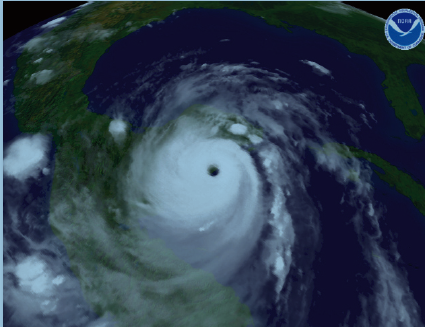
What will happen to a hurricane that runs through
this oil slick?
• Most hurricanes span an enormous area of the
ocean (200-300 miles) — far wider than the
current size of the spill.
• If the slick remains small in comparison to a
typical hurricane’s general environment and size,
the anticipated impact on the hurricane would
be minimal.
• The oil is not expected to appreciably affect either
the intensity or the track of a fully developed
tropical storm or hurricane.
• The oil slick would have little effect on the storm
surge or near-shore wave heights.
What will the hurricane do to the oil slick in
the Gulf?
• The high winds and seas will mix and “weather”
the oil which can help accelerate the
biodegradation process.
• The high winds may distribute oil over a wider
area, but it is difficult to model exactly where the
oil may be transported.
• Movement of oil would depend greatly on the
track of the hurricane.
• Storms’ surges may carry oil into the coastline
and inland as far as the surge reaches. Debris
resulting from the hurricane may be contaminated
by oil from the Deepwater Horizon incident, but
also from other oil releases that may occur during
the storm.
• A hurricane’s winds rotate counter-clockwise.
Thus, in VERY GENERAL TERMS:
o A hurricane passing to the west of the oil slick
could drive oil to the coast.
o A hurricane passing to the east of the slick
could drive the oil away from the coast.
o However, the details of the evolution of the
storm, the track, the wind speed, the size, the
forward motion and the intensity are all
unknowns at this point and may alter this
general statement.
Will the oil slick help or hurt a storm from
developing in the Gulf?
• Evaporation from the sea surface fuels tropical
storms and hurricanes. Over relatively calm water
(such as for a developing tropical depression or
disturbance), in theory, an oil slick could suppress
evaporation if the layer is thick enough, by not
allowing contact of the water to the air.
• With less evaporation one might assume there
would be less moisture available to fuel the
hurricane and thus reduce its strength.
• However, except for immediately near the source,
the slick is very patchy. At moderate wind speeds,
such as those found in approaching tropical
storms and hurricanes, a thin layer of oil such as
is the case with the current slick (except in very
limited areas near the well) would likely break into
pools on the surface or mix as drops in the upper
layers of the ocean. (The heaviest surface slicks,
however, could re-coalesce at the surface after the
storm passes.)
• This would allow much of the water to remain in
touch with the overlying air and greatly reduce
any effect the oil may have on evaporation.
• Therefore, the oil slick is not likely to have a
significant impact on the hurricane.
Will the hurricane pull up
the oil that is below the
surface of the Gulf?
• All of the sampling to date
shows that except near
the leaking well, the
subsurface dispersed oil is in
parts per million levels or less. The hurricane will
mix the waters of the Gulf and disperse the oil
even further.
Have we had experience in the past with
hurricanes and oil spills?
• Yes, but our experience has been primarily with oil
spills that occurred because of the storm, not
from an existing oil slick and an ongoing release
of oil from the seafloor.
• The experience from hurricanes Katrina and Rita
(2005) was that oil released during the storms
became very widely dispersed.
• Dozens of significant spills and hundreds of
smaller spills occurred from offshore facilities,
shoreside facilities, vessel sinkings, etc.
Will there be oil in the rain related to
a hurricane?
• No. Hurricanes draw water vapor from a large
area, much larger than the area covered by oil,
and rain is produced in clouds circulating
the hurricane.
Learn more about NOAA’s response to the BP oil
spill at http://response.restoration.noaa.gov/
deepwaterhorizon.
To learn more about NOAA, visit
http://www.noaa.gov.
Hurricane Season Begins Today
As if the oil spill isn’t enough, today is the first day of hurricane season.

The hurricane guide tells us to have three days worth of food and water stored to get people through a hurricane and its aftermath – loss of electricity, highways blocked with fallen trees, etc. We have a safe room, a large closet next to an outside wall. We have a 7 gallon water storage container, and matches. I’m still working on the rest; I don’t want to be one of those running to the supermarket the day the hurricane might hit.
The good news – for us – is that we did not buy a house in the evacuation zone.

You cannot imagine how seductive some of these houses are. We had assumed we would buy a house on the water. Our beautiful 10th floor apartment on the Arabian Gulf in Kuwait gave us a taste for an endless water view, and that’s what we were looking for:
House 1

House 2

House 3
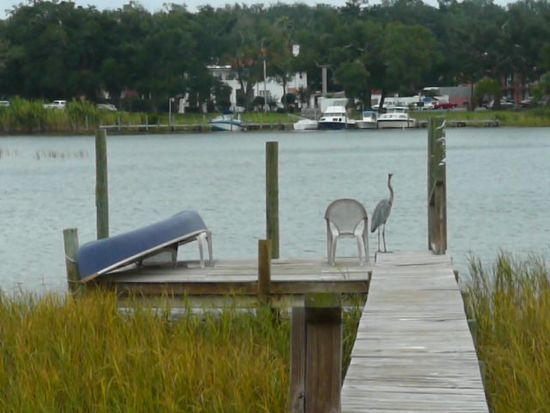
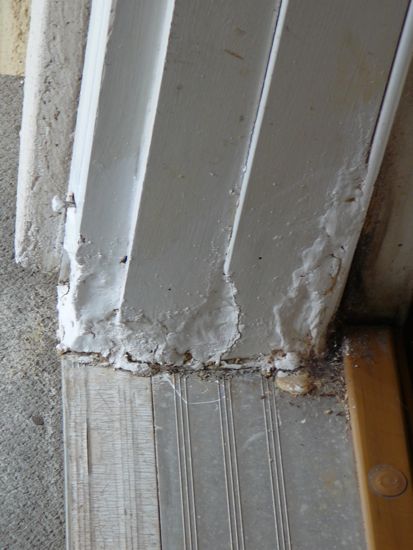
Every house on the water faces the possibility of serious damage in a hurricane. Two of the houses had damage from Ivan, one had ongoing damage from the dampness of being adjacent – well, almost inside – the wetlands. The wetlands are encroaching on two of the properties. One house, we totally loved. We could see ourselves living there, even facing the danger of hurricanes. That is, until we visited the basement, felt the humidity, saw a rotting pillar and realized we would face an unending battle with rot. The doorframe to the outside was rubbery with dampness:
It was a real blow to us giving up our dream.
On the other hand, it is a relief, now, knowing we are not in an evacuation zone.
There are no guarantees against a direct hit by a hurricane. All we have done is improved our odds, somewhat, which is about the best you can do when you live in a hurricane zone.
Recent Comments
ExpatAlien on What Country am I Living … intlxpatr on Yellowstone: Old Faithful to C… Michelle on Yellowstone: Old Faithful to C… Cathy on No Grown-Ups in Charge intlxpatr on Waiting for Snow Wikipedia Donate Button

Amazina


Early Voting in Florida


 Here There and Everywhere