Seen in Pensacola
The truck in front of me (on Davis in Pensacola) looked like a working truck, but it was this sign that caught my eye.


A First For AdventureMan
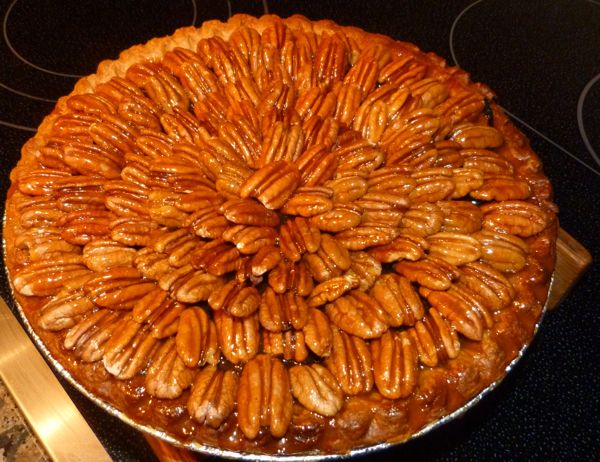
You may think this is ‘just’ a beautiful pecan pie, but it is better than that. This is AdventureMan’s very first pie, ever. He debated even making it for the Great Gathering, because there are so many truly gifted cooks in the family, but in the end, being the courageous soul he is, he tackled it. It looks exactly like the photo of the pie in Southern Living magazine which inspired his effort. I don’t think I have ever seen a more beautiful pecan pie. 🙂 Bravo! Bravo, AdventureMan!
Clean House = Better Physical and Mental Health
Time for some pre-Christmas cleaning 🙂 This from AOL/Huffpost:
A clean house isn’t just “nice to have,” it’s actually a necessity for good mental and physical health. According to a study published in Time, the Indiana University department of Physical Activity, led by associate professor Nicole Keith, discovered a correlation between clean houses and healthy people.
Researchers tracked the physical health of 998 African Americans between the ages of 49 and 65 — a demographic with a high-risk for heart disease – by comparing their levels of physical activity with the cleanliness of their homes. Those people with the cleanest homes were also the healthiest and most active, according to the study results. In fact, the findings also suggested that encouraging people to maintain their home’s cleanliness may be even more important to their overall health than the walkability of the neighborhood they live in.
“At the end of the day, the interior condition of their house seemed to be the only thing affecting their physical activity,” said Keith. “It was not at all what we expected.”
It’s clear by Keith’s statement that their discovery surprised even the researchers, but are these findings really so shocking? Florence Nightingale, a pioneer of modern nursing, famously quoted, “The connection between health and the dwelling of the population is one of the most important that exists.”
Even the Environmental Protection Agency admits that indoor air can be up to five times more polluted than the outdoors. If the average person spends up to 90 percent of their time indoors, we are breathing in dust mites, pet dander, pollen, mold, bug skeletons, and toxins from such innocuous sources as conventional cleaning products and even chemicals emitted from our own clothing and bedding. These toxins manifest themselves as symptoms most people attribute to allergies such as itchy eyes, runny nose, and wheezing, but which should actually be blamed on an unclean house.
And the germy culprits aren’t always where you think they are. Elizabeth Scott, PhD, co-director of the Center for Hygiene and Health in Home and Community at Simmons College in Boston, found staphylococcus bacteria, a common cause of serious skin infections, in 26 percent of the tubs she tested, compared with just 6 percent of garbage cans.
Yes, these statistics provide scientific proof that the mental and health benefits of a clean environment are very real; but, we also look to the renewed energy and happiness our clients describe to us after one of our visits. When we hear our clients use words such as “therapeutic,” “relaxing,” and “motivating” to describe their newly cleaned homes and offices we are reminded that a clean home is truly the embodiment of the science and soul holistic cleaning philosophy we maintain at GreenHouse Eco-Cleaning.
Kuwait Drivers Without Drivers’ Licenses
This disturbing piece of writing is from the Arab Times. Disturbing not just because Kuwaiti citizens are driving without licenses – that’s nothing new – but also because some editor let this piece run without some badly needed editing. Ayb!
Some Citizens Said Driving For Many Years ‘Without’ License
KUWAIT CITY, Nov 23: Intensive traffic campaign the Interior Ministry’s Assistant Undersecretary for Traffic Affairs embarks upon since the past few months uncovered that some Kuwaitis have been driving for many years without license, reports Al-Watan Arabic daily. A source disclosed that a Kuwaiti in his 40s’ recently applied for driver’s license at a driving test section. The added the act is strange in Kuwait since almost every Kuwaiti goes for driving test at the age of 18. Other driving test sections have received similar applications from many Kuwaitis in their late 20s and 30s. Some of the concerned citizens changed their minds to apply for driver’s license after they were caught by traffic officers. He also said many others were caught driving
“The added the act is strange . . . ” Gibberish. And what about that lead sentence?
Most MERS Cases Undetected, report shows
Interesting, Qatar announced today their fourth case – this article says they have had eight confirmed cases and one Tunisian who visited Qatar and came down with MERS. From the Gulf Times:
Most Mers cases going undetected, study says
Researchers estimate that for each case that has been found, five to 10 may have been missed
- Gulf News Report
- Published: 21:32 November 16, 2013

- Image Credit: Reuters
- The Mers coronavirus typically causes severe respiratory problems.
Dubai: A new analysis of Mers case data suggests a large number of infections are going undetected, with the researchers estimating that for each case that has been found, five to 10 may have been missed.
The scientific paper, from European researchers, further suggests that transmission of the Mers virus is occurring at a rate close to the threshold where it would be considered able to pass from person to person in a sustained manner. In fact, the authors say based on the available evidence they cannot rule out the possibility that person-to-person spread is the main mode of transmission of the virus at this point. The other option, they say, is that the virus is spreading via a combination of animal-to-person and then person-to-person transfer.
“We conclude that a slow growing epidemic is underway, but current epidemiological data do not allow us to determine whether transmission is self-sustaining in man,” they write in the article, published in the journal Lancet Infectious Diseases.
The scientists are from Imperial College London, the University of Edinburgh and the Institut Pasteur in Paris. The work was done with funding from Britain’s Medical Research Council, the Bill and Melinda Gates Foundation and other agencies.
To date there have been roughly 155 confirmed MERS cases and at least 65 of those infections have ended in death. All the cases trace back to infections in a handful of countries on the Arabian Peninsula: Jordan, Saudi Arabia, Qatar, the United Arab Emirates and Oman.
On Wednesday, Kuwait reported its second case Mers coronavirus for a man who just returned from abroad, the health ministry said.
In a statement cited by the official KUNA agency, the ministry said the new case was for a 52-year-old Kuwaiti national who was in a stable condition. Media reports said the patient had just returned from a visit to neighbouring Saudi Arabia.
The announcement came hours after Kuwait reported its first case of the Mers virus for a 47-year-old Kuwaiti man who was in critical condition.
Last weekend, Omani officials widened health checks following the country’s first death blamed on Mers. Officials looked for any sign of the virus in people who came in contact with a dead 68-year-old man.
Neil Ferguson, from Imperial College’s MRC Centre for Outbreak Analysis and Modelling, said that while publicly available data are spotty, calculations based on what is known support the argument that only a small proportion of cases are coming to light.
“At the very least there probably have been double that number of infections,” Ferguson said in an interview.
“But it’s considerably more likely in my view that we’ve had maybe five to 10 times more human infections than that. And symptomatic human infections, I would say.”
He stressed that he and his co-authors are not suggesting that the Mers-affected countries are hiding cases, just that the way they are looking for them is not capturing the full scope of the outbreak.
Experts have previously expressed concern that surveillance systems that look only for Mers among people who seek hospital care will only catch the sickest of cases. And in at least one affected country, Saudi Arabia, the criteria for who gets tested for Mers may be less inclusive still.
Dr. Anthony Mounts, the World Health Organisation’s leading expert on Mers, said the agency has been told Saudi health officials are focusing their testing on people with Mers-like symptoms who are gravely ill.
“I know that their surveillance strategy is focused on intensive care patients,” Mounts said in an interview. “That’s the focus of their surveillance strategy.”
Mounts agrees that many Mers cases are probably being missed. But he noted that some other affected countries are taking a different testing approach. For instance, Qatar has tested over 3,000 specimens over the past six months, looking for Mers in people who seek medical help for influenza-like illness, and all people diagnosed with pneumonia.
“They really are testing a lot of people and they’re not seeing this,” he said.
Eight Qataris have been diagnosed with MERS since the virus hit the global public health radar in September 2012. As well a man from Tunisia who contracted the virus is believed to have been infected on a visit to Qatar.
Because of the scarcity of publicly available data, Ferguson and his colleagues used some different approaches to try to estimate the state of the outbreak. He acknowledged that their calculations are estimates, and said of the analysis “it’s not definitive … but I still think it’s informative at least.”
“I would say we’re doing the best we can with the data available to try and address a couple of key questions,” he said. “We would certainly be in a better position if there was fuller [case] reporting.”
A commentary by Canadian epidemiologists lauded the team for the techniques they used to reach their conclusions. Dr. David Fisman and Ashleigh Tuite, who are with the University of Toronto’s Dalla Lana Faculty of Public Health, also hinted that the often-seen instinct to withhold information during infectious disease outbreaks may be futile in the era of computational biology.
“The ability to draw inferences about diseases from non-traditional data sources will hopefully both provide alternate means of characterising epidemics and diminish the temptation towards non-transparency in traditional public health authorities,” they wrote.
One of the questions Ferguson and his co-authors tried to answer relates to whether the virus is spreading person to person at this point or whether what is being seen are infections from an animal source that is igniting limited spread in people.
To do that, they tried to calculate what is known as the virus’s reproductive number — the number of people, on average, an infected person would pass the virus on to. For a virus to sustain itself in people, each person needs to infect at least one other person, a reproductive number of 1.0 or greater.
They could not come to a definitive conclusion, saying with what is known, either scenario is possible. But they said the evidence suggests the reproductive number is near 1.0.
— with inputs from agencies
“Death Knell for OPEC?”
From AOL News – although this is not really news, announcements have been out there for a while.
Massive Oil Discovery Is Deathblow For Saudis
It’s the biggest find in 50 years and the media is completely ignoring it…
It is 6 times larger than the Bakken, 17 times the size of the Marcellus formation, and 80 times larger than the Eagle Ford shale.
All told the recent discovery outside a sleepy Australian town contains more black gold than in all of Iran, Iraq, Canada, or Venezuela.
The current estimates of 233 billion barrels are just 30 billion barrels shy of the estimated reserves in all of Saudi Arabia.
Now, one renowned international energy expert predicts the proven reserves will be much bigger.
“The find may land at 300 or 400 billion barrels, making it one of the greatest unconventional oil discoveries any of us will see in our lifetimes,” says Dr. Kent Moors and advisor to six of the top 10 oil producers and active consultant to 20 world governments.
“It represents a bona-fide redrawing of the global energy map as we know it,” Moors says, “and the mainstream media is completely ignoring it.”
Editor’s Note: Experts value this find at over $20 trillion. To see the one stock that will deliver a record payday, go here.
Where the Hell is Coober Pedy?
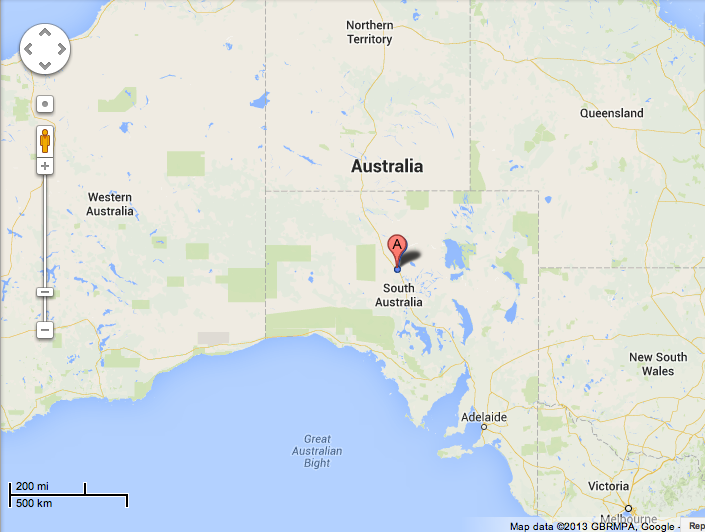
To the people who call this place home, the oncoming oil boom means nothing will ever be the same ($20 trillion worth of oil can do that to a town).
The boom is centered around a place called Coober Pedy, an inhospitable speck on the map in Southern Australia.
The big draw is the riches found in the region’s vast geological structure, the Arckaringa basin.
Encompassing an area in excess of 30,000 square miles, what’s buried within the basin is enough black gold to completely change the global oil landscape-not to mention the lives of early investors.
Analysts believe this is equivalent to investing in Saudi Arabia in the early 1950’s.
And according to this inner circle briefing by Dr. Moors, one little company controls the whole thing.
Editor’s Note: This is the biggest find in 50 years and it will create unheard of fortunes for investors who act now. Watch this unbelievable video to learn more.

The Death Knell for OPEC
This massive find has been likened to the Bakken and Eagle Ford shale oil projects in the U.S., which have created legitimate boom times in Texas and North Dakota.
Even at the lowest estimate, Coober Pedy is set to make Australia a net oil exporter; at the higher estimate, Australia would become one of the world’s biggest oil exporters.
“What we’re seeing up there is a very, very big deposit,” says South Australia’s mining minister, Tom Koutsantonis, “This is a key part to securing Australia’s energy security now and into the future.”
If You Lived Here, I’d Know Your Name: Heather Lende

“You have to read this!” said my book friend, “You’re from Alaska! It’s about a woman who lives in some small town and writes obituaries!”
I grinned politely and put the book in my bag. Some books sound more interesting than other books – I’ve always loved adventures and mysteries and murders – add a little drama to the day-to-day-ness of everyday life. A woman who writes obituaries? Hmmm, not so much.
But spending my afternoons tending to my sweet little 3-month-old granddaughter means I often sit, anchored by the soundly sleeping baby who I don’t want to disturb, even by twitching. I have one hand free – and you can only play so much iPhone Sudoku.
An Alaskan friend had also recommended this book, so early this week I picked it up and started reading.
Oh. my. goodness. Yes, Haines is a small town, but oh the drama of writing obituaries. Oh, the things you learn about your neighbors and the surprises you get learning about their earlier lives. I love the way Heather Lende weaves the writing of the town obituaries with the current ongoing dramas in her own life and in the lives of her friends and makes it work.
It’s not unlike where I grew up, although my hometown had a hospital. We also had moose and bear and elk in our back yards, and learned to treat wildlife with respect, and that the best option was to back away slowly. There are the same senseless deaths from auto accidents, fishing boat accidents and unexpected changes in weather. There is the same feeling of wonder, almost every day of your life, knowing how very lucky you are to live in the midst of such awe-inspiring beauty. It’s hard for me to imagine being an unbeliever living in Alaska.
It’s also a great book to read before going to bed. Some of the books I read are too exciting or too disturbing to read before bed; books that infiltrate your dreams with images and situations that give you a restless night. While Lende deals with death and sadness and drama, there is an underlying message of hope in the neighborliness of your neighbors, the security of living in a town where everybody knows everybody else, in the civility even of people who strongly disagree with one another. If You Lived Here, I’d Know Your Name gives you peaceful sleep. She ties it all together with an ending that rips your heart out; you will never forget this book once you read it. After reading, you will feel like you have lived in Haines, Alaska.
The paperback version is available from Amazon.com for $9.73. No, I no longer own stock in Amazon.com.
Recent Comments
ExpatAlien on What Country am I Living … intlxpatr on Yellowstone: Old Faithful to C… Michelle on Yellowstone: Old Faithful to C… Cathy on No Grown-Ups in Charge intlxpatr on Waiting for Snow Wikipedia Donate Button

Amazina


Early Voting in Florida


 Here There and Everywhere