God-With-A-Sense-of-Humor at King O Felafel in Orlando
After driving seven and a half hours to get to the convention hotel, AdventureMan and I needed dinner! We settled in to our hotel and took a quick look at the menu – nope. We needed something comforting, something familiar. And there it was, just one minute, I am not kidding, from our hotel, the King O Felafel.
God-with-a-sense-of-humor had plopped us splat down in a hotel in the middle of Middle-Eastern-Land. Minutes from Disney, minutes from all the shoddy tackiness of Orlando, we find ourselves “home.”
The King O Felafel’s shop was full of regulars, including one very large family taking up about five tables all put together, and having a wonderful time. The King himself makes his own felafels, using that little felafel making tool, he was so quick. The was clean clean clean, and service was quick.
We started with lentil soup, and I ordered the Vegetarian Platter (which was like a mezze) and AdventureMan ordered a Felafel Sandwich.
Oh, how we have been yearning for the simple joy of a felafel sandwich done right. The King O Felafel was heaven for us.

Thank goodness I remembered to take a picture before we demolished the entire platter!

So simple, so good. A homemade felafel. Perfection.


This shop is not undiscovered. He has a large clientele of all kinds of people who appreciate superb food, beautifully and tastily prepared.
Across the street from the King O Felafel is a mosque which also has a gym and a meeting hall. There are several other ‘Mediterranean’ restaurants nearby, and several hookah lounges. There are so many shops in this little area of Kissimmee with ‘halal’ foods and even groceries selling halal meats. Wow.
Mosque – my photo was blurry, so I grabbed this from Google Maps. I guess it used to be a computer shop; now it has arabic writing on it and a sign that says it is the AMYL Center (Masjid Shadi)


Seville’s Palace Cafe for Breakfast
We had a favorite place for breakfast, Adonna’s, but first they discontinued AdventureMan’s favorite – Biscuits and Gravy – and then they discontinued mine, which was Cinnamon Roll French Toast. What to do? Where to go? We go often to The Scenic Diner, but we wanted something different.
We checked out a few places but nothing felt right. Then we remembered the Palace Cafe at Seville, a place we had wanted to try for breakfast for quite a while.
They had a good crowd, but we were seated immediately and coffee and tea arrived within minutes. As we ordered, AdventureMan said “oh! We haven’t had beignets here; let’s have those!” and I applaud the waitress, who didn’t bat an eye, didn’t say a thing, not a single thing about all the times I have been there with GCCDC groups and ordered beignets for all the tables, because they are so good.
When they arrived, I told AdventureMan how often I had them before; I just couldn’t let him believe a lie. These beignets are like the ones we ate in New Orleans, a little like the lightest deep fried donut you ever ate. So much air, and powdered sugar – that can’t be all that bad for you, right? Right? Aren’t they beautiful?

I had the Palace eggs, which comes with grits or hash browns or fruit, and it was perfect:

AdventureMan had the breakfast croissant. He said it was a pretty good croissant – he still misses our breakfasts in France.

There were families there, children playing while the adults visited. There were adult groups, there were buddies. It was active without being noisy.
It was also one of the best breakfasts we have had in a long time. We love this place.

. . . Red Fish, Blue Fish on Pensacola Beach
I remember reading the book, One Fish, Two Fish, Red Fish, Blue Fish to my son – maybe about a hundred thousand times, you know how kids love Dr. Seuss. This was a restaurant people started talking about months before it ever opened. Great location. New concept, re-using metal shipping containers, very environment-friendly – what’s not to like?

Our son and his wife got there first, not too long after it opened. Their experience was less than stellar. They loved the ambiance, sitting out by the lapping waves on Quietwater Sound (except when hit by an errant bean-bag, one of the risks you take sitting near the bean-bag toss section, but hey – when you’ve already waited 45 minutes for a table, you take what you get.) They loved the food – when they got it. It took them fifteen minutes, and tracking down a waitress themselves just to get a menu, more time to get their orders placed. All in all, they said, a great evening with some annoyances. That is not a stellar recommendation.

We tried it a week or so later, at lunch. No crowd, but neither was there a hostess, people just kind of wandered in looking around, a little lost, and some waiter or waitress would holler “just seat yourself!”
No sooner had we seated ourselves – every table has a great view – than our waitress appeared. We have NO complaints about the service; the service at lunch time the day we were there was great. It was one of those perfect Fall days in Pensacola, temperature maybe 75° with blue blue skies, a Blue Angel takes a whirl over us as we are sipping our iced teas, the waves are lapping, breezes breezing – lovely.
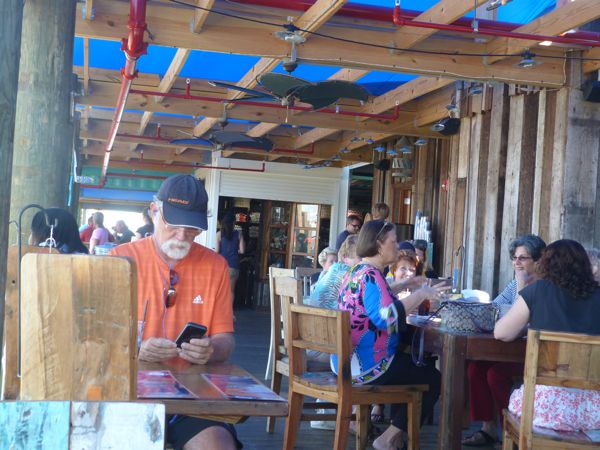
The wait staff wear Tshirts indicating they are “CREW”

AdventureMan ordered the BLATT, bacon lettuce avocado tomato and tilapia, which came hot and fresh and tasted . . . OK. Fine. Nothing special. Sort of small by Pensacola standards.

Fries are a side. You pay extra for fries, they don’t come with the meal.

I ordered Asian Slaw with fish on top. When it came, I was delighted that the fish was not deep fried, but grilled. The fish was delicious. I was not delighted that the Asian slaw was barely there, and had a Caribbean lime flavor. The waitress brought me some soy sauce. Not the same. Tiny portion – by Pensacola standards.

Great location. Nice, beachy, casual ambiance. Lots of local groups trying the place, having a good time. We had great service, but date nights you might experience slow service.
Here’s the thing. Just a short walk up the walk is Flounders, with great french fries, truly superb, so crispy delicious that people who are not supposed to eat fries have to succumb to the temptation to try a fry or two or three or . . .
Beach food isn’t cheap, but at Flounders, fries are included with the meals. Service is almost always pretty good. You rarely have to wait longer than 20 minutes at a really really busy time to get seated. Larger menu, more entrees than Red Fish Blue Fish.
It’s a tough comparison, but it’s a reality,and inevitable, especially when you are almost next door neighbors. Red Fish Blue Fish is going to have to step up its game.
Where is Terekeka, South Sudan?

Today the church prays for the diocese of Terekeka, in the South Sudan. I have never heard of Terekeka – have you?
When I looked for it on Google Maps, it didn’t have any information. When I went to The South Sudan and then googled Terekeka, it came up with a reference, and I had to go to this website to find it – they had a map.
The organization who put up the map, Harvesters Reaching Nations, has two locations in the southernmost part of South Sudan, the newest nation on earth. They are building hospitals, and taking in orphans. If I hadn’t gone looking, I would never have heard of the good works they are doing, saving lives, changing lives.
This is what they say:
We currently serve more than 190 orphans in two locations in South Sudan – Yei and Terekeka. Our school in Yei provides a Christian education to more than 500 students. In addition to our school-age orphans, more than 400 children from surrounding villages attend our school.
The Harvesters campus in Yei consists of 90 acres of land donated by the South Sudan government. Since our beginning in 2001, we have built homes, dorms, classrooms and other facilities within a fenced-in campus. We use the land we own beyond the fencing for planting and growing corn, tomatoes and other vegetables for use in the orphanage.
Harvesters’ campus in Terekeka, South Sudan opened in 2010. At this campus, we currently provide care for 44 orphans, but will grow to 80 in the near future. We have built homes, dorms and a clinic within a five acre, fenced-in campus. Additional facilities, including a church and school classrooms, will be built in the near future as the needs and resources dictate.
To do this, they sold everything they owned, and moved to the South Sudan, and used the proceeds from selling everything to build the hospitals and schools. I bet they are the happiest they have ever been, and the most thoroughly engaged in life they have ever been.
Airline Fees We Love To Hate
Frequent Flyer.com reveals a new survey identifying the fees airline travelers hate the most:

It goes without saying that of the many gripes travelers currently have about flying, the so-called ancillary fees charged by the airlines for, well, everything they can disaggregate from the core service would rank near the top of the most-despised list.
But of the multitude of such fees, which irk travelers the most?
A new survey conducted by Skift shines some light into that dark corner of the travel experience.
According to a poll of 1,000 adults, the most and least reviled airline fees are as follows:
Bag check fees (50.1%)
Seat selection fees (18.4%)
Inflight WiFi fees (12.4%)
Inflight food or beverage fees (9.7%)
Early boarding fees (9.4%)
Although there was general unanimity across age and other groups, there were a few interesting demographic disconnects:
Wealthier travelers were less bothered by bag fees but more bothered by seat-selection fees.
Less wealthy travelers were notably less bothered by inflight meal/drink fees.
Younger flyers were more bothered by inflight WiFi fees.
Travelers 65 years and older were most bothered by inflight meal/drink fees.
Mackey’s Mud House in Pensacola

The Rooftop Dining area at Mackey’s Mud House, Pensacola
Mackey’s Mud House has been open mere months, but is already attracting attention in downtown Pensacola for it’s variety in tastes and the freshness of their offerings.
We decided to give it a try. We love the growing sense of life in downtown Pensacola, love the open market and the variety of restaurants.
The chips and salsa knocked our socks off.

I love the colored chips, but, even better, they were thin and crisp. The salsa tasted fresh, and had just a little bite. It was a great way to start the meal.
I ordered cider slaw and the Mediterranean Pasta. The slaw was the way I like it, no mayonnaise, and tasty. The Pasta had more of that fresh taste – made with all fresh ingredients, maybe the healthiest pasta I have eaten in a long time.


AdventureMan’s Mediterranean Pizza was also fresh and delicious, and as you can see, there was so much of it we had to take some home for dinner. Yumm. 🙂

We ate inside; it was still a little too warm for me outside.

Our waitress was Jen, who was totally on top of things, friendly, efficient and informed, without being intrusive. We’ll be going back. . . and I’m thinking this is a great place to watch the Pensacola parades from . . .

Saudi Arabia Inching Toward Allowing Women to Drive

Saudi Arabia is the only country in the world where women are not allowed to drive. There is an irony – there is no law banning women from driving. They do not issue driver’s licenses to women, they arrest women seen driving, and they do not – officially – teach women to drive. Thank God for good fathers and brothers and husbands, who take their daughters, sisters and wives to isolated places and teach them, often for the good of the family in case of an emergency.
Saudi women drive in Europe, in the USA – they drive everywhere except in their own country. The government shows signs of wanting to allow women to drive (officially) but they seem hesitate to stir the wrath of the religious police who believe – based on nothing – that God forbids women to drive. Recently, the head of the Saudi religious police said there is nothing in Islam that forbids a woman to drive. What’s the hold-up guys?
This article is from AOL Auto News, where you can also see a video of a woman driving in Saudi Arabia with cars passing her and waving encouragement:
Saudi Arabian Women To Protest Driving Ban On Oct. 26
Saudi society is slowly inching toward more equality, but driving is still disallowed for women

When Farha was a young girl, about seven years old, her mother told her something that rocked her world: She said women could drive.
For Farha, a 24-year-old writer who has spent her entire life in Saudi Arabia, this was akin to a Western child learning the truth about Santa Claus. She’d only ever seen men behind the wheel in her country, where women are not permitted to drive. The revelation was slightly scandalous, a little bit funny, and totally paradigm-shifting.
It took another two years for Farha (who didn’t want to be identified with her last name due to the sensitivity of the issue in her home country) to decide she would, one day, learn how to drive a car. And, for good measure, she’d learn how to ride a bike. Two modes of transportation that have been banned to women and girls for most of Farha’s lifetime.
On Oct. 26, women in Saudi Arabia will engage in the third protest against the female driving ban by getting behind the wheel anyway. The protest won’t be widely attended, because the vast majority of women in Saudi Arabia don’t know how to drive. There are no driving schools in the Kingdom that cater to females, and state agencies will not issue a driver’s license to a woman.
“Since there is no justification for the Saudi government to prohibit adult women citizens who are capable of driving cars from doing so, we urge the state to provide appropriate means for women seeking insurance of permits and licenses to apply and obtain them,” a petition at the protestor’s web site reads. The web site has been blocked within Saudi Arabia, yet there are still a thousand or so names on the petition. The few women who are adept behind the wheel learned while living overseas, often in the U.S., Canada, or nearby Bahrain or Dubai.
In urban areas, women are chauffeured around by male relatives or paid drivers, or they pay for taxis. In rural areas, the driving ban generally isn’t enforced, and more women drive out of necessity. One woman who was recently videotaped disobeying the ban got support from her fellow (male) drivers, who passed by and gave her the thumbs up, a sign that society may be more willing to accept an eventual change.
Learning to drive
Farha tackled the task of learning to drive first by reading about the process. She edited a story on how to drive for her high school newspaper, and from that she felt she learned quite a bit. Then her father spent some time talking to her about how cars work, and the theoretical aspects of driving. He took her out for a few hours over the course of a few days, letting her drive around their neighborhood in the coastal city of Jeddah. But she never ventured onto the main roads.
She also learned the basics of riding a bicycle, but doesn’t consider herself adept at either skill. When the ban is lifted, she said she’ll sign up for classes at a real driving school.
“I always thought this ban would go away when I was 18,” she told AOL Autos. We connected with her through a publication where Farha wrote, under a pseudonym, about the driving ban. “And I’m still hoping it will be lifted when I am 26.”
“I always thought this ban would go away when I was 18,” Farha said. “And I’m still hoping it will be lifted when I am 26.”
Not driving makes life’s everyday movements difficult. Sidewalks aren’t available, so walking isn’t realistic. Farha’s father has mostly been responsible for driving her and her mother around, but five months ago he got into a car accident and broke his leg. He is currently unable to drive. Farha feels the burden of her father’s injury. If she could drive, she said, she could bring him to doctor’s appointments and help him get out of the house. Instead, the family is home-bound unless they pay someone to bring them places.
Farha has hired a part-time driver to take her to and from work. It costs about 2,000 to 3,000 Saudi riyals (or around $530 to $800) a month for a driver. That’s about the same amount that women make earning minimum wage in Saudi Arabia, prompting many women to just stay home.
“A lot of women don’t feel the incentive to work and hire a driver,” she said. “It doesn’t make any economic sense.”
Some women opt for the public bus system, but that makes women from conservative families feel nervous because it exposes them to strange men – the exact problem the country is trying to avoid by banning women drivers. Taxis run the same problem, putting females into cars with strange men. “It doesn’t make sense,” Farha said.
Farha is considering signing up for a karate class, but she’ll have to pay her driver for more hours or take a taxi to the classes. On top of the class fees, the price of getting to and from karate starts to seem like a silly amount of money, she said.
And she worries she’s spending too much money on herself. She could spend 30 riyals on a taxi each way, or she could donate that money to a family in need. Or spend that money sending school supplies to girls in other countries.
“It’s a difficult decision to make every time,” she said.
One unintended consequence of the rule strikes Farha as incredibly unsafe: Women often let their 13-year-old sons drive them around when they are out of other options. Farha’s observation was backed up by a U.S. intelligence research note made public by Wikileaks, which noted that these young drivers sometimes get into very serious accidents.
Weird, long history
Oddly enough, there isn’t any actual law in Saudi Arabia banning women from driving. In 1991, the late Grand Mufti of Saudi Arabia, Sheik Abdulaziz bin Baz issued a fatwa prohibiting women from driving. A fatwa is different from a government law, in that only followers of the religious leader who issues the fatwa are obliged to follow that law. But given the intertwined nature of Saudi Arabia’s government and its religious leaders, the fatwa took hold. The government agency in charge of issuing driver’s licenses will not issue one to a woman. Saudi Arabia’s court system relies heavily on fatwas from the Grand Mufti.
So, in essence, the religious order became a rule that everyone follows, even though it’s not enforced by the Saudi government. The government just makes it impossible for women to get drivers licenses, and if they catch women driving, they make them sign a pledge promising they won’t do it again.
Abdulaziz bin Baz said at the time that the ban would protect women, because allowing women to drive would put them out in society alone, leaving them to mix with men. If women were stranded by the side of the road due to a flat tire or car problem, they could end up being assaulted or raped by a man who came to help them, argue critics who still uphold the ban.
A reporter for the Christian Science Monitor recalled a 2012 conversation with a man in Saudi Arabia about what would happen if the ban was lifted. “What would happen if a woman got in a car accident, he asked? Then she would be forced to deal with the male driver of the other car, a stranger, with no oversight – a problematic situation in a country where male guardianship of women is deeply entrenched.”
Just last week, a Saudi cleric came under fire for claiming women were damaging their pelvises and causing birth defects by driving. Sheikh Saleh bin Saad al-Lohaidan argued women should put reason ahead of their hearts, because it “could have negative physiological impacts as functional and physiological medical studies show that it automatically affects the ovaries and pushes the pelvis upward.”
Saudi society is slowly inching toward more equality for women. Just this week, four women became attorneys. Earlier this year, women were allowed to work in retail establishments that sell underwear and bras, taking away the embarrassment for women who’d previously had to purchase these items from male salespeople.
Since around 2006, the Saudi government has been indicating it would consider lifting the driving ban if society deems it acceptable for women to drive. Diplomatic cables released by Wikileaks showed the U.S. government has been paying attention to this issue, and putting some pressure on the Saudis to change their ways.
Will of the people?
But it’s clear the Saudi government won’t make any controversial moves: “This has to do with the will of Saudi society,” said Saudi Justice Minister Muhammad Al-Issa in a TV interview in April, according to a translation by the non-profit group MEMRI. “If Saudi society, given its culture, wants women to drive, it’s fine. But if society has any reservation for whatever reason, that’s fine too.”
Farha said she’s holding out hope that the rules will change, as soon as possible. But the change will depend greatly on men’s attitudes.
“More men certainly support it now, but … they have their concerns,” she said. And “some are outright hostile to the idea.”
When she does get her license, Farha said she’d like to try driving a sports car. It doesn’t matter what kind, she just would like to try driving something fun. But she’d rather be able to walk or bike to work, even if she could drive.
“Cars feel suffocating inside,” she said. “But the whole idea is to lift this difficulty for women. I hope it happens soon.”
In sharing this story, and others, with our readers we hope you are inspired to Raise Your Hand for girls’ education, helping us spread the word on this crucial effort.
Kuwait Divorce Rate “50% and Rising”
How did I miss this truly excellent article in the Arab Times?
Divorce Rate In Kuwait 50pc … And Rising
Huge Increase Seen In ‘Cheating’
A good, productive and stable marriage is built on one’s ability to love someone else and make sacrifices for that person. We in this region as a whole are sometimes very materialistic and usually wealthy. Many a time couples get married for the wrong reasons. Sometimes because marriage is the new “thing to do”, it’s merely the new toy. Maybe the honeymoon period is the only highlight of the whole affair.
Lawyer Waleed Khaled Al-Dousari was talking to the Arab Times on marriages in Kuwait, exploring the causes behind the increasing rate of divorces in the society. “The rate of divorce in Kuwait has reached more than 50 per cent, and the number is still on the rise,” he adds.
Q: How would you describe marriage in Kuwait, and have the trends changed?
A: Traditionally, the ideal marriage was tribal, related families encouraging their offspring to marry cousins or other relatives in order to increase and strengthen the tribe, or occasionally to marry into another tribe in order to heal rifts between families. Another reason for such marriages was that families knew the background of the partner.
As is the case in some Latin countries, young couples in the region are allowed to meet under the watchful eyes of a chaperon. In Kuwait, however, the marriage is arranged without any part of the girl’s body (including her face) being seen by the prospective groom, who must rely on the reports of his female relatives as to his wife’s appearance.
There are three main elements in an Arab marriage. First, the groom must discuss and agree the dowry with the bride’s father. This might include gold, jewelry and clothing and is usually of considerable valuable. After the dowry settlement, comes the actual marriage contract, which is conducted by a legal or religious representative.
The bride is asked in the absence of the prospective groom if she agrees to the marriage and this question is then put to the groom. After the agreement, the groom joins hands with his future father-in-law and, with two witnesses present, the marriage becomes official.
However, there’s another stage before the couple actually meet as man and wife: the wedding party. Celebrations are segregated, with the women in one section of the house or private ballroom and the men in another. Finally, on the last night of celebrations, the couple meets, accompanied by all their friends, and eventually leaves for their honeymoon. On their return, they either live with the groom’s parents and become members of the extended family or – as is increasingly the case – set up a separate home by themselves.
According to Sharia, a Muslim man may have four wives, provided that he can look after them materially and treats them equally. This practice is now dying out, however, not only because only a few can afford it, but also because women are becoming more independent and assertive and many refuse to accept it.
In fact, a Muslim woman can insert a clause in the marriage contract that restricts her husband from marrying another woman for as long as the contract is valid. The wife also retains her own name after the marriage.
Although gender roles have always been clearly defined in the Islamic world, with the man as ‘provider’ and the woman as ‘nurturer’, both the man and the woman are increasingly going out to work, although this is much less common in Saudi Arabia, where there are restrictions on women working, except in culturally ‘acceptable’ occupations such as medicine and teaching. However, many Saudi men are reluctant to marry doctors and nurses, who have physical contact with male patients.
A man can divorce his wife simply by saying ‘I divorce you’ three times. He can rescind the divorce if this was done in the heat of the moment, but only if the wife agrees (and only on three occasions though). On the other hand, even if a wife has a good reason to seek a divorce (e.g. if her husband has been unfaithful, abused or deserted her, or engaged in criminal activity), she must go to a court for the case to be heard.
The husband must maintain a divorced wife and any children from the marriage if the wife is unable to support herself. He can claim custody of any sons when they reach a certain age; however, the priority is given to the mother, but this still depends on the sect of the couple. A female divorcee usually returns to her family, and few remarry.
Although a Muslim woman may not marry a non-Muslim man unless he converts to Islam, the reverse isn’t the case. Non-Muslim women are often pressurized into converting, and there have been many cases of foreign women marrying Arabs and then discovering that the local culture and lifestyle are unacceptably restrictive. It should also be noted that, in the event of the breakdown of such a union, the children are usually kept by the husband in his home country.
Expatriate workers can usually be married in the Gulf, provided that they meet the civil and religious requirements of their home country. Embassy and consulate staff sometimes performs civil marriage ceremonies, again provided that certain requirements are met. Religious ceremonies can be arranged, but only in countries that allow churches or similar non-Muslim places of worship.
Although many young citizens in Kuwait are still seeking the blessing and help of their parents for choosing life partners, some youngsters in Kuwait prefer finding their partners without parental guidance and mediation. This approach is the result of cultural interactions. This changing trend has become quite noticeable in the countries of the region.
Q: Why are we currently encountering an increasing rate of divorce in the country?
A: A good, productive and stable marriage is built on one’s ability to “love” someone else and make sacrifices for them. We in this region as a whole are sometimes very materialistic and usually wealthy. Many a time couples get married for the wrong reasons. Sometimes because marriage is the new “thing to do”, it’s merely the new toy. Maybe the honeymoon period is the only highlight of the whole affair.
In some cases, both partners may be in need of intimacy and so they get married to have that kind of intimacy. There’s nothing wrong with that. In fact in this arrangement, there is one good thing in that youngsters feel that they should “get married first” before “becoming intimate with anyone”. That’s a noble and encouraging thought.
But after the first few months or the first couple of years, we start noticing the first signs of trouble, and you see both sides contemplating the “D” word. They think “I don’t need this.” And rightly so, they really don’t need it. Both are wealthy, both have high paying jobs, their rooms in their parents’ houses are still empty and perhaps are still untouched with their original furniture in place and in tact.
Other reasons, however, come along due to the change in the definition of marriage as a whole from the perspective of both men and women. Even families in Kuwait today no longer feel shameful that their daughter or son is divorced. Some families are actually encouraging their daughters to divorce, because sometimes that divorce gives her more financial gains than she already has.
In Kuwait, it is a huge problem when a man cannot provide a luxurious life to his wife. It is his duty to provide her with the maid, driver, shopping every now and then, and the ability to travel at least on a yearly basis.
However, not all Kuwaitis are able to provide this kind of lifestyle for their wives and children.
Another issue is that of cheating. There is a huge increase in the percentage of cheating wives and husbands. It has become so easy for a husband or wife to cheat on each other, especially because marriages are neither based on love nor respect.
The high divorce rate in Kuwait insinuates that we are too spoiled to remain stuck to our marriages.
So what will happen to us in say 50 years? The world will be less dependent on our oil, and the oil will become less abundant anyway. We will become poorer in general. Isn’t that right?
We will have less materialistic “toys” to play with. And therefore we will be less spoiled. And I think we will tend to stay committed to our marriages more.
Our men will start actually doing some “work” to earn a living. And less of these jobs will be suited to women, and women will have less incentive to leave the umbrella of her husband’s (modest) financial security. Just like the times of our grandfathers and grandmothers.
Now, this might be a bleak picture, but maybe with less material distractions, and with healthier marriages, I only see us becoming happier people.
Q: So what happens, when a couple comes asking for a divorce?
A: From my experience as a lawyer, the usual scene when two couples ask for a divorce is that they come to my office in the image of two enemies who completely hate each other, and cannot even stand being in the same room with each other.
The women usually tries to file as much cases against her husband to get all the rights that she wants, and the man tries to do the same thing.
Q: What is the role of Shari’a law in divorce cases? Is there a difference between the rights that a woman may take if she was Sunni or Shi’ite?
A: In Kuwait we abide by the Islamic Sharia law when it comes to marriage or divorce. Therefore, when a couple asks for a divorce, usually there are certain proceedings that should take place.
To apply for divorce, you should be of sound mind and be able to make your own choices.
The first step the couple should do is to register the case at the Moral and Family Guidance Section at the court.
Shortly afterwards, a counselor will meet the couple and discuss their problems. They are then given a three-month time to try and solve the problems, before beginning the divorce process.
If the couple, or either of them, still insists on divorce, the papers will be forwarded to the court for the judge to study the case. The judge will discuss it with the couple and listen to the witnesses. It could take a couple of sessions before the judge makes his decision. The couple needs to attend all the proceedings.
A woman may be granted a divorce if she can prove that her husband has physically hurt her or mentally tortured her. A woman also may sue for divorce if her husband abandons her for a period of three months, or if he has not taken care of her needs or that of their children.
The law allows women to obtain a khula – a separation, when she returns the dowry to the husband.
The Sharia Court will accept a divorce lawsuit from Muslim men or Christian or Jewish women married to a Muslim and apply the Islamic laws.
If the divorce applicants are both Muslims, but from different countries and are residents in Kuwait, they will be divorced according to the administrative laws in their country, or the Kuwaiti law, whichever they wish. While Sharia is same in all Muslim countries, there are a few administrative differences between the various schools of thought.
If the couple is from the same country, the law of their country, will be applied or the Kuwaiti law may be applied, if they so wish.
If the husband is a Muslim and the woman is not a Muslim, the Kuwaiti laws will be applied, or the law of the country where they had got married will be applied.
If the couple is non-Muslim, they can seek divorce according to the law of their country, at the embassy or consulate.
There is not much difference between the two sects when it comes to divorce; there is only one main difference, and that is a Sunni women can take the custody of her children without ever having to return them to their father. However, the father can be with his children on previously arranged days.
According to the Shi’ite sect, the father can take his children when the children reach the age of seven or above, by which time the children too have a say in that kind of decision.
However, even the issue of custody is abused by some women, who place a huge financial burden on the man under the pretext of asking for the children’s upkeep. Some women do so despite being financially well off themselves.
Q: Can you give us examples of some divorce cases in Kuwait?
A: One intriguing divorce case involved a woman who divorced her husband on their wedding day because she found out at the wedding ballroom that groom had not made the costly arrangements that she had asked for, and instead chose a reception that cost much.
Some women get divorced because they see divorce as a financial gain for them. Men are sometimes forced to provide his divorcee with a house, a maid, a driver, and a monthly alimony for her and her children.
In many cases the reasons are very silly, which makes it very difficult for us lawyers to take any stand on the issue. For example one woman filed for a divorce because she didn’t like the way her husband made sounds while eating.
Q: What do you think is the role of society to tackle the problem of increasing divorce rates? How can education help reduce the rate of divorce, or help couple’s understand and appreciate the true value of marriage?
A: In light of high rates of divorce cases, social authorities should play a role in educating youth about the basic criteria for sound marriages. Grassroots associations and the media in the Gulf have to educate families about potential negative aspects of coercing young males and females to marry relatives, in the first place, and also how arranged marriages can have very harmful results on both couples, especially as they might not be suitable for each other.
Most of the persons I have met expressed desire to marry non-relatives, thus affirming the idea that parents must refrain from coercion. Moreover, to by taking away the right of youngsters to choose their life partners is against religious values and common sense.
Some official reports estimate that divorce cases in Kuwait are at 50 percent, and the phenomenon has been linked to diverse factors related to modern-day developments in the country, and western concepts and values and post-oil-boom social transformations.
Most males in Kuwait tend to get acquainted with the would-be “soul mate” personally while the majority of the females favor the parents’ role in this regard.
In Kuwait, we are starting to have many welfare societies that are helping couples to refrain from divorce as much as possible. However, the problem is that we do not have the right education concerning marriage in the country.
Neither families nor schools educate children on marriage or even give them the chance to fall in love and make their own choices of who they want to get married to.
We need to set a proper age limit for marriage for both males and females, because some are getting married at a very young age, such as 17 and 18. This is also leading to the great increase in divorce rates. The proper age for males to get married should be between 26 and 30, and that for the females should be above 20. However, that is only my opinion.
As to the qualifications of the would-be partner, the couples should believe in commitment. They should be educated. There is the need to be attracted to the physical appearance of each other and not be forced to get married to people they don’t know. Then of course financial capacities and employment are important factors. These are not the most important issues though.
biography
Born in 1983
Khaled Al-Dousari: currently a divorce lawyer at the Mohamad Saleh Al-Sabti, Lawyer Office. Started at the office in January 2007.
Graduated from the Academic Law Institute in Jordan in 2006.
Until today he has taken up to 300 cases of divorce.
By: Rena Sadeghi
Taliban Says Malala ‘Has Done Nothing To Earn Prize’
Mr. Taliban, did you see Jon Stewarts interview with Malala? (See below) All she wants is an education. She wants an education for herself, but also for all children in Pakistan. Your children, too! She wants them to have that opportunity, that’s all. And she has paid the price for her courage speaking out, and she bravely continues to state the obvious – there is nothing in Islam against educating women.
MIRANSHAH, Pakistan: The Pakistani Taliban Thursday said teenage activist Malala Yousafzai had done “nothing” to deserve a prestigious EU rights award and vowed to try again to kill her.
The European Parliament awarded the Sakharov human rights prize to the 16-year-old, who has become a global ambassador for the right of all children to go to school since surviving a Taliban murder attempt.
Malala survived being shot in the head by a TTP gumnan on October 9 last year and is seen as a leading contender for the Nobel Peace prize, to be announced on Friday.
“She has done nothing. The enemies of Islam are awarding her because she has left Islam and has became secular,” Tehreek-e-Taliban Pakistan (TTP) spokesman Shahidullah Shahid told AFP by telephone from an undisclosed location.
“She is getting awards because she is working against Islam. Her struggle against Islam is the main reason of getting these awards.”
He repeated the TTP’s threat – made numerous times in recent months -try again to kill Malala, “even in America or the UK”.
Malala and moved to Britain in the wake of the shooting for treatment and to continue her education in safety.
Feted by world leaders and celebrities for her courage, Malala has addressed the UN, this week published an autobiography, and could become the youngest ever Nobel Peace Prize laureate on Friday.
Her autobiography “I am Malala”, written with journalist Christina Lamb, has gone on sale in Pakistan and Shahid warned the Taliban would target bookshops stocking it.
“Malala is the enemy of Islam and Taliban and she wrote this book against Islam and Taliban,” he said. (AFP)
Recent Comments
ExpatAlien on What Country am I Living … intlxpatr on Yellowstone: Old Faithful to C… Michelle on Yellowstone: Old Faithful to C… Cathy on No Grown-Ups in Charge intlxpatr on Waiting for Snow Wikipedia Donate Button

Amazina


Early Voting in Florida


 Here There and Everywhere