


Palm Island
There used to be a resort out on Palm Island, with a couple restaurants, a swimming area, an amusement park and boats that took the trip out there and back every half hour or so. Now, it’s all gone, flattened. All that is left of Palm Island is this:

And it isn’t even a palm tree!
Truck Loading in Doha
We don’t know what is in these huge sacks; we see the same in Kuwait and think it may be cement on the way to be mixed – or sand to mix with the cement. They are not secured. It may be that the sheer weight of whatever is inside glues it to the truck bed, but we don’t want to be anywhere near these trucks when they go around a sharp curve – or a roundabout.

Here is a close-up. You can see they are not secured in any visible way:

Doha Olympics 2016
Although Doha has been eliminated from the competition, the signs are still up, glorious signs. My favorite one is the woman archer:

Although I also like the joy of the young boy with the banner:

Is it just me, or do most of the women on the banners in Doha bear a resemblance to a young Sheika Mosa?
I love the Doha spirit. The 2016 Summer Olympics were a long shot, and Qatar took the chance. It was seriously considered. Not a lot you can do about the “searing” climate, and, unfortunately, it isn’t cold enough or snowy enough to be considered for the winter olympics, but they have some great golf and tennis tournaments, an a big bicycle tour in February.

Doha Dhow Building
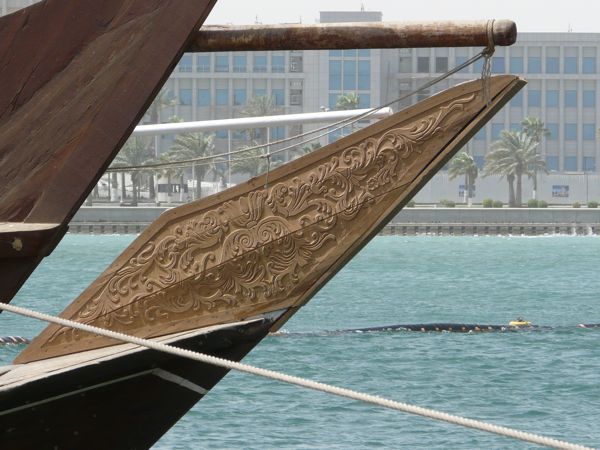
We were so sad, visiting Oman, to see that dhow building has gone into decline in Sur, and then equally delighted to see the craft being revised and guarded in Doha. The new dhows being built preserve the design of the older working dhows, and include extra, labor intensive and expensive touches, like the wood carving:
I had to start with this one, because it includes the fabulous QCPI (Qatar Center for the Presentation of Islam) building in the background – what an impact it gives the Doha skyline!



Minister Proposes Eliminating Prostitution Entirely
From today’s Al Watan / Daily Star:
Minister vows to eradicate prostitution
KUWAIT: Interior Minister Sheikh Jaber AlـKhaled AlـSabah on Wednesday pledged to eradicate prostitution and close down any brothels in all of Kuwait”s districts. He said that the ministry will not hesitate to take legal action against any person or official who does not accomplish his role in banning such unethical behavior.
“Kuwait”s territory means a lot to us, and I am extremely concerned about the entire country, not just one district,” said AlـKhalid.
Sheikh Jaber said that the ministry intends to launch a major campaign against brothels and prostitution, in order to end such phenomena in Kuwait. ـAgencies
My comment: I commend the Minister, and I admire his resolve. I hate prostitution; I hate the fakery involved, I hate what it does to the prostitutes, their futures, and how it damages family relations.
But how do you stop prostitution? How can you eliminate the supply, when the demand continues? Instead of the pathetic prostitutes and their demented pimps, perhaps the focus should be on the customers who encourage prostitution to exist?
Japan, Seeking Trim Waists, Measures Millions
This article, from The New York Times (you can read the entire article by clicking here) gives me a big grin.
I can’t imagine American lining up because the government says we will have our waists measured, and be expected to meet a certain standard or lose weight and be penalized. Can you imagine Kuwaitis allowing the government to tell them how big their waists can be?
Japan is one of the most law-abiding nations on earth – I guess you have to be, when you have so many people occupying so little space. When you think of the Japanese, you think of politeness, courtesy. Outbreaks of rage are an anomoly.
And the government is right – obesity causes more and more expense down the road because it exacerbates other conditions. But someone’s weight is a very personal thing!
By NORIMITSU ONISHI
Published: June 13, 2008
A poster at a public health clinic in Japan reads, “Goodbye, metabo,” a word associated with being overweight. The Japanese government is mounting an ambitious weight-loss campaign.
Summoned by the city of Amagasaki one recent morning, Minoru Nogiri, 45, a flower shop owner, found himself lining up to have his waistline measured. With no visible paunch, he seemed to run little risk of being classified as overweight, or metabo, the preferred word in Japan these days.
But because the new state-prescribed limit for male waistlines is a strict 33.5 inches, he had anxiously measured himself at home a couple of days earlier. “I’m on the border,” he said.
Under a national law that came into effect two months ago, companies and local governments must now measure the waistlines of Japanese people between the ages of 40 and 74 as part of their annual checkups. That represents more than 56 million waistlines, or about 44 percent of the entire population.
Those exceeding government limits — 33.5 inches for men and 35.4 inches for women, which are identical to thresholds established in 2005 for Japan by the International Diabetes Federation as an easy guideline for identifying health risks — and having a weight-related ailment will be given dieting guidance if after three months they do not lose weight. If necessary, those people will be steered toward further re-education after six more months.
To reach its goals of shrinking the overweight population by 10 percent over the next four years and 25 percent over the next seven years, the government will impose financial penalties on companies and local governments that fail to meet specific targets. The country’s Ministry of Health argues that the campaign will keep the spread of diseases like diabetes and strokes in check.
The ministry also says that curbing widening waistlines will rein in a rapidly aging society’s ballooning health care costs, one of the most serious and politically delicate problems facing Japan today. Most Japanese are covered under public health care or through their work. Anger over a plan that would make those 75 and older pay more for health care brought a parliamentary censure motion Wednesday against Prime Minister Yasuo Fukuda, the first against a prime minister in the country’s postwar history.
Qatteri Cat’s Lazy Summer Days
The Qatteri Cat sends his greetings and wants you to know he is doing fine, just kicking back and enjoying the hot summer sun. He has a couple favorite places, near windows, where he can watch the world go by. He steps down to nibble a little grass from time to time, or to go get a bite to eat, or sip a little water (especially after AdventureMan has showered, he says that is the BEST!), but he is just taking life easy right now.

Jody Shields and The Fig Eater
This is one of those books I picked up off the staff recommendations shelf at Barnes and Noble – one of the very best sources for cult classics like Wicked: The Life and Times of the Wicked Witch of the West, books that don’t get a lot of press hype but whose readership grows slowly by word-of-mouth.
The cover caught my eye. This woman is dressed modestly enough, all the important parts are covered, but look at her eyes – there is a sultriness there, and a challenge that I find intriguing. This shows signs already of being an-out-of the-ordinary book.

The book opens in the early 1900’s with a murder. We follow the investigations of the chief Inspector, and we follow the parallel investigations of his wife, a Hungarian, Erszebet, and her ally, the English Wally. It’s a mystery, and in this exquisite book, the process of solving the mystery is so much more interesting than who actually did it, or even why.
The most fascinating character in The Fig Eater is the nature of fin de siecle Vienna, it’s customs, it’s caste system, it’s manners, and the fusion of East and West. Entire meals are described, cafe’s, cakes, cooking methods. Clothing is described in loving detail, and we visit a tuburculosis sanitarium as well as an insane asylum.
We study Kriminalistics with the Inspector and his assistant, we learn the fundamentals of early photography from an three fingered photographer. We experience early Viennese medical practices.
We learn all kinds of Hungarian superstitions and beliefs, we dance at the Fasching Balls of Vienna, and we simmer with the repressed sexuality of the times. We mourn with the bereaved, we shiver in the cold winter, and we steam in the brutal heat of an extended summer.
The end is so totally unexpected that I had to go back and read it again. My bet is, that if you accept the challenge of reading this book, you will have to, too. Even after you have read it again, you will not be totally sure what has happened, and yet . . . it is a satisfying ending.
This was a wonderful read.
I will leave you with a quote:
The Inspector has always prided himself on his ability to listen, as a good Burger is confident of his business acumen. During interrogations, he can distinguish the different qualities of the witnesses silence, as if it were a tone of voice.
He had admonished Franz more than once for interrupting him. Don’t be so hasty. Slow down and listen. In the Pythagorean system, disciples would spend five years listening before they were allowed to ask a single question. That was in the 4th Century BC. Another philosopher, Philo of Alexandria, wrote about Banquets of Silence, where even the correct posture for listening was determined.
In Kriminalistic there is a text on the subject. He orders Franz to read it as part of his lesson. “To observe how the person question listens is a rule of primary importance, and if the officer observes it he will arrive at his goal more quickly than by the hours of examination.”
Recent Comments
intlxpatr on A Lawless, Authoritarian … Kuwait Someday on A Lawless, Authoritarian … intlxpatr on Oh Thank You, Amazon! Rivergirl on Oh Thank You, Amazon! intlxpatr on Give to Those Who Ask Wikipedia Donate Button

Amazina


Early Voting in Florida


 Here There and Everywhere