I had one reader write me in the background saying I was rude to publish these letters. No, It is not rude. I told her/him about all the hits I get on these publishings; people who are checking out the names, who get the same trusted friend letters I get, fishing for the gullible reader who will succumb. When we share these scam letters (and phone numbers) we protect others from identity fraud and losing money to cons and scams.
Hello My Dearest
Please permit me to introduce myself, my name is Sabrina Kipkalya Kones, 24yrs old female (single) and i’m from Kenya in East Africa. I appeal to you to exercise a little patience and read through my letter because i feel quite safe dealing with you in person, for that, I’m writing this mail to you with due respect, trust and humanity and with pains, tears and sorrow from my heart, strongly believing in Al-Mighty God/Allah that you will consider my letter and help me and also benefit from me. Although, we have neither met in person nor by communication. But i believe, it is one day you get to know someone, either by physical or through correspondence. Honestly, i wish to contact you personally for a long term business relationship and investment assistance in your country.
My Father (Hon. Kipkalya Kones)was the former Kenyan road Minister. He and the assistant minister of home affairs (Mr.Lorna Laboso) were on board when the plane crashed on the Tuesday 10th, June, 2008 which was headed to kericho and crashed in a remote area called kajong’a, in Western Kenya and the plan number was ( Cessna 210 ). My late Father was an investor, he Invested his fund to Kenya stock exchange market, Gold storing investment, he was a preference shareholder in Shell Petroleum Company and deals in Real Estate building investment. My late Father deposited the sum of USD$5.800.000.00M in my name here in Burkina Faso.
You can read more about the crash through the below site: http://edition.cnn.com/2008/ WORLD/africa/06/10/kenya. crash/index.html
You are entitle of financial benefit of 30% of the total fund and 5% will be set aside for any expenses incured during the time ofcompleting the transaction on your side, while the rest of the fund shall be my investment capital in your country. i have no knowledge of international transaction of this nature but I took this decision personally because it occured to me that transfer of this type must involve an expenditure,on the other hand, in the absent of expenses, the 5% set aside will be return to me. As soon as I receive your positive response showing your interest I will put things into action immediately. In the light of the above, I shall appreciate an urgent message indicating your ability and willingness to handle this transaction sincerely. Awaiting your urgent and positive response.
Please do keep this only to your self for now until the bank will transfer the fund. I beg you not to disclose it until i come over because I am afraid of my wicked uncle who has threatened to kill me and have the money alone ,I thank God Today that am out from my country (Kenya) but now In(Burkina Faso) where my father deposited these money with my name as the next of Kin. I have the documents for the claim.
The New Yorker is an expensive subscription and worth every penny. This article takes an enormously complex situation, breaks it down into components and summarizes the options and their drawbacks. No wonder President Obama is having a problem finding a strategy – there aren’t a lot of winning options out there, and we don’t need to get stuck with another tar baby.
Wars cost money. There is an election coming up. The economy is just now moving past the downswing, and we still have wounded from Iraq and Afghanistan to take care of. Can anything we do make a difference? Will that difference be appreciated or will it add to our reputation as a world bully? All these are factors when formulating a strategy.
At the end of the eighth century, Harun al-Rashid, a caliph of the Abbasid dynasty, built a palace in Raqqa, on the Euphrates River, in what is now Syria. His empire stretched from modern Tunisia to Pakistan. It was an age of Islamic discovery in science, music, and art; Rashid’s court of viziers inspired stories in “One Thousand and One Nights.”
In June, the Islamic State in Iraq and al-Sham (ISIS) declared Raqqa the seat of a new caliphate, presided over by Abu Bakr al-Baghdadi, a fierce preacher who was once an American prisoner in Iraq, and is now in hiding. The city has lost its splendor. Public executions are “a common spectacle” on Fridays in El Naim Square or at the Al Sa’a roundabout, a United Nations human-rights commission reported last month. ISIS fighters mount the dead on crucifixes, “as a warning to local residents.”
ISIS emerged a decade ago as a small Iraqi affiliate of Al Qaeda, one that specialized in suicide bombings and inciting Iraq’s Sunni Muslim minority against the country’s Shiite majority. The network regenerated after 2011 amidst Iraq’s growing violence and the depravities of Syria’s civil war. This year,ISIS has conquered cities, oil fields, and swaths of territory in both Syria and Iraq. The movement draws its strength from Sunni Arab communities bitterly opposed to the Shiite-led government in Baghdad and the Alawite-dominated regime in Damascus, led by Bashar al-Assad.
Defense Secretary Chuck Hagel has called ISIS “as sophisticated and well funded as any group that we have seen . . . beyond anything we have seen.” The group has former military officers who can fly helicopters, spot artillery, and maneuver in battle. ISIS is increasingly a hybrid organization, on the model of Hezbollah—part terrorist network, part guerrilla army, part proto-state.
President Obama has decided that the United States must now attack ISIS, if only from the air. The President vacationed on Martha’s Vineyard, and golfed conspicuously, as his initial aerial campaign in Iraq unfolded. He has been less than forthright about why, after pledging to end America’s costly war in Iraq, he believed a return to battle there was necessary. But in interviews and other forums Obama has offered a casus belli, in three parts.
ISIS has massacred religious minorities, including Christians and Yazidis, and American air strikes can prevent more wanton killing, the President has said. A second imperative is the defense of the Kurdistan Regional Government, a semi-autonomous, oil-endowed American ally in northern Iraq, which a few weeks ago was teetering under pressure from ISIS but has since recovered, with the aid of American air power. The third, and most resonant, reason that the President has given is self-defense: to disrupt ISIS before it tries to attack Americans in the region or inside the United States.
ISIS has beheaded one American journalist, James Foley, and threatened to execute a second. Yet some terrorism specialists point out that ISIS is consumed by the sectarian wars in Syria and Iraq, and has shown no intent to launch attacks in the West, or any ability to do so. Still, ISIS has attracted five hundred British volunteers, many scores of other European passport holders, and even some Americans to its fight; they might eventually turn toward London, Berlin, or New York. Last week, British authorities announced that the threat of a terrorist attack on its home soil was “severe,” given the rising number of British jihadis now among the militants in Iraq and Syria.
The question about President Obama’s resumption of war in Iraq is not whether it can be justified but where it will lead. Air strikes against a well-resourced guerrilla army will do little if they are not accompanied by action on the ground. It would be a catastrophic error for the United States to take on that role. But what other professional force will dislodge the self-proclaimedISIS caliphate and then control the population? American policy assumes that Iraq’s squabbling politicians will rally a Shiite-led army to fight ISIS in the country’s Sunni heartland. On recent evidence, this assessment looks unrealistic.
In Syria, the options are worse. Obama has said repeatedly that he does not believe that Syria’s moderate rebels have the capacity to overthrow Assad or defeat jihadists. Yet the alternatives would allow Syria’s violence to fester at the cost of tens of thousands more civilian lives or would tacitly condone an alliance with the brutal Assad, who has been implicated in war crimes.
Obama and his advisers have at times taken refuge in a self-absolving logic: We can’t force people in other countries to unite around our agenda, so, if they don’t, whatever calamity unfolds is their responsibility. As a retreat from American hubris, this form of realism has appeal. As a contribution to a stable Middle East, it has failed utterly.
It is not yet clear that ISIS will endure as a menace. Fast-moving extremist conquerors sometimes have trouble holding their ground. ISIS has promised to govern as effectively as it intimidates, but its talent lies in extortion and ethnic cleansing, not in sanitation and job creation. It is vulnerable to revolt from within.
The group’s lightning rise is a symptom, however, of deeper instability; a cause of that instability is failed international policy in Iraq and Syria. If the United States is returning to war in the region, one might wish for a more considered vision than Whack-a-Mole against jihadists.
The restoration of human rights in the region first requires a renewed search for a tolerable—and, where possible, tolerant—path to stability. ISIS feasts above all on the suffering of Syria, and that appears to be unending. The war is in its fourth year, with almost two hundred thousand dead and nine million displaced, inside the country and out. The caliphate now seated in Raqqa is the sort of dark fantasy that can spring to life when people feel they are bereft of other plausible sources of security and justice.
“We don’t have a strategy yet,” the President remarked last week, infelicitously, about Syria. He does have a coalition of allies in the region that are willing to challenge ISIS’s ambition, including Jordan, Turkey, Saudi Arabia, and the United Arab Emirates. These countries patronize disenfranchised Sunnis in Iraq and Syria, and some of their support certainly reaches jihadists, includingISIS. Yet they share an interest in reducing Syria’s violence and in promoting regional and local Sunni self-governance that is less threatening and more sustainable than what ISIS has created. Ultimately, Sunnis will need the kind of autonomy that Kurds presently enjoy.
Leading a coalition of this character is hard, uncertain work. George H. W. Bush, the President whose foreign policy Obama seems to admire most, did it successfully in the runup to the Gulf War of 1991, by intensive personal engagement. Obama has more than two years left in the White House. To defeat ISIS, but also to reduce its source of strength, will require the President to risk his credibility on more than just air strikes.
Steve Coll, a staff writer, is the dean of the Graduate School of Journalism at Columbia University, and reports on issues of intelligence and national security in the United States and abroad.
Every year around this time, we get a whopper of a cable bill, far above our normal bill.
And we gird for war.
I used to handle it and AdventureMan would sometimes laugh from his office. (Once an insurance agent said to me “You READ the policy??” when I told her I was discontinuing it because the things it covered were things that didn’t apply, and the things that I needed weren’t covered.) When AdventureMan volunteered to handle the annual cable bill call, I danced for joy.
If you want to win, you have to have a strategy. But not any old strategy is going to win the cable bill battle, you have to have the strength and fortitude for THE LONG PHONE CALL.
As we do this, I can hear my Dad’s voice as he would do battle over the phone, with the post office over an extra charge on a package, or a financial institution about just when that interest should be paid and how it should be calculated.
You can’t do this unless you have the time and energy.
AdventureMan ultimately prevails, and saved us over $600 over the course of the cable year, but it is a tedious battle, at one point, the equivalent of a siege, a battle of attrition, as he goes through what we are buying line by line.
The cable representative, however, has his own weapons – wire and smoke and mirrors, disguised as bundles and discounts and specials. They can “stack” some, but not others, and the packages may not be as described. It’s dirty warfare, down in the trenches, but the ultimate weapon is that AdventureMan has the time, and they have their time limits.
One day we are hoping to walk away from cable altogether, but until we can figure out how to get Downton Abbey, Game of Thrones, and other programs we like on a reliable basis, we stick with the devil we know.
Its been a sad couple of months, starting with our cat’s death, and a friend’s death. We grieve Pete, we miss him, and we ask ourselves if we made a big mistake thinking a knee operation would be the right thing, if he would have lived happily without it? Pete was in pain. There were days he couldn’t go up the stairs. There were days he spent almost the entire day in his heated bed. We didn’t see a lot of options. Other sad news has hit; it feels like a season of losses.
In the Lectionary readings, we are reading Job, Ayyoub, and I think if my friend who said “Al-hamdallah!” when I told her my father is dying. I learned so much from her. She made me understand I am to thank God even for the bad things, it is God’s will, and a part of a bigger picture I will never see. And then this morning, I saw a reference to an old post, a post from 2006, a post I don’t even remember writing.
Thorns Sandra felt as low as the heels of her shoes as she pushed against a November gust and the florist shop door.
Her life had been easy, like a spring breeze. Then in the fourth month of her second pregnancy, a minor automobile accident stole that from her.
During this Thanksgiving week she would have delivered a son. She grieved over her loss. As if that weren’t enough, her husband’s company threatened a transfer. Then her sister, whose holiday visit she coveted, called saying she could not come for the holiday.
Then Sandra’s friend infuriated her by suggesting her grief was a God-given path to maturity that would allow her to empathize with others who suffer. She has no idea what I’m feeling, thought Sandra with a shudder.
Thanksgiving? Thankful for what? She wondered. For a careless driver whose truck was hardly scratched when he rear-ended her? For an airbag that saved her life but took that of her child?
“Good afternoon, can I help you?” The shop clerk’s approach startled her.
“I….I need an arrangement,” stammered Sandra.
“For Thanksgiving? Do you want beautiful but ordinary, or would you like to challenge the day with a customer favorite I call the Thanksgiving “Special?” asked the shop clerk. “I’m convinced that flowers tell stories,” she continued. “Are you looking for something that conveys ‘gratitude’ this thanksgiving?”
“Not exactly!” Sandra blurted out. “In the last five months, everything that could go wrong has gone wrong.”
Sandra regretted her outburst, and was surprised when the shop clerk said, “I have the perfect arrangement for you.”
Just then the shop door’s small bell rang, and the shop clerk said, “Hi, Barbara…let me get your order.” She politely excused herself and walked toward a small workroom, then quickly reappeared, carrying an arrangement of greenery, bows, and long-stemmed thorny roses. Except the ends of the rose stems were neatly snipped: there were no flowers.
“Want this in a box?” asked the clerk.
Sandra watched for the customer’s response. Was this a joke? Who would want rose stems with no flowers! She waited for laughter, but neither woman laughed.
“Yes, please,” Barbara, replied with an appreciative smile. “You’d think after three years of getting the special, I wouldn’t be so moved by its significance, but I can feel it right here, all over again,” she said as she gently tapped her chest. And she left with her order.
“Uh,” stammered Sandra, “that lady just left with, uh….she just left with no flowers!
“Right, said the clerk, “I cut off the flowers. That’s the Special. I call it the Thanksgiving Thorns Bouquet.”
“Oh, come on, you can’t tell me someone is willing to pay for that!” exclaimed Sandra.
“Barbara came into the shop three years ago feeling much like you feel today,” explained the clerk. “She thought she had very little to be thankful for. She had lost her father to cancer, the family business was failing, her son was into drugs, and she was facing major surgery.”
“That same year I had lost my husband,” continued the clerk, “and for the first time in my life, had just spent the holidays alone. I had no children, no husband, no family nearby, and too great a debt to allow any travel.”
“So what did you do?” asked Sandra.
“I learned to be thankful for thorns,” answered the clerk quietly. “I’ve always thanked God for the good things in my life and never questioned the good things that happened to me, but when bad stuff hit, did I ever ask questions! It took time for me to learn that dark times are important. I have always enjoyed the ‘flowers’ of life, but it took thorns to show me the beauty of God’s comfort. You know, the Bible says that God comforts us when we’re afflicted, and from His consolation we learn to comfort others.”
Sandra sucked in her breath as she thought about the very thing her friend had tried to tell her. “I guess the truth is I don’t want comfort. I’ve lost a baby and I’m angry with God.”
Just then someone else walked in the shop. “Hey, Phil!” shouted the clerk to the balding, rotund man.
“My wife sent me in to get our usual Thanksgiving Special….12 thorny, long-stemmed stems!” laughed Phil as the clerk handed him a tissue-wrapped arrangement from the refrigerator.
“Those are for your wife?” asked Sandra incredulously. “Do you mind me asking why she wants something that looks like that?”
“No…I’m glad you asked,” Phil replied. “Four years ago my wife and I nearly divorced. After forty years, we were in a real mess, but with the Lord’s grace and guidance, we slogged through problem after problem. He rescued our marriage. Jenny here (the clerk) told me she kept a vase of rose stems to remind her of what she learned from “thorny” times, and that was good enough for me. I took home some of those stems. My wife and I decided to label each one for a specific “problem” and give thanks for what that problem taught us.”
As Phil paid the clerk, he said to Sandra, “I highly recommend the Special!”
“I don’t know if I can be thankful for the thorns in my life.” Sandra said. “It’s all too…fresh.”
“Well,” the clerk replied carefully, “my experience has shown me that thorns make roses more precious. We treasure God’s providential care more during trouble than at any other time. Remember, it was a crown of thorns that Jesus wore so we might know His love. Don’t resent the thorns.”
Tears rolled down Sandra’s cheeks. For the first time since the accident, she loosened her grip on resentment. “I’ll take those twelve long-stemmed thorns, please,” she managed to choke out.
“I hoped you would,” said the clerk gently. “I’ll have them ready in a minute.”
“Thank you. What do I owe you?”
“Nothing. Nothing but a promise to allow God to heal your heart. The first year’s arrangement is always on me.” The clerk smiled and handed a card to Sandra. “I’ll attach this card to your arrangement, but maybe you would like to read it first.”
It read: “My God, I have never thanked You for my thorns. I have thanked You a thousand times for my roses, but never once for my thorns. Teach me the glory of the cross I bear; teach me the value of my thorns. Show me that I have climbed closer to You along the path of pain. Show me that, through my tears, the colors of Your rainbow look much more brilliant.”
Praise Him for your roses; thank him for your thorns!
I know God can bring great good out of all things. I have seen this in my own life, out of the worst circumstances can come good I could never have foreseen. I am praying this fervently; that he will bring great good out of all circumstances.
“Did she just say what I thought she said? my co-leader asked me, and I laughed.
“You mean ‘You’re not from around here?'” I said, which was not exactly what she had said but was exactly what she meant. He laughed.
“Exactly!” he said, and he laughed.
She had not used those exact words, but, uncomfortable with some of the questions our diplomats were asking, and clearly over her head, she had turned to me and asked me how long I’d been here, and dismissing me, told the group she had been here all her life, etc. I hadn’t been arguing with her. I hadn’t said a word. I was just the nearest dog to kick, someone on whom she could vent her frustration.
It’s so human. I’ve never lived anywhere that I didn’t hear some version of it, rarely to my face, usually about others, but it’s a fall-back position and it is present in every culture.
I told him about my many moves – 31 – and my cat theory. When you bring a new cat into a house with cats, you shut the new cat in a room (with food and litter, you know, cat things) until the other cats get used to the smell. Then you allow the new cat among the old cats for a short time and put it away again. You do this for a couple days, and then allow the cat to be among the other cats with you present to see how it goes. Sometimes it takes a while for the new cat to be accepted. Sometimes a cat just fits right in.
I told him I do the same thing, when I get to a new place I just quietly show up, in church, in a new group or two, and stay quiet. I watch who sits with whom, I listen to what they say. Sometimes one time with a group is enough, and I know it’s never going to be a good fit and I don’t go back. Other groups, I just keep showing up but I stay quiet . . you know, letting them get used to my “smell,” LOL.
Most of the time, I fit right in. It doesn’t take that long. Every now and then I run into a cat who doesn’t appreciate my presence, and I have to make a decision. Usually it is a bully-cat who can sniff our my independence and irreverence in spite of my deferential behavior; sometimes I will stick around, sometimes I back away. You’re not going to change a bully-cat, and I am not one for a cat-fight. The bully-cats often do themselves in and implode.
This woman was busy imploding.
My generally enthusiastic group was quiet when they got back on the bus, and I let them be. I really didn’t want to deal with this meeting, either.
The next day, we all talked. I asked what they had learned from the meeting and one diplomat, the most outspoken, said “Learned nothing! She talked and talked and talked (she was doing that hand thing that means a person is talking and talking) and she never answered a single question!”
A second diplomat laughed and said “Like a diplomat, only we are better at it” and everyone laughed.
This is the hottest part of the summer. You’d think in late August things would start cooling down a little, but no, we hit a record high last week and we haven’t had a good rain for weeks.
September is worse. When I think September, I think back to school, sweaters and wool skirts. Even in Seattle, it is too warm in September for sweaters and wool skirts; the afternoons can get really warm in September. In Pensacola, it’s just mostly a continuation of an endless August, a waiting for October. The only hint of winter is a slight cooling of night time temperatures.
I dream of Alaska, of Montana, and North Dakota, I dream of cool nights sleeping with an open window, I dream of featherbeds and brisk walks on chilly mornings . . .
Some of our friends have no idea what life is like in places like Qatar and Kuwait, it’s like they think we lived in tents in the desert. They don’t know about all the sky scraping apartment blocks, the spacious villas – and they don’t know about the ubiquity of take-out food and good restaurants. We could find almost everything we wanted, and reveled in the variety, the only thing we could not get was genuine Mexican food. You could go to Chili’s or Taco Bell, but for the real deal? No where.
So in Pensacola, we are blessed to have several very good Mexican restaurants, the Cal-Mex and the Tex-Mex kind, where sour cream and lettuce and guacamole bless every plate, but every now and then, we look for where the Mexicans are eating – and we found a new one, well, new to us, and not too far away.
Taqueria Olgy is in a small strip mall just south of Beverly on “W” street. It’s the first mall on your left as you drive south and you had better keep your eyes wide open or you will miss it; the signage is not that significant.
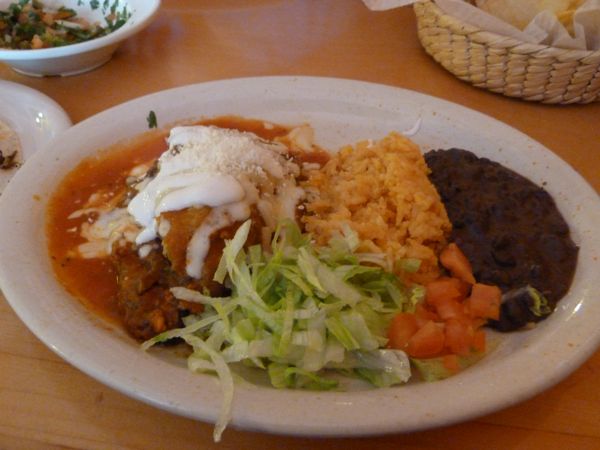
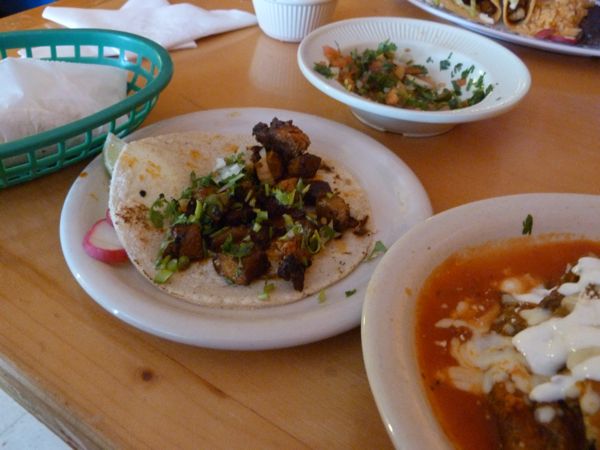
Inside, it is very spacious, maybe two strip mall sections that have merged, lots of booths, and lots of loyal customers. The menus are in English, and there are photos everywhere to help you choose. We were there at lunch and had the lunch specials. I haven’t had a chile relleno for a long time, so I choose the #1 special, a chili relleno and a taco (you could choose the kind of meat) Al Pastore. Oh YUMMMMM.
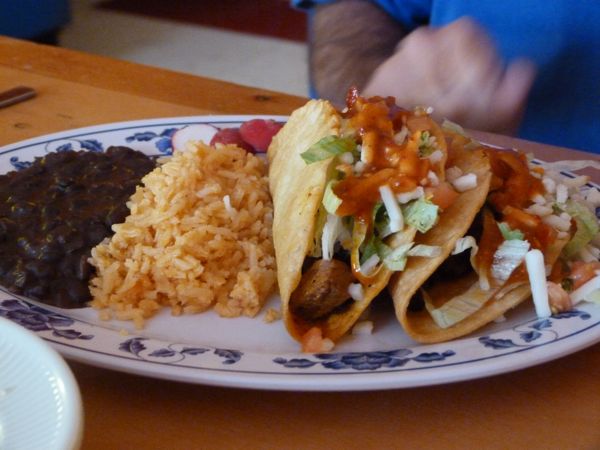
AdventureMan had the taco plate and said his was also really good. He liked it so much that while I was with the group last week, he went back and had the soup of the day and the #1 chile relleno with taco that I had.
We are still huge Taco Rock fans, but hey, it’s August, the temperatures are in the soaring and searing mode, and Taqueria Olgys is also well air conditioned. We feel so blessed to have such great authentic places to choose from.
Now, if only a good Ethiopian restaurant would come to Pensacola . . . 😉
The people in my group last week suffered greatly in the high temperatures and high humidity we are experiencing. I must be adapting a little; I remember being thankful for the breeze.
“What do you wear when it gets this hot?” they asked me, “like around the home?”
I laughed. I learned a thing or two in Tunis, in Amman, in Tabuk and Riyadh, in Kuwait and in Doha. At home, I dress like local women, in long loose dresses.
Or worse. I dress like their maids. In the souks you could find wonderful, 100% cotton dresss that were loose and flowing, and that is good in hot weather so the air can circulate. Some of the dresses were nicer, but the dresses I liked a lot for just being around the house doing what people do, like making sure the dishes are done and a meal prepped, doing a little quilting or reading . . . you could buy these great little dresses for about $3.00 in the souks. Not only were they practical – especially when you live in a house with a cat, and always put on “real” clothes just as you are about to run out the door so you don’t have any cat hair on you – but they came in great colors and prints, designs that made me happy to put them on.
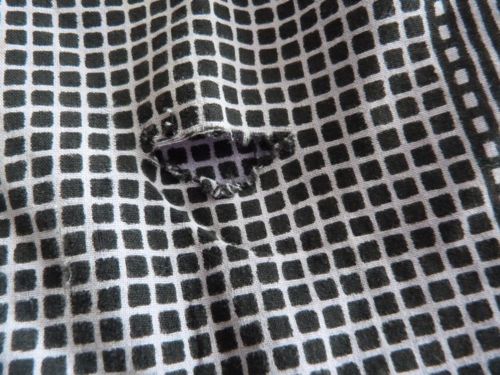
Now, one of my all time favorite dresses, in purple and black, has bit the dust. I liked it because it had some geometrics, and the geometrics changed, and – it was purple. I have worn it for about six years now, and I have worn it out. I mended it several times when the underarm seams ripped:
But now, it has gotten all soft, so soft the material just rips easily with holes that cannot be mended.
I like this dress so much I am saving it and cutting it up so it will have another new life as a quilt 🙂
And I am thinking it is time to plan a trip back to Doha and Kuwait to replenish my hot weather dresses 🙂
I had a really super group of diplomats in town this week, really smart people dealing with serious topics – arms control, human rights, freedom of the press, immigration – and the appointments were fabulous. They were greeted at Baskervile-Donovan by a German speaker, coffee and cakes, and the presentation was a clear outline on corporate fund raisers, goals, and candidate selection.
We had a few extra minutes before our next appointment, and as we were just next door to Joe Patti’s, I took them there for a peek into life for “real” Pensacolians. Of course, they loved Joe Patti’s.
While I was there, my phone rang and it was a stranger, telling me she had a package for me from a friend in Kuwait. When could she bring it by?
You know how sometimes it’s hard to think? My mind was full with my delegation, but I set a time – and I was at Joe Pattis, so I quickly bought some cookies to serve and headed out for our next appointment.
When I said goodbye to the delegation for the last time and headed home, I put the coffee on and prepared for my Kuwait guests. They arrived and we had a wonderful visit, a friend in common and lots to talk about. And oh my, the packet my friend sent, full of fabrics from the Kuwait souks, a care package for my quilting addiction:
Even better – and it feels so wonderful to have a friend who understands me so well – look at the bag she sent them in! It is SO adorable! It is something I would have bought in a heartbeat, so unique, so special! My heart is dancing with ideas for a new quilt!
Thank you, Hayfa 🙂 for a real treat, both the fabrics and the friend you sent to carry the package 🙂








 Here There and Everywhere