Much Cooler
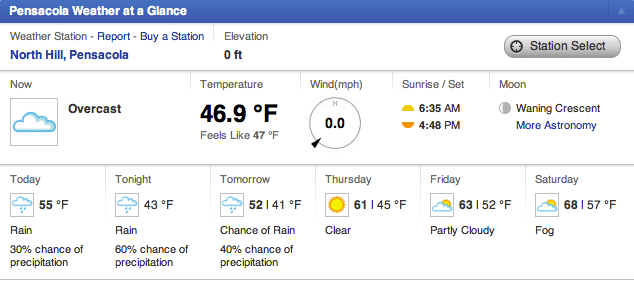
“Today is forecast to be much cooler than yesterday”
This morning I woke up to discover I had slept eight hours. This is something wonderful for me; a week ago I had to give up taking Benedryl. I am a light sleeper, and I have allergies, so taking one Benedryl every night helped me with both. My doctor said it was time to give it up, that components of Benedryl are thought to contribute to formation of those plaques that speed Alzheimer’s and dementia. Yikes!
For a week I have struggled. I could go to sleep normally, but would awake around three and spend a couple hours wishing I were asleep. Sometimes I could fall back asleep, sometimes not. Part of the problem is the unseasonal warmness of the temperatures, I toss and turn, looking for a cool place.
Then, if I had not managed to get back to sleep, I would find myself getting cross during the following day, a sure sign, just like a toddler, that I need a nap. My naps would be deep and restoring, but probably not that great if I wanted to sleep well the next night. It was a self-perpetuating and destructive cycle. I wondered if I would ever be able to sleep normally again.
Last night I slept normally, and deeply. I woke at six, rested, happy. It helped that the Qatari Cat found elsewhere to curl up last night; many a night I wake up and he is tangled up in my legs and bedding, snoring with contentment. Most important – last night it was cooler. When the temperatures hit in the seventies outside, it can be around 80°F inside when we go to bed, and it makes me restless. I like colder temperatures, and – last night was colder. I slept great! It gives me hope!
Temperatures are lower today, too, and it gives me energy. The heat saps my drive; the cooler temperatures help me be more productive, a good thing in a season where there is much to do! 🙂
Tant de Brouillard – Foggy Morn in Pensacola
I learned a new word today, le brouillard, from a blogger who liked my Pensacola parade post. I always take a look to see, and this time, it was like taking a brief vacation to a place I love – the villages of France, and the morning market, or marche. His blog is My French Heaven, and he writes in French and English, good exercise for those of us who need to polish up our language skills. Warning: the photos on his blog are EXPLICIT. You will want to eat those oysters, vegetables and sweets right off the page.
He was waiting, this morning, for ‘le brouillard se dissipe’ and I smiled because on my way home from the early service this morning, I had to stop and take some photos of foggy Pensacola and the foggy bayou:


If, in the midst of this crazy time of the year, you can give yourself a small gift and a short virtual vacation, take a moment to have a cup of green tea and visit my friend Stephane at My French Heaven.
Pensacola Christmas Parade 2012
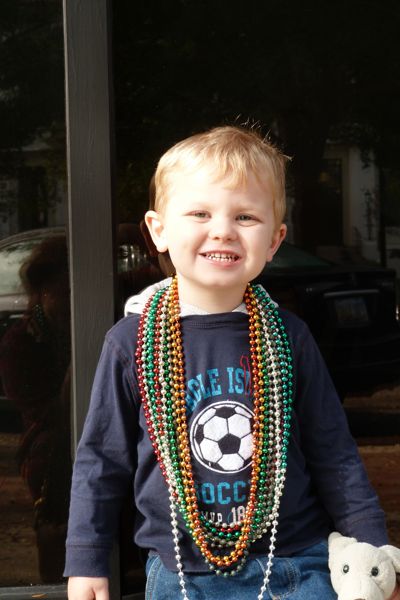
A perfect evening. Got there minutes before the one mile runners came by, parking at our church and walking to our favorite spot, meeting up with our son, his wife, and the adorable little boy who truly gets everything that is happening. This is his third parade; he always loved the lights and loud noises, but this year, he GETS it, gets the floats and the bands and the BEADS!
“I love this tradition,” my daughter-in-law says, leaning over to kiss me as we meet up to watch the parade and do a little-boy-transfer. He is coming to spend the night with us. He has his own room in our house.
ZOOOOOMMMMM! the motorcycle police accompany the runners, EEERRRRRRRROOOOOOOOOWWWWWWWW the fire engine, all lights and noise comes by at the beginning of the parade, and then a high school band from New Orleans with a killer beat leads the parade. Wooooo HOOOOOOOO, shouts Intlxpatr, totally into another cultural experience. 🙂
One of the optical shops had running eyeballs, totally hilarious!

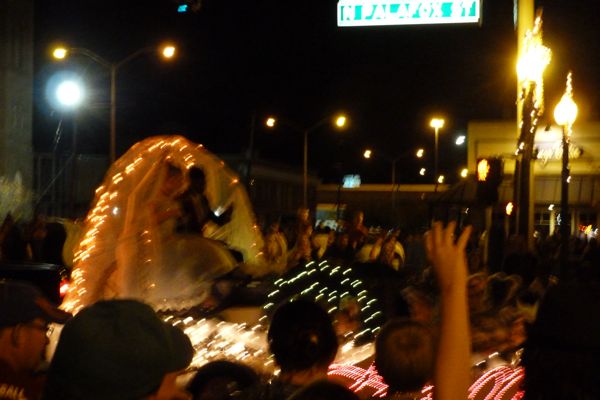
“Beads! Beads!”

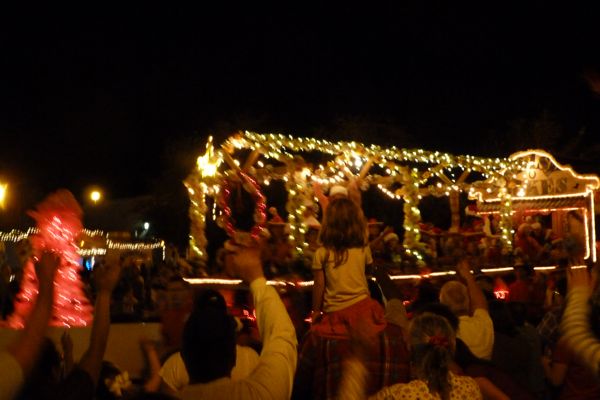
This float was giving out Chobani yoghurt

“Beads! Beads! More beads!” People taller than I were catching beads – and then passing them on to the little children. So kind, so generous.

My favorite, of course, a pirate ship:
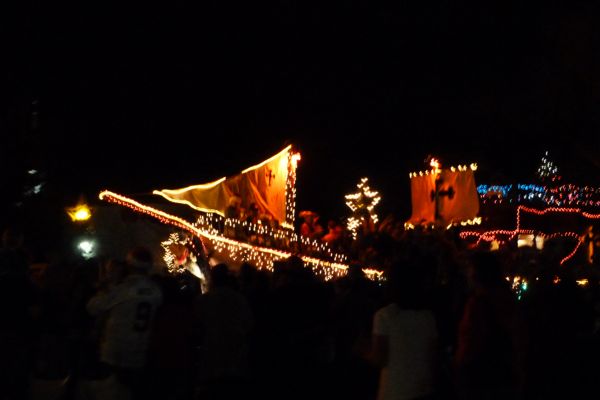
This parade is great fun. Here is a thing I love about Pensacola. About 50,000 people attend. Many walk from nearby neighborhoods, others drive down and park – there is still plenty of parking in Pensacola. People gather peacefully. There is no fighting over great spots; there are a lot of great spots from which you can watch the parade. At the end of the parade, everyone disperses peacefully – no fighting. In fifteen – twenty minutes the crowd is GONE, 50,000 people gone home, peacefully. It is a great community, all walks of life, all having a great time watching this home town Christmas parade.
Early this morning, the morning after, we started a new tradition – we got a long stick with a hook, and went after some of the beads stuck up in the trees. AdventureMan and Q got started while I went to church, meeting up with some experts who gave them tips – and beads. Such is the kindness of strangers, and the brotherhood of bead chasers. 🙂
Great Weather for the Pensacola Christmas Parade
The weather in Pensacola is crazy right now, after a couple months of cooling temperatures, we are up in the 70’s during the days and down in the 60’s at night, maybe the 50’s – it is so warm that our aloe is blossoming, she thinks it is spring.
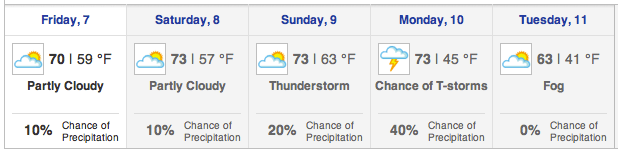
The good news is that the Pensacola Christmas Parade is tomorrow night, and it looks like it will be a balmy evening with NO RAIN! We are looking forward to taking our grandson – this will be his third Christmas Parade, but this is the first time he is really walking and talking, and we think the sound and lights (it always starts with the motorcycle police and the fire engines blasting and all their emergency lights spinning) are going to blow him away. This year he will be able to shout “beads! beads!” and scramble with the other kids for beads and candies; the parade is a wild mix of Christmas and Mardi Gras. It is a hilarious experience, and we are eager to see it through his eyes.

The Gift of Saint Nicholas
This is from today’s Lectionary reading on the saints, by James Kiefer; today is the feast of Saint Nicholas, and in many European countries, little children find their shoes filled with little gold coins (chocolate) or . . . sticks with coal (usually also candy, these days)
The true Saint Nicholas embodied the spirit of anonymous giving – a grace more rarely seen in these days of blogs and twitters and 15 seconds of news coverage.
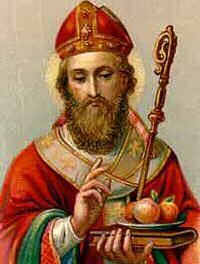
(of course I chose this image of Saint Nicholas because of the pomegranates 🙂 )
NICHOLAS OF MYRA
FRIEND OF CHILDREN, GIVER OF GIFTS, CLIMBER OF CHIMNEYS, ETC. (6 DEC 326)
The story of St. Nicholas offers a possible way of dealing with the “Santa Claus” problem, to parents who do not want to lie to their children, even in fun, but do not want to say simply: “Bah, humbug! There is no such thing as Santa. Forget about him.”
Nicholas was a native of the western part of what is now Asiatic Turkey. He became Bishop of Myra in the fourth century, and there are many stories of his love for God and for his neighbor.
The best-known story involves a man with three unmarried daughters, and not enough money to provide them with suitable dowries. This meant that they could not marry, and were likely to end up as prostitutes. Nicholas walked by the man’s house on three successive nights, and each time threw a bag of gold in through a window (or, when the story came to be told in colder climates, down the chimney). Thus, the daughters were saved from a life of shame, and all got married and lived happily ever after.
Because of this and similar stories, Nicholas became a symbol of anonymous gift-giving. Hence, if we give a gift to someone today without saying whom it is from, it can be called “a present from Saint Nicholas (or Santa Claus).” Some parents explain this to their children and invite the child to join them in wrapping a toy (either something purchased for that purpose, at least partly with the child’s allowance, or else a toy that the child has outgrown but that is still serviceable) or an outgrown but not shabby item of the child’s clothing, or a package of food, and then going along to donate it to a suitable shelter that will give it to someone who will welcome it. This gift is then called “a present from Santa,” so that the child understands that this is another name for an anonymous gift given to someone whom we do not know, but whom we love anyway because God does. (Presents within the family can be “From Santa” or “From Santa and…”)
Pictures of Nicholas often show three bags of gold next to him, and often these bags have become simply three disks or balls. Nicholas became the patron of an Italian city (I think Bari, which is where his body is now buried) that was a center of the pawnbroking business, and hence a pawnbroking shop traditionally advertises by displaying three gold balls over its front. It is thought that some persons looking at pictures of Nicholas confused the three round objects with human heads. Hence there is a story of a wicked innkeeper who murdered three boys and salted their bodies to serve to his guests, to save on the butcher’s bill. Nicholas visited the inn and confronted the innkeeper, who confessed his crime, whereupon Nicholas prayed over the brine-tub and the three boys leaped out unharmed. Other stories have him saving the lives of three innocent men who had been condemned to death. Still other stories have him coming to the rescue of drowning sailors (could this be related to the brine-tub incident?). Nicholas has always been popular with children, mariners, pawnbrokers, the Dutch, the Russians, and recently, the department-store owners. (American readers may remember the story of the brine-tub through reading it as children in the book The Dutch Twins, by Lucy Fitch Perkins, author of The Spanish Twins, The Italian Twins, and many similar books, all children’s favorites in the middle of this century. They may now be banned as politically incorrect — I have no idea. If your children know the brine-tub story, from this book or elsewhere, they may be interested to know how it may have originated.)
In many countries, Nicholas visits children on his feast day, 6 December, and brings them gifts then. In these countries, there is usually no exchange of Christmas presents, but there may be gifts again on January 6, the feast of the coming of the Wise Men, who brought gifts to the Holy Child of gold, frankincense, and myrrh. In America, it may be thought necessary to yield to outside pressure and let Nicholas distribute gifts on December 25.
If you want to show your children (or yourself) how Nicholas is remembered by Christians with a background different from your own (unless, of course, this IS your background), you might want to attend an East Orthodox service at this time. Many Eastern Orthodox congregations have services on the evening before 6 December that feature “visits from Saint Nicholas.” He appears as a bishop, with no red suit. The faithful leave their shoes outside the church door, and find in them afterwards gold coins (actually chocolate wrapped in gold foil) representing the gold dowries of the three daughters. To find a service and inquire what it is likely to be like, look up CHURCHES, ORTHODOX in the Yellow Pages. For an English-language service, “Orthodox Church in America” or “Antiochan Orthodox” parishes are likely choices, but do not overlook other possibilities.
We are told, but it is uncertain, that Nicholas was imprisoned for his faith before the accession of Constantine, and that he was present at the Council of Nicea in 325. We may note in passing that the picture of him as roly-poly is a late development. Early stories indicate that he was generous to others, but not given to self-indulgence. Indeed, even as an unweaned infant, he fasted regularly on Wednesdays and Fridays.
by James Kiefer
The Monarch Caterpiller Ornament
Only a friend can know you so well as to send you a gift like this. When I arrived home from Seattle, this was waiting, and we had to unwrap it right away. When I saw it, I laughed, and ran to show AdventureMan, and we nearly danced for joy, it is so perfect for our tree.
AdventureMan loves butterflies, is creating gardens to attract butterflies, and my sweet Doha friend was looking for a Monarch butterfly ornament, but instead, she found the caterpillar.

How perfect for Advent! We love the season of expectation, waiting for the birth of this dear little babe who will make all the difference. The caterpillar is the form of the Monarch before it goes into the caccoon and transforms into the Monarch. Perfect for the season of waiting expectantly 🙂
John of Damascus
This morning, as I read my Lectionary readings, I noticed I had skipped the Saint yesterday (I was trying to get a lot done) and it was John of Damascus. Checking the blog, I can see I printed this several years ago – 6 years! – but because it was new to me all over again, I am printing it again for you.
It is fascinating to me. John of Damascus defended the use of icons in worship. He distinguished between using an icon as an aide, and worshipping an icon. He was defended by his powerful position with a khalif, a Moslem who believes that images are forbidden. And we think WE live in interesting times . . . 🙂
JOHN OF DAMASCUS
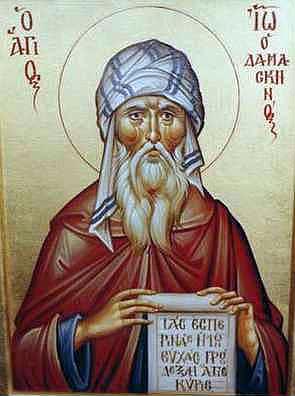
(I love this photo because he is wearing a gutra 🙂 )
HYMN-WRITER, DEFENDER OF ICONS (4 DEC 750)
John is generally accounted “the last of the Fathers”. He was the son of a Christian official at the court of the moslem khalif Abdul Malek, and succeeded to his father’s office.
In his time there was a dispute among Christians between the Iconoclasts (image-breakers) and the Iconodules (image-venerators or image-respectors). The Emperor, Leo III, was a vigorous upholder of the Iconoclast position. John wrote in favor of the Iconodules with great effectiveness. Ironically, he was able to do this chiefly because he had the protection of the moslem khalif (ironic because the moslems have a strong prohibition against the religious use of pictures or images).
John is also known as a hymn-writer. Two of his hymns are sung in English at Easter (“Come ye faithful, raise the strain” and “The Day of Resurrection! Earth, tell it out abroad!”). Many more are sung in the Eastern Church.
His major writing is The Fount of Knowledge, of which the third part, The Orthodox Faith, is a summary of Christian doctrine as expounded by the Greek Fathers.
The dispute about icons was not a dispute between East and West as such. Both the Greek and the Latin churches accepted the final decision.
The Iconoclasts maintained that the use of religious images was a violation of the Second Commandment (“Thou shalt not make a graven image… thou shalt not bow down to them”).
The Iconodules replied that the coming of Christ had radically changed the situation, and that the commandment must now be understood in a new way, just as the commandment to “Remember the Sabbath Day” must be understood in a new way since the Resurrection of Jesus on the first day of the week.
Before the Incarnation, it had indeed been improper to portray the invisible God in visible form; but God, by taking fleshly form in the person of Jesus Christ, had blessed the whole realm of matter and made it a fit instrument for manifesting the Divine Splendor. He had reclaimed everything in heaven and earth for His service, and had made water and oil, bread and wine, means of conveying His grace to men. He had made painting and sculpture and music and the spoken word, and indeed all our daily tasks and pleasures, the common round of everyday life, a means whereby man might glorify God and be made aware of Him. (NOTE: I always use “man” in the gender-inclusive sense unless the context plainly indicates otherwise.)
Obviously, the use of images and pictures in a religious context is open to abuse, and in the sixteenth century abuses had become so prevalent that some (not all) of the early Protestants reacted by denouncing the use of images altogether. Many years ago, I heard a sermon in my home parish (All Saints’ Church, East Lansing, Michigan) on the Commandment, “Thou shalt not make a graven image, nor the likeness of anything in the heavens above, nor in the earth beneath, nor in the waters under the earth — thou shalt not bow down to them, nor worship them.” (Exodus 20:4-5 and Deuteronomy 5:8-9) The preacher (Gordon Jones) pointed out that, even if we refrain completely from the use of statues and paintings in representing God, we will certainly use mental or verbal images, will think of God in terms of concepts that the human mind can grasp, since the alternative is not to think of Him at all.
(Here I digress to note that, if we reject the images offered in Holy Scripture of God as Father, Shepherd, King, Judge, on the grounds that they are not literally accurate, we will end up substituting other images — an endless, silent sea, a dome of white radiance, an infinitely attenuated ether permeating all space, an electromagnetic force field, or whatever, which is no more literally true than the image it replaces, and which leaves out the truths that the Scriptural images convey. (One of the best books I know on this subject is Edwyn Bevan’s Symbolism and Belief, Beacon Press, originally a Gifford Lectures series.[note – now out of print])
C S Lewis repeats what a woman of his acquaintance told him: that as a child she was taught to think of God as an infinite “perfect substance,” with the result that for years she envisioned Him as a kind of enormous tapioca pudding. To make matters worse, she disliked tapioca. Back to the sermon.) The sin of idolatry consists of giving to the image the devotion that properly belongs to God. No educated man today is in danger of confusing God with a painting or statue, but we may give to a particular concept of God the unconditional allegiance that properly belongs to God Himself. This does not, of course, mean that one concept of God is as good as another, or that it may not be our duty to reject something said about God as simply false. Images, concepts, of God matter, because it matters how we think about God. The danger is one of intellectual pride, of forgetting that the Good News is, not that we know God, but that He knows us (1 Corinthians 8:3), not that we love Him, but that He loves us (1 John 4:10).
(Incidentally, it was customary in my parish in those days for the preacher to preach a short “Children’s Sermon,” after which the children were dismissed for Sunday School, and the regular sermon and the rest of the service followed. What I have described above was the Children’s Sermon. I remained for the regular sermon, but found it a bit over my head — a salutary correction to my intellectual snobbery.)
In the East Orthodox tradition, three-dimensional representations are seldom used. The standard icon is a painting, highly stylized, and thought of as a window through which the worshipper is looking into Heaven. (Hence, the background of the picture is almost always gold leaf.) In an Eastern church, an iconostasis (icon screen) flanks the altar on each side, with images of angels and saints (including Old Testament persons) as a sign that the whole church in Heaven and earth is one body in Christ, and unites in one voice of praise and thanksgiving in the Holy Liturgy.
At one point in the service, the minister takes a censer and goes to each icon in turn, bows and swings the censer at the icon. He then does the same thing to the congregation — ideally, if time permits, to each worshipper separately, as a sign that every Christian is an icon, made in the image and likeness of God, an organ in the body of Christ, a window through whom the splendor of Heaven shines forth.
My prayer for us all for today is that we may each be that window through which the splendor of Heaven shines forth.
Why Do the Nations . . . ?
It’s that wonderful time in the church year, the new year starting in Advent, and we begin back at the beginning of the psalms and read the forecasts of Isaiah. My very favorite time of the year, so full of expectation of the coming of the tiny baby who changes everything . . .
Psalm 2
1 Why do the nations conspire,
and the peoples plot in vain?
2 The kings of the earth set themselves,
and the rulers take counsel together,
against the Lord and his anointed, saying,
3 ‘Let us burst their bonds asunder,
and cast their cords from us.’
4 He who sits in the heavens laughs;
the Lord has them in derision.
5 Then he will speak to them in his wrath,
and terrify them in his fury, saying,
6 ‘I have set my king on Zion, my holy hill.’
7 I will tell of the decree of the Lord:
He said to me, ‘You are my son;
today I have begotten you.
8 Ask of me, and I will make the nations your heritage,
and the ends of the earth your possession.
9 You shall break them with a rod of iron,
and dash them in pieces like a potter’s vessel.’
10 Now therefore, O kings, be wise;
be warned, O rulers of the earth.
11 Serve the Lord with fear,
with trembling 12kiss his feet,*
or he will be angry, and you will perish in the way;
for his wrath is quickly kindled.
Happy are all who take refuge in him.
Isaiah 1:10-20
10 Hear the word of the Lord,
you rulers of Sodom!
Listen to the teaching of our God,
you people of Gomorrah!
11 What to me is the multitude of your sacrifices?
says the Lord;
I have had enough of burnt-offerings of rams
and the fat of fed beasts;
I do not delight in the blood of bulls,
or of lambs, or of goats.
12 When you come to appear before me,*
who asked this from your hand?
Trample my courts no more;
13 bringing offerings is futile;
incense is an abomination to me.
New moon and sabbath and calling of convocation—
I cannot endure solemn assemblies with iniquity.
14 Your new moons and your appointed festivals
my soul hates;
they have become a burden to me,
I am weary of bearing them.
15 When you stretch out your hands,
I will hide my eyes from you;
even though you make many prayers,
I will not listen;
your hands are full of blood.
16 Wash yourselves; make yourselves clean;
remove the evil of your doings
from before my eyes;
cease to do evil,
17 learn to do good;
seek justice,
rescue the oppressed,
defend the orphan,
plead for the widow.
18 Come now, let us argue it out,
says the Lord:
though your sins are like scarlet,
they shall be like snow;
though they are red like crimson,
they shall become like wool.
19 If you are willing and obedient,
you shall eat the good of the land;
20 but if you refuse and rebel,
you shall be devoured by the sword;
for the mouth of the Lord has spoken.
Recent Comments
ExpatAlien on What Country am I Living … intlxpatr on Yellowstone: Old Faithful to C… Michelle on Yellowstone: Old Faithful to C… Cathy on No Grown-Ups in Charge intlxpatr on Waiting for Snow Wikipedia Donate Button

Amazina


Early Voting in Florida


 Here There and Everywhere