Strasbourg Magic
It is perfect May weather in Strasbourg right now – warm and sunny, even hot, one minute, crashing thunder, lightning and pouring rain the next. One minute you are catching the last rays of the sun on the Strasbourg Cathedral, and the next, you are ducking into the nearest restaurant to get out of the rain, have a little wine and flammekeuchen, give the weather a chance to change once again and you are on your way.

Besides the fact that we always have a lot of fun in Strasbourg – it is a great town for walking – remember that shoe store that was closed for the holiday on Friday? I have French feet; German shoes are too wide, American shoes are too serious . . .but French shoes are always just right. We go again, first thing Saturday morning, and they have all the newest shoes in the yummiest colors and they have them all in my size!

Just look at these colors! Grape! Orange sherbet! Fuscia/raspberryt! I am not really so much a shoe person, but oh! When the right shoe comes along! I know it! AdventureMan waits patiently, smiling indulgently, as I try on almost everything in my size.
Looking at me seriously, he says “Buy what you want! Who knows when you will be back in Strasbourg? I insist, you must buy at least four pair!” (Now THAT is true love.)

Truly a magical day in Strasbourg. 🙂
Old Fashioned Piracy Goes High Tech
Thanks to blogger BitJockey, and news service Reuters for this update on the Somali pirates:
MADRID (Reuters) – Somali pirates are planning attacks on shipping using detailed information telephoned through by contacts in London, according to an intelligence report cited by Spanish radio on Monday.
The pirates have built up a network of informants in London with access to sensitive data from shipping companies about vessels, routes and cargoes, according to a European military intelligence report that Cadena Ser radio said it had seen.
The pirates receive their information by satellite phone and use sophisticated equipment to locate their targets, Cadena Ser said.
The intelligence report also said that the pirates seem to avoid attacks on ships of some nationalities, including British ships.
It listed several attacks in which the pirates had surprised crew with detailed information of their prey, including the nationalities of those on board.
Cadena Ser did not provide any more details about where the report originated, identifying it only as “European.”
Western nations have sent warships to try to stop the pirates, who have made millions of dollars from ransoming ships and their crews in strategic shipping lanes off the Horn of Africa that connect Europe to Asia.
They are currently holding about 20 vessels with nearly 300 hostages, according to monitoring groups.
Efforts to fight the pirates have been hindered by the gaps in international maritime law, which have sometimes left it unclear who, if anyone, can put them on trial.
Spanish authorities have disagreed among themselves over what to do with 14 Somalis caught last week by a Spanish warship. A judge tried to bring some of them to Spain while the government argued they should be sent to a court in Kenya.
(Reporting by Jason Webb; Editing by Kevin Liffey)
A Quiet Friday in Strasbourg
“I have no agenda,” I said to AdventureMan as we walked the streets of Strasbourg, yesterday, walking and walking, through throngs of Strasbourgois, “but tomorrow I really need to go by the shoe store.”
He knows I love one particular shoe store.
We were up for breakfast by eight this morning – still nine, body time, Kuwait time, so it really felt like sleeping in. We are staying in a very exclusive hotel in Strasbourg with wonderful parking, we come, we park the car, and we just walk and walk and walk. We have a code to get into the hotel if we are out too late and the front door is locked. The rooms are simple, but bright and clean and stocked with shampoo and soap and spacious closets. The loo is separate from the shower room; I really like that. This hotel is so exclusive you probably couldn’t stay here – unless you, like us, are formerly military. The military hotels here have an agreement that people from other country’s forces can stay. There is a special rate for us former-military, a very agreeable rate that includes breakfast with the lightest, flakiest croissants in the world. I think it has to be the butter of the Alsace.

We were lucky to get a room. There was a huge crowd of people, a group, staying here, too.
So we headed out, taking our time, heading for the shoe store and an antiquities store AdventureMan wanted to visit. In the shoe store window are about six different pair of shoes I could happily scarf up, if only the store were open, but there is still a half an hour. We kill time, I tell AdventureMan I will catch up with him, and I stand in front of the shoe store waiting for it to open. Half an hour, I am still waiting, and AdventureMan comes; his store hasn’t opened, either.

It is very quiet in Strasbourg, this Friday morning, and we are marveling at how relaxed the French are about getting up. Hmmm . . . even my favorite pharmacy is very late opening. . . several of the bakeries are not open . . . the historic post card store AdventureMan wanted to visit is closed . . .
Remember I told you I can be slow sometimes? So can AdventureMan. Around 11, we start wondering if it is a holiday. When we go to lunch, we ask, and they say “oh yes! It is the day of the end of the war! It is a holiday!” and the light bulb goes on. We will have to stop by our favorite stores tomorrow, and today, we are having a wonderful, very quiet day in the heart of Strasbourg, it is wonderful having the city mostly to ourselves. Well, we are sharing it with several thousand other tourists arriving from Germany, from Italy, and from other parts of France.
It smells so good here. There are lilacs blooming everywhere, and other wonderful smelling flowers:

We love it that the French signs for picnics show a baguette and a bottle of wine in the picnic basket:

Walking in Strasbourg is so lovely; no matter where you look, there is something marvelous:
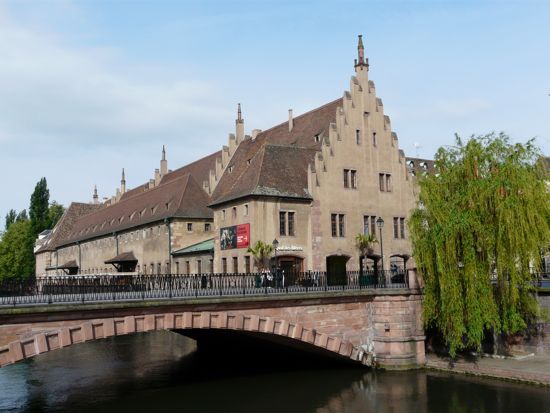
We had lunch at Le Pasha, a Tunisian restaurant. It was absolutely delicious! Sorry, we were so hungry I didn’t remember to take any photos. We had brik, a lamb stew/ lamb chops, and Tunisian pastries. It was a sweet restaurant:

And now, AdventureMan is snoozing, music to my ears. 🙂 We need a little down time as much as we need the walking, the lilacs, the vistas and the sips of wine.
Breaking all the rules
I’m breaking all the rules I made for myself. I didn’t know how to tell you I was leaving, but I thought I would tell you after I left.
Actually, I am not gone yet. My husband and I just grabbed an opportunity for a quick Mother’s Day getaway (Americans celebrate Mother’s Day this coming Sunday) and I am in France, drowning my sorrows 🙂 and walking and eating really delicious salads and pretending I am not up to my ears in boxes.
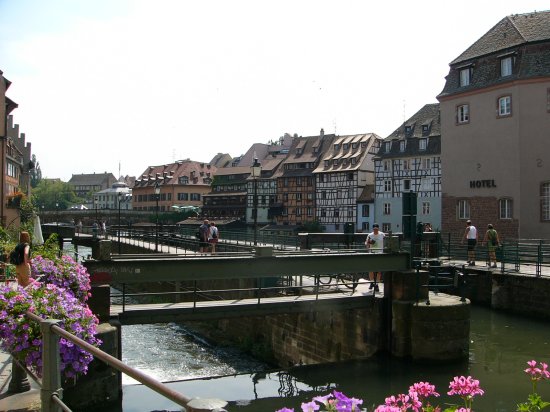
There are lilacs blooming everywhere, and wisteria. There are still some tulips. There are hydrangea. It is a riot of new life, color and growth. I am enjoying myself immensely. Very soon, it will be over and I will be back in Kuwait, packing boxes.
I will tell you more later, and even share some photos with you.
You are all so dear to me. I can’t tell you how much it hurts to move on. Usually, I cope by not thinking about it, just doing it. Somehow, in this situation, I don’t think that’s going to work very well.
Thank you for all your sweet thoughts. I haven’t decided if I will keep blogging; circumstances change . . . I will have to see if I even have anything to blog about!
Somali Pirate Code of Conduct
Ever since I was a kid, I found pirates interesting and exotic and adventurous. The truth is probably that those olden day pirates had bad teeth, scurvey – they had lived hard and fast and they probably aged quickly.
Of course, today we have Johnie Depp and the Pirates of the Caribbean series, which makes pirating look mostly like a lot of fun.
So a year or so ago, I wrote a post on the Somali pirates, and got an interesting response. It got me started looking more deeply into what is going on with the pirates there.
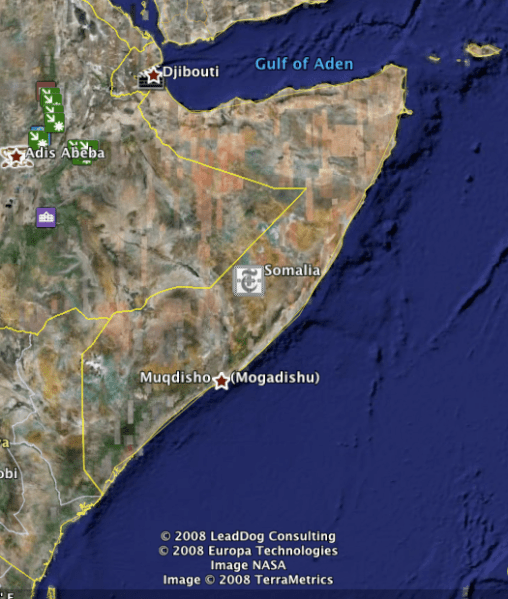
Yesterday, in the paper was an article about the Somali pirate code of conduct – with fines and punishments for infractions. I found a complete article in Newsweek, April 27.
What is bothering me now is that the one pirate captured by the US when it retook the captured US freighter (in the report filed by one BBC reporter) said he was just a frail teenager, a kid, and that the pirates had already agreed to surrender when they were blown out of the water. You could hear her attempting to control her rage.
I know it is a thorn in the side for all shippers and freighters and passenger ships who travel through waters anywhere near to Somalia. And yet . . . I kind of ask myself what the options are? Somalia is a for sure failed-nation. They haven’t been able to cobble together a government for over twenty years. Deadly, long lasting poisons have been dumped along their shoreline – and major industrial nations paid Somalis a pittance to dump their wastes there. Their coastline has been overfished. Families are starving, live is – or was – dismal.
I think it is pretty cool that they developed an enforceable – and enforced – code of conduct.
Here is the article from Newsweek:
It was a hit with the U.S. public, but president Obama’s decision to authorize the Pentagon to kill three Somali pirates who took an American sea captain hostage sent shudders through the world’s shipping and insurance industries. Because the pirates are motivated chiefly by money, maritime experts say, they have—at least until now—taken good care of the crews they hold captive. A document retrieved from a ship hijacked last year contained a “list of written rules” of conduct pirates had to follow, according to a maritime security expert who requested anonymity when discussing sensitive material. The document included a series of “punishments” to be imposed on any hijacker who struck a hostage.
Shipping companies and insurers are far more likely to fork over large ransoms if they have confidence that their personnel and cargo will be released unharmed, and while the scourge of piracy has been disruptive, so far there have been virtually no casualties among innocent people. According to estimates, there were 111 pirate attacks off the Somali coast in 2008; 42 were successful, resulting in the capture of 815 seamen. As of last week, according to one estimate, all but 37 had been released, and two had died—one reportedly of illness. Experts say the rate of attacks has increased sharply this year, and “the more [authorities] shoot, the more the pirates will shoot back,” says Tom Wilson, a Somalia analyst for the British consulting firm Control Risks.
Protecting the 23,000 merchant vessels sailing annually near the Horn of Africa would require a naval fleet of at least 60 ships, according to U.S. government and private experts; the existing international antipiracy task force has about 20. And attacking the Somali coastal villages where the pirates are based could potentially radicalize generations of Somalis. “That would be a 19th-century solution,” says Neil Roberts, a marine insurance expert with Lloyd’s Market Association in London. Industry experts say the only solution to piracy is the creation of a viable Somali government back on dry land.
According to industry officials, ransom demands have ranged as high as $25 million—but in most cases they are negotiated down to about $2 million to $3 million, and insurers then pay out claims to the shipping companies. As hijackings have increased in frequency, pirates have become fussier about how their money gets delivered. Initially, said a shipping-industry source who also asked for anonymity, ransoms were often handed off to shady Somali expats in places like Kenya. After Kenyan authorities cracked down, the pirates began insisting on airdrops via parachute into the ocean near Somali coastal villages, where they have cash-counting machines ready. Until the U.S. opened fire, one of the pirates’ biggest headaches had been dealing with the sheer volume of money they’ve collected. Last year, according to an insurance-industry official, one pirate’s boat capsized because he had overloaded it with cash.
I found this on National Post dated April 30, 2009; it is a copy of what I had read in the newspaper:
MOGADISHU — A mobile tribunal, a system of fines and a code of conduct: the success of Somali pirates’ seajacking business relies on a structure that makes them one of the country’s best-organised armed forces.
A far cry from the image conveyed in films and novels of pirates as unruly swashbucklers, Somalia’s modern-day buccaneers form a paramilitary brotherhood in which a strict and complex system of rules and punishments is enforced.
They are organized in a multitude of small cells dotting the Indian Ocean and Gulf of Aden coastline. The two main land bases are the towns of Eyl, in the breakaway state of Puntland, and Harardhere, further south in Somalia.
“There are hundreds of small cells, linked to each other,” Hasan Shukri, a pirate based in Haradhere, told AFP in a phone interview.
“We talk every morning, exchange information on what is happening at sea and if there has been a hijacking, we make onshore preparations to send out reinforcement and escort the captured ship closer to the coast,” he explained.
Somali piracy started off two decades ago with a more noble goal of deterring illegal fishing, protecting the people’s resources and the nation’s sovereignty at a time when the state was collapsing.
While today’s pirates have morphed into a sophisticated criminal ring with international ramifications, they have been careful to retain as much popular prestige as possible and refrain from the violent methods of the warlords who made Somalia a by-word for lawlessness in the 1990s.
“I have never seen gangs that have rules like these. They avoid many of the things that are all too common with other militias,” said Mohamed Sheikh Issa, an elder in the Eyl region.
“They don’t rape, and they don’t rob the hostages and they don’t kill them. They just wait for the ransom and always try to do it peacefully,” he said.
Somalia’s complex system of clan justice is often rendered obsolete by the armed chaos that has prevailed in the country for two decades, but the pirates have adapted it effectively.
Abdi Garad, an Eyl-based commander who was involved in recent attacks on U.S. ships, explained that the pirates have a mountain hide-out where leaders can confer and where internal differences can be solved.
“We have an impregnable stronghold and when there is a disagreement among us, all the pirate bosses gather there,” he told AFP.
The secretive pirate retreat is a place called Bedey, a few miles from Eyl.
“We have a kind of mobile court that is based in Bedey. Any pirate who commits a crime is charged and punished quickly because we have no jails to detain them,” Mr. Garad said.
Some groups representing different clans farther south in the villages of Hobyo and Haradhere would disagree with Mr. Garad’s claim that Somalia’s pirates all answer to a single authority.
But while differences remain among various groups, the pirates’ first set of rules is precisely aimed at neutralizing rivalries, Mohamed Hidig Dhegey, a pirate from Puntland, explained.
“If any one of us shoots and kills another, he will automatically be executed and his body thrown to the sharks,” he said from the town of Garowe.
“If a pirate injures another, he is immediately discharged and the network is instructed to isolate him. If one aims a gun at another, he loses 5% of his share of the ransom,” Mr. Dhegey said.
Perhaps the most striking disciplinary feature of Somali “piratehood” is the alleged code of conduct pertaining to the treatment of captured crews.
“Anybody who is caught engaging in robbery on the ship will be punished and banished for weeks. Anyone shooting a hostage will immediately be shot,” said Ahmed Ilkacase.
“I was once caught taking a wallet from a hostage. I had to give it back and then 25,000 dollars were removed from my share of the ransom,” he said.
Following the release of the French yacht Le Ponant in April 2008, investigators found a copy of a “good conduct guide” on the deck which forbade sexual assault on women hostages.
As Ilkacase found out for himself, pirates breaking internal rules are punished. Conversely, those displaying the most bravery are rewarded with a bigger share of the ransom, called “saami sare” in Somali.
“The first pirate to board a hijacked ship is entitled to a luxurious car, or a house or a wife. He can also decide to take his bonus share in cash,” he explained.
Foreign military commanders leading the growing fleet of anti-piracy naval missions plying the region in a bid to protect one of the world’s busiest trade routes acknowledge that pirates are very organised.
“They are very well organized, have good communication systems and rules of engagement,” said Vice Admiral Gerard Valin, commander of the French joint forces in the Indian Ocean.
So far, nothing suggests that pirates are motivated by anything other than money and it is unclear whether the only hostage to have died during a hijacking was killed by pirates or the French commandos who freed his ship.
Some acts of mistreatment have been reported during the more than 60 hijackings recorded since the start of 2008, but pirates have generally spared their hostages to focus on speedy ransom negotiations.
With the Robin Hood element of piracy already largely obsolete, observers say the “gentleman kidnapper” spirit could also fast taper off as pirates start to prioritize riskier, high-value targets and face increasingly robust action from navies with enhanced legal elbow room.
They have warned that the much-bandied heroics of a U.S. crew who wrested back control of their ship and had their captain rescued by navy snipers who picked off three pirates could go down as the day pirates decided to leave their manners at home.
I used to read science fiction novels about a diplomat named Retief, I think they were by Keith Laumer. He would find himself in an alien environment with a horrible unsolvable problem and he would find a great solution, where everyone walked away OK. I wish there were a Retief who could negotiate a win/win out of this situation.
Amazing Day
Yesterday turned out to be one of those days that surprise you. I didn’t have a lot of hope for the day, I started off feeling negative and thinking about cancelling appointments. My head has been a little stuffy, I have a mild cough, altogether, I am not in peak form.
I decided to keep my appointments, which required preparation, and the prep turned out better than I had expected. In fact, the entire day was full of unexpected blessings.
First – I know not all of Kuwait experienced it, but the storm! Lightning! Rain! Rain in late late April! Whoda thunk?
Then, the light – drama drama drama – dark dark clouds, but sunlight on the white-capped water, bringing out all the shades from turquoise through jade and lapiz into deep purple – oh, what joy! Last but not least, the wonderful breeze that kept everything from being hot and sticky – what a day! What I might have missed!

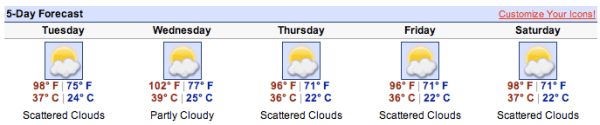
Forecast: Hot and Crabby
It isn’t my fault. I was born in the cold winter months in Alaska, and to this day, I thrive in cooler weather. When October comes to Kuwait and I can feel an occasional cool breeze on my face, I am in heaven for the next six months. When the rains come, I dance for joy.
So, alternatively, when I open the door to take a photo of the sunrise from my balcony, and it is as warm outside as it is inside, my heart sinks.
The sunrise this morning was awesome – lights and darks and sparkles all over the place:

What is not to love?
I’m trying not to be grumpy. I’m trying to think cool thoughts, and to be cool-headed. Keep me in your prayers, please, for sweetness of spirit, and for peace of spirit, and for super organizational skills.
The Thirteenth Tale – Setterfield
After reading some heavier stuff, I needed a break, and waiting on my “read me!” bookshelf has been this book, The Thirteenth Tale, another one of those I pick up at the last minute and stuff into the last remaining centimeter of space in my overstuffed suitcases. Nobody recommended it, it just looked like it might be good.

It was good, although now I can’t think of anything so gripping about it. Setterfield took the classic gothic novel – she mentions Jane Eyre frequently – and updates it, makes it modern and personal. It was a good, fun read, had me hurrying through my daily “must-do’s” so I could read more – I like a book like this now and then.
And – the main character, Margaret Lea, loves books. 🙂 She works in her family old-books business, leads a quiet, kind of sad life, haunted by the loss of her own twin early in life. When contacted by famous novelist Vida Winter to write her biography, she is intrigued, and accepts the job offer, which involves going to stay in Vida Winter’s house.
Part of what is fun reading this book is that we are dealing with an “unreliable narrator” with Vida Winter. Sometimes she is lying, sometimes she is lying by omission, and part of the mystery is that Margaret must try to verify what she has been told and try to figure out what has been left out. She has a great adventure in the process.
This is great escape reading. Good for a long plane trip, good for sitting by a sick relative in the hospital, good for using as a carrot (“if I get this done, and this, and this – then I get to go read ‘The Thirteenth Tale!’ “) You can buy it on Amazon.com for around $10 paperback.
Sunrise 26 April 2009
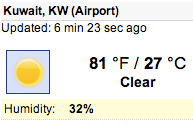
Last night, out for dinner, the air was not cool and refreshing. It was warm. The outdoor seating was thronged; for many, the temperatures are wonderful; for me, it is a little stale. Just the night before, we were outside and it was wonderful, still a tiny cool breeze now and then. Overnight, you can feel the inevitable approach of the scorching summer. It’s coming. It’s almost here.
Sunrise this morning was silvery. There are some fleecy little clouds up in the sky, but no, it doesn’t look like rain, only a little tease.

At 0700, it is already hot.
The pace is picking up, lists of things to do growing instead of shrinking . . . the pressure is on.
Horseback Riding Camp

“Whatever you might have heard from your kids” the camp director started, and AdventureMan and I looked at one another with concern, “it is just rumors. The counselors did not have a big drunken party, and we have the situation under control.”
We hadn’t heard anything. We were there to pick up our son and his best friend from Horseback Riding Camp. They were eight years old and this was their first time away. We had dropped them off a mere week before, at the clean clean little chalet camp in Southern Germany, where they would learn to ride and take care of their horses.
“So, son,” AdventureMan starts with that casual voice grown-ups use with their children when about to launch an interrogation, “tell us about the camp!”
We were driving back, and wanted to get a campers-eye-view of the week. Our eight-year-old son was exhausted and not very talkative; it was only during the following week that most of the details came out.
He hated horseback riding. He hated taking care of horses. The instruction they got was minimal to non-existent. Most days they missed their horse riding lessons because the counselor overslept. The kids got up and got their own breakfast – cereal – until the milk ran out, and then they ate it dry.
Horrors. We had done everything right. We had checked the camp references, had visited and inspected the camp before deciding to send him there, had met the counselors – horrors! In fact, our son enjoyed the week, but mostly because they had a TV, and no supervision. They spent most of the week watching TV.
In the following years, he went to other camps – adventure training camp, karate camps, Space Camp (that was the best organized) and then became a camp counselor himself, teaching karate. Our most graphic memories as parents, however, are of picking him up at horseback riding camp and learning how loosely organized and supervised it was, compared to what the brochure said and the inspection visit promised.
Recent Comments
intlxpatr on Shampoo Ginger tigerbutterya0c5ff1d… on Shampoo Ginger intlxpatr on British Soldier Kidnapped, Esc… John on British Soldier Kidnapped, Esc… intlxpatr on British Soldier Kidnapped, Esc… Wikipedia Donate Button

Amazina


Early Voting in Florida


