Geraldine Brooks: People of the Book
I love the way Geraldine Brooks writes. I got hooked when I read Nine Parts of Desire and then again when I read Year of Wonders. You can read my review on her award winning March here. So I could hardly wait for People of the Book to come out in paperback, so I could read it. (Those hard cover books hurt too much when they fall over if I fall asleep, and are too heavy and bulky to carry on airplanes.)

Here is what I like about Geraldine Brooks. Her books are not easy to read. They make you uncomfortable. They make you think. They give you another perspective, and that perspective challenges your assumptions.
The heroine, Hannah, is not very likable. She is cold, she makes poor decisions, and she has a very uneasy relationship with her mother. She is, on the other hand, a master of her craft, which is stabilizing and restoration of old books. She is the specialist called in by museums to help preserve masterful works, and to identify forces at work which can cause grave damage to these books.
While this is a work of fiction, it is based on an actual book and some of the history surrounding it. The Sarajevo Haggadah, a Jewish holy book, is a real book. Some of its history is known – including the fact that it was twice saved from destruction by Moslems, one a very brave librarian in Sarajevo who rescued and preserved it risking his own life, the fact that it was saved from destruction during the Italian inquisition by a Catholic priest. From tiny bits of physical evidence, Geraldine Brooks weaves an entire book creating a story how all the individuals and forces that might have been involved in the creation and preservation of this one special book.
People of the Book is a mystery – Hanna goes in and in the process of evaluating and analyzing the book, gathers tiny bits of “evidence” – a tiny grain of salt, a hair, wine stains. As she investigates, lab results come back, filling in missing pieces of how this book might have travelled from Spain of the convivencia (Medieval Spain) to modern day Sarajevo. Slowly, slowly, Brooks reveals to the readers the real (fictional!) people behind the tiny pieces of evidence.
The plot is interesting. What grabbed me from the beginning, however, is that this is a real book-lovers book, written by a woman who loves books. We learn about how books are created, how book conservators know, from looking at the origin of a sheet of paper, where a book was created and about what time period it was created. We learn about different treatments of paper, we learn about inks, we learn how pigments are created, and we learn about illustrations.
I was captivated by all the love of book-creation present in this book. Most of all, I love it that she dedicated this book to the librarians of the world, those unsung heros who devote their lives to the preservation of information. It was definitely worth a read – and, as an exception to most of my rules, it will probably be worth a re-read.
A friend recommended a video of Geraldine Brooks discussing this book at a book-talk at Northeastern University. It is a little long – you will need about 38 minutes of your time if you want to listen to this amazing woman:
Female Police Given Ranks Equal to Men
The Police Academy attracted 16 women with university degrees – HOOOO-AHHH! I imagine these women are going to shake things up a little – in a good way – around police headquarters. Mabruk, mabruk, Kuwait.
Women officers given rank equally to men
Staff Writer – from Al Watan
KUWAIT: An Amiri decree was issued requiring female police officers to be put on equal footing with their male counterparts in terms of rank. Accordingly, Minister of Interior Sheikh Jaber AlـKhaled AlـSabah issued an executive order to rank women police officers according to the same requirements as given to male officers.
The first batch of women police now includes 16 Lieutenants, all of which have university degrees, eight Warrant Officers, all holding technical diplomas, and three Sergeants who have secondary school certificates.
Last updated on Friday 27/3/2009
First Kuwaiti Policewomen Graduate
Wooo HOOO on you, Kuwaiti policewomen! It is always hard to be in the vanguard, you take the criticisms, you take the disbelieving stares, and you handle questions, even from your own families. It’s always tough to be out front – to be a leader.
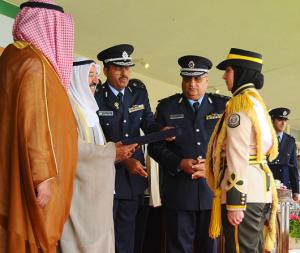
First group of policewomen graduate
From today’s Al Watan
KUWAIT: His Highness the Amir and Supreme Commander of the Armed Forces Sheikh Sabah AlـAhmad AlـSabah has attended on Wednesday the graduation ceremony of the 35th batch of military cadets, the 20th batch of specialized officers and the first batch of female cadets at the Support Authority Institute of the Saad AlـAbdullah Academy for Security Sciences.
The ceremony witnessed the graduation of the first batch of policewomen in the country. His Highness the Amir who arrived at the academy at 10:30 a.m. was warmly received by the Minister of Interior Lieutenant General Sheikh Jaber AlـKhalid AlـSabah, as well as other senior police officers.
The ceremony was also attended by His Highness the Crown Prince Sheikh Nawaf AlـAhmad AlـSabah, Vice President of the National Guards Corps Sheikh Mishaal
AlـAhmad AlـSabah, His Highness the Prime Minister Sheikh Nasser AlـMohammed AlـSabah, First Deputy Prime Minister and Minister of State for Defense Sheikh Jaber AlـMubarak AlـSabah, as well as other members of the ruling family, senior statesmen and members of the families of the graduating cadets.
Representatives of the 35th batch of military cadets then handed over the national flag to the representatives of the 36th batch. The Assistant Director General of the Academy for Education and Training Affairs Brigadier Dr. Waleed Khalaf BinـSalama read the ministerial decrees before inducting the new male and female police officers into the police force.
His Highness the Amir handed the graduates awards and certificates in appreciation for their efforts and then received the shield of the academy, that is dedicated to him, from Major General Yousef Mubarak AlـMedhahka. ـKUNA
Last updated on Thursday 26/3/2009
Al Kout Festival
Wooo HOOOO! An event we know about BEFORE it happens!
March 31 and April 1, 11am -7pm. American University of Kuwait, Salmiya Campus
The Arabian Heritage Project is proud to present “Al-Kout Festival”
(Old Kuwait Festival) an event being held to celebrate the grand opening of the
Arabian Heritage Project, a research, archival, and outreach center dedicated to
promoting and fostering the heritage of the Peninsula and related cultures.
Two days of celebration from 11 am till 7 pm at the American University Of
Kuwait campus in Salmiya. The event will include National Museum Exhibits, live
performances by Kuwaiti traditional bands (Bin Hussein and Mayouf), Sawt
musicians, Bedouin poetry, Kuwaiti History Game Show, distinguished live
Craftsmen, a Bazaar, old Kuwaiti cars, refreshments; basically a chance to
experience authentic Kuwaiti Tradition and Culture at its best.
The Festival opens at 11am, performances (Kuwaiti Sawt musicians, poetry,
Kuwaiti music piano recital, etc.) begin at noon. Sea bands begin at 5pm each
day.
Please note, parking is limited. Carpooling is advised.
Diary of a Six Day Bahama Cruise
In yesterday’s e-mail, thank you old friend!
Diary of a Six Day Bahamas Cruise
DEAR DIARY … DAY ONE
My husband and I are all packed and ready to get on the cruise ship. I’ve packed all my pretty dresses and make-up. I’m really excited.
DEAR DIARY .. DAY TWO
We spent the entire day at sea. It was beautiful and we saw some whales and dolphins. What a wonderful vacation this has started to be. My husband spent most of the day gambling. I met the Captain today and he seems like a very nice man.
DEAR DIARY … DAY THREE
I spent some time in the pool today. I also did some shuffle boarding and hit some golf balls off the deck. The Captain invited us to join him at his table for dinner. I felt honored and we had a wonderful time. He is a very attractive and attentive gentleman. My husband spent more time gambling.
DEAR DIARY … DAY FOUR
Went to the ship’s casino … did OK .. won about $80. My husband wanted to stay and gamble more. The Captain invited me to have dinner with him in his state room. We had a luxurious meal complete with caviar and champagne. He asked me to stay the night but I declined. I told him there was no way I could be unfaithful to my husband.
DEAR DIARY … DAY FIVE
Went back to the pool today and got a little sunburned. I decided to go to the piano bar and spend the rest of the day inside. The Captain saw me and bought me a couple of drinks. He really is a charming gentleman. He again asked me to visit him for the night and again I declined. He told me that if I didn’t let him have his way with me he would sink the ship. I was appalled. My husband spent most of the night gambling.
DEAR DIARY … DAY SIX-
My husband spent most of the day gambling.
I saved 1600 lives today …. twice !!!!
Just to be perfectly clear – this is a JOKE! It is not me, Intlxpatr, that went on the cruise. It is a joke!
St. Patrick’s Day Coming March 17
St. Patrick’s Day is coming – tomorrow – March 17th. St. Patrick’s Day is not, as it would sound, a particularly religious holiday. While it is a huge celebration, in the United States it is more about being Irish than it is about St. Patrick. Most of the Irish, when they came to America, had about as much status as the Bangladeshis in Kuwait – they were at the bottom of the social heap. It was a long long struggle to achieve respectability; even longer to be free of the prejudices against them.
The Irish celebrated the election of John F. Kennedy the same way the African Americans celebrated the election of Barak Obama – it was the ultimate sign of being part of a united America, full citizenship – “one of us” could be President.
Here are previous posts I have written telling more about St. Patrick, and St. Patrick’s Day celebrations:
St. Patrick and the Wearing of the Green
We visited Ireland several years ago, a visit AdventureMan recounts with relish. I made all the arrangements, bed and breakfasts, travel plans, etc. and AdventureMan was uncommonly unenthusiastic. Once we got there, I understood why. Being THE MAN, when we are in the car together, most of the time, he drives. Arriving in Ireland, you have to drive on the “other” side of the road (I did not say the “wrong” side!) Many roads in Ireland are narrow. Cool calm AdventureMan had met his match. He HATED driving in Ireland.
The part of the trip I loved the most was going to Cashel, one of the St. Patrick sights in Ireland:

It was one of the most beautiful places I have ever visited. The weather was glorious, warm and sunny without being too hot.
From Cashel, Ireland, website:
Cashel has a very ancient history, albeit only documented since the 4th Century. The Rock of Cashel, with its well preserved ecclesiastical remains, is one of Ireland’s most spectacular landmarks, rising above the surrounding plain and dominating the land route southward.The large Cathedral, ancient round tower and the very early Romanesque Cormac’s Chapel , perched on a dramatic outcrop of rock, were silent witnesses to many of the stirring events of Irish History; St.Patrick converted the local King Aenghus, here in the 5th century; Brian Boru was crowned King of Ireland on this spot in the early 11th Century. The Vicar’s Choral has been restored and the site, one of the most visited in Ireland, now provides an interpretative centre, (multi lingual) an interesting museum, guided tours and superb views over the extensive and beautiful plains of Tipperary.
We were visiting in Mid-July. It rained a lot, but the day we drove to Cashel was gorgeous. Even on the rainy days, there were periods of blue sky and sunshine, and the air was crystal clear and sweet. I guess the rain is the reason Ireland is so green, so piercingly beautifully green. I would go again in a heartbeat, but I think this time we would hire a driver!

Tuesday’s Dust Storm
I didn’t think Tuesday’s dust/sand storm was that bad – I was out, driving here and there (and everywhere LOL); you could see about a hundred meters, enough to stop. I was on side streets, mostly, not going all that fast and I never felt like it was that bad. I didn’t even think the tiny bit of rain we got was a problem (we need rain so badly) until I saw the outside of my car; it looked like I’d driven from Dakar to Paris; it looked hmmm. . . weathered!
My first sand storm was in Doha, Qatar. My niece and I were grocery shopping, and suddenly we saw people outside with their gutras and scarves wrapped around their faces like Lawrence of Arabia (you don’t see that a lot here.) When we went out, it was gritty. The air was full of sand, but you could still see.
Using our worst judgement, we decided to go driving along the Corniche. Hunhhh – there wasn’t a lot of traffic; we had the roads pretty much to ourselves and the wind was whipping and the sand got thicker and thicker and everyone we saw was covering their faces – at some point, good judgement kicked in and we crawled slowly back home, exhilarated with our sandstorm adventure. It really was a sand storm. There were drifts of sand all over the road.
In Kuwait, the grit is a lot smaller. These are mostly dust storms – your face is stiff and tight if you are out for any length of time, and I find I am having to wash my hair all the time, even twice a day, if I have to go out, because it is like my fine hair has suddenly gone coarse – the layer of dust adheres to hair and makes it thick and tangly.
Here are a couple photos from the dust storm on Tuesday:
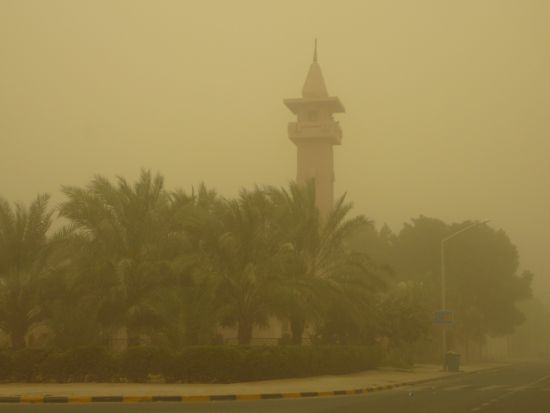
I love the lushness of the palm trees thickly surrounding this mosque.

I love it that private citizens put up these sabilles, to provide drinking water to the thirsty. I love it even more when the sabille is beautiful, fun, or unusual in some way that takes it out of the merely serviceable and into the realm of imagination. This is a take-off on the huge Kuwait water towers, unique to Kuwait, a symbol of the city.
Honored Guest
In every country where I have lived, we have felt like honored guests. This week, I have been truly honored, my blogging friend Hilaliya has asked me to be an occasional guest blogger on his revamped blog, now featuring a Kuwait Blogging Diwaniya. Pretty cool, huh? I have to admit it, I have a smile from ear to ear.
The revered blogger Don Veto led the way with an article yesterday, and I jumped in today.
In honor of my ear-to-ear smile, it’s called Smile for me Baby – Let Me See Your Grill but fair warning – it’s political polemic, about parliamentary gridlock, so you will see a grittier side of Intlxpatr.
Wild Blue Yonder
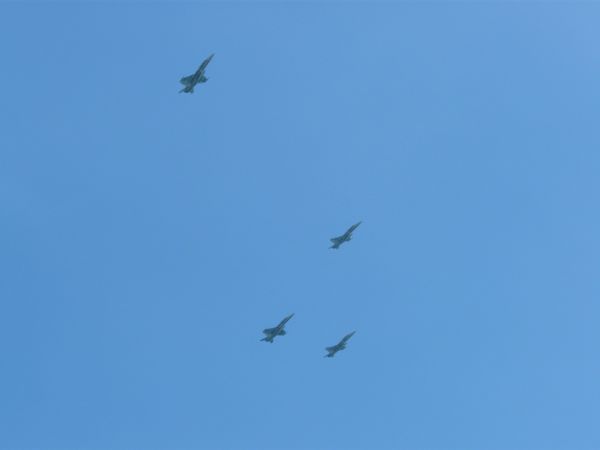
Today was the Kuwait show of military might. No sandstorm, thanks be to God. Somehow, I had thought yesterday was Wednesday and thought how sad it was it would have had to be cancelled. When I woke up today and realized it was Wednesday, I could hardly wait.
Just the sound of the roaring jets gives me a grin. I once lived near a huge airbase, and we lived with the sound day and night. It never bothered me. I always knew these were men and women who sacrificed their lives to serve their country in a profession that looks a lot more glamorous than it is. Flying can be exciting, but it can also be very tedious. You are away from your family for long hours. It gets old. They persevere.
The young men and women chosen to fly these fighter planes have to have superior physical condition and reflexes. Think about you and the car your daddy gave you – it may be expensive, but it didn’t cost billions. These planes do. It’s an amazing responsibility, a privilege and an honor to be selected.
Bu Yousef, tell your friend he was supposed to waggle his wings when he flew by so I would know which one he was! 😉
Macaholic, it was a little hazy, but the attack helicopters are for you. 🙂



In Xanadu: A Quest by William Dalrymple
This book was on my (huge) “Read Me” stack, and I picked it up for a change of pace. As I started reading, I wondered “how did this get there?” My first instinct was it was a recommendation from Little Diamond. As I was reading, however, I came across a segment that was what our priest had read in church around the Feast of the Epiphany about the birthplace of the wise men who came seeking the Christ Child after his birth. I wrote down the title and ordered it from amazon.com (which has some copies used from 72 cents).

William Dalrymple wrote this book when he was a mere 22 years old. He and a travelling companion took off to trace Marco Polo’s journey from Jerusalem to Xanadu, where he was taking oil from the sanctuary lamp to Kubla Khan.
In a world where we have all been taught to be so careful, they take incredible risks. They travel on the cheap – staying in fleabag hotels, sometimes sleeping “rough”, i.e. out in the open. They travel any way they can – an occasional train, but more often a truck, a bus, whatever is going their way. One very long segment they travelled on top of a pile of coal.
They travel from Jerusalem up through Syria and into Turkey, then turn east and cross Iran, Pakistan and Afghanistan to China. They have some amazing adventures, see some astounding scenery and because of their mode of travel, have a lot of time to talk with their travelling companions or people in the cities where they are staying.
I am blown away that an unmarried couple would cross Iran, Pakistan and Afghanistan. I guess they told people they were married to share a room (they were on a budget) and they were only friends, not a couple, but what a risk. I am astonished that they were never asked to produce a marriage license or any proof of marriage when they stayed in hotels. I am astonished at the girls (one left in Lahore and another joined him, but these are girls who are friends, not anything more) would travel on the backs of trucks full of men, and never blink an eye.
The book is occasionally hilarious. Most of the hilarity results from foods they have to eat – sometimes it is the only food available – or from misunderstandings because of lack of a common language, or due to their frequent bouts of diarrhea, what I really liked about the author was that he was rarely pompous, and when he is funny, it is usually about some conversation he has had, or some mistake he has made.
One of my favorite parts of the book happens in Iran:
As we sat waiting for the bus to Tabriz, the next town on Marco Polo’s itinerary, we watched the mullahs speeding past in their sporty Renault 5s. Iran was proving far more complex than we had expected. A religious revolution in the twentieth century was a unique occurence, resulting in the first theocracy since the fall of the Dalai Lama in Tibet. Yet this revolution took place not in a poor banana republic, but in the richest and most sophisticated country in Asia. A group of clerics was trying to graft a mediaeval system of government and a pre-medieval way of thinking upon a country with a prosperous modern economy and a large and highly educated middle class. The posters in the bus station seemed to embody these contradictions. A frieze over the back wall of the shelter spoke out, in the name of Allah, against littering. On another wall two monumental pictures of the Ayatollah were capped with the inscriptions in both Persian and English:
BEING HYGENIC IS DIRECTLY RELATED ON THE MAN’S PERSONALITY
and:
ALLAH COMMANDS THE RE-USE OF RENEWABLE RESOURCES.
We had expected anything of the Ayatollah. But hardly that he would turn out to be an enthusiastic ecologist.
The challenge of this journey is to follow as closely as possible the path Marco Polo took, but two segments of the journey go through off-limits areas. They find a way into one, to discover later it is an atomic testing area, and the second, at the very end, around Xanadu, they find receptive Chinese officers who take them to have a brief glimpse of the ruins of Xanadu while booting them out of the area. As they stand in Xanadu, they repeat a poem that every American child grows up with in English Literature:
In Zanadu did Kubla Khan
A stately pleasure-dome decree:
Where Alph, the sacred river, ran
Through caverns measureless to man
Down to a sunless sea.
So twice five miles of gertile ground
With walls and twoers were girdled round:
And there were gardens bright with sinuous rills.
Where blossom’d many an incense-bearing tree:
And here were forests ancient as the hills,
Enfolding sunny spots of greenery.
(Coleridge)
I liked this book. Dalrymple is a history major, and often quotes from historical – even obscure – texts to illuminate what he observes. I think I may look at a couple more he has written since.
Recent Comments
intlxpatr on Shampoo Ginger tigerbutterya0c5ff1d… on Shampoo Ginger intlxpatr on British Soldier Kidnapped, Esc… John on British Soldier Kidnapped, Esc… intlxpatr on British Soldier Kidnapped, Esc… Wikipedia Donate Button

Amazina


Early Voting in Florida


