Michael Malone: Handling Sin

Have I told you (only a hundred times?) that our family loves books? We buy them, we discuss them, and we pass them around. The one I am about to review came from my son, who got it from the wife of his wife’s father. Heee heee heeee, figure that one out!
Have you ever read A Confederacy of Dunces by John Kennedy Toole? As soon as you start reading Handling Sin, you get the same impression; this book is whacky, and will probably be an underground cult favorite. The author of Confederacy of Dunces, John Kennedy Toole, committed suicide – or so we are supposed to believe. I am not so sure. Handling Sin sounds SO like it, and they both heavily feature New Orleans.

Right off the top, this books starts out weird and keeps right on going. It opens with our hero, Raleigh Whittier Hayes at a Civitan (social and civic works group, kind of like diwaniyya) meeting at the local Chinese restaurant in Thermopylae, North Carolina, where his fortune cookie at the end of the meal says “You will go completely to pieces by the end of the month.” Raleigh sells insurance, he runs and watches what he eats because most of his family gets diabetes; and Raleigh likes order. When we meet Raleigh, he’s not all that likable.
His dying father takes off, leaving a message for Raleigh that he needs to do seven (crazy-sounding) tasks and meet him in New Orleans at a specific date and time, having accomplished these tasks, otherwise he won’t go back to the hospital for his cancer treatments.
His big fat best friend, Mingo Sheffield, insists on coming along. His wife, Aura, just laughs and tells him he needs to loosen up a little when he starts complaining about his Dad’s quest, and begins her campaign for mayor. His nice, safe structured little universe is flying apart, his twin teen-age daughters are out of control, reality as he knows it has just taken a big crunching shift and Raleigh is out of his element.
Perfect! It’s those times of maximum discomfort that we begin to achieve our maximum potential, isn’t it? If we stay in our safe little world, we aren’t challenged to grow, to think new thoughts, to see things from another perspective.
Handling Sin has a series of events that are at the same time heart warming, serious, and side-splittingly funny. I laughed out loud so many times reading this book, as our hero and his friend and all those he picks up along the way find themselves in the most outrageous and unlikely adventures, and learn what they are capable of (OK, for all you grammarians, do not end your sentences in a preposition, do as I say, not as I do!) I would not be at all surprised if this book were made into a movie, it is so much fun. As you rock along, Malone also deals with serious health issues, racial issues, family issues, political issues and law and order. You laugh, you cry, you learn a little and you laugh again. It’s a great read.
This was my back-up book on my flights back to Kuwait, and worth the weight – it’s a kind of big book. AdventureMan can hardly wait to get into it; he had started it but allowed me to read it while he caught up with his jet lag. Who knows who we will pass it along to when he finishes? It’s that good!
Winter Wonderland
Snowstorms make for dangerous driving, but oh, so beautiful moments. I wanted to share some with you:

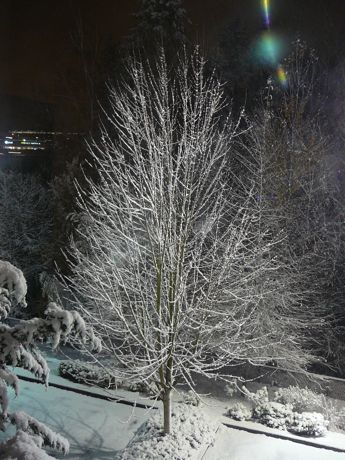

Emmet Watson’s
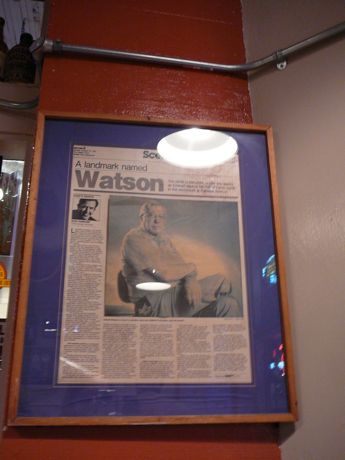
There was a crusty old journalist/columnist at the Seattle Post-Intelligencer named Emmet Watson, who loved good food. He opened his own little place, hidden down in the Pike Place Market, back behind a lot of other shops. It even has a small outdoor eating area for the summer months. If you want some of Seattle’s best, most authentic northwest seafood, this is where you head. He isn’t around anymore, but his small restaurant still is, and worth a trip to the market.
Emmet Watson article:
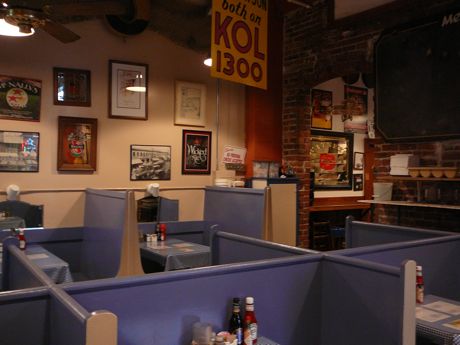
Interior of restaurant:
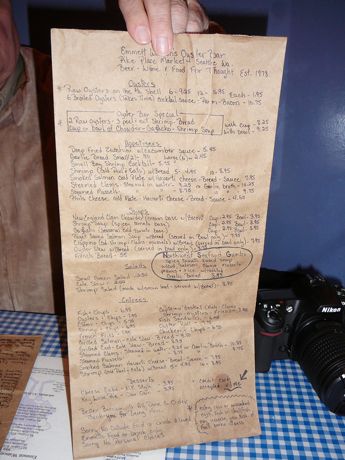
Hand written menu on brown paper bag:
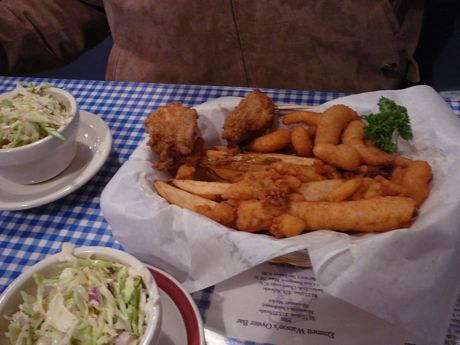
Captain’s seafood basket:
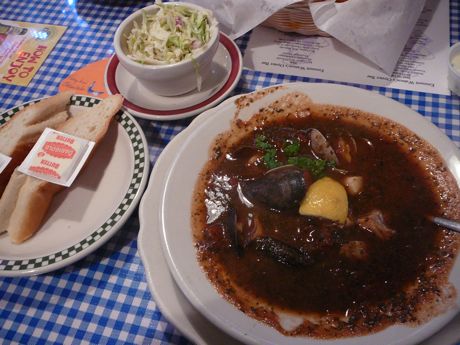
Cioppino:
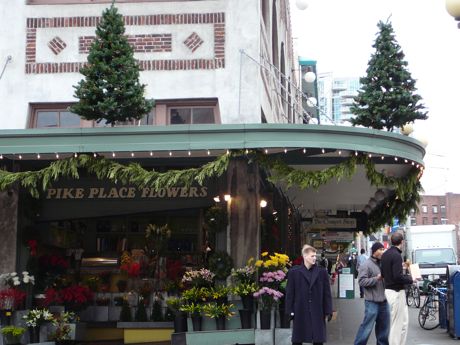
Pike Place Market Readies for Christmas
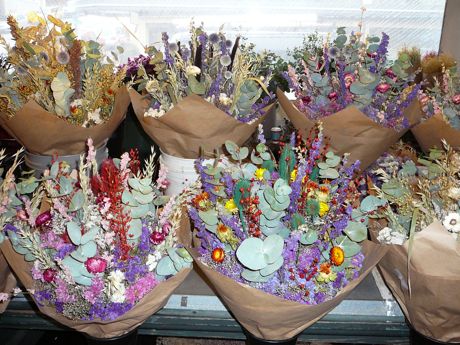
I’ve always loved the Pike Place Market. It’s like the heart – and stomach – of Seattle. My favorite time of year is November, when there are far fewer tourists, but still fresh vegetables, fresh fish, and wonderful arrangements of pine boughs and Mexican peppers (called “ristras” when all strung together.)


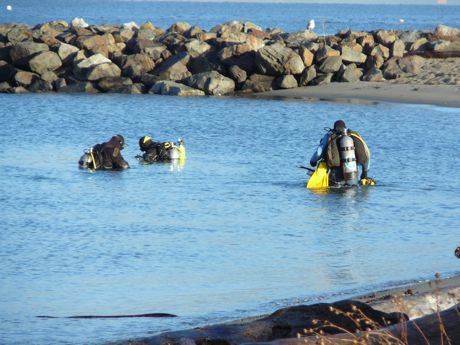
Hard Core Divers
I can hardly believe my eyes. On some of the coldest days of the year, there are still people eager to don their wet-suits and hit the marine reserves, do a little diving. I can’t imagine; it makes me shiver just to think about it!
Extra Ferry Runs
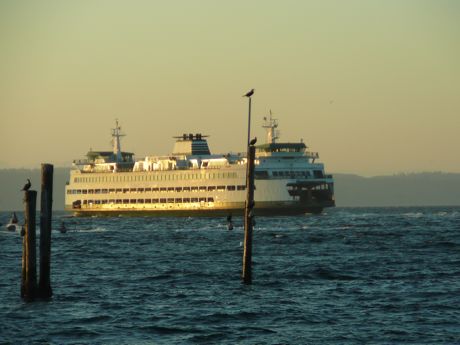
At the worst possible time – just before the huge Thanksgiving rush to the ferries – cracks were discovered in the hulls of four of the ferries in the transportation system. Once the cracks were discovered, the four ferries had to be taken off the runs – they don’t take chances here on people’s lives.
Ferry boats that can carry cars take specialized care to build and to repair. It will be a while before they are back in service, or replaced.
Meanwhile, people are on their way to grandmother’s house – by ferry. Cars are lined up for miles, waiting to get on. They have a strictly enforced system; there is no cutting in line, no going to the front – you get in line when you get there and you take your turn. Being Seattle, there are multiple places along the lengthy lines where you can buy coffee, and places where you can make a pit stop, to dump the coffee.
Families bring books and puzzles, and just plan on the wait. They build the ferry-waiting time into their schedule. Thanks to mobile phones, many families walk on (no waiting to walk-on, and it is a lot cheaper) and have people pick them up on arrival on the Winslow/ Kingston/ Whidby Island side.
The transportation officials also put on extra ferries, so just about as one loads up and leaves, another arrives. You may have to wait a while, but it is about as efficient as it can get.
And then, after dinner, it all reverses, and people come back on the ferries. I try to imagine the revenues those ferries bring in on this one four day weekend, and I can’t begin to imagine.
Thankgiving Invitation
Adventure Man and I will be attending different Thanksgiving Events this year, the first time ever. Here is the invitation to the event he will attend:
Thanksgiving!
•HEAR YE! HEAR YE!
•A THANKSGIVING CELEBRATION IS AT HAND
•A TIME TO GET TOGETHER TO GIVE THANKSGIVING, TO VISIT, TO CELEBRATE AND OF COURSE, TO EAT
•COME ONE AND ALL, COME EARLY TO THE THANKSGIVING CELEBRATION (usually the gathering starts around 9:00am)
•EVERYONE IS WELCOME AND BRING ANYONE YOU CAN GET TO COME ALONG
•COME EARLY, STAY LATE
•WE’LL HAVE THANKSGIVING LUNCH BETWEEN
1:00-1:30 PM
•THERE WILL BE ENOUGH FOOD PREPARED EARLY, IN CASE THE CHILDREN NEED TO EAT
•HOWEVER, THERE WILL BE PLENTY TO SNACK ON BEFORE THE MEALTIME
•KIDS BRING YOUR BATS, SOFTBALLS, KICKBALLS, FOOTBALLS, ROLLER SKATES, BIKES, SCOOTERS, ROPES OR WHATEVER
•Stay and Enjoy the leftovers for supper!!
WHEN: THANKSGIVING DAY, NOVEMBER 22, 2007
(Oh what fun!)
A Heavenly Day in Kuwait
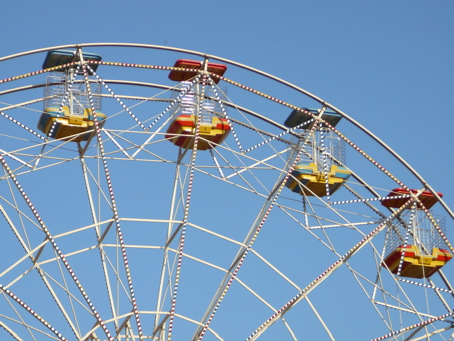
Adventure Man and I spent the whole day together yesterday, a true sabbath day, worship and play, and very little work. I hope you had the same kind of day. The weather is perfect for strolling along the Corniche, the beautiful blue sky was perfect for taking photos, and the haze over Kuwait made it a little bit dreamlike.
Hawally Park:


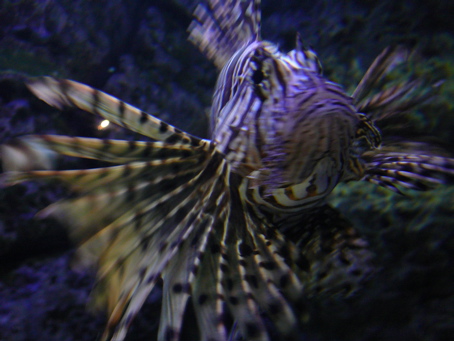
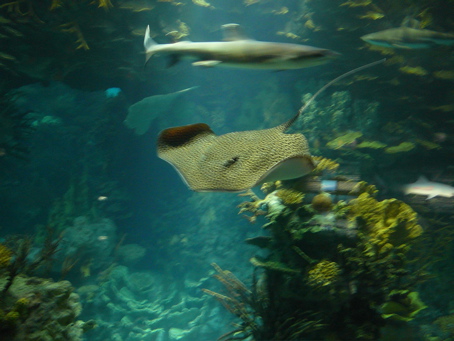
We love the Marine Science Center – total WOW:
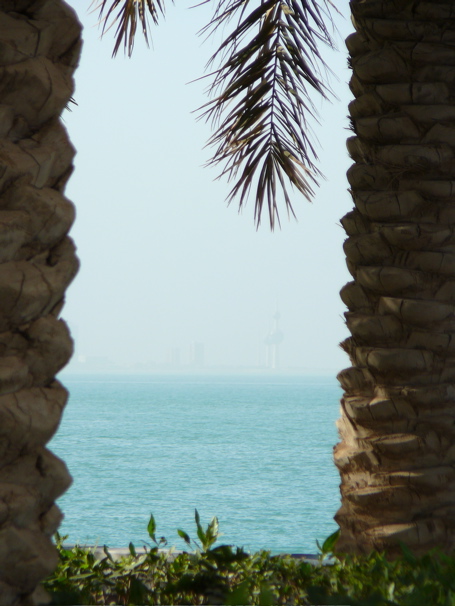
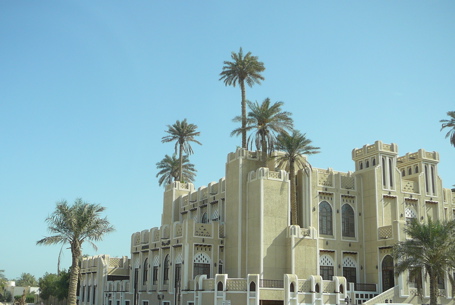
We think this is place is amazing – we think it might be used for parties, but we don’t know. Anyone?
Dinner at Al Manshar – on a perfect autumn evening.

Poor Witness
I had hoped to miss the worst of the traffic yesterday morning when I got on the highway, but for some reason, traffic was still heavy. Suddenly, in less time than it takes for me to write it and for you to read it, there were silver and red sparkles in the air, a shrieking of tires, and a car two cars in front of me trying to regain control, bouncing between two lanes.
Everything slowed to an almost halt, without – thanks be to God – any further collisions. One car, weaving in and out, had clipped another.
I’ve often been amazed at how closely these cars whip in and out without crashing. I think I’ve just never seen it happen before. That impact sends the car that’s hit totally out of control. By the grace of God, no one appeared to be physically injured.
I wondered if I should stop, but I realized I didn’t know anything. I didn’t even know for sure which car had been the hitter and which had been the hittee. I would be a very poor witness. All I saw was this firework like explosion of silver and red – the tail light, I am guessing. And heard the sickening screech of tires as both cars tried to avoid a more serious collision.
A good witness isn’t someone who is guessing. I continued on. Saw the aftermath of an almost identical accident just another kilometer up the road. The good news is that it slowed down the traffic, made it more meditative. . . life is short, folks. There is nowhere we have to be in that big of a hurry.
Operation Hope Options
What I love about Operation Hope, in addition to the good works they are doing in the Kuwait Community, dreaming big and making it happen – is that they offer a variety of ways for the public to support them.
If you can give hands-on help, they welcome you.
If you cannot – they welcome your donations!
Here is there most recent newsletter – please, if you can help this worthwhile effort, in whichever way you are most comfortable, please, help. You could have a lot of fun helping pack the winter clothes, or delivering the bags. Or you could have a lot of fun throwing some of your money at the problem.
OPERATION HOPE – KUWAIT
A Mission of Mercy
October 28, 2007
Greetings OH Family!
Exciting news ~ 1,200 winter bags were packed Friday afternoon. Thanks to numerous volunteers the colossal task of setting up, packing, and cleaning up was very quickly accomplished (with the bulk of our winter apparel packed in about an hour’s time!). Moms, dads, children of all ages, business exec’s, and even someone’s grandmother helped to make the miracle happen! My daughter says the pile of bags resembles Mount Everest. . . I think I agree with her!
Another 1,200 coats, thermal underclothing, hats, socks and gloves will need to be packed this Friday, November 2nd at 3:30 PM. This packing date will be a very special one because it is the OH – KUWAIT Student Day. All students (pre-k to university) are encouraged to participate. Kindly RSVP your confirmation to Ms. Kathleen on ophopevolunteer@yahoo.com at your earliest convenience. We’ll require a set-up team to help at 1:30 PM as well. The set-up group should be strong and team-oriented.
The cement foundation for our new headquarters was laid yesterday, and the tent ought to be erected by the weekend ~ God willing. Thanks again to Mr. Nasir for his generous donation!
Thanks also to Debbie B. for donating some of her handicrafts for OH to sell at the bazaars this fall/winter. We appreciate your support!
Deliveries to the poor will begin on Wednesday, October 31st. We’ll need six drivers with SUV’s to arrive at my home at 12:45 PM to load & deliver 324 winter bags in Jabriya. (Mubarak Hospital janitors/porters)
Our second group of volunteer drivers should arrive to my home at 5:45 PM on Wed., October 31st to load & deliver 250 winter bags in Khaldiya. We’ll need 4 SUV drivers at that time. (Kuwait University janitors/porters)
Our third group of volunteer drivers should arrive to my home at 9 PM on Wed. October 31st to load and deliver 128 winter bags in Jabriya. We’ll need 2 SUV drivers at that time. (Mubarak Hospital janitors/porters)
Our fourth delivery will take place at 5 AM on Thursday, November 1st. OH Administrator, Jaye Lynn; Student Ambassador, Emily; and I will make that delivery of 73 bags to Mubarak Hospital janitors & porters.
Kindly RSVP your committment to Ms. Kathleen on the address mentioned earlier for the day & time you can help us deliver. We’ll also need one or two OH photographers are on hand at each delivery, please.
Donations have been steadily coming in ~ glory to God! We still need an additional KD 250 to pay for the next 1,200 hats, socks and gloves that students will be packing this Friday. Your support is most appreciated.
Currently the outstanding balance for the 5,000 coats that were shipped in is KD 17,475.000. Please prayerfully consider hosting a fundraising event, or making a donation that we may continue to pay off these coats. For those who have hosted a fundraiser or given a donation I thank you so very much! The number does seem rather large BUT God’s provision is larger! Each update to follow this one will feature the total outstanding balance at the start so that you may be blessed to watch the sum fall!
Proceeds from Kuwait’s largest charity bazaar (December 8th @ the Crowne Plaza Hotel – Farwaniya) will be donated to OH – KUWAIT!! Please support this exciting one-day event by volunteering (and attending). We estimate we’ll need 40 – 50 volunteers. If you are interested in helping please contact Ms. Kathleen as soon as possible. This may be an ideal opportunity for Boy/Girl Scouts and National Honor Society members to fulfill their obligations to community service hours. Also, if you wish to participate as a vendor, please contact Bazaar Coordinator Karla K. at 626-6223.
Brothers and sisters there are so many opportunities to help ~ so many means in which to make a profound difference in someone’s life. Let us not allow a busy schedule or even a social stigma dictate to whom and how much compassion we extend. Jesus didn’t just help people. He inspired others to do so and encouraged helping behaviors. My prayer for each of us is that the Lord would prompt us to lend a helping hand to the needy and deepen our compassion amidst suffering.
God bless,
Sheryll Mairza
OPERATION HOPE – KUWAIT
Recent Comments
intlxpatr on Shampoo Ginger tigerbutterya0c5ff1d… on Shampoo Ginger intlxpatr on British Soldier Kidnapped, Esc… John on British Soldier Kidnapped, Esc… intlxpatr on British Soldier Kidnapped, Esc… Wikipedia Donate Button

Amazina


Early Voting in Florida


