The Rains in Africa
There are times – it doesn’t matter where I am, but it’s usually a grocery store. Kuwait. Qatar. Pensacola – they all have this elevator music, music you barely notice, until you find yourself unconsciously belting out “I miss the rains in Africa . . . .”
I love that song. We’ve visited many African countries, and occasionally just before or after the rainy season. When the drops of rain hit the dry earth, there is a scent like no other, an earthy, clean perfume smell.
MIT scientists have worked out the source of that intoxicating scent – tiny bubbles.
Earthy, Post-Rain Smell Explained by MIT Scientists
By Jim Algar, Tech Times | January 18, 11:22 PM

Researcher create slow-motion video of “champagne bubble” effect to show the origin of the familiar after-rain smell. Raindrops can release aerosols from the ground into the air as they hit, researchers find.
(Photo : MIT)
Researchers say they’ve used high-speed photography to show the origin of the familiar earthy, sweet smell that lingers in the air following a rainstorm.
Scientists call that aroma petrichor, and have long ascribed it to chemicals and oils in soil released as aerosols when raindrops hit the ground.
Now researchers at MIT say they’ve created super-slow-motion footage to demonstrate how that “rain smell” moves from the ground into the air.
“It’s a very common phenomenon, and it was intriguing to us that no one had observed this mechanism before,” says professor of mechanical engineering Cullen R. Buie.
“Rain happens every day — it’s raining now, somewhere in the world,” he says.
When a raindrop impacts a porous surface, the researchers found, it traps tiny bubbles of air that then shoot upwards like the bubbles in a glass of champagne, ultimately bursting out of the raindrop in a fizz of aerosols.
Those aerosols contain aromatic elements that can be released by light rainfall and spread by winds, they say.
More aerosols are produced by light or moderate rainfall than during heavy rainfall, which is why the familiar petrichor odor is more commonly apparent after a light shower, they add.
“Heavy rain [has a high] impact speed, which means there’s not enough time to make bubbles inside the droplet,” says postdoctoral researcher Youngsoo Joung.
The scientists filmed raindrops falling on a variety of surfaces, including 16 kinds of soil and 12 engineered materials.
Identifying a mechanism for raindrop-induced generation of aerosols may help to explain how some kinds of soil-based diseases are spread, Joung says.
“Until now, people didn’t know that aerosols could be generated from raindrops on soil,” he says. “This finding should be a good reference for future work, illuminating microbes and chemicals existing inside soil and other natural materials, and how they can be delivered in the environment, and possibly to humans.”
The MIT scientists are conducting further experiments with surfaces containing soil bacteria and pathogens, including E. coli, to see if rainfall and its aerosol-generating mechanism can spread them.
“Aerosols in the air certainly could be resulting from this phenomenon,” Buie says. “Maybe it’s not rain, but just a sprinkler system that could lead to dispersal of contaminants in the soil, for perhaps a wider area than you’d normally expect.”
The results of the MIT study have been published in the journal Nature Communications.
219 Girls Remain Missing; Nigerian Villages Beset by Boko Haram
Today, on AOL News, a report on the ravaging of two villages in Nigeria by Boko Haram, with satellite images showing the carnage and destruction as survivors tally more than 2,000 dead. The craven Nigerian Army claims the losses are more like 200.

Meanwhile, of the almost 300 girls kidnapped a year ago by Boko Haram, 219 are still missing. Those who returned, returned by escaping. No one rescued them. The remainder are likely “married” to their captors, slaves to the household and many of them are probably pregnant. To be pregnant by a Boko Haram soldier creates a severe social problem if they are ever freed or rescued – the family cannot marry off an impure daughter. The children of these unions face a desolate future, wherever they are.
The world watches when terrorists wreak havoc in Paris, thousands crush the cretins who kill in the name of God, but no-one lifts a finger to help these small villages in Northeast Nigeria, beset by destructive vermin.
JOHANNESBURG (AP) — Large areas of Nigerian towns attacked by Islamic extremists were razed to the ground in a widespread campaign of destruction, according to satellite images released Thursday by Amnesty International.
Amnesty International said the detailed images of Baga and Doron Baga, taken before and after the attack earlier this month, show that more than 3,700 structures were damaged or completely destroyed.
The images were taken Jan. 2 and Jan. 7, Amnesty International said. Boko Haram fighters seized a military base in Baga on Jan. 3 and, according to witnesses, killed hundreds of civilians in the ensuing days.
Daniel Eyre, Nigeria researcher for the human rights group, said in a statement that the assault on the two towns was the largest and most destructive of all the Boko Haram assaults analyzed by Amnesty International.
The group said interviews with witnesses as well as local government officials and human rights activists suggest hundreds of civilians were shot; last week, the human rights group noted reports of as many as 2,000 dead. The Nigerian military has cited a figure of 150 dead, including slain militants.
Nigeria’s home-grown Boko Haram group drew international condemnation when its fighters kidnapped 276 schoolgirls from a boarding school in northeast Chibok town last year. Dozens escaped but 219 remain missing.

You can find much more information in this article on BBC News/Africa.
Freedom of Speech: Je Suis Charlie
In our country, in the West, open discussion is a part of life. Your point of view may be ignorant, or repugnant to me, but I will defend to the death your right to express your opinion. One of the great weapons of freedom of speech is humor. It’s hard to maintain a dignified moral high-ground when one of the cartoonists piques with a cartoon showing the emperor has no clothes. Or at least the emperor has flaws, as do we all.
Pensacola is blessed with such an editorial cartoonist, Andy Marlette. Andy Marlette is controversial, and in a state with lax gun laws and pistol-packin-mamas, he risks his life daily, skewering the pomposity of us all. Occasionally, he is outrageous. Occasionally, he is offensive. That’s OK. If an editorial cartoonist isn’t skewering someone, or all of us at once, he isn’t doing his job. His job is to elicit discussion.

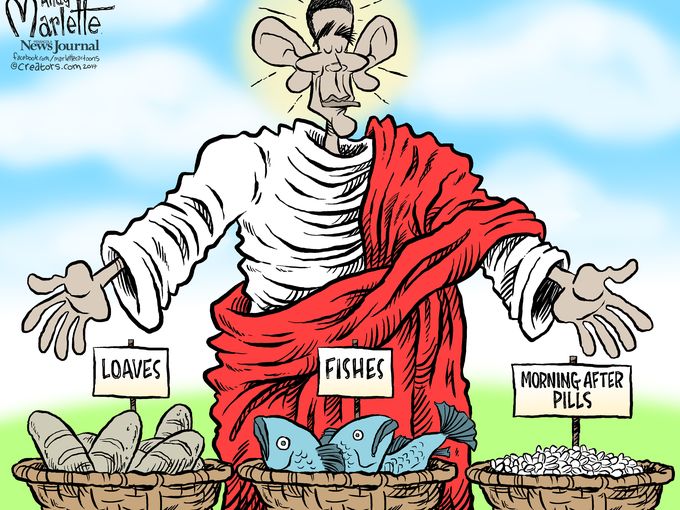



I have lived for so long in Moslem world that I take a risk now, offending my Moslem friends, by printing the cartoon of Mohammed weeping. It’s the cartoon that touched me to the bone. I have listened and learned in the Moslem world, and I have never met with hatred. The Mohammed I have read about in the Qu’ran and in hadith, and heard about in legend and stories from my Moslem friends portrayed a prophet who, like Jesus, was all about loving and serving the one true God. He would weep at what has been done in his name, as Jesus weeps for us, when we kill others in his service.

ISIS: Follow the Money
I wish I could say that I had written this, but no, this is an article by Howard Shatz, published in Politico and brought to my attention by Digg, who sends me remarkable items:

President Obama is laying out his strategy to counter the Islamic State, whose rampages across Iraq and Syria have riveted Americans’ attention on a zone of conflict that many had hoped to forget. Many are urging him to step up military action. But if Obama wants to defeat the jihadis, he will need more than airstrikes—he should follow the money.
For all that ideology, religious belief and perhaps a lust for violence and power might motivate those who fight for the Islamic State (known variously by the acronyms ISIS and ISIL), money is what keeps the group going. As with any state, ISIL has bills to pay and mouths to feed. Even for the world’s richest terrorist organization—which, by all available accounts, ISIL is—money doesn’t grow on trees, and nothing in the world comes for free.
So where does ISIL’s money come from? As part of my research at the RAND Corporation, since late 2006 I have been studying the finances, management and organization of the precursors to the Islamic State—Al Qaeda in Iraq and the Islamic State of Iraq—using their own documents, manuals and ledgers. More recently, Rand has teamed up with scholars from Princeton and Emory universities, as well as analysts from other organizations, to study more than 150 documents produced between 2005 and 2010. Although our work is still not yet done, we can draw a number of conclusions.
The most important thing for U.S. policymakers to remember is that ISIL now possesses the financial means to support a long-term fight—some $2 billion, according to a recent report in the Guardian, citing a British intelligence official. At the same time, ISIL’s preferred fundraising methods and many financial commitments create vulnerabilities. The organization was badly damaged by late 2009, thanks to a combination of coalition and Iraqi forces, as well as intervention by the Iraqi government, and it can be badly damaged again. But without the establishment of a widely accepted, legitimate political order in Iraq, ISIL cannot be eradicated—and will continue to seek out and mete out cash.
ISIL raises most of its money domestically in Iraq and Syria. Its income streams include oil smuggled to other countries in the region, extortion, taxes—especially on non-Muslim minorities—and other essentially criminal activities.
Oil is ISIL’s biggest source of revenue but also presents the biggest problem. ISIL controls about a dozen fields in Syria and Iraq, in addition to a number of refineries, including mobile refineries. Based on media accounts, RAND has estimated the total production capacity of these fields to be more than 150,000 barrels per day, although actual production is estimated to be much lower: The website Iraq Oil Report has reported that exports for the month of August at about 2.4 million barrels per day, for instance.
ISIL smuggles this oil out in tanker trucks—clearly visible from the sky should any drone pass overhead, so the smuggling is not particularly furtive. The group then sells the oil to whoever will buy it—reported in the media to be buyers in Syria, Turkey, the Kurdistan Region of Iraq and possibly in Iran and even Bashar Assad’s regime in Syria, among other countries. Sales take place at rates deeply discounted from world prices. But even so, revenues have been estimated in the media at $1 million, $2 million or even $3 million per day.
We have seen this before. From 2006 to 2009, ISIL’s predecessor, the Islamic State of Iraq, raised perhaps $2 billion through smuggled oil originating in the Baiji refinery in northern Iraq. This ended as a result of a concerted effort by U.S. and Iraqi forces to destroy the group and create the conditions in which the Iraqi government could exercise its law-and-order responsibilities, as well as vastly improved management at Baiji, owned by the Iraqi government.
So where does all of ISIL’s money go?
ISIL historically has paid its members (yes, it maintains payroll sheets) based on a flat monthly rate per person and then additional fixed amounts for each wife, child and dependent unmarried adult woman in the household. In Anbar, Iraq, the rate was $491 per year in 2005 and 2006, and then about $245 per year per dependent; the rate was similar in Mosul in 2007 and 2008. These payments to family are meant to continue if the ISIL member is captured or killed—a primitive form of life insurance. If enough members are captured and killed, however, these costs start to mount.
ISIL also pays rent for its members in some cases—payments that might be bonuses to high-performing members, although we cannot be sure—and medical expenses for some members and their families. In the past, the group has sometimes hired lawyers to help get captured members out of jail. And it runs safe-houses and has to buy equipment. Guidelines published by a predecessor of the group say that expense reimbursements should be filled out in triplicate and explain where each copy goes within the organization. We don’t know for sure whether ISIL today is making money or even breaking even, but at least in Anbar from 2005 to 2006, the money was being spent as fast as it came in.
As a cash-based organization, ISIL relies on couriers not only to deliver messages among its dispersed leadership but also to move money—follow the right courier and you get to the leadership. Because it deals only in cash, ISIL also needs to worry about the honesty of its members. We have seen instances of skimming for personal enrichment, as you might see in any cash-based criminal network.
As a state, albeit a twisted version of one, ISIL also has administrative expenses. It is responsible for making sure electricity and water flow and the roads stay repaired in the regions of Iraq it now controls—including parts of the Anbar, Ninewa Salah-al-Din, Kirkuk and Diyala governorates. Whether the group chooses to or is able to fulfill those responsibilities creates a vulnerability: A discontented population is unlikely to remain passive under ISIL’s leadership.
Even if ISIL is making $3 million per day—at the higher end of the various estimates out there—then it makes slightly more than $1 billion per year. Just to be conservative, in case ISIL is doing more business than we’re aware of, let’s double that to $2 billion per year. Although exact totals are difficult to find, in 2013, before ISIL’s advance, the Iraqi government spent far more than $2 billion per year running the governorates ISIL now controls, including salaries to civil servants, other costs of service provision and investment spending. That means ISIL likely isn’t keeping up the same level of service that the Iraqi government once did. True, ISIL need not maintain that level—it hardly rules with the consent of the governed. But it’s not only a problem that those under its rule can rebel, as happened in 2007 and 2008; with the exception of oil, the group’s continued revenue-raising also depends on there being enough money to skim and extort from the economy, and this requires some minimum level of services and economic activity.
There is little that outside forces can do to halt the extortion and skimming that take place within ISIL territory. Oil smuggling, though, can be disrupted, at least to an extent. Intelligence resources from the United States, Iraq and any other country that takes on ISIL should be focused on identifying middlemen and buyers for the smuggled fuel and using any means necessary to halt those purchases.
It would be counterproductive to destroy oil field infrastructure, since repairs would be expensive and legitimate governments will need those oil revenues when they reestablish control. But mobile refineries should be targeted, and roads and other pathways that tanker trucks use to transport oil to and from oil fields should be made impassable by military means. The refineries and roads can be easily repaired when the time comes, but for now, ISIL should find it very difficult to move oil from fields.
Stopping ISIL will of course require much more than disrupting its funding. It will have to be defeated militarily, and legitimate, trusted governments will have to be established in Iraq and Syria to defeat the group over time. There’s no simple path to achieving this, but as long as ISIL’s coffers remain full, the task will not get any easier.
Where is Lokoja, Nigeria?
Today the church celebrates the Birth of John the Baptist, whom the Moslems call Yahyah, and who has a much-visited tomb in the Ummayyad Mosque in Damascus, Syria. The church also prays today for the diocese of Lokoja, Nigeria, which is just south of Abuja, from where 300 girls were kidnapped by Boko Haram, people who believe girls should not be educated. Most of those girls are still missing. Three hundred girls . . . Lokoja . . . John the Baptist . . . Syria . . . so much need for prayer. . . The reading is from Forward Day by Day.

TUESDAY, June 24 The Nativity of Saint John the Baptist
Isaiah 40:11. He will feed his flock like a shepherd; he will gather the lambs in his arms, and carry them in his bosom, and gently lead the mother sheep.
So much of our scripture is violent and distressing, yet there are many passages like this, full of comfort and assurance that the trouble is over. Others might look at it and say, “Your God is violent and terrible, and the reassurances are flat and silly.”
Maybe that’s true. I tend to look at them more as descriptions of how we experience our lives rather than declarations of God’s nature. Our lives are difficult and often catastrophic—earthquakes, malaria, civil wars, and dangerous militias, to name only a few issues—and our lack of control means we blame God for it. But I don’t think God acts that way. And in the face of catastrophe, we say meaningless things: “Everything happens for a reason.” That’s no comfort at all.
Isaiah speaks peace to his people, trying his hardest to take their pain seriously and to offer the truth that everything will be okay in the end. When it’s not okay, it’s not yet the end. That “okayness” might be justice here or it might be eternal life, but this present trouble is not the end of the story.
PRAY for the Diocese of Doko (Lokoja, Nigeria)
Today the Church remembers The Nativity of Saint John the Baptist.
Ps 85 or 85:7-13; Isaiah 40:1-11; Acts 13:14b-26; Luke 1:57-80
Return to Islam, or You’re Dead, Sudanese Woman Told
From the Kuwait Times:
Sudanese woman may face death for choosing Christianity over Islam
KHARTOUM: A Sudanese court gave a 27- year-old woman until today to abandon her newly adopted Christian faith and return to Islam or face a death sentence, judicial sources said on Monday. Mariam Yahya Ibrahim was charged with apostasy as well as adultery for marrying a Christian man, something prohibited for Muslim women to do and which makes the marriage void. The final ruling will be announced today.
Ibrahim’s case was the first of its kind to be heard in Sudan. Young Sudanese university students have mounted a series of protests near Khartoum University in recent weeks asking for an end to human rights abuses, more freedoms and better social and economic conditions.
The authorities decided on Sunday to close the university indefinitely. Western embassies and Sudanese activists sharply condemned the accusations and called on the Sudanese Islamist-led government to respect freedom of faith. “The details of this case expose the regime’s blatant interference in the personal life of Sudanese citizens,” Sudan Change Now Movement, a youth group, said in a statement.
President Omar Hassan Al-Bashir’s government is facing a huge economic and political challenge after the 2011 secession of South Sudan, which was Sudan’s main source of oil. A decision by Bashir last year to cut subsidies and impose austerity measures prompted violent protests in which dozens were killed and hundreds were injured. — Reuters
Heroes At The Dinner Table
“That’s Jollaf rice!” the Nigerian journalist said, a note of delight in her voice. She is famous for her passion and persistence drawing attention to the environmental issues in the Niger delta related to oil extraction and production. I told her that here in the Gulf, it’s called Jambalaya, but we all agreed that it very likely had African roots. She delighted my heart; she had three helpings.
When we have visitors from foreign countries, I try to serve foods they can identify – grilled vegetables, a chicken dish, several salads, a dessert. This time, because we had no Moslems, we used a real Cajun sausage in the jambalaya (pork), and jumbo shrimp.
The award-winning Finnish environmentalist has his own online website and a goal of planting 100 million trees by 1017. He is well on his way, visiting and planting trees in new countries every week. He also has his own band and has a CD out with Finnish music.

Our South African guest manages a large rhino reserve, protecting the rhinos from those who would kill them for their horns, thinking it renews sexual energy. Poor rhinos! He was quiet, but an acute observer, and the highlight of the evening was as he sang the haunting South African national anthem, Nkosi Sikelel’, with the Finnish guest. They did not sing all 11 verses (!) in all the different languages; just one verse, it was very moving:
Our own sweet environmentalist was with us. We think our son and his wife are super heroes; they fight for justice and a clean environment. This evening, our son stayed at home with the grandchildren and his wife, who works with clean water, was able to join and talk shop over dinner with her counterparts from other parts of the world.
It isn’t so easy anymore to get these dinners on the table, off the table, dessert served, etc. I used to be able to do these easily, for more than 20 people, but I also had help, LOL! But these dinners give us so much joy that I can’t imagine giving them up any time soon.
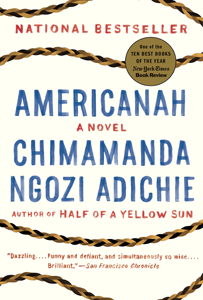
Chimamanda Ngozi Adichie: Americanah
“Ouch! Ouch, Chimanda! Stop!”
(Oh wait.)
Don’t stop.
It’s me who can’t stop. I read everything Chimamanda Ngozi Adichie writes. I only started reading her by accident, when I was facilitating the Kuwait Book Club I never intended to belong to, and found myself reading so many books by authors I had never heard of. We were reading Half Of a Yellow Sun and all of a sudden, I WAS Nigerian. She can do that. She uses the senses, she uses the thoughts in our head. We are really not so alien, us and the Nigerians I start to think. I have Nigerian friends, from the church. We all get along. We have a good time together.
“Not so fast!” Chimamanda tells me in Americanah, her newest book, which I put off buying until I could find it in paperback. “You are very different! You think differently! And growing up in a country where there are black and white, race becomes an issue that it is not when you are black, and everyone is black, and you are growing up in Nigeria.”
Hmmm. OK. That makes sense. I mean, I thought I was Nigerian because in Half of a Yellow Sun, I was Igbo, living in an academic community in Nigeria, and hmmmm. You’re right, Chimamanda, there were no white people around. Just us Nigerians.
Chimamanda, with her sharp, all-seeing eyes, her sharp ears and her sharp tongue make me cringe as she comes to the USA and comes up against assumptions many have about Africa. Do you even know where, exactly, Nigeria is? Do you know where Ghana is? Most Americans can find Egypt on a map of Africa, and MAYBE South Africa, but the rest is . . . mostly guesswork. Because we send clothing and food aid to African countries, we have the idea that all Africans are poor, but that is not so, and is insulting to the middle-class and upper class Africans who travel elsewhere for leisure – and education.
I don’t know how much of Chimamanda Ngozi Adichie’s book is autobiographical and how much is fiction. I know that her observations are acute, she nails expat friendships, she spotlights our blind spots and hypocricies, and she holds you in her grip because she is no less harsh with herself – if, indeed, her Ifemelu, the main character in Americanah, is reflecting Chimamanda’s own experience. The experiences, coming here, the overwhelming differences in manners and customs, even volume of voice and width of hand expression, are so immediate, so compelling, so well described that they have to have been experiences she herself had, and had the eyes to see. She must have taken notes, because she totally nails the expat experience.
Book ads and book reviews focus on Americanah as a book about being black in America, and it truly is that – as seen from the eyes of a non-American black, as she often reminds us.
She is hard on herself, returning to Nigeria, and quick to note that much of the change is in herself and her changed perspective. While I love the romantic storyline, I was disappointed by the fantasy ending, given how self-disciplined Adichie is at keeping it real in every other facet of the novel. On the other hand, I am still trying to think of an ending that would work for me, and I can’t. While her ending wraps it all up neatly, it’s the one part of the book where her sharpness dulls.
One of the things I liked best about the book was going behind the scenes, being Nigerian, going to school, having coffee, working, going to parties with other Nigerians, chatting with my girlfriends. We’ve done things with nationals of different countries before, but you know as soon as you walk in that your presence changes things. Chimamanda Ngozi Adichie takes me with her and no one knows I am there, observing, learning, figuring out how things are done when it’s “just us” Nigerians.
Here’s why I am a Chimamanda Ngozi Adichie addict. She keeps it real. She has eyes that see, and ears that hear, and a gift for capturing what she sees and hears and a gift for writing it down. She has insight, into herself, into others, into character and motivations. She is sophisticated and unpretentious, she admires and she mocks, but when she mocks, it is as likely to be self-mockery as mockery of another person, class, ethnicity or nation. Reading Adichie, I understand our similarities – and our differences. I believe she would be a prickly friend to have, but I would chose her as a friend.
Awards
● Winner of the 2013 National Book Critics Circle Award for Fiction
● One of The New York Times’s Ten Best Books of the Year
● Winner of the The Chicago Tribune 2013 Heartland Prize for Fiction
● An NPR “Great Reads” Book, a Washington Post Notable Book, a Seattle
Times Best Book, an Entertainment Weekly Top Fiction Book, a Newsday Top 10 Book, and a Goodreads Best of the Year pick.
Where is Rwanda and How Do They Celebrate a Genocide Anniversary?
Today the church prays for the diocese of Byumba, in Rwanda. There is Rwanda, below, right in the heart of Africa, nestled between the Democratic Republic of the Congo, Uganda, Kenya, Tanzania and Burundi.
 Rwanda was in the news this last week for something very special. Most of our western news stations gave it zero coverage, but you could catch a glimpse online. This, from the Christian Science Monitor: on an amazing event just twenty years after one of the worst genocides in my memory. To me, it is wonderful and inspiring that they forgive one another and love one another to live in peace with one another. It gives me hope for our world.
What to celebrate in Rwanda’s genocide anniversary
The 20th anniversary of the Rwanda genocide should focus as much on how the African nation worked toward reconciliation through forgiveness as on the mass slaughter itself.
This month, Rwanda marks the 20th anniversary of an event that its name is most associated with – the 1994 mass slaughter of the Tutsi minority and many in the majority Hutu. Over 100 days starting April 7, more than 800,000 people were killed, many by neighbors incited to ethnic hatred by a political elite. It is a genocide often cited since then to justify military intervention in similar ongoing atrocities.
But another lesson from Rwanda’s experience deserves to be remembered – an amazing reconciliation of killers and survivors through individual confession and forgiveness in nonjudicial village courts.
This type of reparative justice in an intimate setting could prove useful in countries that will need post-conflict healing, such as Syria, Colombia, andMyanmar (Burma). It might also help prevent a cycle of revenge and retribution in those countries, as it has in Rwanda.
Most of Rwanda’s main perpetrators in the genocide have been tried in regular courts, either in Rwanda, Europe,, or the International Criminal Tribunal for Rwanda, set up by the United Nations. But for hundreds of thousands of others who were charged with killing, the Rwandan criminal-justice system was too weak and its jails too full. Legal trials would have taken decades. The country had to fall back on a form of community-based traditional justice known asgacaca.
Other post-conflict countries in transition, notably South Africa, have relied on a similar process with their truth-and-reconciliation commissions. But the bodies have usually been more formal and national in scope. Rwanda’s gacaca are far more personal, designed to achieve the end result of allowing people who knew each other to resume living in the same community. They also bring together an entire village to witness a confession, attest to its sincerity, encourage forgiveness by the victim, and agree on some reparation, such as helping till a victim’s fields for a time.
It hasn’t worked in every case. Many Tutsis who killed Hutus have not been tried. Many victims could not bear the trauma of hearing how their loved ones had died. And many Hutus disappeared or were able to hide from the truth.
The government under President Paul Kagame, despite its drift toward authoritarian rule, has encouraged the process by outlawing formal use of ethnic identities. “The divisionism of before is gone. All of us now have equal access to opportunities,” a young Rwandan told The Christian Science Monitor.
The gacaca rely on the guilty to listen to the stories of their victims with empathy, admit their acts with repentance, and rethink their self-identity within the community. For the victims who forgive, the process can lift feelings of rage and bitterness. Much of the justice lies in the restoration of relationships as much as in material reparations.
Rwanda is not yet a “post-ethnic” African nation. But the possibility of a future political class inciting Hutus and Tutsis to take up violence now seems slim. More Rwandans have a higher sense of identity.
As the world helps Rwanda mark the 1994 genocide, it should also spread the lessons of this post-genocide reconciliation. Dispute resolution is a common technique in every society, whether in families or courts. But when almost every village in an entire nation goes through it, the lesson is worth repeating elsewhere.
Ladysmith Black Mombazo Live in Niceville
My co-Mother-in-Law leaned over and said “I don’t think they could have done this twenty-five years ago.”
I think she’s right. Northwest Florida is still one of the most conservative societies in America, and yet, in spite of all probabilities, we are in the Mattie Kelly Cultural Center, in Niceville, Florida, surrounded by a HUGE and enthusiastic audience, all of whom have shelled out big bucks to hear this talented group out of South Africa.

As soon as we saw the initial ads, AdventureMan marked his calendar, so we could call the very first day tickets were available. I don’t really believe in bucket lists, but I do believe in grabbing an opportunity when it presents itself; we have loved the sounds of Ladysmith Black Mombazo forever.
Last night was a thrill. I was astonished at how wildly enthusiastic the audience was; it was a mix of all walks of the population, academics, retired folk, groups of school children, and . . . fans. Wildly enthusiastic fans. A group knows when it is treasured, and it feeds on the positive response. Ladysmith Black Mombazo thrilled our hearts.
Here is one of my favorites, expecially the introduction:
Recent Comments
Cathy on No Grown-Ups in Charge intlxpatr on Waiting for Snow intlxpatr on Waiting for Snow Abou Tabblouleh on t… on Waiting for Snow Abou Tabbouleh on in… on Waiting for Snow Wikipedia Donate Button

Amazina


Early Voting in Florida


 Here There and Everywhere