One Kings Lane: Excellent Customer Service
They didn’t even answer the phone. When I called Customer Service to tell them that of the 12 drinking glasses they had sent me, 11 arrived perfectly, one arrived in smithereens, smashed, crushed. I can’t imagine how 11 could be flawless and one could be so badly damaged.
They told me to leave a message, so I did. As I was holding the paperwork in my hand, I was able to give them my order number and what had happened. I told them I didn’t want to return the glasses I received – I totally love them – but would they send me a replacement for the one that arrived in smithereens?
They didn’t call me back. I barely noticed, I was having a busy day, only around six did I think of it and had second thoughts about dealing with them again.
Then early yesterday morning I found their e-mail, sent shortly after I had called, telling me they had no replacements, but they would credit my account for the entire amount and I could give them to charity or use them as I wished.
I was blown away. Who does that?
It’s not like I need more e-mail, but every e-mail they send me has something lovely. These are the glasses I bought:

No, no, they are not glamorous, but they are perfect for everyday use. They are made of recycled glass, they have wide bottoms and they have little raised fleur-de-lis on them.
Why is this important? I have a cousin; when he was a boy he would talk enthusiastically and knock over his drinking glass. It got to be a family joke. But you can prevent these things. If you have children and want them to learn how to dine with adults, you choose items that will help them succeed – wide bottom glasses, for example, that are not easily tipped over, with details on the outside that will help little hands grasp the slippery outsides without slipping. It’s not that hard, you just have to give it a little thought.
It isn’t that hard to give children tools they need to grow strong and capable, and confident. You give them concepts, you give them knowledge, you give them practice. You also give them a sport, something that will teach them how their body moves and how to bring it under their own control, so that when they reach their teen-aged years, they will move with grace and have learned self-restraint. 🙂
One King’s Lane is also where I found the fabulous bathtub I showed you. I still yearn for this tub!

And today, oh my sweet heaven, I found a pair of bookshelves I can barely restrain myself from ordering. They are beautiful, and unlike anything I would find in Pensacola, and oh! They hold books!

They Know What I Like!
I get all kinds of ads, and it is scary how much information they can put together to figure out what I might be interested in. Today I got an ad that headlined this bathtub:

Is that not gorgeous? I don’t have need of a bathtub . . . but I thought about creating a need . . . only to learn that it is already sold out. But what gorgous lines! I am WOWed.


One Lonely Little Snowflake Not Shown on Russian TV
Journalists are tough, and snarky. All the photos and stories coming out of Sochi about the orangey brown water coming out of the taps, doors kicked down so new TVs can be installed (better late than never) etc. These are things we take for granted when we go to other countries, especially when they are undergoing rapid construction. There are times when deadlines are not met and things do not go smoothly. (I will never forget the look on the face of our building care-taker, who had sworn to me, over and over, he had no key to my apartment, but who walked in one day when my car was at the dealership for repairs, and he thought I was gone, too.) Things happen.
But one journalist on NPR (National Public Radio) cracked me up totally talking about the opening ceremony, and how beautiful it was until the climax, and the five snowflakes morphed into five Olympic rings – or at least that was the plan. “Four rings – and one lonely little snowflake! This is the memory of the Sochi games!” he chortled, and I found myself laughing, too, at that one lonely little snowflake.
I would hate to be the person responsible for that snowflake, or any of the hotel problems. It may be modern day Russia, but heads can still roll 😦
As it turns out, the Russians never saw that. They saw a doctored tape from the rehearsal, when all went as scored:

Report from Huffpost via AOL:
SOCHI, Russia (AP) — Smoke and mirrors? Russian state television aired footage Friday of five floating snowflakes turning into the Olympic rings and bursting into pyrotechnics at the Sochi Games opening ceremony. Problem is, that didn’t happen.
The opening ceremony at the Winter Games hit a bump when only four of the five rings materialized in a wintry opening scene. The five were supposed to join together and erupt in fireworks. But one snowflake never expanded, and the pyrotechnics never went off.
But everything worked fine for viewers of the Rossiya 1, the Russian host broadcaster.
As the fifth ring got stuck, Rossiya cut away to rehearsal footage. All five rings came together, and the fireworks exploded on cue.
“It didn’t show on television, thank God,” Jean Claude-Killy, the French ski great who heads the IOC coordination commission for the Sochi Games, told The Associated Press.
Producers confirmed the switch, saying it was important to preserve the imagery of the Olympic symbols.
The unveiling of the rings is always one of the most iconic moments of an opening ceremony, and President Vladimir Putin has been determined to use the ceremony as an introduction of the new Russia to the world.
Konstantin Ernst, executive creative director of the opening ceremony, told reporters at a news conference that he called down to master control to tell them to go the practice footage when he realized what happened.
“This is an open secret,” he said, referring to the use of the pre-recorded footage. The show’s artistic director George Tsypin said the malfunction was caused by a bad command from a stage manager.
Ernst defended his decision, saying that the most important part was preserving the images and the Olympic tradition: “This is certainly bad, but it does not humiliate us.”
NBC was to air the ceremony in the U.S. on tape delay later Friday.
Glitches are not uncommon at Olympic opening ceremonies.
There was a minor controversy over trickery involving the fireworks at the opening ceremony of the 2008 Beijing Olympics, after it was revealed that some of the display featured prerecorded footage.
Fireworks bursting into the shape of gigantic footprints were shown trudging above the Beijing skyline to the National Stadium near the start of the ceremony. Officials confirmed that some of the footage shown to TV viewers around the world and on giant screens inside the stadium featured a computer-generated, three-dimensional image.
In addition, a tiny, pigtailed 9-year-old girl in a red dress who sang “Ode to the Motherland” was lip-synching. The real voice belonged to a 7-year-old girl who was replaced because she was deemed not cute enough by a member of China’s Politburo.
At the 2006 Winter Games in Turin, Luciano Pavarotti’s performance was prerecorded. The maestro who conducted the aria, Leone Magiera, said the bitter cold made a live performance impossible.
___
Associated Press writers Stephen Wilson and Oskar Garcia contributed to this report.
Babayaga by Toby Barlow

You know how books come your way in coincidental ways? Amazon.com had told me I needed to read Babayaga, so I ordered it. I’ve always loved mythologies, I devoured them like candy when I was young, always looking for more. Babayagas are very old, and exist under many names in most cultures – elderly women who usually deal with concoctions, often medicinal, who live alone. In the west, they were often called witches, in the Slavic countries, babayaga, and it seems to me there is an old woman used to scare children in the Gulf, too. It seems to be a cross-cultural phenomenon.
Here is what Wikipedia has to say about Babayaga:
Baba Yaga is a witch (or one of a trio of sisters of the same name) in Slavic folklore, who appears as a deformed and/or ferocious-looking elderly woman. She flies around in a mortar and wields a pestle. She dwells deep in the forest, in a hut usually described as standing on chicken legs, with a fence decorated with human skulls. Baba Yaga may help or hinder those that encounter or seek her out, and may play a maternal role. She has associations with forest wildlife. Sometimes she frightens a hero (e.g. by promising to eat him), but helps him if he is courageous. According to Vladimir Propp’s folktale morphology, Baba Yaga commonly appears as a donor, a villain, or something altogether ambiguous. In many fairy tales she kidnaps and eats children, usually after roasting them in her oven).
Andreas Johns identifies Baba Yaga as “one of the most memorable and distinctive figures in eastern European folklore,” and observes that she is “enigmatic” and often exhibits “striking ambiguity.”[1] Johns summarizes her as “a many-faceted figure, capable of inspiring researchers to see her as a cloud, moon, Death, Winter, snake, bird, pelican or earth goddess, totemic matriarchal ancestress, female initiator, phallic mother, or archetypal image”.[2]

Barlow’s BabaYaga includes all the backstory, inserted here and there, the Russian purges, revolts, revolutions, the wars, the mud, the snows, following the troops, and several different Babayaga, while focusing one one, the beautiful and mesmerizing Zoya, who lives in a magical post World War II Paris. She in unforgettable – unless, of course, she has woven a spell to muddy your mind and make you forget.
What I love about this book is that if it were true, you would still think it is fiction. If every single thing happened just as Barlow wrote it, you would never believe it. LOL! A wicked sour old babayaga turns a police detective investigating a murder into a flea; he finds it a novel experience and manages to make things come right even as a flea.
A young American man, Will, loving living in Paris, works for an ad agency and also for THE Agency in the heady days of post war Paris, where the rules are not yet in place and lines are fuzzy. Falls for a witch with a long history of loving and killing men, but that’s life. Is it better to love and lose than never to have loved? What if your love is a gorgeous babayaga who helps you live life with a vibrance and intensity you have never experienced?
There is a long, intricate, time-appropriate adventure/spy/industrial-scientific plot which I am not sure I entirely followed, with murders and shootouts and the Paris jazz and club scene, and it didn’t matter one whit whether I could follow the plot line or not, it was a wild ride of a novel and a lot of fun. 🙂
Ghost of Christmas Past
I remember Thanksgiving. It was yesterday. The season has never gone so fast, with Thanksgiving being so close to Christmas. Taking care of my sweet little granddaughter in the afternoons was a wonderful, quiet interlude in an otherwise swirling-with-events December, complicated by AdventureMan and I both catching terrible colds and lacking energy during the middle part leading up to Christmas.
I wouldn’t pass up the babysitting part for anything. My little granddaughter is the sweetest little baby ever. If she fusses, she doesn’t fuss much, and it is easily covered by “change my diaper” or “feed me” or “I really need to sleep” or I’m bored, walk me around a little until I fall asleep” or “Now I really really need to go to sleep!” Every now and then she fools you with an “I’m too hot! Take some clothes off!” but that makes me laugh, because once you do she is so grateful she just gurgles and coos. She is also beautiful 🙂
We had a wonderful Christmas, colds gone, great houseguests, fun family times, including taking our grandson to his first Nutcracker. Just after Christmas we rushed off to a family wedding in south Florida – a horrid 13 hour drive down – so I grabbed a few Christmas photos before it all gets taken down:
Here’s what I love. We have so many decorations loaded with Christmas baggage – you know the kind. “Oh! We got those candlesticks the year we moved to Wiesbaden!” “Oh! Remember that palm tree from our CENTCOM years?” “Look! Our creche!” “Oh! Our Damascus ornaments!” It is wonderful, and it is time consuming, and with a short Christmas this year, and a lot going on, I did something I have never done before. I saw some ornaments in WalMart, I call them “bang-for-your-buck” ornaments, sparkling snowflakes and stars, 20 for $2.98.
I bought a lot. Maybe about $25 worth. A lot of twinkling little stars and snowflakes.
The tree was all silver balls and silver stars this year, with an ivory cross on top.
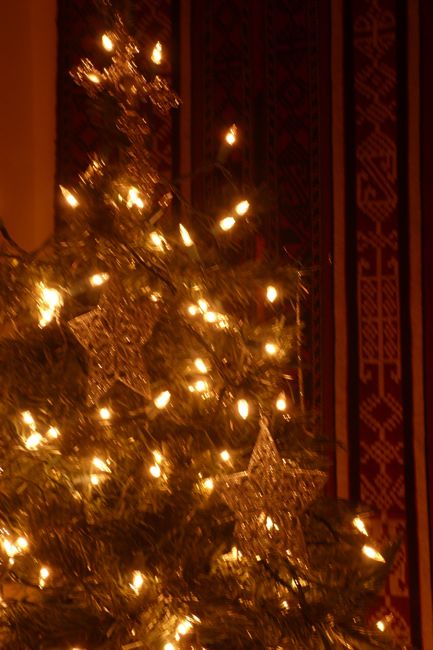
The stairwell was all silver snowflakes. It was magical. It was also quick and easy and inexpensive – I grinned every time I saw it.
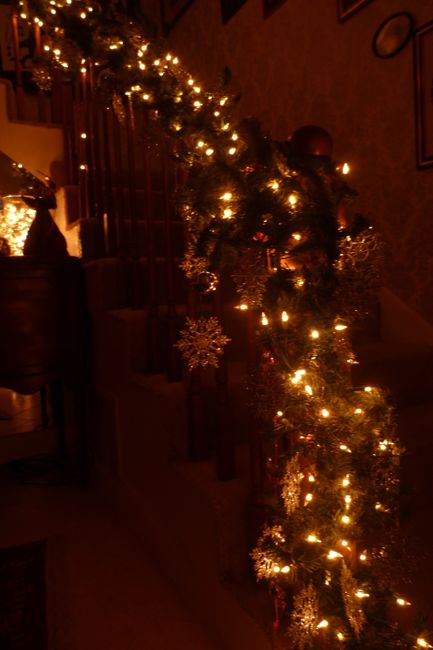
I did pull the Nurnburg angel out; I don’t think I can do Christmas without her and she provided a pop of red against all the greenery and silver and white.

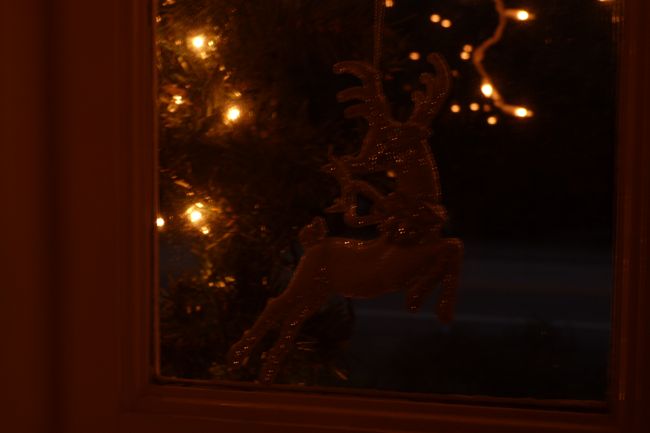
The little silver reindeer are easy; stored all together in a box that says “Early Christmas” right along with the suction cups that hold them up – if it takes me five minutes, it’s a slow year, LOL.
Qatar Wins Guiness Record for Largest Flag

As Qatar goes into National Day frenzy, they capture the title for World’s Largest Flag. Mabruk, Qatar!
As the country gears up for National Day celebrations, a Qatar national flag measuring 101,000+sqm was yesterday recognised by the Guinness World Records as the largest flag in the world, beating current record holder Romania, which created a 79,000sqm flag last year.
The flag, described as the “Flag of Gratitude and Loyalty”, is currently spread across a large area on the outskirts of the capital.
The announcement was made in the presence of a huge gathering of Qatari citizens at a glittering ceremony held at the Katara amphitheatre.
A Guinness World Records official flown in from the UK presented the certificate of recognition to a representative of the “Flag of Gratitude and Loyalty” team at the event.
Speaking about the flag, the Guinness World Records official said: “This is a big challenge and one of the most difficult records I have seen. The record grew many times from 1976 and the current record to break is almost 80,000sqm. It was established in Romania last year with a flag that set the record of 79,000sqm.”
He described the Qatari flag as “a very large engineering project involving a lot of challenges”, which must follow the Guinness World Records guidelines.
“More than 2,000 people have taken part in this project, which is supported by Brooq Qatari Magazine and Katara. Yesterday, I went to see the flag on location and was impressed by the quality of manufacturing, stitching, material and quality of fabric – all were of very high standards, as well as the participation of the people involved as nobody wanted to leave after the work was done. The flag means so much to them than just its size,” he pointed out before announcing the size of the flag.
The audience at the unveiling event were later serenaded by the Qatar Armed Forces orchestra.
From Tree to Amazing Carving
Thank you, once again, Hayfa, for this wonderful item:
(The original piece did not include this information, which I found at the Daily Mail Online:
A Chinese artist has won a place in the Guinness Book of Records after creating the world’s longest wooden carving.
Zheng Chunhui, a famous wood carver, spent four years creating the artwork which is over 40ft long and made from a single tree trunk.
Read more: http://www.dailymail.co.uk/news/article-2509367/Guinness-Book-Records-creating-worlds-longest-wooden-carving.html#ixzz2ngOQX2Os
One tree, four years of work and an indescribable amount of talent: that’s what it took to create this incredible masterpiece. A famous Chinese wood carver chopped down a single tree and tirelessly worked on it for over four years to make this piece. Your jaw will hit the floor when you see what he created.


Zabbaleen Cave Church in Cairo
My friend Hayfa sends me the most amazing things. Her mind is another Here, There and Everywhere Kind of mind. 🙂
This article resonates with me because when we moved to Tunis, the garbage collectors would fight over our trash. I felt horrible, we had an infant, and there were diapers in the trash. 😦 Our maid would take cans and jars and especially jars with lids out of the trash, and ask if she could take them. We learned before throwing anything away to see if she wanted it first. They used, and re-used, everything. We learned to look at our consumption in a whole new way. It was one of the best things about living in an ‘alien’ community; we learned to see ourselves with different eyes.
Thank you, Hayfa, for this fascinating article.
The Cave Church of the Zabbaleen in Cairo
The Monastery of Saint Simon, also known as the Cave Church, is located in the Mokattam mountain in southeastern Cairo, Egypt, in an area that is known as ‘garbage city’ because of the large population of garbage collectors or Zabbaleen that live there. The Zabbaleen are descendants of farmers who started migrating from Upper Egypt to Cairo in the 1940s. Fleeing poor harvests and poverty they came to the city looking for work and set-up makeshift settlements around the city. Initially, they stuck to their tradition of raising pigs, goats, chickens and other animals, but eventually found collecting and sorting of waste produced by the city residents more profitable.
The Zabbaleen would sort through household garbage, salvaging and selling things of value, while the organic waste provided an excellent source of food for their animals. In fact, this arrangement worked so well, that successive waves of migrants came from Upper Egypt to live and work in the newly founded garbage villages of Cairo.
For years, the makeshift settlements of the Zabbaleen were moved around the city trying to avoid the municipal authorities. Finally, a large group of Zabbaleen settled under the cliffs of the Mokattam or Moquattam quarries at the eastern edge of the city, which has now grown from a population of 8,000 in the early 1980s, into the largest garbage collector community in Cairo, with approximately 30,000 Zabbaleen inhabitants. Egypt is a Muslim-majority country, but the Zabbaleen are Coptic Christians, at least, 90 percent of them are. Christian communities are rare to find in Egypt, so the Zabbaleen prefer to stay in Mokattam within their own religious community even though many of them could afford houses elsewhere.
The local Coptic Church in Mokattam Village was established in 1975. After the establishment of the church, the Zabbaleen felt more secure in their location and only then began to use more permanent building materials, such as stone and bricks, for their homes. Given their previous experience of eviction from Giza in 1970, the Zabbaleen had lived in temporary tin huts up till that point. In 1976, a large fire broke out in Manshiyat Nasir, which led to the beginning of the construction of the first church below the Mokattam mountain on a site of 1,000 square meters. Several more churches have been built into the caves found in Mokattam, of which the Monastery of St. Simon the Tanner is the largest with a seating capacity of 20,000. In fact, the Cave Church of St. Simon in Mokattam is the largest church in the Middle East.
 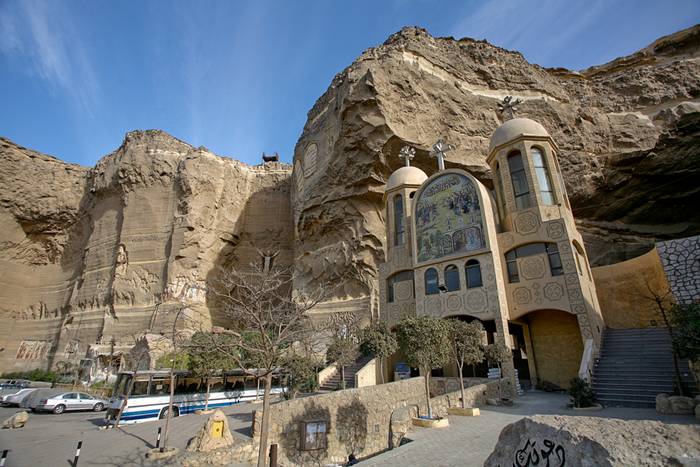 Photo — Link
 Photo — Link
 Photo — Link
 Photo — Link
 Photo — Link
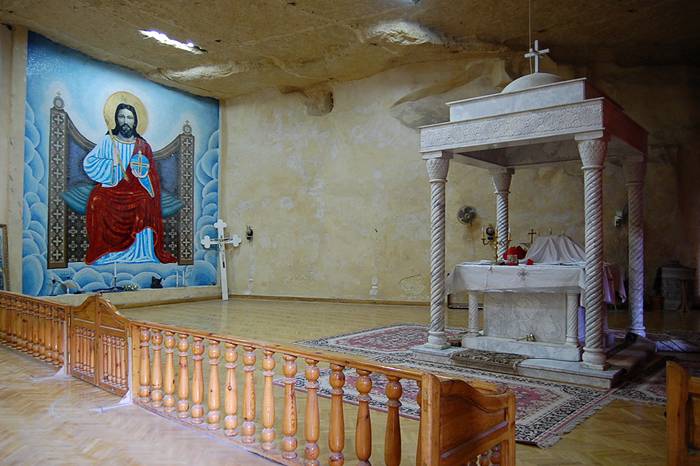 Photo — Link
 Photo — Link
 Photo — Link
 Photo — Link
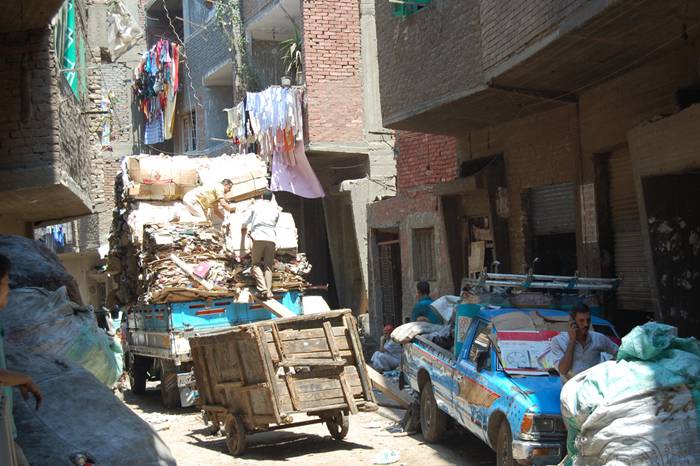 Photo — Link
|
USAF Band Flash Mob at National Air and Space Museum
Once again, Hayfa, you have found a total winner. Wonderful music, wonderful surprise for the museum visitors 🙂
Recent Comments
ExpatAlien on What Country am I Living … intlxpatr on Yellowstone: Old Faithful to C… Michelle on Yellowstone: Old Faithful to C… Cathy on No Grown-Ups in Charge intlxpatr on Waiting for Snow Wikipedia Donate Button

Amazina


Early Voting in Florida


 Here There and Everywhere