“We’ve started the count-down calendar,” said my beautiful and very pregnant daughter-in-law, “We have so many things we want to get done before the baby comes.”
We were gathered at one of our favorite casual lunch places, a place where we could eat well and our 3 year old could be both free to roam a little, and safe to roam, while the grown-ups talked.
“We’ve started, too,” I smiled at her, “I need to finish up her baby quilt, and two quilts for the homeless project I have due in September. And of course, we will be out of the loop the last two weeks before she is born, so I need to keep motivated now.” I know she will call on me once the new baby is here; I am the back-up, the “can you fix dinner / wash the dishes / hold the baby while I shower / clean up the baby spit / run to the grocery store/ feed the cats” person. I love it. It’s why we moved here, to be here when they need us, when they need the help. Being close to family, being there to help when they need the help – this is one of the great lessons we learned from our friends in Amman, in Kuwait, in Doha, in Tunis.
We also have an Alaska adventure in store, planned before any of us knew the new baby was en route. It’s not Africa, but we aren’t up for another of those 17 hour rides from Atlanta to Johannesburg this year. Alaska will be fun, a sentimental journey back to my origins for me, and a whole new environment for AdventureMan.
“We’ll also have the school break to cover,” beautiful D-I-L added, “but I know there is going to be a cousin’s camp; I just don’t know when it is going to be.”
Cousins camp – oh what fun. All the little like-aged cousins get together for a week of hell-bent-for-leather activities, from water parks to fire departments to scavenger hunts, they keep those little rascals so busy that they just fall into bed at night. It’s all good.
“I know it’s all going to fall into place,” she sighed, smiling at our son, “but we need that calendar to keep us on track.”
(Play the video of the Soweto Gospel Choir as you read this summary from today’s Lectionary Readings How I would love to be able to attend this festival!)
BERNARD MIZEKI
CATECHIST AND MARTYR IN AFRICA (18 JUNE 1896)
Bernard Mizeki was born in Portuguese East Africa (Mozambique) in about 1861. When he was twelve or a little older, he left his home and went to Capetown, South Africa, where for the next ten years he worked as a laborer, living in the slums of Capetown, but (perceiving the disastrous effects of drunkenness on many workers in the slums) firmly refusing to drink alcohol, and remaining largely uncorrupted by his surroundings. After his day’s work, he attended night classes at an Anglican school.
Under the influence of his teachers, from the Society of Saint John the Evangelist (SSJE, an Anglican religious order for men, popularly called the Cowley Fathers), he became a Christian and was baptized on 9 March 1886. Besides the fundamentals of European schooling, he mastered English, French, high Dutch, and at least eight local African languages. In time he would be an invaluable assistant when the Anglican church began translating its sacred texts into African languages.
After graduating from the school, he accompanied Bishop Knight-Bruce to Mashonaland, a tribal area in Southern Rhodesia (now Zimbabwe), to work there as a lay catechist. In 1891 the bishop assigned him to Nhowe, the village of paramount-chief Mangwende, and there he built a mission-complex. He prayed the Anglican hours each day, tended his subsistence garden, studied the local language (which he mastered better than any other foreigner in his day), and cultivated friendships with the villagers. He eventually opened a school, and won the hearts of many of the Mashona through his love for their children.
He moved his mission complex up onto a nearby plateau, next to a grove of trees sacred to the ancestral spirits of the Mashona. Although he had the chief’s permission, he angered the local religious leaders when he cut some of the trees down and carved crosses into others. Although he opposed some local traditional religious customs, Bernard was very attentive to the nuances of the Shona Spirit religion. He developed an approach that built on people’s already monotheistic faith in one God, Mwari, and on their sensitivity to spirit life, while at the same time he forthrightly proclaimed the Christ. Over the next five years (1891-1896), the mission at Nhowe produced an abundance of converts.
Many black African nationalists regarded all missionaries as working for the European colonial governments. During an uprising in 1896, Bernard was warned to flee. He refused, since he did not regard himself as working for anyone but Christ, and he would not desert his converts or his post.
On 18 June 1896, he was fatally speared outside his hut. His wife and a helper went to get food and blankets for him. They later reported that, from a distance, they saw a blinding light on the hillside where he had been lying, and heard a rushing sound, as though of many wings. When they returned to the spot his body had disappeared. The place of his death has become a focus of great devotion for Anglicans and other Christians, and one of the greatest of all Christian festivals in Africa takes place there every year around the feast day that marks the anniversary of his martyrdom, June 18.
“Red Robin!” I sang, and AdventureMan responded “YUMMMMMMMM!” I had mentioned I am getting ready for my annual hamburger, and he became obsessed with Red Robin and we had to go there. I had the Whiskey River Chicken Salad. If I only have one hamburger a year, I want it closer to the 4th of July. It doesn’t have to make sense to you, but it matters to me. If you only eat one hamburger a year, it has to be a really good hamburger. 🙂
Back to the “YUMMMMMMM!”
Now, that’s good marketing. There is nothing not good about “YUMMMMMMM”
A campaign where you train people to think “YUMMMMM!” every time you hear Red Robin – brilliant!
We love good marketing. We love good ads; we notice good ads and good marketing techniques. We also scorn the bad ones.
Here’s what we love:
Mayhem – the entire series for Allstate, also the Allstate commercials when suddenly the black-guy-who-was-President-in-24’s voice comes out of an unlikely person.
Gecko/Geico – anytime you smile and you remember who the ad is for, that’s a good ad.
“What’s in Your Wallet?” Those hilarious Vikings make the point for Capitol One.
There are ads we like, but they don’t win our awards because while we like them, we can’t remember who they are for. If you can’t remember who an ad is for, the ad isn’t effective.
Campaigns I hate:
COX TV ads, all of them, just dumb.
Direct TV ads, just dumb.
Toilet Paper ads
As you can imagine, AdventureMan and I can have this conversation over a lot of long-distance drives and over a lot of meals.
So – what’s your favorite ad campaign? And why? Worst?
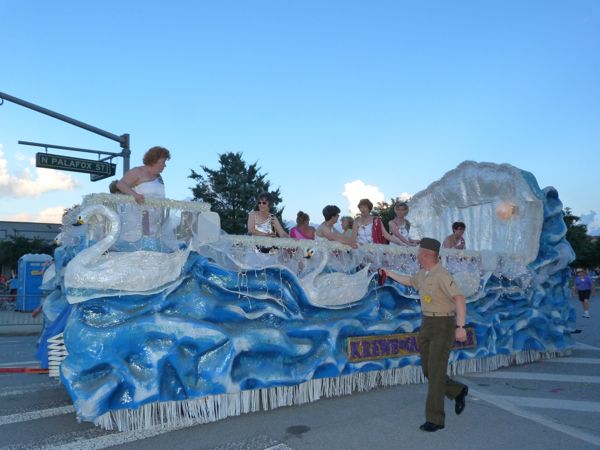
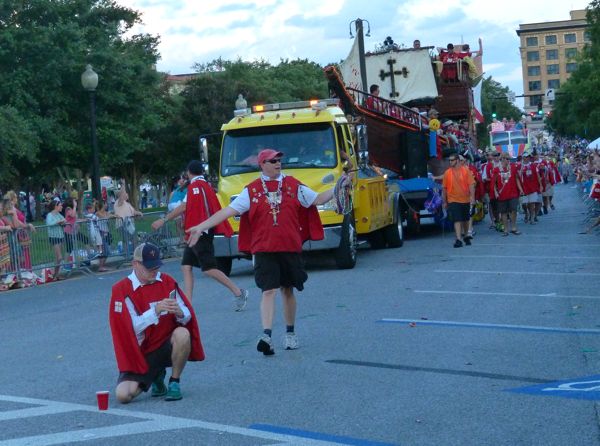
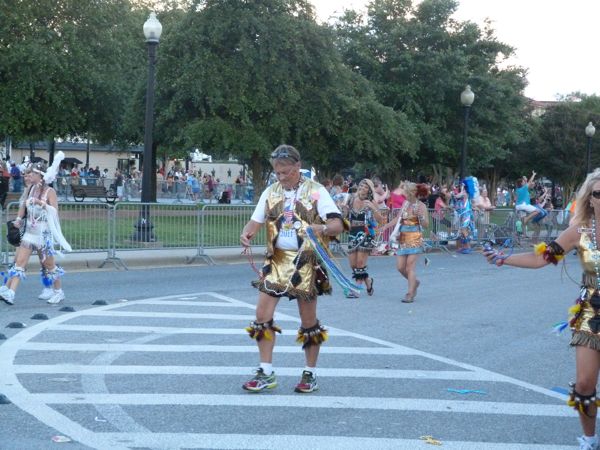
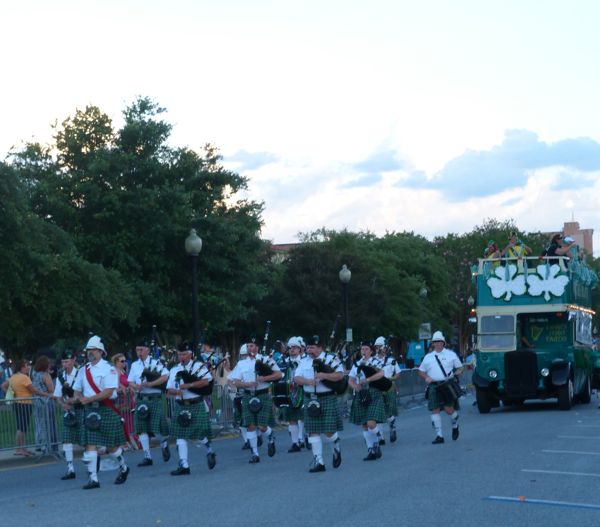
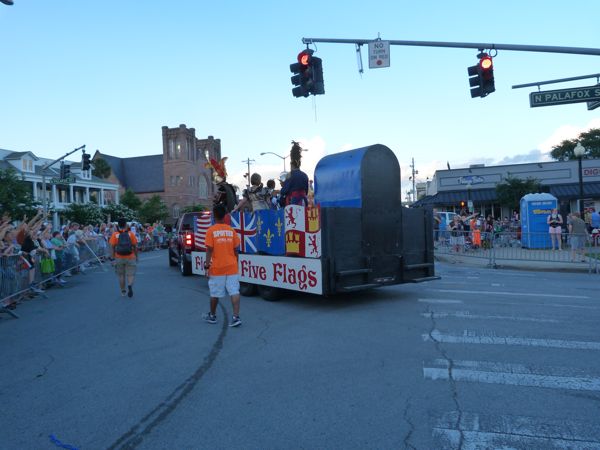
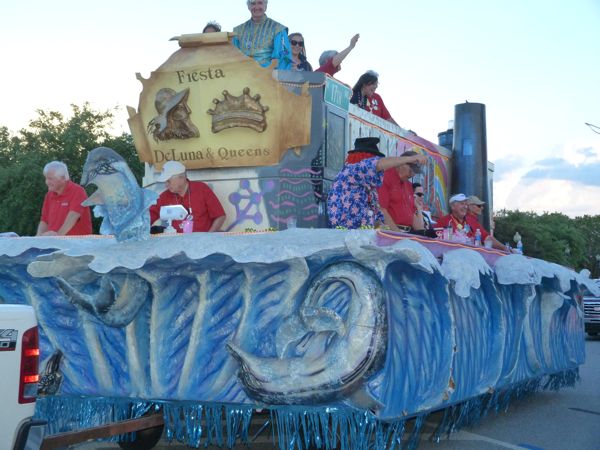
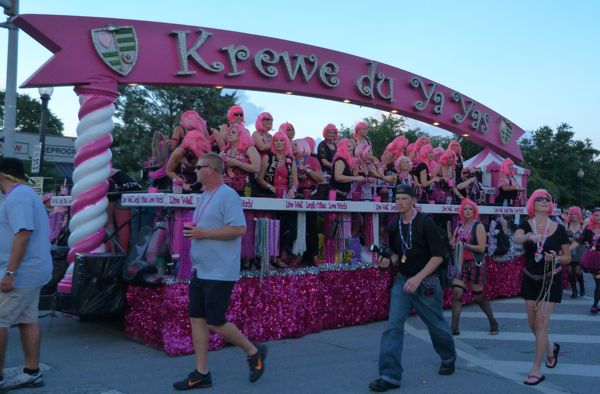
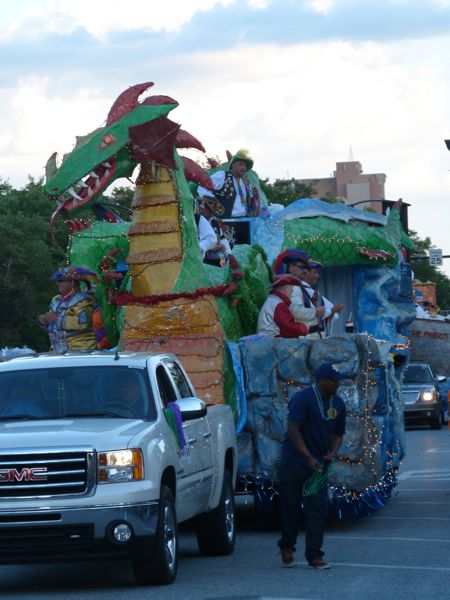
I’ve never lived anywhere with so many parades, and as Pensacola cools down a little and an offshore breeze blows away the heat of the day, a parade sounds like fun. Tonight is the Fiesta of Five Flags Parade. I can’t think of a parade since Lent, so maybe this is the kick off of the new season. Pensacola has an active and lively social scene, with all these Mardi Gras Krewes, and the older our grandson gets, the more of the parade we get to see! I think we got through three quarters of the parade tonight, and oh what fun.
The people on the floats are having a great time. They have these great alter-egos, get to wear elaborate costumes, and there may be some alcohol involved, LOL. The people on the ground are having a great time, you can really get into the waving and trying to catch the beads. Some of the beads are prettier than others, but as AdventureMan says, it’s all plastic. Having said that, you should see him scramble! He is good at catching beads.
And oh my, they are so good to the kids, with stuffed toys, beads, ice cream bars, frisbees, trinkets, including pieces of eight!
Honestly, there are some things in life I will never get tired of – parades and fireworks. I feel so blessed to live in Pensacola.
These photos are not in the right order because I just did a group dump into the photo gallery, and it scrambled them when they were inserted into the blog entry.
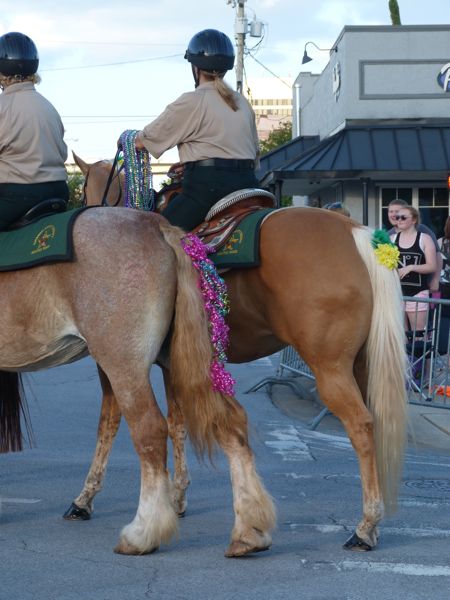
The parade always starts with the Pensacola motorcycle police, with flashing lights and roaring engines!
I love that they decorate the horses tails:
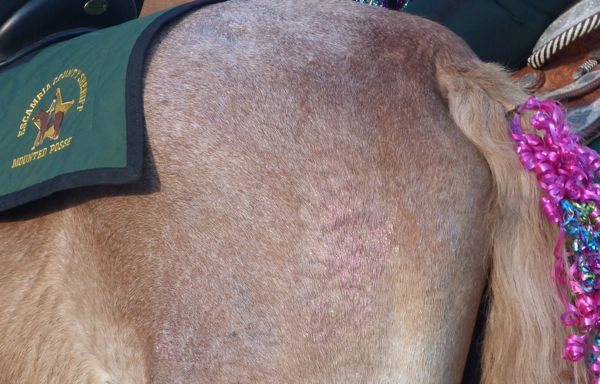
And then AdventureMan pointed out they also rubbed glitter into the horses haunches to make them pretty 🙂
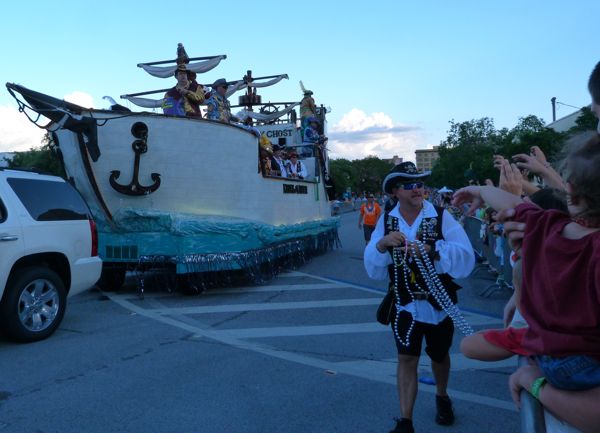
So many beads! We got to the parade a mere ten minutes before it began, but it was more lightly attended, and we were able to be right up front. Our little grandson had a great view, and people were so kind giving him beads, throwing him beads, toys, etc.
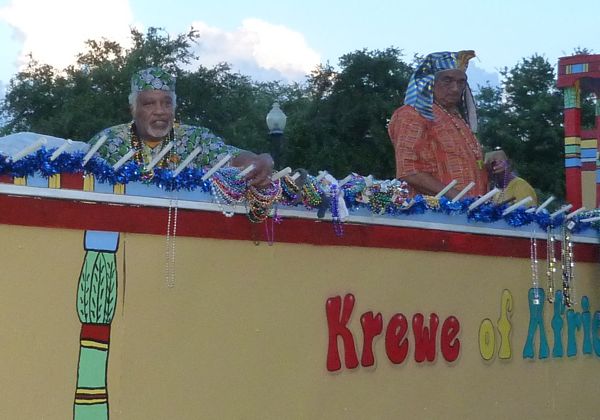
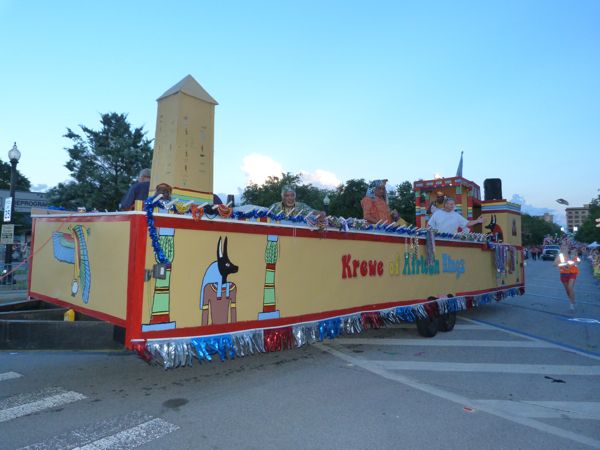
Look at all those beads they plan to throw! There was a throne on this float with King Tut!
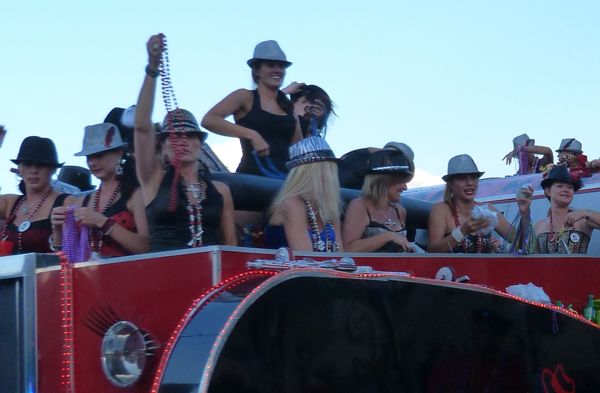
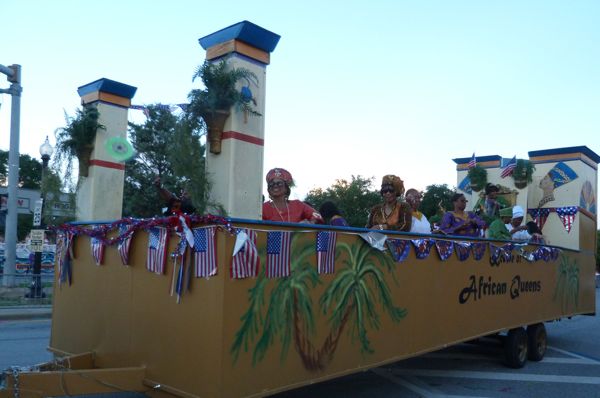
These ladies were having a grand time!
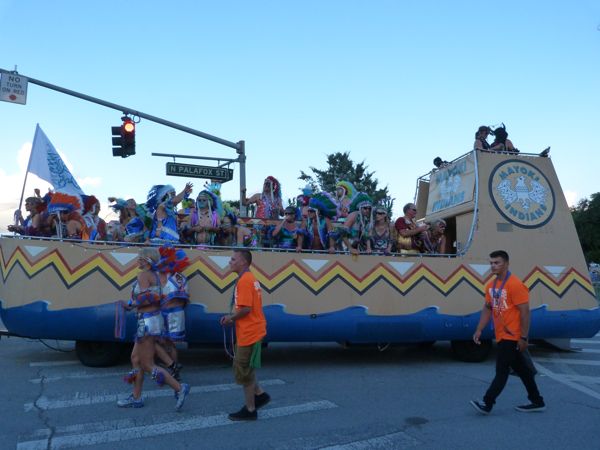
The Mayoki Indians seemed to be the Krewe having the best time of all, with two floats loaded with beads, and more ‘foot Indians’ handing and throwing beads into the crowds:
The flame throwing baton twirler got lots of applause:
We saw our little grandson rubbing his eyes and asked if he was ready to go home, and he was. One of these days he will be old enough we will see an entire parade. I had a minor concern that Tropical Storm Andrea would blow in bad weather and make the parade unlikely, but nothing of the sort, we had great weather, a lovely evening and a wonderful time making good memories with our little grandson.
A confluence of events happened at a period in my life when I was paying attention, and those things coming together have influenced me enormously. The first was participation in a bible study conducted in a branch of Christianity not my own, whose dogma is occasionally repellant and repugnant to me, but whose study of the chapter in the bible is thorough. The second was my move back to the Islamic world, and my choice to study Arabic at the Qatar Center for the Presentation of Islam.
In both cases, what I learned is that we have more in common than we have differences. I also learned that if we focus on the differences, it can be devastating.
Both groups know the Bible. My Moslem sisters knew the bible better than I did, and when discussing such issues as covering hair and wearing abaya, could quote me verses from my own book which re-inforced their argument. It was mortifying – and edifying.
My Baptist friends also surprise me. For every one who rails against gay marriage or ordination of women, there was another who would laugh and quote scripture saying “did you notice the same penalty for a woman who cuts her hair? or wears pants in public?” I learned a lot about my own religion, my own beliefs, and the goodness of others by my interactions with both these groups.
One of the differences in the Moslem world was that many houses I went into (I was honored to be invited into their homes) were very plain. The furniture might be basic or elaborate, but often, the walls were bare. Maybe there might be a calligraphy with a Quranic verse on the wall – that was it. No paintings, especially no human figures – no idols, no images.
In my house, I am surrounded by images, photos, paintings, weavings – they give me joy, but I do not worship them. They are not idols, they are merely art or family – things that make me smile. I distinguish between idols and gods. Yesterday’s reading from Deuteronomy sticks with me, however, and I can hear my sweet teachers at QCPI saying to me “But doesn’t it say in Deuteronomy 4 that you are to have no idols?”
Deuteronomy 4:25-31
25 When you have had children and children’s children, and become complacent in the land, if you act corruptly by making an idol in the form of anything, thus doing what is evil in the sight of the Lord your God, and provoking him to anger, 26I call heaven and earth to witness against you today that you will soon utterly perish from the land that you are crossing the Jordan to occupy; you will not live long on it, but will be utterly destroyed.
27The Lord will scatter you among the peoples; only a few of you will be left among the nations where the Lord will lead you. 28There you will serve other gods made by human hands, objects of wood and stone that neither see, nor hear, nor eat, nor smell. 29From there you will seek the Lord your God, and you will find him if you search after him with all your heart and soul. 30In your distress, when all these things have happened to you in time to come, you will return to the Lord your God and heed him. 31Because the Lord your God is a merciful God, he will neither abandon you nor destroy you; he will not forget the covenant with your ancestors that he swore to them.
Hilarious! Thank you, John Mueller and the Guardian for this giggle.
Qatar returns statues to Greece amid nudity dispute
Culture clash erupts after Greek minister visits Doha show and spots ancient treasures covered in strategically placed cloth.
Naked ambition: cash-strapped Greece has long been wooing Qatar. The display was meant to ‘open a bridge of friendship’ between the countries. Photograph: Alamy
It was a spat that nobody wanted – neither the Greeks, the Qataris nor, say officials, the two nude statues that sparked the furore.
But in a classic clash of cultures, Greece has found itself at odds with the oil-rich state – a nation it is keen to woo financially – over the presentation of masterworks depicting athletes in an exhibition dedicated to the Olympic games.
“The statues are now back at the National Archaeological Museum in Athens,” said a culture ministry official.
The dispute, though authorities are not calling it that, broke when Greece’s culture minister, Costas Tzavaras, arrived in Doha last month to discover the “anatomically challenging” treasures cloaked in cloth for fear of offending female spectators.
“In a society where there are certain laws and traditions authorities felt women would be scandalised by seeing such things, even on statues,” added the official who was present at the time.
“The minister, of course, said while he totally respected local customs he couldn’t accept the antiquities not being exhibited in their natural state,” she told the Guardian. “They were great works of art and aesthetically it was wrong.”
The statues, an archaic-era Greek youth and a Roman-era copy of a classical athlete, were to be the centrepiece of an exhibition entitled Olympic Games: Past and Present. Bankrupt Greece was delighted to facilitate when organisers in Doha got in touch. Mired in its worst economic crisis in modern times, the debt-stricken country is eager for investment from the Gulf state, which this year promised to pour €1bn into a joint investment fund.
In another hopeful sign, the emir of Qatar, Sheik Hamad bin Khalifa Al Thani, recently bought six isles in the Ionian sea with a view to building palaces on them for his three wives and 24 children.
Visiting the Qatari capital for the opening of the show, Tzavaras seized the opportunity to describe the exhibition as “opening a bridge of friendship” between the countries. The discovery of the covered-up antiquities was a setback few had envisaged.
“We don’t want to portray it as a row, and we certainly didn’t want it to overshadow the exhibition,” explained the official. “It was all very friendly. When they turned down our request (to remove the cloth) the statues were boxed up again and sent back to Athens.”
Mystery, nonetheless, shrouds the affair. The show, which had previously been hosted in Berlin, features more than 700 artworks from around Greece, including numerous nude statues. It remains unclear why Qatari authorities had taken such umbrage over the antiquities in question, although officials in Athens described the young athletes – both from Eleusis – as being especially beautiful.
BEIRUT: The minaret of Aleppo’s ancient Umayyad mosque was destroyed on Wednesday, Syrian state media and a watchdog reported, with the regime and the opposition blaming each other.
An archaeological treasure in Aleppo’s Unesco-listed Old City, the mosque has been the centre of fighting for months and had already suffered extensive damage.
With insurgents and the regime caught in a stalemate in the key northern city, the ancient mosque has fallen in and out of rebel hands several times.
The Umayyad mosque was originally built in the 8th century but was apparently destroyed and then rebuilt in the 13th century.
It has recently fallen back into rebel hands, but has been left pockmarked by bullets and stained with soot.
Antique furnishings and intricately sculpted colonnades have been charred, valuable Islamic relics ransacked and ancient artefacts, including a box purported to contain a strand of the Prophet Mohammed’s (PBUH) hair, looted.
Rebels say they have managed to salvage ancient handwritten Quranic manuscripts and have hidden them.
On Wednesday, as reports broke of the minaret’s destruction, activists uploaded video shot at the scene, but there was no video immediately available showing the moment of the blast that caused the collapse.
As with multiple other attacks in Syria’s spiralling conflict, which the UN says has left more than 70,000 people dead, the regime and the opposition blamed each other for the damage.
State media said jihadist Al-Nusra Front fighters blew up the minaret, and accused the group classed by the United States as a “terrorist” organisation of seeking to blame loyalist forces.
But rebels, the opposition and activists all said the army was responsible.
“Tanks began firing in the direction of the minaret until it was destroyed,” one rebel said in a video posted on YouTube, insisting rebel snipers were not stationed inside the minaret.
“We were afraid that it would be targeted,” he said.
“The Assad regime has done everything it can to destroy Syria’s social fabric. Today, by killing people and destroying culture, it is sowing a bitterness in people’s hearts that will be difficult to erase for a very long time,” the video added.
Meanwhile, an activist who identified himself as Zain al-Rifai said he saw an army tank “fire several shells directly at the Umayyad mosque, including at the minaret”.
He also claimed the force of the explosion was magnified because of landmines planted by the army in the mosque complex before the rebel takeover.
“When the army was in control of the mosque, it planted mines across the complex. When the rebels took over, they demined the area, but couldn’t come near the minaret for fear of snipers.
“When the tank shell hit the minaret, it must have caused the mine to explode,” said Rifai, who works with the Aleppo Media Centre, a network of citizen journalists on the ground.
Responding to regime claims that the jihadi-Al-Nusra Front had blown up the minaret, Rifai asked: “Why would an Islamic group blow up a minaret?”
The main opposition National Coalition, recognised by dozens of states and organisations as the legitimate representative of the Syrian people, mourned the ancient minaret’s destruction.
“The deliberate destruction of this minaret, under whose shadow Saladin… and (10th century Iraqi poet) Al-Mutanabbi rested, is a crime against human civilisation,” said the Coalition.
We’ve had a stormy weekend, temperatures dropped once again and we were able to turn off the air conditioning and open all the windows 🙂 I love the cool winds. Today is overcast and warmer, sigh, but still not so hot as to have to close the windows and turn on the A/C.
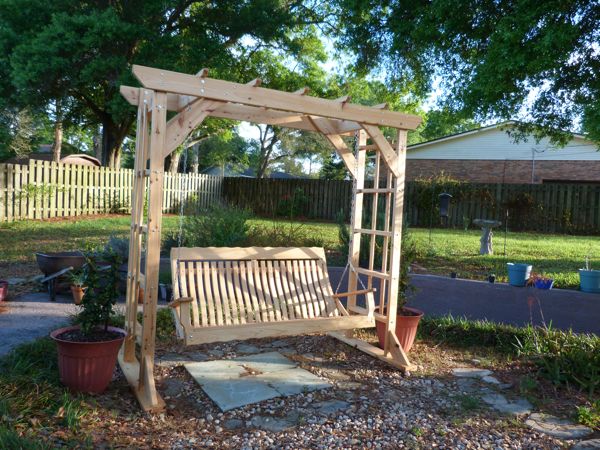
Meanwhile, we are enjoying our yard, including the new Mother’s Day gift – to me, and more widely, to my family. Everyone loves this swing!
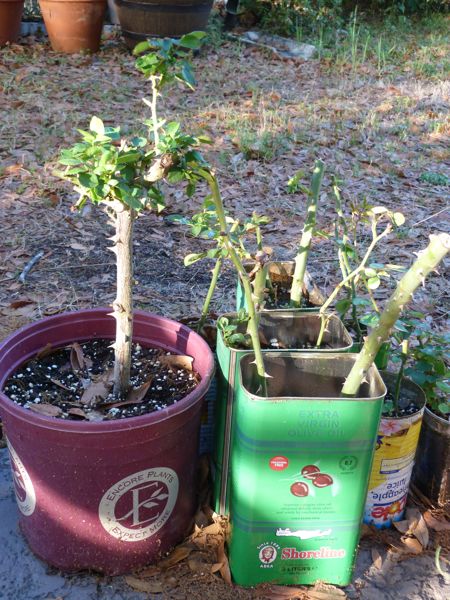
I’ve started up some new roses from my ever-flowering old branches, which the Pensacola Rose Society helped me identify as French Lace:
AdventureMan has potted up our mints – we have a large variety – and they are thriving! We also appear to have a good crop of blueberries coming in! 🙂
Yesterday when I got home from a day-long seminar on Heirloom Feathers (a follow up to another one earlier in the week on making quilts from Heirloom linens), with Cindy Needham, well-known expert and instructor, (that’s Cindy giving us an extra demo during lunch on how to do beading embellishments while on an airplane)
I found a huge bouquet of flowers from my sister and her husband, who had been house guests this week. It’s one of those gorgeous days we have a few of in Spring, warm and sunny, not too hot, and oh, this bouquet looks like Spring. Arriving home and finding this gorgeous bouquet just made my heart laugh. Can you see the Easter Bunny? We had time to walk and talk, to laugh and share stories, and we were able to take them to Five Sisters. We hope they come back soon 🙂
We’ve had a busy week. AdventureMan is getting ready for the big Expo and garden sale in May, we expect our next set of house guests tomorrow morning, and meanwhile, we have our normal daily busy lives to follow. Tonight we meet up with friends we love, people who spend their lives doing good for others, and with whom we always have great conversations, and tomorrow, early, we pick up the house guests, get them settled in, and share an Easter banquet with them, and with our son, his wife, our sweet little grandson and her mother and her husband.
I found a wonderful new Spring salad recipe to share with you 🙂 Very easy, very good:
Spring Asparagus Salad
Ingredients
1 tablespoon rice vinegar
1 teaspoon red wine vinegar
1 teaspoon soy sauce
1 teaspoon white sugar
1 teaspoon Dijon mustard
2 tablespoons peanut oil
1 tablespoon sesame oil
1 1/2 pounds fresh asparagus, trimmed and cut into 2-inch pieces
1 tablespoon sesame seeds
Directions
1. Whisk together the rice vinegar, red wine vinegar, soy sauce, sugar, and mustard. Drizzle in the peanut oil and sesame oil while whisking vigorously to emulsify. Set aside.
2. Bring a pot of lightly-salted water to a boil. Add the asparagus to the water and cook 3 to 5 minutes until just tender, but still mostly firm. Remove and rinse under cold water to stop from cooking any further.
3. Place the asparagus in a large bowl and drizzle the dressing over the asparagus. Toss until evenly coated. Sprinkle with sesame seeds to serve.
Tomorrow is our happiest of holidays, the day that sin and death are defeated and HOPE for all mankind is welcomed joyfully into the world. Happy Easter, my friends.
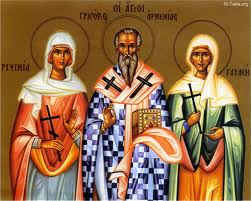
Today the church remembers Gregory the Illuminator, Bishop and Missionary of Armenia, c. 332.
Armenia, the first Christian kingdom in history, was converted through the efforts of Gregory. This kingdom came to an unhappy end as an independent state in 430, yet some two and one-half million persons today are still culturally Armenians. They enjoy a racial, linguistic, and religious heritage which is one of the world’s oldest and richest. Their community has endured fifteen hundred years of dispersion, harassment, and often severe persecution.
The truly marvelous story of Christian Armenia began when the infant Gregory, who was a prince by birth, was exiled by enemies and reared by a compassionate Christian family in Cappadocia (modern central Turkey). As an adult and a Christian he returned to Armenia and converted the king, Tiridates, heir of Gregory’s old enemies. This was not done easily. Indeed, many legends have grown up around the tradition of Gregory’s great difficulties, hardships, and sufferings in effecting the conversion of the king and subsequently the kingdom. For this work he is called the “Illuminator.” Gregory was eventually consecrated Bishop of Echmiadzin and was the organizer of the Armenian Church.
The Episcopal Church has enjoyed a warm and friendly relationship with the Armenian Church for many years. Offer thanks for that friendship.
We thank you, O God, for the witness of Gregory the Illuminator and for the people of Armenia. Amen.
Almighty God, whose will it is to be glorified in all your saints, and who raised up your servant Gregory the Illuminator to be a light in the world, and to preach the Gospel to the people of Armenia: Shine, we pray, in our hearts, that we also in our generation may show forth your praise, who called us out of darkness into your marvelous light; through Jesus Christ our Lord, who lives and reigns with you and the Holy Spirit, one God, now and for ever. Amen.













 Here There and Everywhere