The Pensacola Christmas Parade
“Do you know they are expecting over fifty thousand people??” my friend asked me over the phone. I had suggested we meet up. “I didn’t know there were fifty thousand people in Pensacola!”
She was going, but we probably would not see one another. My son and his family were meeting me at the church and we would watch together.
I have never seen a Christmas parade like it in my life. For one thing, the weather is perfect. It is cool enough for long sleeves, even a sweater, some Pensacolans were all bundled up. No rain – I understand last year the parade was rained out. No snow – it’s been really cold all week, and it’s going to be cold again tomorrow, but today – and tonight – were perfect.
“Where will we meet?” my son asked when he called.
“I’m leaving now; meet on the steps of the church” I answered. “See you there.”
* * * *
“I’m here, but not on the steps, across the street, under the tree right in front of the school” I left a message.”
“Mom! Where are you?”
“I’m by the school under a tree – wait, I can see you, I’m waving, I’m waving!” and finally he saw me, and we all had our little space.
It was a great space for viewing the parade. A great place for a little 9 month old Happy Baby, who loved the sirens and the police and the flashing lights, and the bark on the tree. He had a ball, and then he was tired.
Here is what is hilarious. It was not a great place for parade activity. I’ve never seen a parade like this, but this is very Pensacola, or so I’ve been told. First, this is the least ‘politically correct’ parade ever. It was wonderful! Floats full of Marys and Josephs and little baby Jesus, and shepherds and angels, marching evangelists carrying bible verses – LLOOLLL, a big thumb of the nose at secularity. This town celebrates the Nativity!
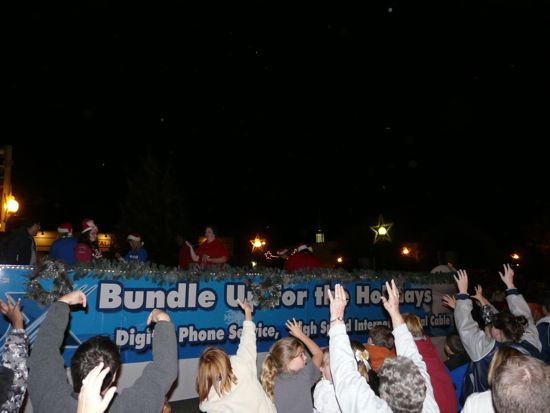
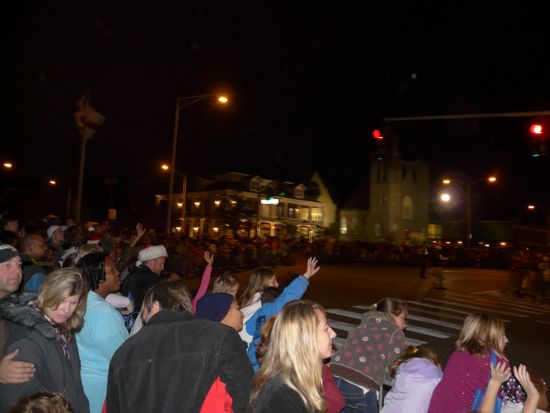
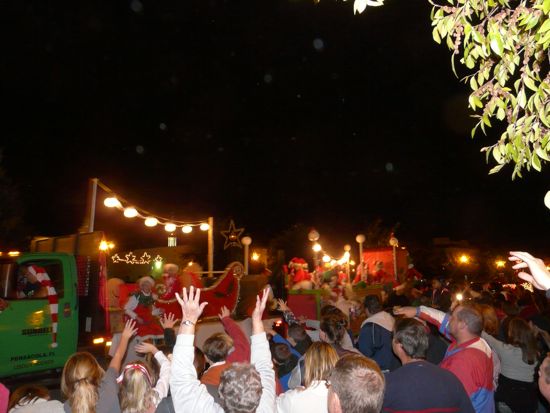
The Holy Bible Float:
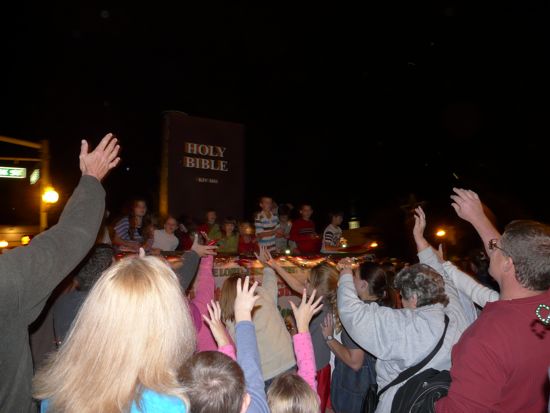
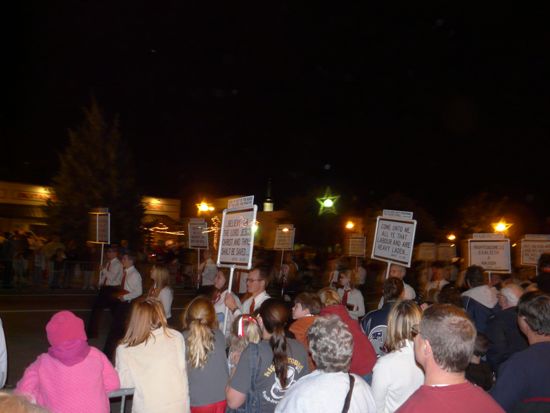
The sign-carrying evangelists:
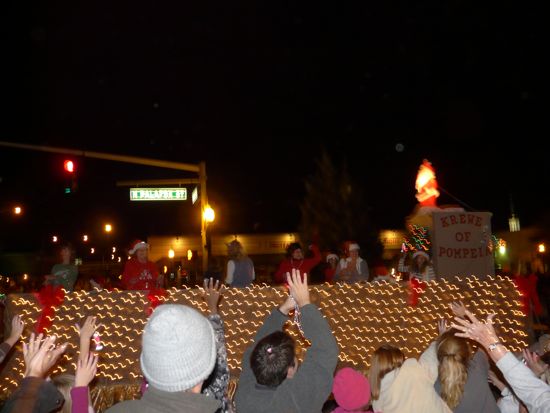
The Krewe of Pompeii Float (Krewes are local social groups that form to celebrate Mardi Gras)
Krewe of YaYas Float:
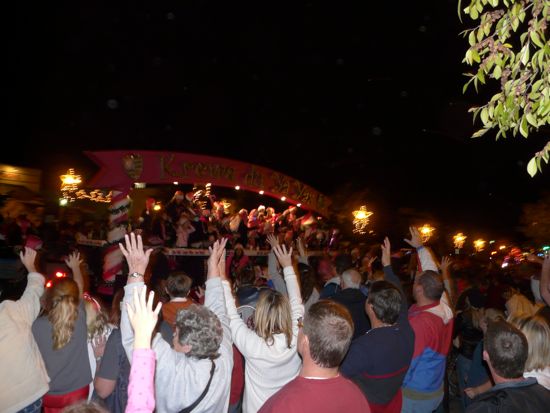
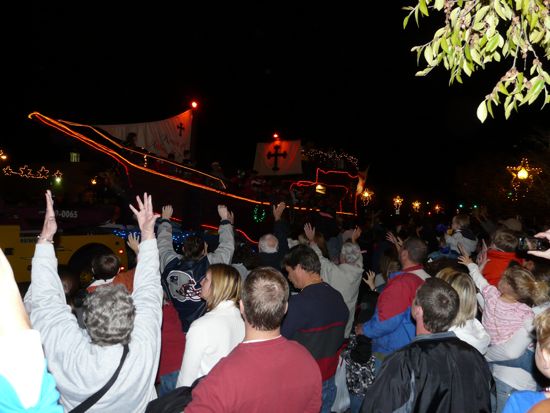
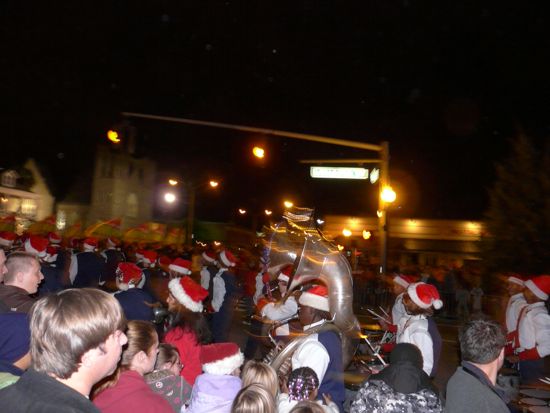
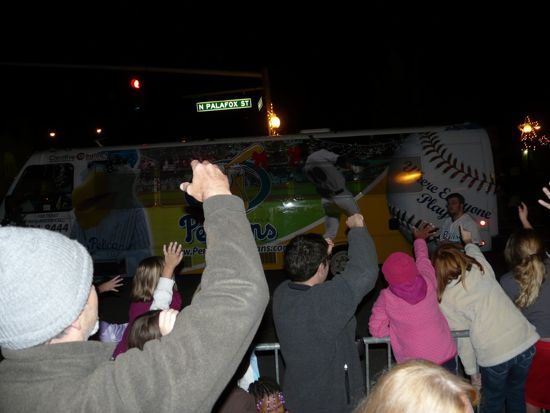
Did you notice something in all those photos? Did you notice all the hands up?
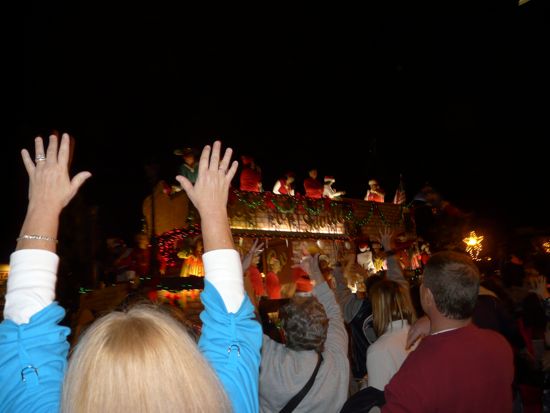
Did you see all those hands up? It took me a while, but I finally figured it out, all these people want beads! And Santas are throwing beads, and angels are throwing beads, and the Blue Angels are throwing beads, and . . . Joseph and Mary are throwing beads!
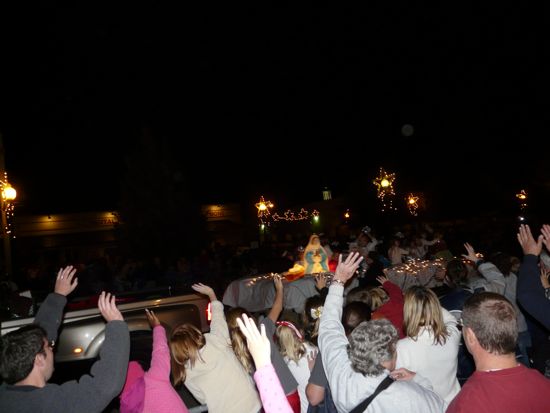
I had made a strategic mistake! The woman next to me had 15 or 20 beads, all kinds and all colors, and I was busy taking photos, and I had none. I then also noticed that I was under a tree, and the tree was catching beads that should have been mine!
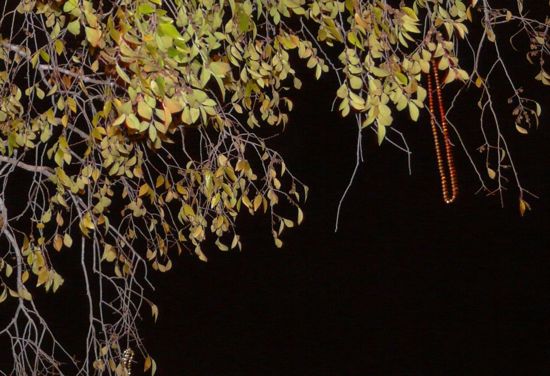
Time to get serious. I put the camera away and started waving with the rest.
My treasures:
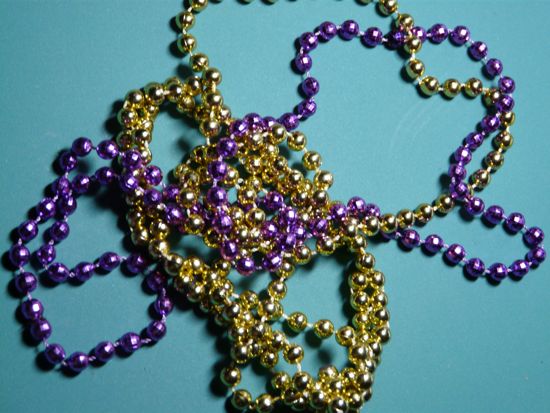
Big Wooo HOOO on me; every kid in Pensacola has like seven hundred beads, but I have my start, I have two! LLOOLL, next parade, I have my priorities. No more photos. Beads!
If you want to have a really good time, come to Pensacola for one of the liveliest and most fun parades I have ever attended.
The Christmas Lights of Pensacola
Last night, after our son and his family left after dinner, AdventureMan had a gleam in his eye. (No! not that gleam!)
“Want to go out and look at the Christmas lights?” he asked.
“Oh! Yes! Yes!” He knows I love the lights.
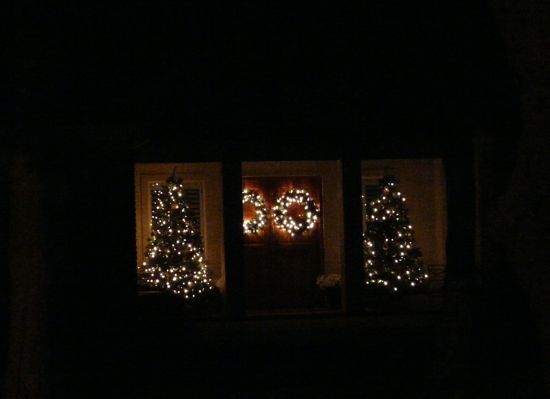
Pensacola isn’t so over-the-top as the Tampa Bay area used to be. Pensacola uses a lot more white, a lot less music and moving displays. Pensacola is more restrained, and more traditional.
Just so you will know where I am coming from, here is my favorite:

Thoughtful, restrained, elegant. There are a lot of this kind of display, and I love them. I also love the others, although many are more exuberant. There seem to be a lot of white deer, and . . . some of them move their heads. Yes! I am telling the truth!
Some people just get totally into the spirit of the season, and go all out. Here is a sampling of what we saw:


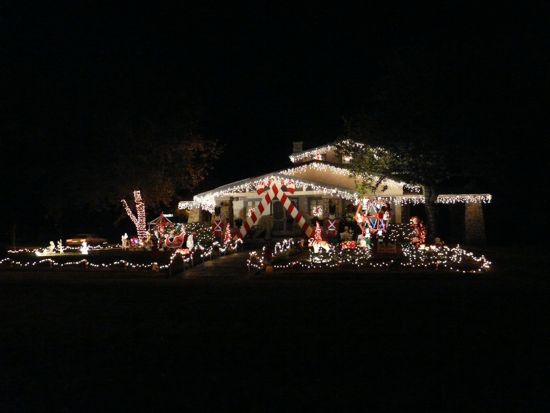
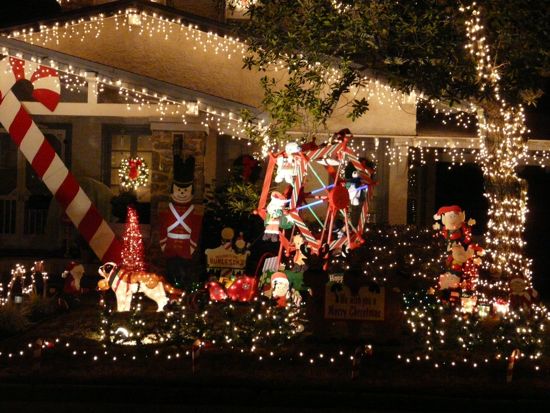


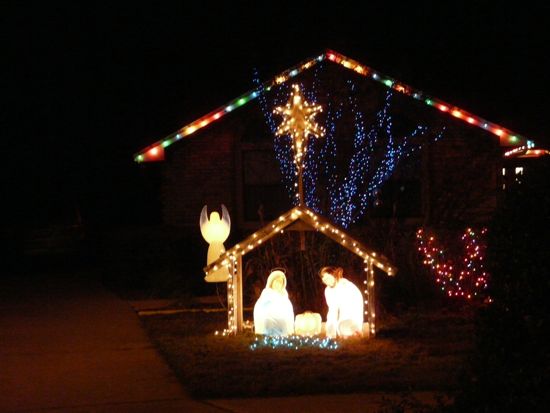
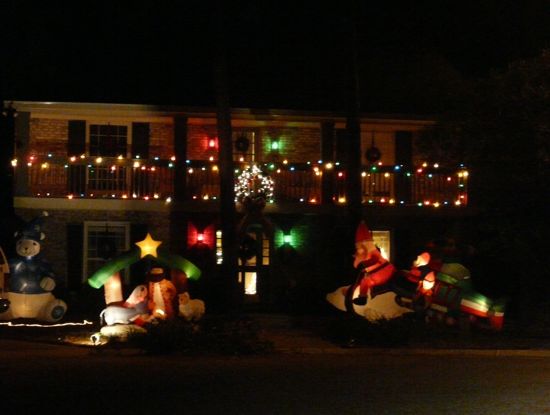
I can’t help but find this funny; Frosty the snowman and the Creche juxtaposed:
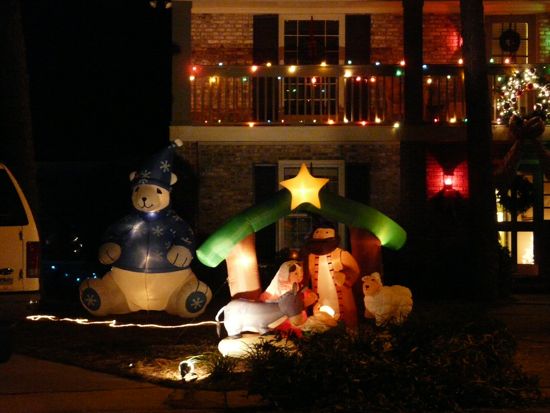
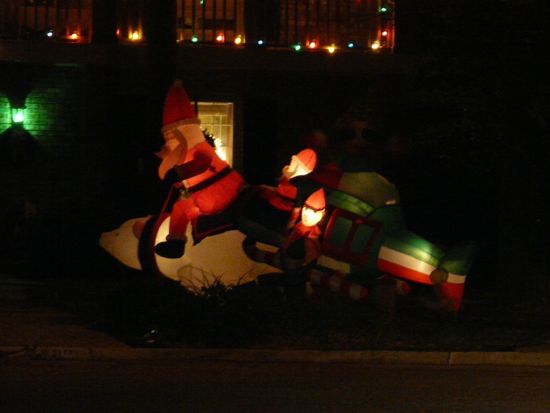
Along with Santas on rockets, LOL!
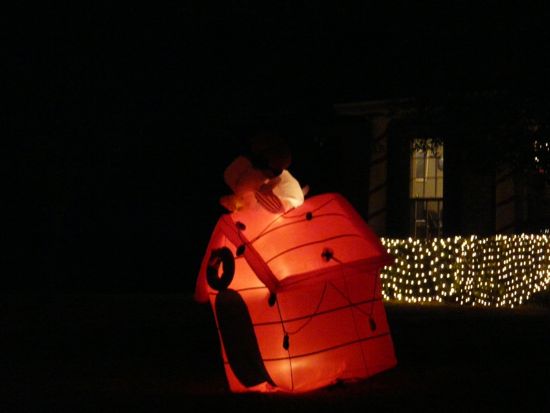
This is a Christmas Snoopy as an aviator on top of his doghouse. What does it have to do with Christmas? LLOOLL!

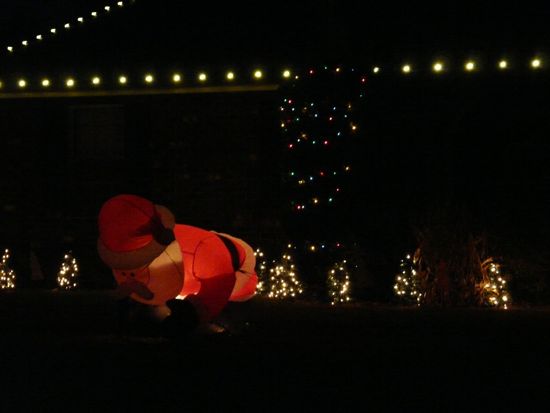
A lot of people are using balloons, with varying results. Santa on a motorcycle, Santa on rockets, all kinds of balloons, problematic because sometimes balloons loose air.
Here are Santas, and then a Santa loosing air, LOL


I love the way WordPress has put snow on all the blogs for December (you can turn it off if you don’t like it) but with these photos, snow falling is perfect. 🙂
Pantone Names Spring Colors for 2011
I’m a total sucker for colors, especially wonderful names like Regatta and Blue Curacao, Honeysuckle and Peapod. 🙂

It may only be early winter, but it’s never too soon to start thinking about spring. If you’re among the trendsetters who like to keep things “au courant” in your interior, take a look at the spring fashion color report, courtesy of the expert forecasters at Pantone.
Each season, Pantone surveys the designers of New York Fashion Week to identify the most directional colors to guide the season. Take a look at these hue choices — and what inspired them — then pick a hue or two and start thinking of ways that you, too, can get inspired and revamp your style for the coming seasons.
You can read the entire post at AOL News Shelterpop
Amer Al Hilal on Kuwait’s Ban on DSLR Cameras
Woooooo Hooooo Amer Al-Hilal, a man I am proud to call my friend. It takes such great courage to speak out when something is going terribly wrong, and Amer knows how to do it articulately, rationally, and as the gentleman he is.
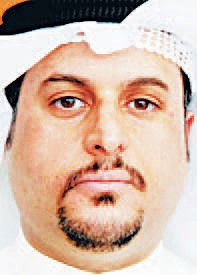
From his article in the Arab Times:
Camera ban regressive idea
‘Don’t stifle home-grown talent’
For a country that possesses a Constitution which safeguards civil liberties and freedom of speech, Kuwait sporadically sure likes toying with those liberties such as tentatively banning the Blackberry service, shutting down You Tube, impeding public gatherings and marches, banning and censoring books, literature, films and magazines which are available elsewhere in the Gulf.
This week according to media reports, and highlighted extensively in local Weblogs and Twitter, a palpable growing outcry is directed at the tentative plans by The Ministry of Information, Ministry of Social Affairs and Ministry of Finance to outlaw public photography and relegate it to journalism purposes only. This has allegedly resulted in the ban of Digital Single Lens Reflex Cameras (DSLRs) in public places. If this charade is true, then it bodes ill for this country, another regressive move into the annals of ignorance.
During the 1980s video cameras and photographic equipment were also shunned by the authorities. I remember visiting Failaka in 1985 and being confronted by a military officer who demanded I hand in my bulky video camera until I left the island. These types of infringements in the name of security were insignificant — we still had an attempt on HH the Amir, explosions at Foreign Embassies in Kuwait and an actual invasion.
Why does this country always attempt to stifle home-grown talent? Banning cameras in public places is demoralizing to all the passionate, talented young Kuwait men and women who have excelled in this field and love their hobby, not to mention visitors who attempt to document their travels here. Moreover, banning DSLR cameras is irrational and counterproductive if you think about it; in this day and age of iPhones, Blackberries, 5 MP plus camera phones, Google Earth and the like, anyone can take photograph of anything, quietly, without fanfare, which makes the potential DSLR ban even more preposterous.
I have just returned from a trip to Dubai where I witnessed dozens of tourists proudly using their cameras to document Burg Khalifa and the other picturesque locations. No one stopped them, impeded them or asked them what they were doing and you know why, because they respect people’s rights and are intent on making their country more appealing. UAE is able to manage security matters confidently because they have proper security and ID processes in place: eye scanners at airports and entry points, proper electronic government, high fines for breaking the law, a brilliant CCTV system in place in every street corner (not the shoddy black and white choppy, streaming-like quality of the limited equipment we have here) — they truly invest in their infrastructure, maintain it and upgrade it.
If Kuwait is serious about its security then it should invest in the same caliber of CCTV and not the bargain basement tenders that usually go towards ineffective systems (i.e. Highway signs with the useless ‘no mobile’ plasma screen) belonging to members of the matching ministry who want a ‘piece of the action’. The sad reality is the government sector here would rather ban something than actually strive to improve it through sheer hard work and effective processes. It’s just easier to ban; a question of laziness and neglect.
Needless to say, Kuwait seems unfazed when foreign jets infiltrate our airspace and take aerial shots of our oil refineries and military installations, or when agents and their local conspirators are found to possess blueprints and photographs of said installations, but no, lets go after the ‘little guy’, the amateur photographer or tourist on the street taking pictures. It’s a hypocritical, spineless action by the authorities.
Moreover, I suspect the issue is not just relegated to security, a myriad of reasons could have led to the support of this ban, fundamentalists who felt cameras and pictures are a ‘Tool of the Devil,’ government officials and ministries disgraced at seeing shots of Kuwait’s dilapidated infrastructure, environment and mismanagement on weblogs, internet forums and magazines. You cannot conceal the squalid side of Kuwait; it is there for everyone to see.
Furthermore, this law against public photography will not be enforced, just as seatbelt, no mobile while driving, no litter, no smoking areas, and other ‘laws’ cannot be enforced in this Land of Confusion.
Amer Al-Hilal is webmaster of http://www.hilaliya.com and can be reached at amer@hilaliya.com.
Kuwait Ministries Ban Photography?
I am in total shock.
Thank you, Bit Jockey, for sending this to me, an article from the Kuwait Times.
We had so much fun! We had photo challenges, Kuwait sunsets, National Day Celebration photos, so much fun. And now, you can get arrested for taking photos? Not of military or political or sensitive buildings, not for reasons of national security, but . . . just because?

Most photographers in Kuwait are careful not to photograph women, or any citizens without their permission. Why on earth was this ban created?
How on earth will they enforce it? What are the penalties?
KUWAIT: After the ban three ministries placed on photography, most Kuwaiti youth are a bit confused about what to do with their cameras if they can’t use them in public and why such laws were implemented in the first place. The Ministry of Information, Ministry of Social Affairs and Ministry of Finance recently came to the conclusion that photography should be used for journalism purposes only. This has resulted in the ban of Digital Single Lens Reflex Cameras (DSLRs) in public, on the streets and in malls
.
What most Kuwaiti photographers have come to wonder is how such a decision could be reached by authorities, especially considering that digital cameras and cell phone cameras have the same abilities. What most people think of photography as a hobby has become a bit misguided due to the fact that the country has so little exposure to art. While using a DSLR, passersby may wonder if the camera is being used for the wrong reasons.
Mohammed Al-Eisa, who picked up photography as a hobby more than 10 years ago, said that he has decided to take photos of animals or still life due to the fact that these subjects don’t mind having their picture taken and don’t make a scene. “I started facing problems the very first day I bought my camera,” Mohammed added.
What often happens is that a big black camera tends to worry people. Taking a picture of a stranger would seem like much less of an issue if you were using a more discreet camera or even a cell phone. Mariam Al-Fodiry said that she has faced similar problems with her hobby and that being a girl doesn’t help at all. She said that in some cases it makes the problem even worse. “Switching to abstract and landscape photography was one the options I considered after getting into enough trouble,” Mariam said.
Majed Al-Saqer said that sometimes people stop him while he is in his car with his camera, as if he were planning to kill someone with it. He said that he isn’t sure what the real problem is, whether it is people taking photos of each other or the size of the camera.
Sweet Prospect: Music At Christ Church
I remember when I lived in Qatar, and Kuwait, and then Qatar again, how I would read about something in the paper – the day after it happened. The things I did go to – and there were some spectacular events in Qatar – were mostly word of mouth, a personal invitation, very few cultural events were well advertised.
Not so in Pensacola. There is a wonderful Symphony, truly wonderful. There is an Opera, and several theatres, and even a Pensacola Ballet. And there is Music at Christ Church.
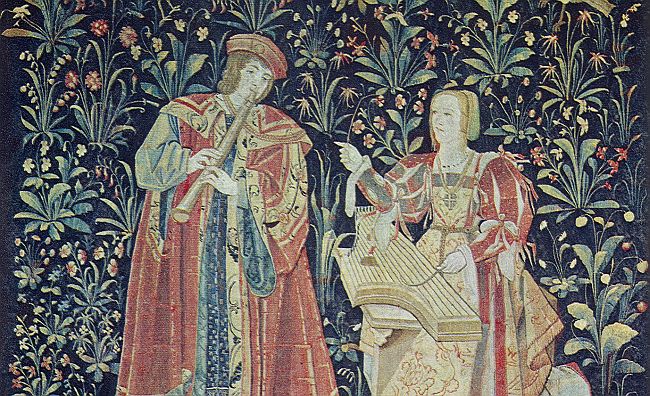
Yes, I am partial. We attend Christ Church, and I always love a concert where the surrounding is so beautiful. Tonight’s concert was irresistible – hammered dulcimers. Hammered dulcimers! Some of the earliest music in our country was hammered dulcimer. Lucky for me, AdventureMan loves music, and was as eager as I was to go to this concert.
So off to church in the morning, then meet up with our son and his wife – who ran the half marathon today, HOOOO-AHH! And of course, our darling little grandson, who wants nothing to do with me these days, not when there is AdventureMan, the original fun-guy. Famous Dave’s Barbeque, a wonderful meal with a truly great waiter, patient, kind, didn’t mind a baby and four dawdling adults – good fun, good conversation, good food, and then off to the concert.
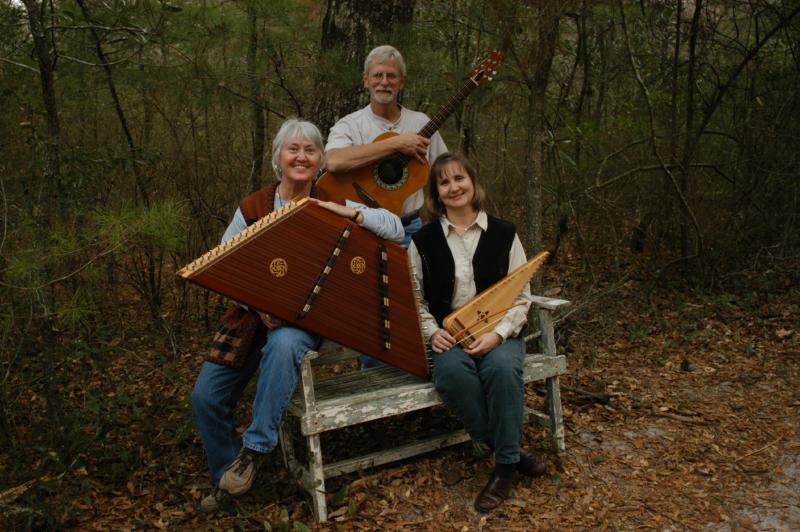
The sun started setting around 3:30, and the concert began in the dimmed church around 4. It was sheer magic. The group, Sweet Prospect, is so talented, and their music is so lovingly performed. Melissa Allured plays the recorder as well as most of the melodies in the selections they played today, Sheryl Bragwell plays the hammered dulcimer and a bowed psaltery, and Gary Diamond backs them up with guitar. They played a wide variety of tunes; Scottish, Irish, early American, even a very Wyndham Hill sounding piece from a Lopez Island (Washington State) artist Gary Haggerty, called Coffee American, which was lively and quick.

(angel playing Psaltery)
I have a complaint. The concert was only an hour long. I could have listened longer. But oh, what a wonderful hour it was! I love the Music at Christ Church program. There is a suggested donation for the concert, but if you can’t afford the $10 donation, no one is standing there scowling if you want to come into the church and hear some great music. There is a bowl out for collecting the donation, people toss their donation in and sit down. The concerts are also sponsored by several levels of music lovers at Christ Church who are patrons of the arts, and contribute generously so that these opportunities are available to the Pensacola community. How cool is that?
The good news is that on the Sweet Prospects website you can also listen to some of their recordings, and you can buy their CD’s. THIS IS IMPORTANT, ADVENTUREMAN! The one I really really want is called Cold Frosty Morn. If you go to their website, it tells you how to order it, or you can find one of the bookstores in Pensacola that sells it. (hint hint) It is Christmas music. If you want to go listen to a tune or two by Sweet Prospects, click on the blue type above, and listen away. 🙂 If you live in Pensacola, and you want to learn to play the dulcimer – or several other early musical instruments – there is a group that welcomes you and will teach you how. Learn to play hammered dulcimer – in Pensacola. I am blown away.
It’s just been such a great day, full of church, family and culture. We are so glad to be in Pensacola.
I just wish Sweet Prospects would be picked up to be sent on a cultural tour to our embassies in the Middle East. I wish our friends there, who love music, and who know the early musical instruments of the Middle East, could hear this music, and see these instruments, which are so similar. As I enjoyed every minute of this concert, I was wishing my Arab Gulf friends could be hearing it, too. This music is so American, and yet, you can hear the early strains of the Irish, the Scottish, and yes, even the sounds of the Holy Lands, brought back to Europe by the early crusaders.
Tabbouli Dance (Thank You, Daggero)
I’m in my office trying to write a blog entry and AdventureMan is next door, and it’s been a long time since I have heard him laugh so hard. He is laughing and Holy Smokes, he is almost dying laughing, and it’s all Daggero’s fault, my friend Daggero, my mysterious friend who has commented for so many years now on my blog that I think of him like a brother, although none of us have ever met.
Here is what was making him laugh so hard. Once I started watching, I was laughing, too. It is a total hoot, not just the song but all the fun they had making this, and the utter decorum with which he ‘shakes his booty,’ LLLLOOOOOOLLLLLL!
Notice also, his home has some very nice art pieces. 🙂
A Day in Flomaton, Alabama
All we knew when we started the day was that we wanted to explore a little bit north of Pensacola, maybe even up into the part of Alabama that is across the state line to the north (as opposed to the part of Alabama that is across the state border to the west). We thought we were having a very boring day until we wandered into Flomaton, and AdventureMan discovered a railroad museum.
Flomaton is at the very top of the map:

The railroad museum was also an older house, now the museum, and an older 2 room cabin out back, moved from its original location. Here is a recreation of the old front parlor:


The Railroad Collection room:

The log cabin was out back of the house, and had two women spinning wool into yarn on the porch, who very graciously allowed me to take their photo:
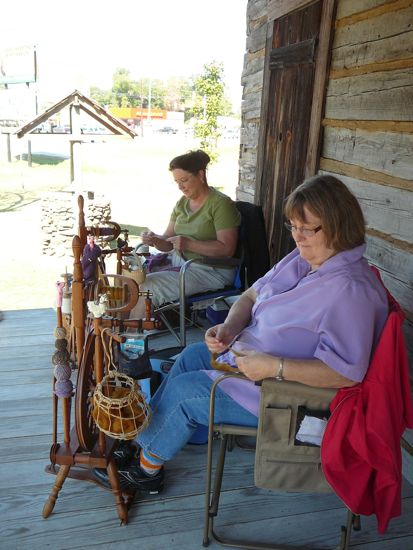
Inside the log cabin – we were told the couple who lived in this cabin had 12 children; they slept on the floor on pallets at night:


At the museum, there was a flyer about “Back to your hometown weekend” in Alabama, which just happened to be that very weekend. The town was full of returning people, there had been a parade and fireworks the night before (three former homecoming queens told me about this) and there was a street fair to celebrate Home Town Flomaton. 🙂
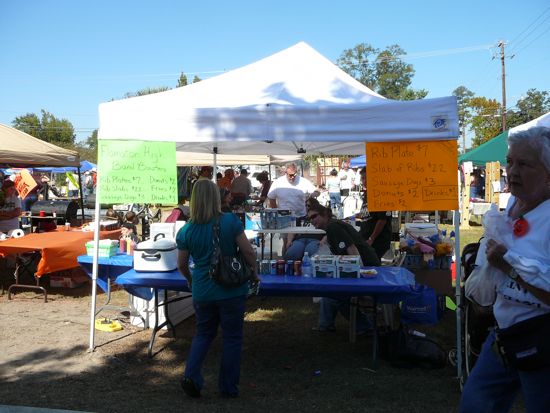
It was nearly lunchtime. We could smell Barbecue. The street fair was just a block away and there was parking right there, right by the fair. It was so much fun:

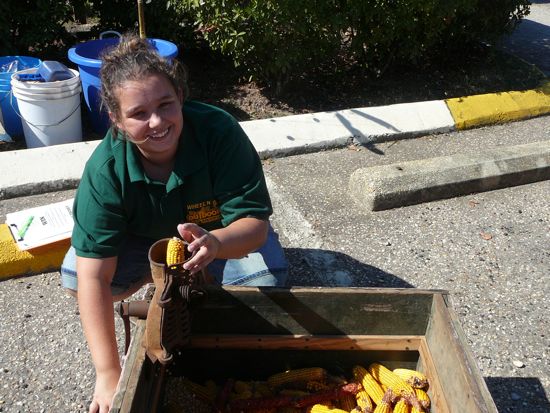
People were so kind and so helpful. This young woman was grinding corn, and we speculated that it must have been a great modern invention, and a real time saver, when it was invented. A woman passing by said she remembers her own mother using the same machine; all the corn was then taken to be ground, and stored in large airtight bottles in a dark ‘keeping room’ with preserves and food to get them through the winter.

This band was playing blues, gospel and country music, and they were pretty good!



As we stood and watched the choir, another woman welcomed us, and told us we really needed to see the new library (it was gorgeous!) and if we hurried, we could catch the Raptor Show at Otter Point. A Raptor Show!


Inside, there was a butterfly house, and several displays of local natural life:

There was also a wonderful hiking trail out over the wetlands, well maintained and beautiful:

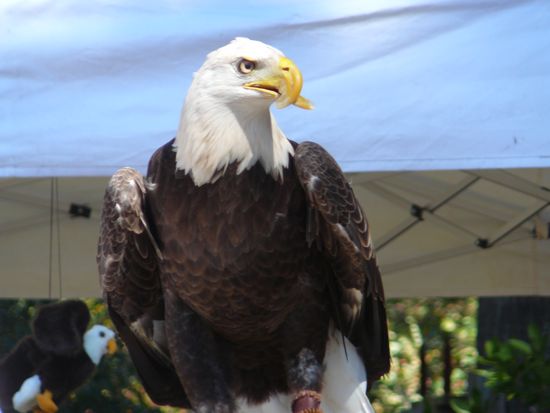
The Raptor presentation was very well done, informative and funny, on many levels. They had a large audience of children, who learned a lot, and also adults like us, who also learned a lot. The bald eagle’s beak is deformed by PCB’s, which, although banned back in the 1970’s, are still present in the environment in quantities high enough to cause birth deformities. The only reason they were able to adopt the bald eagle, a protected species, was that while he can hunt, he cannot tear his food apart with his malformed beak.
It was a day full of gracious hospitality. People were so kind to us, and went out of their way to make us feel welcome and to explain what we were looking at. For a day that started with no clear goal, we felt like we had been abundantly blessed by happening across this beautiful October day in Flomaton, Alabama.
Father and Son Send Camera into Space
Once again, my Kuwaiti friend has sent me amazing footage of a father-son Science project, where they found a way to send a camera and iPhone into the atmosphere, broadcasting what it saw back to earth. The video story is here:
1001 Inventions: Muslim Inventions That Changed the World
A fabulous new exhibition, 1001 Inventions has opened, and will be coming to this country in December of this year. The exhibit details our Muslim heritage in the arts and sciences.
1001 Inventions – Discover The Muslim Heritage In Our World
From coffee to cheques and the three-course meal, the Muslim world has given us many innovations that we take for granted in daily life. As a new exhibition opens, Paul Vallely nominates 20 of the most influential- and identifies the men of genius behind them
Saturday, 11 March 2006

1 The story goes that an Arab named Khalid was tending his goats in the Kaffa region of southern Ethiopia, when he noticed his animals became livelier after eating a certain berry. He boiled the berries to make the first coffee. Certainly the first record of the drink is of beans exported from Ethiopia to Yemen where Sufis drank it to stay awake all night to pray on special occasions. By the late 15th century it had arrived in Mecca and Turkey from where it made its way to Venice in 1645. It was brought to England in 1650 by a Turk named Pasqua Rosee who opened the first coffee house in Lombard Street in the City of London. The Arabic qahwa became the Turkish kahve then the Italian caffé and then English coffee.
2 The ancient Greeks thought our eyes emitted rays, like a laser, which enabled us to see. The first person to realise that light enters the eye, rather than leaving it, was the 10th-century Muslim mathematician, astronomer and physicist Ibn al-Haitham. He invented the first pin-hole camera after noticing the way light came through a hole in window shutters. The smaller the hole, the better the picture, he worked out, and set up the first Camera Obscura (from the Arab word qamara for a dark or private room). He is also credited with being the first man to shift physics from a philosophical activity to an experimental one.
3 A form of chess was played in ancient India but the game was developed into the form we know it today in Persia. From there it spread westward to Europe – where it was introduced by the Moors in Spain in the 10th century – and eastward as far as Japan. The word rook comes from the Persian rukh, which means chariot.
4 A thousand years before the Wright brothers a Muslim poet, astronomer, musician and engineer named Abbas ibn Firnas made several attempts to construct a flying machine. In 852 he jumped from the minaret of the Grand Mosque in Cordoba using a loose cloak stiffened with wooden struts. He hoped to glide like a bird. He didn’t. But the cloak slowed his fall, creating what is thought to be the first parachute, and leaving him with only minor injuries. In 875, aged 70, having perfected a machine of silk and eagles’ feathers he tried again, jumping from a mountain. He flew to a significant height and stayed aloft for ten minutes but crashed on landing – concluding, correctly, that it was because he had not given his device a tail so it would stall on landing. Baghdad international airport and a crater on the Moon are named after him.
5 Washing and bathing are religious requirements for Muslims, which is perhaps why they perfected the recipe for soap which we still use today. The ancient Egyptians had soap of a kind, as did the Romans who used it more as a pomade. But it was the Arabs who combined vegetable oils with sodium hydroxide and aromatics such as thyme oil. One of the Crusaders’ most striking characteristics, to Arab nostrils, was that they did not wash. Shampoo was introduced to England by a Muslim who opened Mahomed’s Indian Vapour Baths on Brighton seafront in 1759 and was appointed Shampooing Surgeon to Kings George IV and William IV.
6 Distillation, the means of separating liquids through differences in their boiling points, was invented around the year 800 by Islam’s foremost scientist, Jabir ibn Hayyan, who transformed alchemy into chemistry, inventing many of the basic processes and apparatus still in use today – liquefaction, crystallisation, distillation, purification, oxidisation, evaporation and filtration. As well as discovering sulphuric and nitric acid, he invented the alembic still, giving the world intense rosewater and other perfumes and alcoholic spirits (although drinking them is haram, or forbidden, in Islam). Ibn Hayyan emphasised systematic experimentation and was the founder of modern chemistry.
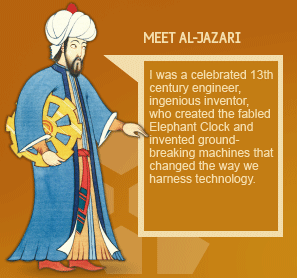
7 The crank-shaft is a device which translates rotary into linear motion and is central to much of the machinery in the modern world, not least the internal combustion engine. One of the most important mechanical inventions in the history of humankind, it was created by an ingenious Muslim engineer called al-Jazari to raise water for irrigation. His 1206 Book of Knowledge of Ingenious Mechanical Devices shows he also invented or refined the use of valves and pistons, devised some of the first mechanical clocks driven by water and weights, and was the father of robotics. Among his 50 other inventions was the combination lock.
8 Quilting is a method of sewing or tying two layers of cloth with a layer of insulating material in between. It is not clear whether it was invented in the Muslim world or whether it was imported there from India or China. But it certainly came to the West via the Crusaders. They saw it used by Saracen warriors, who wore straw-filled quilted canvas shirts instead of armour. As well as a form of protection, it proved an effective guard against the chafing of the Crusaders’ metal armour and was an effective form of insulation – so much so that it became a cottage industry back home in colder climates such as Britain and Holland.
9 The pointed arch so characteristic of Europe’s Gothic cathedrals was an invention borrowed from Islamic architecture. It was much stronger than the rounded arch used by the Romans and Normans, thus allowing the building of bigger, higher, more complex and grander buildings. Other borrowings from Muslim genius included ribbed vaulting, rose windows and dome-building techniques. Europe’s castles were also adapted to copy the Islamic world’s – with arrow slits, battlements, a barbican and parapets. Square towers and keeps gave way to more easily defended round ones. Henry V’s castle architect was a Muslim.
10 Many modern surgical instruments are of exactly the same design as those devised in the 10th century by a Muslim surgeon called al-Zahrawi. His scalpels, bone saws, forceps, fine scissors for eye surgery and many of the 200 instruments he devised are recognisable to a modern surgeon. It was he who discovered that catgut used for internal stitches dissolves away naturally (a discovery he made when his monkey ate his lute strings) and that it can be also used to make medicine capsules. In the 13th century, another Muslim medic named Ibn Nafis described the circulation of the blood, 300 years before William Harvey discovered it. Muslims doctors also invented anaesthetics of opium and alcohol mixes and developed hollow needles to suck cataracts from eyes in a technique still used today.
11 The windmill was invented in 634 for a Persian caliph and was used to grind corn and draw up water for irrigation. In the vast deserts of Arabia, when the seasonal streams ran dry, the only source of power was the wind which blew steadily from one direction for months. Mills had six or 12 sails covered in fabric or palm leaves. It was 500 years before the first windmill was seen in Europe.
12 The technique of inoculation was not invented by Jenner and Pasteur but was devised in the Muslim world and brought to Europe from Turkey by the wife of the English ambassador to Istanbul in 1724. Children in Turkey were vaccinated with cowpox to fight the deadly smallpox at least 50 years before the West discovered it.
13 The fountain pen was invented for the Sultan of Egypt in 953 after he demanded a pen which would not stain his hands or clothes. It held ink in a reservoir and, as with modern pens, fed ink to the nib by a combination of gravity and capillary action.
14 The system of numbering in use all round the world is probably Indian in origin but the style of the numerals is Arabic and first appears in print in the work of the Muslim mathematicians al-Khwarizmi and al-Kindi around 825. Algebra was named after al-Khwarizmi’s book, Al-Jabr wa-al-Muqabilah, much of whose contents are still in use. The work of Muslim maths scholars was imported into Europe 300 years later by the Italian mathematician Fibonacci. Algorithms and much of the theory of trigonometry came from the Muslim world. And Al-Kindi’s discovery of frequency analysis rendered all the codes of the ancient world soluble and created the basis of modern cryptology.
15 Ali ibn Nafi, known by his nickname of Ziryab (Blackbird) came from Iraq to Cordoba in the 9th century and brought with him the concept of the three-course meal – soup, followed by fish or meat, then fruit and nuts. He also introduced crystal glasses (which had been invented after experiments with rock crystal by Abbas ibn Firnas – see No 4).
16 Carpets were regarded as part of Paradise by medieval Muslims, thanks to their advanced weaving techniques, new tinctures from Islamic chemistry and highly developed sense of pattern and arabesque which were the basis of Islam’s non-representational art. In contrast, Europe’s floors were distinctly earthly, not to say earthy, until Arabian and Persian carpets were introduced. In England, as Erasmus recorded, floors were “covered in rushes, occasionally renewed, but so imperfectly that the bottom layer is left undisturbed, sometimes for 20 years, harbouring expectoration, vomiting, the leakage of dogs and men, ale droppings, scraps of fish, and other abominations not fit to be mentioned”. Carpets, unsurprisingly, caught on quickly.
17 The modern cheque comes from the Arabic saqq, a written vow to pay for goods when they were delivered, to avoid money having to be transported across dangerous terrain. In the 9th century, a Muslim businessman could cash a cheque in China drawn on his bank in Baghdad.
18 By the 9th century, many Muslim scholars took it for granted that the Earth was a sphere. The proof, said astronomer Ibn Hazm, “is that the Sun is always vertical to a particular spot on Earth”. It was 500 years before that realisation dawned on Galileo. The calculations of Muslim astronomers were so accurate that in the 9th century they reckoned the Earth’s circumference to be 40,253.4km – less than 200km out. The scholar al-Idrisi took a globe depicting the world to the court of King Roger of Sicily in 1139.
19 Though the Chinese invented saltpetre gunpowder, and used it in their fireworks, it was the Arabs who worked out that it could be purified using potassium nitrate for military use. Muslim incendiary devices terrified the Crusaders. By the 15th century they had invented both a rocket, which they called a “self-moving and combusting egg”, and a torpedo – a self-propelled pear-shaped bomb with a spear at the front which impaled itself in enemy ships and then blew up.
20 Medieval Europe had kitchen and herb gardens, but it was the Arabs who developed the idea of the garden as a place of beauty and meditation. The first royal pleasure gardens in Europe were opened in 11th-century Muslim Spain. Flowers which originated in Muslim gardens include the carnation and the tulip.
“1001 Inventions: Discover the Muslim Heritage in Our World” is a new exhibition which began a nationwide tour this week. It is currently at the Science Museum in Manchester. For more information, go to www.1001inventions.com.
Recent Comments
ExpatAlien on What Country am I Living … intlxpatr on Yellowstone: Old Faithful to C… Michelle on Yellowstone: Old Faithful to C… Cathy on No Grown-Ups in Charge intlxpatr on Waiting for Snow Wikipedia Donate Button

Amazina


Early Voting in Florida


 Here There and Everywhere