Doha Museum of Islamic Art, Take 4
I can’t let friends or family come to Doha without a trip to the serene beauty of the Doha Museum of Islamic Art. Little Diamond was content to view the exhibits at her own speed, so I visited a few of my favorite friends:
I never tire of spending time with Iznik Tiles

There is an Iranian piece that bowls me over with its beauty

And I just have this thing for light fixtures. This is a mosque lamp, and I think it is Turkish

But oh, look at the interior of the museum itself:
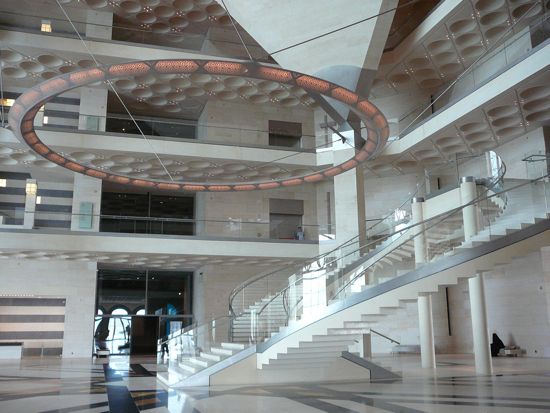
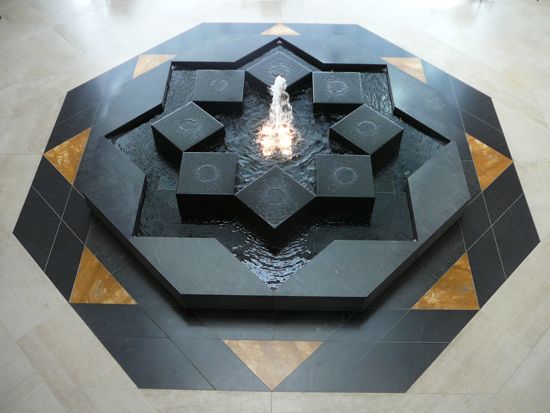
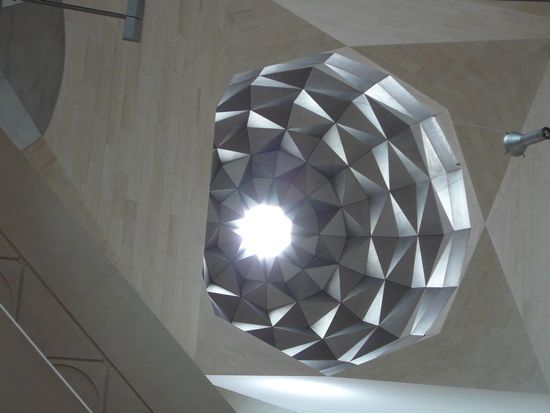
There is a breathtaking view of the Corniche Skyline from the spot where, on the map, they say the coffee shop should be. It really needs a coffee shop there. The restrooms are immaculate, the gift shop has lovely items, the exhibits are lush and beautiful, but you need a place to sit and think about what you’ve seen, compare notes, recharge so you can go back and take another look at something you are wondering about. It really, really needs that coffee shop.
More Doha by Dusk
It’s my favorite time of day, when the sun is setting and the long rays of light bring out colors and hues you don’t see in the harsh, pitiless light of the daylight sun. It is also poignantly transient; you have to shoot fast, and even as you shoot, the light is changing and fading:
Here, the fishermen are more intuited than seen:

The light is almost gone. The Doha Museum of Islamic Art seems to be smiling over the assembled dhows:

The Doha Mumtaz Tailor
As a last resort, we head to the Mumtaz tailor to see if he knows where we might find the exact fabric for Little Diamond’s pants. No, says the Mumtaz Tailor, but actually he saw a lot of it just a couple years ago, but it is all gone now.
This tiny little shop, just off Karabaa, is probably not one you would go into if someone hadn’t taken you there.
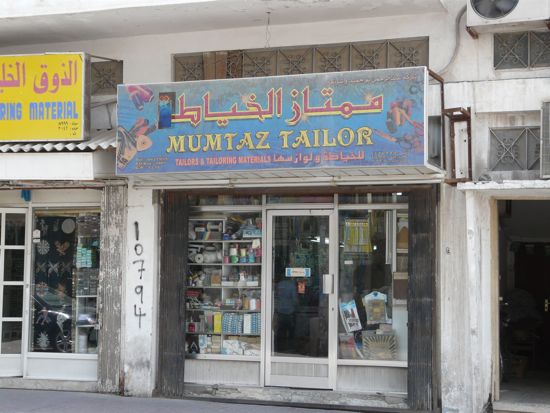
One of my stitch-group buddies took me on a Doha tour just before she was leaving, took me to all the tiny shops you would never know about if a good friend didn’t take you there. The Mumtaz Tailor is a gold mine. If anyone has just the buttons you need, that zipper in an unusual shade, the lining to go under the cut out brocade – he’s got it, or he knows who does. He also has all the tools-of-the-trade that people who quilt or sew need – good scissors, measuring tapes, embroidery threads, hoops, a whole host of things you don’t even know what they are until you need them. The Mumtaz Tailor has them, tucked inside his fairly small shop, from floor to ceiling, and he knows where they are.
One year, I bought about twenty hajj towels, the very large, thirsty cotton white towels available here in sets of two for men making the hajj to Mecca. I took them to the Mumtaz tailor and he embroidered my family member’s names in English on one end and in Arabic on the other end and I even got to choose the colors. It was the hit of Christmas; a totally unique gift from Doha.
Although he didn’t have the fabric we sought, the minute we walked in I spied a bolt of the only batik fabric I have ever seen in Doha. Six years ago, I bought several meters of this and I have been looking for it ever since, with no success. I bought five more meters. Wooo HOOOOO!

Kodak Retires Kodachrome
This is from AOL’s Wallet Pop / Financial News
Kodak retires ‘film that captured youth of Baby Boomers’
Sarah Gilbert
Jun 22nd 2009 at 3:30PM
As the Paul Simon song goes, “Mamma don’t take my Kodachrome away…” But Kodak is doing it anyway, retiring its iconic Kodachrome color film, effective immediately.
I shoot film. (Much to the shock and chagrin of friends and casual acquaintances and family members who see the receipts for processing.) And a few months ago, I was shopping for my favorite, Kodak Portra VC.
I went to photo lab after photo lab, finding only one roll of 100-speed film at a Wolf’s Camera that was going out of business; and nothing at my regular haunt, Citizen’s Photo. Are they retiring my film? I wondered, panicky.
Finally at a huge camera store I spied a totally empty film shelf, but for a five-pack of expired portrait film. Bingo! I rushed home to make sure it was still available at B&H Photo Video, the New York-based photo store of record. Thank the gods of photography, it was still being produced.
But for fans of Kodak’s famous first commercially-successful color film, introduced in 1935, the hunt will now begin in earnest. Kodak is retiring Kodachrome, saying it’s too complex and expensive to produce. Other films — such as my fave, Kodak Portra, and commercial heavyweights Kodak Max and Kodak Gold — now account for greater than 99% of Kodak’s still-picture films. Due to its complexity, only one commercial lab in the world, Dwayne’s Photo, in Parsons, Kan., still processes it.
The lab, which has committed to continue processing the film through 2010, has a sad message on its homepage, saying how sorry the lab’s owners are to see it go. “Kodachrome was truly an icon of the 20th century and has certainly been a very important part of Dwayne’s business for many years. Once it’s gone, nothing will ever capture “those nice bright colors” in quite the same way,” they write, referring to the Paul Simon song “Kodachrome.”
Kodak will stop producing the film, which was only made at one plant, immediately and expects retail stocks will last through the fall, unless fans stockpile. As for me: I’m headed to buy a roll or two, so I can capture a bit of my film heritage before it, too, is gone
Doha Museum of Islamic Art – Summer Visit
The Doha Museum of Islamic Art is open during the hottest part of the day. It must be that everyone else is travelling, or at home having lunch, taking a snooze or that they don’t know the museum is open – we had almost the entire museum to ourselves, and we felt like honored guests!
The museum is just beautiful, as beautiful as before. This time, without the crowds of people, I really had time to appreciate the interior, the beauty of the materials that went into this building, and the sound of water throughout, making you feel cool and refreshed.
And then, there is that never-ending view of the Doha skyline, seen through the windows overlooking the Gulf:

It just boggles my mind that we are encouraged to take photos, that photos are not forbidden. I love this photo; I am sorry it is not so sharp but if I had used a flash, I would have spoiled the moment. These two men had no idea I was taking their photo; I figure it is OK because you don’t know who they are, you can’t see their faces. I just loved these grizzled warriors examining an even earlier warrior.

I tried so hard not to breathe, still, there was some shake. Sometimes the shot you get is the shot you get.
These tiles draw me back to the museum again and again; I love the intersection of cross and star:
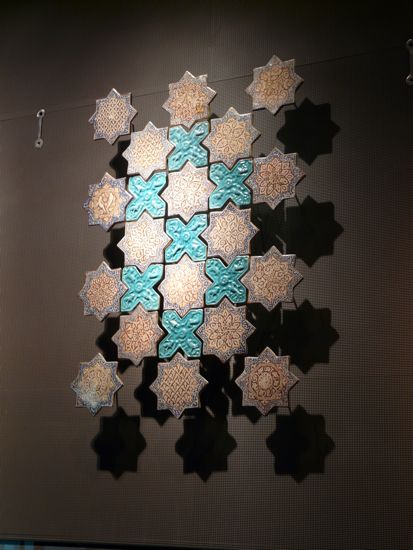
I used it in placemats for my mother, and in a quilt for my youngest sister:
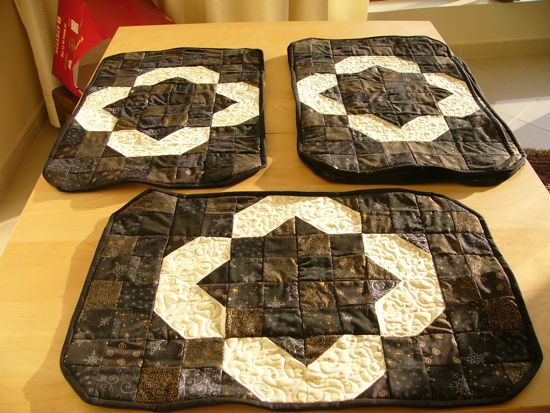

The pattern still draws me, and I have some other ideas of how to use it . . . 🙂
If you have ever thought of visiting this museum, oh WOW, the summer is the time to do it at your leisure. It is quiet, and cool and calm; you can stop and reflect on the beauty of the collected pieces, you are not rushed, there is no one around but you and the guards. Go now! It is the perfect time to visit.
It’s also free. It’s free, it’s open to the public for free, no charge, just come enjoy the beauty. What an amazing gift to the people of Qatar. And to the rest of us!
First Visitor to Doha; Souk al Waqif
We are very happy in Doha. This has to be one of the easiest moves we have ever made, even though I had to sell my car. 😦 We moved back into the same house on the same compound where we lived before. There is a whole learning curve I have already mastered – city layout, major roads, grocery stores, book stores, fabric stores, and major sights – been there! done that!
And yet, Doha has changed enough to still be stimulating and exciting.
Nonetheless, when I was contacted by a friend coming to Doha, with a little time to fill, I felt slightly daunted. We have had lots of visitors here; I tell them to come in November – February, March at the latest, except for Little Diamond, who has lived several places in the Middle East and knows exactly how hot it can be, and who copes with the differences.
I got to the hotel exactly as she and her husband were coming down – perfect timing. I had some suggestions, but what she wanted to do was what I love to do – see Souq Waqif and if we have time, see the new museum. Since they are only yards apart, I had a huge smile on my face.
The smile kept getting bigger – as we drove up to the Souq al Waqif, a truck left in the most perfect, shaded parking spot; THAT is God smiling, it has to be, parking places like that just don’t happen without help.
And, as it turn out, not only does she love the Souq Waqif, she also loves taking photos, so we had ourselves a wonderful time.
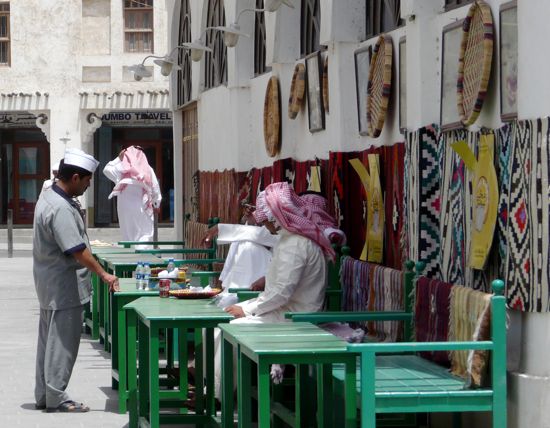
Not one single photograph with a person was taken without that person’s permission; not one single person said “no.” They were all “ahlen wa sahlen” (Welcome! Welcome!) It was a sweet morning, and although it was one of the hottest days of the year, it was dry, and the heat was bearable.
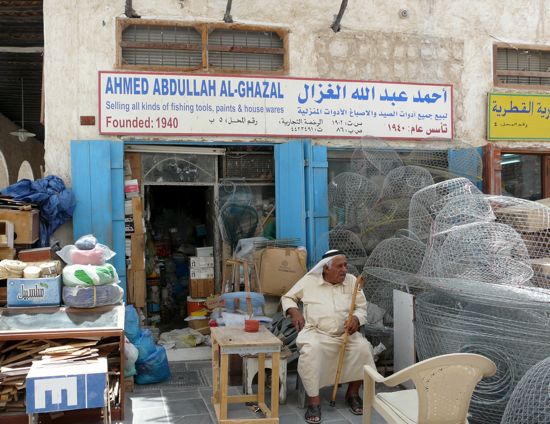
One of my favorite shops in the Souq al Waqif; he has all the things fishermen really need – from traps to twine:
The bird souk is active and beautiful:

It’s a real working souk, offering all kinds of household goods:
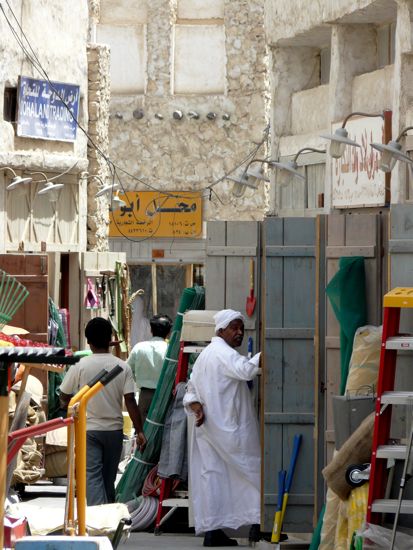
Look at the huge serving platters in the background – imagine them piled high with rice and mutton, or rice and chicken! Delicious!
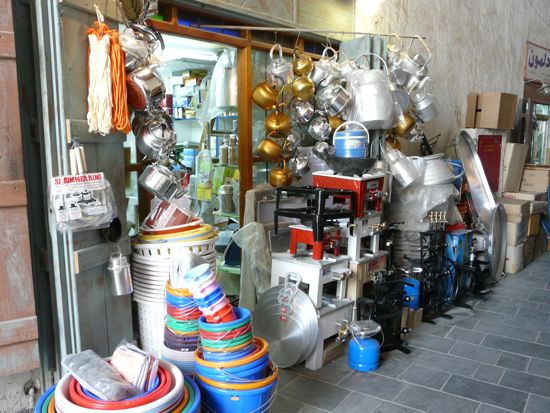
This is the first time I have ever seen this store – it has only been open one month. Everything in it is made in Doha:


This was one of the nicest stops on our tour. The eqal maker and his helper are so gentle and full of good information.

We had a great time, a wonderful lunch at the Ispahan:

No time for a nap! On! On!
Signs of the Times in Doha, Qatar
There are a whole series of these signs, carefully placed at eye-level at most stoplights. Here are two; it takes me a while to get in the right position at the right time and to have my camera ready, but I am learning to always have my camera ready:
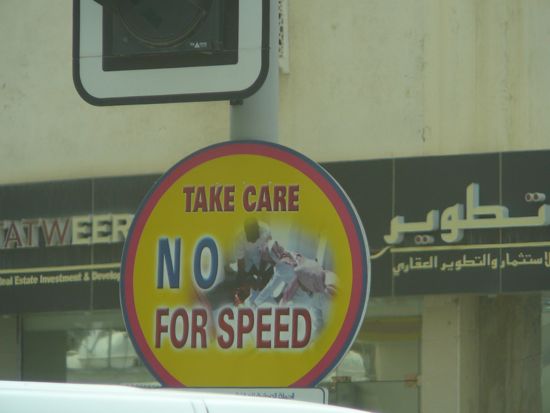

May God richly bless my husband for his patience; I am always calling out “Can you pull over so I can get a picture of that sign?” In Arabic, this one says “Bunshury al Rodoa”

I speak some Arabic, not a lot, like I can’t discuss politics with you, or anything complex, but I know shapes and colors and directions, and it all comes in handy. I took this sign because my favorite color is purple, and it is a very hard name to remember, when you are looking for something specific that is purple. 🙂

And see if you can guess why this is my very favorite photo of all 😉

Friday Lunch with AdventureMan at Assaba
After all these years, we know each other so well.
“Where are we going to eat today?” he asks as we leave church.
“It’s your turn to choose” I tell him.
“No, no, it’s your turn,” he insists, “I chose Ruby Woo’s last Thursday night.”
“No. You didn’t. I did,” I tell him, and remind him that I also chose another place later in the week, but it was a place that he really likes.
What he wants me to do is to throw out my idea and then he shoots it down. Sometimes I throw out three ideas, and he shoots them all down!
“What are you in the mood for, what kind of food?” I ask him. Usually he doesn’t like a lot of meat, so I am surprised, really surprised, when he says Lebanese. When we lived in Kuwait, he almost never chose Lebanese except for Tanureen, where they had such good fish.
“Yeh, but now there is no good Lebanese restaurant near where I work,” he replies, “and I am missing Lebanese food.”
I know just the place. My two pool buddies took me to lunch there back in January when I visited. I THINK I know how to get there, and, as it turns out, I do! (It’s always a disaster trying to find a place when your husband is really, really hungry.) It’s called Assaba, and it is like entering a different world. They’ve taken a very humdrum building, and re-facaded and decorated the ground level and one flight up to resemble a Lebanese Village. It is a lot of fun.
We ordered mostly mezze (appetizers) and an order of shish taouk to share. (Shish taouk is boneless chicken pieces that have been marinated in lemon juice and a little garlic and yoghurt, for those who don’t know about it. It is delicious, and often served with a mighty garlic – mayonnaise. )
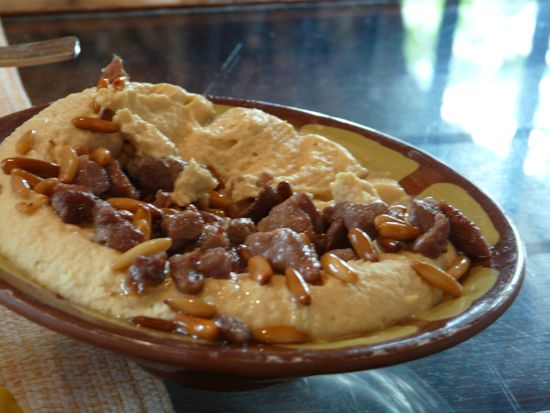
We agreed that the very very best dish of all was the Mohammara, a dish made of finely chopped walnuts, red peppers and a few other things. (Mishary, on Some Contrast, printed a great recipe.)

We had hummous with something that tasted a little like liver, and baba ghanoush, and meatless chickpea moussaka:


And this is how the shish taouk looks when it arrives, with hot bread to keep it warm:
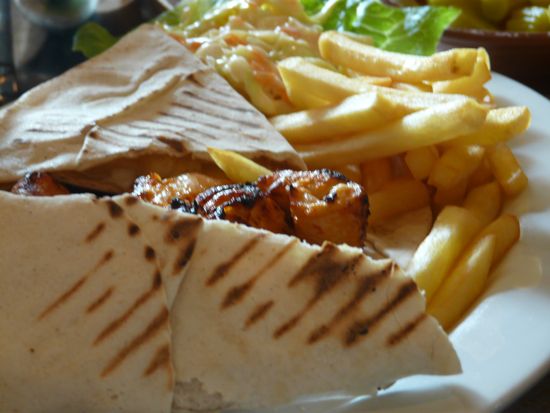
It was a magnificent meal. We ate too much. It was just so pleasant, sitting there, great food, beautiful surroundings, us all relaxed after church and mellow. AdventureMan came back from washing his hands all excited – “You’ve got to go use the Ladies Room! See if they have a beaten copper sink! I want one of those!”
I did, and this is what it looks like:

I think we might have to take another trip to Damascus, and bring it back with us. Do you know what a designer in the US would charge us for a sink like that?? We can go, find a sink, spend time in a city we love and come back for what the cost of the sink would be in the US.
I want the door:
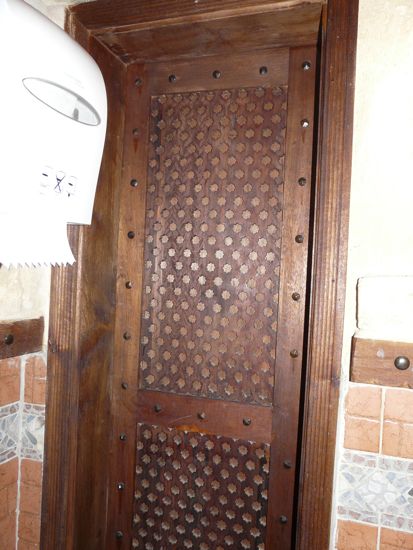
I think I had better have it made here!
Here is the shower he wants, from Robin’s House at Nkwali Camp, in Zambia:

Even Friday lunch with AdventureMan is an adventure. 🙂
Dar Al Thaqafa in Doha, Qatar
I have very special feelings about Dar Al Thaqafa. When I was new in Qatar, as I started to read a very special book, it fell out of the binding. Maybe the heat has melted the glue, I don’t know, but it was not my book! It was loaned to me by the Ambassador to Qatar from Japan, and holy smokes, I had ruined it!
I went ahead and read the book, and then I had to figure out how to get it re-bound. I asked around, no one had any idea. Finally, I asked at one of the Dar al Thaqafa stores (there are several in Doha) and they told me about the Dar al Thaqafa printing plant, which was not far from where I lived.
I took the book there. They said they could rebind it. It would take about a week. I didn’t even ask the cost; it didn’t matter, I had to return the book in good condition.
When I went to pick up the book, they wouldn’t let me pay them. The man who gave it to me – with beautiful bindings and end-papers – had a big prayer bump on his head. He told me he wanted me to remember that not all religious Muslims were terrorists. I almost cried. Maybe I did, a little, when I got back to the car, it is just such a perfect example of God’s grace, and how we are supposed to love one another and be kind to one another.
So this weekend, as I drove around familiarizing myself with my old secret back ways to get places, I came across the first Dar Al Thaqafa book store I ever visited, with Little Diamond, down near the Dira’a fabric souks. You would hardly know it was there, if you didn’t know it was there. We only found it because the toy vendor outside had some dancing Saddam Husseins and Osama bin Ladens – I have never seen them anywhere else. Then we spotted the bookstore – and oh, what heaven, all kinds of books, a bookstore any book lover would love:
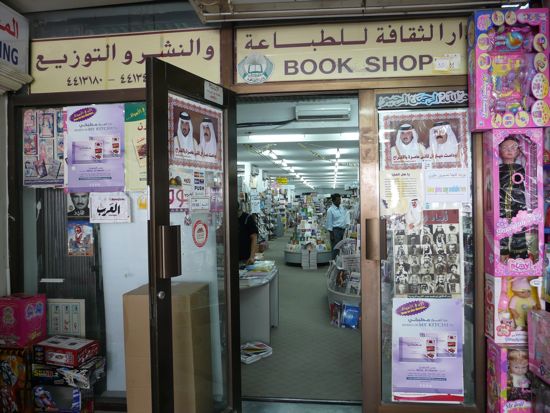
Qatar is a conservative country. You might be wondering how I can take pictures so freely – I always ask.
So I asked if I might take photos of the bookstore.
“Why” asked the man at the desk.
“I love this bookstore,” I responded, “and I take photos of places that might not exist in the next five or ten years. I try to record what was special and unique in a country.”
He beamed with delight!
“This is the oldest bookstore in Qatar!” he exclaimed! “This is the original of all the Dar al Thaqafa bookstores!” He gladly gave me permission to photograph.

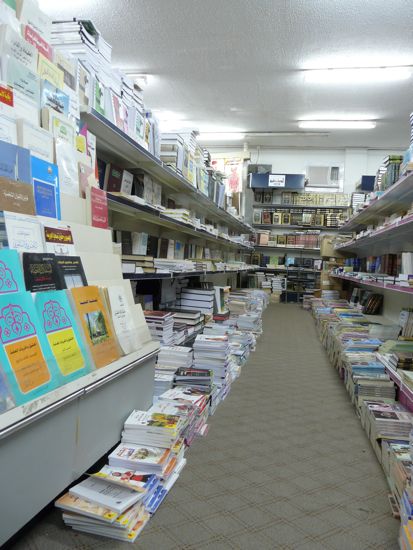
They carry textbooks, reference books, religious books, children’s books, and all kinds of school supplies, from the most elementary grades through the most specialized university courses.
You know I read and write Arabic on a very very basic level. I can proudly say my niece, Little Diamond reads and writes on a fluent level, and as we leave book stores, we are often staggering under the load of the books she buys to take home and read. This store, and the Jarir bookstores, are a couple of our favorite stops.
I had a family cookbook printed with all our best of the best recipes – the Dar al Thaqafa on Merqab did the printing and cover and binding for me. They did a great job.
As much as I like going to a Barnes and Noble, you walk into just about any Barnes and Noble and it is like walking into the same one, whether you are in Pensacola, Seattle, Houston, Charleston – they all pretty much follow the same pattern. It is calculated and more than a little sterile. Not so the Dar al Thaqafa, where books are piled here and there, pens are all in one place, children’s books in piles – you kind of have to search for what you want, but they usually have it, or can find it for you, or tell you where to go for it.
Baking Cookies for Palestine
When I was just starting out my own life, I had an idea what kind of life I wanted, but I had no clue how to get it. When AdventureMan and I met, we had the same vision, it was so cool, so unbelievable. We married, and this amazing life has unfolded.
Not everyone is born to move. You have to be good at change. Change can be daunting. Some people are better at staying in one place, sinking deep roots, developing lifetime relationships. Some people – like AdventureMan and me – have a need for stimulation, and we get it by changing locations. We feel so blessed.
It is always painful leaving the place we have been living, pulling up roots is just plain painful. The transplantation process takes time for the organism to adjust, for new roots to develop and take hold. Sometimes, the plant fails. In our case, we have had our failures to thrive, but for the most part, every move has helped us to learn and grow in new ways. We feel truly blessed; we have the lives we were born to lead.
Arriving back in Doha, I called my good friend. We have never lost touch, with e-mail and visits we have stayed in contact, and now I am calling her so she has my new number in Doha.
“You must come Tuesday morning!” she enthused, “We are baking cookies for Palestine!”
This wonderful woman was my teacher for reading and writing Arabic, and she did a great job. I read and write about as well as a five-year-old, but I can sound out words, and can write my name. Best of all, I adored this teacher, and when she called and asked me if there was something I could teach her daughters during the long hot Doha summer, I said “yes” and a new adventure began.
One of the things that happened is that I learned I never really knew what the day might bring. Getting to know her, her daughters, and her family better, I learned now ignorant I am of how totally differently others live their lives and see the world. I was learning all the time, and most of it was from the daughters. On one occasion, the daughters called me at 6 in the morning – they are never up at six! They asked if I would take them to the hospital to see their mother, and I sleepily said “Yes, of course,” and asked what time they wanted to go.
“Now!” they replied, joyfully, for this was a birth.
My sweet daughter-in-law was visiting, with our son, and so the two of us rushed over to pick up the girls, who came loaded with carafes loaded with coffee, boxes of finjan (tiny Arabic coffee cups) and sweets, loading up the car with goods and joyful laughter. When we got to the hospital, we had a quick visit with the Mom and then – the guests started arriving.
First – the room. Our friend was in a king sized bed, surrounded by lush curtains which could be pulled. She had a marble floor and a marble private bathroom with private shower, and a small dressing room. There was a visiting area with velvet covered seating for around 16 people, and mahogany paneling everywhere. This is the poshest maternity ward I have ever seen.
Many of the guests were stopping on their way to work. “When you visit someone in the hospital,” the girls informed me, “a thousand angels pray for you, for having made this visit.” These visits are de rigueur, an absolute must. We were there an hour, a constant stream of women came and went, staying around ten minutes, each receiving a small coffee. Then, the girls told us we could go, that they would stay to take care of serving the coffee and sweets.
The entire episode, we never had one clue as to what we were doing, or what was going to happen next. I learned just to go with whatever was happening, stay quiet, watch and learn. Sometimes, I ask questions, if there is a quiet moment.
So when my friend says come bake cookies, I go. I remember when she first baked her first cookie; she called me to come. She didn’t have a mother, growing up, and there were gaps – like how to bake cookies. We spent a morning learning how to make mamool, and it took me three days to get the smell of butter out of my hands. It was so much fun.
As I entered the workroom twenty pair of eyes looked up at me. Everyone was neatly dressed in aprons and headscarves, but my friend wasn’t there! I found my friend, we exchanged greetings, and she came to workroom to get me started. I had my own apron with me, and they provided me with a headscarf; we all looked a lot alike, little baker women. As a beginner, I got to put out the dough, later put the date paste on each piece of dough, later roll the dough around the date paste and put a hole in the top.
Most of the women, vastly more experienced than I, were using little tweezer tools to crimp the dough into the fabulous tiny ridges you can see in the photo. My friend explained that one of the women’s husbands had made the special tools for making the holes in the dough, and the table for them to use packing up the cookies and wrapping them, another had provided a portable oven for baking the cookies, another donated semolina (the flour) and another the dates.
Working once a week, making these beautiful cookies, (biscuits, if you are British trained) the women have built two wells in Palestine, and are currently building a bakery. They took their grief and outrage over Al Raza and turned it into the most amazing effort for good. They feed the hungry, give water to the thirsty, they clothe the poor, they take care of families whose men are imprisoned.
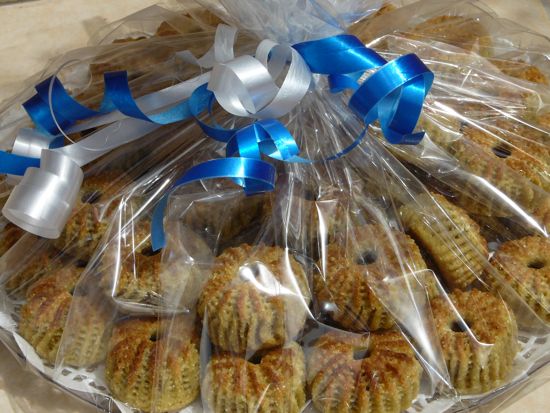
“You must come back!” one woman says as I am heading out the door. “You are a good worker!”
I wouldn’t miss it for the world. 🙂
Recent Comments
Kitchen on Isiais: Winding Down intlxpatr on Shampoo Ginger tigerbutterya0c5ff1d… on Shampoo Ginger intlxpatr on British Soldier Kidnapped, Esc… John on British Soldier Kidnapped, Esc… Wikipedia Donate Button

Amazina


Early Voting in Florida


