Wandering in Barcelona’s Gothic Quarter

We return to Place Cataluñya. We got off at La Rambla (now you can see it in the daylight, above) and we need to figure out how to get to the Barcelona Cathedral, in the Gothic section, where I had thought we might have lunch.


We’ve had three years to research this trip and there aren’t enough hours or days to do all the things we want to do in Barcelona. And every now and then, something happens that no amount of research might have prepared you for.
When we got to the cathedral, there was some kind of elder celebration. There were big circles of people dancing, having a wonderful time. It was unexpected. It was joyful!


I love that this was some kind of church-sponsored activity, not for tourists, not for us, but for them! And they were having a wonderful time, dancing!

The famous Not-Roman arch . . . not even old, not antique, more a seasoning.


We wandered, then found a little tapas place, not one of the places we had so carefully researched, but at this point, we are REALLY HUNGRY. It is cute, and full of antique Spanish antique pieces. AdventureMan, full of courage, did the ordering. I had a plate of thin jambon and cheese and he had a bowl of sausages with bread. This is not the kind of food we normally eat, but this place had nothing resembling a vegetable. It did have olives.


The beer was Estrelle, really good and cold.


And here, AdventureMan ventured to have a glass of vermouth. I wish you could have seen his grimace! He did not like it at all. We were glad we hadn’t picked up a bottle from the Carrefour to take on the ship. It would have been wasted on us!

Now that we are not urgently hungry, we have time to look for the place where AdventureMan wants to have Barcelona chocolate with churros. He knows exactly where we need to go.
On the way, we run into a large demonstration for a separate Basque nation. It is peaceful. I guess we all have our divisions.


The Gothic quarter is fascinating, full of unexpected messages and art, so we wander, but with purpose and direction. We find Petritxol Barcelona, for hot chocolate and churros for AdventureMan. I had some kind of coffee and chocolate heaped with non-sweetened whipped cream, chocolate overload. We’ve done 10K steps today, 11K yesterday. I feel no guilt eating this decadent, lucious chocolate. Later, I only wish I had bought more chocolate to take with me.


The sidewalk and street surfaces are very hard and after the chocolate, we were ready to wander back to the hotel for an afternoon snooze. My husband is talking about taking it easy tomorrow – breakfast, packing up suitcases for delivery to ship, bus to ship, checking in, leaving again for lunch in Barcelonetta, then reboarding. I am eager to get unpacked, check the wrinkling of my clothes, and get acquainted with the spaces on the ship.


The walk back is full of interesting sights, places, were we not so tired, we might linger, have a glass of wine and watch people, buy some local cheese.


A modern take on a Spanish penthouse. You can almost guess how elegant it must be inside.

I’ve worn the same navy striped linen dress for three days – with a T-shirt while we flew and a different t-shirt in Barcelona. It goes everywhere. It has no nationality. I had put on the green French terry dress to wear today, but when we went to breakfast, I discovered it was too hot, so I changed back into my linen dress. Very comfortable. Tied my navy hoodie around my shoulders, and was glad to have it riding on top of the bus. It is sunny, but cool in shade or breeze.
Back in the hotel by mid-afternoon for a rest, my husband snoozing. So far I have felt no effects from jet lag. I will try not to nap so I can sleep tonight. Sleeping on the overnight flight worked well for me.
Hop On, Hop Off in Barcelona
The first time I ever rode a Hop On Hop Off (HOHO) bus was in Barcelona. I was attending an International Quilt Show with two other friends, and we had a ball. I’ve raved about it for years, eager to get AdventureMan to Barcelona. I knew he would love it.
Leaving Sagrada Familia, we hopped back on the HOHO bus. It is the most beautiful day, sunny, warm but not too warm, and Barcelona is full of the most idiosyncratic architectural detail. I am in heaven.
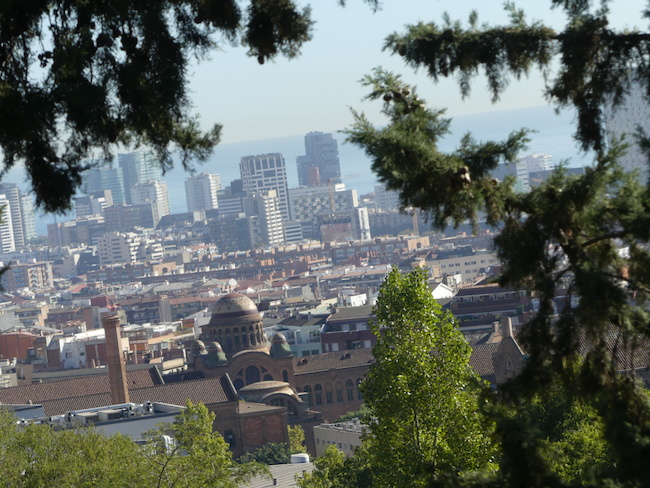

People-who-know tell us we MUST drink Vermouth in Barcelona. I think my parents used vermouth when they made martinis, but I have no idea what it tastes like. We are intrigued.


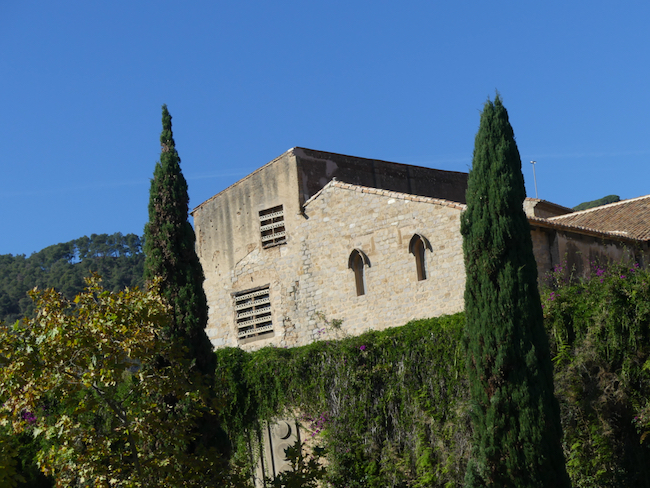
Imagine, just for a minute, living in this house. It must have high ceilings and spacious rooms. Imagine the added space, up on the rooftops, where you can have drinks or dinner, or put out the clothes drying racks where no one can see.

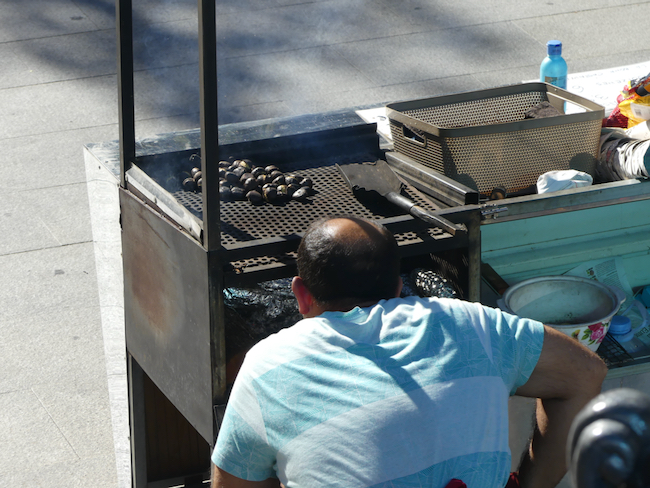
Fresh roasted chestnuts! They smell so much better than they taste (my opinion)


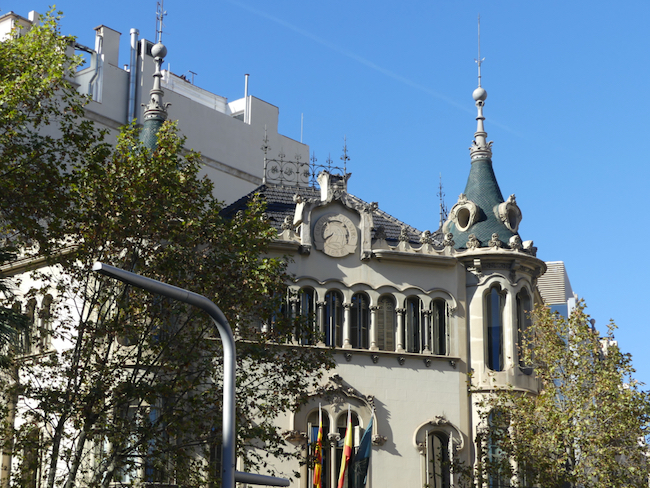
Of all the jobs I wouldn’t want, replacing huge plates of glass far above the ground would be one of them.

Gaudi apartment building; the same architect who drew up the plans for Sagrada Familia.
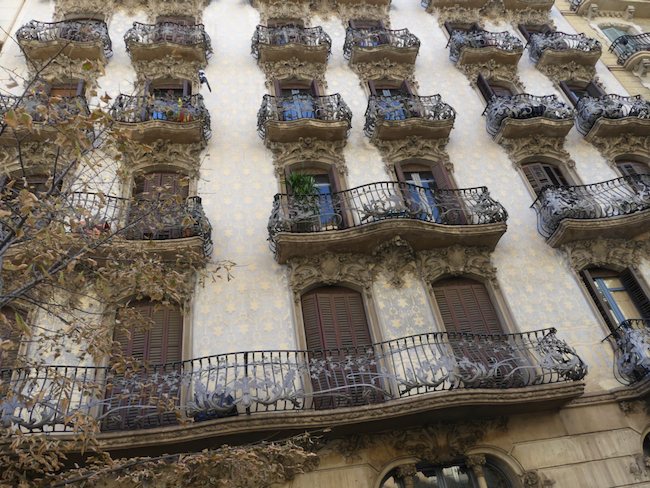


We returned to Place Cataluna, starving. We had a great breakfast, but it has now worn off and we want something light to eat for lunch and some famous Barcelona chocolate!
Barcelona, A Breast Cancer Run, and Sagrada Familia
I slept lightly but slept from 10 p.m. to 7:45 a.m., so good enough. We keep expecting jet lag to kick in, but I think we are so busy we are sleeping well at night from sheer exhaustion. We took our time getting ready and headed down to breakfast. What a surprise! Different, but beautiful and tasty and plentiful. I had a little cereal, some thinly sliced ham and sausage, and an espresso, then another. AdventureMan had bread and sausages, with some delicious jam and four fresh orange juices. The room was full of cruisers, some from Princess, so I don’t know who will be cruising with us.
From our room after breakfast, we could see hundreds of pink t-shirted women running. I know this race! Where else do thousands of women race in bright pink T-shirts in October and November? It’s a huge run against breast cancer, and it goes on and on. Streets are closed.


Where we thought we would catch the HopOn HopOff bus is closed off. We have to walk a short distance to the next stop, but we don’t care. This is lovely, and wonderful! They were still running when we went to Plaza Cataluña and we had to cross them going to the plaza, then come back from the place because the buses had to be caught elsewhere.
When we got to the bus, I didn’t have a mask and had to go back to the hotel to pick one up. When we got back to the bus, it was perfect timing, we got a great seat up on top.


We got to Sagrada Familia just in time for our 10:30 tickets. I was surprised we had to go through security like airplane security.
(There are many places you can buy your tickets in advance. We bought our Hop On Hop Off tickets and our Sagrada Familia tickets directly from the operators. Sagrada Familia has a very nice website: https://sagradafamilia.org/en/)
Sagrada Familia was beautiful; beautiful lines, like a stone forest holding up the ceiling. The stained glass windows were stunning. The colors were like Matisse, but without images. We just basked in their loveliness. There wasn’t a huge crowd, and it was quiet and respectful. I can’t imagine what it might be like in high season.

It is a gorgeous Sunday morning, and these people have the most amazing location, just across from Sagrada Familia. What a lovely place to have your Sunday morning coffee and newspaper.

I love the beauty of the statuary, and – look at the frame! It looks like giant teeth!


This has to be a metaphor for the abundance of the Earth . . .

Look how tenderly this (King?) holds this precious baby


It is an artist’s gift, I believe, to use earthly materials to express the inexpressible and barely attainable. Gaudi combines earthliness and Godly tenderness and compassion in a remarkable and awe-inspiring way.
AdventureMan was not wild about visiting Sagrada Familia when there are so many great places to visit in Barcelona. He went to please me. He was WOWED. He still talks about this visit with awe. Best visit ever!
Living off My Fat: Adaptation
It probably all started growing up in Alaska, where my mother would measure us in July to order our snowsuits as soon as the new catalogs came out. We lived where ships didn’t come in the winter, so supplies for the winter needed to be ordered – and received – before the ships could no longer navigate the channel.

Then came our life in Germany, where we lived by what my sister called “Commissary rules.” Her one word of advice as a newlywed leaving Germany, while I was staying, was “When you see something in the Commissary or PX you think you MIGHT need, buy it.” Definitely a no-regrets philosophy.
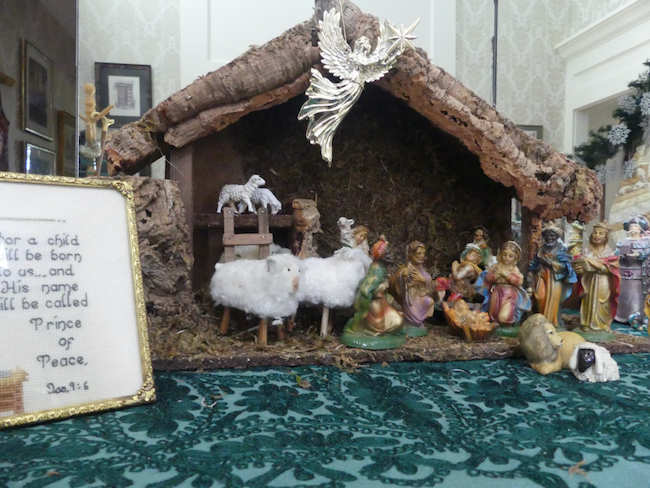
When we were sent to live in Tunisia, in the late 1970’s, we were instructed to take everything we might need for the next two years. Some things – chocolate chips – we learned to live without. We adapted to new foods, new ways of doing things. One of the great treats was the fresh, gorgeous, silky olive oil; I would take my jar to the little olive oil vendor at the nearby souk and he would weigh my jar, fill it, subtract the weight of the jar and charge me for the oil, which made everything taste French.

I did have a two-year supply of shoes for a growing toddler, also clothing for him in graduated sizes, and two years of age-appropriate books I could pull out of the closet. We were able to mail-order through the embassy pouch, and my mother was able to mail me little extras. One year, when I was running the Christmas bazaar, she was able to find red and green Christmas fabrics in July, at a discount, and mail them to us for our crafting. It was such a luxury!
In Qatar, I was always bringing back duffels with quilting rulers and rotary cutters for my quilting friends. In Kuwait, it was books for my book club and American sugar for a friend who liked to bake. Kuwait had sugar, but more coarse, and American sugar melts more quickly for a finer result. Who knew?
There are items from the past I still have in abundance – dental floss, women’s underwear, shoes – and staples I buy but no longer use in the quantities I once did because we no longer live a life where we entertain a lot nor prepare for unexpected people on temporary duty who need a meal and an exchange of currency. I am trying to bring down my supplies of artichoke hearts and pimentos, beans and rice, canned tomatoes, chutney, Tupperware and hand soap.

My Little Free Library, one of the best birthday gifts ever, helps me keep my books from overflowing.
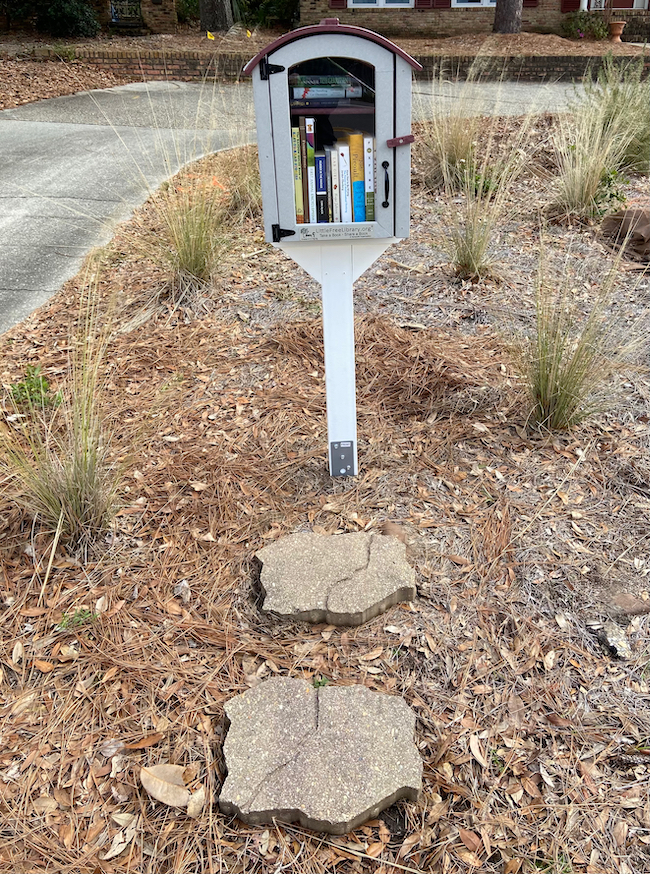
We are happy, these days, to be living with less. We are still caught by surprise by rolls of baking parchment we are still using from Kuwait, dental floss leftover from our years in Tunis and an excess of Christmas decorations we still need to pare down. We try to go easy on ourselves. “Ah,” we sigh, “it’s a process.” God grant that we live long enough to use up all those supplies we bought “just in case.”
Back in Kuwait
No, No don’t get excited. It’s a metaphor.
When I lived in Kuwait, I would tell my friends it was a lot like living in Alaska, and I loved the look on their faces. Then I would explain – in Alaska, people wait eagerly for good weather, and when it comes, they can’t get enough of it. We are outdoor people.
For much of the year, Alaskans are trapped inside, and have to be good at finding things to do to keep themselves from going crazy.
In Pensacola, as it was in Kuwait, the temperatures are very hot. Kuwait was mostly very dry, and had sandstorms, unlike Pensacola, but shared having a long coastline, and heat with humidity in the summers.
So now, as in Kuwait, I am up early, to get to the pool and swim my laps, so lovely and cool. If I need to grocery shop, I try to shop on the way home, so as not to have to venture out again as the day heats up. I get home, and tend to the Little Free Library while it is still in the shade. Most of the rest of the day I spend inside, except for picking up grandchildren at their camps.
It is a great time to do some quilting. I am just about to start when Ragnar, my helper, comes in to join me. (Also, AdventureMan is outside weed-eating and edging, which is of endless amusement and torment to Ragnar, who forgets he was once a feral, outdoor cat, and was lucky to survive.)

I do a couple more things to set up, hoping Ragnar will take the hint and move off to find something more interesting. He doesn’t. In the end, I have to lift him (lovingly) and place him in another room on a blanket we call Blue Mama, because Ragnar particularly loves sleeping on this blanket.
He doesn’t come back, and I spend the morning “back in Kuwait,” enjoying my confinement by working with fabrics and colors I love, patterns I would never wear but enjoy the challenge of working them into quilts.

Chasing Petroglyphs: Our Last Day in Moab

Today is a day purely for leisure and having fun; we head into Moab for the Moab Arts Fest. It is very family-oriented, with games and entertainment and food, and booths with hand crafted items. I find a fiber artist and a great gift for my sister, a spidery light bright red wrap with silk fibres pressed into it. It is stunning. I can easily imagine it on my stylish sister.
We decide to have lunch at Singha Thai because we so thoroughly enjoyed their food our first night in Moab. This food was equally impressive.


So much food, the veggies crisp-cooked and delicious! AdventureMan had the basil chicken with lots of broccoli, and I had the ginger chicken, more sweet red peppers and spring onions. We couldn’t begin to eat it all, so we packed it up and had it on our Trail’s End veranda for our own sunset dinner.
Chasing Petroglyphs: Newspaper Rock, Needles and Canyonland
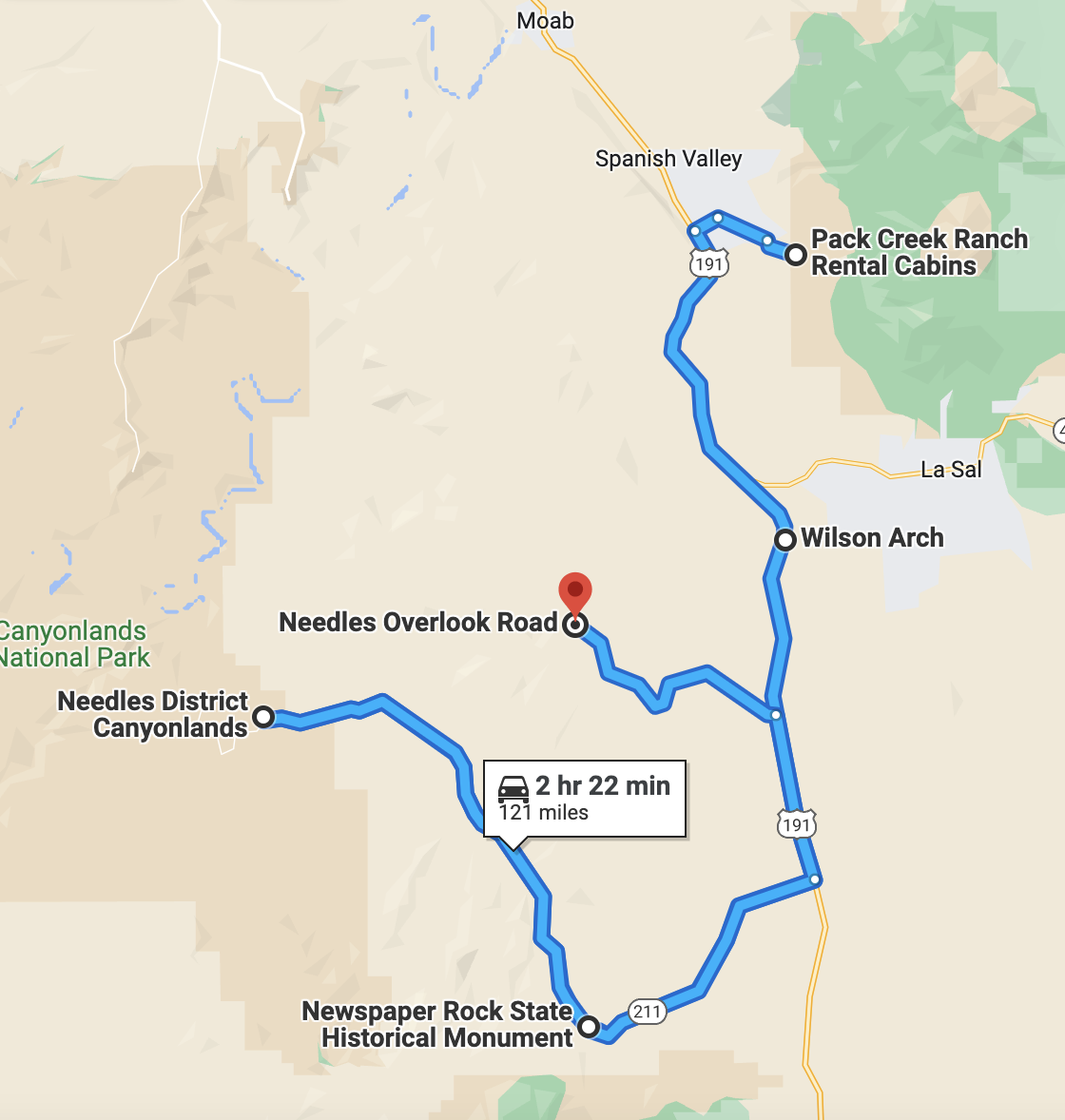
As AdventureMan reads through these posts, he delights in how much he has already forgotten, and he looks forward to reading about what he called “one of our light days.”
I look at him in astonishment. As occasionally happens, I remember things very differently,
“We got a relaxed start,” I begin, which in our language means we did not hit the road at the crack of dawn, but maybe around 0830, “but we were on the road until about 2:00! And it was some tough driving! No place to stop for lunch, we just had apples and oranges by the side of the road.” And water. Lots and lots of water. It was again in the 90’s, and very dry, and there are signs everywhere warning us to drink water.
We don’t have to start from Moab, we just reach SR 191 and turn south. The first thing we come across is Wilson’s Arch:


And another place called Hole in the Wall, but I can’t tell if it is a famous Hole in the Wall or an adventure outfitting place. There is an ATV perched precariously on the top of the cliff.
We turned off 191 to go to Canyonlands, and soon came to Newspaper Rock.

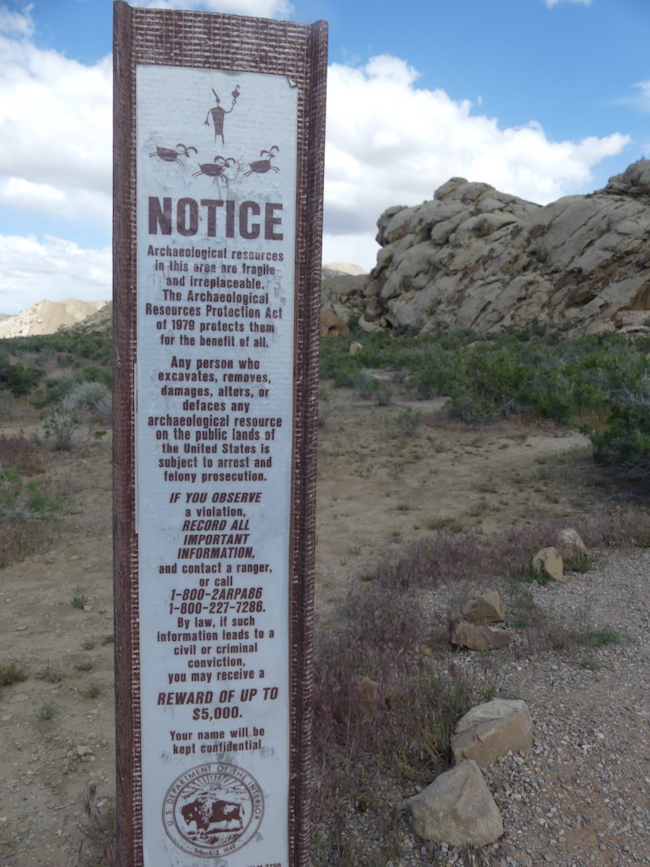
Early on, I mentioned how fragile and transient petroglyphs can be. We don’t really know who made them. We know that many of the earliest petroglyphs incised were written over, improved, by later early peoples. And then, modern day man, who had done the most damage of all – carving his initials over ancient glyphs, removing glyphs, defacing glyphs, rubbing glyphs (thus eroding their edges and making them more vulnerable to weathering elements), chalking glyphs to make them more visible, even touching glyphs leaves chemicals that damage the quality of the glyphs.
When we got to Newspaper Rock, we parked at the wrong end of the parking lot and ended up on a trail going entirely the wrong way. AdventureMan kept saying he thought we needed to go back, but the further along we got, the more I thought we were on the right track – until the track ended. We walked back, and just at the other end of the parking lot was the Newspaper Rock – near the road and protected by a large grill.
The thing is – I saw others, too, nearby. I am so thankful they protected Newspaper Rock, because through the years many of the incisions have been defaced. I am hoping that the others are being protected by the very lack of trails and signage, by the lack of publicity. It’s a pity we should have to protect the petroglyphs from our own citizens.


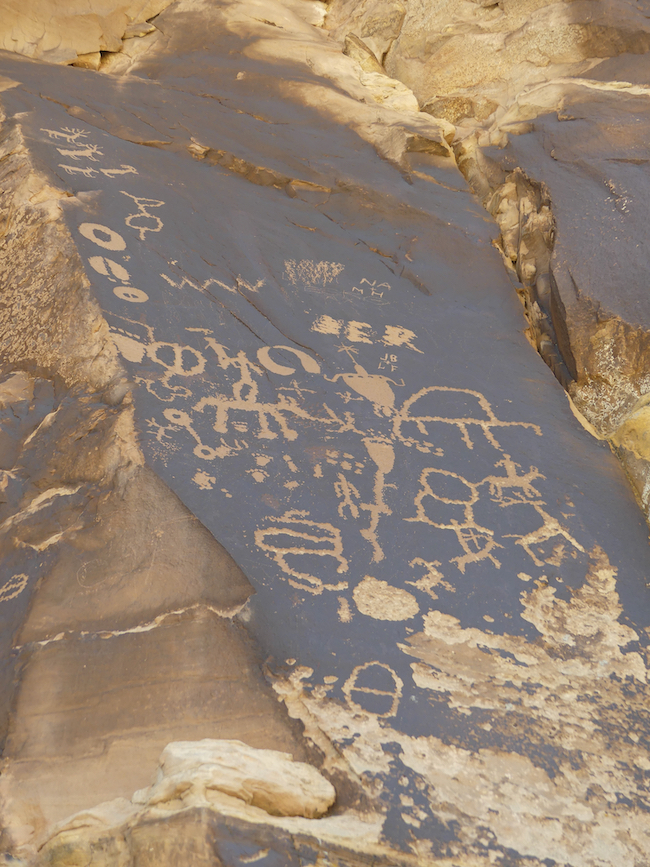
I think of Newspaper Rock as a kind of scratch pad. Even Leonardo da Vinci, the great inventor, engineer and artist, made sketches before he executed a masterpiece. I can see traces of the Fremont peoples, and I can see scraps of petroglyphs we have viewed in Vernal.

AdventureMan found Newspaper Rock a very emotional experience. He felt connected to these early people. When I look at these footprints of all sizes dancing around, I feel their joy. And look at the hand – that is almost modern in it’s representation of a human hand; and I think back to the petroglyphs at White Mountain which may have represented the human hand or may have represented the terror of a bear claw. These feet are so happy, and, interestingly, so similar in form. I wonder how they were formed?
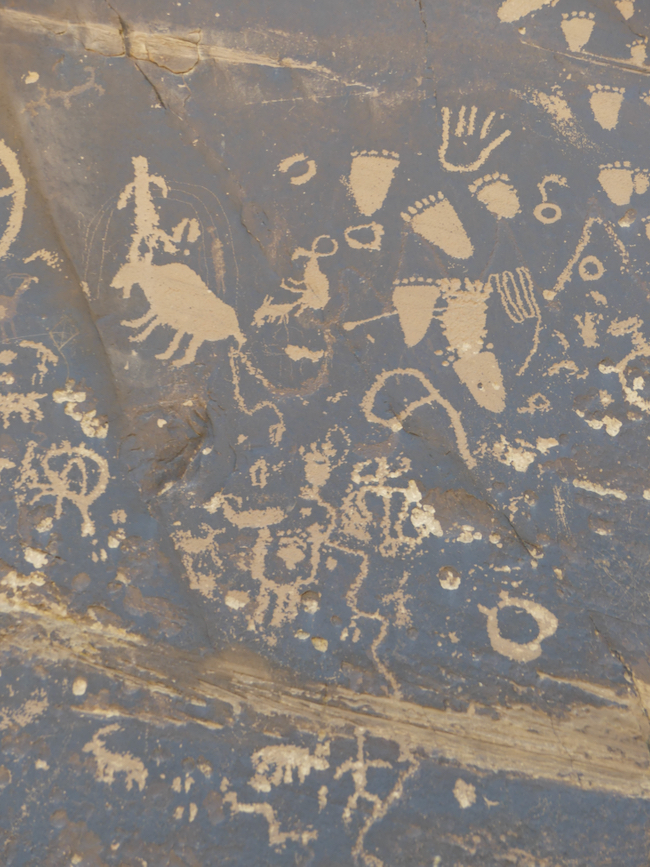
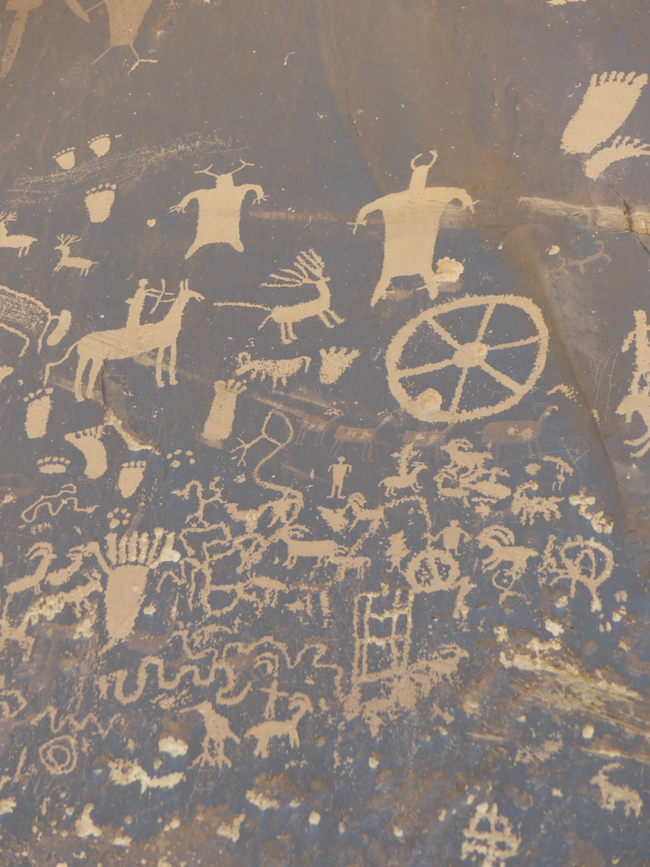

I’ve broken the wall into different panels with photographs; taken in total, it is overwhelming.


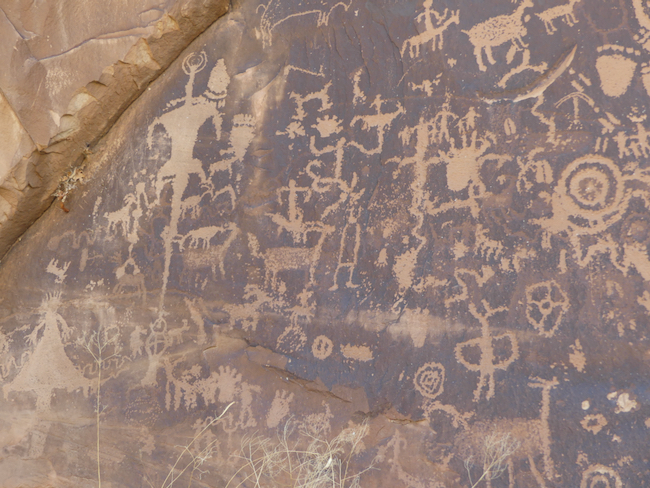
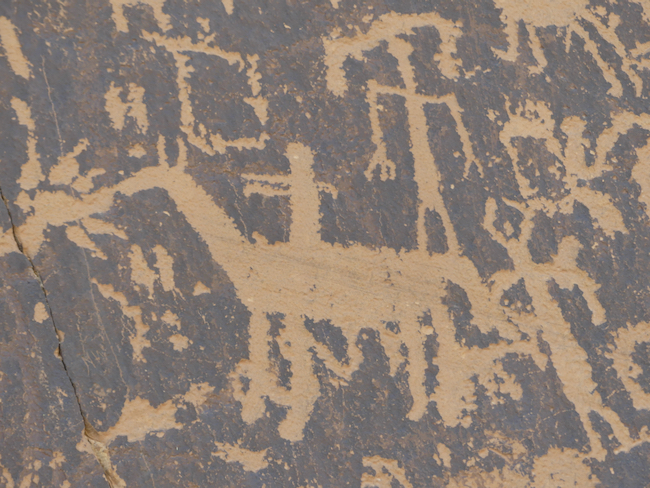
Much more modern era; we see horses introduced

Those lines – snakes? Rivers? Directions? A life?

I would guess this central figure is a shaman, with what coming off his headdress? Some kind of special decoration on his legs? The target symbol, as opposed to the spiral? The smaller horned man? All those animals – prayers for a good hunt? Celebration of a good hunt?

This one intrigues me – a scorpion? It is just weird!

A dancing bison? Look at the feet and . . . um . . . feet; they are very hoof like. An elk with a magnificent rack and maybe a spear in it’s side?

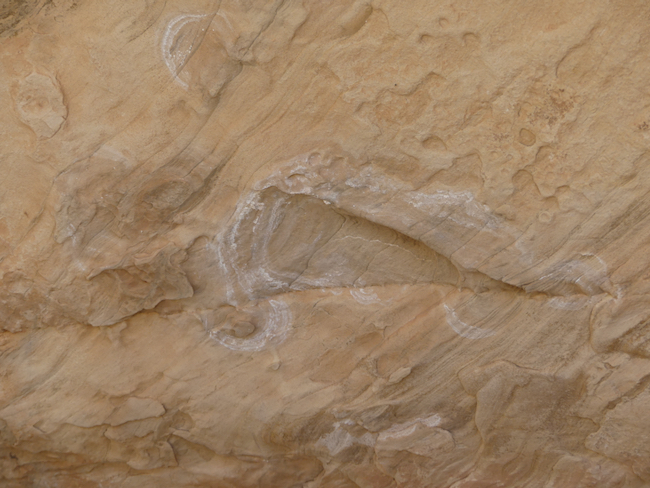
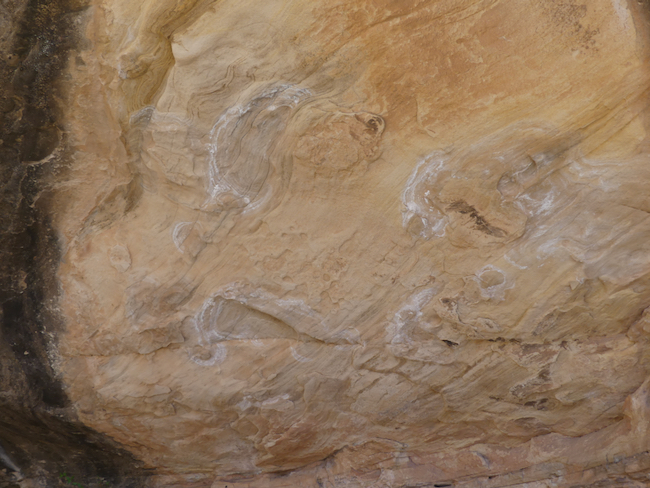
These last two are not with the others. I believe some well-meaning guide has chalked them so that visitors can see the faint traces.

And this is what the Newspaper Rock looks like in total.

We were no longer alone. Visitors from all over the world were coming, looking and photographing.
We drove to the end of the drivable-without-dire-warnings road. The scenery was increasingly arid and bleak, with it’s own terrible beauty. At one point, we were about to hike out to an old dwelling cave, and we looked at each other. It was noon, and signs everywhere were saying “do not hike in the hottest hours” and it was HOT. We drank some water, ate some oranges, got back in the car, reluctant to pass on an adventure, but happy to pass on potential disaster.

There was actually a ranch out here, and this was the last water we saw. It’s still Spring.

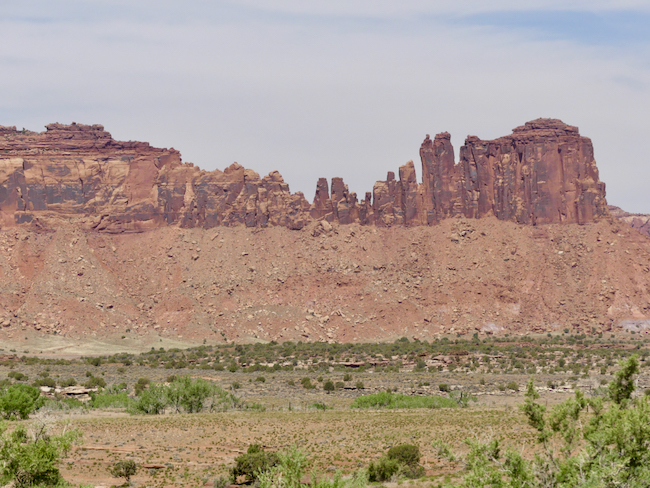


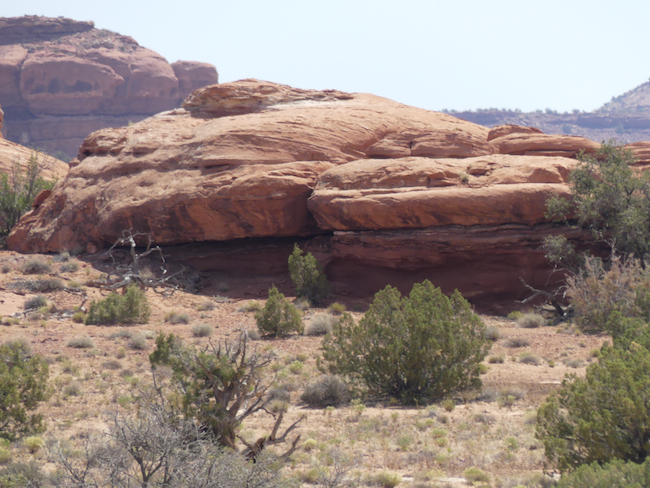
Just a half mile there, and a half mile back . . . we passed.
Chasing Petroglyphs: Tour of the Tilted Rocks
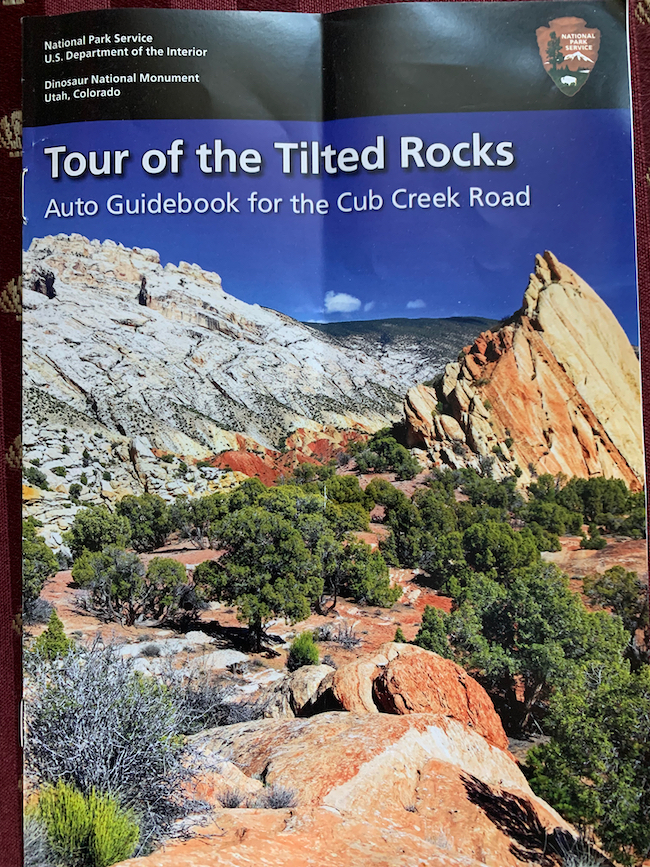
We leave the Wall of Bones to go back to the visitor center to pick up our car and hit The Tour of the Tilted Rocks.

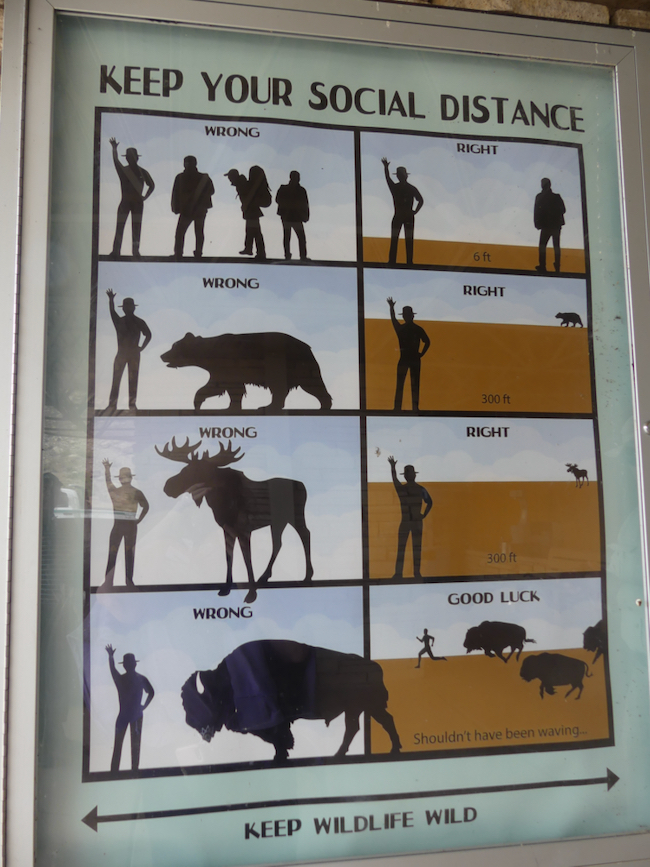
Most of the visitors in this late May time frame seemed to be people in our demographic, 60s and older, people out exploring our country as singles and couples. We saw a couple of groups, and a couple of tours, but most of the people we saw looked a lot like us – retired, with the luxury of time to go exploring.
Most of these people were, like us, physically fit enough to climb the uneven trails, climb a few slippery rocks and hike straight uphill to view the petroglyphs.
Leaving the Quarry Hall “Wall of Bones,” we got into our car for the “Tour of the Tilted Rocks” and spent the next couple of hours engaging with the spectacular scenery, helped along by both the brochure and the frequent guideposts along the way. We visited four separate petroglyph sites and countless sites of geological and paleontological interest.

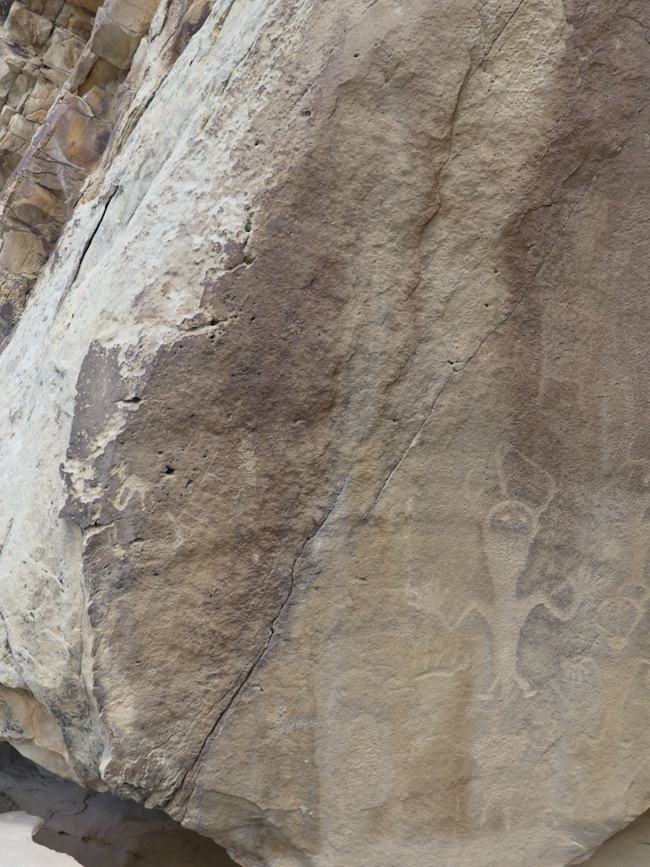

A wealth of petroglyphs! I can see similarities in these glyphs to the Fremont glyphs we saw yesterday, but these are more on the level of scratch sheets, practice for the advanced figures we saw at the McConkie ranch. You can see some elementary necklaces. I overheard in a passing group a person say that square heads are men and more rounded heads are women. I’m not sure that is true, but now I have more to evaluate.

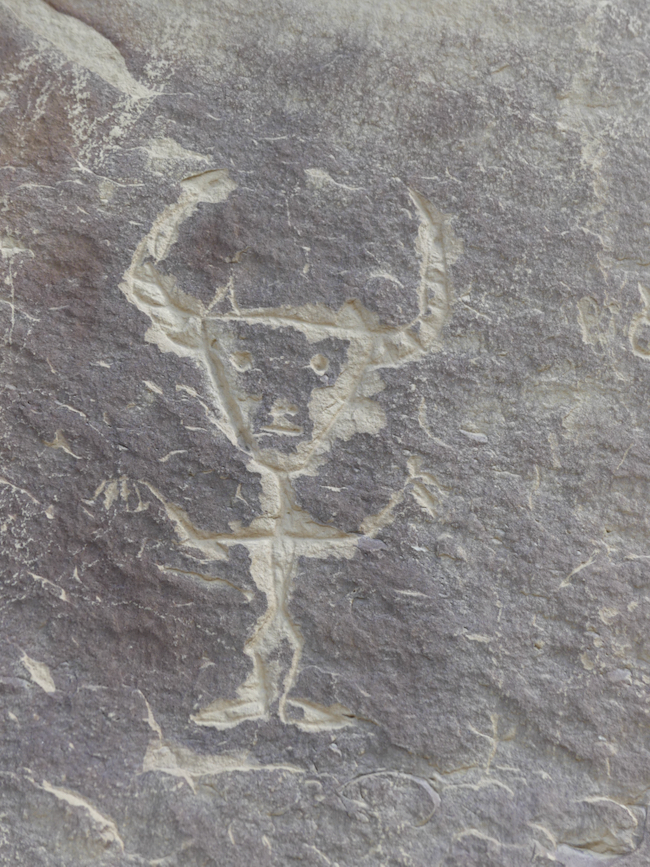


Yet another site; love this . . . headdress? Or is it a jug with flowers – and legs?

The shoulder – waist proportion appears to be still evolving here. I can see a crescent moon and indications that some figures are probably men. Or maybe fertile women, with the moon?
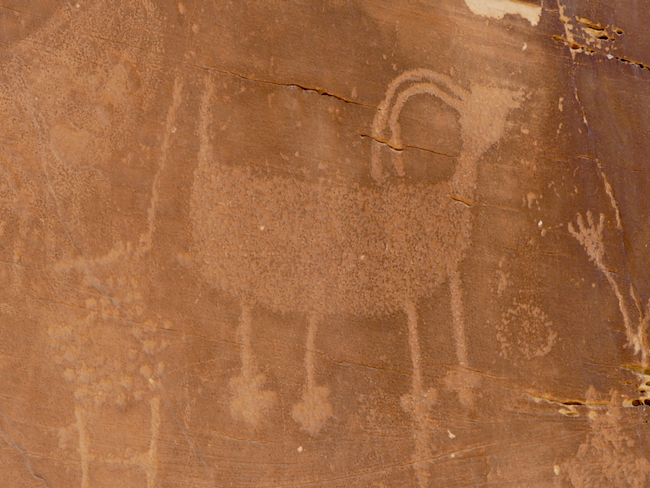


So does the round head mean this is a woman? Her body seems more elaborately patterned than others. She appears to be waving. In some cultures, the spiral indicates long life, but maybe it can also mean a trail of life or a giver of life? More questions than answers 🙂

As the day heats up, these climbs seem more aggressive. We have hats, we have water and the dry heat sucks the moisture out of us.

So, a square head with elaborate patterning, maybe slaying a deer? So no, elaborate patterning is not a female thing.


This site has a lot of lizards

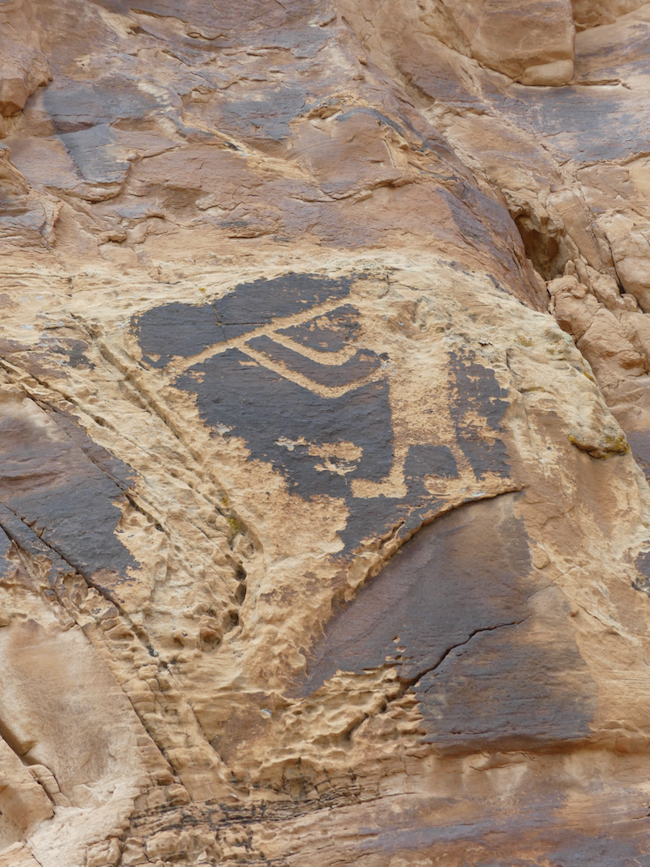


I would love to know what this is about. An altar, with celestial bodies above? I wish I had a clue.
On the way back to Vernal, we had lunch at the Naples Country Cafe. I ordered the Naples Country Breakfast, and thank God for a helpful waitress who asked me what kind of gravy I wanted over it all. I hadn’t read it very carefully, just saw that it had a couple of eggs. She advised me to get the Junior version of it, and I asked for no gravy, no cheese. What arrived at the table was two eggs over easy on a plate full of hash brown potatoes, with a sausage, a slice of bacon and a piece of ham, and two slices of sourdough bread with homemade boysenberry jam. I was picky about what I allowed myself to eat, but I did eat all the jam, on half a slice of bread, because it was so irresistibly delicious.
We got back to our room mid-afternoon to rest or nap a little, and to pack up for our drive tomorrow down to our cabin outside of Moab, Trail’s End at Pack Creek, which we hope will provide four nights of spectacular night sky viewing.
Chasing Petroglyphs: Dinosaur National Monument
I love it when I underestimate an attraction. This is the day we visit the Carnegie Quarry/ Douglass Quarry. I am going to quote from the Dinosaur National Monument Day Trip 5 folder now: The Visitor Center contains a fine bookstore, exhibits explaining the fossils, petroglyphs, and other park features, and information about how to see fossils in the park. The Carnegie Quarry . . . is one of the best Jurassic Period dinosaur finds in the world. Between 1909 and 1924, Paleontologist Earl Douglass discovered 10 species of dinosaurs, twenty complete skeletons and skulls. The Carnegie Quarry and other fossil quarries in the park have greatly advanced the study of dinosaurs. Current research in the park is focused on understanding the ecosystems the dinosaurs lived in, which has resulted in the discovery of new species of dinosaur, salamander, frog, lizard, mammal and plants. By protecting fossils, we can better understand the past. By understanding the past we can better understand the present.

There is so much I find both impressive and moving about this site. First, Douglass discovers this amazing site where an ancient river regularly flooded, killing local species in an early version of climate crisis, the bodies would be stuck in the mud, the mud baked hard, like concrete, and the cycle continues, layer on layer of bones, many with skeletons relatively intact, piled up in this location.
He had the genius to know it was a paleontological gold mine. Workers extracted skeletons that are now in the finest paleontology museums in the world. To me, here is where true vision comes in – Douglass had the vision to preserve an entire partially excavated wall of fossils, to create a beautiful, light-filled building to protect the wall, and to open this wall of fossils to the public, at no charge.
What better way to build public understanding and public support?
We drove to the visitor center, and caught a shuttle, which makes the circuit every 15 minutes. Soon we arrived at the Wall of Bones.
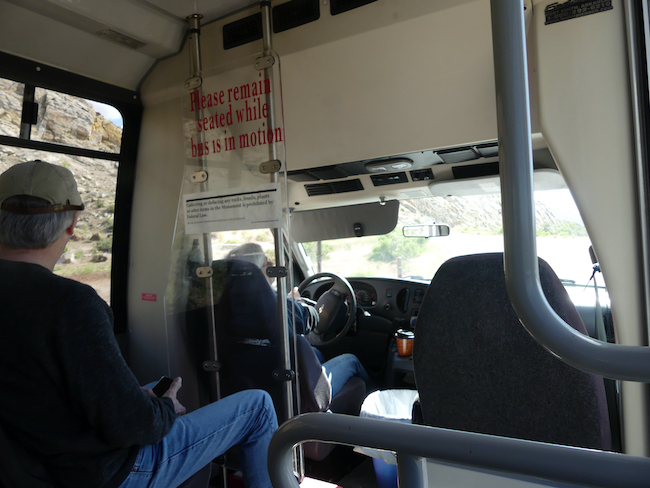
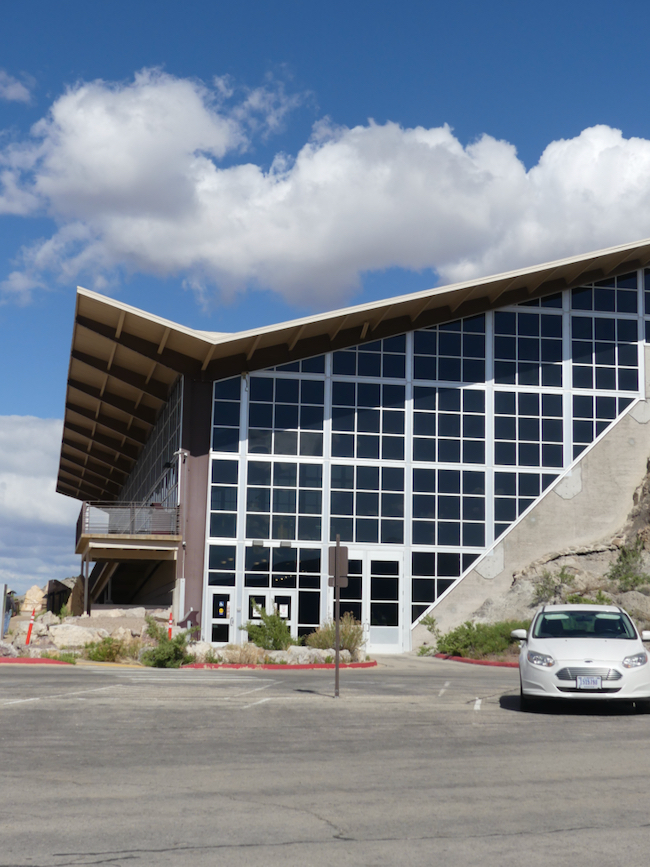


On the upper level, there are interactive stations which will help you identify exactly whose bones you are looking at. It’s amazing stuff.
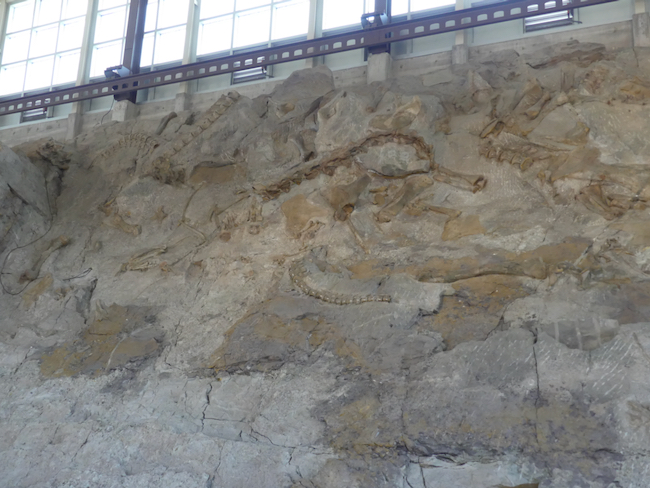

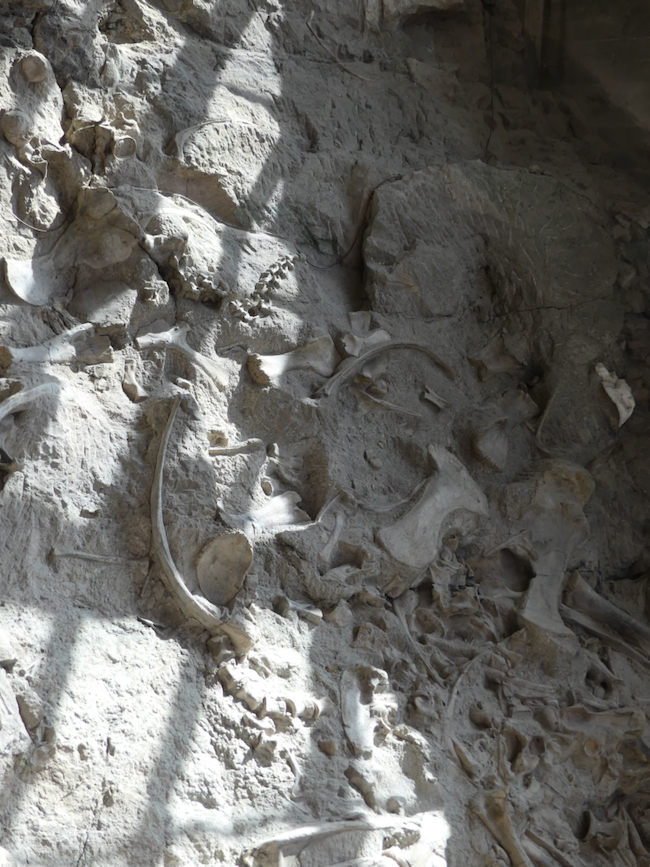


All kinds of informational displays help you understand exactly what you are seeing.


I had never heard of Dinosaur National Monument. I saw it on the map and thought it would be an interesting stop on our way to Moab. I had no idea I would be so blown away by the Fremont Petroglyphs at McConkie Ranch or this Wall of Bones at the Dinosaur National Monument. Life remains a great adventure.
Chasing Petroglyphs, the McConkie Ranch
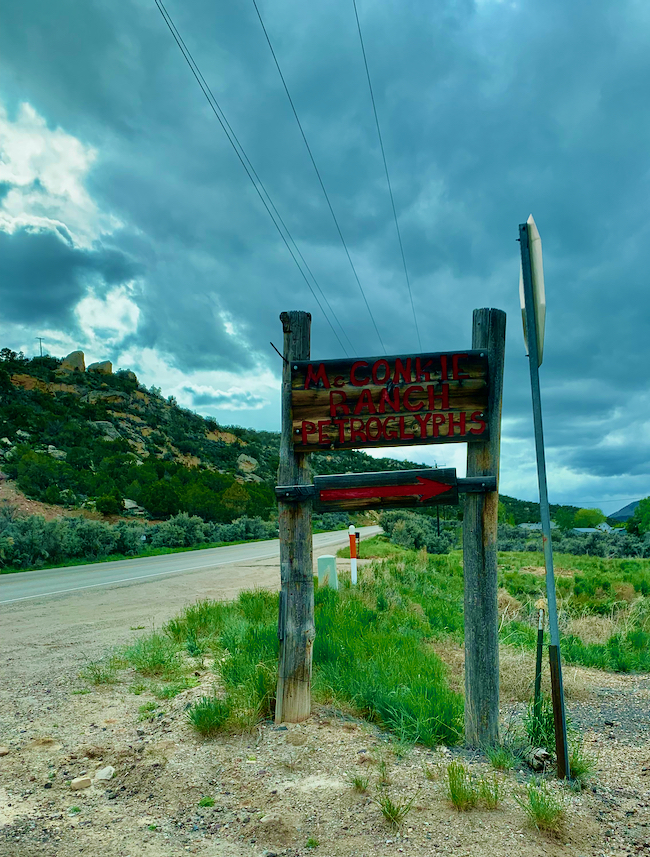
Imagine a ranch at the bottom of a huge long red cliff, a private ranch, which allocates land to public parking and has created a path about a half a mile to the cliffs and then up the cliff itself, to the shelves where the petroglyphs are.
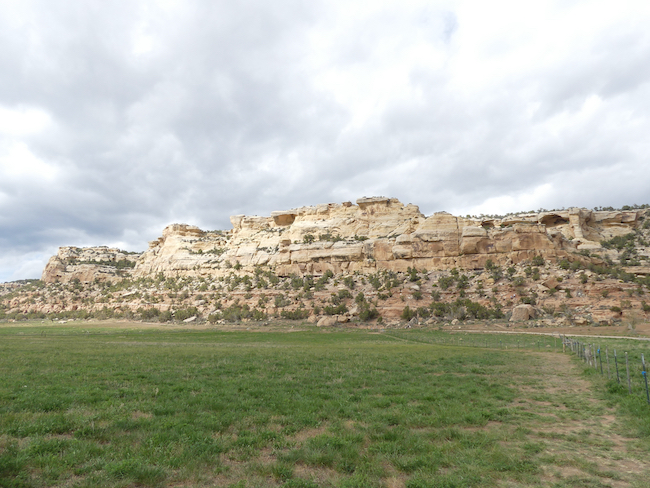
I hope they had volunteers helping, as there were steps and a well-cleared path to help us make the climb. To top it all off, there is no charge. There is a donation box in the parking lot. There is signage, there are marked trails. This is the generosity of the human spirit in action, making these petroglyphs available to those of us who take an interest in them. Not charging us anything, trusting we will donate. Creating paths and a place to park. God bless the McConkies.
We are delighted we can still make this sort of trek. While the path zigzagged, it felt like we were going straight up. In places, we needed to climb up rocks. We were both panting when we reached the top, but oh, it was so worth it. These petroglyphs, were Fremont people petroglyphs, some very simple and dramatic, but many glyphs of people with elaborate necklaces, headdresses (or else they were aliens), and clothing. It was worth every minute of the climb. These are some of the loveliest petroglyphs I have ever seen.

We were very conscious as we climbed that it was dangerous. There were slippery spots, and other places which required some climbing. It isn’t just a matter of fitness, it is also a matter of acclimation to the altitude – AdventureMan and I were both very aware of how vulnerable we are, making these climbs. And we are so exultant when we make it to the top. We can still do this!
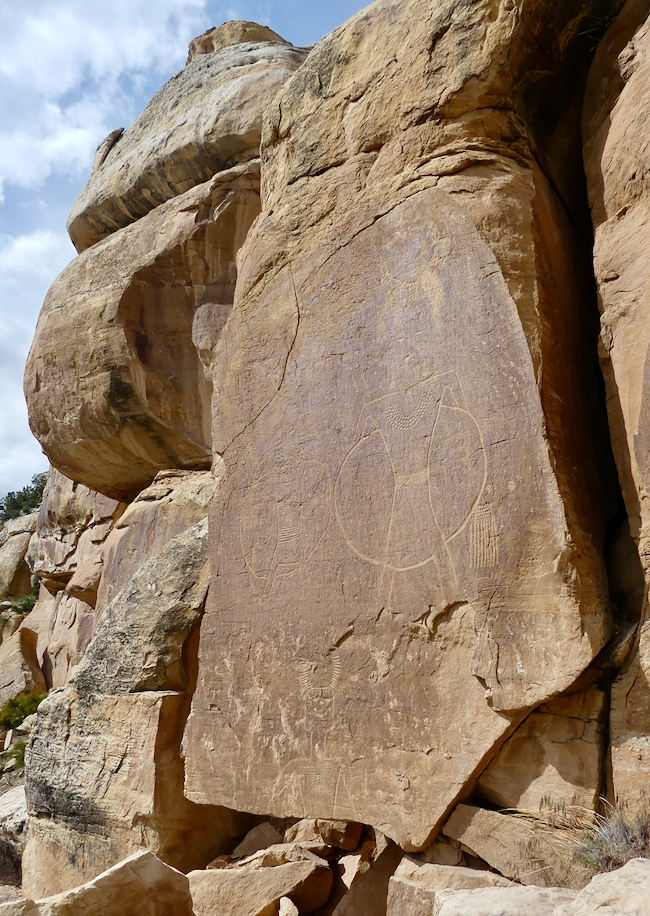
What does it mean that there is a circle around so many of the figures? Does it mean they are living? Does it mean they have moved on to the next life? Is it some kind of ancient hula-hoop? What I love are the bodies, the way these figures are more modern, with wide shoulders narrowing to a smaller waist.
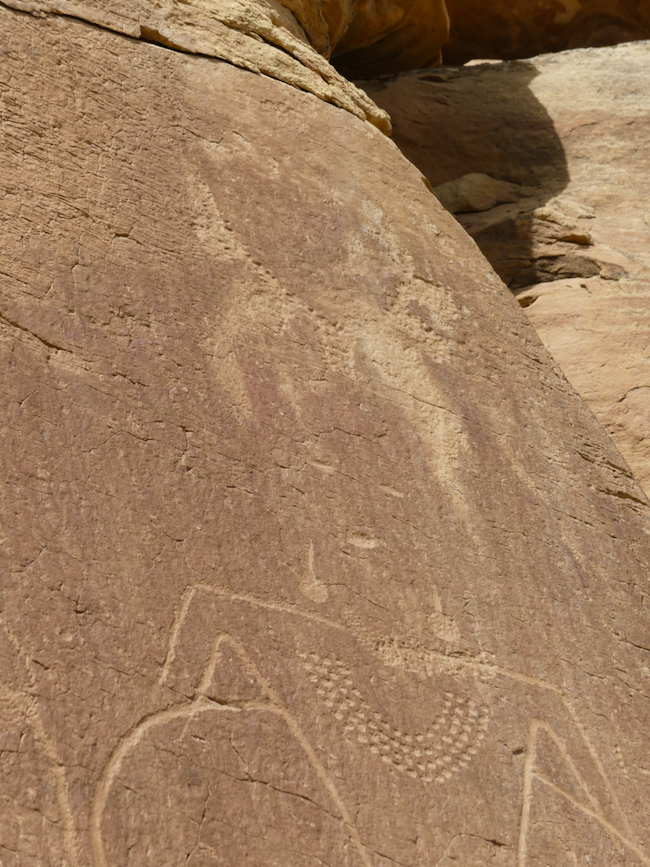
Culturally, we tend to think of people wearing earrings and necklaces as female – are these female? No sign of breasts. Are they warriors? Priests? We don’t know.

A purse? A warrior decoration? A metaphor for seeds and falling rain? This is a fertile field for speculation.

Circles. Ear decorations. Necklace. Eyes and Mouth!

I am fascinated by the creature to the left. Some kind of skirt – corn husks? What would constitute a lower covering with separate strands? Gives a masculine feeling, but shoulders not so broad as the others. (Can you see why we chase petroglyphs? So much mystery!)

Parts are lost as rock cleaves and sheds . . . this head appears square, but what is this decorated halo-like circle around the top of the head? What is in his hand – is that a bell of some kind, with a clapper? The head of an enemy? A space suit helmet?
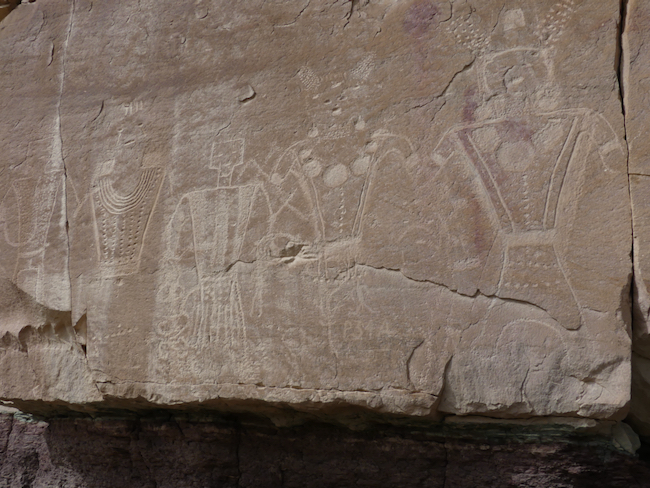
Look – horns! AdventureMan, who loves to yank my chain, says this is clear proof of aliens among us from earliest times, with their space suit and buttons and elaborate decorations.

So many questions. Feathers? What is he holding? What are the extra lines from shoulder to waist? Is that a helmet on his head?

AdventureMan would say that this is proof of jet-propulsion suits. I think it may have more to do with procreation . . . But what about this guy in the lower right, his head is more rounded and he looks like he has antannae?
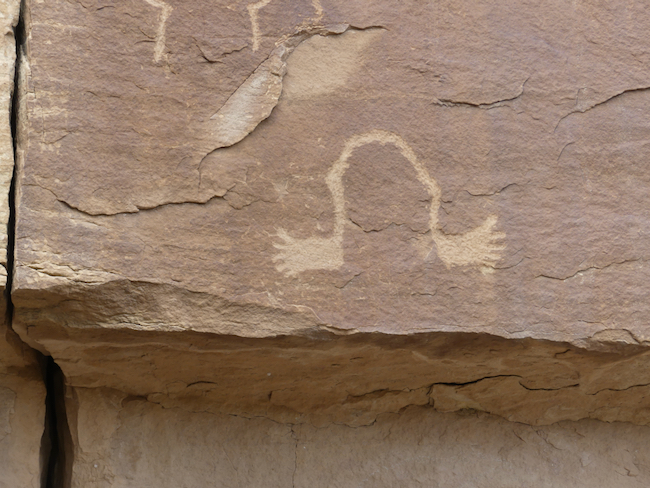
These crack me up. It looks like a scratch-pad to me, practice for something else. But wait – see below – an entire section appears to have been cut away! Where is it? What is missing? I don’t even begin to know where to start looking for answers.

For me, this interlude, at the McConkie Ranch, physically challenging, in the heat of the late afternoon (but what great light for photos!) was one of the highlights of our trip. I look at this work by an ancient people and I marvel.
We have chased petroglyphs in Botswana and Namibia, in Saudi Arabia, in France, and in the United States. None have enchanted me the way these have.
Recent Comments
intlxpatr on Shampoo Ginger tigerbutterya0c5ff1d… on Shampoo Ginger intlxpatr on British Soldier Kidnapped, Esc… John on British Soldier Kidnapped, Esc… intlxpatr on British Soldier Kidnapped, Esc… Wikipedia Donate Button

Amazina


Early Voting in Florida


