Grenada, Spain; One of the Most Beautiful Cities on Earth
Did you know the Spanish word for pomegranate is “grenade?” I didn’t know that either, but pomegranate is one of my favorite fruits. When I was a little girl, my mother would buy me a pomegranate now and again (these were not common where I grew up) because of the legend of Persephone. I was heavy into Greek and Roman mythology and she encouraged my explorations.
Grenada in named for the pomegranates. They grow everywhere in Grenada, and were in full fruit when we visited. After some of the rainy touring days we had, Grenada shone forth in warm sunshine and blue skies with perfect clouds for photo-taking. We toured the town, and then (dramatic pause) (hushed voice) we visited the Alhambra.
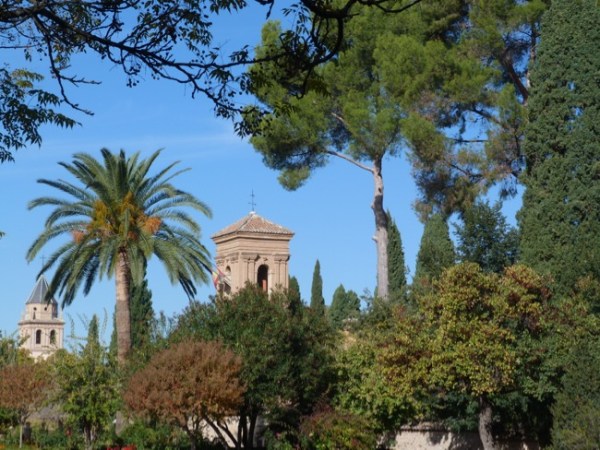
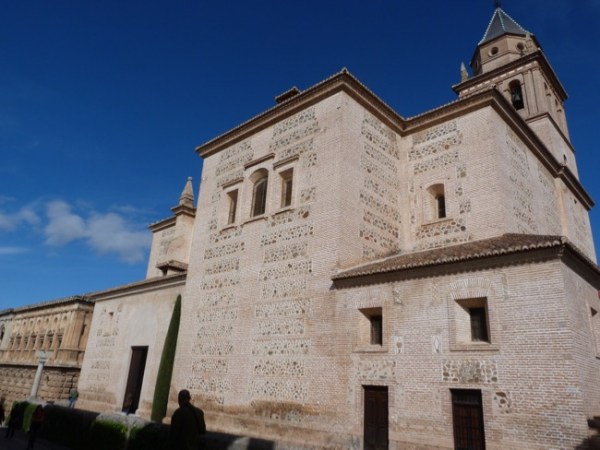
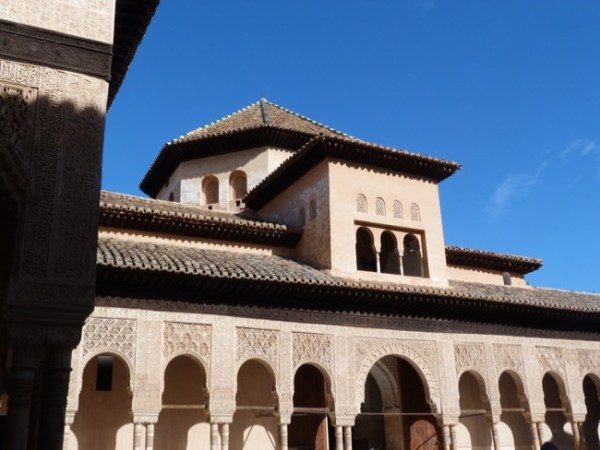
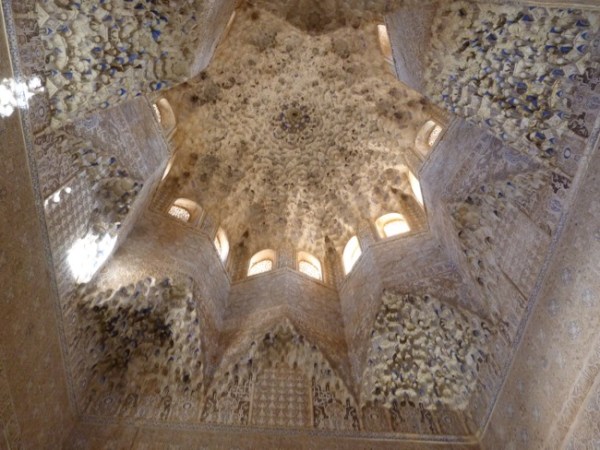
What I have loved about this journey is the intermingling of Arabic in the Spanish; Guadalquivir River “wadi al kebir”, Alhambra “al hamra”, and it really is very red. And it really is very beautiful, so very beautiful in glorious detail. I’m going to bore you with more photos than you ever wished to see because . . . well, I hate to be rude, but . . . it’s my blog. I love each and every photo.

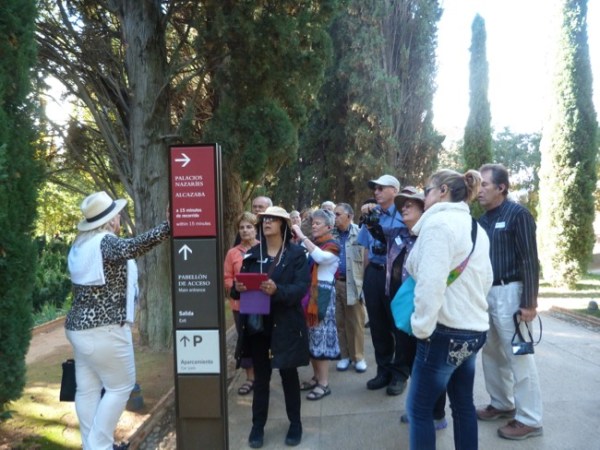
This is our group, gathering around our guide to enter the Alhambra.
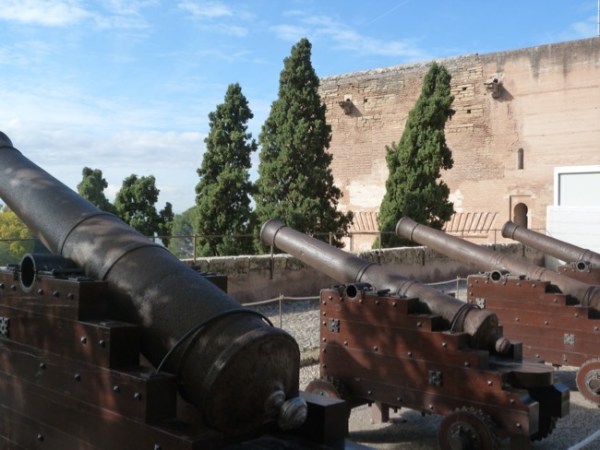
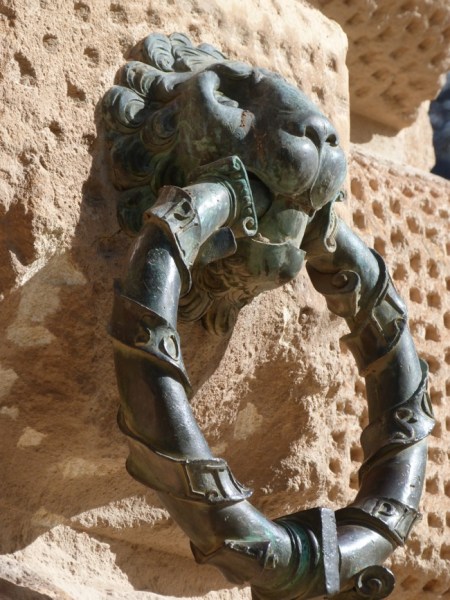

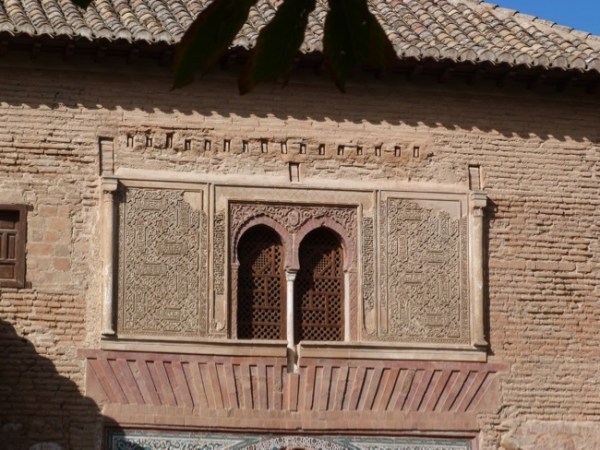


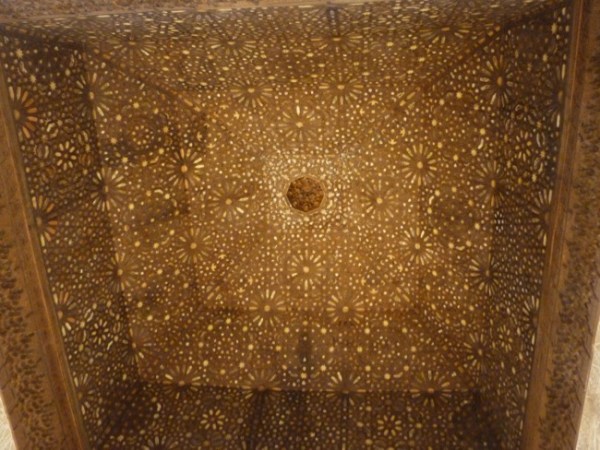


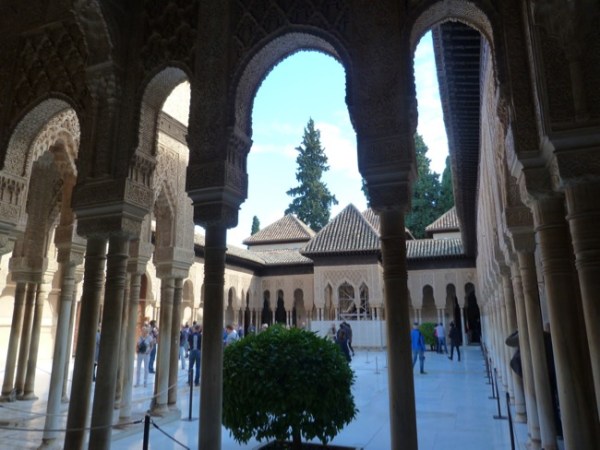
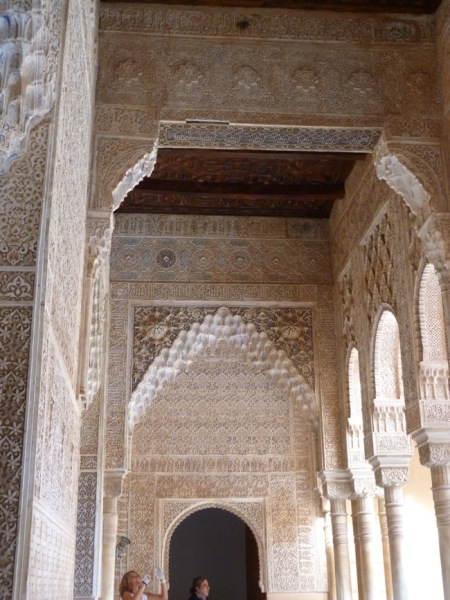
If this were a fabric, I would have a dress made of it. I loved the intricate intersection, and the blending of the blue and cream and brown.

This is my favorite photo, for any number of reasons, cats, light and shadow, intricate tracery on columns, etc. but it is also a reminder of a very strange occurrence. I had just finished taking this shot, hunched down for a low angle, when a young woman in a group of four came along and shoved others, and then me, out of the way. Literally, she took my arm and started to move me and said “we’re taking a group photo now.”
Normally, I tend to defer, but her arrogance, and her disregard for the feeling of others prickled me, and so I pulled my arm away and looked at her cooly, and said “as soon as I am done with my photo, I will move and you can take your shot. Or you can shoot it from another angle.” I don’t know why I did that, I am surprised at myself. I don’t like to cause trouble. But who has the right to shove others out of the way???
That is the memory this photo brings back.

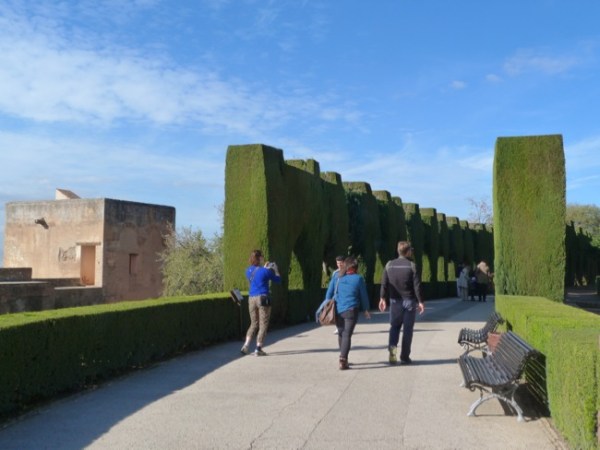
Please look at this photo, not that it is anything special but because there are people in it. I want you to appreciate how really, really, very hard it was to take some of these photos without people in them. I had to wait and wait, sometimes, (gasp!) I even got separated from my group for a short time, in the interest of getting an unimpeded shot. We were there at a lovely time of the year, perfect weather, and we thought there would not be too many tourists. We were astonished, in Seville, in Cordoba, in Grenada just how many tourists there were.


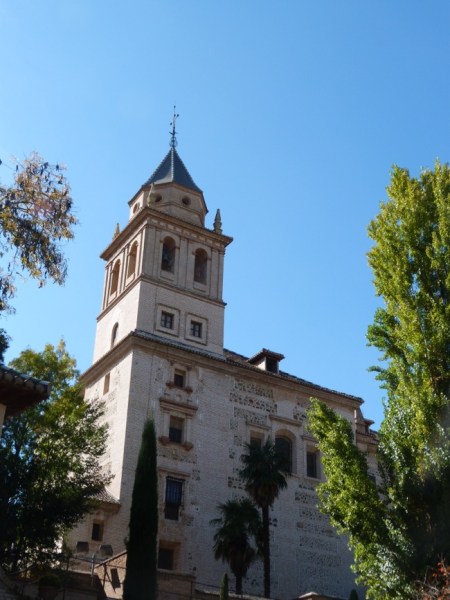
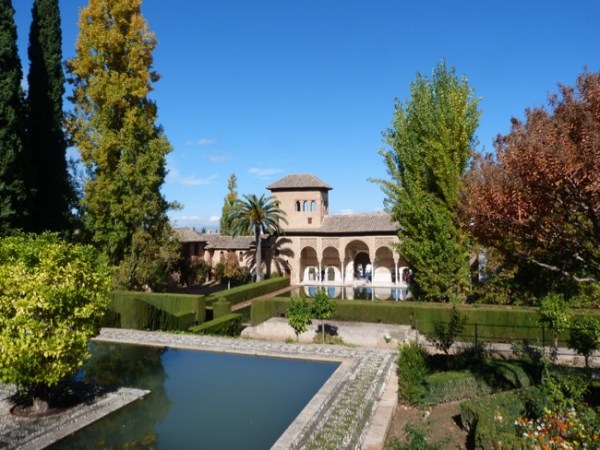
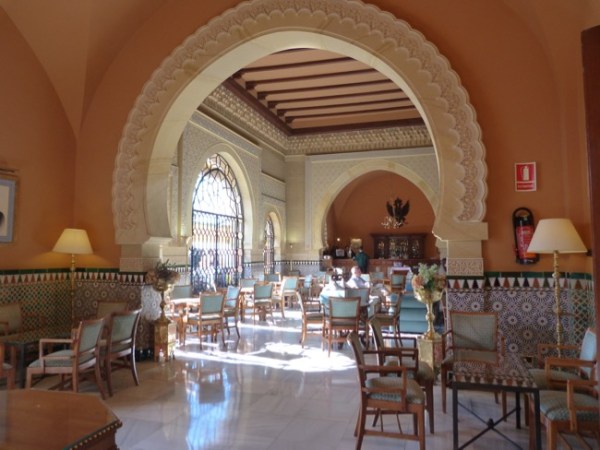
And here is where AHI Travel did something really right. This is the last day of the tour, tomorrow we all disembark and head for the Malaga airport and from there, to places scattered around the world. Just a short walk from the Alhambra is a beautiful hotel, beautifully situated, the Alhambra Palace. We’ve made note of it because we intend to come back to Grenada, and we want to stay in this hotel. This is where we ate lunch.


Our group had a closed in verandah with a beautiful view. Lunch was served in courses, and each was carefully prepared, and delicious. Very very clever way to end the tours on a high note 🙂

The room was beautiful. The table service was beautiful.

The view was beautiful.

After the meal, we got back on the bus to head back for the ship. Once on board, we had a Smithsonian meeting and then another lecture and then dinner, and something happened that has not happened to me for a long time, I had to pack at the last minute. Our suitcases had to be outside our door before we went to bed so they could be loaded to go, very early the next morning, to the airport.
I was coming down with something. I felt hot and feverish, and my nose was running. All my life, I have had nightmares about last minute packing. I hate doing last-minute anything, I am a planner, I like having a certain amount of control over my life, even though it is an illusion, it is an illusion I work hard to maintain. How did this happen to me? How is it that I am packing at the last minute, feverish and anxious?
It all got done. Fortunately, there are a limited number of places you can put things. For some reason, I am not able to download all our boarding passes, so we have only the first ones and will have to get the rest at the airport. I know where my passport is (I never have found the one I lost somewhere in my office) and my tickets and somehow we are finished and all is well by bedtime. I just hate that feeling of being rushed; when I am rushed, I make mistakes.
Every now and then something good happens. There is a huge line in Malaga, but our new friends also have tickets that put us in another line, and we get through quickly, with no problems. We say goodbye, we’ve exchanged e-mail addresses, and we go our separate ways. We have time to relax.
We arrive in Paris barely on time, and it is a Sunday morning with long lines at security, and there is no way out, we have to stand in line. We watch one very elderly man, unsteady, but with a great sense of humor, cope as he has to go through the full-body scan. Even though it is a few days before the bombing, security is tight. The airport is a nightmare. We have no idea where our next gate is, and we are almost running, as it is already our boarding time and we are not there. We have to go down this hall and that, then down to some gate where we catch a bus, then from that bus to somewhere else where we get to our plane with five or ten minutes to spare. That is cutting it way to close for me, but I know by now that I am coming down with one of the world’s worst colds and I sleep all the way from Paris to Atlanta, waking up now and ten to drink some Pomegranate Pizazz with honey to make the cold go away.
Not only does the cold not go away – I very generously shared it with AdventureMan. We both felt so bad we were sleeping all the time and didn’t even notice the jet lag 🙂 so by the time we were well again, we were also sleeping on Pensacola time. As soon as we were well, we got the super-strong flu shots to protect ourselves from anything worse than we’ve just had. 🙂
Tangiers!
We’ve never been to Tangiers before, and although we have had a couple sprinkles, it looks as though we may have a great day to see Tangiers. Tonight is our next-to-last night on board, we are meeting friends for dinner tonight in the big dining room where they are serving duck (!) and life is sweet.
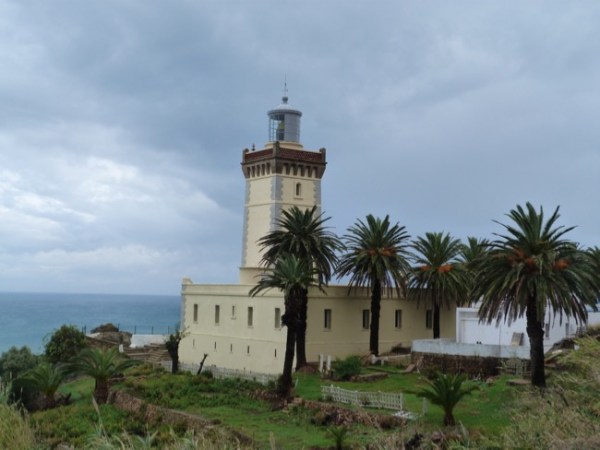
We start with a drive through Tangiers, on our way out to The Pillars of Hercules and Cap Spartel, where the Atlantic Ocean crashes into the Mediterranean Sea.
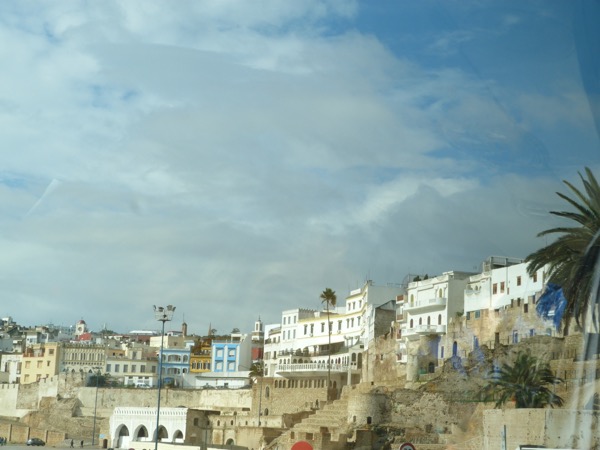


Pillars of Hercules

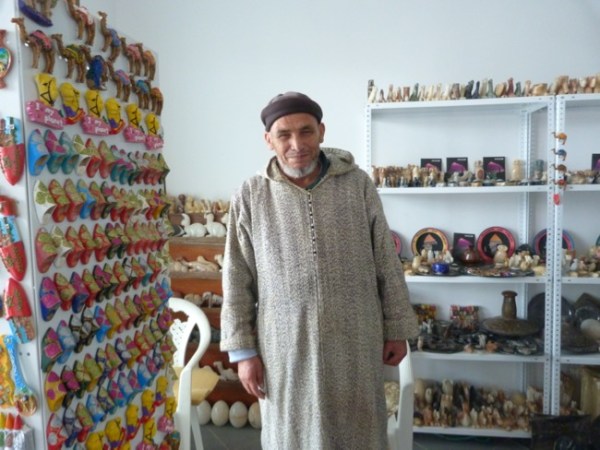



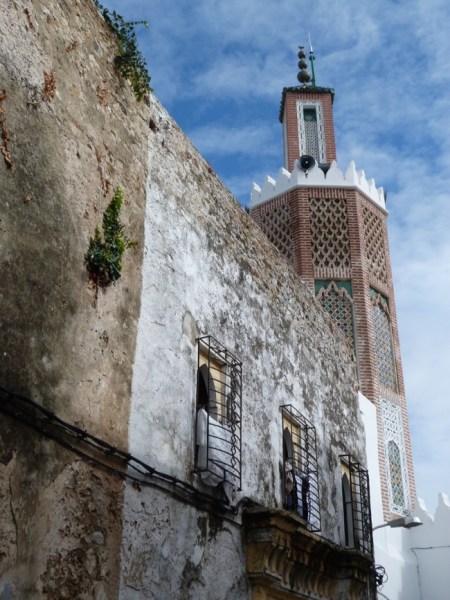

This shop was really special to me; I found a pair of hand made silver earrings for my daughter-in-law. I only had 270 Moroccan Dirhams on me, and the earrings were D540. The store-keeper said 270 was impossible, surely I had dollars or euros to make up the difference? Yes, but I really wanted those earrings for 270 Dirhams. So I walked away, walked back up the street to the store where the guide had taken the Smithsonian group, and then, ten minutes later, we were following the guide back past this shop and I heard a voice calling loudly “Madame! Madame! I want you to have the earrings!” and I said “But I only have 270 Dirhams and we are going now!” and she said “Take them, take them!” and I stuck them in my purse and quickly paid her and that was that. They are beautiful earrings 🙂
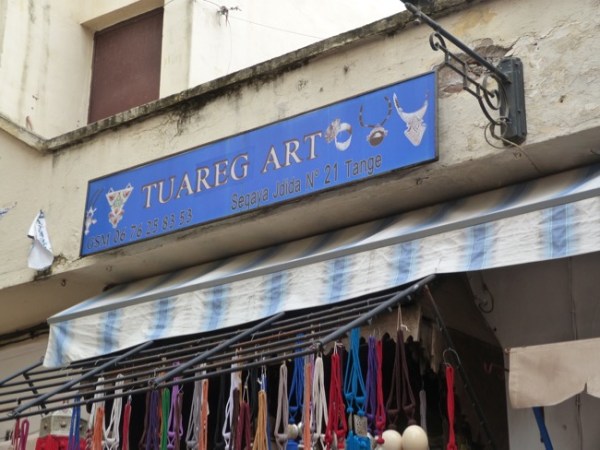


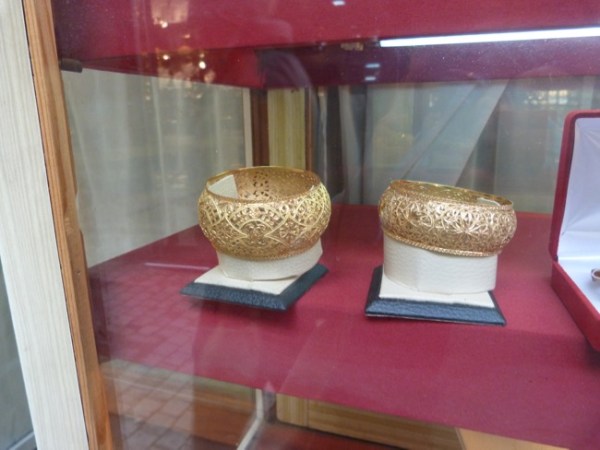
The only little gold shop we passed our entire tour in Morocco:

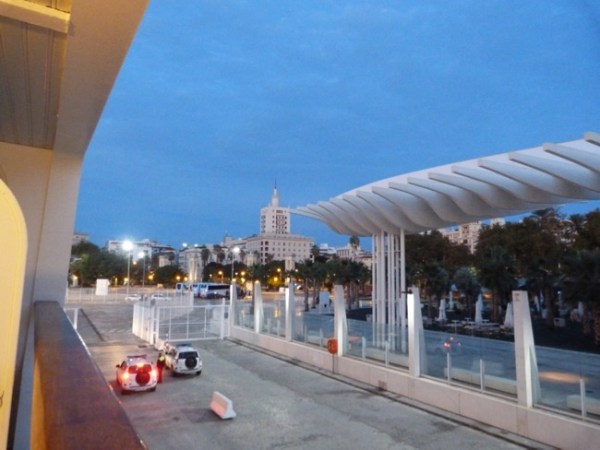
The American legation. Interesting, the tour was supposed to be over, but our Smithsonian guide said we were supposed to see this, and the guide didn’t want to take us there, but the Smithsonian guy insisted. So then we went through what I call the “real” souks, where instead of all the hawkers, there are real people buying food and clothing and daily necessities. If the Smithsonian guide hadn’t insisted, we would have missed a really cool part of Tangiers.


This is the view from our cabin of Tangiers. It was beautiful.
Fez and On to Tangiers
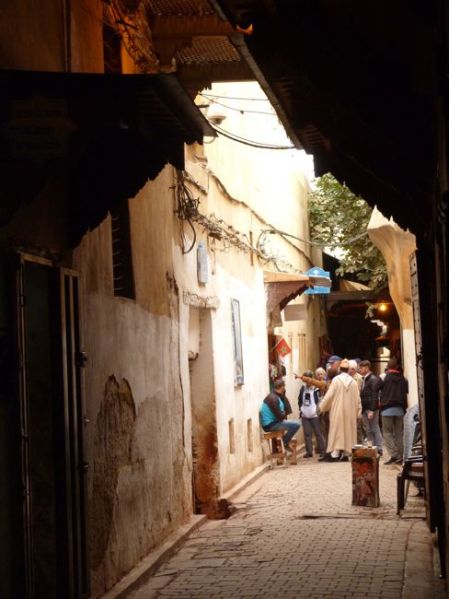
We walked a thousand miles today, or so it seems, through the narrow streets of Fez. There was no going off on our own; Fez is complicated. The last time we were here, we hired a private guide who could take us through the souks and to other sites in Fez. This time, we were 40 people following a sign held up saying “Turquoise.”
I was behind an otherwise perfectly nice man who was using an i-Pad to take photos. As we went through the narrow streets with bread bakers, cookie sellers, date sellers, etc. from time to time he would stop, totally blocking traffic, and take his photo, and then start again. There were places he could step out of line and take a photo, but he evidently didn’t want to give up his place in the long narrow line. For the first fifteen or twenty times he did it, I just wanted to clobber him, then I found a way to get ahead of him and it was no longer my problem.
The leather dying souks that were so colorful and stinky were closed for remodeling! Whoda thunk it?


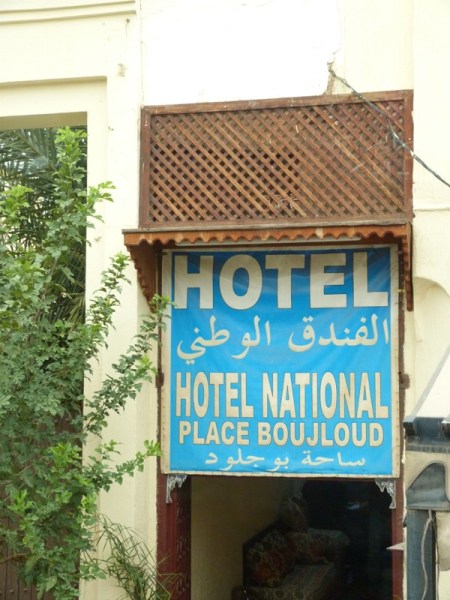
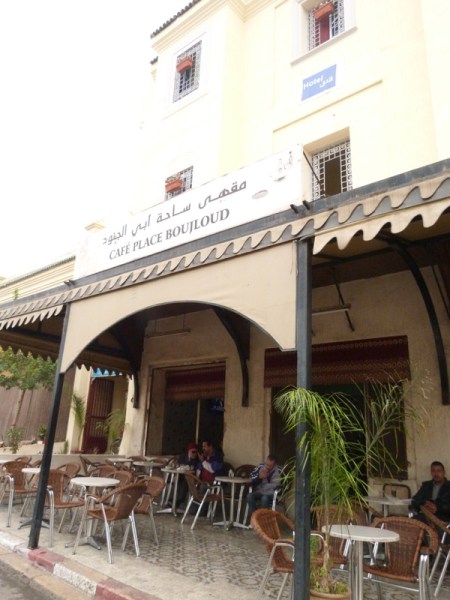
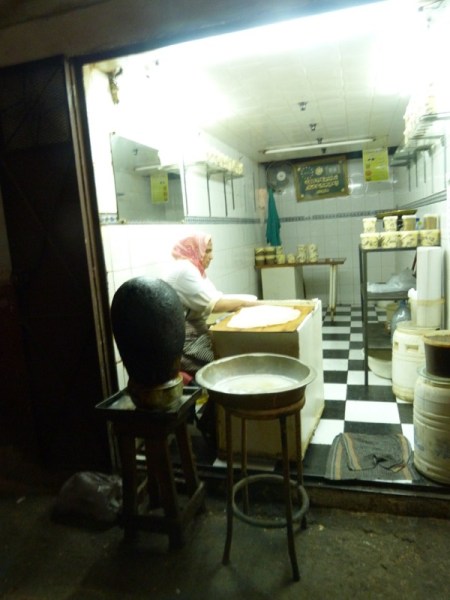
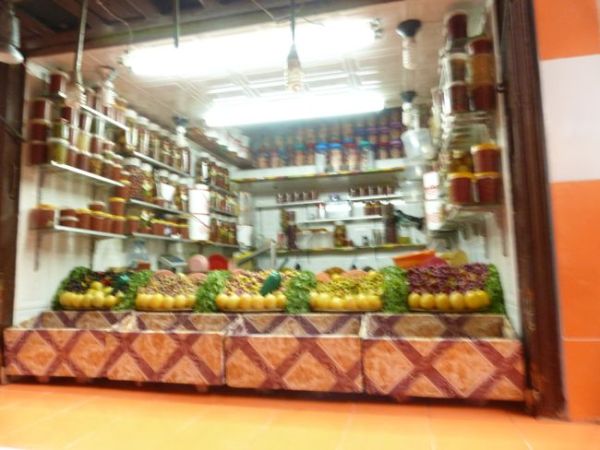
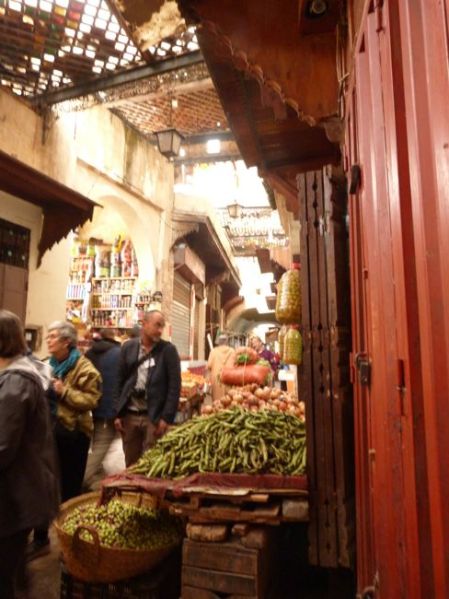


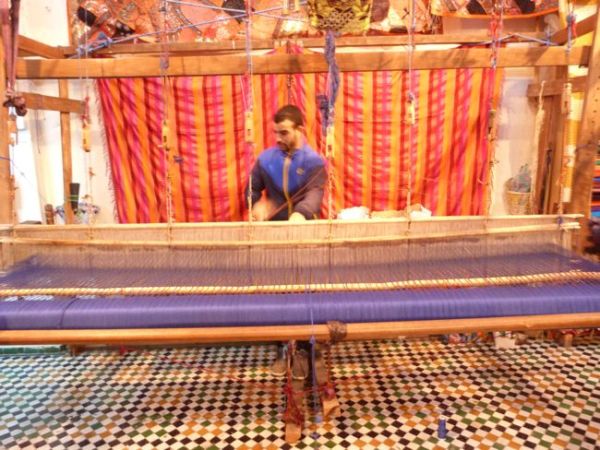
My first shopping on the trip; a silk weaving factory, and the colors are irresistible!


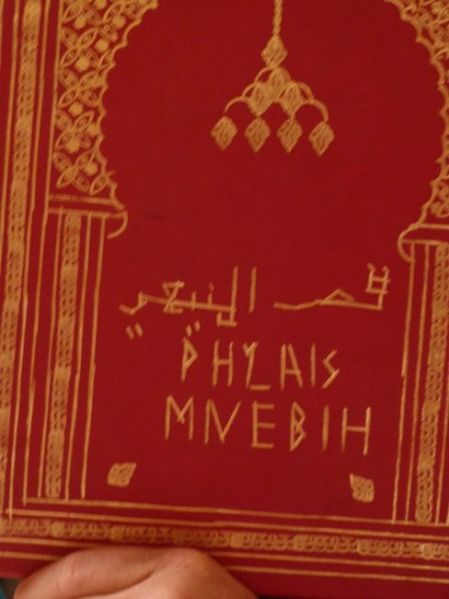
Another group dining experience, a lovely space, sort-of Moroccan food, Palais Mnebih feeds hundreds in a short time.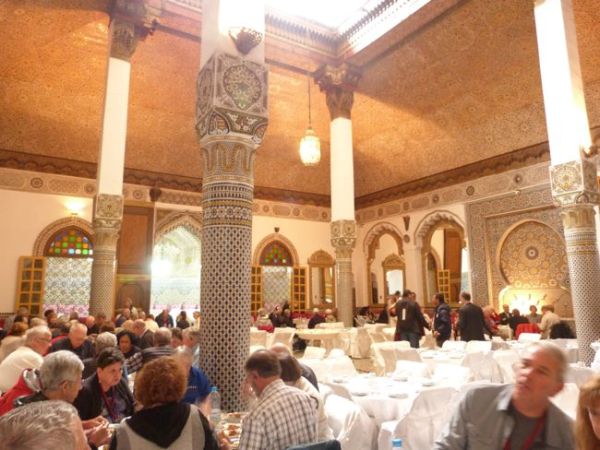



And on to Tangiers, where our ship is waiting for us at the dock!

Rabat and Volubilis, On the Road in Morocco
Somehow the scheduled departure this morning is delayed due to problems getting the buses to the ship, and some sort of negotiations are going on. We leave for Rabat, getting there late morning, and it is pouring. We start at a Marinid Site, Chellah, and I walk down and take photos, listening to the guide, getting wetter and wetter, and then I think “Hmmm, I don’t really care that much” and head back up hill to the nice, dry bus.
I like taking photos, but trying to take photos with rain rain rain is not so easy. This is an overview of a structure at Chella, and if you look closely, you will see a stork on the top of the tower on the left. This site is covered in storks! I had to wonder, what makes this site so attractive to storks, and the guide said they had been coming here forever.
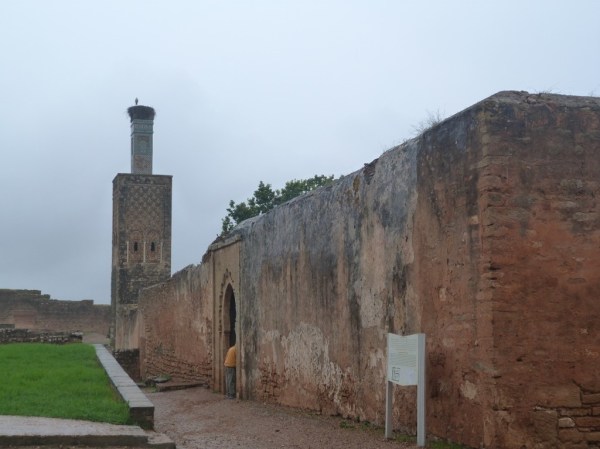


This marabout must be for a woman; it has a green door:

We go to visit a mosque that never got built, and another mosque that someone built for some reason, and I don’t have any photos because it was POURING rain and I just stayed on the bus and read my book. Around noonish, we headed for the Golden Tulip, another place that is feeding hundreds, buffet style, forgettable food.


We make a photo stop at the Kasbah of the Udayas

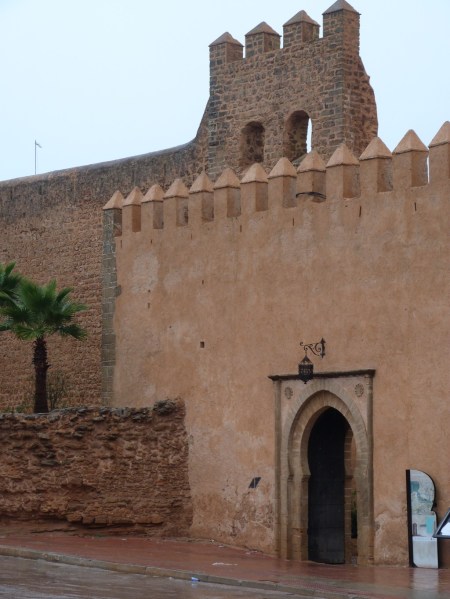
And then a photo stop at the Udaya Gate


We are in a bit of a rush; we want to get to Volubilis, an ancient Roman site, before the sun goes down. When we get there, it is raining, and slick, and the sun is going down.


It is very beautiful, and every time we have come here, to Volubilis, it has rained. AdventureMan liked this stop a lot more than I did.
El Jadida and Casablanca, Morocco
As we leave Marrakesh, I tell AdventureMan that we could easily drive here, and that gas prices are really good:

And AdventureMan reminds me that it is not the price per gallon, but the price per liter. Oh. That’s very different. The Moroccan countryside on our drive to El Jadida reminds me of Tunisia back in the late 1970’s when we lived there, full of little marabouts, or burial places of people who lived saintly lives. The guide explained if it is white, it is a man’s grave, if it has green or blue, it is a woman.

Market days along the route:
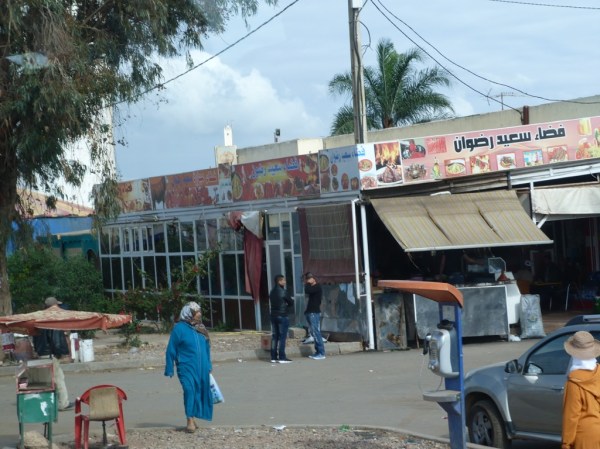


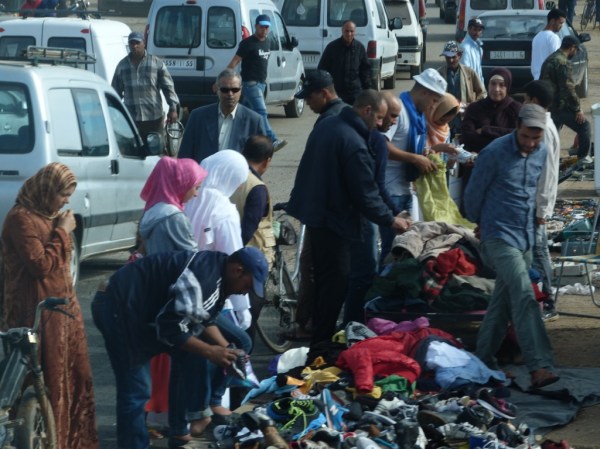

We reach El Jadida, where we are visiting an old Portuguese cistern. It turns out to be very beautiful. It also starts raining cats and dogs, making it very hard to take a good photo in any unsheltered place. The rain is really coming down! We are soaked!
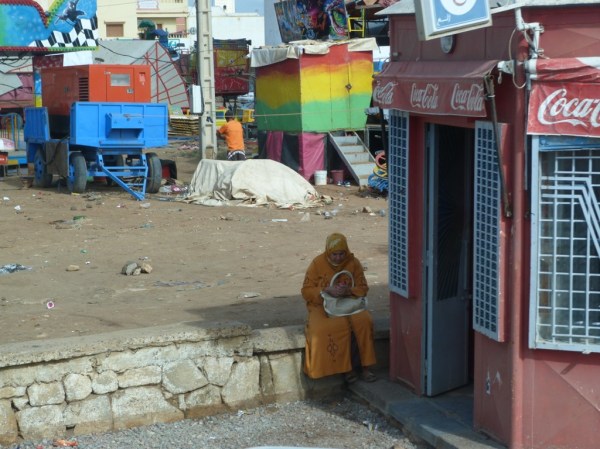

Those are not blue skies; those are cloudy grey skies!
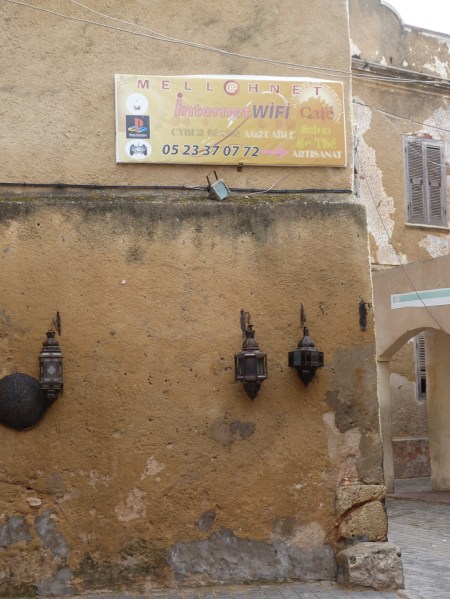
Light fixtures 🙂


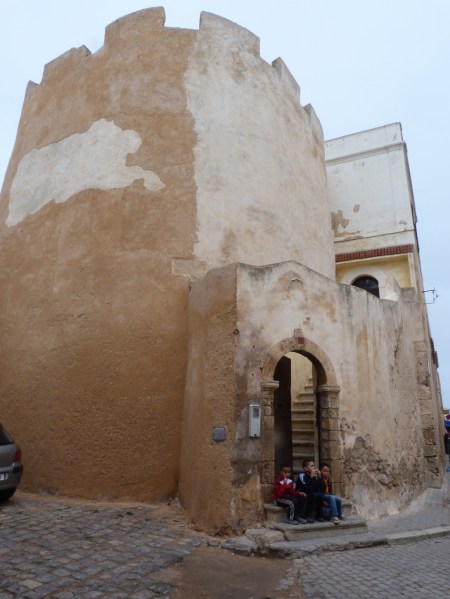
The old ramparts of the Portuguese fort:

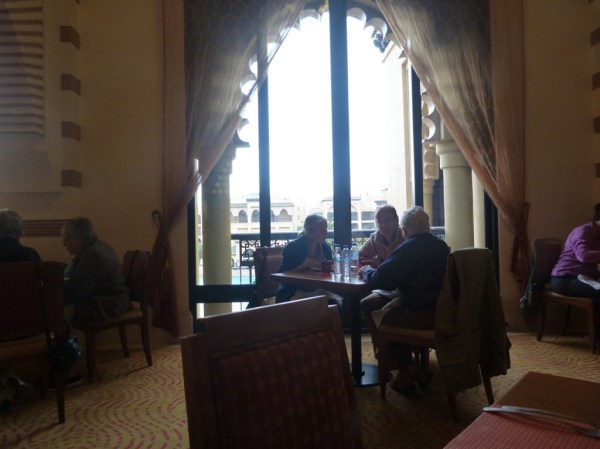
We stopped at a huge place where, once again, they were set up to serve groups. There must have been 500 – 600 people serving themselves. I saw ONE Moroccan dish. There were several Chinese dishes, an entire section of Italian entrees, all in all, a very bland selection of “international foods” which means you can find something to eat, but it won’t taste all that great. It is engineered to be nourishing and inoffensive. There were many many kinds of desserts, in tiny portions. This was a very not-special kind of place to eat.

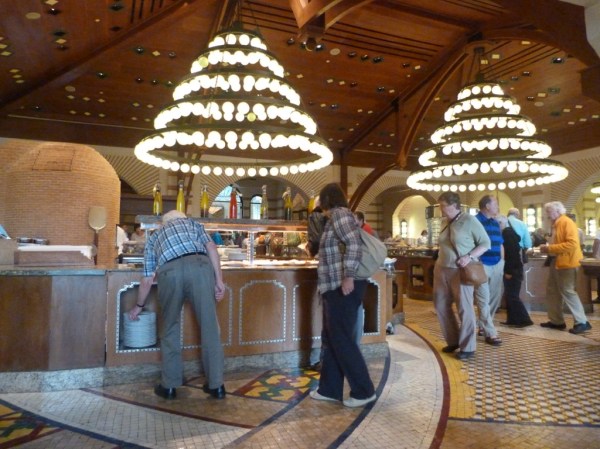


The entry was built to be impressive:
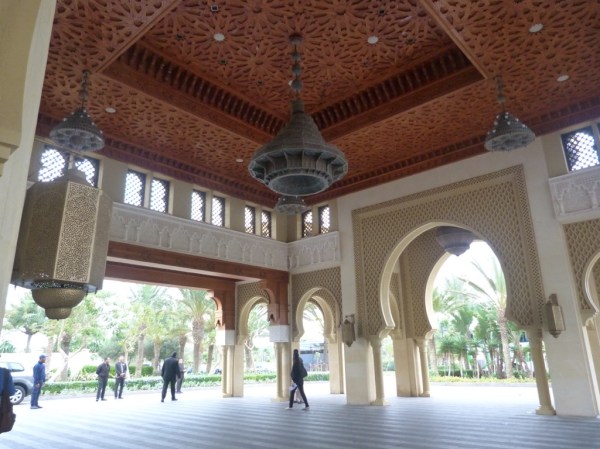
We were very close to Casablanca, and made a trip along the coastline to see one of the largest mosques in the world, the Hassan II mosque.

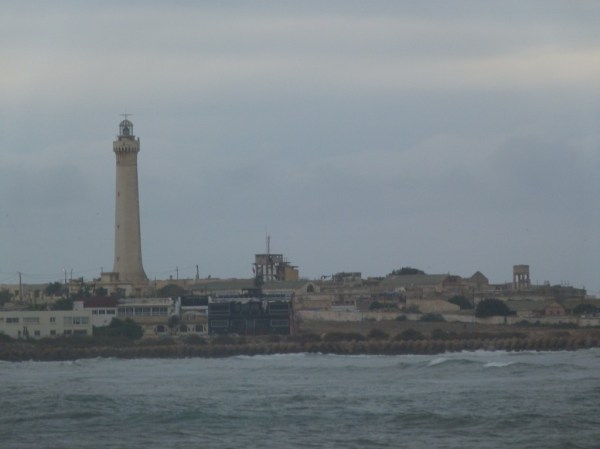

We made a brief stop so everyone could photograph “Rick’s Cafe.” which never existed except in the movie, but now has a restaurant of that name, in Casablanca, and draws in a lot of people who saw the movie.

Hotel Le Meridian N’Fis in Marrakesh
I can be a pain in the neck when I don’t get my way. When we booked, we had been told our room would be at the Sofitel Marrakech, and I was excited. When we got our final package, we found we were going to the Meridian N’Fis, not the same kind of hotel at all.
“Oh, but it is one of the finest rooms!” we were assured, and they explained that it just was too cumbersome to have some of the guests in one hotel and some in another. Umm. OK.
We hopped in a cab from the Jamaa El-Fna; it was easy. The cab ride cost a dollar. We could have walked, but we didn’t know where the hotel was, and it was maybe a mile away. Our guide had called and said we would be arriving separately (our guide, Antonio, was superb) so they were expecting us. They gave us an orientation, and showed us to our room.
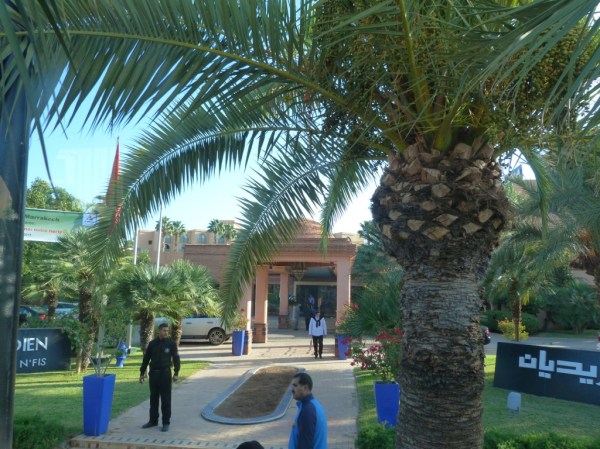
Entrance to the hotel:
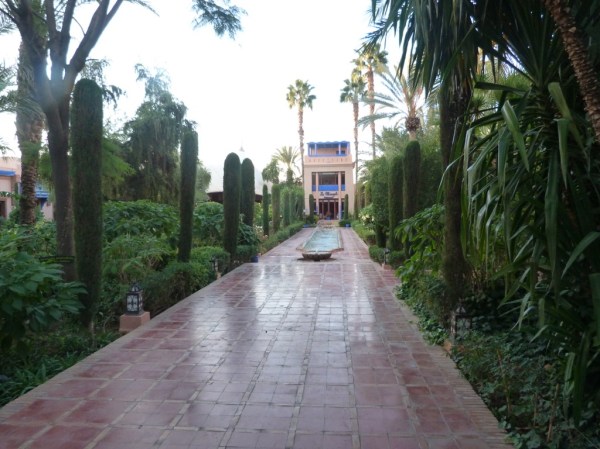
Passage to our room:

Gardens and pool:

Gorgeous serene spa:

Lovely seating areas:

Hallway to bar, lounge and restaurant:

You can see, it is a lovely hotel, modern, clean, has some atmosphere. Here is our room. It is spacious, the bathroom is large, and we have our own sitting area with complimentary wine and fruit, and our own patio outside. It’s lovely.
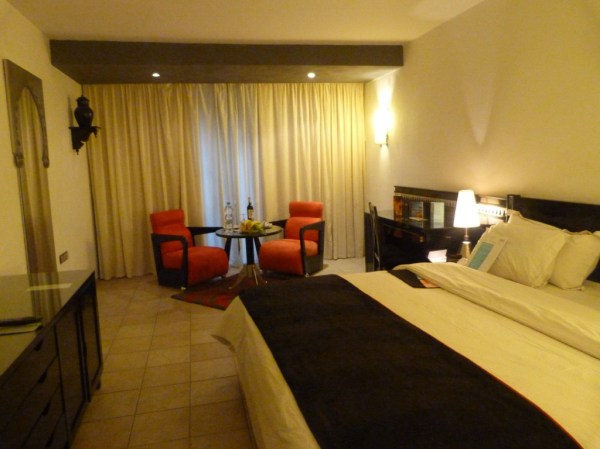

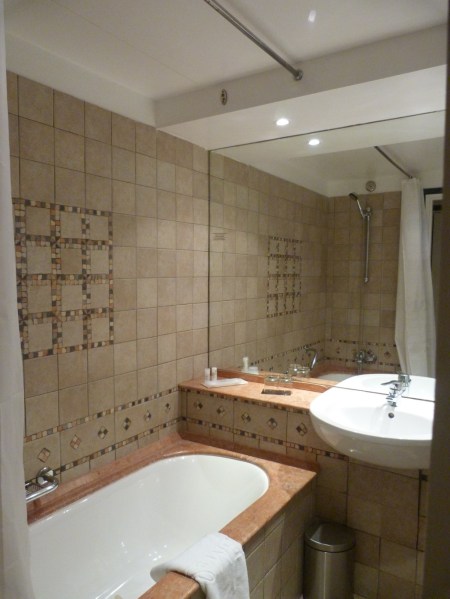
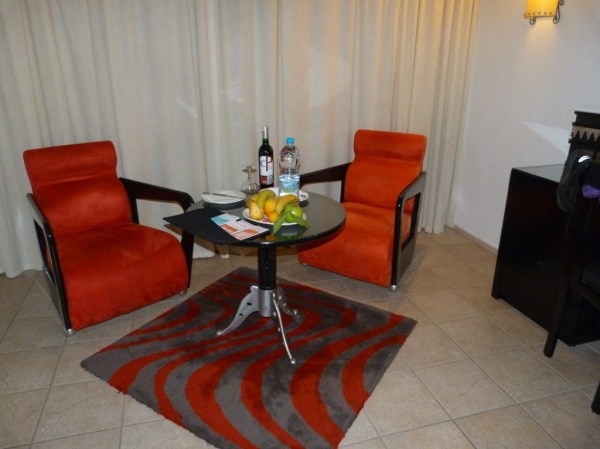

You can see it is very modern and very clean. We also discovered it is across from a mall, which, when we visited, reminded us greatly of Qatar and Kuwait, and we wondered if Gulf money was invested in creating the mall. It had a Carrefour, and many modern stores. It was fun wandering around with the Moroccan shoppers. The hotel is only a short distance from the oldest and newest shopping areas in town.
I tried to be a good sport. (I am betting AdventureMan would roll his eyes; I was quiet, and disappointed, and not very happy.) I would never stay here in a million years if I were not part of a group. It is western. It is Morocco-lite. I remember with great nostalgia the homey hotel we stayed in years ago, with its wonderful tiny restaurant and genuine food, tiled walls and beautifully worked wood and I wish we were staying somewhere “more Moroccan.”
The bed is wonderful. The bath is wonderful. The promised Wi-Fi is non-existent.
We had a “garden” view. I asked the conceirge where the rooms were that had the view of the Atlas mountains, and he said only a few rooms, at the top of the hotel had a view, and only on a very clear day. It must have been these rooms:

The food in the dining room is pretty good. In fact, we ate pretty well. Breakfast featured one woman making thin, flaky Moroccan pastries, worth waiting in line for.
As we left the hotel for El Jadida, there were souvenir vendors at the bus. Our fellow travelers who had stayed with the group were a little shopping-starved, and these vendors did great business. The prices seemed reasonable, too, as shoppers snapped up silver bangles, earrings, clothing and shawls. As the buses began to pull out, the most popular vendor hopped on her motorcycle to head for the next stop. I admired her entrepreneurship.

On Our Own in the Souks of Marrakesh and the Jemaa el-Fna
Free at last!
We are as giddy as children let out of school as the groups head left and we head right, going deeper into our favorite territory, the souks (small shops) in the great city of Marrakesh.
Before we ever went to Marrakesh, many years ago, we read a book by Elizabeth Warnock Fernea, author of Guests of the Sheikh, called A Street in Marrakesh, talking about how her family lived in the center of Marrakesh, among Moroccans, and the adjustments they made as they grew to learn more about their environment. You know how you can read a book and feel like you had lived it? We felt we had lived in Marrakesh.
When we visited with our son, we had a car and were driving all through Morocco. We had left Ouazazarte and driven over the Atlas Mountains, stopping here and there to buy fossils and “thunderballs” which are also called geodes. It was late, and dark when we got to Marrakesh, and we had to stop and ask directions at a gas station how to find our hotel. We knew we were near, and we didn’t know how to close the distance. This was before smart phones and Google Maps.
Our son and I watched AdventureMan from the car, and as we watched him ask the two men working there, one pointed left and one pointed right. We were dying laughing. And, actually, both were right, there was an obstacle between us and the hotel and you could go right – or you could go left. At that moment, a motorcycle drove up, listened to the question and offered to guide us to our hotel. This is the essence of Morocco to us; the kindness and the hospitality of the Moroccans.
I wish I could remember the name of the hotel, but our room was huge, and full of tile work. Our son had his own area, on a separate level in the same room, and his own TV. It was a far cry from a sterile, modern hotel; this was full of color and detail, tile and wood work.
The next day, we hired a private guide for a tour of Marrakesh, and had a wonderful time exploring all kinds of wonderful places.
So now, off we go, and the smells and the feel of the souks almost make us giddy; we are back in our element.
As we wander, we can hear roosters crowing, and, in the middle of the souks, we find a souk devoted to roosters. It is the middle of the afternoon, a quiet time of day, perfect for wandering.
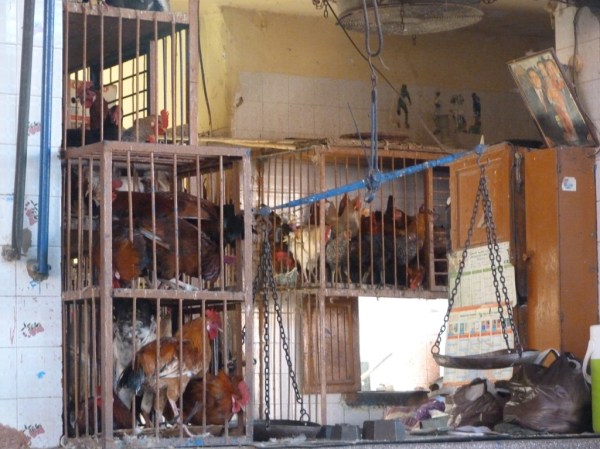
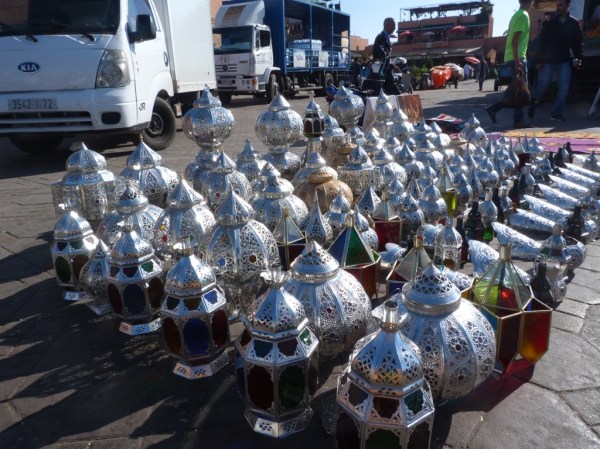
Me and my attraction to light fixtures 🙂
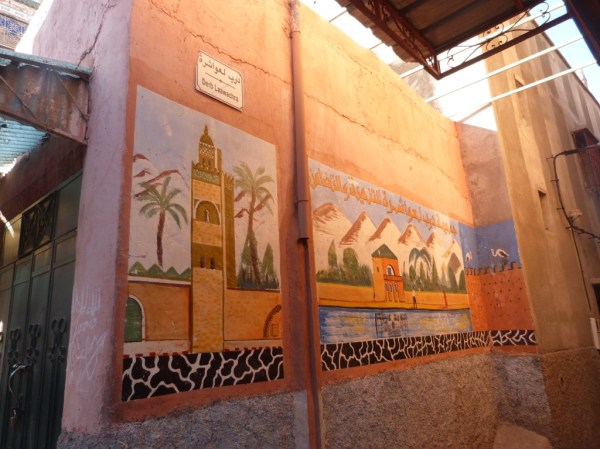
A mural of the Koutoubia mosque; one of the reasons we felt so secure in this souk is that if you get lost, you just look for the highest tower around, and that is the Koutoubia mosque, which takes you to Jemaa el-Fna.


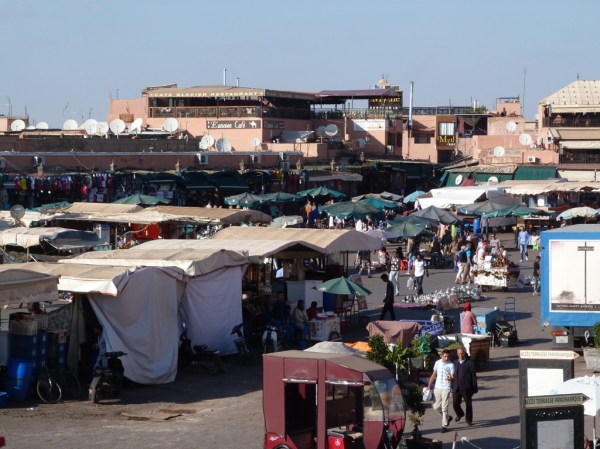
We walked to our content, and then settled in at late afternoon to a cafe with a terrace high over the Jemaa el-Fna, where we had our choice of tables and could watch the market come to life. As we sipped our mint tea, the other tables filled; Moroccan families, tourist couples, assorted characters. The day is gorgeous, we have a shaded location, life is sweet. We’ve soaked in the sights and the smells. We’ve done more than our 10,000 steps. We enjoyed this afternoon immensely.




Dining in the Dar Es Salaam, Marrakech

We have driven a couple hours to get from Casablanca to Marrakech, and the bus lets us off just a short walk from the restaurant, the Dar Es Salaam. I don’t believe this restaurant is open to the public; I believe this restaurant is a dedicated group-tours service restaurant.
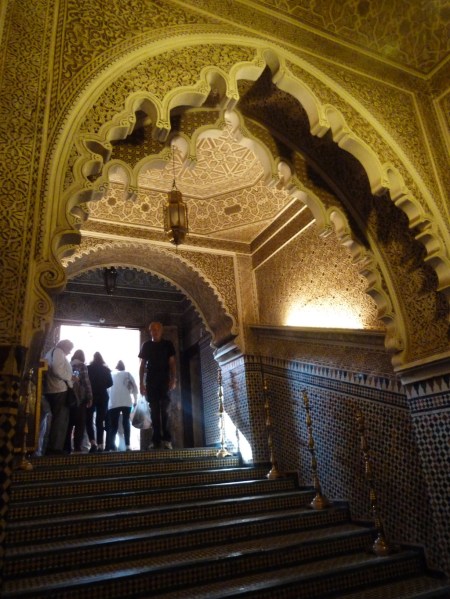
I admire what they do. They have a lovely venue, it looks like it might have been one of the grand old homes in the city, or even an old mosque. It has elaborate decorations, and lovely spaces. Whatever it was at one time, it has been gutted, and turned into a restaurant that can seat and feed many many people in a very short amount of time.

Those are not leftover bread crumbs on the table, they are rose petals to welcome groups.


Tables were marked with signs indicating Smithsonian and/or Purple, and as soon as eight people were seated around a table, service began, first hot towels, then water and small appetizers/mezze. They were pretty good. Most were not heavily spiced.


Appetizers were some kind of lentils, a beet salad, a mashed potato and pea combination, something maybe with a little lamb, and olives. The olives were delicious.
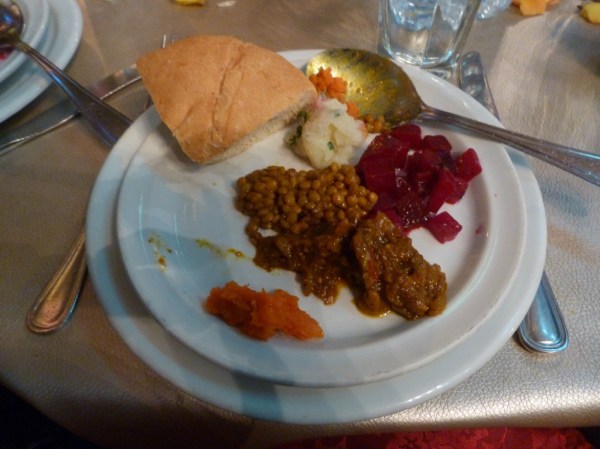


They served a huge tajine with some kind of beef dish. It was well cooked, like beef and carrots, with little or no spices that I could detect. Nourishing. Filling.
The venue is spectacular. It is truly a fabulous environment in which to take a meal. The catering service has paid attention to detail, with rose petals on the table, good settings, enough water, good sweets at the end of the meal and hot mint tea poured with a flourish. The restrooms were clean and there were several. I admire the way they can serve so many people so quickly, get-them-in, get-them-out and give them a meal in which there is little to object to . . . unless you’ve had Moroccan cooking before, and like a little taste in your food. We like taste in our food.
We’ve been married and traveling together for so long now that we know we aren’t going to be able to stay with the group. We love Marrakech; we’ve been here before. The last time was with our son, about fifteen years ago, but not a lot has changed. Our group leader looks a little worried, until we explain that we know the city, we speak Arabic and French, we know the customs, and we can find our way to the hotel on our own when we are finished. We walk – we almost run – away before anyone else knows we are gone.
Seville’s Folklorique Museum
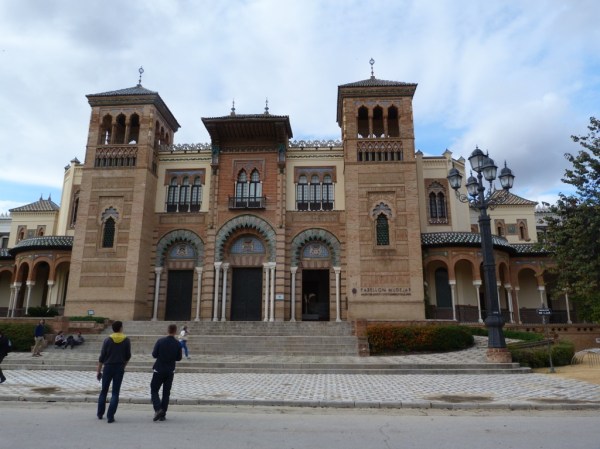
Just across a large plaze is another wonderful museum, one I could happily spend many days in. Once again, they waved us through, they would not take our money. There were several exhibits showing us how things came about, how they developed wheat grinding, for example, how fabrics were woven, all with tableaux and short videos. We watched one very long video about a church that carries the Saint or Madonna around the town on a special cart once a year, and celebrates with a festival.
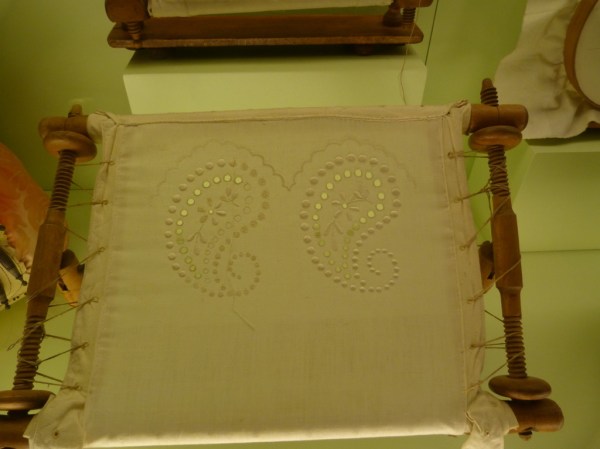
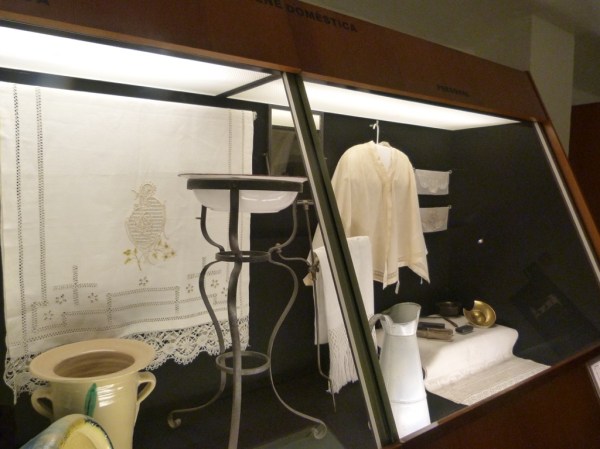
My favorite part of this museum is one whole wing devoted to textiles, embroidery and gossamer shawls, that remind me so much of the ancient, transparent “shayla” the elderly women used to wear as veils in old Qatar and old Kuwait. Nothing like the black opaque headscarves and face coverings of today; these were light and airy and as fragile as a spider’s web. I have one I treasure, but I keep it wrapped in a box because it can tear so easily. Here is a whole wing of a museum with glorious examples of exquisite handiwork of this nature.
Hand embroidered cut-work:
Hand worked lace and cut-work on fine linen:
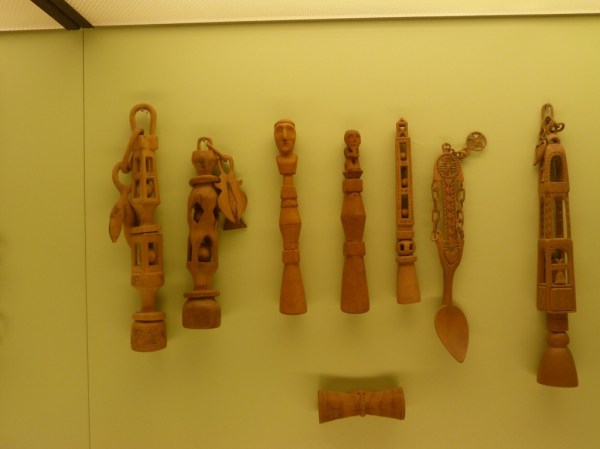
Decorative tools and utensils:
The Folklorique Museum and tile patterns done in stone and mosaic:
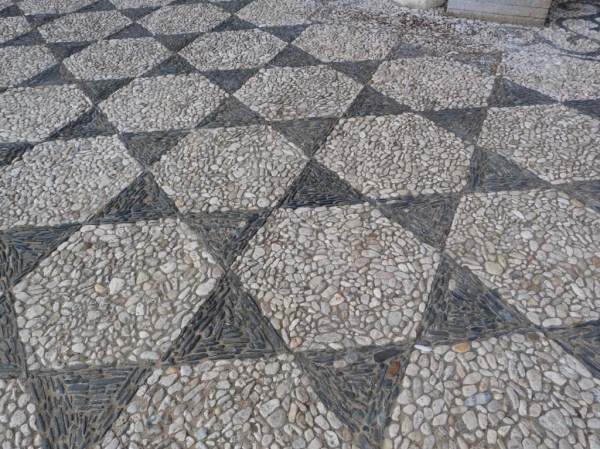
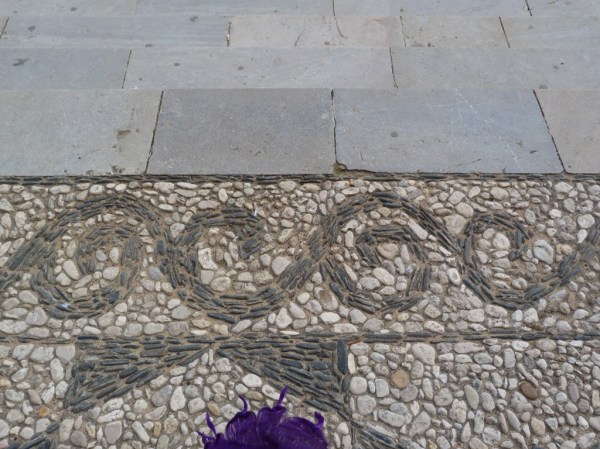
Gossamer lace work:

Glorious white work:

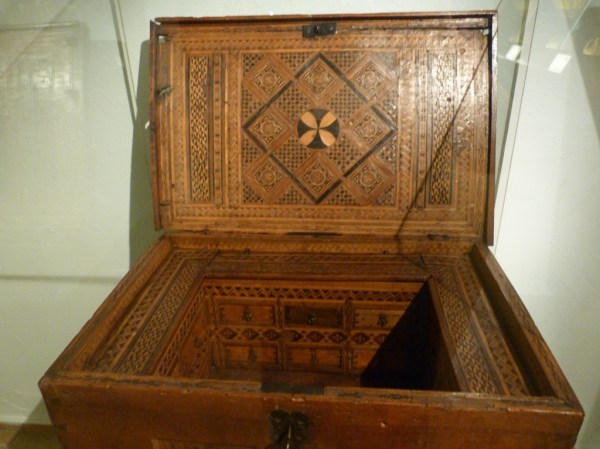
Finely woven and embroidered silk:

We would haunt the flea markets of France, and find many similar treasures in France, tossed out by people who wanted new and glossy. I bought linens of all kinds, but nothing of this quality.
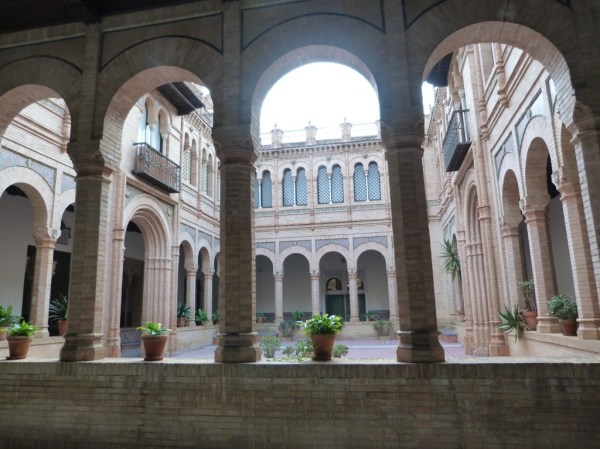
We were thrilled to have this extra day to see Seville more thoroughly, and to explore these two museums. Once again, and easy 10,000 steps 🙂
Hopping off at Seville’s Museum of Archaeology
We had wanted to see this museum, and thanks to this bonus day, woo hoooooo, the Hop-On Hop-Off bus lets us off just a short walk through the park to the Museum. The Museum attendants waved us through, wouldn’t even take our money, and directed us to start down-stairs.

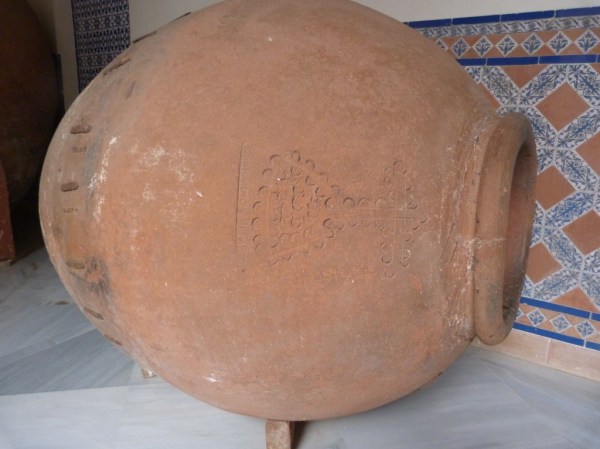
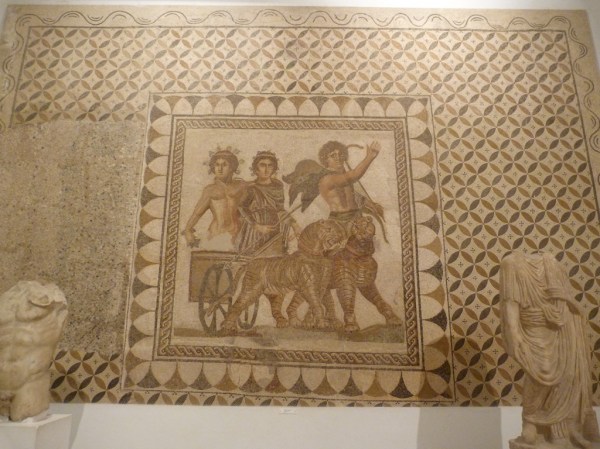
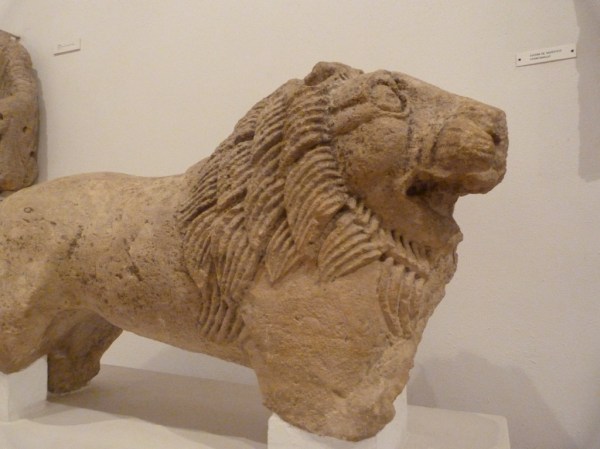
This museum is full of treasures, carefully curated, beautifully edited. The pieces they display give good information. We found something lovely in every room. MdventureMan often commented about how good this museum was about placing the find in a meaningful context:


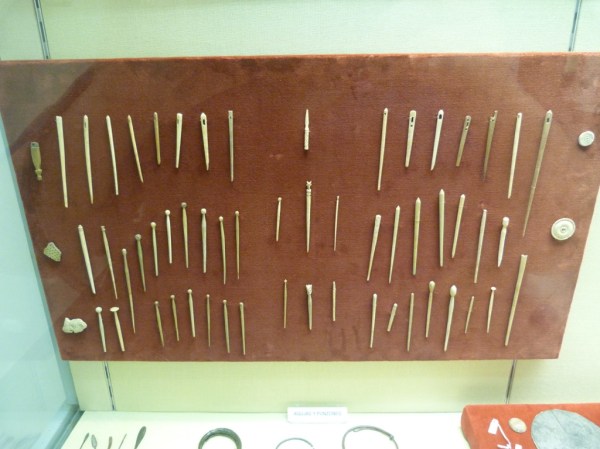
I am always interested in early needles 🙂 How man figured out how to make them from tiny bones, how they got the eyes in the needles without splitting them, fascinates me.

Recent Comments
ExpatAlien on What Country am I Living … intlxpatr on Yellowstone: Old Faithful to C… Michelle on Yellowstone: Old Faithful to C… Cathy on No Grown-Ups in Charge intlxpatr on Waiting for Snow Wikipedia Donate Button

Amazina


Early Voting in Florida


 Here There and Everywhere