Amazing Day
Yesterday turned out to be one of those days that surprise you. I didn’t have a lot of hope for the day, I started off feeling negative and thinking about cancelling appointments. My head has been a little stuffy, I have a mild cough, altogether, I am not in peak form.
I decided to keep my appointments, which required preparation, and the prep turned out better than I had expected. In fact, the entire day was full of unexpected blessings.
First – I know not all of Kuwait experienced it, but the storm! Lightning! Rain! Rain in late late April! Whoda thunk?
Then, the light – drama drama drama – dark dark clouds, but sunlight on the white-capped water, bringing out all the shades from turquoise through jade and lapiz into deep purple – oh, what joy! Last but not least, the wonderful breeze that kept everything from being hot and sticky – what a day! What I might have missed!

Shimmering Sunrise
It’s not yet eight in the morning, and the temperature is almost 90°F / 32°C . . . this is the beginning of hot hot hot:

There was a group of fishermen in the water this morning, just before sunrise, using old fashioned nets; the water must be very warm now. The sun had to battle a thick layer of low lying clouds, and won the battle.

I don’t know if it shows up in this photo at all, but to the left, there is a bright spot with just a tiny slice of rainbow peeking through. 🙂 A good omen! Have a great day, Kuwait.
Kuwait: Our History Runs in our Blood (Mohammed Ali Dashti)
Kuwaitis showing new interest in the past; Traditions, culture wiped out by ‘change’
From today’s Arab Times; you can read the entire interview by clicking here
A born artist makes it his life’s mission to chronicle the past of Kuwait using his artistic skills and his academic erudition. His brush strokes have brought to life scenes from a Kuwait straddling a dying hidebound order and a modern state taking birth. His passion drove him beyond the pale of his canvas to physically revive some lost traditions for posterity.
Read on to find out more about Mohammed Ali Dashti’s enchanting four-decade long mission and some of the precious values from the past which we have now lost and which he fears we may never recover.
Q: You are involved in a rather enchanting profession of recreating the past. What is your goal?
A: When oil was discovered in Kuwait, the state underwent a rapid transformation. The change was very sudden and very fast. In a short span of time, Kuwait leapt from an ancient system to a very modern state. This change wiped out many elements from our traditions and culture.
Until sometime ago, the people of Kuwait were disposing of the antiquated paraphernalia from their homes. But now, there is a sudden interest in these items, and now they are buying them back to preserve the past. It is the only way of holding fast to our roots and knowing how our forefathers, not from a distant past, conducted their lives. Kuwaitis are buying doors and furniture used in the old Kuwaiti homes.
We, as an organization, are working to preserve our history for posterity to learn and know. We produce ancient household items like the Mubkhar (incense stand) with which our grandparents used to scent clothes and fan fragrant smoke around the house.
In the old days, we had no airplanes or cars. The only way we were connected with other places in the region was the sea. Kuwait, owing to its geographical advantages, became a center for shipbuilding. Kuwaitis were experts in making dhows for different purposes. Boats were built in a variety of sizes and designs based on their use. There were cargo ships, fishing boats and vessels for pearl diving. The size of boats ranged from a meter to up to 6 meters. This is another aspect of history that we are trying to preserve and we have been recreating many of the original models our ancestors voyaged in.
We showcase our creations at universities, malls, schools and other places. Thus we have been able to generate interest in our past. We take our craftsmen along and explain to the present generation about Kuwait’s history.
Q: What do you think has created this new interest in the past among Kuwaitis? Can this be read as a reemergence of old traditional values?
A: Our history actually runs in our blood. It is very difficult to detach ourselves from our cultural roots. And so whenever any nation travels too far away from its true origins, at some point of time, it stops and tends to recall the past. History is what gives our existence contextual relevance. And we often try to find it by clawing back into our past, by remembering the way we came through.
Q: You said you make old-model boats. Aren’t you specialized in Warjiyas, the simplistic fishing boats from the past? Which is the biggest boat you have ever built?
A: The biggest boat I have ever built so far is 6 meters long. I make Warjiyas because it is most symbolic of our old fishing traditions. These boats were very famous among the people on Failaka Island. They used it for fishing and it is very easy to construct.
The specialties of Warjiya are: it is wholly made of palm tree to the last detail. The body is built with spines of palm leaf, which are trussed using ropes made our of palm fiber. It is very light and so easy to carry.
Warjiyas sort of became extinct about 60 years ago with the advent of oil and the independence of the state’s economy from fishing and pearl diving. We can’t return to those ancient livelihoods, and so we are now planning to start an annual Warjiya race to keep the tradition alive. The first race will be held in September this year.
Q: Do you have any plans of reviving even the tradition of fishing along with these boats?
A: No, as I said, we can’t actually go backwards to keep our original traditions alive. So, these things can only happen in a token manner. The aim is to keep the future generations aware about how their grandfathers and people before them lived. We don’t have to make our children live a similar life to make them appreciate the ancient way of life.
Q: All over the world there is great demand for antique items. Is what we are seeing in Kuwait a similar trend — a fascination for antique pieces — or is it more than that?
A: No. It is not just a fad in Kuwait. The people really care for the past and there are efforts at all levels to preserve relics from the past or have their duplicated versions. These efforts have been sincerely undertaken by Kuwait National Museum and other private museums in the country, and between them they share a vast treasure of valuable relics and information about Kuwait’s past.
The government is also giving due encouragement to all of us to help us in our endeavors. The ministry of information is doing everything within its means to promote our traditional and cultural heritage in other Gulf countries and beyond.
Start Your Weekend with a Dance!
I have a great friend who sends me some of the most amazing things. This morning, my whole day, my whole weekend will be brighter because of this one amazing piece – take a look for yourself. It is WONDERFUL!
“More than 200 dancers were performing there version of “Do Re Mi”, in the Central Station of Antwerp. with just 2 rehearsals they created this amazing stunt!”
Celebrating Cultures – Kuwait!
From today’s Al Watan:

This photo is so gorgeous, it almost makes me weep! Woo HOOO on you, Christopher Sanan; you showed the beautiful face of Kuwait to the world!
Canon Middle East announces Kuwaiti one of the 13 winners of ”Celebrating Cultures”
KUWAIT: Canon Middle East, the worldـleading innovator and provider of imaging products and solutions, has announced the winners of its regional photography competition titled “Celebrating Cultures ـ How Do You See Your World?” With more than 42 entries from Kuwait, Christopher Sanan was announced as one of the 13 winners for his photograph titled ”Drought”.
The Canon photography competition encouraged photographers of all ability to submit a cultural, historical or heritageـinspired photograph of their country for a chance to win a state of the art DSLR Canon camera ـ the EOS 1000 D.
“We were impressed with the overall high standard of photography across the region, especially Kuwait, and were amazed at the depth of talent that exists. The inaugural Canon “Celebrating Cultures ـ How Do You See Your World?” competition was very well received and has created a platform for the region”s talented photographers to showcase their work. Many of the images captured the diversity, beauty and spirit of the region. Winning entries are currently being exhibited at GPP 2009, for all photography enthusiasts to see,” said Hendrik Verbrugghe, CCI Marketing Manager, Canon Middle East.
The quality of entries from across the region made the judging process difficult for the independent onـline panel of experts which consisted of well known photo editors, photographers and a representative from Canon Middle East.
“Canon Middle East is committed to supporting photography in the region and making it accessible to all. The Canon Photography Competition is an ideal platform to nurture and recognise local talent. The tremendous response to the Canon Celebrating Cultures ـ photo competition is a testament to the region”s exceptional photographic talent,” concluded Hendrik Verbrugghe.
To view the winning entries visit the Canon stand at GPP or visit the Canon micro site on http://www.gulfphotoplus.com/canoncompetition/winners.php
Canon is a worldـleading innovator and provider of imaging and information technology solutions for individuals and businesses. Canon provides both individual products and complete networked technology solutions for information input, management and output. Its product range is divided between Business Solutions (developing IT products, solutions and services for both the office and professional print environments) and Consumer Imaging (photography, video and digital camera, Laser and Inkjet printers). Canon Middle East is the operational headquarters for Canon in this region, and is based in Dubai, UAE. Further information about Canon Middle East is available at: http://www.canonـme.com
Last updated on Thursday 9/4/2009
Daytime Weather Drama
No sooner had I sent the last post than all hell broke loose. The sky opened up and the rain poured down, Qatteri Cat hid under the table, the lightning danced out over the Gulf, two, three strikes at a time, the wind blew, the thunder roared and my camera had a hard time knowing where to focus. I am running around, trying to capture some of the drama, and eventually things start to lighten up. Qatteri Cat has resumed his spot on the table and watches as things calm down.

I download my shots and attempt to upload – only to discover – we lost our Internet.
I run the diagnostic programs and it tells me it is the server, nothing I can do, so I work on other projects and come back – maybe an hour later – to discover I’m back up again.
So here is a little of what we saw:
Torrents – real torrents of rain, sheets of rain:

And here are some drops being blown by the wind:

And all those little white things? Those things you can see against the dark of the trees? Those are raindrops, except they are more like very long drops!

I feel like a little kid. It was fun. It was wonderful. I want more! I want more! More!
Palestinian Handicrafts Cultural Exhibit at Bayt Lothan
Wooo HOOOOO, courtesy of Al Watan another event BEFORE it is over! This time, before it even happens! Woo HOO, see you there. I can hardly wait; I think Palestinian embroidery is gorgeous.
Nonprofit Palestinian Cultural Handicrafts Exhibition at Bayt Lothan
Handicrafts reـaffirm the Palestinian national identity and support needy children and families

KUWAIT: The Palestinian Culture Center will hold the first of its two annual exhibitions for 2009 at Bayt Lothan. The show includes a large collection of textileـbased traditional handmade crossـstitch, as well as pottery from Hebron, books about Palestine in English and Arabic, posters, slide shows, Palestinian food and family oriented activities.
The Palestinian Culture Center is a nonـprofit organization that was established in Jordan in 1993. It aims to preserve the rich heritage and culture of Palestine and help support women and their families in the Palestinian refugee camps become economically independent.
This year was an active year for the Center due to the affects of the global financial crisis placing a further strain on the poor, as well as the violent and aggressive Israeli military onslaught on Gaza. As a result, the Center worked hard to increase the salaries of the 500 or so women who do the embroidery work, as well as pay for their transportation from the camps, and motivate them by granting bonuses for quality work.
Exhibition Highlights
* Traditional crossـstitch embroidery of dresses, linens, shawls, cushions, table runners, cards, coasters, belts, purses, bookmarks and more
* Handmade ceramics from Hebron
* Books, posters, cards, key chains, kafiyas and DVDs
* Paintings from Palestinian artists from Jerusalem and other occupied areas
* Multimedia slideshows on Palestine
* Food sale of traditional Palestinian food such as thyme and sumaq, and on Thursday only baked goods and other traditional plates
Palestinian embroidery using needles and silk thread is a manifestation of the Palestinian identity as it has evolved over the ages. An age old art, all Palestinian ladies, young and old, would spend hours embroidering their trousseau, dresses, shawls and cushions. Using geometrical shapes at first, and then evolving to depict images from nature surrounding them, the dresses are famous for their flowery designs and bold natural colors of indigo and red. Symbols of the ubiquitous cypress trees surrounding the orange groves, roses, jasmine and the famous olive tree are typical motifs in these dresses.
The exhibition is being held at Bayt Lothan in Salmiya, which is next to Marina Mall and facing the Arabian Gulf Road.
It will be held for four days starting Monday, April 6, 2009, through Thursday, April 9. It is open to the public from 10:00 am to 1:30 pm and 4:30 pm to 8:30 pm on Monday through Thursday.
The Palestinian Culture Center thanks Bayt Lothan for their generosity in providing the premises free of charge.
Last updated on Monday 30/3/2009
Female Police Given Ranks Equal to Men
The Police Academy attracted 16 women with university degrees – HOOOO-AHHH! I imagine these women are going to shake things up a little – in a good way – around police headquarters. Mabruk, mabruk, Kuwait.
Women officers given rank equally to men
Staff Writer – from Al Watan
KUWAIT: An Amiri decree was issued requiring female police officers to be put on equal footing with their male counterparts in terms of rank. Accordingly, Minister of Interior Sheikh Jaber AlـKhaled AlـSabah issued an executive order to rank women police officers according to the same requirements as given to male officers.
The first batch of women police now includes 16 Lieutenants, all of which have university degrees, eight Warrant Officers, all holding technical diplomas, and three Sergeants who have secondary school certificates.
Last updated on Friday 27/3/2009
Al Kout Festival
Wooo HOOOO! An event we know about BEFORE it happens!
March 31 and April 1, 11am -7pm. American University of Kuwait, Salmiya Campus
The Arabian Heritage Project is proud to present “Al-Kout Festival”
(Old Kuwait Festival) an event being held to celebrate the grand opening of the
Arabian Heritage Project, a research, archival, and outreach center dedicated to
promoting and fostering the heritage of the Peninsula and related cultures.
Two days of celebration from 11 am till 7 pm at the American University Of
Kuwait campus in Salmiya. The event will include National Museum Exhibits, live
performances by Kuwaiti traditional bands (Bin Hussein and Mayouf), Sawt
musicians, Bedouin poetry, Kuwaiti History Game Show, distinguished live
Craftsmen, a Bazaar, old Kuwaiti cars, refreshments; basically a chance to
experience authentic Kuwaiti Tradition and Culture at its best.
The Festival opens at 11am, performances (Kuwaiti Sawt musicians, poetry,
Kuwaiti music piano recital, etc.) begin at noon. Sea bands begin at 5pm each
day.
Please note, parking is limited. Carpooling is advised.
Barbara Nadel: The Ottoman Cage
I got the recommendation for this book from Little Diamond; we have a long family tradition of trading books back and forth, my sisters, our children, even my mother; we are all sending books and exchanging suggestions all the time. I know I can count on Little Diamond and Sparkle for particularly good recommendations, and they never disappoint me.
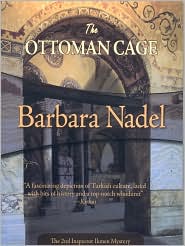
When The Ottoman Cage arrived, I was put off by the cover. “Who’s Likely to Like This?” the cover asked – it seemed like screaming to me – “Fans of Donna Leon and exotic, atmospheric locales”
Remember, I am in a dark time, taxes, turbulence, destabilization. . . I am easily disgruntled when I am vulnerable like this. I don’t want to think I am so predictable. I love reading Donna Leon! So I am predisposed (grumble grumble grumble) NOT to like Barbara Nadel.
I fail miserably. The first five pages I am resisting. By the sixth page, I am ready to stay up all night to read this book (I don’t really, but I did finding myself making more time to read so I could find out what happens next.)
It is like the Donna Leon series in that while the plot is original and interesting, the real focus is on the police inspector, his crew, the relationships with friends and characters, the bureaucracy, and the way systems and institutions function in modern day Turkey.
One particular relationship was of great interest to me, that of Suleyman, who dutifully married his first cousin. They both tried very hard to make it work, but when we meet him, we discover that the marriage has become a painfully dry and desolate place, where each lead their individual lives, with very little of the relationship together.
Another character is detective Cohen, a rare Jew in the police force described as follows:
When one has been known and admired as a prolific womanizer for most of one’s adult life, any change in that situation can come rather hard. Although Cohen had been married since the age of nineteen, he had never let that fact or indeed his rather short stature and dishevelled apearance hold him back from the most ardent pursuit of other women. Jokey charm, of which he possessed copious amounts, had always seen him through. The knowledge that women love a man who can make them laugh had successfully taken him to many bedrooms and had, quite frequently, resulted in his being asked back again. Until this year.
Whether it was because now he was on the ‘wrong’ sied of forty five or just a patch of ill fortune, Cohen didn’t know but the fact was beyond dispute. Women, it seemed, didn’t want him any more. The rbuffs and even in one notable case the cruel sound of mocking laughter were hideously painful for him to bear. Even his long-suffering wife, who had for so many years pleaded with him to leave other women alone and attend to her, had lost interest. He’d tried to find a little comfort in her arms the previous night when he found that he couldn’t sleep, but she, like all the lithe little girls that he still so desired, had just sent him on his way, back to his customary couch, flinging her curses in his unfaithful wake.
It was, Cohen would have been the first to admit, his own fault. Had he bothered to try and be faithful to Estelle he would now, in his middle years, have both a friend and a over with whom he could take comfort as the lines overwhelmed his face and the loose skin around his middle began to sag. His wife was, after all, ageing like himself and, unlike the pretty little tarts he hankered after, unable to point mocking fingers at his inadequacies.
The plot hinges on a dead boy, a beautiful boy, found dead, alone, on a bed in an empty, tasteful but unlived in home. Who is he? Why is he here? Why is he dead?
We meet the gossipy neighbors, we meet the Armenian community, we meet some of the lowest characters you would ever hope to meet, the kind the police deal with every single day. Nothing is simple, one single clue leads slowly, painfully to another. I give credit to Nadel; she relies on good honest police work, chasing down the clues, going through the stacks of old files, interviewing unsavory lowlifes; the things good police really do to solve their cases.
More than the plot, I loved the rich and intricate textures of this mystery novel, I loved the descriptions of the interiors and the interior lives of the characters. Nadel has that in common with the other writers I read serially – Leon, Pattison, Qiu Xiaolon, James Burke and Peter Bowen. It is another rich entry into the genre of the “mystery novel set in exotic, atmospheric locations.”
Definitely worth a read!
Recent Comments
Kitchen on Isiais: Winding Down intlxpatr on Shampoo Ginger tigerbutterya0c5ff1d… on Shampoo Ginger intlxpatr on British Soldier Kidnapped, Esc… John on British Soldier Kidnapped, Esc… Wikipedia Donate Button

Amazina


Early Voting in Florida


