Breathless Day
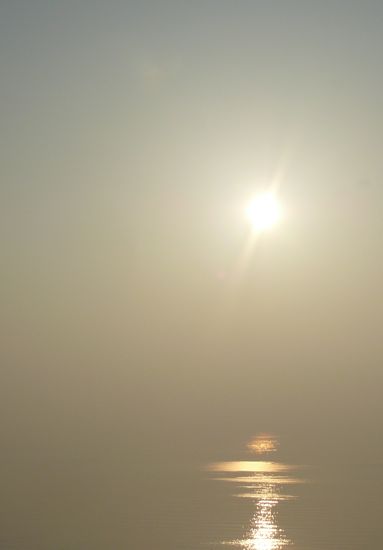
The air is still, and there isn’t a single wave on the vast, flat glassy Gulf. At eight in the morning, it is already breathlessly hot:

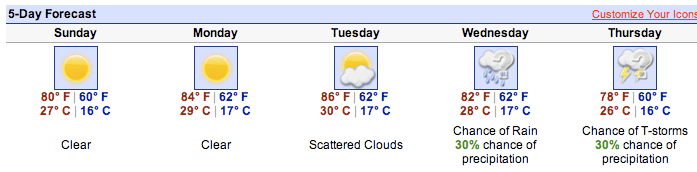
It’s not getting any better. Maybe by the beginning of next week, as you can see, a little “cold” weather will be moving in 😉

The only way you can determine the difference between water and air is the layer of yellow tinged haze on the far horizon:

Here is what my life looks like right now:

Yesterday, a sweet friend dragged me away from all the packing and focus on moving and treated me to a day at the Aquatonic Spa. I admit it, she had to drag me – I can get so immersed in my misery that I don’t even want to do something fun.
In spite of my churlishness, we had a great time. Playing around in that fabulous pool, and then having beauty treatments afterwards – it just took all the misery out of me. I felt great for the first time in weeks. I slept last night without waking, and awoke refreshed, thanks be to God, and thanks to my friend who knew what I needed better than I did.
Income Tax Blessing
You didn’t think those words could all be used in the same sentence, did you? AdventureMan and I have to pay something called “quarterly estimated taxes” and this year, I guess because our investment income went seriously down, we overpaid our taxes. I know, I know, that doesn’t sound like good news to you, but it sure beats the pit-in-the-stomach of learning that you owe more to Uncle Sam. We overpaid, and we will go ahead and apply it to next year’s taxes and hope that everything works out well next year, too.
We used to talk to my father about ways he could pay less tax on his income and savings. He would look at us and say “But the government was always good to me!” (he worked for the government) “They paid my salary! They pay my retirement! They help pay my medical bills! Why would I not want to pay them taxes?”
It was an extraordinary attitude; I have never forgotten it.
Brilliant Sunrise, 5 Apr 09
Goooooooooooood Morning, Kuwait! 🙂
It is going to be another gorgeous day in Kuwait. Don’t let this “heavy fog” deter you. When I got up, the sunrise was so bright, I couldn’t see the sun, it was refracted all over the sky. I was only able to get the shot by focusing on the reflection of the sun on the water.
It is going to be a fantastic week – sweet warm days and cooling off evenings, perfect for sitting outside and drinking coffee, visiting with friends – and a little later in the week, a chance of more rain:
AdventureMan and I saw Journey to Mecca yesterday, along with about 500 others living in Kuwait. The movie is still packing people in! The audience was about 3/4 full with children, and I thought “oh this is going to be great, crying children and people talking on their cell phones.” I was SO wrong. Although the movie theater was full, I did not hear a single phone, I did not hear a single crying child – the movie held us all spellbound. We loved the movie, and we loved seeing it in the IMAX theatre.
(There are special headsets for non-Arabic speakers, with the dialogue in English. We didn’t know; they just spotted us as probably-non-Arabic and handed us the headsets.)
Sometimes, I am just slow. My niece, Little Diamond, had recommended a book called Travels with a Tangerine: From Morocco to Turkey in the Footsteps of Islam’s Greatest Traveller, but it was not until yesterday that I got it – that Ibn Batuta was from Tangiers! Sometimes, I am just slow . . . sometimes I can grasp subtleties but the obvious escapes me totally.

You can buy this book from Amazon.com for a mere $10.17 plus shipping. Yes, I own stock in amazon.com.
You can also probably find it at the Kuwait Bookstore, that amazing store in the bottom of the Al Muthanna Mall, near the Sheraton Circle downtown.
Feast Day of John Donne
In church, on Friday, the speaker was discussing Lenten practices, and told us of a woman who seriously committed herself to Lent, but allowed herself respite on the feast days of the saints of the church. She has one coming up today – the feast of John Donne, a great priest, poet and thinker in the church.
His life is fascinating, and when he falls in love and secretly marries the daughter of the rich and powerful man for whom he works, he is imprisoned. When released, he began preaching, and ended up revered for his work with the church, and his fine writings.
He was also ahead of his times. Here is one of the essays/meditations best known in our culture; it is often read at funerals, and says, as many are saying now – we are all connected. What happens to my neighbor, happens to me. In this earthly world, we are connected in ways we don’t even understand, and it is our duty, as well as our own best interest, to look after our neighbor:
MEDITATION 17, BY JOHN DONNE
NUNC LENTO SONITU DICUNT, MORIERIS
[Now this bell tolling softly for another, says to me, Thou must
die.]
Perchance he for whom this bell tolls may be so ill as that he know not it tolls for him; and perchance I may think myself so much better than I am, as that they who are about me and see my state may have caused it to toll for me, and I know not that.
The church is catholic, universal, so are all her actions; all that she does, belongs to all. When she baptizes a child, that action concerns me; for that child is thereby connected to that body which is my head too, and ingrafted into that body whereof I am a member. And when she buries a man, that action concerns me: all mankind is of one author and is one volume; when one man dies, one chapter is not torn out of the book, but translated into a better language; and every chapter must be so translated. God employs several translators; some pieces are translated by age, some by sickness, some by war, some by justice; but God’s hand is in every translation, and his hand shall bind up all our scattered leaves again for that library where every book shall lie open to one another.
As therefore the bell that rings to a sermon calls not upon the preacher only, but upon the congregation to come, so this bell calls us all; but how much more me, who am brought so near the door by this sickness.
There was a contention as far as a suit (in which piety and dignity, religion and estimation, were mingled) which of the religious orders should ring to prayers first in the morning; and it was determined that they should ring first that rose earliest. If we understand aright the dignity of this bell that tolls for our evening prayer, we would be glad to make it ours by rising early, in that application, that it might be ours as well as his whose indeed it is. The bell doth toll for him that thinks it doth; and though it intermit again, yet from that minute that that occasion wrought upon him, he is united to God. Who casts not up his eye to the sun when it rises? but who takes off his eye from a comet when that breaks out? Who bends not his ear to any bell which upon eny occasion rings? but who can remove it from that bell which is passing a piece of himself out of this world?
No man is an island, entire of itself; every man is a piece of the continent, a part of the main. If a clod be washed away by the sea, Europe is the less, as well as if a promentory were, as well as if a manor of thy friend’s or of thine own were. Any man’s death dimishes me because I am involved in mankind, and therefore never send to know for whom the bell tolls; it tolls for thee.
Neither can we call this a begging of misery or a borrowing of misery, as though we were not miserable enough of ourselves but must fetch in more from the next house, in taking upon us the misery of our neighbors. Truly it were an excusable covetousness if we did; for affliction is a treasure, and scarcely any man hath enough of it. No man hath affliction enough that is not matured and ripened by it and made fit for God by that affliction. If a man carry treasure in bullion, or in a wedge of gold, and have none coined into current money, his treasure will not defray him as he travels. Tribulation is treaure in the nature of it, but it is not current money in the use of it, except we get nearer and nearer our home, heaven, by it. Another man may be sick too, and sick unto death, and this affliction may lie in his bowels as gold in a mine and be no use to him; but this bell that tells me of his affliction digs out and applies that gold to me, if by this consideration of another’s danger I take mine own into contemplation and so secure myself by making my recourse to my God, who is our only security.
You can read his history and learn more about him here: John Donne.
St. Oscar Romero
I didn’t even know we had a St. Oscar Romero, so when it came up on my screen, this morning as I was doing my daily lectionary readings I took a little time to read about him.
What an incredible man – and a modern day saint, too, a man for our times:
OSCAR ROMERO
ARCHBISHOP OF SAN SALVADOR, AND THE MARTYRS OF EL SALVADOR
(24 March 1980)
Óscar Arnulfo Romero y Galdámez (August 15, 1917 – March 24, 1980), commonly known as Monseñor Romero, was a priest of the Roman Catholic Church in El Salvador. He later became prelate archbishop of San Salvador.
As an archbishop, he witnessed numerous violations of human rights and began a ministry speaking out on behalf of the poor and victims of the country’s civil war. His brand of political activism was denounced by the hierarchy of the Roman Catholic Church and the government of El Salvador. In 1980, he was assassinated by gunshot while consecrating the Eucharist during mass. His death finally provoked international outcry for human rights reform in El Salvador.
In 1997, a cause for beatification and canonization into sainthood was opened for Romero and Pope John Paul II bestowed upon him the title of Servant of God. The process continues. He is considered the unofficial patron saint of the Americas and El Salvador and is often referred to as “San Romero” in El Salvador. Outside of Catholicism Romero is honored by other religious denominations of Christendom, like the Church of England through its Common Worship. He is one of the ten 20th-century martyrs from across the world who are depicted in statues above the Great West Door of Westminster Abbey, London.
You don’t have to be perfect to be a saint, in fact in the reading for today, St. Paul writes that “22 For I delight in the law of God in my inmost self, 23 but I see in my members another law at war with the law of my mind, making me captive to the law of sin that dwells in my members. 24 Wretched man that I am! Who will rescue me from this body of death? 25 Thanks be to God through Jesus Christ our Lord!
So then, with my mind I am a slave to the law of God, but with my flesh I am a slave to the law of sin.
We cannot, in our own strength do right all the time, even if we want to choose rightly. Oscar Romero may not have been perfect (because none of us are, it’s not like I know anything scandalous about him) but he dedicated himself to righting a major wrong he saw in society, and his persistence and dedication ended up causing his death.
In Xanadu: A Quest by William Dalrymple
This book was on my (huge) “Read Me” stack, and I picked it up for a change of pace. As I started reading, I wondered “how did this get there?” My first instinct was it was a recommendation from Little Diamond. As I was reading, however, I came across a segment that was what our priest had read in church around the Feast of the Epiphany about the birthplace of the wise men who came seeking the Christ Child after his birth. I wrote down the title and ordered it from amazon.com (which has some copies used from 72 cents).

William Dalrymple wrote this book when he was a mere 22 years old. He and a travelling companion took off to trace Marco Polo’s journey from Jerusalem to Xanadu, where he was taking oil from the sanctuary lamp to Kubla Khan.
In a world where we have all been taught to be so careful, they take incredible risks. They travel on the cheap – staying in fleabag hotels, sometimes sleeping “rough”, i.e. out in the open. They travel any way they can – an occasional train, but more often a truck, a bus, whatever is going their way. One very long segment they travelled on top of a pile of coal.
They travel from Jerusalem up through Syria and into Turkey, then turn east and cross Iran, Pakistan and Afghanistan to China. They have some amazing adventures, see some astounding scenery and because of their mode of travel, have a lot of time to talk with their travelling companions or people in the cities where they are staying.
I am blown away that an unmarried couple would cross Iran, Pakistan and Afghanistan. I guess they told people they were married to share a room (they were on a budget) and they were only friends, not a couple, but what a risk. I am astonished that they were never asked to produce a marriage license or any proof of marriage when they stayed in hotels. I am astonished at the girls (one left in Lahore and another joined him, but these are girls who are friends, not anything more) would travel on the backs of trucks full of men, and never blink an eye.
The book is occasionally hilarious. Most of the hilarity results from foods they have to eat – sometimes it is the only food available – or from misunderstandings because of lack of a common language, or due to their frequent bouts of diarrhea, what I really liked about the author was that he was rarely pompous, and when he is funny, it is usually about some conversation he has had, or some mistake he has made.
One of my favorite parts of the book happens in Iran:
As we sat waiting for the bus to Tabriz, the next town on Marco Polo’s itinerary, we watched the mullahs speeding past in their sporty Renault 5s. Iran was proving far more complex than we had expected. A religious revolution in the twentieth century was a unique occurence, resulting in the first theocracy since the fall of the Dalai Lama in Tibet. Yet this revolution took place not in a poor banana republic, but in the richest and most sophisticated country in Asia. A group of clerics was trying to graft a mediaeval system of government and a pre-medieval way of thinking upon a country with a prosperous modern economy and a large and highly educated middle class. The posters in the bus station seemed to embody these contradictions. A frieze over the back wall of the shelter spoke out, in the name of Allah, against littering. On another wall two monumental pictures of the Ayatollah were capped with the inscriptions in both Persian and English:
BEING HYGENIC IS DIRECTLY RELATED ON THE MAN’S PERSONALITY
and:
ALLAH COMMANDS THE RE-USE OF RENEWABLE RESOURCES.
We had expected anything of the Ayatollah. But hardly that he would turn out to be an enthusiastic ecologist.
The challenge of this journey is to follow as closely as possible the path Marco Polo took, but two segments of the journey go through off-limits areas. They find a way into one, to discover later it is an atomic testing area, and the second, at the very end, around Xanadu, they find receptive Chinese officers who take them to have a brief glimpse of the ruins of Xanadu while booting them out of the area. As they stand in Xanadu, they repeat a poem that every American child grows up with in English Literature:
In Zanadu did Kubla Khan
A stately pleasure-dome decree:
Where Alph, the sacred river, ran
Through caverns measureless to man
Down to a sunless sea.
So twice five miles of gertile ground
With walls and twoers were girdled round:
And there were gardens bright with sinuous rills.
Where blossom’d many an incense-bearing tree:
And here were forests ancient as the hills,
Enfolding sunny spots of greenery.
(Coleridge)
I liked this book. Dalrymple is a history major, and often quotes from historical – even obscure – texts to illuminate what he observes. I think I may look at a couple more he has written since.
“I’m Melting! I’m Melting!”
At our church this weekend, our priest was making a point, using water, and he sprinkled various members of the congregation, to a series of “eeeeekks!”
I was reminded of several years ago – we had bought a new house, and our church has a special ceremony of blessing for a residence. As the priest carefully points out, he/she is not actually blessing the house, but blessing the inhabitants – nonetheless, every room has a special prayer, and the priest sprinkles a little holy water in each room.

more animals
As he sprinkled the water in one room, some hit my youngest sister, Sparkle. I watched her struggle not to do it, but she couldn’t resist.
“Ohhhh, I’m melting, I’m melting!” she cried out, like the Wicked Witch of the West in The Wizard of Oz.
Thank God, the priest was a good friend. He paused, looked at me and said “she is YOUR sister?” I nodded. He sighed, before continuing, and said “why am I not surprised?”
“Generation of Spoiled Idiots”
I have a dear friend who sends me the most amazing things. This started my day with a howl of laughter:
I am embarrassed to tell you – I remember rotary phones. I even remember party lines, where you had to wait for your neighbor to finish his call before you could make your own, and you never knew who might be listening to your conversation. I remember planes that had large, beautiful lady’s lounges, with a seating area for nursing mothers. I remember when living in Germany was a huge problem to many young people who ran up huge phone bills, calling their families when they were lonely – no internet, no VOIP. I remember transistor radios, and Walkmen! LLLOOOLLLL!
The Feast of St. Andrew
This is the Feast of Saint Andrew, one of my favorite of all the Saint’s Days, and the Saint’s feast closest to my very favorite season of the church or all – Advent, during which we prepare our hearts for the arrival of the little baby Jesus.
I learned things I never knew, reading James Kiefer’s write up for The Lectionary including that Andrew is known for bringing others to Christ. He was one of two of the very first Apostles, and while not often mentioned individually, is mentioned as one who brings others to the knowledge of Christ.

ANDREW THE APOSTLE
(30 NOV NT)
Most references to Andrew in the New Testament simply include him on a list of the Twelve Apostles, or group him with his brother, Simon Peter. But he appears acting as an individual three times in the Gospel of John. When a number of Greeks (perhaps simply Greek-speaking Jews) wish to speak with Jesus, they approach Philip, who tells Andrew, and the two of them tell Jesus (Jn 12:20-22). (It may be relevant here that both “Philip” and “Andrew” are Greek names.) Before Jesus feeds the Five Thousand, it is Andrew who says, “Here is a lad with five barley loaves and two fish.” (Jn 6:8f) And the first two disciples whom John reports as attaching themselves to Jesus (Jn 1:35-42) are Andrew and another disciple (whom John does not name, but who is commonly supposed to be John himself — John never mentions himself by name, a widespread literary convention). Having met Jesus, Andrew then finds his brother Simon and brings him to Jesus. Thus, on each occasion when he is mentioned as an individual, it is because he is instrumental in bringing others to meet the Saviour. In the Episcopal Church, the Fellowship of Saint Andrew is devoted to encouraging personal evangelism, and the bringing of one’s friends and colleagues to a knowledge of the Gospel of Christ.
Just as Andrew was the first of the Apostles, so his feast is taken in the West to be the beginning of the Church Year. (Eastern Christians begin their Church Year on 1 September.) The First Sunday of Advent is defined to be the Sunday on or nearest his feast (although it could equivalently be defined as the fourth Sunday before Christmas Day).
Several centuries after the death of Andrew, some of his relics were brought by a missionary named Rule to Scotland, to a place then known as Fife, but now known as St. Andrew’s, and best known as the site of a world-famous golf course and club. For this reason, Andrew is the patron of Scotland.
When the Emperor Constantine established the city of Byzantium, or Constantinople, as the new capital of the Roman Empire, replacing Rome, the bishop of Byzantium became very prominent. Five sees (bishoprics) came to be known as patriarchates: Rome, Alexandria, Antioch, Jerusalem, and Byzantium. Now, the congregation at Rome claimed the two most famous apostles, Peter and Paul, as founders. Antioch could also claim both Peter and Paul, on the explicit testimony of Scripture, and of course Jerusalem had all the apostles. Alexandria claimed that Mark, who had been Peter’s “interpreter” and assistant, and had written down the Gospel of Mark on the basis of what he had heard from Peter, had after Peter’s death gone to Alexandria and founded the church there. Byzantium was scorned by the other patriarchates as a new-comer, a church with the political prestige of being located at the capital of the Empire, but with no apostles in its history. Byzantium responded with the claim that its founder and first bishop had been Andrew the brother of Peter. They pointed out that Andrew had been the first of all the apostles to follow Jesus (John 1:40-41), and that he had brought his brother to Jesus. Andrew was thus, in the words of John Chrysostom, “the Peter before Peter.” As Russia was Christianized by missionaries from Byzantium, Andrew became the patron not only of Byzantium but also of Russia.
Andrew is the national saint of Scotland. George (23 Apr) is the national saint of England, Patrick (17 Mar) of Ireland, and Dewi = David (1 Mar) of Wales. George, who was a soldier, is customarily pictured as a knight with a shield that bears a red cross on a white background. This design is therefore the national flag of England. It is said that Andrew was crucified on a Cross Saltire — an ‘X’ -shaped cross. His symbol is a Cross Saltire, white on a blue background. This is accordingly the national flag of Scotland. A symbol of Patrick is a red cross saltire on a white background. The crosses of George and Andrew were combined to form the Union Jack, or flag of Great Britain, and later the cross of Patrick was added to form the present Union Jack. Wales does not appear as such (sorry!). Whether there is a design known as the cross of David, I have no idea.
by James Kiefer
Doha Museum of Islamic Arts Opens
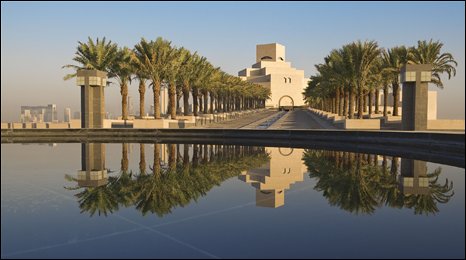
My friends in Doha tell me that the long-awaited Museum of Islamic Arts, designed by I.M. Pei (who showed up for the opening, along with Robert de Niro) opened this weekend. I can hardly wait to see it for myself.
By Lawrence Pollard
BBC News, Doha
A few years ago, prices in London auction houses went through the roof – not for the classic modern or contemporary art, but for works from the Islamic world.
Fabulous jewels, manuscripts and ceramics were fetching 10 times their estimate and more, and it soon emerged this was thanks to the al-Thani family, rulers of Qatar, the tiny gas-rich Gulf state.
They had tempted the veteran architect I M Pei – the man behind the glass pyramid at the Louvre – to design one last statement building, a spectacular museum on a purpose-built island in Doha, which would house only the best Islamic art.
Then they went shopping for their collection.
And this weekend the museum opens, a dramatic pile of white limestone shapes inspired by Islamic architecture and full of 800 of the finest examples of Islamic art.
Not long ago, the idea of culture being a reason to visit the Gulf would have made other Arabs laugh. No longer.
The Syrian cultural historian Rana Kabbani sees a political element to the museum, putting Doha on the cultural map.
“I think all the rulers in the Gulf see what they really lack is culture on a grand scale, as a kind of imperial identity. It’s a political-cultural lack. They have the means, and they’re going for it.”
The hope is that – like hosting a Grand Prix or buying a football club – a fabulous collection of art will bring prestige, attract tourists and create a brand.
That’s why along the coast, two museums are planned for Abu Dhabi – branches of the Louvre and Guggenheim.
New conversation
But what exactly is the Islamic art in the collection? What can ceramics from southern Spain have in common with metalwork from the Silk Route city of Samarkand?
One thing which links them is the misconceptions about Islamic art held by both east and west.
Designer and writer Navid Akhtar explains: “The conversation tends to go: ‘How come you don’t paint people? Because its forbidden.’
“There’s little understanding of the scriptures or commentaries, or the concept of art, so we’re left with a limited conversation.
“There’s a lot of figurative Islamic art. And the geometric patterns aren’t just pattern.”
The Koran has no comment on the visual arts.
The prophet was firmly against idols, but then so were Jews, orthodox Christians and puritan Anglicans at various times.
Many religions mistrust images but their cultures still end up using them – Islam however has had less use for them.
“The Koran is not a narrative like the old or new testament, it doesn’t tell a story, a narration you can illustrate,” says professor Doris Abouseif, author of Beauty in Arabic Culture.
“The Koran is precepts, it guides but doesn’t narrate.”
Any museum will show Persian and Indian miniatures, or Arab pottery with figures of animals or people.
They won’t be from a mosque, but the figure isn’t banned from wider Islamic culture.
‘Whole language’
One element Islamic objects have in common is intricate geometric patterns.
Some scholars think this is a craft habit, pure and simple, but to many younger Muslim artists the geometry holds something else.
“Pattern is a whole language of colour, form and shape,” says Reem al-Faisal, a Saudi artist-photographer.
“Each colour symbolises a state of the soul or being. It’s poetry translated into material elements.”
Mr Akhtar agrees: “Many of these things, as well as being objects of beauty, have functional usage, but then hidden beyond that is the sense of transcendence that they create.”
The chief curator of the new museum, Oliver Watson, is British, as are many of the staff.
The museum houses 800 artistic and historical works from three continents
The study of Islamic art is a western creation, which Ms al-Faisal says is not a problem so long as more Muslims now take up the study.
“I don’t care if it’s Muslims or Westerners – the problem is that there’s not enough research and that’s a mistake of the Muslims.
“They should have studied their own civilisation far more, they’ve been in hibernation for 500 years. There has to be a reawakening – they have to start studying their own history.”
Qatar’s museum will be just a glittering collection of greatest hits unless it manages to become, as promised, a centre of education and research into the history of this beautiful art.
Recent Comments
ExpatAlien on What Country am I Living … intlxpatr on Yellowstone: Old Faithful to C… Michelle on Yellowstone: Old Faithful to C… Cathy on No Grown-Ups in Charge intlxpatr on Waiting for Snow Wikipedia Donate Button

Amazina


Early Voting in Florida


 Here There and Everywhere