Of Little or No Interest to Most People
I began this blog in 2006, living in Kuwait. Kuwait was resource-rich for blogging; lots of bloggers, all kinds of interests; as a new resident in Kuwait, it gave me a portal into a new world, a new way of seeing things, and a way to meet wonderful people I might otherwise have never encountered. Kuwait was also rich in ex-pats, people from all over the world came to Kuwait to work, to send money home to their families, to create a better life. Many of those stories are in previous entries.
One story in particular still makes me laugh. I was at a dinner party at the British Embassy, seated next to a Nigerian woman. “So how did you come to live in Kuwait?” I asked, as I always do, because the answers are always so varied and unexpected.
She said she came to work with her husband. She leaned in and said in a low voice “I look deep inside you and tell you things you never knew about yourself.”
I’m pretty good at keeping a polite face, but I think I slipped a little then as I looked at this very respectable woman and thought “Witchcraft??” “Psychologist?” And she laughed, and said “I’m a radiologist.” We became good friends. I loved her sense of humor and her love of life.
There was a lot to write about, so many things that were new and unusual and often lovely. Before I left Kuwait, my blog had more than a million hits. Before I left Doha, I had more than two million. That was 16 years ago, and blogging has diminished, I no longer live such an exotic and interesting life and I have less time to write. The blog has struggled on.
This morning, I noticed I am about to hit 2,900,000 hits. Maybe this week. That’s fun for me. And it makes me wonder if I will live long enough, write long enough, to hit 3 million.

“Your Mission is to Shine”
Today, our priest took on the brave task of dealing – not with politics or political events, (God forbid!) but addressing how we, as members of the body of Christ, are to respond to these events. We are to be light. We are to do what the bible tells us to do. We are to treat our fellow human beings – even those who are not like us, who do not share our opinions, with the dignity and love with which every human being were created.
Holy Smokes! That’s a tall order. We are to love one another. We are to welcome the stranger. We are to share. We are not to gossip or say mean things about our friends – or anyone!
In the resources posted online for his sermon, he quotes C. Andrew Doyle, 9th Bishop of Texas, from his blog. Because it is publicly posted, I am sharing because when he posts, he expects people to read.
Tuesday, January 27, 2026
An Embodied Christian Call to De‑escalation, Dignity, and Truthfulness in Immigration Enforcement
O God,… we thank Thee for Thy Church, founded upon Thy Word, that challenges us to do more than sing and pray, but go out and work as though the very answer to our prayers depended on us and not upon Thee… Help us to realize that man was created to shine like the stars and live on through all eternity. Keep us, we pray, in perfect peace, help us to walk together, pray together, sing together, and live together until that day when all God’s children, Black, White, Red, and Yellow, will rejoice in one common band of humanity in the kingdom of our Lord and of our God, we pray. Amen.
— Martin Luther King Jr.
A pastoral and theological statement for this moment — with particular concern for Minnesota.
Introduction
Episcopal Bishop of Minnesota Craig LoyaI write this statement not as a political pundit but as a pastor and teacher of the Christian faith, as a bishop in the line of the Apostles, now having served in that particular office for 18 years. I have read and followed events regarding immigration throughout my time as bishop and have made no secret of my belief that the church is called to serve all people. Over the last month, I have been watching events across the country, with particular interest in Minnesota.
The Church exists to care for souls, which means I will care for souls on both sides of any partisan debate. I will speak both to Republicans and Democrats, to Independents and the politically exhausted, to immigrants and citizens, to agents and to those who fear the agents, to people who protest and to people who feel threatened by protest. I will not tell anyone how to vote. But neither will I stand silently when fear overwhelms our public life. How could I? Our hearts grieve at what we are bearing witness to in the world around us, especially as it has to do with immigration.
Across the country, immigration enforcement has become a flashpoint of fear and rage. In Minnesota, that tension has sharpened into tragedy and public crisis.
In recent weeks, Minnesota has seen increased federal immigration enforcement, described by the DHS as the largest operation ever, alongside mass arrests, major protests, and increasingly fraught encounters between federal agents and Minnesotans. This includes multiple shootings involving federal immigration agents in Minneapolis this January alone, including both the killing of Renée Good and this weekend’s shooting that killed Alex Pretti. Nationwide demonstrations have followed over the past week, bringing unrest beyond Minnesota state lines.
Many Minnesotans who support aggressive enforcement are motivated by real concerns: the rule of law, public safety, fairness to those who immigrate legally, and the fear that communities can’t absorb disorder. Those concerns deserve a hearing. But no concern, however sincere, justifies dehumanization, disproportionate force, or policies that treat human beings as leverage.
In parallel with this violence, we have watched the conflict escalate rhetorically and tactically: on threats to invoke the Insurrection Act, talk of “occupation,” and weaponized public speech hardened into competing moral absolutes.
This is precisely the kind of moment that Christians should practice what I have elsewhere called an embodied apologetic: arguing not merely with words but demonstrating publicly, concretely, and nonviolently what we believe about the human person, the nature of authority, and the lordship of Jesus Christ.
By demonstrating, I mean far more than marching or civil disobedience. I mean demonstrating the love of Christ to all people. Remembering that in the migrant in our midst, we see the neighbor as defined by Jesus and the stranger God tells us to care for.
Groundwork: immigration enforcement and the theological depth of creation
To sit quietly while immigrants are demonized, blamed for crime, or dehumanized is to sit quietly while Christian doctrine is being threatened.
The Christian claim is that the Word became flesh, that humanity is encountered, named, and raised to new life in the material particularity of Jesus Christ. The Christian faith does not treat bodies, human lives, or human faces as incidental. When Christians claim that the incarnation altered the universe, we mean that the material world has theological depth.
Every human being bears the image of God, including the migrant at the border and the undocumented worker. That includes the asylum seeker fleeing gunfire and the citizen bystander who gets caught in the middle. It includes the protester holding a sign in the street and the federal agent wearing the uniform.
Human dignity is not conferred by paperwork, politics, or popularity. Human dignity is linked to God by the very generosity of the Godhead to bring us into being.
And when we understand human sinfulness not simply as “bad behavior” but as the fracture between what God has made and our too-often selfish desire to remake creation in our own image…well, then we have a theological framework for our contemporary moment.
The doctrine of sin explains our predicament. But the Christian gospel that Jesus Christ entered into our fractured humanity to redeem and reconcile us to God is our explanation of how things change.
As Christians understand human brokenness and healing, we are neither naïve about fear and disorder nor resigned to it. We recognize sin; we name it; we flee from it. But we do not stand and watch it with holy indifference.
We do not sanctify fear, baptize cruelty, or call dehumanization “prudence.” To insist otherwise isn’t pragmatism; it’s theological divorce: declaring some aspects of creation safe for politics and using Christian language to justify policies or tactics that degrade human dignity or scapegoat racial and ethnic minorities. The Church cannot allow this faith, the faith of every Christian generation, to be twisted in the service of anti-immigrant cruelty.
Which means we cannot accept a public order so structured that it trains us, through constant repetition and a steady diet of dehumanizing rhetoric, to see some people as contaminants, vermin, or existential threats by virtue of their very existence. That’s not realism. It’s idolatry.
And when that mythology attaches itself to nation-states, bullets inevitably follow. The Church has seen where such theological claims lead when fused with nationalism, racial mythology, and demands for unquestioned allegiance.
Christ alone is Lord. No other power takes precedence over the Church in Christ. And when any political ideology inclines that way, Christians must stand against it. If race-craft and nationalist mythology run rampant unchecked in our politics, they will destroy our democracy. Worse still, they are in the end a theological threat to the church.
If federal agents lose sight of their own humanity or basic constitutional rights amid tense confrontations, everyone loses. We are not only witnessing a newfound morality that allows harm, but we are also allowing a state to do moral injury to those who serve in law enforcement.
De‑escalation is Christian obedience
Because Christ is Lord, we cannot tolerate panic as policy. Christian leaders should call for immediate de‑escalation tactics in Minnesota and nationwide, especially from federal leaders, federal agencies, and ICE. Here’s why and how:
Because life is not a bargaining chip. When policies or tactical shifts treat human bodies as leverage, political leverage, intimidation leverage, violent “force multiplier” leverage, the state courts us into an anti‑human logic that Christians cannot affirm. It’s that simple.
Because fear is contagious. When immigration enforcement looks like a militarized invasion, everyone gets trained to be afraid: parents who teach their kids to hide, workers who avoid hospitals and schools, congregations that fear gathering for worship, citizens who fear recording with their phones, and agents who become afraid, too (more reactive, more quick to see every person of color as a threat).
That fear feeds on itself. Dehumanization multiplies. When any human group is treated as subhuman, everyone’s capacity for recognizing humanity begins to slip away, including the humanity of agents ordered to do their jobs.
Because the Church has something unique to say about what it means to be human.
Unlike many voices in our public life, the Church does not merely talk about human dignity; our allegiance to Christ compels us to embody it. Our witness must not be a slogan; it must be a public pattern of life: prayerful, truthful, courageous, nonviolent, hospitable, committed to the dignity of our neighbors and the strangers who live among us.
For these reasons and more, what we’re seeing must be named:
Agents are operating with increasing combat‑style visibility: helmets and vests, crowd‑control weaponry designed for more confrontational policing, tactical vehicles, and face masks.
Such a posture is often experienced as intimidation rather than order, and it can train communities toward avoidance and suspicion.
Whether you believe immigration law is too harsh or not harsh enough, Christians cannot remain silent about how our public life is changing. Domination is not justice.
When repeated lethal encounters happen across a concentrated operation, even if investigations ultimately exonerate agents in each incident, the moral burden shifts.
The question is no longer simply, “Was this legal?” but “What kind of society are we becoming, if incidents like this become normalized?”
Immediate steps we are asking for, nationwide
Stop. Take a breath. Listen. De‑escalate.
How can federal agencies and federal leaders de‑escalate tactics and posture immediately?
Pause operations that have produced multiple lethal encounters over a short period of time and inflicted widespread trauma across immigrant communities. Commit to visible accountability: name badges, clear chains of command, and timely release of video and incident documentation consistent with due process. Prioritize de‑escalation techniques in training materials and practices — especially community‑engaged operations where children and bystanders are likely to be present. End tactics that reasonably read as intimidation. Even if lawful, if their predictable effect is widespread fear and trauma in communities, stop them and adopt alternatives.
The DHS itself has framed this Minnesota operation as “the largest enforcement operation we’ve ever conducted in Minnesota.” That is cause for additional, not lesser, scrutiny.
What can state and local leaders do to protect both public safety and civil liberties?
Fully protect lawful protest while continuing to hold protesters civilly and criminally accountable should violence occur. Commit to clear nonviolent crowd‑management techniques that don’t replicate wartime intimidation. Do everything in your power to lower the temperature, rather than rhetorically inflaming the situation. Provide additional support and resources for communities experiencing disproportionate fear, including immigrant communities, communities of color, and neighborhoods receiving saturation enforcement.
What can protesters and activists do to practice disciplined nonviolence?
Commitment Card for Peaceful Protests
You are angry. You are grieving. Many of you are operating in understandable fear for your lives. But Christians do not get to numb ourselves to moral agency in the adrenaline of a crowd. Violence is not leadership. If you condemn dehumanization, you cannot then dehumanize the person in the uniform. If you are going to protest for dignity, you must demonstrate dignity.
What can the Church do?
Hold public prayers for peace and truthfulness.
Explicitly call on Christians to lower the temperature where they are: online, in-person, wherever misinformation, dehumanization, and fury are allowed to settle and fester.
Teach our people that anger is human, but vengeance is demonic. Demand better of our leaders. Insist on civil institutions that honor human dignity.
Open churches for pastoral care where needed.
For immigrants afraid to leave their homes. For families disrupted by ICE raids and detentions. For anxious citizens who feel too afraid to leave their homes. And yes, for agents’ families who love their children too much to let them keep policing. In the Diocese of Texas, we do not have the luxury of believing only one side of this conflict sits in our pews.
Consider organizing accompaniment/aid in lawful and disciplined ways: Food. Shelter support. Transportation to court hearings. Connections to legal resources. Trauma care. Emergency family preparedness plans. We are currently doing this in the Diocese of Texas, as are many dioceses around the country. You can contribute to our legal fund here. You can contribute and learn more about our convening a multi-faith initiative here feeding people. We will have a new immigration portal up in the near future. I hope this will inspire you to gather local leaders to demonstrate God’s love in Christ in various ways to our immigrant neighbors near our churches.
Train de‑escalation teams for vigils/demonstrations: Teams whose explicit task is to lower the temperature, protect the vulnerable, and prevent further harm. Consider training specific leaders for this ministry if it does not already exist in your community.
Preach and teach the holistic truth of Christian anthropology starting now. That Scripture does not sort people into worthy and unworthy buckets as our habit of Christian life. That there is no politics or policy so vital that we should make an idol of it. That we will not hand the American Church over as a get-out-of-accountability-free card to any national leader or political party that demands our silence or allegiance in return for temporary power.
Christianity is a serious faith precisely because it comes with a seriousness of expectation: that we will love our neighbors as ourselves. That we will speak truth to power. That we will love our enemies. And while Christians are not the silent majority, perhaps the silent Church will speak now.
The Associated Press has reported clergy in Minnesota risking arrest as part of their public witness.
People of faith are beginning to recognize what’s at stake in this moment.
We preach forgiveness, and we preach against sin.
We preach that Christ alone is Lord.
If we say the Word became flesh, we cannot allow policies and tactical shifts that treat human flesh as disposable. If we say Christ alone is Lord, we will not give the silence of the Church to any leader, any political party, or any government agency that demands our blessing as the price of patriotic cooperation.
Social de‑escalation is not merely political point‑scoring. It’s a confession that God’s government doesn’t require us to terrorize our neighbors into obedience, that Christ doesn’t radiate power through humiliation, and that the Spirit produces something other than fear within those who follow him.
Friends, we have been here before in our nation’s history. During my tenure, it was not that long ago that we faced the George Floyd period, among others. Yet, many who will read this can remember the fight for desegregation. We must rise to our better angels again in this moment, wherever we find ourselves. So I say:
To the anxious in our congregations: you are not forgotten.
To immigrant communities in our states: you are not alone.
To officers and agents who feel beyond the reach of critique or moral accountability: you are wrong about that. And, you are also not beyond God’s grace.
To the Church: we must not become the chaplain of fear.
Friends: de‑escalate.
Let’s insist publicly, prayerfully, and steadfastly for social de‑escalation in Minnesota and nationwide. Let’s demand accountable governance and policies that recognize our common dignity. Let’s refuse every ideology that functions by dehumanization. And let’s practice an embodied Christianity that shows our neighbors what it looks like when citizens are governed, not by panic, but by the peace of Christ.
Because otherwise it is not merely a political failure – it is a spiritual failure: a society willing to forget what a human being is. May God give us the courage to tell the truth. The discipline to refuse violence. And the grace to become, together, the kind of people who can carry that peace into a frightened world.
Posted by C. Andrew Doyle at 9:06 AM
Labels: ICE, immigrant, immigration, immigration reform, minneapolis, minnesota
Oh Those Poor White People, Those Poor White Men
First, a disclaimer. I like men. I like men a lot. Some of my best friends are men, of all colors and nationalities. I am married to a white man.
Our Glorious Leader, the Bone-Spur Coward-in-Chief declares (as he has in Executive Orders from Day One of his Regency) that diversity, equality and inclusiveness are discrimitory against white males, and are hurting them.
I challenge Trump to take a look at statistics. I challenge him to tally the ranks of CEOs and Executives in the USA to see just what percentage of each sex and race are in those positions, and in what proportions. IF white males are not dominant, I will eat this post.
Yes. This is a rant. Yes, I am livid. As a woman, I was privileged to go to university, privileged because my own father was sure that women’s place was in the home, having children, taking care of you know, women things. He was shocked and horrified that I didn’t get a teacher’s degree or a nursing degree, or why had he sent me to college?
A very small percentage of women and people of color have managed to get to the highest positions of influence, power and wealth in the United States. So tell me about the poor white men!
For my American friends who scorn the Middle East; I lived in three countries, Qatar, Kuwait and Saudi Arabia where the voters – men – recently voted for the women in their countries to have the vote. These were men who love their mothers, sisters, cousins, wives and daughters and wanted them to have the dignity of choice of leadership in their own countries. They educated their daughters, and even, in Saudia Arabia, would take their daughters out to the deserts and teach them how to drive, even though it was illegal in Saudi Arabia for women to drive. These Arab, Islamic men you denigrate supported the right of females to vote, to have access to good education. At one time they sent them to the United States. I don’t imagine they will be sending their daughters -or their sons – here now.
It is unthinkable to me that these statements are issuing from privileged white men in charge of our country. We’re looking at universities in Ireland and Scotland where universities will, as US universities once did, encourage free exchange of ideas and fraternity, and equality and respect and dignity of all people.
At one time, not too long ago, in our country, we had laws, and those laws were obeyed! We had laws protecting the cleanliness of our air and water, we had laws protecting the rights of citizens – and non-citizens. We had laws against profiting from public office, laws requiring the disclosure of personal interests, and recusal from decisions that might enrich the decision-maker. We had laws requiring oversight of government policies. We had a Supreme Court that acted with impartiality. We had a President who was not above the law. We had alliances with countries with whom we stood shoulder to shoulder for decades against bullies and thugs.
I expect my son will call and warn me that our Orange Acting President of Venezuela is about to take away my citizenship and send his Goons to my door with zip ties for speaking out. Or maybe just come and shoot me in the face as I offer cookies and ice tea?
Delinquent and Begging Forgiveness
It is five p.m. Pensacola Time, this 30th day of December, and I am starting a new series of posts, a trip we took in August to the British Isles, ending in Bergen, Norway.

While I am still the same Intlxpatr you remember from back in 2006 – yes, almost 20 years ago, I have aged. I still feel the same on the inside, but there are hints even I cannot ignore. I have slowed down. I have given up things that might damage me, like skiing and ice skating, and walking too fast on slick surfaces. Like staying up late at night to finish a book. Like eating too late at night, and cooking for large crowds.
None of this happened quickly, and most of happened unconsciously. We used to joke about becoming “elderly” and we don’t joke about that anymore, or we joke about it differently, with more respect.
We still love to travel, but we travel differently, too. Today I started to plan a trip to the Big Bend National Park in Texas, and to some petroglyph sites north of there, and when I went to plot the map, I discovered it was 1100 miles. When we got to Pensacola, 15 years ago, we might do that in two days, like making a stop in Houston or Fredricksburg, but now, we don’t travel like that. We fly places, rent cars, spend more time in one location. As I looked at the map and the distances, my heart sank. We could do it – and we would pay a price. I sighed, and started looking at other options.
When we finished trips, I might give myself a month or so to sort through the photos and to integrate what I had seen and learned, and then I would start writing and not stop until I had finished up the trip, a day or two. This is the first year I have not written up any trips, and so I will start with this one, The British Isles.
It’s been on the books for three years. We like to plan. We like to research. We weren’t as excited about this trip as others (almost anything on the Mediterranean). It turned out to be one of the best cruises yet.
And there were differences. We had planned to take it easy – we didn’t. This trip was so packed with destinations, we were on the run every day. We booked ahead for early tours at our destinations, so there wasn’t a lot of sleeping in. I had books with me, but the only reading I got done was on the airplanes, going and coming back. There were days, I am embarrased to admit, when we woke up and had to check what day it was and which city, which country we were in. There is one day that I uploaded photos, ran short of time, thought I had saved them, carefully deleted from my camera and disk, then discovered I had lost two days worth of photos. Fortunately I had also taken some on my camera, and Adventureman to the rescue – he had taken some beautiful photos.
All I’m saying is that I am confronted by some realities I never dreamed would apply to me. Uncomfortable realities relating to energy levels, bone density, conditions that only applied to The Elderly. Oh. Wait.
So we are traveling a little differently now, maybe just a little slower, definitely lighter, expecting less of ourselves and truthfully, enjoying it more. AdventureMan told me tonight he has noticed over the years I am putting in less written content and more photos. Sadly, it’s because sometimes I can’t remember! Sometimes I just get tired of writing! But I am committing to sharing this trip with you, starting now.
The map at the top is the route we followed. We gave ourselves two days in London to adjust to the time change before joining the Viking Jupiter. I may be rueful about aging, and less compultive about posting, but we really loved our time on this voyage.
Morocco, Malta and the Mediterranean: Another Great Adventure
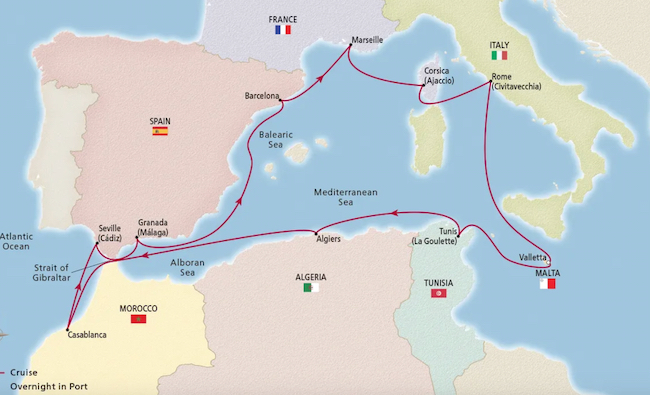
We thought we were done with cruising (this happens a lot) when suddenly this trip popped up on Viking’s new itineraries. We waited only two days, and called to reserve. The cabin area we want was already almost sold out! We got the last cabin, not the normal cabin we reserve, and felt lucky to get it. I checked the cabin catagories; the ship was almost entirely sold out.
Algiers. Malta. Ajaccio. Places we had never been before. It got our hearts racing.
We tried something new; for Barcelona, we booked a tour through Viator to visit the hillside Monastery of Monserrat. For Tunis, where we lived so many years ago, we booked through Tours for Locals, so that we could have a personalized visit to see things that mattered to us. We paid in advance – like more than a year in advance.
We are cautious with our money, so this was a little scary for us. Booking private tours in expensive. Between booking and implementing, a lot can happen. And what if the guides don’t show up??? What is your fallback? By faith, we bit that bullet and it worked out great for us.
It was also a long trip with 23 days total and various climates, so I did not believe I could do it with a carry-on. I used a bigger suitcase, again, by faith, and checked it. We never had a problem, and I was thankful to have a variety of clothing appropriate to the cultures and climate.
This trip took place from mid-November to early December. Today, AdventureMan asked me how I wanted to spend the weekend, and I said “I want to write up the trip for the blog.” In between getting home and now, I had to get Christmas decorations up, bake Christmas dishes, do Christmas Eve dinner, Christmas Day brunch, deal with having norovirus (me, just before Christmas), deal with AdventureMan having norovirus (shortly after Christmas, and with AdventureMan getting a papercut that turned into a severe infection with heavy duty antibiotics. Take Christmas down. Oh, and jury duty. And welcome the New Year with friends.
We are just now getting back to normal. At the end of this month, we start a major bath reconstruction that will disrupt us for six to eight weeks. Now is the time 😊.
“I Think She’s a Liar!”
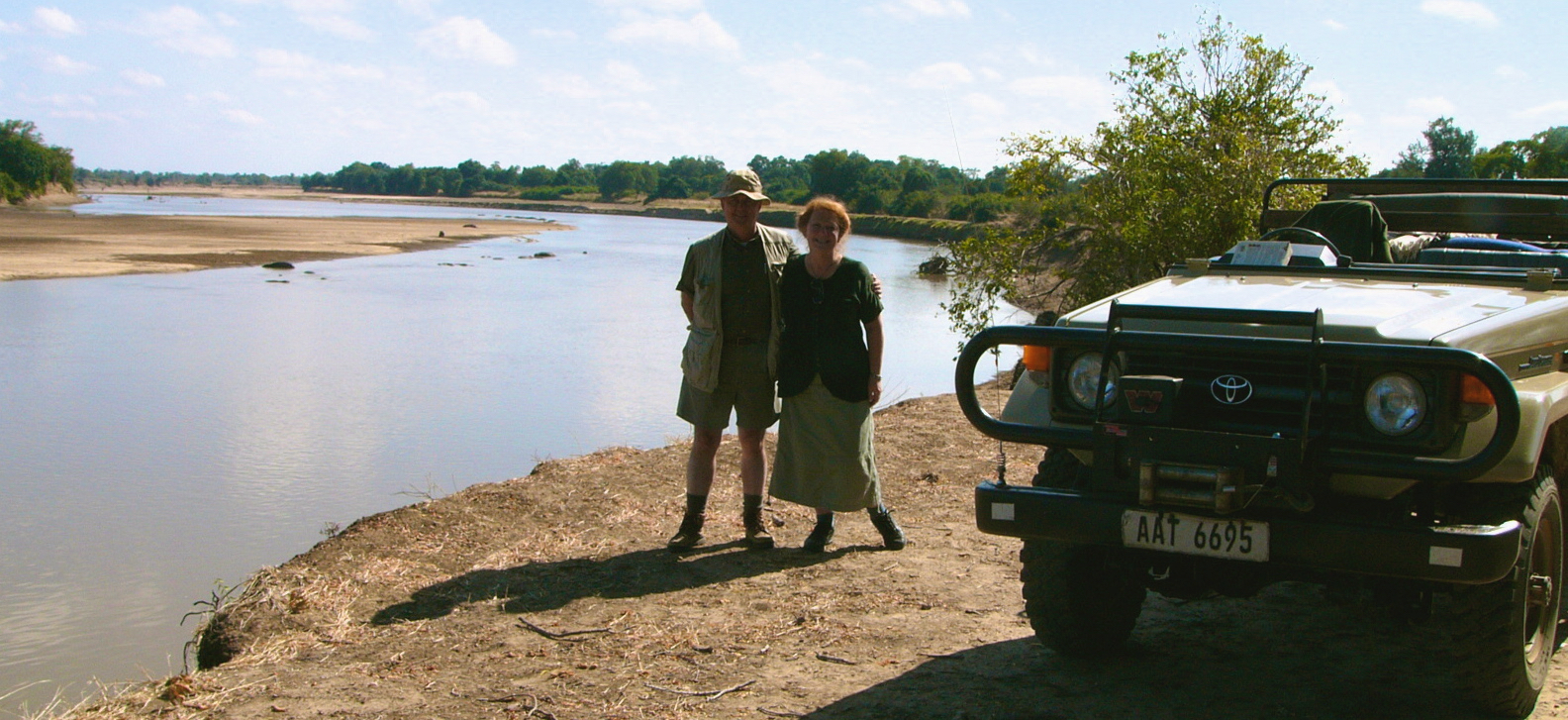
AdventureMan has just come back from running errands and he has some tales to tell. One of his adventures has to do with meeting a woman a little older than him.
“No matter what I said, she’d been there, done that,” he said. “Like we talked about war experience, and I told her I fought in VietNam. She just nodded and said “I lost two husbands fighting in VietNam.”
“We talked about travel in Africa, and as it turns out, she had been everywhere. She’s travelled all the places we’ve been. I think she’s a liar.”
We’ve all run into them – the lunatics who make themselves big by lying.
And then I stopped, caught by a thought. This blog. My own experiences, roaming the world and then settling down in a small Southern city. It sounds wild. Unbelievable.
I have a friend who once told me “Isn’t it wonderful God blessed us with our different kind of lives? I never wanted to travel, and I love that I got to grow up in a small Southern town where I knew everyone.”
She was right. The thought of living all my life in one place makes me choke; I feel strangled. And living here, I am careful not to talk too much about all the places we have lived, and all the places we have visited. I am careful not to talk about the risks we have taken and the adventures we have had. I got the life I was created to live, and it might sound incredible to others.
It brought me up short. I think of people reading this blog and wondering how it can all be true. I read entries from years ago and I can hardly believe it myself! And I believe it’s entirely possible that people might think I am exaggerating or elaborating.
I shrug my shoulders. Yes, I want to have credibility. No, I am not to concerned with whether people believe me or not. And it is interesting to me to be given a sudden shift in perspective. I know how I see myself, and then, in an instant, I see how I might be perceived in another way.
18 Years as Intlxpatr

18 years as Intlxpatr, and who knew I’d still be blogging? I remember the combination of terror and excitement with which I began – and the kindness of the bloggers in Kuwait who welcomed me in, and what great discussions we had. Mostly I remember how much I learned from those early years. I had begun thinking there were things I wanted to remember; I had no idea I would be learning so much, and changing my own perspectives in response. For that, I thank God for giving me the courage to start, and the commitment to persevere.
I’m not the same person now as when I started. What I love is that I am surrounded by people within 20 years on either side of my age who are also changing, evolving, thinking about the bigger things and focusing, too, on the greatness of the small things.
One of the big changes in my life came with being diagnosed with diabetes ten years ago, losing, over the course of ten years, forty pounds and finding again how much I enjoyed swimming. I was once a competitive swimmer; I quit at 16, I just didn’t like being so focused on winning. It spoiled swimming for me. Now, I can’t wait; I get in the pool and just chug along until I’ve done two miles, three days a week. On the days I am not swimming, I miss swimming!
My blood sugar and A1C are NORMAL! I feel twenty years younger!
So today I welcome you in for some healthy and delicious snacks. (Yes! Chocolate is healthy!) All good things in moderation.

My healthy favorite, a blueberry smoothie!

Not boring fruit! Exciting presentation.

Charcuterie!

Veggies for the strong and courageous!

Oranges!

Small amounts of something delicious – you get to choose!

Chocolate to top us off, good healthy chocolate.
I appreciate your stopping my to help me celebrate. Thank you for your support these many years.
On A Mission: Target Eifel Tower
In preparation for this trip, we had several family meetings to put together activities and priorities. Each one of us came up with one “Must” (mine was wandering in the Marais – Mission Accomplished!) so that we had some focus. My granddaughter, N, wanted to go to the top of the Eifel Tower.

We started working on access to the tower months before we departed Pensacola. Tickets were not available. Ticket scalpers had begun scooping up access tickets early in the game and selling them for exaggerated prices. This made life uncomfortable for tours and guides and independent tourists. N’s mother and I would check the official website often, with no luck.
N’s mother is a determined woman – and she lived in a Paris suburb where she taught English for a year, how is that for bold? She determined that accessing the tower would be the number one goal on Day One. Once the family had rested, showered and dressed, they took off to find out what access possibilities looked like on the ground.
They learned it is all luck, but that there are some times when access is likelier than other times. Meanwhile, they had a wonderful adventure and found a Kebab restaurant they all loved.
AdventureMan and I also found a restaurant we loved, Chez Barbara, just a short walk from our hotel. We loved it so much we ate there twice. As an aside, usually I take great notes to help me write up these trips, but when I went to look at my notes, the only notes I had were the Menu from Chez Barbara!
Chez Barbara
47 Rue Washington
75008 Paris France
Menu at Chez Barbara
ENTRÉES
Escargots – 6 pièces 10.00€
Croustillant de chèvre sur salade 8.00€
Carpaccio de bœuf fromage dur et câpres 10.00€
Melon et Jambon Serrano 10.00€
Burrata sauce pesto tomates 10.00€
PLATS
Croque Mr frites ou salades 13.00€
Croque Mme frites ou salades 14.00€
Burger ‘Chez Barbara’ frites 17.00€
Salade italienne 16.00€
Salade, tomates, artichauts, burrata, jambon sec
Salade de croustillant de chèvre chaud 16.00€
Fish & chips 19.00€
Mi-cuit de thon au sésame et purée 19.00€
Bœuf bourguignon (Black Angus) purée de pommes de terre 19.00€
Cuisse de canard confit purée de pdt 19.00€
Tartare de bœuf frites & salade 19.00€
Entrecôte grillée sauce au poivre frites 22.00€
DESSERTS
Crème brulée 8.00€
Tarte tatin, crème fraîche ou glace vanille 8.00€
Fondant au chocolat crème anglaise 7.00€
Baba au rhum 9.00€
SNACK
Tapenade des olives 6.00€
Grissini et Jambon Serrano 7.00€
Assiette de frites 5.00€
Assiette de charcuteries 12.00€
Assiette de fromage 9.00€
Croque Mr frites 13.00€l
I share this with you so you can see the prices, which we found quite reasonable. Wines, beer, and liquors also seemed reasonable – this is downtown Paris, a block from the Champs Elysees’.
What drew us to Chez Barbara was the menu – very down to earth French foods – and then the atmosphere. This was not a snooty restaurant. It was a local restaurant. In the outside seating area, a local sports team was meeting (heavy on beer and french fries) and a girl met up with a man who looked like her father, and they had a plate of french fries and a plate of cold cuts, which they shared, and several glasses of wine. A friendly Australian who worked as a day laborer offered to translate but we told him we were OK, and thanked him for his offer. There was a television and a small bar.
It was also another very hot evening, and we were jet-lagging. We split an Italian salad and a Beouf Bourguignon, and we drank a red Bordeaux. It was a great evening.

Police presence was heavy. As we ate (again, the windows to the street collapsed to the side, we were entirely part of the outdoors) several police cars came by nee-ner, nee-ner, and on the way back to the hotel we saw a person being ticketed for stopping. It was a chauffeur, waiting for a family dining at Cafe’ de Paris.
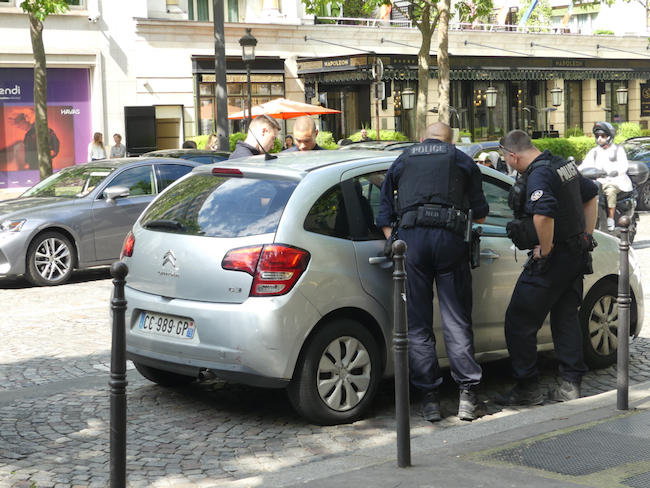
True confession: AdventureMan was very angry with me for photographing the police in action. He was right. I was probably not supposed to do that. Sometimes I take unnecessary risks. Don’t do what I do!
We linked up with our family who were eager to get to bed, get a good night’s sleep, and AdventureMan made plans for the next day to hike up to the top of the Arch with the grands while Mom and Dad sought to get those elusive tickets to climb the tower.
Seventeen Years as Intlxpatr
I don’t blog as often these days – who knew retirement would be so busy? I’ve now lost 40 pounds in retirement – did I mention I was diagnosed diabetic about ten years ago? I started with water aerobics, and when COVID hit, went bach to swimming. We learned to swim in Alaska, when we were very young. Everyone had boats, and every kid learned to swim, even though we had life jackets. The pool where we learned to swim, Evergreen Park, doesn’t even have that old glacier-river fed swimming pool anymore. Yes. It was cold. It didn’t matter. We loved swimming.
Now I am swimming three days a week, 2 miles a day. I love getting up early in the morning and hitting the pool early. I love the quiet of lap swimming and the noise of my pool buddies. It’s a great way to start the day.
I found this great Blogaversary cake honoring those early days in Alaska – won’t you have a piece? There’s another, if you don’t want to mar the beauty of this one.


Being an Alaskan has profoundly influenced who I am; it gave me a spirit of adventure and exploration. We spent a couple years in Seattle, and then moved to Germany with our lively parents, who took us everywhere during the 10 years they lived there.

We lived in Heidelberg. We had our high school proms and graduation in the Heidelberg Castle. We would jump on a train and go to Paris, or Berlin, or Amsterdam. It was an extraordinary adventure.

I met AdventureMan when my sister married in the Heidelberg Castle. We’re heading back later this year to visit some of the cities we were unable to visit during the long years of the Cold War, when there was a wall and a curtain that kept us all divided.



All those early years, they didn’t have “blogging.” It wasn’t until I got to Doha that I discovered blogs, and not until I got to Kuwait that I took the plunge and started this blog. I was terrified. The blogging scene could be rough, and people writing anonymous comments could be brutal. An expat who offended a high official could be sent home, and I didn’t want my husband to suffer for my mistake.
As it turned out, while it was important to tread carefully, blogging opened up a whole new world to me, and I met some really special people who helped me see things in new ways. Blogging changed my life. It gave me a voice, even if it was a timid one. The longer I blogged, the more confident I became – thanks to my fellow bloggers and friends who encouraged me.
So, to honor you, I do this annual virtual party, and invite all of you to enjoy these astounding cakes that people with vision create. I celebrate them, too, and their wondrous talent.

I appreciate the years of friendship and support you have given me. I thank you for reading about my travels and adventures, and for sharing my joys and woes. Thank you, thank you.

Four Corners: Hiking and Petroglyphs
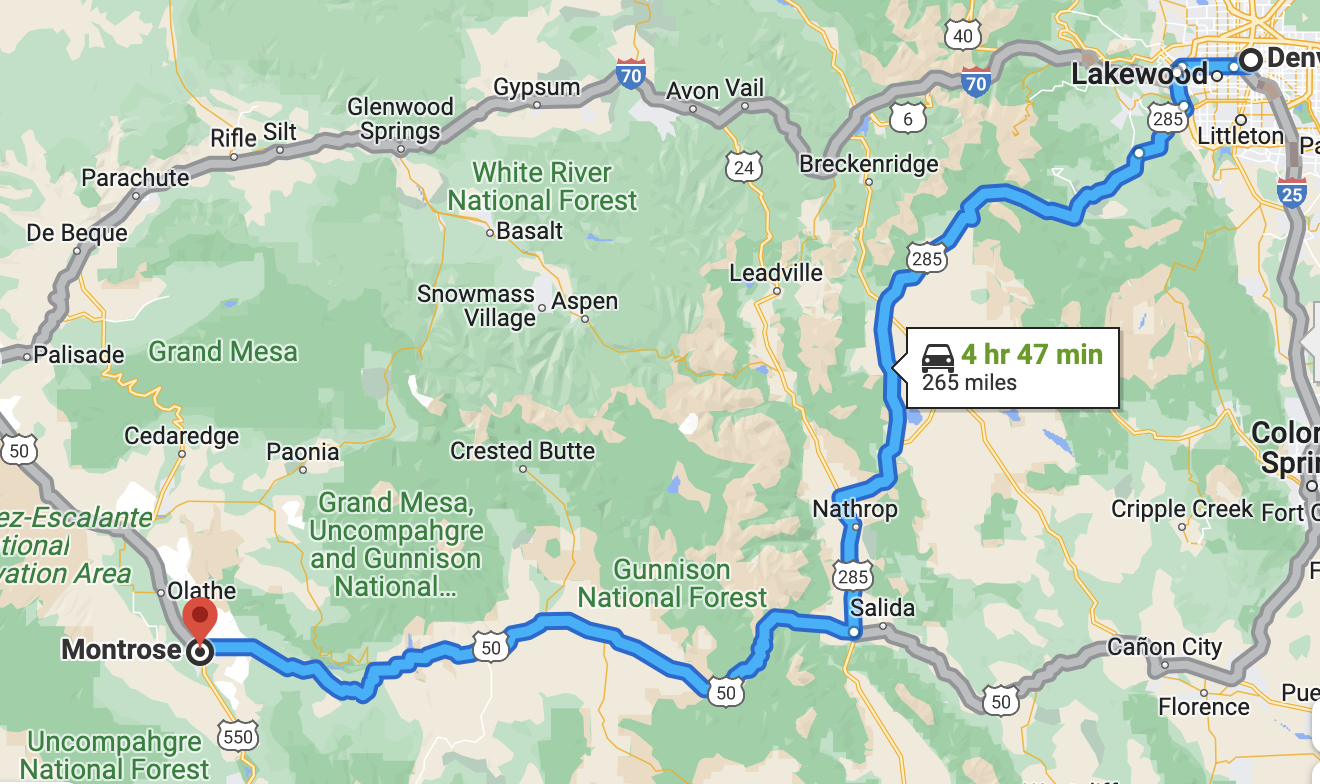
I used to be such a good blogger. I’d take a trip, or have an interesting experience, and I would sit right down and write all about it. It took me a couple months to write up the Barcelona to Abu Dhabi Trip and now – it is August, and I am just now getting to May in Colorado. The focus of this trip is family and hiking, and the map is below:
We love flying into Denver; my niece, Little Diamond (now Professor Little Diamond 😊 ) lives there with her twins and husband-soon-to-be. More and more we choose to rent with Hertz; they have a special relationship with our insurance company and we get good deals. This time, we rolled in and they said “pick any car in this row” so we chose a beautiful cadet blue Suburu Forester.

After an evening of family fun, we headed out early next morning for Montrose, CO, and took a beautiful drive with snow and the early signs of Spring through Ute territory. You’ll see a map of all of that later – it’s astounding.




We’re having a lot of fun with the Subaru; it drives great but we are having to get used to the motor turning off every time we stop. It starts up quickly enough when we press the gas, but it is unnerving at first. I also was confused about what the temperature was; it went through wild fluctuations until I discovered that what I thought was the temperature gauge was in fact the miles-per-hour reading.


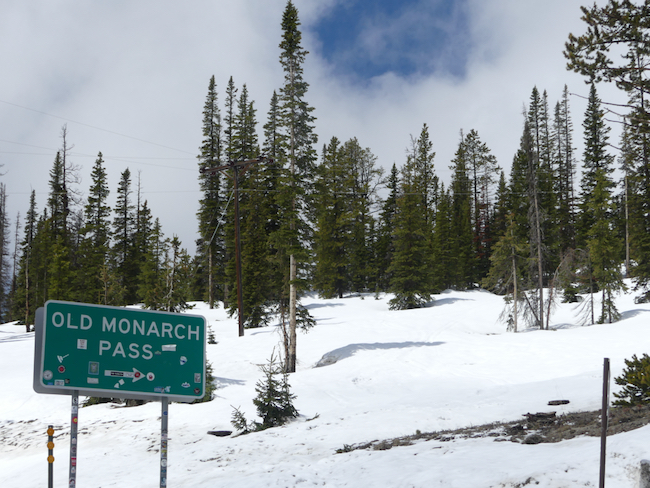

It’s a mixed kind of day for our first drive, lots of sunshine, but also enough clouds to give us some drama, once even a brief snowstorm, and stunning contrasts between late winter and the first signs of Spring as we roll along. All in all, it’s a glorious day.
We arrive in Gunnison at lunch time – a great Western Town.
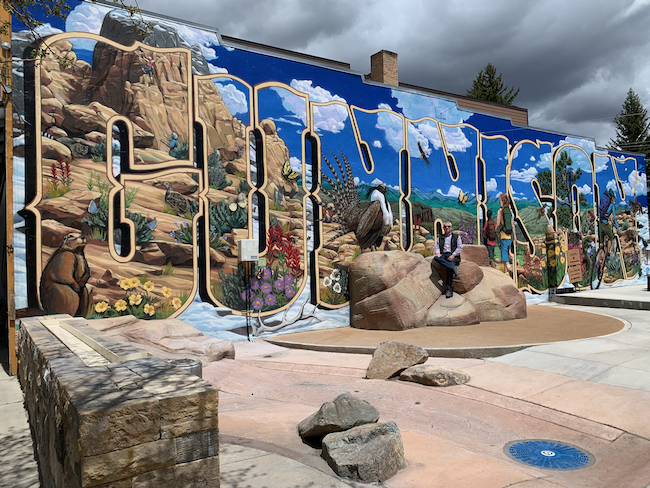


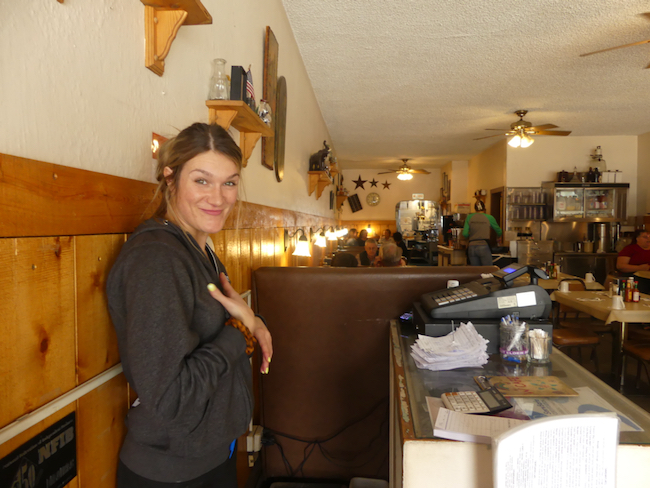
We chose the W Cafe because, as you can see on the sign, this is where the locals eat. It’s Mother’s Day and we got here just in time before the after-church crowd arrives. I asked the cashier if I could take her photo. I thought the owner of this cafe showed genius. All the waitresses were local. They were all pretty, and they all knew all the people who came in. No wonder this is where the locals eat! The food was pretty good, too. We didn’t expect a lot of salad and/or vegetables out here in hiking country, but to our surprise, we were able to find them with almost every meal.
We head on from Gunnison to Montrose, where we have reservations at a B&B. The scenery makes a dramatic change.
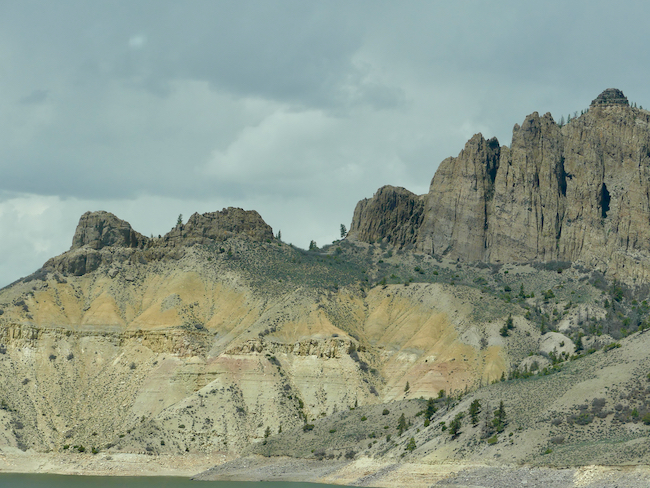


These are the Collegiate Mountains.
Recent Comments
ExpatAlien on What Country am I Living … intlxpatr on Yellowstone: Old Faithful to C… Michelle on Yellowstone: Old Faithful to C… Cathy on No Grown-Ups in Charge intlxpatr on Waiting for Snow Wikipedia Donate Button

Amazina


Early Voting in Florida


 Here There and Everywhere
