Paranoia: Locked Out
Yesterday was bizarre. The blog has become a part of my routine – I get up, grab a cup of coffee, pick up my e-mails, take care of any business that needs be taken care of, read my daily Lectionary readings (see blogroll) and then – I get to visit with YOU!
Imagine how I felt when I could see my blog, but couldn’t log on to it. I don’t know what the problem was.
I tried it on my computer. It kept telling me my password was wrong. Since I have worn the letters off many of the keys on my keyboard, it COULD be wrong, but you know your fingers have this kind of mechanical memory, you know how you can type and your fingers know where the letters are and you don’t even think about it, just think about what you want to say?
So I asked for a new password, thinking oh well, I could change it back to something I might be able to remember. The new password didn’t work. Three times I tried with new passwords, and nothing worked.
I went back and used Adventure Man’s computer, and still couldn’t access.
I have a life, so I went on with my life, and later in the day tried again, with the same results.
Paranoia kind of kicked in. I wondered if I was being blocked? If WordPress was being blocked?
This morning, same story, except this time I prayed and tried all the passwords, promising God if he would just help me get on, just once, I would post my problems (in case it happens again) and change my password, (in case someone has messed with me) and do all the admin work I need to get done.
I haven’t backed up the blog for a long time. I don’t really have time to do it today. Aaaarrrrgh.
But my first, paranoid though was wondering if I had annoyed someone and if I was being blocked.
Then common sense kicked in, thank God, and I figure it was just some kind of technical anomaly. . . it’s like medicine, and political “science”, and all this computer wizardry – there are a lot of black holes, information we just don’t have yet, and I am guessing that this was just one of those anomalies.
I thank you all for bearing with me, and continuing to comment and check on me!
And no, I am not blogging from Syria. The visa never came through. 😦
Sex or Backbiting?
Most of you know, I do the daily readings from The Lectionary (you can always click on it from my Blogroll, down to the right) as part of my spiritual discipline. I also read the daily meditations on Forward Movement, (also in the blogroll.)
Rarely do I share them with you, but this one is where Christianity and Islam are so closely intertwined that I dance for joy – that much can be forgiven to one who loves, but our tongues get us into a lot of trouble.
I know that backbiting is one of the great sins to be avoided during the upcoming holy season of Ramadan, too.
James 3:1-12 The tongue is a fire…a world of iniquity…a restless evil, full of deadly poison.
I sometimes wonder if the churchfolk who seem obsessed with sexual behavior are reading the same Bible I am. If I said that someone was “living in sin,” I know what parts of the body you’d think I was talking about. Yet if it were James or other New Testament authors talking, they would probably be referring to the tongue.
For every reference in the New Testament to sins involving sex, there must be ten concerning speech. Why? Because while sex is certainly one form of communication, speech is a more potent one in the daily life of a congregation. Words have power.
God creates the world and keeps in touch with it, after all, by his Word; and words are how we keep in touch with each other. But the word that can create can also destroy–a reputation, an institution, a life. Words tell us who and how we are and whether we belong; words bind the community together-or tear it apart. Sexual misconduct is bad–and easy to recognize as bad.
The sniping, backbiting, spite, and deceit that go on in some communities are often hard to see, let alone root out. Yet their effect is more corrosive over the long term. How did our priorities get so mixed up?
PRAY for the Diocese of South Carolina (United States)
Ps 38 * 119:25-48; 1 Kings 9:24-10:13; Mark 15:1-11
For Sparkle
Cool palm tree, huh, Sparkle?

But yes, yes, it IS strangely tall.
This is how they disguise communication towers in Kuwait. No! It isn’t really a palm tree, but I knew you would love the whimsey and creativity of it all.
The Nativity of John the Baptist
This will be a long, technical post that you can skip if religious matters don’t interest you. It is aimed at my colleagues who enjoy comparing points of religion.

This week, we celebrated the feast of the birth of St. John, known as The Baptist. There were several scriptural readings (see below which is from the online Lectionary on my blogroll)
We had a reading I hadn’t heard before:
An account of the mercy of thy Lord bestowed upon his servant Zachariah, when he called upon his lord in low tones, praying: My Lord, my very bones have become feeble and my head has turned hoary with age, but never have my supplications to Thee, Oh Lord, remained unfruitful. I am apprehensive of the behavior of my relations after my death, and my wife is barren. I beg Thee, therefore, do Thou bestow upon me from Thyself a successor to be my heir and to be the heir of the blessings of the House of Jacob; and to make him one who should be pleasing in Thy sight, O Lord . . . .
(it tells of Johns conception and birth)
We commanded Yahya (John): Hold fast the Book; and we bestowed upon him wisdom while he was still young, as a token of tenderness from Ourself and to purify him. He grew up righteous, and was dutiful towards his parents and was not haughty or rebellious. Peace was on him on the day of his birth, and on the day of his death, and peace will be on him on the day he will be raised up to life again.
As I am hearing this reading, I am thinking “I am pretty familiar with our scriptures, and while it sounds familiar, I don’t think I have ever heard this reading before,” and I thought maybe it was from one of the less often read books that not all churches agree is part of the scripture.
And then – the reader said “This reading on John is from the Qu’ran.”
I was amazed. First – I had no idea John was mentioned in the Qu’ran. I know Jesus is in the Qu’ran, and my Saudi women friends told me Jesus’ name is in there more than the name of the Prophet Mohammed. (Peace be upon all the prophets!) But I had no idea John was in the Qu’ran, Chapter 19, which is called the book of Maryam, and also tells of the life and ministry of Jesus.
Second – I’ve never heard the Qu’ran read in a Christian church service before, but why not? It added, not subtracted, from our understanding of John. I thought it was pretty cool.
Here is what our Lectionary has to say about John the Baptist:
THE BIRTH OF JOHN THE BAPTIST
(24 JUNE NT)
Our principal sources of information about John the Baptist are
(1) references to his birth in the first chapter of Luke,
(2) references to his preaching and his martyrdom in the Gospels, with a few references in Acts, and
(3) references in Josephus to his preaching and martyrdom, references which are consistent with the New Testament ones, but sufficiently different in the details to make direct borrowing unlikely.
According to the Jewish historian Josephus (who wrote after 70 AD), John the Baptist was a Jewish preacher in the time of Pontius Pilate (AD 26-36). He called the people to repentance and to a renewal of their covenant relation with God. He was imprisoned and eventually put to death by Herod Antipas (son of Herod the Great, who was king when Jesus was born) for denouncing Herod’s marriage to Herodias, the wife of his still-living brother Philip. In order to marry Herodias, Herod divorced his first wife, the daughter of King Aretas of Damascus, who subsequently made war on Herod, a war which, Josephus tells us, was regarded by devout Jews as a punishment for Herod’s murder of the prophet John.
In the Book of Acts, we find sermons about Jesus which mention His Baptism by John as the beginning of His public ministry (see Acts 10:37; 11:16; 13:24). We also find accounts (see Acts 18:24; 19:3) of devout men in Greece who had received the baptism of John, and who gladly received the full message of the Gospel of Christ when it was told them.
Luke begins his Gospel by describing an aged, devout, childless couple, the priest Zechariah and his wife Elizabeth. As Zechariah is serving in the Temple, he sees the angel Gabriel, who tells him that he and his wife will have a son who will be a great prophet, and will go before the Lord “like Elijah.” (The Jewish tradition had been that Elijah would herald the coming of the Messiah = Christ = Annointed = Chosen of God.) Zechariah went home, and his wife conceived. About six months later, Gabriel appeared to the Virgin Mary, a kinswoman of Elizabeth, and told her that she was about to bear a son who would be called Son of the Most High, a king whose kingdom would never end. Thus Elizabeth gave birth to John, and Mary gave birth six months later to Jesus.
After describing the birth of John, Luke says that he grew, and “was in the wilderness until the day of his showing to Israel.” The people of the Qumran settlement, which produced the Dead Sea Scrolls, sometime use the term “living in the wilderness” to refer to residing in their community at Qumran near the Dead Sea. Accordingly, it has been suggested that John spent some of his early years being educated at Qumran.
All of the gospels tell us that John preached and baptized beside the Jordan river, in the wilderness of Judea. He called on his hearers to repent of their sins, be baptized, amend their lives, and prepare for the coming of the Kingship of God. He spoke of one greater than himself who was to come after. Jesus came to be baptized, and John told some of his disciples, “This is the man I spoke of.” After His baptism by John, Jesus began to preach, and attracted many followers. In fact, many who had been followers of John left him to follow Jesus. Some of John’s followers resented this, but he told them: “This is as it should be. My mission is to proclaim the Christ. The groomsman, the bridegroom’s friend, who makes the wedding arrangements for the bridegroom, is not jealous of the bridegroom. No more am I of Jesus. He must increase, and I must decrease.” (John 3:22-30)
John continued to preach, reproving sin and calling on everyone to repent. King Herod Antipas had divorced his wife and taken Herodias, the wife of his (still living) brother Philip. John rebuked him for this, and Herod, under pressure from Herodias, had John arrested, and eventually beheaded. He is remembered on some calendars on the supposed anniversary of his beheading, 29 August.
When John had been in prison for a while, he sent some of his followers to Jesus to ask, “Are you he that is to come, or is there another?” (Matthew 11:2-14) One way of understanding the question is as follows: “It was revealed to me that you are Israel’s promised deliverer, and when I heard this, I rejoiced. I expected you to drive out Herod and the Romans, and rebuild the kindom of David. But here I sit in prison, and there is no deliverance in sight? Perhaps I am ahead of schedule, and you are going to throw out the Romans next year. Perhaps I have misunderstood, and you have a different mission, and the Romans bit will be done by someone else. Please let me know what is happening.”
Jesus replied by telling the messengers, “Go back to John, and tell him what you have seen, the miracles of healing and other miracles, and say, ‘Blessed is he who does not lose faith in me.'” He then told the crowds: “John is a prophet and more than a prophet. He is the one spoken of in Malachi 3:1, the messenger who comes to prepare the way of the LORD. No man born of woman is greater than John, but the least in the Kingdom of God is greater than John.”
This has commonly been understood to mean that John represents the climax of the long tradition of Jewish prophets looking forward to the promised deliverance, but that the deliverance itself is a greater thing. John is the climax of the Law. He lives in the wilderness, a life with no frills where food and clothing are concerned. He has renounced the joys of family life, and dedicated himself completely to him mission of preaching, of calling people to an observance of the law, to ordinary standards of virtue. In terms of natural goodness, no one is better than John. But he represents Law, not Grace. Among men born of woman, among the once-born, he has no superior. But anyone who has been born anew in the kingdom of God has something better than what John symbolizes. (Note that to say that John symbolizes something short of the Kingdom is not to say that John is himself excluded from the Kingdom.)
Traditionally, the Birth of Jesus is celebrated on 25 December. That means that the Birth of John is celebrated six months earlier on 24 June. The appearance of Gabriel to Mary, being assumed to be nine months before the birth of Jesus, is celebrated on 25 March and called the Annunciation, and the appearance of Gabriel to Zechariah in the Temple is celebrated by the East Orthodox on 23 September. At least for Christians in the Northern Hamisphere, these dates embody a rich symbolism. (NOTE: Listmembers living in Australia, New Zealand, South Africa, southern South America, or elsewhere in the Southern Hemisphere, press your delete keys NOW!) John is the last voice of the Old Covenant, the close of the Age of Law. Jesus is the first voice of the New Covenant, the beginning of the Age of Grace. Accordingly, John is born to an elderly, barren woman, born when it is really too late for her to be having a child, while Jesus is born to a young virgin, born when it is really too early for her to be having a child. John is announced (and conceived) at the autumnal equinox, when the leaves are dying and falling from the trees. Jesus is announced (and conceived) at the vernal equinox, when the green buds are bursting forth on the trees and there are signs of new life everywhere. John is born when the days are longest, and from his birth on they grow steadily shorter. Jesus is born when the days are shortest, and from his birth on they grow steadily longer. John speaks truly when he says of Jesus, “He must increase, but I must decrease.”
(Of course, it is to be noted that none of this symbolism proves anything, since the Scriptures do not tell us that Jesus was born on 25 December. The symbolism of the dates is used by Christians, not as evidence, but as material for the devout imagination.)
FIRST LESSON: Isaiah 40:1-11
(Isaiah speaks of someone who will cry out, “Prepare the way of the LORD.”)
PSALM 85
(The long exile is over, God has retored his people, mercy and truth are reconciled.)
SECOND LESSON: Acts 13:14b-26
(Paul preaches about Christ, and how the prophets, including John the Baptist, all pointed forward to him.)
THE HOLY GOSPEL: Luke 1:57-80
(The birth of John the Baptist; his father Zechariah’s song of praise.)
by James Kiefer
Gulf History Source
Thank you, Kinan, for bringing this website to our attention yesterday on the Kuwait boats blog entry. I had been to the site before, while looking up information on Gulf Architecture. The blogger writes from a particularly Qatar point of view, but what he learns and documents applies greatly to all the countries along west side of the Arabian Gulf. And I am adding him to my blogroll.
I love this man’s attention to detail. I have lifted a photo from his page on Arab Gulf boats. This is the typical toilet on the bigger old boats. It is called a zuli. Ugh!
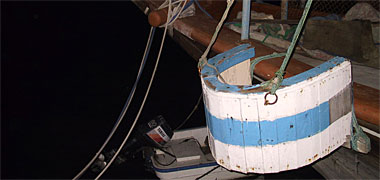
The website is catnaps.org and if you click here, it will take you to his fascinating and fairly thorough website on Arabian Gulf boats. If you click here, you will find a long article on Gulf Architecture but he has an entirely separate entry for Islamic Architecture. It is not easy reading, but it is not something you will be tested on at the end of the hour, either. It’s just a great opportunity to learn more about a subject you never considered.
On his About page, the author tells us his name is John Lockerbie and:
In addition to working in the areas of project management, architecture, planning and urban design I have taught architecture, graphic design and presentation. I have had a wide scale of design involvement ranging from the exciting design worlds of crockery, cutlery, glass and napery, rising in scale through other aspects of graphic, interior, architectural and urban design to strategic planning. I have also been lucky enough to have worked in change management and primary education.
On a hot, lazy day when you have nothing better to do, you can spend a couple hours getting lost on his website, and come away a more knowledgable person for having done so.
Again, thank you Kinan, for a truly GREAT weblink.
Blarney Blarney Blarney
There is a two syllable word that starts with “b” and has to do with bulls and excrement and you use it to imply that someone is saying something that is not true. It is not a polite word, but there is a perfectly good two syllable word that also starts with a “b” and that is “blarney.”
When Adventure Man is chatting me up about something, and I can see where it is going, him spinning all these illusions and wanting my buy-in and this is the perfect “b” word to use: Blarney, Blarney, Blarney. We always end up laughing.
And Blarney is the word-a-day for today:
This week’s theme: toponyms coined after places in Ireland.
blarney (BLAHR-nee) noun
1. Flattery.
2. Misleading talk.
[After the Blarney stone, a stone in Blarney Castle in Blarney village,
near Cork, Ireland which, according to legend, gives the gift of the gab
to anyone who kisses it.]
A Word a Day is in the blogroll to the right, or you can subscribe to A Word a Day here.
Little Diamond’s Peeve
Little Diamond, my niece living and working in Beirut, has a pet peeve, which I remembered as I was writing a comment on an earlier piece.
“I HATE it when people write ‘discrete’ when they mean ‘discreet!” she exclaimed, inflamed.
OOOps. I don’t know if I do it of not. Now, I look it up every time so I won’t inflame Little Diamond.
dis·creet (dĭ-skrēt’)
adj.
Marked by, exercising, or showing prudence and wise self-restraint in speech and behavior; circumspect.
Free from ostentation or pretension; modest.
[Middle English, from Old French discret, from Medieval Latin discrētus, from Latin, past participle of discernere, to separate, discern.
dis·crete (dĭ-skrēt’)
adj.
Constituting a separate thing. See synonyms at distinct.
Consisting of unconnected distinct parts.
Mathematics. Defined for a finite or countable set of values; not continuous.
[Middle English, from Old French, from Latin discrētus, past participle of discernere, to separate.
Here is where it get’s tricky:
dis·cre·tion (dĭ-skrĕsh’ən)
n.
The quality of being discreet; circumspection. See synonyms at prudence.
Ability or power to decide responsibly.
Freedom to act or judge on one’s own: All the decisions were left to our discretion.
The first is used to describe behavior. The second is used to describe the state of being separate. They have identical pronunciation, thank God. You can see they are from the same root.
The third is a type of behavior made by a person having the freedom to choose separately. I am guessing it is more related to discrete than to discreet, but usually when you behave with discretion, you behave discreetly.
Yeh, we are word-nerds.
Readings for Today
You will notice to the right, in my Blogroll, is an entry for The Lectionary. The Lectionary readings are scheduled so that every three years you read completely through the Bible. Actually, my sect, which is Episcopalian (the American version of Anglican, although the two have been closer at some times than others) shares the same readings with many other Christians, we also have some books/chapters in our Bible that most of the main-line Protestant bibles don’t have.
Today’s gospel reading is one of the hardest ones. You look at it and you read it and it SOUNDS so simple:
Luke 6:27-38
27 ‘But I say to you that listen, Love your enemies, do good to those who hate you,
28bless those who curse you, pray for those who abuse you.
29If anyone strikes you on the cheek, offer the other also; and from anyone who takes away your coat do not withhold even your shirt.
30Give to everyone who begs from you; and if anyone takes away your goods, do not ask for them again.
31Do to others as you would have them do to you.
32 ‘If you love those who love you, what credit is that to you? For even sinners love those who love them.
33If you do good to those who do good to you, what credit is that to you? For even sinners do the same.
34If you lend to those from whom you hope to receive, what credit is that to you? Even sinners lend to sinners, to receive as much again.
35But love your enemies, do good, and lend, expecting nothing in return.* Your reward will be great, and you will be children of the Most High; for he is kind to the ungrateful and the wicked. 36Be merciful, just as your Father is merciful.
37 ‘Do not judge, and you will not be judged; do not condemn, and you will not be condemned. Forgive, and you will be forgiven;
38give, and it will be given to you. A good measure, pressed down, shaken together, running over, will be put into your lap; for the measure you give will be the measure you get back.’
There is nothing easy about loving your enemy. One priest, as I was anguishing through this passage, told me “You don’t have to LIKE them, but you MUST love them.” That helped, but still, loving your enemy is probably the hardest thing on earth to do. And “Do not judge”????? Holy smokes, we judge one another on a daily basis, and usually not to their credit.
Give, even if you think the begger may be lying?
And then, the hardest one of all – “Forgive, and you will be forgiven.” So like, if I don’t forgive . . . I don’t get forgiveness? Like I have to give up my grudges, the chip on my shoulder? I have to forgive the unforgivable, the personal insults, the slights, the jerk who cuts me off on the road? I have to forgive my neighbor? I have to forgive my friend? My husband? George Bush? Osama bin Laden? I have to forgive to receive forgiveness??
But, at the last, the reward – that no matter how hard it is, if you follow these rules, abundant life will be poured in your lap.
You can follow the daily readings by clicking on the Lectionary, in the blogroll, and scrolling down to the current week. Click on the week and it will take you to the daily readings, which include the Psalms, the Old Testament, the New Testament and the Gospel. The reading above, from Luke, is today’s Gospel reading.
NYT Article on “Shiitization of Syria”
My neice, Little Diamond wrote this morning referring to an excellent piece entitled Catalytic Conversion about persistent rumors of “Shiitization” in Syria. The article, by Andrew Tabler, is from today’s New York Times Sunday Magazine section, begins here:
The Middle East is abuzz with talk of “Shiitization.” Since the war in Lebanon last summer, newspapers, TV news channels and Web sites in Egypt, Saudi Arabia and elsewhere have reported that Sunnis, taken with Hezbollah’s charismatic Shiite leader Hassan Nasrallah and his group’s “resistance” to Israel, were converting to Shiite Islam. When I recently visited the semi-arid plains of eastern Syria, known as the Jazeera, Sunni tribal leaders whispered stories of Iranians roaming the Syrian countryside handing out bags of cash and macaroni to convert families and even entire villages to Shiite Islam.
You can read the original article from the New York Times Sunday Magazine section HERE.
Audio and Video Streaming Stopped?
My neice, Little Diamond, checking on Kuwaiti Censorship went to the Ministry on Information where she found this statement:
الإذاعة والتلفزيون
على الإنترنت
حتى إشعار أخر
Audio & Video Streaming is stopped
until further notice
And I just checked it, but I can’t figure out if it means they are discontinuing audio and video streaming from their site, or if they intend to discountinue audio and video streaming into Kuwait?
Anyone know anything?
Recent Comments
intlxpatr on Yellowstone: Old Faithful to C… Michelle on Yellowstone: Old Faithful to C… Cathy on No Grown-Ups in Charge intlxpatr on Waiting for Snow intlxpatr on Waiting for Snow Wikipedia Donate Button

Amazina


Early Voting in Florida


 Here There and Everywhere