Cutting for Stone by Abraham Verghese

Someone in my book club in Qatar mentioned this book, Cutting for Stone, a while back, and I bought it, but it has sat for months on my to-read shelf (LOL, there are actually several, but one with the most important books, and another with the ‘guilty pleasures,’ the ones I am addicted to and save as a reward for good behavior, like vacuuming.)
When a good friend said she was reading it, and that it was good, I decided to move it up in priority, sort of like taking medicine, read a book that is good for you.
Oh WOW.
First, it is a great, absorbing story. Twin boys are born, totally unexpected, to an Indian Catholic nun and an English surgeon, working in Addis Ababa. How they were conceived is a mystery. The mother dies in childbirth, the father flees in horror, the children are born conjoined at the head and must be separated. The boys are adopted by an Indian couple, doctors at the hospital, and are raised with love and happiness.
That’s just the beginning!
I’ve always wanted to go to Ethiopia and Eritrea. I want to visit Lalibela, and some of the oldest Christian churches in the world. When my father was sick, he had a home health aid from Ethiopia, Esaiahs, who told me about the customs in his church, and how Ethiopian Christianity is very close to Judaism, with men and women separated in the church, and eating pork forbidden.

Reading this book, I felt like I had lived there, and I want to go back. The author captures the feelings, the smells, the visuals, the sounds, and if I awoke in a bungalow at the MIssing (Mission) Hospital, I would say “Ah yes! I remember this!”
I kept marking sections of this book that I loved. Here is one:
They parked at Ghosh’s bungalow and walked to the rear or Missing, where the bottlebrush was so laden with flowers that it looked as if it had caught fire. The property edge was marked by the acacias, their flat tops forming a jagged line against the sky. Missing’s far west corner was a promontory looking over a vast valley. That acreage as far as the eye could see belonged to a ras – a duke – who was relative of His Majesty, Haile Selassie.
A brook, hidden by boulders, burbled; sheep grazed under the eye of a boy who sat polishing his teeth with a twig, his staff near by. He squinted at Matron and Ghosh and then waved. Just like in the days of David, he carried a slingshot. It was a goatherd like him, centuries before, who had noticed how frisky his animals became after chewing a particuar red berry. From that serendipitous discovery, the coffee habit and trade spread to Yemen, Amsterdam, the Caribbean, South America, and the world, but it had all begun in Ethiopia, in a field like this.
We live inside the hearts and minds of doctors, some practicing under the worst possible conditions, and learn how they make their decisions and why. Verghese is a compassionate author; while his characters may be flawed, they are forgivable and forgiven.
Another section I loved, the man speaking is Ghosh, the man who adopted the twins with Hema, another doctor:
“My genius was to know long ago that money alone wouldn’t make me happy. Or maybe that’s my excuse for not leaving you a huge fortune! I certainly could have made more money if that had been my goal. But one thing I won’t have is regrets. My VIP patients often regret so many things on their deathbeds. They regret the bitterness they’ll leave in people’s hearts. They realize that no money, no church service, no eulogy, no funeral procession no matter how elaborate, can remove the legacy of a mean spirit.”
Things in Ethiopia get sticky, politically, and one of the twins is forced to flee, implicated in an airplane hijacking only because he was raised with a young woman involved. He is spirited into Eritrea, where he awaits his ride out to Kenya, and he helps the Eritrean rebels when large numbers of wounded are brought into his area. When the time comes to leave, his thoughts will strike a chord in anyone who has ever been an expat:
Two days later I took leave of Solomon. There were dark rings under his eyes and he looked ready to fall over. There was no questioning his purpose or dedication. Solomon said “Go and good luck to you. This isn’t your fight. I’d go if I were in your shoes. Tell the world about us.”
This isn’t your fight. I thought about that as I trekked to the border with two escorts. What did Solomon mean? Did he see me as being on the Ethiopian side, on the side of the occupiers? No, I think he saw me as an expatriate, someone without a stake in this war. Despite being born in the same compound as Genet, despite speaking Amharic like a native, and going to medical school with him, to Solomon I was a ferengi – a foreigner. Perhaps he was right, even though I was loath to admit it. If I were a patriotic Ethiopian, would I not have gone underground and joined the royalists, or others who were trying to topple Sergeant Mengistu? If I cared about my country, shouldn’t I have been willing to die for it?
The book has a lot of observations about coming to America; some of which made me laugh, some which made me groan. Coming back is always a shock to people who have lived abroad for a time, but it is a huge shock to those coming for the first time:
The black suited drivers led their passengers to sleek black cars, but myman led me to a big yellow taxi. In no time we were driving out of Kennedy Airport, heading to the Bronx. We merged at what I thought was a dangerous speed onto a freeway and into the slipstream of racing vehicles. “Marion, jet travel has damaged your eardrums,” I said to myself, because the silence was unreal. In Africa, cars ran not on petrol but on the squawk and blare of their horns. Not so here; the cars were near silent, like a school of fish. All I heard was the whish of rubber on concrete or asphalt.
As I neared the end, I read more slowly, unwilling for this book to end. It is one of the most vivid and moving books I have ever read. AdventureMan has gone online to find the nearest Ethiopian restaurant so we can have some injera and wot.
The Dressmaker by Posie Graeme-Evans
When I wrote up this book for another site, I could not even remember the main character’s name. (Ellen Gowan) I found the book annoying, and most of the time, when a book annoys me, I don’t even tell you about it, I just don’t bother reviewing it at all.

I find the plot thin. I find the characters unmotivated. I find many of the choices of the characters unbelievable. We haven’t been given enough back-story to make the characters truly live.
Ellen has a real streak of bad luck. On her 13th birthday, a well-born young man gets fresh with her and in rural Victorian England, it becomes her problem – her reputation is damaged by a callow young man from a wealthy family. On the same day, an earthquake strikes her village, killing her father, and she and her mother subsequently lose their home.
They take up residence with Ellen’s aunt, her mother’s sister, and it is a happy time, all except for her aunt’s husband, a cruel man who isolates and beats his wife, who can do nothing about it. A wife is property. Her marriage was arranged; she has no where to go if she were to leave. She works hard at keeping her husband happy, so he won’t beat her or take it out on anyone she loves.
When you are dealing with an abusive manipulator, however, there is no pleasing, right? Ellen and her mother are thrown out, but also thrown a lifeline, and take up residence with a dressmaker, where Ellen hones and develops a talent for costume design (meaning evening dress, calling clothes, mourning clothes – wealthy Victorian women had huge wardrobes of ever-changing fashionable clothes.)
Ellen makes some really bad choices – in my opinion. I’m not going to tell you what those choices are, because I don’t want to give you too much of the story, in case you want to read it yourself.
Long story short, she ends up a very successful fashion designer/producer in London, only to face ruinous blackmail because of her past.
OK, here is what I really liked about the book. While I found the characters, descriptions, plotlines and dialogues pretty awful, I loved reading about the fashions, and I found reading about the social status of women – not all that long ago – where women in England had few choices and fewer opportunities – fascinating. I have friends in Kuwait and Qatar who face some of the same limitations. How soon we forget; it wasn’t that long ago that we faced the same challenges, the same limitations.
The freedom to live on our own. The freedom to earn and manage our own money. The rights to our children. All these issues are fresh in The Dressmaker, and too easily taken for granted in our own.
Lord of Death by Eliot Pattison
I didn’t know that much about the Chinese obliteration of Tibetan culture in Tibet. I didn’t know about the systematic destruction of the monasteries, or at least not in detail. I didn’t know about the brutal re-education techniques for the Bhuddist monks. I didn’t know how strong and resistant the peoples of Tibet are to the Chinese incursion.
I’ve learned most of what I know reading Eliot Pattison’s series featuring Shan Tao Yun, a Chinese detective. Or he used to be. In the first book, The Skull Mantra, we meet Inspecter Shan Tao Yun in one of those re-education camps, where he has been tortured and mistreated almost to his physical limits, and the Bhuddist monks teach him new ways of thinking, and those ways help him to see things differently – and to survive.
The Tibetans hate the Chinese, but they make an exception for Inspector Shan Tao Yun, who earns the respect of both Tibetans and Chinese for his unwavering integrity, and his ability to solve the most intricate puzzles. As he does, we learn more about different aspects of life today in Tibet.
The Lord of Death introduces us to the evolving mountain climbing industry developing in Tibet, just across the border with Nepal. Western climbers will see themselves in a very new light reading this book, which involves the murder of the visiting Chinese Minister of Tourism, an American female climber, and former members of a clandestine CIA trained group of Tibetans during WWII.
In every volume, I learn something fascinating. In this book, I learned more about the early struggles of the Chinese Cultural revolution, the corruption of Chinese ideals, and more about Tibetan ways of thinking. I cannot wait for the next book to come out. You can visit his website here: Eliot Pattison.com
Her Fearful Symmetry by Audrey Niffenegger
This was another find passed along by either Big Diamond or Little Diamond, via my Mom, and oh, what a find. Audrey Niffenegger wrote The Time Traveler’s Wife, a highly unusual book which hit the best seller list like a hurricane. This book, Her Fearful Symmetry, solidifies the perception that this author has real talent, thinks way outside the box, and creates characters and situations that, while unlikely, are likable and who become real enough for us to identify with them.
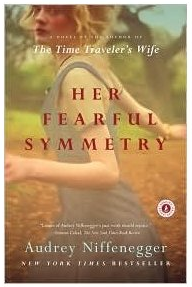
The title is based on a poem by William Blake, a poem I have always liked:
The Tiger
TIGER, tiger, burning bright
In the forests of the night,
What immortal hand or eye
Could frame thy fearful symmetry?
In what distant deeps or skies 5
Burnt the fire of thine eyes?
On what wings dare he aspire?
What the hand dare seize the fire?
And what shoulder and what art
Could twist the sinews of thy heart? 10
And when thy heart began to beat,
What dread hand and what dread feet?
What the hammer? what the chain?
In what furnace was thy brain?
What the anvil? What dread grasp 15
Dare its deadly terrors clasp?
When the stars threw down their spears,
And water’d heaven with their tears,
Did He smile His work to see?
Did He who made the lamb make thee? 20
Tiger, tiger, burning bright
In the forests of the night,
What immortal hand or eye
Dare frame thy fearful symmetry?
While this tale is a great yarn, it helps to know this poem, there are a lot of literary references in the novel and the title is just one of them.
As the story begins, there is a death, a will, and a set of mirror-image twins who inherit a flat in London overlooking a famous cemetery. The flat is in a building and has an upstairs neighbor, a man succumbing to obsessive-compulsive disease, and a downstairs neighbor, an aging bachelor, all a little eccentric in the nicest, English sort of way. The twins, Valentina and Julia, are twenty years old, and waif-like, still dressing alike, doing almost everything together.
There is also a ghost. No, wait! Two ghosts, and a kitten ghost. No, wait! I forgot! Lots of ghosts!
What I love about Audrey Niffenegger is that she takes what we perceive as reality and gives it a twist, and once you buy the twist, you are off on a wild ride. This book is a wild ride, with unforgettable characters and some unexpected kinks and thrills, as well as more than a couple shudders and chills.
The Book Thief by Markus Zusak
Until I sat down to write these reviews (so I can pass these along to friends in Kuwait who I know will read and discuss them 🙂 ) I didn’t realize that the books had so much in common. They both take place in the WWII time frame, and both are told from the point of view of children coming of age in this time. Both are love stories, romantic, parental, community – they have many of the same elements. They both have bullies, and children who steal. They both have wise adult conspirators, mentors and guides.

In The Book Thief, right off you get a chill. One of the main characters in a personification of Death, a tired, weary, cynical Death, but a Death who is fascinated by his humans. When the opening pages are written by Death, you get a feeling that this can’t be good.
And, in the beginning, it is not good. Liesel is on her way . . . somewhere, we don’t know where, on a long train ride, during which her brother dies. They are forced off the train, and her brother is buried in some small village where they are unknown; the grave will probably never be visited. Shortly after, they re-board another train, and when they arrive, Liesel is turned over to a government foster family agency, and she is placed with a rough, uneducated couple in a small village on the outskirts of Germany.
Not far from Dachau.
So many similar elements . . . people at the mercy of their government, and the madness of the politicians and mass hysteria. Bullies, but not just in the schoolyards, here there is also a nationally encouraged group of bullies, the Nazis, and people in every village are encouraged to join the party. The kids join Hitler Youth and practice to become good Nazis.
Except inside each one of us resides a spirit of humanity, and if you let that spirit dominate, you can come into conflict with the party, even if you appear to comply most of the time. Liesel’s foster parents turn out to be a very humane sort. They feel compassion for the Jews marched through their village on the way to the camps, and attempt to give them a little bread, for although they have little to share, they can see that these Jews are starving.
And then, a stranger arrives on the doorstep, the son of a man who saved Liesel’s Papa’s life in the first world war. He is Jewish. He needs a place to be hidden. Liesel’s foster parents take him in and hide him in the basement.
Only after I read the book and read the afterword did I discover this is a book written for young adults, and that makes me laugh, because I am not a young adult, and I enjoyed the book so much. I love books about the triumph of the human spirit, the triumph of good over evil, and the triumph of hope and life over hopelessness. Even Death has a heart, in this book.
I know that there will be one copy of this book in Kuwait; I am leaving it with a friend I know will read it, and I know she will pass it along, because this is a book worth discussing. I hope you are friends with my friend, and that you will get a chance to read it, too!
Hotel at the Corner of Bitter and Sweet by Jamie Ford
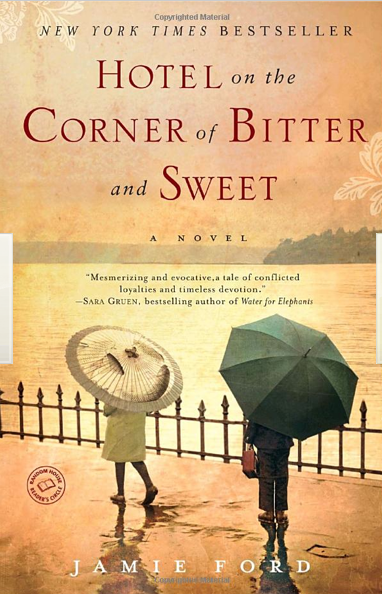
This book had everything going for it, and still I had a hard time getting into it. The book was given by Little Diamond to my Mom – Little Diamond often passes along the very best, thought-provoking books, and in our family we pass the best along, so I knew it would be good. I love the title. The book is set in a part of Seattle now called – euphemistically – The International District, but as I was growing up, and among older Seattle-ites, it is called Chinatown, even though that is not politically correct, or geographically correct. Chinatown was never Chinatown, it was a group of distinct populations – Chinese, Japanese, later Vietnamese, Korean, even later Ethiopian, Sudanese, Somali, Pakistan . . . you could call it immigrant-ville, I suppose, if you were really, really politically incorrect. My Chinese friends still call it Chinatown.
Last, but not least, Jamie Ford started this book as a short story at a camp run by Orson Scott Card, one of my favorite authors, especially to recommend to young people. Orson Scott Card knows how to capture the painful contradictions of being teens and young adults, the conflicts with parents, the loves, requited and un, and most of all, he understands how the young see things clearly as unfair; it’s only later when we start seeing shades of grey.
In spite of all those positives, I hated his voice. I hated the smug little Chinese boy he started as, a scholarship student, first generation born in the US, mocking his parents, fighting off bullies. . . Here is what I hated the most. He had a girlfriend, and he didn’t understand chivalry, like walking her home. He protected her, but he was a pretty self-absorbed little boy.
I kept reading because he had some interesting friends. I liked his friend the jazz player, and I liked the gruff lunchroom lady, and I liked his friend Keiko. I understood his parents pushing him to excel, and their not understanding the struggles this caused Henry; I liked his parents. Because the book jumps around in time, I also liked his wife, and felt annoyed that Henry was all caught up in this old romance when he had a perfectly good wife, but I kept reading.
I am so glad I did. About a third into the book, we begin to see Henry transform into the man he will become. He gets help, he gets mentoring from unexpected people, and he becomes more likable.
The book also deals with a terrible time in US history, a time when we turned on our own citizens and sent our citizens of Japanese descent to concentration camps right here in the USA. The Japanese were a class act; most of them were hurt and outraged, but compliant. Many men volunteered to fight in the war in spite of this slap in the face, this accusation of potential treason. It is a shameful time in our own history, and particularly so for Henry, who loves a Japanese girl, Keiko.
By the end, I loved this book. I hope you will, too.
Forgotten Garden by Kate Morton

This book is a mystery, written as a fairy tale. At the beginning, we are given a part of the story, and with every chapter we learn a few additional factors. There are some dark alleys, and maybe some red herrings.
Oh wait! Maybe it’s gothic; there is a huge mansion with a variety of unsavory rich folk and stereotypical kindly servants and a Cinderella-like relative and dark secrets lurking in the corridors.
A young woman researches her grandmother’s history to try to figure out who she was and what her story was. She had arrived in Australia, four years old, and alone in 1913. We go back and forth in time, and we see the story from many different eyes, each adding pieces to our puzzle.
The annoying thing about this mystery – to me, anyway, is that it seems to me that there are a lot of distracting tongue-in-cheek references to fairy tales which seem to imply that the story we are reading follows some kind of prototypical pattern. There is a real book of fairy tales involved, written by someone who seems to be related in some way to the young woman’s grandmother, but there are too many coy coincidences and too many interweavings for me; several times I just wanted to throw the book across the room in disgust.
I finished it, but it left me with a bad taste in my mouth. It was murky, and I never got the feeling that the author truly cared about her characters, but was playing some kind of intellectual game with the plot, and it just annoyed me.
What’s Really Hood: A Collection of Tales from the Streets by Wahida Clark, et al
Sometimes do you pick up a book and you don’t really know why you did? I saw this book in Target, and picked it up on an impulse. I read the cover and thought “you know, this is way out of my culture and out of my comfort zone” but then I thought hey – it’s a sub-culture in my own country, and like isn’t it hypocritical to be so interested in other cultures and then to ignore this sub-culture in my own country? Plus, I had a friend called Wahida, . . . well, it doesn’t have to make sense. It’s just the way it was.

I read the whole book. Some of what I read was frankly repellant. Some of the sex was so implausible that I can’t tell if my ideas are just way out of step with the changing times (and there are clues that this may be the problem) or that this sub-culture just has constant, earth-shaking sex.
The book contains five very different stories, but there are threads of similarity that appear in all five. Drugs are rampant, and destructive to individuals, couples, families, children, friendships, marriages, and the social context. Parenting skills are often fragile or non-existent. The male-female relationships are mostly exploitive.
And they all dream of a better life.
I think that’s what kept me reading. The stories are raw. You might not even like them at all, you might wish you had never heard of this book, but there is an honesty in the rawness, and a yearning to escape. The goal of all the easy money in the drug trade is mostly to GET OUT, to run away to some place safe, to live in a place where gunshots aren’t heard, and where kids can safely go to school.
I learned a lot from reading this book, but it was not an easy read. It is gritty, and characters you find yourself liking get killed off. It’s also stuck with me; I find myself thinking about things it brought to my attention. I’d love for you to read it too, and tell me what you think.
The Glass Rainbow by James Lee Burke
“Here’s the book,” Sparkle said, sliding into the restaurant seat as we all poured over the menu, wafts of garlic, white wine and butter drifting our way. “I’m getting kind of tired of Dave and Clete.”
“What, you mean not just bending the envelope but tearing right through it?” I asked “Or all the gratuitous violence?”
“Mostly the scorn for official procedures,” she started, two little lines between her eyes as she took in all the delicious possibilities, “How about some of that Montepulciano?”
She passed the book along to me. I was in the middle of another book, but oh, the temptation to drop it and get on with a new James Lee Burke.

The book opens with Dave Robicheaux, our recovering alcoholic detective, meeting up with a convict on a work crew whose sister has disappeared and who was found murdered. Bernadette Latiolais’s remains are thought to be the work of a serial killer working the area who targets prostitutes, but Bernadette was an honor student, graduating with a full scholarship promised to a Louisiana university. She was also an heiress, in a small way, to some property at the edge of a swamp. She doesn’t fit the profile, and her brother wants justice – not for himself, he’s doing his time, but for his sister, who never did anything to anyone, and who wanted to create a conservation area to preserve bears.
Right off the top, Robicheaux is outside of his parish, investigating a case nobody cares about in an area out of his jurisdiction.
OK, OK, my sister is right, this is pretty much another formulaic James Lee Burke. There are the corrupt rich families, the amoral women, the voiceless victims. Instead of the old Italian organized crime families, this time there are hired mercenaries, equally creative in killing, but way more efficient in cleaning up afterwards.
I’m just a sucker for James Lee Burke’s writing. Here’s one sample, from his interview with a very rich old man who goes a long way back with Robicheaux’s family:
“Don’t get old, Mr. Robicheaux. Age is an insatiable thief. It steals the pleasures of your youth, then locks you inside your own body with your desires still glowing. Worse, it makes you dependent upon people who are half a century younger than you. Dont’ let anyone tell you that it brings you peace, either, because that’s the biggest lie of all.”
Burke’s Dave Robicheaux and his private-investigator friend Clete are flawed men, prone to violence, but I cut them a lot of slack because in each novel they are bright shining avengers of all the wrongs done to the weak and helpless. They are Quixotic. They fight the rich and powerful for the rights of the common man. They know the risks they take, and they are too old to think they are going to survive every bad guy they go after. It’s a good thing the law of averages doesn’t hold true in novels; they should have been dead a long time ago.
What keeps me coming back are the lyrical descriptions of life along the Atchafalaya Bayou, community life in New Iberia, Louisiana, and Robicheaux’s family life, wife Molly, daughter Alifair (now grown to young womanhood) and Snuggs their cat and Tripod their raccoon, as well as the knowledge that at the end of the book, in spite of every evidence to the contrary, Dave and Clete will emerge alive, if damaged, and their indirect and violent path will have achieved some semblance of justice.

(I ordered the spaghetti with a white-wine mussel sauce, and Sparkle ordered the chicken marsala. Mom had seafood diablo.)
“My Name is Legion”
To me, this is one amazing story, so many elements. A man is possessed – not by one unclean spirit, but by many, and in his misery, he is so strong that he cannot be safely chained. Jesus casts those demons into pigs, who run off a cliff and die.
The swineherds run to the city. I’ll bet they were not happy; they would have to tell the owners of all those pigs – two thousand pigs, that’s a lot of pigs – that the pigs were all dead. The people from the village could see the newly-healed man, and still they asked Jesus to leave. I am betting there were some mightily displeased merchants who were really mad about those pigs.
But the former demoniac asks to go with Jesus and Jesus tells him to stay, and tell the people how his life has changed since Jesus healed him. I imagine it took a lot of courage. I imagine he wanted to stay near to Jesus, fearful unclean spirits would re-enter him. I hope he was able to stay clean and to tell of this miracle in his life.

Mark 5:1-20
5 They came to the other side of the lake, to the country of the Gerasenes.* 2 And when he had stepped out of the boat, immediately a man out of the tombs with an unclean spirit met him. 3 He lived among the tombs; and no one could restrain him any more, even with a chain; 4 for he had often been restrained with shackles and chains, but the chains he wrenched apart, and the shackles he broke in pieces; and no one had the strength to subdue him. 5 Night and day among the tombs and on the mountains he was always howling and bruising himself with stones.
6 When he saw Jesus from a distance, he ran and bowed down before him; 7 and he shouted at the top of his voice, ‘What have you to do with me, Jesus, Son of the Most High God? I adjure you by God, do not torment me.’ 8 For he had said to him, ‘Come out of the man, you unclean spirit!’ 9 Then Jesus* asked him, ‘What is your name?’ He replied, ‘My name is Legion; for we are many.’ 10 He begged him earnestly not to send them out of the country.
11 Now there on the hillside a great herd of swine was feeding; 12 and the unclean spirits* begged him, ‘Send us into the swine; let us enter them.’ 13 So he gave them permission. And the unclean spirits came out and entered the swine; and the herd, numbering about two thousand, rushed down the steep bank into the lake, and were drowned in the lake.
14 The swineherds ran off and told it in the city and in the country. Then people came to see what it was that had happened.
15 They came to Jesus and saw the demoniac sitting there, clothed and in his right mind, the very man who had had the legion; and they were afraid. 16 Those who had seen what had happened to the demoniac and to the swine reported it. 17 Then they began to beg Jesus* to leave their neighbourhood. 18 As he was getting into the boat, the man who had been possessed by demons begged him that he might be with him. 19 But Jesus* refused, and said to him, ‘Go home to your friends, and tell them how much the Lord has done for you, and what mercy he has shown you.’
20 And he went away and began to proclaim in the Decapolis how much Jesus had done for him; and everyone was amazed.
Recent Comments
ExpatAlien on What Country am I Living … intlxpatr on Yellowstone: Old Faithful to C… Michelle on Yellowstone: Old Faithful to C… Cathy on No Grown-Ups in Charge intlxpatr on Waiting for Snow Wikipedia Donate Button

Amazina


Early Voting in Florida


 Here There and Everywhere