Lunch in Paris (A Love Story With Recipes) by Elizabeth Bond
I just finished this book, and I need to review it so that I can pass it along to my daughter-in-law, who sees France, as I do, through eyes of love. Americans either love France or hate it, for some reason France evokes strong emotions one way or the other.

This author is a New Yorker, and her experiences are not my experiences, because her culture is not my culture. New York is a culture all its own. On the other hand, her experiences as an expat are universal, and her insecurity with the language, the culture and the customs are magnified by her commitment to marrying a French man and living in France for the rest of her life.
For the record, I really loved this book.
Can you read a recipe and have a pretty good idea what it is going to look like and how it will taste? In my family, we read cook books for fun. The recipes Elizabeth Bond has included are great recipes, a great start on French cooking the simple and fresh way. Even someone who has never cooked French food can make most of the dishes she creates in this book. In my very favorite chapter, A New Year’s Feast, there are several recipes for North African dishes I have eaten and loved – and oh, I am eager to try these! Chicken Tajine with Two Kinds of Lemon! Tajine with Meatballs and Spiced Apricots! Oh, YUMMMM!
In one part of the book, the author talks about some very basic differences between how Americans approach life and how the French view life:
I watched the couples walking around the lake. “Maybe it’s the New Yorker in me. I’m too used to rushing around. But everyone here is so relaxed, it’s like they’re moving in slow motion.”
“Why should they rush? They’re not going to get anywhere.”
Sometimes I really have no idea what he is taling about.
“You will never understand. You come from a place where everything is possible.” We lay side by side on the grass, our eyes half closed.
“It’s Henry Miller that said, ‘In America, every man is potentially a president. Here, every man is potentially a zero.’ ”
And then he told me a story.
“When I was sixteen it was time to decide what kind of studies I would pursue. I was the best in the class in Math and Physics, but also the best in Literature. I went to the school library and the woman behind the desk gave me a book. It was called All the Jobs in the World. I looked through it. I found two things I liked: scientific researcher and film director. I brought the book to the front and showed her my choices. ‘Ah non,’ she said, ‘You forgot to look at the key.’ And she pointed to the top of the page. Next to each job were the dollar signs – three dollar signs if the job paid a lot of money, one dollar sign if it paid very little. Next to the dollar sign was a door. If the door was wide open it was very easy to tet this job, if the door was open just a little bit, it was very hard. ‘Regard,‘ she said, ‘You have picked only jobs with no dollar signs and a closed door. Tu n’y arriveras jamais. You will never get there.”
‘You should become an engineer,’ she said. My parents never met anyone who did these other things. We don’t come from that world. They had no friends they could call to get me a job. They were afraid I would fail and they couldn’t help me. They were afraid I would have no place in the society. And I didn’t have the force to do it myself. I didn’t want to disappoint them. So I became an engineer.”
“It’s just like that here. If you want to do something different, if you head sticks up just a little, they cut it off. It’s been like that since the Revolution. You know the saying, Liberte,’ Egalite,’ Fraternite,’ equality is right in the middle. Everyone has got to be the same.
Of all the stories Gwendal has told me, before or since, this one shocked me the most. Never in my life, not once, had anyone ever told me there was something I couldn’t do, couldn’t be.
Have you ever known an expat wife (a woman who has married a man of another culture and lived in his country)? Expat wives are some of the bravest women I have ever met. No matter how long you have been married to a man of another culture, you can still be surprised.
The expat wives I have known have been smart, gifted people, woman who have been blessed to see the world through the eyes of more than one culture, and it changes everything. Their children are amazing – most will speak – and think – in more than one language. They have a sort of international fluidity, as well as intercultural fluency. It isn’t everyone’s choice, but those who chose it often live lives you and I can only begin to imagine. Elizabeth Bond has opened the door a little, and shared some of those experiences with us.
The book I bought has Reader’s Groups questions in the back, and they are good questions. Read the questions first; it gives you food for thought as you read through her experiences.
News from Better Books and Cafe in Kuwait
I found this in my e-mail this morning, and I am happy to share it with you – another book store in Kuwait, and this one sounds like it has wonderful books.
I am only curious about one thing . . . they sent it to me by my real name. At my real-name e-mail address. . . How do they know me (she ponders . . .)?
News from Better Books and Cafe – Kuwait’s only used bookstore and cafe (don’t miss the contest!):
Collectible and Rare Books for Sale: 10 KD – 300 KD to include The Arab of the Desert by H.R. Dickson and 40 Years in Kuwait by Violet Dickson. Also, a book signed by President John F. Kennedy.
Return Policy: Return a book bought from us and get 1/2 purchase price back in store credit for your next purchase. Read, return and save.
Book Buying Policy: We give store credit for most books. Bring them in for evaluation.
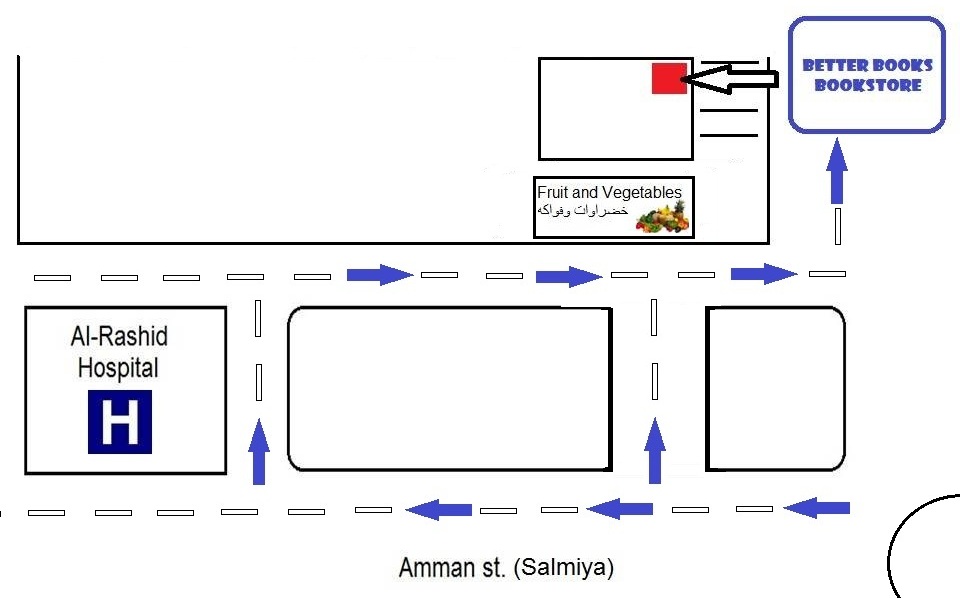
Hours/Phone/Location: 10am-8 pm daily. Cell 66637351. Behind Al Rashid Hospital.
Directions:
Take 4th Ring Road to Salmiya
Past Highway 30
Past Fire Station on Right
At light – Amman Street – take right
through next light
See Al Rashid Hospital on Left
At Roundabout take a U-turn
Now see attached map
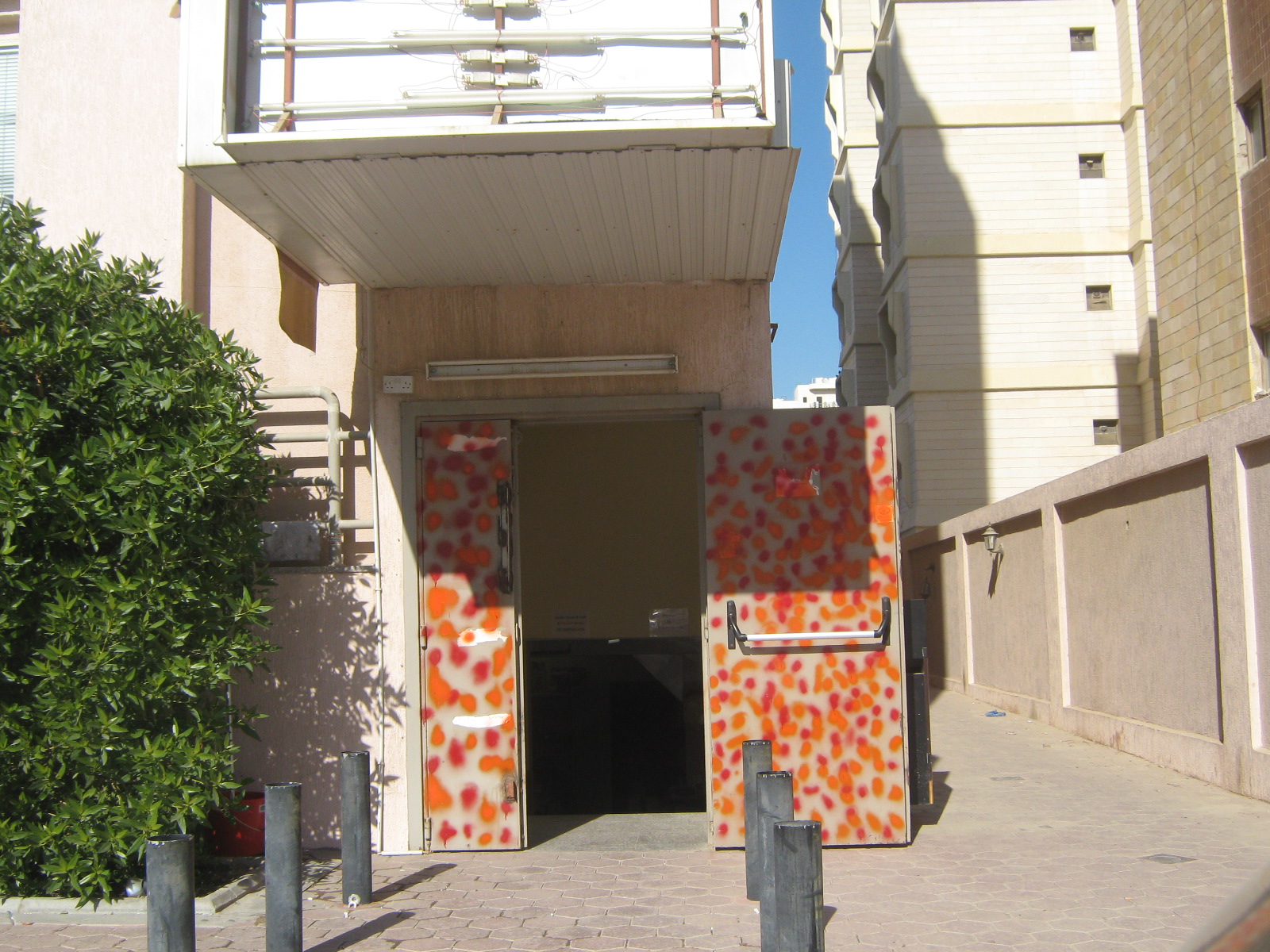
Look for RED/ORANGE door (photo attached)
TOASTMASTERS MEETINGS –
Desert Pioneers Club 2nd and 4th Tuesday 7.15 – 9.05 pm
Timbre Talkers 1st and 3rd Tuesday 7.15 – 9.05 pm
Capitol Speakers 1st and 3rd Saturday 6.30 – 8.30 pm
Bright Horizons 2nd and 4th Friday 9.30 – 11 am.
GAVEL CLUB MEETINGS Every Friday Night 5.30 – 7.30 pm.
In April, there will be Healing, Meditation, and Reiki classes at Better Books. Email jsshetty99@yahoo.com or call 99315825 for more details.
Better Books is now on FACEBOOK! Click THIS and ‘like’ us for regular updates – new arrivals, events etc.
Better Books sells 1 KD books on http://www.souq.com FREE DELIVERY
Contest from Better Books and Cafe:
Answer the following questions correctly and be among the first five correct email replies to receive 1 KD off your next purchase.
1. Who wrote 40 Years in Kuwait?
a. H.R. Dickson
b. Violet Dickson
2. What organization do ‘The Capitol Speakers, Desert Pioneers, Bright Horizons and Timbre Talkers’ belong?
a. Toastmasters
b. Gavel Club
3. What well known British saying adorns a red poster at Better Books?
a. Keep Calm and Carry On
b. When going through hell, keep going
Just return this email with answers to 1, 2, and 3.
Feel free to forward this email to your friends.
Here is what the entrance looks like:
If I were in Kuwait, I would be on their waiting list for copies of The History of Architecture in Old Kuwait City by Saleh Abdulghani Al-Mutawa, one of the most interesting books I read in Kuwait about how houses used to be built, why, and why modern architects need to pay attention to the lessons of the past.
Alexander McCall Smith and The Saturday Big Tent Wedding Party

Just back from a wonderful two day trip to Botswana, visiting my dear and beloved friend Precious Ramotswe, who owns the #1 Ladies Detective Agency. For her, I make an exception to the paperback book rule (buy paperbacks because hard covers can hurt you if you fall asleep and they fall over) and get on the pre-publication order list so that Amazon will send me the book as soon as it comes out.
The Saturday Big Tent Wedding Party arrived Wednesday night. My husband was expecting a friend, and when the doorbell rang I thought “oh my, he is really early!” but it was the UPS guy, who had left a book-sized package on my doorstep. I had just finished an easy but fun book (The Map Thief by Heather Terrell) and was at odd ends as to what to read next, and this was an easy answer. As my husband drank Arabic coffee and sweet sweet Arabic tea, and ate delicate Middle Eastern treats downstairs, I got to start The Saturday Big Tent Wedding Party.
You know the books. They aren’t difficult to read, but while you are reading, you are transported to another world. Precious Ramotswe’s Botswana is not a world without problems, but the solutions to the problems are often found in softer gentler ways, ways that would seem counter-intuitive in our culture, but make total sense when you are raised in Botswana. There is a value placed on peaceable interaction, and maintaining relationships, on forgiveness, and going to extra mile. It’s a sweet world, and a great escape.
As usual, there are several intertwining plot lines with ingenious and unexpected solutions. I suspect that is what keeps me glued to this series – I cannot anticipate the solutions. That, and the gentleness of her outlook, the sweetness of life in Botswana, and the dignity and integrity of McCall’s primary characters.
I don’t know how McCall manages to keep the series fresh, but he avoids the formulaic and I find each book a treat. My favorite part of this book is how Mma Potokwane manages to wangle and invitation to Mma Makutsi’s wedding:
Mma Potokwane noticed the other woman’s uncertainty. “Yes,” she continued. “There’s that problem. And then there’s another problem. Problems come in threes, I find, Mma. So the next one – Problem number two, so to speak – is the cooking of food. You know what I find, Mma, it is this: the people doing the cooking never have enough pots. They say they do, but they do not. And right at the last moment they discover that there are not enough pots, or, more likely, the pots they have are too small. A pot may be big enough to cook your meat and pap at home, just for a family, but do not imagine that it will be big enough to cook for a couple of hundred people. You need big, catering-size pots for that.”
She was now warming to her theme. “And the third problem is the food itself. You may think that you have enough for the feast, and you may be right when it comes to the meat. People usually have enough meat – often rather too much, in fact. But they forget that after their guests have eaten a lot of meat, they need something sweet, and often they have made no arrangements for that. A wedding cake? Yes, but there will only be one small piece of that for each guest – usually not enough. So people find themselves wishing that they had had the foresight to get a supply of ordinary cake for the guests to eat with their tea. And where is this cake? Not there, Mma.”
Mma Ramotswe glanced at Mma Makutsi; this was not the way to speak to a nervous bride, she thought. “I’m sure that everything will work out well,” she said reassuringly. “And if there are any problems, they will surely just be small ones – nothing to worry about.”
Mma Potokwane looked doubtful. “I hope so,” she said. “But in my experience, it never works out like that. I think it’s better to be realistic about these things.”
Mma Makutsi picked up her pencil to add something to her list. “You said something about pots, Mma. Where would I be able to get these big, catering-size pots?”
Mma Potokwane examined her fingernails. “Well, we have them at the orphan farm. Each of the house mothers has a very large pot. I’m sure that we could do something . . . ”
Run to your bookstore and buy The Saturday Big Tent Wedding Party!
Cutting for Stone by Abraham Verghese

Someone in my book club in Qatar mentioned this book, Cutting for Stone, a while back, and I bought it, but it has sat for months on my to-read shelf (LOL, there are actually several, but one with the most important books, and another with the ‘guilty pleasures,’ the ones I am addicted to and save as a reward for good behavior, like vacuuming.)
When a good friend said she was reading it, and that it was good, I decided to move it up in priority, sort of like taking medicine, read a book that is good for you.
Oh WOW.
First, it is a great, absorbing story. Twin boys are born, totally unexpected, to an Indian Catholic nun and an English surgeon, working in Addis Ababa. How they were conceived is a mystery. The mother dies in childbirth, the father flees in horror, the children are born conjoined at the head and must be separated. The boys are adopted by an Indian couple, doctors at the hospital, and are raised with love and happiness.
That’s just the beginning!
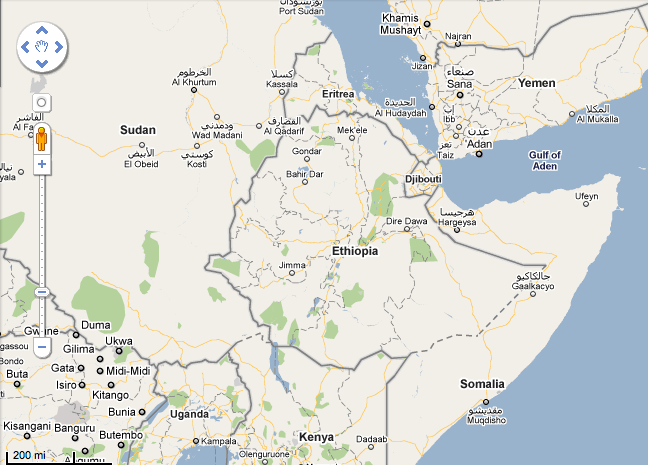
I’ve always wanted to go to Ethiopia and Eritrea. I want to visit Lalibela, and some of the oldest Christian churches in the world. When my father was sick, he had a home health aid from Ethiopia, Esaiahs, who told me about the customs in his church, and how Ethiopian Christianity is very close to Judaism, with men and women separated in the church, and eating pork forbidden.
Reading this book, I felt like I had lived there, and I want to go back. The author captures the feelings, the smells, the visuals, the sounds, and if I awoke in a bungalow at the MIssing (Mission) Hospital, I would say “Ah yes! I remember this!”
I kept marking sections of this book that I loved. Here is one:
They parked at Ghosh’s bungalow and walked to the rear or Missing, where the bottlebrush was so laden with flowers that it looked as if it had caught fire. The property edge was marked by the acacias, their flat tops forming a jagged line against the sky. Missing’s far west corner was a promontory looking over a vast valley. That acreage as far as the eye could see belonged to a ras – a duke – who was relative of His Majesty, Haile Selassie.
A brook, hidden by boulders, burbled; sheep grazed under the eye of a boy who sat polishing his teeth with a twig, his staff near by. He squinted at Matron and Ghosh and then waved. Just like in the days of David, he carried a slingshot. It was a goatherd like him, centuries before, who had noticed how frisky his animals became after chewing a particuar red berry. From that serendipitous discovery, the coffee habit and trade spread to Yemen, Amsterdam, the Caribbean, South America, and the world, but it had all begun in Ethiopia, in a field like this.
We live inside the hearts and minds of doctors, some practicing under the worst possible conditions, and learn how they make their decisions and why. Verghese is a compassionate author; while his characters may be flawed, they are forgivable and forgiven.
Another section I loved, the man speaking is Ghosh, the man who adopted the twins with Hema, another doctor:
“My genius was to know long ago that money alone wouldn’t make me happy. Or maybe that’s my excuse for not leaving you a huge fortune! I certainly could have made more money if that had been my goal. But one thing I won’t have is regrets. My VIP patients often regret so many things on their deathbeds. They regret the bitterness they’ll leave in people’s hearts. They realize that no money, no church service, no eulogy, no funeral procession no matter how elaborate, can remove the legacy of a mean spirit.”
Things in Ethiopia get sticky, politically, and one of the twins is forced to flee, implicated in an airplane hijacking only because he was raised with a young woman involved. He is spirited into Eritrea, where he awaits his ride out to Kenya, and he helps the Eritrean rebels when large numbers of wounded are brought into his area. When the time comes to leave, his thoughts will strike a chord in anyone who has ever been an expat:
Two days later I took leave of Solomon. There were dark rings under his eyes and he looked ready to fall over. There was no questioning his purpose or dedication. Solomon said “Go and good luck to you. This isn’t your fight. I’d go if I were in your shoes. Tell the world about us.”
This isn’t your fight. I thought about that as I trekked to the border with two escorts. What did Solomon mean? Did he see me as being on the Ethiopian side, on the side of the occupiers? No, I think he saw me as an expatriate, someone without a stake in this war. Despite being born in the same compound as Genet, despite speaking Amharic like a native, and going to medical school with him, to Solomon I was a ferengi – a foreigner. Perhaps he was right, even though I was loath to admit it. If I were a patriotic Ethiopian, would I not have gone underground and joined the royalists, or others who were trying to topple Sergeant Mengistu? If I cared about my country, shouldn’t I have been willing to die for it?
The book has a lot of observations about coming to America; some of which made me laugh, some which made me groan. Coming back is always a shock to people who have lived abroad for a time, but it is a huge shock to those coming for the first time:
The black suited drivers led their passengers to sleek black cars, but myman led me to a big yellow taxi. In no time we were driving out of Kennedy Airport, heading to the Bronx. We merged at what I thought was a dangerous speed onto a freeway and into the slipstream of racing vehicles. “Marion, jet travel has damaged your eardrums,” I said to myself, because the silence was unreal. In Africa, cars ran not on petrol but on the squawk and blare of their horns. Not so here; the cars were near silent, like a school of fish. All I heard was the whish of rubber on concrete or asphalt.
As I neared the end, I read more slowly, unwilling for this book to end. It is one of the most vivid and moving books I have ever read. AdventureMan has gone online to find the nearest Ethiopian restaurant so we can have some injera and wot.
The Dressmaker by Posie Graeme-Evans
When I wrote up this book for another site, I could not even remember the main character’s name. (Ellen Gowan) I found the book annoying, and most of the time, when a book annoys me, I don’t even tell you about it, I just don’t bother reviewing it at all.

I find the plot thin. I find the characters unmotivated. I find many of the choices of the characters unbelievable. We haven’t been given enough back-story to make the characters truly live.
Ellen has a real streak of bad luck. On her 13th birthday, a well-born young man gets fresh with her and in rural Victorian England, it becomes her problem – her reputation is damaged by a callow young man from a wealthy family. On the same day, an earthquake strikes her village, killing her father, and she and her mother subsequently lose their home.
They take up residence with Ellen’s aunt, her mother’s sister, and it is a happy time, all except for her aunt’s husband, a cruel man who isolates and beats his wife, who can do nothing about it. A wife is property. Her marriage was arranged; she has no where to go if she were to leave. She works hard at keeping her husband happy, so he won’t beat her or take it out on anyone she loves.
When you are dealing with an abusive manipulator, however, there is no pleasing, right? Ellen and her mother are thrown out, but also thrown a lifeline, and take up residence with a dressmaker, where Ellen hones and develops a talent for costume design (meaning evening dress, calling clothes, mourning clothes – wealthy Victorian women had huge wardrobes of ever-changing fashionable clothes.)
Ellen makes some really bad choices – in my opinion. I’m not going to tell you what those choices are, because I don’t want to give you too much of the story, in case you want to read it yourself.
Long story short, she ends up a very successful fashion designer/producer in London, only to face ruinous blackmail because of her past.
OK, here is what I really liked about the book. While I found the characters, descriptions, plotlines and dialogues pretty awful, I loved reading about the fashions, and I found reading about the social status of women – not all that long ago – where women in England had few choices and fewer opportunities – fascinating. I have friends in Kuwait and Qatar who face some of the same limitations. How soon we forget; it wasn’t that long ago that we faced the same challenges, the same limitations.
The freedom to live on our own. The freedom to earn and manage our own money. The rights to our children. All these issues are fresh in The Dressmaker, and too easily taken for granted in our own.
Lord of Death by Eliot Pattison
I didn’t know that much about the Chinese obliteration of Tibetan culture in Tibet. I didn’t know about the systematic destruction of the monasteries, or at least not in detail. I didn’t know about the brutal re-education techniques for the Bhuddist monks. I didn’t know how strong and resistant the peoples of Tibet are to the Chinese incursion.
I’ve learned most of what I know reading Eliot Pattison’s series featuring Shan Tao Yun, a Chinese detective. Or he used to be. In the first book, The Skull Mantra, we meet Inspecter Shan Tao Yun in one of those re-education camps, where he has been tortured and mistreated almost to his physical limits, and the Bhuddist monks teach him new ways of thinking, and those ways help him to see things differently – and to survive.
The Tibetans hate the Chinese, but they make an exception for Inspector Shan Tao Yun, who earns the respect of both Tibetans and Chinese for his unwavering integrity, and his ability to solve the most intricate puzzles. As he does, we learn more about different aspects of life today in Tibet.
The Lord of Death introduces us to the evolving mountain climbing industry developing in Tibet, just across the border with Nepal. Western climbers will see themselves in a very new light reading this book, which involves the murder of the visiting Chinese Minister of Tourism, an American female climber, and former members of a clandestine CIA trained group of Tibetans during WWII.
In every volume, I learn something fascinating. In this book, I learned more about the early struggles of the Chinese Cultural revolution, the corruption of Chinese ideals, and more about Tibetan ways of thinking. I cannot wait for the next book to come out. You can visit his website here: Eliot Pattison.com
Her Fearful Symmetry by Audrey Niffenegger
This was another find passed along by either Big Diamond or Little Diamond, via my Mom, and oh, what a find. Audrey Niffenegger wrote The Time Traveler’s Wife, a highly unusual book which hit the best seller list like a hurricane. This book, Her Fearful Symmetry, solidifies the perception that this author has real talent, thinks way outside the box, and creates characters and situations that, while unlikely, are likable and who become real enough for us to identify with them.
The title is based on a poem by William Blake, a poem I have always liked:
The Tiger
TIGER, tiger, burning bright
In the forests of the night,
What immortal hand or eye
Could frame thy fearful symmetry?
In what distant deeps or skies 5
Burnt the fire of thine eyes?
On what wings dare he aspire?
What the hand dare seize the fire?
And what shoulder and what art
Could twist the sinews of thy heart? 10
And when thy heart began to beat,
What dread hand and what dread feet?
What the hammer? what the chain?
In what furnace was thy brain?
What the anvil? What dread grasp 15
Dare its deadly terrors clasp?
When the stars threw down their spears,
And water’d heaven with their tears,
Did He smile His work to see?
Did He who made the lamb make thee? 20
Tiger, tiger, burning bright
In the forests of the night,
What immortal hand or eye
Dare frame thy fearful symmetry?
While this tale is a great yarn, it helps to know this poem, there are a lot of literary references in the novel and the title is just one of them.
As the story begins, there is a death, a will, and a set of mirror-image twins who inherit a flat in London overlooking a famous cemetery. The flat is in a building and has an upstairs neighbor, a man succumbing to obsessive-compulsive disease, and a downstairs neighbor, an aging bachelor, all a little eccentric in the nicest, English sort of way. The twins, Valentina and Julia, are twenty years old, and waif-like, still dressing alike, doing almost everything together.
There is also a ghost. No, wait! Two ghosts, and a kitten ghost. No, wait! I forgot! Lots of ghosts!
What I love about Audrey Niffenegger is that she takes what we perceive as reality and gives it a twist, and once you buy the twist, you are off on a wild ride. This book is a wild ride, with unforgettable characters and some unexpected kinks and thrills, as well as more than a couple shudders and chills.
The Book Thief by Markus Zusak
Until I sat down to write these reviews (so I can pass these along to friends in Kuwait who I know will read and discuss them 🙂 ) I didn’t realize that the books had so much in common. They both take place in the WWII time frame, and both are told from the point of view of children coming of age in this time. Both are love stories, romantic, parental, community – they have many of the same elements. They both have bullies, and children who steal. They both have wise adult conspirators, mentors and guides.

In The Book Thief, right off you get a chill. One of the main characters in a personification of Death, a tired, weary, cynical Death, but a Death who is fascinated by his humans. When the opening pages are written by Death, you get a feeling that this can’t be good.
And, in the beginning, it is not good. Liesel is on her way . . . somewhere, we don’t know where, on a long train ride, during which her brother dies. They are forced off the train, and her brother is buried in some small village where they are unknown; the grave will probably never be visited. Shortly after, they re-board another train, and when they arrive, Liesel is turned over to a government foster family agency, and she is placed with a rough, uneducated couple in a small village on the outskirts of Germany.
Not far from Dachau.
So many similar elements . . . people at the mercy of their government, and the madness of the politicians and mass hysteria. Bullies, but not just in the schoolyards, here there is also a nationally encouraged group of bullies, the Nazis, and people in every village are encouraged to join the party. The kids join Hitler Youth and practice to become good Nazis.
Except inside each one of us resides a spirit of humanity, and if you let that spirit dominate, you can come into conflict with the party, even if you appear to comply most of the time. Liesel’s foster parents turn out to be a very humane sort. They feel compassion for the Jews marched through their village on the way to the camps, and attempt to give them a little bread, for although they have little to share, they can see that these Jews are starving.
And then, a stranger arrives on the doorstep, the son of a man who saved Liesel’s Papa’s life in the first world war. He is Jewish. He needs a place to be hidden. Liesel’s foster parents take him in and hide him in the basement.
Only after I read the book and read the afterword did I discover this is a book written for young adults, and that makes me laugh, because I am not a young adult, and I enjoyed the book so much. I love books about the triumph of the human spirit, the triumph of good over evil, and the triumph of hope and life over hopelessness. Even Death has a heart, in this book.
I know that there will be one copy of this book in Kuwait; I am leaving it with a friend I know will read it, and I know she will pass it along, because this is a book worth discussing. I hope you are friends with my friend, and that you will get a chance to read it, too!
Hotel at the Corner of Bitter and Sweet by Jamie Ford
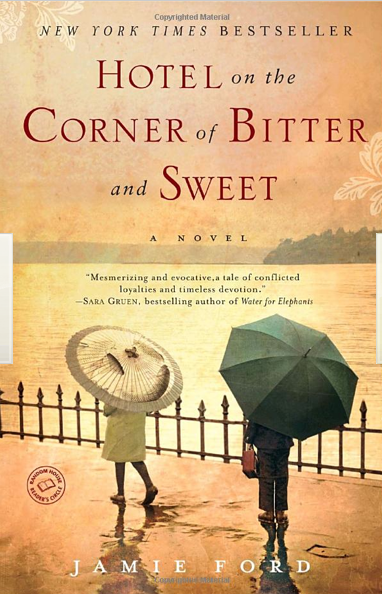
This book had everything going for it, and still I had a hard time getting into it. The book was given by Little Diamond to my Mom – Little Diamond often passes along the very best, thought-provoking books, and in our family we pass the best along, so I knew it would be good. I love the title. The book is set in a part of Seattle now called – euphemistically – The International District, but as I was growing up, and among older Seattle-ites, it is called Chinatown, even though that is not politically correct, or geographically correct. Chinatown was never Chinatown, it was a group of distinct populations – Chinese, Japanese, later Vietnamese, Korean, even later Ethiopian, Sudanese, Somali, Pakistan . . . you could call it immigrant-ville, I suppose, if you were really, really politically incorrect. My Chinese friends still call it Chinatown.
Last, but not least, Jamie Ford started this book as a short story at a camp run by Orson Scott Card, one of my favorite authors, especially to recommend to young people. Orson Scott Card knows how to capture the painful contradictions of being teens and young adults, the conflicts with parents, the loves, requited and un, and most of all, he understands how the young see things clearly as unfair; it’s only later when we start seeing shades of grey.
In spite of all those positives, I hated his voice. I hated the smug little Chinese boy he started as, a scholarship student, first generation born in the US, mocking his parents, fighting off bullies. . . Here is what I hated the most. He had a girlfriend, and he didn’t understand chivalry, like walking her home. He protected her, but he was a pretty self-absorbed little boy.
I kept reading because he had some interesting friends. I liked his friend the jazz player, and I liked the gruff lunchroom lady, and I liked his friend Keiko. I understood his parents pushing him to excel, and their not understanding the struggles this caused Henry; I liked his parents. Because the book jumps around in time, I also liked his wife, and felt annoyed that Henry was all caught up in this old romance when he had a perfectly good wife, but I kept reading.
I am so glad I did. About a third into the book, we begin to see Henry transform into the man he will become. He gets help, he gets mentoring from unexpected people, and he becomes more likable.
The book also deals with a terrible time in US history, a time when we turned on our own citizens and sent our citizens of Japanese descent to concentration camps right here in the USA. The Japanese were a class act; most of them were hurt and outraged, but compliant. Many men volunteered to fight in the war in spite of this slap in the face, this accusation of potential treason. It is a shameful time in our own history, and particularly so for Henry, who loves a Japanese girl, Keiko.
By the end, I loved this book. I hope you will, too.
Forgotten Garden by Kate Morton

This book is a mystery, written as a fairy tale. At the beginning, we are given a part of the story, and with every chapter we learn a few additional factors. There are some dark alleys, and maybe some red herrings.
Oh wait! Maybe it’s gothic; there is a huge mansion with a variety of unsavory rich folk and stereotypical kindly servants and a Cinderella-like relative and dark secrets lurking in the corridors.
A young woman researches her grandmother’s history to try to figure out who she was and what her story was. She had arrived in Australia, four years old, and alone in 1913. We go back and forth in time, and we see the story from many different eyes, each adding pieces to our puzzle.
The annoying thing about this mystery – to me, anyway, is that it seems to me that there are a lot of distracting tongue-in-cheek references to fairy tales which seem to imply that the story we are reading follows some kind of prototypical pattern. There is a real book of fairy tales involved, written by someone who seems to be related in some way to the young woman’s grandmother, but there are too many coy coincidences and too many interweavings for me; several times I just wanted to throw the book across the room in disgust.
I finished it, but it left me with a bad taste in my mouth. It was murky, and I never got the feeling that the author truly cared about her characters, but was playing some kind of intellectual game with the plot, and it just annoyed me.
Recent Comments
Kitchen on Isiais: Winding Down intlxpatr on Shampoo Ginger tigerbutterya0c5ff1d… on Shampoo Ginger intlxpatr on British Soldier Kidnapped, Esc… John on British Soldier Kidnapped, Esc… Wikipedia Donate Button

Amazina


Early Voting in Florida


