Susan Wittig Albert: Nightshade
In her ongoing China Bayles mystery series, China and her husband investigate the death of China’s father, with some amazing outcomes.
These are not heavy reading. This series features a burned-out criminal defense lawyer, who, sick of the slime and the jockying for power and position, cashes in her retirement plans and buys a shop in the small fictional town of Pecan Springs, Texas, where she opens an herbal shop, Thyme and Seasons, which sells live potted herbs, but also herbal wreaths, herbal soaps, herbal bath bombs, herbal teas, herbal shampoos, etc – and shares space with a new age shop called The Crystal Cave, a tea shop called Thyme for Tea, a catering company called Party Thyme and a personal chef service called Thymely Gourmet. She and her girlfriends have a lot of fun.
And, somehow, even in this idyllic life, mysteries seek out China, and she is often involved in crime-solving outside of her normal business. This time, her brother – the brother she never knew she had, the brother her father had with his secretary while China was growing up, wondering where her father was all the time – is murdered, in what appears to be a hit-and-run accident, but is no accident at all. Her brother was trying to get China involved with finding out how and why their father died – another apparent accident, which was no accident. When China isn’t interested (she is still very angry with her dad for what she perceives as a betrayal of her and her mother), her brother hires China’s husband as a private detective to examine the evidence. Then – her brother is killed. China gets involved.
It’s great escape reading, but you often end up learning something, too. China is an idealist, fighting crime and corruption, and God knows, there is enough of that, all the world around, to keep a legion of fictional crime fighters busy.
“After I grew up and joined the Houston legal fraternity, I began to understand what was common knowledge in that gossip-driven oil company town: Robert Bayles and his partner Ted Stone had built their legal practice on dubious oil and energy deals, questionable land transactions, and political dirty work. Their clients included polluters, looters and influence peddlers. Both Ted Stone and my father were frequent guests of the Suite 8F crowd, the group of influential conservatives who met on the eighth floor of Houston’s Lamar Hotel and collectively decided who was going to run for what political office, at the state level and beyond. To ensure that their picks – LBJ had been one of them – made it to the winner’s circle, Suite 8F slipped wads of campaign cash into the necessary pockets. Their contributions decided which politicians moved into positions of power and influence.
Just as important, their money brought them preferential treatment when the bidding opened on lucrative government contracts for dams, ships and shipyards, oil pipelines, military bases at home and abroad, NASA’s Johnson Space Center in Houston. The Lamar Hotel was demolished in 1983 to make room for a skyscraper, but the political influence of 8F lingers like a foul odor, a dirty fog. It’s the subject of books, of doctoral dissertations, of documentaries. It’s common knowledge.”

Reading Albert is a great escape. Even knowing that sweet little Pecan Springs is a microcosm of the rest of the world, not untouched by human frailty, it is a sweet place with a culture all its own. China’s life, surrounded by her loving husband, her stepson, all their pets, their friends, the places they eat, it’s all comfortable, an herbal scented different world.
Dean Koontz: The Face
Dean Koontz writes a lot of books with children in them, usually children in very vulnerable positions, abandoned, neglected, or at the mercy of a cruel adult, or at best, a negligent adult. Adults do play positive roles in his books, but the positive adult is usually damaged in some way – maybe a history of alcoholism, a history of broken relationships – in short, a lot like most of us. Real people, who make mistakes along the way, and try to learn something from them.
I like Dean Koontz. It makes me sad to say that this is just another great escape. Young boy, lost in his famous father’s huge mansion, beautiful-model mother who spawned him and then walked away, like a cat leaves her kittens – it’s a sad, lonely life for a child.
There is the usual creepy, badly twisted bad guy.

There is a good guy in pain, mourning his dead wife, and a ghost who intervenes in human affairs. There are deus ex machina aplenty, and a couple page-turner moments where you don’t want to stop reading, not yet!
It was not a bad book, but if I weren’t so desperate for escape reading, I would not have wasted a minute on this book.
John Berendt and City of Falling Angels
When AdventureMan brought home City of Falling Angels for me, I thought it was another mystery by the author of the famous Midnight in the Garden of Good and Evil. I had loved that book, full of unforgettable characters living in Savannah, Georgia, so I was a little puzzled with the immediacy and real-life feeling of this new mystery when I started it.
It’s set in Venice. The main “character” observes – much like Midnight in the Garden of Good and Evil – Venice, and its population. He arrives just after the horrendous fire that totally destroys La Fenice, the opera house, and we meet a wide variety of characters right off, experience the fire through their first hand experiences. We smell the smoke, we feel their horror as the fire grows, and spreads. We are depressed when the fireboats cannot quell the flames because the waters in the canal have been emptied, and are too low in the others.
I kept waiting for Commissario Guido Brunetti, Donna Leon’s Venetian detective, to show up.
I was about half way through the book when I realized – this wasn’t fiction. It was John Berendt living in Venice, meeting with and interviewing all these fabulously interesting people. Yeh, sometimes I am so SLOW!
But I was hooked. I kept reading. The mystery is how did the fire at La Fenice start, who started it and why. In the end – and believe me this is not a spoiler, because this book is really only peripherally about the fire at La Fenice – people are convicted, but you are never really sure these are the right people, or if, indeed, there was really a crime, or if the crime was negligence – but how can negligence be a crime if it is part of the culture?
One thing Berent says that Donna Leon also implies – don’t go to Venice during tourist season! Go when tourists are not there – after carnival, when it is cold, when it is raining. Stay in Venice, and walk, off the paths the tourists on their one-day-in-Venice travel. Visit the small markets, drop in for a coffee where the locals are drinking, but most of all – walk. And walk. and walk.
This is not an exciting book. It will not hold you on the edge of your seat like some horror thriller, turning pages because you are afraid to turn out the lights. The horrors in this book are the gossip, the strivings of various people to enter into Venetian society, the cut-throat competition for invitations, and who gets the prime seats at the opening night at La Fenice.
On the other hand, I loved his attention to detail, the ease with which Berendt got people to talk to him, the clarity with which he captures their personalities. I loved his description of the interiors, and how he uses the voices of others to paint in a detailed picture of Venice today. I loved being inside the Venetian community, and hearing their innermost thoughts. This was a book I looked forward to at the end of a long day, it took me to another – and fascinating – world. I just wish Commissario Brunetti had showed up. 🙂
Jodi Picoult: Handle With Care
I just finished the latest Jodi Picoult novel, Handle with Care. I was uncomfortable with it at the beginning, as I often am with Jodi Picould novels. She’s like that guest who brings up topics no one else brings up, and sometimes you wish she would stop, but the conversation gets rolling and everyone has an opinion, and the party would be much duller if she weren’t there.
She’s also the friend you would go to if you had an embarrassing problem you couldn’t discuss with anyone else. We all need that kind of friend, an honest sounding board, not afraid to deal with the grit and grime of everyday life.
I know the reason her books make me uncomfortable is that sometimes I see things I don’t like about myself in her characters.

The subject of the book is a disease called osteogenesis imperfecta (OI), and Willow, the youngest daughter, has Type III, which means she was born with broken bones, her bones would break if you picked her up wrong, changed her diaper the wrong way, even if she rolled over. Her bones were brittle, and the slightest thing could cause a break. She is also very smart, and a delightful character.
Picoult takes us inside many heads – the mother, Charlotte, a former pastry chef (Picoult includes some of her very best recipes, YUMMMM), Sean, the fiercely loving father, Amelia, a troubled pre-teen who hides her bulemia and cutting, and Marin, the lawyer, searching for her own birth mother. When Charlotte files a wrongful birth suit against her best friend – and obstetrician – Piper, her life starts to fall apart. It’s hard to believe things could get worse than having a child whose bones break all the time, but things definitely get worse.
What I hated about Charlotte, who has learned to anticipate her damaged child’s needs, is seeing myself through her eyes. Frequently, she shows us our insensitivity to the disabled, how we patronize, how we are oblivious to the simplest needs. Charlotte is a little angry at the world, so protective that she bites back scathing words to outsiders – or doesn’t. People without disabilities – visible disabilities, we all have disabilities, don’t we, just some are visible and some are not? – can be so smug, so unaware of the hardships others face. I cringe when I read this book. I see myself, and I don’t like what I see.
I admire Jodi Picoult. I will read just about anything she has written, because of the courage she has to tackle the most sensitive subjects. This is not a comfortable book to read, but it is a worthwhile book to read.
The Thirteenth Tale – Setterfield
After reading some heavier stuff, I needed a break, and waiting on my “read me!” bookshelf has been this book, The Thirteenth Tale, another one of those I pick up at the last minute and stuff into the last remaining centimeter of space in my overstuffed suitcases. Nobody recommended it, it just looked like it might be good.
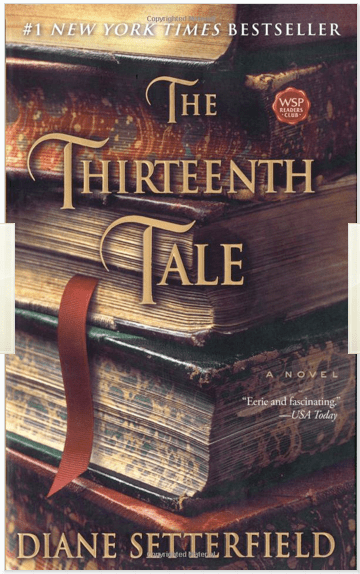
It was good, although now I can’t think of anything so gripping about it. Setterfield took the classic gothic novel – she mentions Jane Eyre frequently – and updates it, makes it modern and personal. It was a good, fun read, had me hurrying through my daily “must-do’s” so I could read more – I like a book like this now and then.
And – the main character, Margaret Lea, loves books. 🙂 She works in her family old-books business, leads a quiet, kind of sad life, haunted by the loss of her own twin early in life. When contacted by famous novelist Vida Winter to write her biography, she is intrigued, and accepts the job offer, which involves going to stay in Vida Winter’s house.
Part of what is fun reading this book is that we are dealing with an “unreliable narrator” with Vida Winter. Sometimes she is lying, sometimes she is lying by omission, and part of the mystery is that Margaret must try to verify what she has been told and try to figure out what has been left out. She has a great adventure in the process.
This is great escape reading. Good for a long plane trip, good for sitting by a sick relative in the hospital, good for using as a carrot (“if I get this done, and this, and this – then I get to go read ‘The Thirteenth Tale!’ “) You can buy it on Amazon.com for around $10 paperback.
Quote from The Thirteenth Tale by Diane Setterfield
“People disappear when they die. Their voice, their laughter, the warmth of their breath. Their flesh. Eventually their bones. All living memory of them ceases. This is both dreadful and natural. yet for some there is an exception to this annihilation. For in the books they write they continue to exist. We can rediscover them. Their humor, their tone of voice, their moods. Through the written word they can anger you or make you happy. They can comfort you. They can perplex you. They can alter you. All this, even though they are dead. Like flies in amber, like corpses frozen in ice, that which according to the laws of nature should pass away is, by the miracle of ink on paper, preserved. It is a kind of magic. “
Maybe that’s why we blog, hoping for a little immortality? Or maybe that’s why we delete entire blogs, entire entries, uncomfortable with the thought that this passing mood or passion will live to be an embarrassment?
Neil Gaiman’s Smoke and Mirrors

Smoke and Mirrors is a collection of – as the author puts it – short fiction and illusions.
My son got me started with Neil Gaiman when he gave me a book called Good Omens. He is probably not an author everyone would like – he can be cynical, but my experience with cynics is that their cynicism is an attempt to disguise a deeply idealistic nature, so his cynicism doesn’t bother me. I love his attention to world mythologies, those beliefs deep down that are passed from parent to child, beliefs so deep we don’t even know they are there.
Smoke and MIrrors was an easy, if uneven, read. I get the impression Gaiman gathered up a bunch of short writings he had done – like sometimes you jot down an idea for something and keep it to be developed later, into a book, a sub-plot, etc. and that these ones never quite graduated.
There are two stories I will never forget. The last story, Snow, Glass, Apples, is a re-telling of the Snow White legend, told from the point of view of the wicked step-mother, set far back in dark times. I will never see Snow White in the same light again. I love the flicker of perception that changes everything. Snow White as a vampiric, wild, uncontrolled child? When Gaiman writes, all the pieces fit together.
The other story hits me on a deeper level. In a house where stray cats come and are cared for, a cat arrives, scarred and damaged, seeking only love. Every night he goes out onto the porch, and late late on some nights, sounds of wild and horrendous battles are heard, from which the cat emerges more damaged, battered and scarred than before. Horrified, the people try to keep the cat inside, but after he has healed enough, he insists on going out again to do battle. One night, the man watches as an apparition appears; on a deep instinctive level, he knows it is a demon / devil. The cat protects the house and its occupants. The story is called The Price, and after I read it, I couldn’t read the book again for a couple days.
When I read Neil Gaiman, it frees me up to think outside the lines, outside the normal boundaries of what we consider normal. This man was gifted with an amazing imagination.
I think of Jesus, and his disciples, the 12 he gathered to help him in his earthly ministry. I think of how often they listened to Jesus – and got it wrong. He would be explaining something, and they just didn’t get it. I wonder how often it still happens, that we think we understand what he is telling us, but our minds are small and fuzzy, and we can’t begin to comprehend the magnitude of what he is telling us.
So I think about angels, and how they are all around us. . . and what if all these little cats and dogs are part of the angels God has sent to protect us? I think how they love us unconditionally, simply, and how good they are for our health (having a pet can lower blood-pressure, for example) and how truly truly AWFUL it is that we might be abusing, starving, neglecting the very angels God has sent to ease our lives and protect us? It fills me with horror!
Neil Gaiman sets me free to think such thoughts. You can read his stories as just stories, but if you have an ounce of depth, you will find your mind wandering to strange places after reading Gaiman. You can find Smoke and Mirrors on Amazon.com for around $10 in paperback, less if you buy it used.
Again, thank you, son, for introducing me to such a mind-stretching author.
An Interview with Chimamanda Ngozi Adichie
This interview is with a woman I admire very much, Chimamanda Ngozi Adichie, who has a new book out, a collection of stories, called The Thing Around Your Neck. Her most recent prior book, Half of a Yellow Sun, which tells of the three year struggle of the Igbo people to secede from Nigeria to create the independent nation of Biafra, and won the Orange Prize for Literature in 2007. The book is a total WOW.
William Dalrymple: The Age of Kali
Having read and loved In Xanadu: A Quest by William Dalrymple, and having received recommendations by friends who say they read ALL of William Dalrymple, I started on this second book, The Age of Kali. I didn’t like it, not one bit. I am proud to say I read it all the way to the end, because often if I don’t like a book, I will say to myself “I don’t need this!” and toss it, but I didn’t, I stuck with it. I am proud because it isn’t easy to stick with a book you don’t like, and I didn’t like this book.

In Xanadu, Dalrymple was wryly funny, hilariously funny, and most of the humor was directed at himself. In The Age of Kali, there is nothing funny.
The Age of Kali is a series of interviews and adventures in India and Pakistan. The author did these interviews and took notes (some are published in slightly different forms as magazine articles) over a period of ten years and then strung them all together to form this book. There is little or no linkage from one to the other. They are grouped geographically.
Here is what I like and admire – this man achieves the most amazing interviews, many times just by asking the right person at the right time. He insinuates himself, asks easy questions, and then sticks in a hard question. He doesn’t seem to flinch from putting himself in danger, and he doesn’t stand on respect when asking his questions. I admire that he went difficult places, interviewed difficult people, and wrote the interviews up without fawning over the celebrity status of his interviewee.
What I don’t like is that he doesn’t seem to like anybody very much. There are no funny anecdotes. By the end of the first interview, I began to get an impression that he doesn’t like India very much (and I believe that is NOT true, as he lives part-time in Delhi) and that India is not a place I want to visit. He interviews corrupt politicians, descendants of the moghuls, Benazir Bhutto – and her mother, Imran Khan (the cricket player) and many others. In each and every interview, he maintains a distance that tells us he doesn’t like these characters very much.
Here are some quotes from early in the book:
These days Bihar was much more famous for its violence, corruption and endemic caste-warfare. Indeed, things were now so bad that the criminals and the politicians of the state were said to be virtually interchangeable: no fewer than thirty-three of Bihar’s State Assembly MLAs had criminal records, and a figure like Dular Chand Yadav, who had a hundred cases of dacoity and fifty murder cases pending against him, could also be addressed as the Honorable Member for Barth.
As he interviews Bihar politician Laloo Prasad Yadav:
I asked Laloo about his childhood. He proved only too willing to talk about it. He lolled back against the side of the plane, his legs stretched over two seats.
‘My father was a small farmer,’ he began, scratching his balls with the unembarrassed thoroughness of a true yokel.
OK, that was funny. I had to read it aloud to AdventureMan. One of the things that still unnerves me living here is that the men are always touching themselves – something so totally forbidden in my culture as to be simply unthinkable.
In his section about Pakistan:
These people – the Pathans – have never been conquered, at least not since the time of Alexander the Great. They have seen off centuries of invaders – Persians, Arabs, Turks, Moghuls, Sikhs, British, Russians – and they retain the mixture of arrogance and suspicion that this history has produced in their character. History has also left them with a curious political status. Although most Pathans are technically within Pakistan, the writ of Pakistan law does not carry in to the heartland of their territories.
These segregated areas are in effect private tribal states, out of the control of the Pakistan government. They are an inheritance from the days of the Raj: the British were quite happy to let the Pathans act as a buffer zone on the edge of the Empire, and they did not try to extend their authority in to the hills. Where the British led, the modern Pakistani authorities have followed. Beyond the checkpoints on the edge of the Peshawar, tribal law – based on the institutions of the tribal council and the blood feud – rules unchallenged and unchanged since its origins long before the birth of Christ.
When I read this, I think of recent headlines about the problems Pakistan is having maintaining order, fighting the status of “failed-nation”, and the chaotic administration of tribal “justice.” The old ways have endured – but as we learned in Three Cups of Tea, there are villages where villagers are eager to have modern schools, eager to educate their daughters, and they, too, are victims of the fanatics who burn the schools and throw acid on women attending school.
The author is told, time and time again by Indian citizens, that India has entered The Age of Kali, “the lowest possible throw, an epoch of strife, corruption, darkness and disintegration.” The book reflects the darkness, corruption and disintegration the author found. I only wish there were some moments of relief, of lightness, hope or humor to encourage the reader on his/her way, but the documentation of this lowest throw was relentless.
Brilliant Sunrise, 5 Apr 09
Goooooooooooood Morning, Kuwait! 🙂
It is going to be another gorgeous day in Kuwait. Don’t let this “heavy fog” deter you. When I got up, the sunrise was so bright, I couldn’t see the sun, it was refracted all over the sky. I was only able to get the shot by focusing on the reflection of the sun on the water.

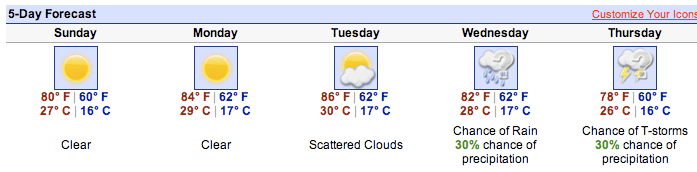
It is going to be a fantastic week – sweet warm days and cooling off evenings, perfect for sitting outside and drinking coffee, visiting with friends – and a little later in the week, a chance of more rain:
AdventureMan and I saw Journey to Mecca yesterday, along with about 500 others living in Kuwait. The movie is still packing people in! The audience was about 3/4 full with children, and I thought “oh this is going to be great, crying children and people talking on their cell phones.” I was SO wrong. Although the movie theater was full, I did not hear a single phone, I did not hear a single crying child – the movie held us all spellbound. We loved the movie, and we loved seeing it in the IMAX theatre.
(There are special headsets for non-Arabic speakers, with the dialogue in English. We didn’t know; they just spotted us as probably-non-Arabic and handed us the headsets.)
Sometimes, I am just slow. My niece, Little Diamond, had recommended a book called Travels with a Tangerine: From Morocco to Turkey in the Footsteps of Islam’s Greatest Traveller, but it was not until yesterday that I got it – that Ibn Batuta was from Tangiers! Sometimes, I am just slow . . . sometimes I can grasp subtleties but the obvious escapes me totally.

You can buy this book from Amazon.com for a mere $10.17 plus shipping. Yes, I own stock in amazon.com.
You can also probably find it at the Kuwait Bookstore, that amazing store in the bottom of the Al Muthanna Mall, near the Sheraton Circle downtown.
Recent Comments
ExpatAlien on What Country am I Living … intlxpatr on Yellowstone: Old Faithful to C… Michelle on Yellowstone: Old Faithful to C… Cathy on No Grown-Ups in Charge intlxpatr on Waiting for Snow Wikipedia Donate Button

Amazina


Early Voting in Florida


 Here There and Everywhere