The Little Prisoner and Child Abuse
Of all the books our book club read this year, The Little Prisoner by Jane Elliott (not her real name) was the most troublesome. The first one to finish said it was boring and repetitive. The second refused to read it at all, that the content would have images that would polute her mind. Both were right, and at the same time, if we refuse to look at what troubles us, we collude with the abuser.
I hate bullying. A man who beats and plays sexual games with a child is a bully and worse – he is a betrayer of trust. Children come into the world pure, clean slates. They can create their own mischief, their own evil, but to be corrupted by an adult – that is the absolute worst sin.
Today’s Gospel reading in The Lectionary is about this very behavior – that betrayal and/or corruption of a child is a huge sin against God:
Matthew 18:1-14
18 At that time the disciples came to Jesus and asked, ‘Who is the greatest in the kingdom of heaven?’ 2 He called a child, whom he put among them, 3 and said, ‘Truly I tell you, unless you change and become like children, you will never enter the kingdom of heaven. 4 Whoever becomes humble like this child is the greatest in the kingdom of heaven. 5 Whoever welcomes one such child in my name welcomes me.
6 ‘If any of you put a stumbling-block before one of these little ones who believe in me, it would be better for you if a great millstone were fastened around your neck and you were drowned in the depth of the sea. 7 Woe to the world because of stumbling-blocks! Occasions for stumbling are bound to come, but woe to the one by whom the stumbling-block comes!
8 ‘If your hand or your foot causes you to stumble, cut it off and throw it away; it is better for you to enter life maimed or lame than to have two hands or two feet and to be thrown into the eternal fire. 9 And if your eye causes you to stumble, tear it out and throw it away; it is better for you to enter life with one eye than to have two eyes and to be thrown into the hell* of fire.
10 ‘Take care that you do not despise one of these little ones; for, I tell you, in heaven their angels continually see the face of my Father in heaven.* 12 What do you think? If a shepherd has a hundred sheep, and one of them has gone astray, does he not leave the ninety-nine on the mountains and go in search of the one that went astray? 13 And if he finds it, truly I tell you, he rejoices over it more than over the ninety-nine that never went astray. 14 So it is not the will of your* Father in heaven that one of these little ones should be lost.
The book was, in one sense, an easy read. It only took about three hours to read it. It was, as the first reader said, repetitive, but then once a bully has found a victim, the behavior does tend to be repetitive, and, as in the book, it also escalates.
The victim’s father bullied her, and he abused her sexually from the time she was four until she was seventeen. He terrorized his wife and other children, and he terrorized the neighborhood with his violence and threats of violence. To this day, the author and her family live far away, and fears her step-father finding out where she is.
I found the writer unlikeable. I wanted to feel more compassion for her than I did. I think part of my problem was that she stayed in the situation even into her teens, even into early adulthood, without seeming to rebel, without taking any steps to get herself out of the situation. She tells us straight away that she has personality defects, troubles with trust and betrayal, and that she sometimes turns to drink. A part of me knows that people who have been systematically abused over a long time can lose that ability to resist, rebel, to ask for help, but another part of me can’t understand it at all. A part of me is impatient with her weakness, I want her to stand on her feet and make her life a testament to her survival, I want her success in overcoming her childhood to be the sweetest kind of revenge. Unfortunately, life is more complicated than that, and her murky ending is probably the more realistic. Abuse leaves lasting damage.
The Little Prisoner is not an easy read in terms of content. There were times I felt she exaggerated to sell the book; to make hers just a little more interesting than the other ones out there with which her book is competing. There is a part of me that would prefer not to see, not to have those images in my mind.
We know, from all the literature, that children who are abused can grow up to be abusers. I have had friends who were abused who refused to have children at all, afraid they would perpetuate the behavior, even though they had a horror of the violence, and were gentle and peaceful people. How do we intervene, how do we break the chain of abusers begetting abusers? How do we change the behaviors? Can abusers really change?
The Little Prisoner brings up a whole host of uncomfortable questions. We can read, we can discuss – but if we choose to look the other way, aren’t we in a small way colluding with the abusers, allowing them to continue while we look the other way?
The Richest Man in Town
This is from AOL’s WalletPop, their how to manage money series.
As I read through this very American tale of building wealth, I wonder . . . how does this apply cross-culturally? Do you think the richest men in the Gulf follow these guidelines? The richest in the EU? The richest Asians? Indians?
Review: The Richest Man In Town by W. Randall Jones
Tom Barlow
May 20th 2009 at 7:30PM
Filed under: Wealth
Some people dream of getting rich. Instead of dreaming, W. Randall Jones, author of The Richest Man In Town, set out to talk to the richest person in each of the 100 U.S. towns he visited for his study to see what commonalities he could find. From these interviews he found 12 attributes that ran rich within these mostly self-made magnates. Apparently, while God could get by with 10 commandments, the rich need a dozen; thus the subtitle, The Twelve Commandments of Wealth.
Let’s get those 12 on the table first (I paraphrase)-
Don’t seek money for money’s sake
Find your perfect niche
Be your own boss
Get addicted to ambition
Be early
Execute or get executed
Fail so you can succeed
Location doesn’t matter
Don’t compromise your morals
Embrace selling
Learn from the best and the worst
Never retire
I have the last one nailed.
Book after book about wealth and entrepenuership seem to boil down to these same points, usually derived from the same inductive reasoning that seems to underlie this book; watch what rich people do, then figure out the principles behind their success. What is missing, imho is the study of failed businesspeople. I often wonder if, for every multimillionaire that followed these commandments, there might not be a hundred who followed them yet failed. Everyone talks to the winners, but until you study the losers, it’s hard to know which commandments are the important ones.
Although the “secrets of the millionaires” genre is well mined, Jones does a particularly deft job of weaving the stories of a hundred people within the commandments structure. His many years of experience as a writer and founder of Wealth magazine are evident in the book’s engaging storytelling and brisk pacing. Many writers of similar books have taken the easier person-by-person approach,
which gives the reader more of the personality of the people interviewed but obscures the insights that the readers seek. Kudos to Jones for taking the hard road.
He also manages to land some very colorful subjects to interview, such as Hartley Peavey of Meridian, Miss. who told him “I believe that life is a test to see how much BS you can take.” Ron Rice of Daytona Beach was fired from six teaching jobs in eight years. Phil Ruffin of Wichita wants his tombstone to read, “This is his last real estate deal.”
For readers who are curious about how the richest man (Jones is apologetic about the use of the word man, but sadly, the richest person in most towns is one) in town came by his fortune, this book may well be best in class. And these commandments leave you free to covet all you want.
Eliot Pattison: Prayer of the Dragon
As you can see, I am into some serious reading. Not heavy reading, but books like carrots – I am the donkey, plodding way, packing my boxes, sorting, weeding, throwing out – it is time consuming, and it is pitiless work. I need the promise of a great excape at the end of my day to keep me going.
Prayer of the Dragon was a GREAT carrot. I like all of Eliot Pattison’s Inspector Shan Tao Yun series, set in Tibet. In his very first book, we meet Shan as he is still in the Tibetan prison camp, imprisoned for exposing corrupt officials in China. He learns a huge appreciation, in prison, for a different way of thinking, and his treasured companions become the Bhuddist monks with whom he is imprisoned. If you want to read this series, you can read any book as a stand-alone, but it helps to read them in order, starting with The Skull Mantra. The Chinese eventually free Shan; they find him useful – as long as he is not exposing corruption in the Chinese bureaucracy. He is free on parole; he lives with the sword over his head. At any time, if he crosses an important person, he can be sent back to the merciless gulag.

In The Prayer of the Dragon Inspector Shan finds himself involved in a series of murders on the mountainside, in a small mining village. The village headman has a great scam going, skimming the miners take, charging passage on the mountain trails, and keeping his village hidden from the Chinese bureaucracy.
Here is what I learned that surprised me. There appears to be a connection between the American Navaho nation and the native Tibetans. They share some body-prototype similarities, and they share many symbols and earliest legends. An first-nation Navaho and his niece are exploring similarities, and commonalities, when two members of their party are murdered while sleeping. The Navaho is charged, by the headman, with the death, because he survived although he is covered in blood. It doesn’t make sense, but it doesn’t have to. The headman needs a scapegoat, and he chooses the Navaho.
It is a fascinating read. Here is an excerpt from a conversation Inspector Shan has with the local director of Public Security:
“I know your type so well, Shan, ” Bing said. “God, how well I know you. I was responsible for ten barracks of prisoners, like you – pathetic, morose creatures with no vision, only bitterness about the past. They would sit in reeducation classes and copy out slogans from the little red books like robots, praising the Chairman, reading aloud apologies printed in other books, using someone else’s words. Never a one among them with the balls to stand up and say Fuck the Chairman, screw the Party secretaries, and screw the limo drivers who brought them to town.”
“I tried at first,” Shan replied in a weary voice. “They sent me to a special hospital for the criminally insane.”
“Unfortunately,” Bing said soberly, “you are the sanest person I have ever met.”
AdventureMan knows I love these books. “Do you want to go to Tibet?” he asks me, and I say “No, if I went I would want to hang around with Inspector Shan and his gang of monks, not do tourist things allowed by the Chinese.” These are great reads, Pattison is doing a great job of bringing the plight of the Tibetans to the conscience of his readers, depicting, in graphic, horrorific detail how the Chinese are systematically crushing and obliterating every shred of Tibetan culture, while claiming they are not. I think one of the very worst things they have done is taking over the Tibetan monastery system and corrupting it into something it was never meant to be, a cruel, ugly deformity.
I can hardly wait for the next book to come out. I am on the waiting list for The Lord of Death, yet another book about Chinese bureaucratic corruption and the adventures Inspector Shan has in Tibet confronting and evading all its manifestations.
Susan Wittig Albert: Nightshade
In her ongoing China Bayles mystery series, China and her husband investigate the death of China’s father, with some amazing outcomes.
These are not heavy reading. This series features a burned-out criminal defense lawyer, who, sick of the slime and the jockying for power and position, cashes in her retirement plans and buys a shop in the small fictional town of Pecan Springs, Texas, where she opens an herbal shop, Thyme and Seasons, which sells live potted herbs, but also herbal wreaths, herbal soaps, herbal bath bombs, herbal teas, herbal shampoos, etc – and shares space with a new age shop called The Crystal Cave, a tea shop called Thyme for Tea, a catering company called Party Thyme and a personal chef service called Thymely Gourmet. She and her girlfriends have a lot of fun.
And, somehow, even in this idyllic life, mysteries seek out China, and she is often involved in crime-solving outside of her normal business. This time, her brother – the brother she never knew she had, the brother her father had with his secretary while China was growing up, wondering where her father was all the time – is murdered, in what appears to be a hit-and-run accident, but is no accident at all. Her brother was trying to get China involved with finding out how and why their father died – another apparent accident, which was no accident. When China isn’t interested (she is still very angry with her dad for what she perceives as a betrayal of her and her mother), her brother hires China’s husband as a private detective to examine the evidence. Then – her brother is killed. China gets involved.
It’s great escape reading, but you often end up learning something, too. China is an idealist, fighting crime and corruption, and God knows, there is enough of that, all the world around, to keep a legion of fictional crime fighters busy.
“After I grew up and joined the Houston legal fraternity, I began to understand what was common knowledge in that gossip-driven oil company town: Robert Bayles and his partner Ted Stone had built their legal practice on dubious oil and energy deals, questionable land transactions, and political dirty work. Their clients included polluters, looters and influence peddlers. Both Ted Stone and my father were frequent guests of the Suite 8F crowd, the group of influential conservatives who met on the eighth floor of Houston’s Lamar Hotel and collectively decided who was going to run for what political office, at the state level and beyond. To ensure that their picks – LBJ had been one of them – made it to the winner’s circle, Suite 8F slipped wads of campaign cash into the necessary pockets. Their contributions decided which politicians moved into positions of power and influence.
Just as important, their money brought them preferential treatment when the bidding opened on lucrative government contracts for dams, ships and shipyards, oil pipelines, military bases at home and abroad, NASA’s Johnson Space Center in Houston. The Lamar Hotel was demolished in 1983 to make room for a skyscraper, but the political influence of 8F lingers like a foul odor, a dirty fog. It’s the subject of books, of doctoral dissertations, of documentaries. It’s common knowledge.”

Reading Albert is a great escape. Even knowing that sweet little Pecan Springs is a microcosm of the rest of the world, not untouched by human frailty, it is a sweet place with a culture all its own. China’s life, surrounded by her loving husband, her stepson, all their pets, their friends, the places they eat, it’s all comfortable, an herbal scented different world.
Dean Koontz: The Face
Dean Koontz writes a lot of books with children in them, usually children in very vulnerable positions, abandoned, neglected, or at the mercy of a cruel adult, or at best, a negligent adult. Adults do play positive roles in his books, but the positive adult is usually damaged in some way – maybe a history of alcoholism, a history of broken relationships – in short, a lot like most of us. Real people, who make mistakes along the way, and try to learn something from them.
I like Dean Koontz. It makes me sad to say that this is just another great escape. Young boy, lost in his famous father’s huge mansion, beautiful-model mother who spawned him and then walked away, like a cat leaves her kittens – it’s a sad, lonely life for a child.
There is the usual creepy, badly twisted bad guy.

There is a good guy in pain, mourning his dead wife, and a ghost who intervenes in human affairs. There are deus ex machina aplenty, and a couple page-turner moments where you don’t want to stop reading, not yet!
It was not a bad book, but if I weren’t so desperate for escape reading, I would not have wasted a minute on this book.
John Berendt and City of Falling Angels
When AdventureMan brought home City of Falling Angels for me, I thought it was another mystery by the author of the famous Midnight in the Garden of Good and Evil. I had loved that book, full of unforgettable characters living in Savannah, Georgia, so I was a little puzzled with the immediacy and real-life feeling of this new mystery when I started it.
It’s set in Venice. The main “character” observes – much like Midnight in the Garden of Good and Evil – Venice, and its population. He arrives just after the horrendous fire that totally destroys La Fenice, the opera house, and we meet a wide variety of characters right off, experience the fire through their first hand experiences. We smell the smoke, we feel their horror as the fire grows, and spreads. We are depressed when the fireboats cannot quell the flames because the waters in the canal have been emptied, and are too low in the others.
I kept waiting for Commissario Guido Brunetti, Donna Leon’s Venetian detective, to show up.
I was about half way through the book when I realized – this wasn’t fiction. It was John Berendt living in Venice, meeting with and interviewing all these fabulously interesting people. Yeh, sometimes I am so SLOW!
But I was hooked. I kept reading. The mystery is how did the fire at La Fenice start, who started it and why. In the end – and believe me this is not a spoiler, because this book is really only peripherally about the fire at La Fenice – people are convicted, but you are never really sure these are the right people, or if, indeed, there was really a crime, or if the crime was negligence – but how can negligence be a crime if it is part of the culture?
One thing Berent says that Donna Leon also implies – don’t go to Venice during tourist season! Go when tourists are not there – after carnival, when it is cold, when it is raining. Stay in Venice, and walk, off the paths the tourists on their one-day-in-Venice travel. Visit the small markets, drop in for a coffee where the locals are drinking, but most of all – walk. And walk. and walk.
This is not an exciting book. It will not hold you on the edge of your seat like some horror thriller, turning pages because you are afraid to turn out the lights. The horrors in this book are the gossip, the strivings of various people to enter into Venetian society, the cut-throat competition for invitations, and who gets the prime seats at the opening night at La Fenice.
On the other hand, I loved his attention to detail, the ease with which Berendt got people to talk to him, the clarity with which he captures their personalities. I loved his description of the interiors, and how he uses the voices of others to paint in a detailed picture of Venice today. I loved being inside the Venetian community, and hearing their innermost thoughts. This was a book I looked forward to at the end of a long day, it took me to another – and fascinating – world. I just wish Commissario Brunetti had showed up. 🙂
Jodi Picoult: Handle With Care
I just finished the latest Jodi Picoult novel, Handle with Care. I was uncomfortable with it at the beginning, as I often am with Jodi Picould novels. She’s like that guest who brings up topics no one else brings up, and sometimes you wish she would stop, but the conversation gets rolling and everyone has an opinion, and the party would be much duller if she weren’t there.
She’s also the friend you would go to if you had an embarrassing problem you couldn’t discuss with anyone else. We all need that kind of friend, an honest sounding board, not afraid to deal with the grit and grime of everyday life.
I know the reason her books make me uncomfortable is that sometimes I see things I don’t like about myself in her characters.

The subject of the book is a disease called osteogenesis imperfecta (OI), and Willow, the youngest daughter, has Type III, which means she was born with broken bones, her bones would break if you picked her up wrong, changed her diaper the wrong way, even if she rolled over. Her bones were brittle, and the slightest thing could cause a break. She is also very smart, and a delightful character.
Picoult takes us inside many heads – the mother, Charlotte, a former pastry chef (Picoult includes some of her very best recipes, YUMMMM), Sean, the fiercely loving father, Amelia, a troubled pre-teen who hides her bulemia and cutting, and Marin, the lawyer, searching for her own birth mother. When Charlotte files a wrongful birth suit against her best friend – and obstetrician – Piper, her life starts to fall apart. It’s hard to believe things could get worse than having a child whose bones break all the time, but things definitely get worse.
What I hated about Charlotte, who has learned to anticipate her damaged child’s needs, is seeing myself through her eyes. Frequently, she shows us our insensitivity to the disabled, how we patronize, how we are oblivious to the simplest needs. Charlotte is a little angry at the world, so protective that she bites back scathing words to outsiders – or doesn’t. People without disabilities – visible disabilities, we all have disabilities, don’t we, just some are visible and some are not? – can be so smug, so unaware of the hardships others face. I cringe when I read this book. I see myself, and I don’t like what I see.
I admire Jodi Picoult. I will read just about anything she has written, because of the courage she has to tackle the most sensitive subjects. This is not a comfortable book to read, but it is a worthwhile book to read.
The Thirteenth Tale – Setterfield
After reading some heavier stuff, I needed a break, and waiting on my “read me!” bookshelf has been this book, The Thirteenth Tale, another one of those I pick up at the last minute and stuff into the last remaining centimeter of space in my overstuffed suitcases. Nobody recommended it, it just looked like it might be good.
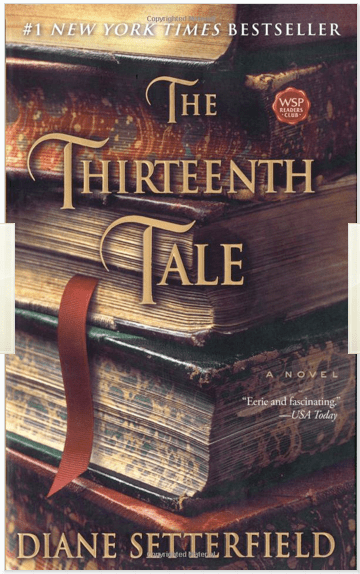
It was good, although now I can’t think of anything so gripping about it. Setterfield took the classic gothic novel – she mentions Jane Eyre frequently – and updates it, makes it modern and personal. It was a good, fun read, had me hurrying through my daily “must-do’s” so I could read more – I like a book like this now and then.
And – the main character, Margaret Lea, loves books. 🙂 She works in her family old-books business, leads a quiet, kind of sad life, haunted by the loss of her own twin early in life. When contacted by famous novelist Vida Winter to write her biography, she is intrigued, and accepts the job offer, which involves going to stay in Vida Winter’s house.
Part of what is fun reading this book is that we are dealing with an “unreliable narrator” with Vida Winter. Sometimes she is lying, sometimes she is lying by omission, and part of the mystery is that Margaret must try to verify what she has been told and try to figure out what has been left out. She has a great adventure in the process.
This is great escape reading. Good for a long plane trip, good for sitting by a sick relative in the hospital, good for using as a carrot (“if I get this done, and this, and this – then I get to go read ‘The Thirteenth Tale!’ “) You can buy it on Amazon.com for around $10 paperback.
Quote from The Thirteenth Tale by Diane Setterfield
“People disappear when they die. Their voice, their laughter, the warmth of their breath. Their flesh. Eventually their bones. All living memory of them ceases. This is both dreadful and natural. yet for some there is an exception to this annihilation. For in the books they write they continue to exist. We can rediscover them. Their humor, their tone of voice, their moods. Through the written word they can anger you or make you happy. They can comfort you. They can perplex you. They can alter you. All this, even though they are dead. Like flies in amber, like corpses frozen in ice, that which according to the laws of nature should pass away is, by the miracle of ink on paper, preserved. It is a kind of magic. “
Maybe that’s why we blog, hoping for a little immortality? Or maybe that’s why we delete entire blogs, entire entries, uncomfortable with the thought that this passing mood or passion will live to be an embarrassment?
Neil Gaiman’s Smoke and Mirrors

Smoke and Mirrors is a collection of – as the author puts it – short fiction and illusions.
My son got me started with Neil Gaiman when he gave me a book called Good Omens. He is probably not an author everyone would like – he can be cynical, but my experience with cynics is that their cynicism is an attempt to disguise a deeply idealistic nature, so his cynicism doesn’t bother me. I love his attention to world mythologies, those beliefs deep down that are passed from parent to child, beliefs so deep we don’t even know they are there.
Smoke and MIrrors was an easy, if uneven, read. I get the impression Gaiman gathered up a bunch of short writings he had done – like sometimes you jot down an idea for something and keep it to be developed later, into a book, a sub-plot, etc. and that these ones never quite graduated.
There are two stories I will never forget. The last story, Snow, Glass, Apples, is a re-telling of the Snow White legend, told from the point of view of the wicked step-mother, set far back in dark times. I will never see Snow White in the same light again. I love the flicker of perception that changes everything. Snow White as a vampiric, wild, uncontrolled child? When Gaiman writes, all the pieces fit together.
The other story hits me on a deeper level. In a house where stray cats come and are cared for, a cat arrives, scarred and damaged, seeking only love. Every night he goes out onto the porch, and late late on some nights, sounds of wild and horrendous battles are heard, from which the cat emerges more damaged, battered and scarred than before. Horrified, the people try to keep the cat inside, but after he has healed enough, he insists on going out again to do battle. One night, the man watches as an apparition appears; on a deep instinctive level, he knows it is a demon / devil. The cat protects the house and its occupants. The story is called The Price, and after I read it, I couldn’t read the book again for a couple days.
When I read Neil Gaiman, it frees me up to think outside the lines, outside the normal boundaries of what we consider normal. This man was gifted with an amazing imagination.
I think of Jesus, and his disciples, the 12 he gathered to help him in his earthly ministry. I think of how often they listened to Jesus – and got it wrong. He would be explaining something, and they just didn’t get it. I wonder how often it still happens, that we think we understand what he is telling us, but our minds are small and fuzzy, and we can’t begin to comprehend the magnitude of what he is telling us.
So I think about angels, and how they are all around us. . . and what if all these little cats and dogs are part of the angels God has sent to protect us? I think how they love us unconditionally, simply, and how good they are for our health (having a pet can lower blood-pressure, for example) and how truly truly AWFUL it is that we might be abusing, starving, neglecting the very angels God has sent to ease our lives and protect us? It fills me with horror!
Neil Gaiman sets me free to think such thoughts. You can read his stories as just stories, but if you have an ounce of depth, you will find your mind wandering to strange places after reading Gaiman. You can find Smoke and Mirrors on Amazon.com for around $10 in paperback, less if you buy it used.
Again, thank you, son, for introducing me to such a mind-stretching author.
Recent Comments
Kitchen on Isiais: Winding Down intlxpatr on Shampoo Ginger tigerbutterya0c5ff1d… on Shampoo Ginger intlxpatr on British Soldier Kidnapped, Esc… John on British Soldier Kidnapped, Esc… Wikipedia Donate Button

Amazina


Early Voting in Florida


