The Cottage Cafe Across from Pensacola Library
“How about lunch?” our friend asked as we left the book club meeting at the library. This was not a meeting we usually attend, but they were discussion Donna Tartt’s book, The Goldfinch, which our group had also recently read and discussed, and we were eager to continue the discussion. She suggested the Cottage Cafe, just across the street, and it looked really cute.


We weren’t the first customers, although we were the only customers in the small dining room. A steady stream of phone calls were coming in, and a steady stream of orders were going out. When I ordered the Oriental Chicken Salad, they were already out of it! I sadly watched an order of about ten boxes leave on a bicycle delivery vehicle, knowing “my” salad was in that delivery.
Ah well. There were plenty of other selections on the menu. AdventureMan started with chili and cornbread, and raved about how good it was.

Our friend ordered the Cottage Cafe Bacon, Lettuce and Tomato, and it looked scrumptious:

I ordered the BLAST, which was bacon, lettuce, avocado, sprouts and tomato, and it was tasty, and I could kid myself it was all veggy and healthy fats, etc, so good for me, right?

AdventureMan’s main meal was barbecued pork. He groaned as he finished it, telling us not to let him order a chili starter AND a BBQ Pork, but as he groaned, he was eating every bite and licking his fingers.

The downside was that it was all so delicious, we really did eat up our meals and did not have space for dessert, and their dessert options sounded fabulous. We’ll have to go back soon and start with dessert 🙂 They are only open until 3, as they also run the Pensacola Victorian Bed and Breakfast next door, the huge Victorian:

1984, A Question of Irony, and a Brief Discussion of Privacy
From yesterday’s USA Today, a very brief article in the USA Round Up:
Alaska: Fairbanks
The number of security cameras in Alaska schools is going up. The Fairbanks Daily News-Mirror reported video cameras are being installed in Fairbanks middle and elementary schools and it’s part of a statewide trend aimed at making schools safer.
As I raised our son, I was – well, most of the time – an attentive parent. I would listen, and when necessary, I would correct. It’s a mother’s job to help her children navigate the pitfalls of life, and to have a tool-box full of resources with which to cope.
Perhaps I did my job too well. Our son became a lawyer, and he is very particular about the things I say, especially when I use a term incorrectly, such as irony.
Here is what Wikipedia says irony is:
event characterized by an incongruity, or contrast, between what the expectations of a situation are and what is really the case, with a third element, that defines that what is really the case is ironic because of the situation that led to it.
I am about to use the term “irony” correctly. 🙂

When I read the above article, I remembered the horror of Orwell’s 1984, the book, and then the movie. The movie was terrifying, the presence of cameras everywhere, hidden, not hidden, just knowing they were everywhere and everything you did could be monitored.
The irony comes in that here we are, with cameras everywhere, and we are glad for it. The irony is that our society has slipped so far from its ideal that we cannot trust our neighbor to behave him or herself, and we protect ourself by placing cameras so as to encourage people to behave.
I am not so sure that our moral codes have ever worked well; I think it seems to be the nature of humanity to claim a moral code, but not to adhere strictly to it. I think of people who talk about the safety of the ’50’s, but I don’t believe that safety was truly that safe. I think children disappeared. I think wives were beaten, women raped. I think robberies and assaults happened, and I think the law was more lax than it is today.
But it is an irony, IMHO, that we welcome cameras today as a low-cost policing of ourselves, our neighbors, and those we fear will hurt us or take our property. We trust ourselves and one another so little that we are increasingly installing cameras. We’ve been considering installing them through our home security company; we have motion detectors, cameras are just the next upgrade. Have we exchanged a high value on privacy for a heightened perceived need for protection of life and property?
Wayfaring Stranger and James Lee Burke in the Heat of August
Just in time to save August from being my most hated month EVER, a new James Lee Burke novel, Wayfaring Stranger.

LOL, escaping from the relentless heat and humidity of Pensacola, I enter the heat and humidity of Burke country, ranging from the oil fields in Louisiana to the desolate social scene of Houston in the 1950’s.
I got hooked on James Lee Burke in a very cold winter February in Wiesbaden, Germany, when I came across a book called A Morning for Flamingos. I like mysteries, but this was a mystery by a poet! When I read about the what an approaching thunderstorm looks like when you live in a little cabin in New Iberia on Bayou Teche, I was lost. I-don’t-know-how-many books later, I’ve been to New Iberia, had lunch by the Bayou Teche and explored Burke country.
Louisiana is soulful, all those little roads, and sugar cane factories (think True Detective, here) but, (sigh) no matter how colorful, no matter how beautiful, the Louisiana in James Lee Burke’s books is better. He’s been there longer, he has the eye to see that heron, that shiver of wind over the water, that glint of pure evil in a bad guy’s eye. I know you think I am blathering on, but kinda-sorta the Dave Robicheaux detective series are all pretty similar, what changes is the particular social injustice. So this is what hooks me – Burke’s relentless battle against injustice, by writing powerful books that get read by a lot of people, and the elegant prose and philosophy he inserts to lift it way beyond the run of the mill mystery book.
The Wayfaring Stranger is the best yet. It’s not one of the Robicheaux series, it’s part of a Holland series, lawmen whose Texas lives and challenges we’ve read about in previous books. Wayfaring Stranger is the story of Weldon Holland (Burke tells us in an after word that Hollan – no D – is an old Texas family name in his line) who lives with his grandfather and runs into the real Bonnie and Clyde. Fast forward and he is fighting in the Ardennes, and the only reason you have faith he will survive is that there are so many pages ahead of you . . . he and one of his men trek, hop a train, and end up in a deserted death camp, where they find one survivor – a woman. The three of them are surrounded by fighting armies and find safety in a local farm’s cellar.
Oops. I’ve already given away that Weldon survives the battle. It’s hard to write much more without giving too much away. It’s a powerful story, powerfully written. It’s about good men and women and weak men and women and how sometimes an evil person can surprise you with a goodness.
Warning. Once you pick up Wayfaring Stranger, you’ll need a block of time so you can just go ahead and finish it. You won’t be putting it down.
Chimamanda Ngozi Adichie: Americanah
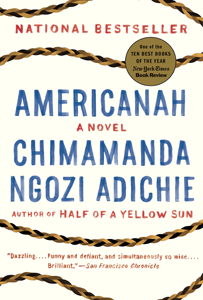
“Ouch! Ouch, Chimanda! Stop!”
(Oh wait.)
Don’t stop.
It’s me who can’t stop. I read everything Chimamanda Ngozi Adichie writes. I only started reading her by accident, when I was facilitating the Kuwait Book Club I never intended to belong to, and found myself reading so many books by authors I had never heard of. We were reading Half Of a Yellow Sun and all of a sudden, I WAS Nigerian. She can do that. She uses the senses, she uses the thoughts in our head. We are really not so alien, us and the Nigerians I start to think. I have Nigerian friends, from the church. We all get along. We have a good time together.
“Not so fast!” Chimamanda tells me in Americanah, her newest book, which I put off buying until I could find it in paperback. “You are very different! You think differently! And growing up in a country where there are black and white, race becomes an issue that it is not when you are black, and everyone is black, and you are growing up in Nigeria.”
Hmmm. OK. That makes sense. I mean, I thought I was Nigerian because in Half of a Yellow Sun, I was Igbo, living in an academic community in Nigeria, and hmmmm. You’re right, Chimamanda, there were no white people around. Just us Nigerians.
Chimamanda, with her sharp, all-seeing eyes, her sharp ears and her sharp tongue make me cringe as she comes to the USA and comes up against assumptions many have about Africa. Do you even know where, exactly, Nigeria is? Do you know where Ghana is? Most Americans can find Egypt on a map of Africa, and MAYBE South Africa, but the rest is . . . mostly guesswork. Because we send clothing and food aid to African countries, we have the idea that all Africans are poor, but that is not so, and is insulting to the middle-class and upper class Africans who travel elsewhere for leisure – and education.
I don’t know how much of Chimamanda Ngozi Adichie’s book is autobiographical and how much is fiction. I know that her observations are acute, she nails expat friendships, she spotlights our blind spots and hypocricies, and she holds you in her grip because she is no less harsh with herself – if, indeed, her Ifemelu, the main character in Americanah, is reflecting Chimamanda’s own experience. The experiences, coming here, the overwhelming differences in manners and customs, even volume of voice and width of hand expression, are so immediate, so compelling, so well described that they have to have been experiences she herself had, and had the eyes to see. She must have taken notes, because she totally nails the expat experience.
Book ads and book reviews focus on Americanah as a book about being black in America, and it truly is that – as seen from the eyes of a non-American black, as she often reminds us.
She is hard on herself, returning to Nigeria, and quick to note that much of the change is in herself and her changed perspective. While I love the romantic storyline, I was disappointed by the fantasy ending, given how self-disciplined Adichie is at keeping it real in every other facet of the novel. On the other hand, I am still trying to think of an ending that would work for me, and I can’t. While her ending wraps it all up neatly, it’s the one part of the book where her sharpness dulls.
One of the things I liked best about the book was going behind the scenes, being Nigerian, going to school, having coffee, working, going to parties with other Nigerians, chatting with my girlfriends. We’ve done things with nationals of different countries before, but you know as soon as you walk in that your presence changes things. Chimamanda Ngozi Adichie takes me with her and no one knows I am there, observing, learning, figuring out how things are done when it’s “just us” Nigerians.
Here’s why I am a Chimamanda Ngozi Adichie addict. She keeps it real. She has eyes that see, and ears that hear, and a gift for capturing what she sees and hears and a gift for writing it down. She has insight, into herself, into others, into character and motivations. She is sophisticated and unpretentious, she admires and she mocks, but when she mocks, it is as likely to be self-mockery as mockery of another person, class, ethnicity or nation. Reading Adichie, I understand our similarities – and our differences. I believe she would be a prickly friend to have, but I would chose her as a friend.
Awards
● Winner of the 2013 National Book Critics Circle Award for Fiction
● One of The New York Times’s Ten Best Books of the Year
● Winner of the The Chicago Tribune 2013 Heartland Prize for Fiction
● An NPR “Great Reads” Book, a Washington Post Notable Book, a Seattle
Times Best Book, an Entertainment Weekly Top Fiction Book, a Newsday Top 10 Book, and a Goodreads Best of the Year pick.
Donna Leon and The Golden Egg
“What are manners?”
“What is ‘nice’, what does it mean?”
“What is ‘kind’?” the most adorable little boy in Pensacola asked me. It was bath time, a time when we have some of our best conversations, and you never know where the conversation will go.
I love these conversations because I have to think, too, but most of all, because I love to watch this little boy’s mind grow in grasping concepts and perceptions. He is four; his class in school is on the letter “U” this coming week, and already he can sound out words in the books we read together. He knows what a globe is, and how it differs from a map. He knows his address, and he can point to Pensacola on the globe.
He knows things because we talk to him, and because he goes to school and his teachers talk to him. His mind is wide open and he is eager to learn, and he asks the most wonderful questions.
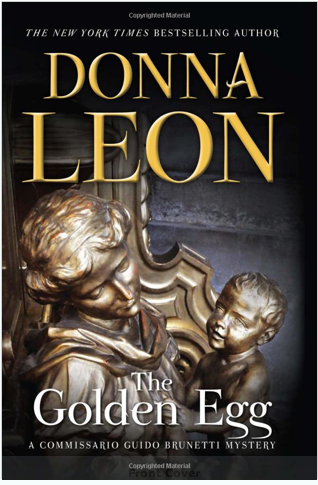
Donna Leon’s Commissario Guido Brunetti has a new case that troubles him. He knows the dead man, not well, but he would see him in his quarter, and he often saw him helping out at the local laundry. He assumed the man was deaf and retarded, everyone knew that. When the dead man has no papers, in bureaucratic Italy, no birth certificate, no medical records, no finance records, no record of social aid (he is poor as well as disabled) Brunetti is troubled. How could such a familiar figure be so undocumented?
His mother is no help; her stories are transparent lies about travel to France and her son having grown up in the country with people whose name she cannot remember.
It is a troubling book. If you read Donna Leon, you will understand how close and wonderful and articulate Brunetti’s family is, how loved and cherished their children. We eat meals with them, we understand how the Venetian vernacular distinguishes those to whom one speaks more frankly and those to whom one lies. Brunetti’s a detective; the things he sees often trouble him, but this case troubles him more than most.
I can’t tell you more without spoiling the ending. All I can tell you is that it will encourage you to love your children, hold them closely, and give them all the benefits in their life-toolbox of attention, instruction and loving discipline that a parent (and grandparent!) can give.
The Invention of Wings by Sue Monk Kidd
This is one terrific book.

Amazon recommended this book to me, and as a person who loves just about everything Sue Monk Kidd writes, I bought it immediately. AdventureMan had also read a review and said it might be a good book for our book club, so he gets it next. Most of my friends have it on Kindle to read soon.
The book is written in two voices, that of Sarah Gremke’, white, and Charlestonian, of Charleston society families, and the other voice of Hetty/Handful, the slave given to Sarah for her 11th birthday. First Sarah tries to refuse the ‘gift,’ then, using her father’s law books, she writes a letter of emancipation for Hetty, and neither effort works. Sarah and Hetty are stuck with each other, stuck with the times, stuck with their situation, and stuck with the institutions that determine and limit what they will accomplish.
Or are they?
There were times, as I read the book, that I felt like I was going to suffocate. First, the heat and humidity of Charleston, South Carolina, are bad enough without the kinds of close-fitting clothing women were required to wear in that day; the thought of wearing those clothes makes me choke.
The limited expectations for women would stunt and damage the strongest female character in that society where those who thrived were those who were pretty, good at getting married, and good at bearing children, dressing appropriately and socializing endlessly at the same stale events.
Slavery damages everyone. No one should have that kind of power over another human being; studies show that when human beings are given power over another their very worst instincts come to the forefront. Why do we need studies? We have the real world to show us what that kind of power does, how it corrupts the one who holds the power so thoroughly that they don’t even know they are corrupted.
These are stories from my time living in countries where people from poorer countries came to work:
My maid had worked for a family where the men pestered her because she was full time and live-in. They assumed she was sexually available to them and made life very difficult for her. Her mistress saw a beautiful silk blouse she wore, a blouse she had saved for and only wore on her day off, and her mistress borrowed it, stained it, returned it and didn’t take any responsibility for ruining her one really nice blouse. It was never mentioned again. Only when the men complained about this woman was she allowed to leave; her mistress didn’t want the men tempted, she got her passport back and come to work for me. Her previous mistress wanted an ugly maid, and the men were hoping for someone more compliant.
The woman who bought my car had saved and saved, and was working under deplorable conditions in a day care. I told her that she had skills, get another job, and she told me that she hadn’t been paid for three months, and if she left she would never get that pay, and also her employer would never give her her passport or allow her to leave. She was, in effect, a slave.
Most of my friends are very good employers, taking good care of the people who come to work for them, but I have seen those (not my friends) who are violent and abusive. Being a slave is being trapped in an existence with no control over your own life.
Monk makes an interesting comparison of white women’s lives with their limitations being not unlike a variant of slavery. Maybe the conditions were a little better, but the un-free-ness was similar.
Sarah Grimke’ and her sister Angelina, against all odds, break free of family expectations and societal constraints. They forge their own way, with Angelina’s gift for rhetoric and Sarah’s keep legal writing. I had never heard of these women before, and I am so glad Sue Monk Kidd wrote this book to raise their visibility both as abolitionists and as some of the very first proponents for women’s rights to full equality.
As a quilter, I also loved in this book that Handfull’s mother is a quilter, and while she can neither read nor write, she puts down her history in an applique quilt which clearly spells out significant events in her life, and is a tool for passing family history from one generation to another.
All the Light There Was by Nancy Kricorian
AdventureMan came into the room where I was reading and handed me this book. “Will you read this?” he asked, and there was a note in his voice that sounded a little aggrieved.

“What’s up?” I asked. “You sound a little peeved.”
“I read this,” he said. “I thought it was pretty good, but when I read the reviews on Amazon, some people called it ‘trivial’,” and I could see he was embarrassed that something he thought was pretty good others believed was of little importance.
Big mistake, Adventureman.
I might read a little of the reviews when deciding whether to buy a book or not, because I won’t remember it when it comes time to actually read the book or review the book, but I never, NEVER read the reviews as I am reading or before I review a book. And, truthfully, I don’t really care what this reviewer says or that reviewer says. Sometimes I read a New Yorker review of a book and I think “that reviewer has her own filter and can’t see beyond her framework” or “Wow! That reviewer saw some things I’d like to see!” Sometimes I will read a review and then read the book and think that the reviewer really missed the mark, positively or negatively, it could be either way.
Reviews are opinions. We all have them. Some you might agree with, some you might not, but don’t let them touch you, or your experience with the book. We are each unique, and see through a unique lens!
First, it delighted me that I read this just after I read Babayaga, because I ejnoy Paris, and delight in walking Paris, and in Babayaga and in All the Light There Was, people do a lot of walking in Paris. So much so in All the Light There Was that I ran down to my little map collection for the Paris maps and would track the heroine through Paris. It was fun.
Although All the Light There Was is called a novel, I don’t think it is. As I read it, I thought it was highly biographical or autobiographical, based on a diary or diaries. The significant details – how the mama stockpiled food just as war was announced and all the places she stored it, including under the bed, the clothing they wore, the sweaters they knit, the indignities they endured, and the risks they bravely took against the occupying Germans – it doesn’t sound made up to me, it sounds like a story someone has told from that time.
The details are so strong – the bicycle tires that are treasured because if they go flat, that is the end of the last transport they have, the dresses that have become too big because people have eaten too little – these details sound like voices to me.
So I would not call this book trivial. This book captures a moment in time, it’s a snapshot. The characters don’t have a lot of depth, the events don’t have a lot of texture, but I do know what occupied Paris ate during the last years of the occupation (turnips) and the ambivalence with which Paris viewed their Jewish citizens. In this war-time Paris, Kricorian captures well Pastor Martin Niemoeller’s poem about When They Came for Me:
In Germany, they came first for the Communists, And I didn’t speak up because I wasn’t a Communist;
And then they came for the trade unionists, And I didn’t speak up because I wasn’t a trade unionist;
And then they came for the Jews, And I didn’t speak up because I wasn’t a Jew;
And then . . . they came for me . . . And by that time there was no one left to speak up.”
Many in Paris were happy to see the Jews go, happy it wasn’t them. Kricorian tackles this issue indirectly, with a light but inescapable hand.
One of the things that was shocking to both of us what that when Maral’s ancient Auntie Shakeh died, and we see the tombstone – she is 35 years old. We knew she and Maral’s parents had escaped the Turkish efforts to eradicate the Armenians in Turkey, but because we are seeing the story through Maral’s eyes, her parents and aunt seem ancient, whereas in today’s terms, they are very young adults.
Don’t read the reviews, AdventureMan! Read the book, take from the book what you will, enjoy your own experience. Write your own reviews!
Babayaga by Toby Barlow

You know how books come your way in coincidental ways? Amazon.com had told me I needed to read Babayaga, so I ordered it. I’ve always loved mythologies, I devoured them like candy when I was young, always looking for more. Babayagas are very old, and exist under many names in most cultures – elderly women who usually deal with concoctions, often medicinal, who live alone. In the west, they were often called witches, in the Slavic countries, babayaga, and it seems to me there is an old woman used to scare children in the Gulf, too. It seems to be a cross-cultural phenomenon.
Here is what Wikipedia has to say about Babayaga:
Baba Yaga is a witch (or one of a trio of sisters of the same name) in Slavic folklore, who appears as a deformed and/or ferocious-looking elderly woman. She flies around in a mortar and wields a pestle. She dwells deep in the forest, in a hut usually described as standing on chicken legs, with a fence decorated with human skulls. Baba Yaga may help or hinder those that encounter or seek her out, and may play a maternal role. She has associations with forest wildlife. Sometimes she frightens a hero (e.g. by promising to eat him), but helps him if he is courageous. According to Vladimir Propp’s folktale morphology, Baba Yaga commonly appears as a donor, a villain, or something altogether ambiguous. In many fairy tales she kidnaps and eats children, usually after roasting them in her oven).
Andreas Johns identifies Baba Yaga as “one of the most memorable and distinctive figures in eastern European folklore,” and observes that she is “enigmatic” and often exhibits “striking ambiguity.”[1] Johns summarizes her as “a many-faceted figure, capable of inspiring researchers to see her as a cloud, moon, Death, Winter, snake, bird, pelican or earth goddess, totemic matriarchal ancestress, female initiator, phallic mother, or archetypal image”.[2]

Barlow’s BabaYaga includes all the backstory, inserted here and there, the Russian purges, revolts, revolutions, the wars, the mud, the snows, following the troops, and several different Babayaga, while focusing one one, the beautiful and mesmerizing Zoya, who lives in a magical post World War II Paris. She in unforgettable – unless, of course, she has woven a spell to muddy your mind and make you forget.
What I love about this book is that if it were true, you would still think it is fiction. If every single thing happened just as Barlow wrote it, you would never believe it. LOL! A wicked sour old babayaga turns a police detective investigating a murder into a flea; he finds it a novel experience and manages to make things come right even as a flea.
A young American man, Will, loving living in Paris, works for an ad agency and also for THE Agency in the heady days of post war Paris, where the rules are not yet in place and lines are fuzzy. Falls for a witch with a long history of loving and killing men, but that’s life. Is it better to love and lose than never to have loved? What if your love is a gorgeous babayaga who helps you live life with a vibrance and intensity you have never experienced?
There is a long, intricate, time-appropriate adventure/spy/industrial-scientific plot which I am not sure I entirely followed, with murders and shootouts and the Paris jazz and club scene, and it didn’t matter one whit whether I could follow the plot line or not, it was a wild ride of a novel and a lot of fun. 🙂
If You Lived Here, I’d Know Your Name: Heather Lende

“You have to read this!” said my book friend, “You’re from Alaska! It’s about a woman who lives in some small town and writes obituaries!”
I grinned politely and put the book in my bag. Some books sound more interesting than other books – I’ve always loved adventures and mysteries and murders – add a little drama to the day-to-day-ness of everyday life. A woman who writes obituaries? Hmmm, not so much.
But spending my afternoons tending to my sweet little 3-month-old granddaughter means I often sit, anchored by the soundly sleeping baby who I don’t want to disturb, even by twitching. I have one hand free – and you can only play so much iPhone Sudoku.
An Alaskan friend had also recommended this book, so early this week I picked it up and started reading.
Oh. my. goodness. Yes, Haines is a small town, but oh the drama of writing obituaries. Oh, the things you learn about your neighbors and the surprises you get learning about their earlier lives. I love the way Heather Lende weaves the writing of the town obituaries with the current ongoing dramas in her own life and in the lives of her friends and makes it work.
It’s not unlike where I grew up, although my hometown had a hospital. We also had moose and bear and elk in our back yards, and learned to treat wildlife with respect, and that the best option was to back away slowly. There are the same senseless deaths from auto accidents, fishing boat accidents and unexpected changes in weather. There is the same feeling of wonder, almost every day of your life, knowing how very lucky you are to live in the midst of such awe-inspiring beauty. It’s hard for me to imagine being an unbeliever living in Alaska.
It’s also a great book to read before going to bed. Some of the books I read are too exciting or too disturbing to read before bed; books that infiltrate your dreams with images and situations that give you a restless night. While Lende deals with death and sadness and drama, there is an underlying message of hope in the neighborliness of your neighbors, the security of living in a town where everybody knows everybody else, in the civility even of people who strongly disagree with one another. If You Lived Here, I’d Know Your Name gives you peaceful sleep. She ties it all together with an ending that rips your heart out; you will never forget this book once you read it. After reading, you will feel like you have lived in Haines, Alaska.
The paperback version is available from Amazon.com for $9.73. No, I no longer own stock in Amazon.com.
Wooo HOOO the New Q8 Books!
Brava! Brava, Fajer! What a great gift to the children and the community, to make Q8Books more accessible and family friendly. Woooo HOOOOO!
Reading and literacy are key to civilization. Brava!
From the Kuwait Times:
Kuwait’s community bookshop gets new life

Finding quality English books in Kuwait is a challenge as any book lover here knows. Local lawyer Fajer Ahmed, 26, recently took up the challenge when she acquired the small but well-loved bookshop, Q8 Books. She moved Q8 Books from downtown Kuwait City into a renovated space in Bayt Lothan, the non-profit arts and culture center located next to Marina Mall in Salmiya. Home to more than 15,000 titles of all genres including literature, general fiction, history, romance, thrillers and mysteries, westerns, classics, cook books, true crime, self help and motivation, family and lifestyle, business and philosophy and arts and crafts, Q8 Books has something to suit every reader’s taste.
By adding sofas, tables, chairs and beanbags, Q8 Books created a cozy, relaxed atmosphere along with free WiFi that invites customers to come and hang out. “We want to encourage reading, writing and communication in Kuwait, “Fajer explained. “As one example, we provide local writers with a place to display and sell their books free of charge, we also do all the administrative work for them.”
A community bookshop
Q8 Books also holds a free weekly story time for children, offers 50% store credit for trade ins, encourages book clubs and other responsible community groups free space to hold meetings and has an outreach project to support a library in Gambia. “We thank Bayt Lothan for giving Q8 Books a home,” Fajer said. “Without them none of this would have been possible.” Q8 Books’ erudite former owner, Jacob, started the bookshop almost a decade ago with only a handful of books. During his travels, he would browse used bookstores and markets to find quality titles that would be appreciated by the book-loving community in Kuwait. Jacob continues to help out at Q8 Books along with a group of dedicated volunteers and support from the Kuwait Writing Club.
Fajer also organizes regular events in order to build Q8 Books as a community space. On the first of November, Q8 Books hosted a Spooky Book night for kids, which included a story telling by local street artist Monstariam dressed in a bunny costume, a crafts and arts table, coloring and glitter, a costume contest and a chance for parents to browse and chat.
Kid and family friendly
“We really enjoyed Spooky Books night,” said Umm Sara, a mother of three children who attended the event all wearing ‘scary’ costumes. “The kids loved the story telling and we got several books. Much better than going to a mall and they got to draw and color and dress up.” The Kuwait Writing Club also took part, judging over 80 submissions for the writing competition. The winning submission will be published in Kuwait Times. “We also had a cover design competition for children to draw covers for the age appropriate horror story, Goosebumps, and every kid that took park received a free book of their choice,” Fajer explained.
Q8 Books will offer monthly events for children and parents with the goal of encouraging reading. “When kids come in playing games on electronic devices, we try to find books with the same characters and get them interested in reading,” Fajer noted. “Welovekuwait.com Children’s Bookshop has also donated coloring and reading books to give for free for every child that walks in.” Q8 Books encourages Kuwait’s community of readers to share their love of reading. They accept donations and offer store credit for traded in books. They also invite anyone to email ask@q8bookstore.com if they are interested in volunteering, donating or just want to talk to someone about suggestions for what to read.
Q8 Books is located in Bayt Lothan, next to Marina Mall. Store Hours: Weekdays 9am- 1pm and 5pm-9pm. Weekends 11am-9pm. Follow them on Instagram @q8bookstore
By Jamie Etheridge
Recent Comments
ExpatAlien on What Country am I Living … intlxpatr on Yellowstone: Old Faithful to C… Michelle on Yellowstone: Old Faithful to C… Cathy on No Grown-Ups in Charge intlxpatr on Waiting for Snow Wikipedia Donate Button

Amazina


Early Voting in Florida


 Here There and Everywhere