Karen Thompson Walker and The Age of Miracles
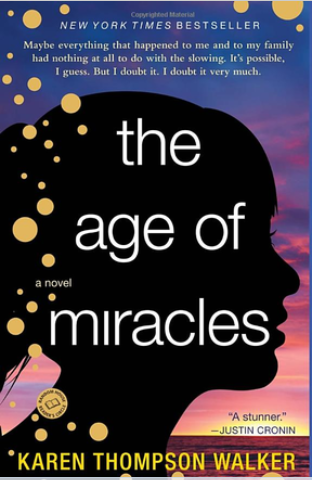
The Age of Miracles is a very odd name for this book, which starts off in a beautiful little coastal town in California, a very normal, modern town, and then everything changes. Suddenly, the earth’s rotation is slowing, incrementally, but resulting in longer and longer days and longer and longer nights. The difference is small at first, but grows.
Julia is in sixth grade, a painful time anyway in most lives where your body suddenly changes and all your relationships with all your friends change, and boys become a major factor. Imagine. All this AND the earth’s rotation is slowing.
No one knows what to expect. No one knows why or how the rotational slowing is happening, and no one has a clue how to fix it. Do you stay on a 24 hour clock, as the days grow to 30 hours? Forty hours? Can you even function in a forty hour day, or sleep a 40 hour night? How do you stay on a 24 hour clock and force yourself to sleep when the sun is shining brightly overhead? How do you have a school day entirely in the middle of the darkest part of the night? How does food continue to grow? What impact does this have on birds? Migrations? How does kicking a soccer ball feel when earth’s gravitational field starts to lessen?
The author does a brilliant job in a what-if situation, and manages to make it quite real. Don’t read this book if you are the suggestible type – it’s just one more thing you’ll start worrying about when you don’t need to. If you can read speculative fiction without letting it influence you, then by all means read this book, it is a good read.
The Death of Bees by Lisa O’Donnell
Death of Bees was another powerful recommendation by National Public Radio.

I believe in a greater power, in a God who sends things my way and that I am meant to be paying attention. Several books have been recommended to me lately which I didn’t choose, or might have avoided had I known how painfully they dealt with poor parenting and children in the depths of horrific poverty.
Here is what the lead into the book says:
Today Is Christmas Eve,
Today is my birthday,
Today I am fifteen,
Today I buried my parents
in the back yard.
Neither of them were beloved.
Oh my goodness! I am sucked in immediately. And immediately I am overcome by the grinding nature of poverty, the enormous amount of energy it takes just to be fed, to have a roof over your head, to function in the bureaucracy that seeks to ameliorate the burdens of poverty.
I am horrified by the lives of innocent children in the hands of people who should never have responsibility for anyone, even themselves, their decision making skills are so non-existent. There are parents who have no idea what self-sacrifice GOOD parenting requires, who raise children who are often trying to survive their own parents.
The Death of Bees has redemption. It has two sisters who love one another and are smarter than the average child. It has a neighbor who notices, not in a snoopy or intrusive way, but in a kind, helping and ultimately sacrificial way. It has moments of black humor, when the neighbor’s dog keeps digging at the parental graves in the backyard and bringing bones inside just at the worst moments.
Ultimately, it is a tale of survival, in spite of the parents, in spite of the system, in spite of betrayals by family and friends. There is a glimmer of hope that life may be different for these sisters, if they can survive their upbringing and overcome their childhood.
Now, go read the book 🙂
Amitav Ghosh and River of Smoke

The National Public Radio website recommended this book as one of the best historical fiction reads, and I had never heard of it, so I ordered it. I ordered it in spite of the little voice I had in my head reminding me that this was the second in a trilogy, that the first is Sea of Poppies. I was too eager. I wanted to jump right in, and the review said it could be read stand-alone. I had read Ghosh’s Glass Palace a couple years ago for book club, loved it, and was eager to read this one.
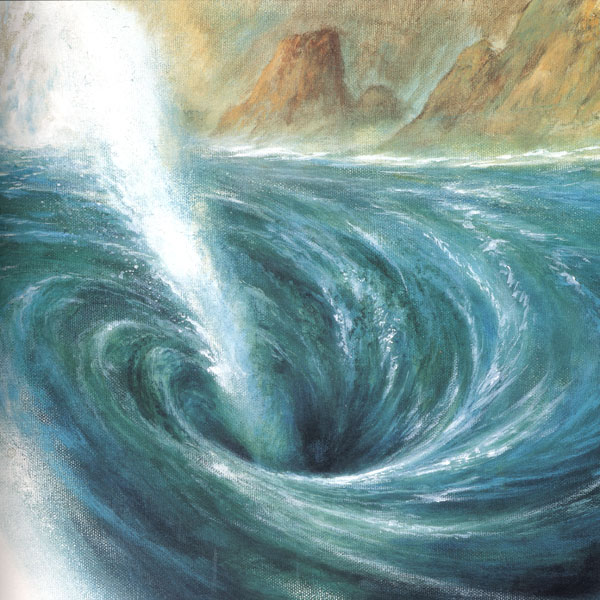
With a raging cold and no possible way I can be around humanity, it was a good time to start. Just picking up the book, it has a dense feel. Once you start, it is like being suddenly in a whirlpool, drowning in new words, characters who have more than one name and more than one identity, whirling between England, Mauritius, Hindustan, Gujerat, Hong Kong, Macau and China, whirling between cultures and professions and trades, but oh, what a ride.
It would have been helpful to be reading River of Smoke on an iPad, where I could poke at a new word and it would give me the meaning, but in truth, you can guess a lot of the meaning of the vocabulary from the context. The seafarers all speak a language sort of like Jack Sparrow, a pidgen language filled with simplified grammar and with words from many nations and cultures. It forces you to slow down. It’s worth it. It would also be nice if you could poke on a place-name and have Google Earth show you where it is. There used to be a website called Google Books, and you could put in a book and it would show you the places in which actions in the book took place; that would be particularly handy reading this book, provide context in place-relations.
But reading slowly is it’s own reward. This book has depth, depth of character, depth of textures and senses, and depth of morality. I love a book like this where you can smell the smoke drifting over the water, where you can smell the sewer and bloated animal corpses floating outside the foreign hongs of the Canton traders, you can feel the textures of the textiles and see their colors, you can taste the exquisiteness of Macau cuisine and you can hike in a Hong Kong not yet settled by anyone, Chinese or foreign.
The scope of time covered by the major part of the story is short, although there are years of back-stories for several characters. The period is 1837-8, during which the Chinese Emperor decides to put teeth in the long established edict against opium trade to China. The edict had been in place, but not enforced, and China watched her citizens sink into opium addiction and lowered productivity. The traders were making fortunes – shiploads of money. Opium was grown in India and shipped from there to China.
When the ban against shipping opium into China is announced, many traders believe it is just another attempt to attain greater bribes on the part of the mandarins, and decline to obey. There is great debate, and while it is lively in the book, it is based on documents from that era, many of the arguments word for word. Traders stood to loose a great deal of money, in truth, it would ruin most of them to lose their shipments.
There is a side story I also like, that of the botanical trade between China and England, and the importation of many of the garden plants we take for granted today, which were unknown until sent from China. Camellia – one of which is the plant for tea, did you know that? Roses, azaleas, orchids – many many familiar plants would be missing from our gardens were it not for their introduction during this period.
Ghosh gives us disparate characters of many cultures and upbringings, and slowly weaves them together, each one tangential to all the others, some closely interwoven. It is a fascinating read, and I can’t wait for the next volume. I may have to go back and read Sea of Poppies while I am waiting.
Doc by Mary Doria Russell

Mary Doria Russell is one of my favorite authors because she tackles large topics fearlessly, humorously and with great compassion. I first read her many years ago in a novel called Children Of God; you can read it stand-alone as I did, but I should have read The Sparrow, which preceded it. That one is about the Jesuits who take the Gospel into outer space, and has some laugh-out-loud moments in the midst of utter hopelessness. Yes. She’s that kind of author, my kind of woman.
Here is the ending Question and Answer from an interview at the back of Doc, an interview with John Connelly:
Q: Authors are often asked what advice they’d give young writers. I would like to ask you a similar question: What do you think the worst advice a young writer could get is?
Mary Doria Russell: Major in English. Join a writer’s group. Blog.
My advice is to major in and do something REAL. Have an actual 3-D life of your own. And please, shut up about it until you’ve got something genuinely wise or useful or thoughtful to share. Then again, I’m a cranky old lady! What the hell do I know?
Reading a book about legendary heroes of the Old West is not something I looked forward to, so the book languished on my “to read” pile until one day I picked it up just because it is written by Mary Doria Russell, and because she has knocked my socks off with every book I’ve read by her.
It starts off slow, summing up the early genteel years of John Henry Holliday in Georgia, just prior to, during and after the War Between the States. At 22 he is diagnosed with acute tuberculosis, and is advised that a drier climate out West might provide him with a more comfortable life, as short as it was likely to be. He had trained as a dentist, so he had a skill. Times were hard, and while he was a very very good dentist, it was a good thing he also had skills with card playing, to supplement his income when people didn’t have the money to go to the dentist.
Don’t skip over the early years, because what happens in the early years resonates into his years living in the West. The majority of the book takes place in Dodge, a border town where laws are made over a card game and by the men who will profit from them. Lives are hard, and short. While it is surely the wild west, the focus is on the relationships Doc builds – Wyatt and Morgan Earp (all the Earp brothers), Bat Masterson, the gals . . . here is where Russell’s artistry shines; the cardboard figures begin to become real people. We start to like one or two, admire another, despise one more.
Here’s what I love about Mary Doria Russell – without being at all preachy, she makes you stop and think about some of the values you hold most dear. Once you get west, 80% of the women featured in the book are prostitutes. Most of the characters drink heavily, and routinely use drugs which are today restricted to prescriptions. There is corruption, and murder, and arson, and abortion, and contraception, and adultery, and there is no one character who is purely good or purely evil, they are all complicated, just as we are. She can lead you to dislike a character, who at just the right moment knows just the right thing to say, and suddenly, you see that character differently, because another facet of his or her character has been revealed.
In the questions at the back of the book, we are asked if we were to meet Doc Holliday, would we like him? I had to ask the question the other way around – if I were to meet Doc Holliday, how would he perceive me? I found myself thinking outside the box, found myself thinking that if I knew my life were going to be very very short, would I want to hang around with normal people, dull, predictable people? Maybe people who look better on the outside than they are, or think more highly of themselves than they ought? Doc Holliday hung around with lawmen and gamblers and prostitutes and bartenders; his patients were law-abiding church-going citizens. Who gave greater color and meaning to his life? Who were more likely to be down-to-earth and practical and unpretentious?
There is an absolutely delightful segment about a Jesuit priest from an old Hungarian aristocratic family who finds himself riding out to visit all the small Catholic Indian parishes on a donkey, replacing a highly popular priest who is very sick; he is teased and mocked and treated with disrespect. One night, cold and wet, covered with dirt and filth in the desert, he has an epiphany that changes his life. Mary Doria Russell books have these luminous moments, worth reading the entire book for, and which will bring a smile of memory to your face long after you have finished reading the book.
Foods a la Louisiane: Jambalaya
Did I tell you I collect cookbooks? One of the guidelines I use is that the cookbook have the name of a person attached to each recipe; if your name is on a recipe going into a book, you know you are going to be very careful that this recipe is really, really good.
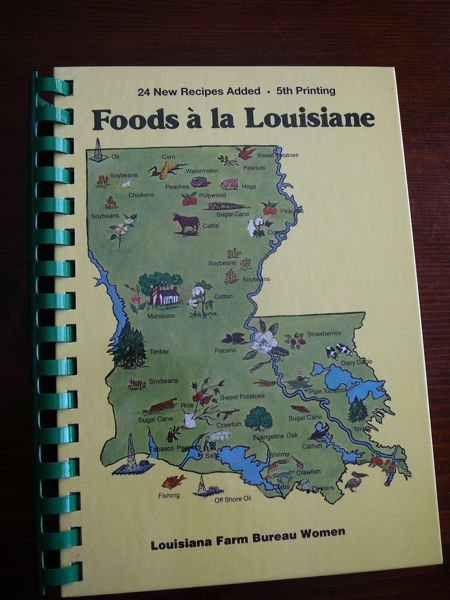
I don’t remember buying this cookbook, but it is a gem. On the other hand, there have been some surprises . . . there is a recipe for making boudin, that ubiquitous Cajun sausage, and it starts off with “1 large hoghead.” The directions state that you boil the hog’s head until tender, let it cool, remove meat from bones, then grind hoghead meat with heart, kidney, onions, parsley, etc. in a meat grinder.
Thank goodness boudin is not a favorite of mine. Andouille, a spicier sausage, IS a favorite of mine and if I see a recipe for andouille, I am NOT going to look at it.

I love making jambalaya – and here is a genuine Louisiana recipe:
JAMBALAYA
1/2 cup vegetable oil or drippings
2 medium onions, chopped
2 stalks celery, chopped
1 cup fresh parsley, chopped
1 medium green pepper, seeded and chopped
1/2 cup chopped green onion tops
Water
2 1/2 teaspoons salt
1 teaspoon garlic powder
Red Pepper to taste
Pepper to taste
Browning agent or 2 teaspoons Kitchen Bouquet
2 lbs peeled raw shrimp
4 cups long grain rice
Heat oil over low heat in a heavy 6 quart Dutch oven until warmed. Add vegetables; saute until lightly browned. Add enough water to cover vegetables; add seasoning and browning agent. Bring to a boil; add shrimp. Cook over medium heat for 10 minutes. Stir in rice; cook 10 minutes. Cover and cook until rice is tender, stirring occasionally. Yield 10 – 12 servings.
I do jambalaya all the time (DISCLAIMER: I am neither a Louisiana native nor of Cajun descent, so what I do cannot be taken as authentic, even if it is tasty 🙂 ) and I use more spices, chopped tomatoes and I don’t add the shrimp until the rice is cooked; I add it at the end and give it five minutes for the heat of the rice and cooked ingredients to cook the shrimp. We also use andouille sausage (or a turkey sausage if we are entertaining Moslem friends) and some cut artichoke hearts, maybe a small jar of pimentos, maybe some leftover peas. Sort of like a jambalaya/paella 🙂
Donna Leon and Beastly Things Made Me Cry
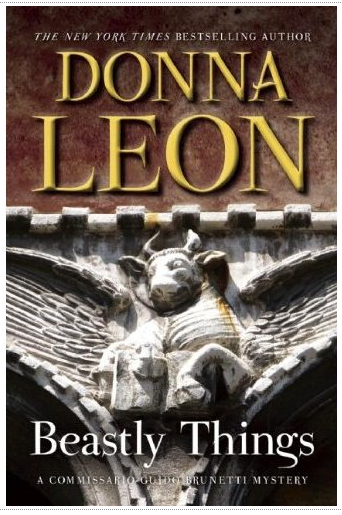
I can always count on Donna Leon. She gives me a good read, a solid mystery, a social issue, the louche damp atmosphere of Venice and the Venetian aristocracy, and my good friend Guido Brunetti, police commissario, with his lovely wife and dear children and great Italian meals.
This time, she fooled me.
A barrel chested man is found floating in the canals with no identification. When identified, he is found to be a veterinarian, separated from his angry and hostile and broken-hearted wife.
Then Donna Leon pulls me way out of my comfort zone – TWICE. First, there are parts of the book I can scarcely read, as she talks about the meat industry. I’m reading this book, dealing with the meat industry, and I’ve just watched the movie GreY posted on the devastation meat eating causes in your metabolism and blood; the passages in Beastly Things sealed the deal – I don’t think I can eat red meat again. I’m not sure I can even be around red meat. Leon is fearless; she spotlights issues few dare to tackle. There are issues here that are not for the faint-hearted. Read at your own risk.
It’s a tricky mystery, and at the end, Leon catches me by surprise again, as she describes the funeral of the veterinarian, a very unusual funeral, where his patients are also in attendance. It was hard to read. My eyes were blurring. If you like mysteries, if you have pets you adore, this is the sweetest literary funeral you will ever attend.
Psalm 55; Old Wisdom for Today
I’ve always liked this Psalm, from today’s readings in the Lectionary. It captures the worst betrayal, that of a friend, with whom you have shared meals and confidences. It captures the dichotomy of diplomacy, when one speaks with words ‘soft as butter’ which are, in truth, as steely as drawn swords. It captures the curse of the violent, those who cause strife and bloodshed and who die young.
Psalm 55
To the leader: with stringed instruments. A Maskil of David.
1 Give ear to my prayer, O God;
do not hide yourself from my supplication.
2 Attend to me, and answer me;
I am troubled in my complaint.
I am distraught 3by the noise of the enemy,
because of the clamour of the wicked.
For they bring* trouble upon me,
and in anger they cherish enmity against me.
4 My heart is in anguish within me,
the terrors of death have fallen upon me.
5 Fear and trembling come upon me,
and horror overwhelms me.
6 And I say, ‘O that I had wings like a dove!
I would fly away and be at rest;
7 truly, I would flee far away;
I would lodge in the wilderness;
Selah
8 I would hurry to find a shelter for myself
from the raging wind and tempest.’
9 Confuse, O Lord, confound their speech;
for I see violence and strife in the city.
10 Day and night they go around it
on its walls,
and iniquity and trouble are within it;
11 ruin is in its midst;
oppression and fraud
do not depart from its market-place.
12 It is not enemies who taunt me—
I could bear that;
it is not adversaries who deal insolently with me—
I could hide from them.
13 But it is you, my equal,
my companion, my familiar friend,
14 with whom I kept pleasant company;
we walked in the house of God with the throng.
15 Let death come upon them;
let them go down alive to Sheol;
for evil is in their homes and in their hearts.
16 But I call upon God,
and the Lord will save me.
17 Evening and morning and at noon
I utter my complaint and moan,
and he will hear my voice.
18 He will redeem me unharmed
from the battle that I wage,
for many are arrayed against me.
19 God, who is enthroned from of old,
Selah
will hear, and will humble them—
because they do not change,
and do not fear God.
20 My companion laid hands on a friend
and violated a covenant with me*
21 with speech smoother than butter,
but with a heart set on war;
with words that were softer than oil,
but in fact were drawn swords.
22 Cast your burden* on the Lord,
and he will sustain you;
he will never permit
the righteous to be moved.
23 But you, O God, will cast them down
into the lowest pit;
the bloodthirsty and treacherous
shall not live out half their days.
But I will trust in you.
Hurricane Isaac Hanging Around
Hurricane Isaac – for Pensacola – has turned out to be not so much. Yes, there has been high water, due to the ceaseless winds pushing water onshore. Yes, there are some bursts of high winds. Yes there are some heavy showers.
We’ve seen worse, we’ve had worse storms. The think about Hurricane Isaac is that while there is nothing you can put your finger on, he is like that annoying guest who stays too long. He is hanging around, and we would like to get on with our lives.
Example: Our grandson’s school is still closed, and our son and his wife need to go to work today. Fortunately, AdventureMan and the Happy Toddler have a great relationship, and AdventureMan has made a plan to introduce him today to the public library, it’s treasure trove of childrens’ books, and that you can take them home – but you have to take them back. We hope the library is open today! We don’t know! It’s just annoying and inconvenient, these are minor things, not the great huge overwhelming problems that Plaquemines Parish is facing with their huge guest who insists on hanging around. Huge and slow, just the size and duration is causing expensive and life-threatening problems.
My plan for today is to put the heavy things back on the walls, mirrors I didn’t want to replace, framed art-work and hangings I didn’t want damaged if we were hit by the hurricane or tornado. Yes, there are still tornado warnings. No, I am not so worried.

At 6:30 this morning it was hot and humid. At 0900, it is still hot and humid, with occasional showers of warm rain. Aargh. Thanks be to God, no flooding in our house, no breeches in our defenses. We’re ready to move on. We’re ready for this to be over.
The Night Circus by Erin Morgenstern

Every now and then a book comes along that engages me so thoroughly that I don’t even want to read another book for a while after finishing it. The Night Circus was that book for me; one of the most memorable and unique books I have read in a long time. From its much quoted opening line to the very end, I was enchanted. I loved living inside this book.
And then I got a surprise. Have you heard of Good Reads? I was introduced to Good Reads by an acquaintance, a friend-of-a-friend (whose reading I still follow on Good Reads because she introduced me to a book, An Unquiet Mind: A Memoir of Moods and Madness which was one of those books that come just at a time you need them; I had another friend who was off her meds, and struggling with the highs and lows of bipolar disorder. I didn’t know how to help her. The book helped me understand what she was going through and why she would go off her meds.)
So when my friend invited me to join Good Reads I did. I had started notebook after notebook, trying to keep track of books I’ve read so I could look them up when I needed to recommend them to someone, and here was this wonderful spot where I could record the books I read and keep track of them. Even better, they send me little notes and recommend books they think I will like based on books I have rated – and their recommendations are GOOD!
So when I went to Good Reads to record The Night Circus, I ended up reading other reviews, and discovered that this is a book few are neutral about. Many people love it. There is also a strong contingent who heartily dislike it.
The people who love it, love it for the same reasons that the people who dislike it dislike it. That’s always a shock to me, no matter how experienced I become, no matter how long I live – what? Other people see through different eyes and have different opinions???
To me, The Night Circus is a very sensual book. It has layers and layers of things going on, and, as in real life, you catch glimpses, especially at the beginning, but you don’t really know how these glimpses connect. As you read through the book, the scenes and events you read about earlier start to form a more complete picture, the puzzle pieces start to come together, but you never really know how this puzzle is going to look when it is finished.
For me, each glimpse was a jewel. The Night Circus tackles the nature of existence, what is real, what is a trick of distraction, a manipulation of the laws of the universe or pure deception. It features a contest between two talented men who pit their student against one another in a very long contest.
Each page of the book has layers of textures, scents, flavors, sounds and visions, woven together with the eye of an artist. I love the aromas integrated into the circus, cinnamon caramel apples, hot spiced punch, buttery popcorn, all with elusive and intriguing undertones, scents that you can almost – but not quite – identify. I love the descriptions of the clothing, of the circus tent constructions (there were many) and the sharp discipline of a circus all done in black and white. I loved the music, and the feats of engineering that constructed some of the circus wonders. I loved the artistry of the clock, and the winter garden. I loved the magic of the breathtaking acts, and the humanity of the characters.
Some complain on Good Reads that the descriptions in The Night Circus overshadow the plot. OK. Maybe. The descriptions nourished my imagination, took me on circular routes, just as this novel does. As I read the complaints, I could see a sharp divide between those who want to accomplish, and those who are happy to enjoy the journey. The Night Circus is a journey, in the old tradition of “there is no frigate like a book,” a journey that will take you places you have never been before. Just as I feel when I return from many of our travel adventures, I miss this great exploration of the landscape put forth in The Night Circus.
Hemingway and A Movable Feast

After reading The Paris Wife, I had to read Hemingway’s A Movable Feast. I wanted to see how he saw his Paris years, and how his version integrated with the fiction version of Hadley’s. I was prepared to not like the book.
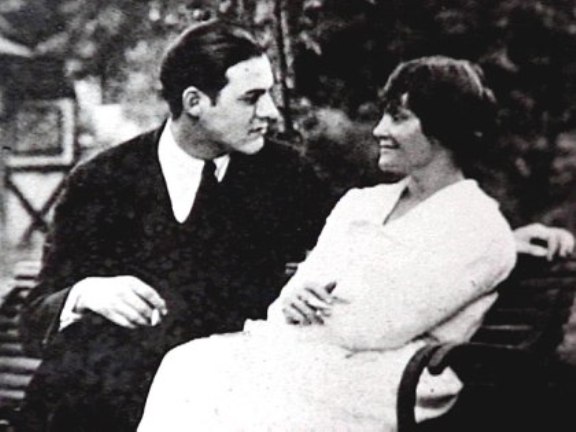
I was not prepared to like it as much as I did. Hemingway writes of the years when he was young, newly married and wildly happy, living a stimulating and lively life with lively friends. They were poor, but he was following his dream. They had a lot of fun.
Hemingway wrote this book, full of stories of their Paris life, full of names you know – Ezra Pound, Scott and Zelda Fitzgerald, Picasso, Closerie des Lilas, Les Deux Magots, Brasserie Lipp, the Louvre . . . and as you read it, you are there. He writes in the moment; you are right there experiencing it along with him. He writes of people he likes, and people he doesn’t like. He writes about his own vices – an addiction to horse racing, for example – and he writes with enormous sadness about how he came to be distracted from his marriage and lost the most wonderful relationship that ever happened to him. He blames it on the careless rich. He takes some responsibility.
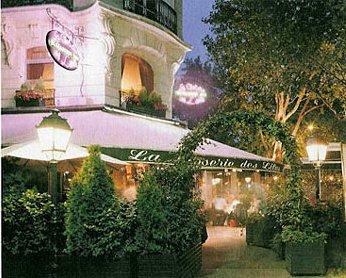
He also writes very frankly and openly about people he doesn’t like and why. I couldn’t help but think it is a heady thing, being an acclaimed author, where you can take revenge by putting people you dislike in your books. Hemingway uses real names and real people and often portrays them in a distinctly unflattering light. It made me wonder if he was planning to commit suicide all along; that or he just didn’t care what people think, and it seems he might have been the kind just not to care.
Just after finishing this book, and talking one last time with his first wife, Hadly, Hemingway committed suicide. It leaves me wondering if he was driven to suicide by regret, or by fears that his bigger-than-life life of adventure, travel, high life and travel was over, or if he had serious bouts of depression all his life, and this was just another, deeper depression?
It is a great read, especially paired with Paula McLain’s book, The Paris Wife. I thought it might be “he said – she said,” but Hemingway and the fictional Hadley in The Paris Wife both agree that they had a love and marriage that was very special, that Paris was a wonderful stimulating, alive environment, and that it was a great tragedy when the marriage ended. A Movable Feast seems to say that destroying his marriage to Hadley was one of a cocktail of self-destructive behaviors over which he tried to ride herd (gambling on the horse races, drinking, drugs, a coterie of star-struck sex partners outside of marriage, inability to focus on his work, a curmudgeonly nature . . .)

It’s also an easy read. I particularly enjoyed reading it on the iPad because you can do that swirly-finger-thing and find out what words mean or see the street locations as he walks Paris, see whether a cafe or restaurant in Paris still exist. It would be a good airline read – keeps your attention and finishes quickly.
As little as I like Woody Allen, it was fun to see Midnight in Paris, and to have some visuals of this go-go inter-war era.
Two things that stuck out for me: Hemingway loved walking in Paris, as do I. He also talks here and there about the benefits of being hungry. There were times when money was tight; they wore old shabby clothes, and there were times they didn’t have much food. He talks about hunger sharpening your other senses. On the other hand, very quickly when he has money, he has a great meal and a drink – or two – or three.
Bottom line, I’m glad I read this book. It’s given me a lot to think about.
Recent Comments
ExpatAlien on What Country am I Living … intlxpatr on Yellowstone: Old Faithful to C… Michelle on Yellowstone: Old Faithful to C… Cathy on No Grown-Ups in Charge intlxpatr on Waiting for Snow Wikipedia Donate Button

Amazina


Early Voting in Florida


 Here There and Everywhere