The Best Gingersnaps Ever
I knew what I was going for. Not the pallid ‘snaps’ that pass in the stores, no, the real gingery cookies, with real snap.
I went to my old faithful, a book I got back many a year ago when I was a new bride, the Joy of Cooking. It is a great edition, and you can see, it is falling apart. I can’t part with it:

Here is the Gingersnap recipe, altered slightly because I wanted guaranteed ‘snap.’
Gingersnaps
(Makes about 10 dozen 2 inch cookies)
Preheat oven to 325°F.
Cream 3/4 cup butter
2 cups sugar
Stir in:
2 well beaten eggs
1/2 cup molasses
2 teaspoons vinegar
Sift and add:
3 3/4 cups all purpose flour
1 1/2 teaspoons baking soda
3 – 4 teaspoons ground ginger
1 teaspoon cinnamon
3/4 teaspoon cloves
Mix ingredients until blended. Form dough into 3/4 inch balls. Bake on a greased cookie sheet for about 12 minutes. As the ball melts down during cooking, the cookie develops the characteristic crinkled surface. At 12 minutes, take the cookies out, sprinkle top with the decorator sugar (bigger chunky sugar that won’t melt down into the cookie) and return to the oven for 5 or 6 minutes.
Remove from oven, cool.
Mine are not the prettiest – next year I will know to leave more room between the cookies – but they are the BEST gingersnaps I have ever made. They have a little soft chewiness, and a little crispiness, around the edges. They are SPICY!

The original recipe, in the Joy of Cooking, uses a little less spice and a marshmallow topping. The Joy of Cooking is a wise investment, and if you can find one of the older ones in a used book store, you will have a treasure house of old, tried and true recipes. The authors are Irma S. Rombauer and Marion Rombauer Becker, and my edition is a Signet Special, first edition, printed in 1973.
The Tourist; Olen Steinhauer

Haven’t I read this book before? Or didn’t I see a movie, The American, with George Clooney? You know, depressed assassin? Thinking about suicide? In some villa along the Mediterranean or is it the Adriatic? Some enigmatic handler, and who do you trust? And then The Tourist swerves off in another direction and while this particular thread of plot is new, it still seems vintage LeCarre, only maybe a little less solid information. Lots of jumping from place to place with little motivation, lots of shifts in trust, and betrayals.
While I like books where reality keeps shifting, this one had a few too many shifts for me. I have a feeling that spying is a lot less about fast cars and shooting someone so they won’t give away a secret, and lot more about the dull, painstaking work of stitching together swatches of information in ways that form a meaningful pattern, trying hard not to create patterns that don’t exist. I imagine that there is a big problem today with the huge volume of information, sifting through to figure out what matters, and what is mere distraction.
This book is a good airplane read, holds the interest, but give me LeCarre for the grim grey world of spies and their work any day.
Kisses From Katie by Katie Davis

This is a photo from Katie’s blog: Kisses From Katie.
Do you believe in God? Do you believe that God believes in you? Then how do you live your life? Do you commit 100% to God and trust him to provide as you leave all your riches behind and follow him, serving the poorest of the poor, speaking for those who have no voices?
I will warn you, this unforgettable book has a lot of talk about God in it. A part of me watches in horror, wondering how long Katie can continue to serve God with all her heart, with all her soul, and with all her mind? How long she can work against all odds, trusting in God to lift her and provide for her and her children. This is a true story, an ongoing life. A part of me fears a terrible crash, but the greater part of me prays for Katie, and stands in awe of her courage and her commitment.
I don’t know who told me about Kisses for Katie, the blog. As soon as I started reading it, I was addicted.
Now for the shocker: Katie is only 23 years old. A year before she graduated from high school, she felt an undeniable call to do a 6 week mission teaching in a school in one of the poorest parts of Uganda. At the end of her six weeks, she couldn’t bear to leave. She returned, finished out her senior year in high school (HIGH SCHOOL!) but she never felt entirely ‘home,’ her heart was with the children of Uganda, the poorest of the poor.
Although her parents had her doubts, the strength and consistency of Katie’s belief that she was called to serve in Africa brought them around, and they agreed she could go work for a year in this small, poor village, before starting university. At eighteen, Katie was teaching, raising money for food, tuition and uniforms for over 100 children, and working to prepare all the meals, bathe all the children, and teach them about the love of Jesus.
When I saw, a month ago, that Katie had a book published, I had to buy it. Kisses from Katie is inspirational and unforgettable. Her story continues on her blog, but the book lays all the groundwork, the heartaches and the joys, the delights of her 13 adopted daughters, the horrors of the Ugandan bureaucracy, Katie’s dogged day-by-day fight to claim and save lives. She is a remarkable young woman, powered by an awesome God.
If Katie were going to burn out, I think it would have happened earlier, as she suffered terrible disappointments, and made truly amazing sacrifices to raise her girls, to be their “mommy” and to insure the educations of over a hundred children. With a growing foundation, Amazina, and a growing group of contributors, she carries on, and the miracle of this book is that she doesn’t seem to sense the amazing woman that she is at all, she seems to believe that she is a simple woman following God’s will for her life, and reveling in it, joyfully surrounded by her 13 adopted daughters and frequent foster babies. She feels blessed to have the life that God created her to live.
I stand in awe.
You can order this book from Amazon.com for $12.49 plus shipping. It might even change your life, or how you view your life. Yes, I own stock in Amazon.com. No, I make no money from recommending this book. 🙂
The Tiger’s Wife by Tea Obreht
The Tiger’s Wife was the perfect book to get me from Pensacola to Seattle, and through the Atlanta airport, full of bustle on a Sunday, packed flights, no quiet, no privacy. Thank God for a good, engrossing book, that takes you totally out of where you are to a world where things are not always what they seem.

The book is set in an unnamed country in East Europe which has just come out of a war, and the main character and her best friend are en route across a border which did not exist before the war, on an aid mission to immunize children who were once neighbors, and are now in a different country.
The primary relationship in the book is the bond between a young girl and her grandfather, and the stories he tells her as they walk up to the zoo, the Jungle Book he reads to her as they visit the animals, and the stories she finds for herself as she participates in the post-war rebuilding. It is a fascinating book because what she is writing about is not always what she is really writing about; the stories and legends and experiences are metaphors for another reality and a life lesson.
I don’t want you to think that this is one of the mindless airport books I sometimes tell you about. If it were, I would tell you “this is not great literature; this is an airport read.” Not this book. This book is literature. This book has meaning, and events you will think about and talk over with other readers long after you have finished the book.
In the back of The Tiger’s Wife is an interview in which one of my favorite new authors, Jennifer Egan (A Visit From the Good Squad) interviews Tea Obreht about her writing process, her life, her vision, etc. Fascinating reading, too, and also reader’s guide questions help you see things you might need to see and might otherwise miss.
My Life in France by Julia Child with Alex Prud’homme
I wish I had more self-discipline, and read more heavy weight books, but what I find is that when I read heavy non-fiction these days, it falls over when I fall asleep. Mostly, I read the New Yorker, or catch up with my news online, while listening to NPR.
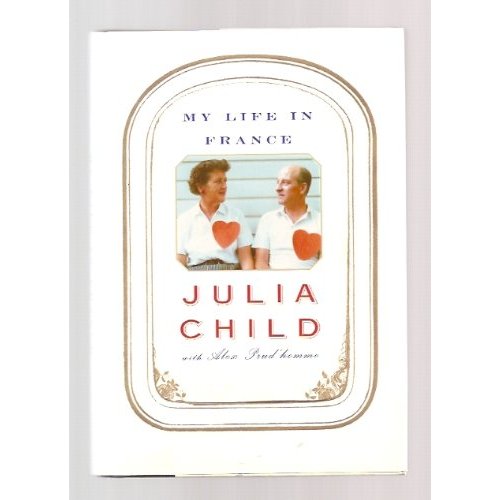
I don’t know how I got My Life in France, if I ordered it or if I bought it in B&N. I’ve had it for a while. We’ve always loved Julia Child; her programs were a hoot, and she was an accomplished woman who never took herself too seriously. I will never forget one time I saw her on a Martha Stewart Christmas Special; they were doing a tall Croquembouche, and at one point, Julia was not throwing on the caramelized sugar strings the way Martha wanted her to and she grabbed the little thrower-thing out of Julia’s hand to show her how. I gasped! That is like grabbing a spoon from the Queen of England, no! No! You can’t grab a spoon from Julia Childs! You can’t show Julia Childs how to do it, Martha, you BOW to Julia Childs!
Julia Childs, classy woman that she was, just watched Martha with fascination and never showed an ounce of annoyance.
The book is hilarious. While alive, she worked with her grandson, Alex Prud-homme, gathering correspondence – she was a copious letter writer, and people in those days kept their snail mail to refer back to, the way we keep e-mails. They sat in her sunny garden, and he would ask her a few questions, and off she would go, regaling him with stories of people, places, occasions, parties, and especially FOODS.
Julia Childs worked for the OSS in World War II, the forerunner to the CIA. Stationed in India, she met her husband, and after the war ended, they married. Stifled in her California life, and and Paul jumped at a chance to live overseas. Imagine – Paris! She had to adapt to a totally different way of life, totally different living space, a totally different way of shopping for food, and she had to learn to cook. Since she was in Paris, and because she is the woman she is, she signed up for cooking classes at the Cordon Bleu, where she worked hard to master the techniques to successfully produce the sauces and delicate flavors which makes French cuisine so delicious.
She also moves to Marseilles, to post-war Germany, and to Norway, and manages to produce two books, each of which took, literally, years to finalize, because of her attention to detail, and wanting to make sure that women using her books could understand exactly what to do, and when to do it.
This is a really fun book. I would have loved to know this adventurous, courageous woman, who meticulously tested every recipe for Mastering the Art of French Cooking and changed the lives of serious cooks in America. No, I have never cooked from her book. No, I don’t have her book. I have a Larousse Gastronomique, from which she worked to get the ‘true’ Frenchness of French cooking, but I don’t have any cook books by Julia. I have put out a hint, though, and I am hoping to get one for Christmas. 🙂 Not just for me – AdventureMan is making serious inroads into adventurous cooking. He has mastered blackened fish tacos, and seared tuna, woo hoooo! He is working on the ultimate cornbread. Just wait until I get him started on the quintessential French Onion Soup, or even – maybe – French bread!
We Need to Talk About Kevin: The Movie
“So what is your group reading?” I asked my friend as we talked my last evening in town, after a visit from Qatar, several years ago.
“I’m about to start something called ‘We Need to Talk About Kevin’ for Book Club,” she responded, “it’s like an Orange Award Winner.”
“What’s an Orange Award?” I asked
“I dunno,” she laughed, “but it’s on the list.” I was able to pick it up on my way to the airport.
A week later, I called her. “Are you reading ‘We Need to Talk About Kevin?'” I asked, and there must have been a note in my voice she recognized. “Why did you recommend this AWFUL book to me? It’s awful!”
“Can you put it down?” my friend asked.
“No! No, I can’t! But I can tell this isn’t going to end well.”
“Where are you?” she asked, and I told her.
“I’m right at the same place,” she said. “I hate it.”
We continued talking regularly as we read the book, a book which is truly, truly one of the scariest, most awful books I have ever read. Sometimes an author can make it so real, it’s almost too real, like the nightmare you can’t wake up from.
I passed the book along to some reading friends, and each one had the same reaction.
“WHY am I reading this? It’s awful!”
It IS awful, and, I suspect, so awful because if you have a child you think might have psychopathic tendencies, your life might be a nightmare. And you live with a sense that this isn’t going to end well, and it must be like waiting for the guillotine to fall and chop off your head.
What I didn’t know was that they’ve made it a movie. I haven’t seen any mention of it in the United States, but I’m told it’s opened in England.
The trailer captures some of the terror of the book. I’d suggest you read – or listen to – the book, by Lionel Shriver, before you see the movie. I honestly don’t know if I can go see it, it’s that scary for me. I reviewed We Need to Talk About Kevin, the book, here.
Why I Love Reading James Lee Burke
For James Lee Burke, I make an exception to the paperback only rule. (Paperbacks are lighter, so if you fall asleep, they don’t hurt you when they fall over. They travel well on airplanes, and you can leave them behind when you finish them, and not feel bad. Yes, I have heard about Kindle. No, I don’t think it meets my needs. I like to pass books along.)
I was on the “mail it to me the day it comes out” list at Amazon for his newest book, a Hackberry Holland mystery set in the wilds of Texas. I hit page 2 and came across this:
“The sheriff had arrived at an age when he no longer speculated on the validity of a madman’s visions or, in general, the foibles of human behavior. Instead, Hackberry Holland’s greatest fear was his fellow man’s propensity to act collectively, in militaristic lockstep, under the banner of God and country. Mobs did not rush across town to do good deeds, and in Hackberry’s view, there was no more odious taint on any social or political endeavor than universal approval. . . “
His books transcend the banality of modern mysteries.
This book is Feast Day of Fools, and I’ll tell you more about it when I’ve finished.
Harlan Coben: Long Lost

This totally light weight mystery was just right for a beach read. It was light on motivation, light on character description, light on substance – it was a very fluffy mystery.
Long lost love calls and says “come to Paris; I need you” and doltish hero heads off. Confusing plotting calls for some irrational police interaction, some unknown bogeymen, and a truly thin story line.
You can read it in about an hour, though, or stretched out between beach activities, it might be good for a weekend. Not only lightweight, but forgettable.
Uyen Nichole Duong: Mimi and Her Mirror
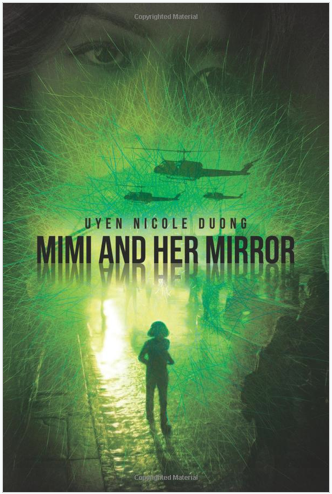
I must be on a streak. I really wanted to like this main character, Mi Chou (Mimi) but I found her obsessive, impulsive, overly emotional, self-absorbed and boastful. Her strongest relationship in the book is with her three way mirror. She specifically claims not to be narcissistic, and I think the story tells us otherwise.
The book is supposed to be fictional, and I truly hope some parts are fictional, but the strengths of the book lie in the ‘coming to America’ experience, which she captures well. She has a strong eye for ironies, hypocrisies and cultural differences. Her beginnings are vague, as is often the case when an immigrant goes through the shell-shock of being cut off from their own culture and grafted into another. I believe the author drew strongly on her own experiences to write this part of the book, and to me, it is the strongest part.
Mi Chau and her family leave Viet Nam during the great evacuation, and are given a spot on the planes that should have gone to someone else. Her entire family, mother, father, sister and brother all escape together, leaving behind a beloved grandmother who refuses to leave. Their entry into the US goes smoothly. They are the first wave of Vietnamese, the lucky ones. They have support, they have jobs. They have lost their own world, and they struggle. All this is part of the normal immigrant experience.
Neither is it abnormal that the children thrive through their struggles, and achieve excellent eduations. What is distracting to me in the book is how Mimi bases her self worth first on her academic excellence, and later in life on what she owns, and on her status. She has accomplished so much, she owns high-status symbols, but she is miserable and her life is empty.
Is it because of her experience as she evacuates out of Vietnam? Is it a character defect? There are no meaningful relationships in her life, she lives an empty and soulless existence, focusing on work and accomplishment and status symbols. Her major problem, as I see it, is an unwillingness to connect, to step out of herself and see through other’s eyes.
It’s an interesting book. There are, in my opinion, better books about the Vietnamese coming-to-America experience, and one is Anne Fadiman’s The Spirit Catches You and You Fall Down about immigrant Hmong, which is rich in cultural teachings, rich in relationships, and I still remember details more than ten years after I first read it. It is only available in Kindle format now, through Amazon, although they may have a used copy from time to time. Way better book than Mimi.

Anne Enright: The Gathering
What is it with my problem with Man Booker Award winners? The last one I remember is White Tiger, which we read in our Kuwait book group, and I hated. Actually, it was the main character I hated . . . and possibly that is what is happening with me and The Gathering, now that I think about it.

We meet Veronica, Irish, from a large Irish family, as she learns of the death of her brother Liam. Through claiming the body, preparing for the funeral, the funeral and the aftermath, we are there with Veronica as she whines and complains, as she disparages her family members while ignoring her own husband and family, and she drinks too much. She gets up at noon, and stays up all night, avoiding her husband. Her language is frightful, and her sexual episodes are crude and explicit . . . offensive, but maybe it is the utter distraught nature of a woman in the throes of the deepest grief?
Slowly, slowly, the story unfolds. For me, I was never sure what was truth and what was imagination, in terms of the story. Were the children abused, molested, neglected? Or are these the creative imaginings of a troubled woman? There seems to be a thread of insanity in the family – can we trust that she is a reliable narrator?
As little as I liked the main character – hmmmm, that seems to be a problem I am having a lot right now, or at least I’ve had a run of main characters I don’t like very well – I finished this book. I’m glad I read it so that I can talk about it if it comes up in a discussion, but it did not inspire or elevate me in any way, and I didn’t even feel a lot of compassion for the narrator.
Recent Comments
ExpatAlien on What Country am I Living … intlxpatr on Yellowstone: Old Faithful to C… Michelle on Yellowstone: Old Faithful to C… Cathy on No Grown-Ups in Charge intlxpatr on Waiting for Snow Wikipedia Donate Button

Amazina


Early Voting in Florida


 Here There and Everywhere