Blue Skies, Old Ruins
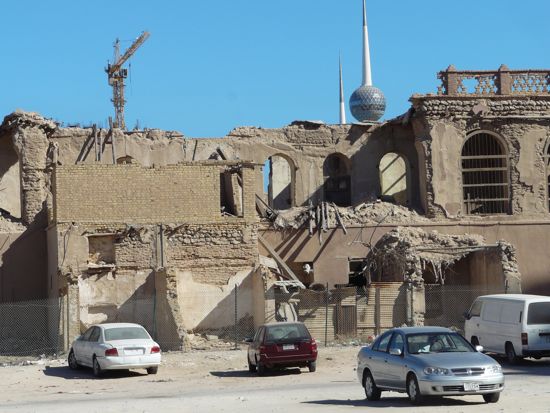
Running about Kuwait, we stopped just to appreciate these ruins. You drive past them all the time, and it gets so you don’t even notice them. Today, the sky is SO blue, and the ruins are so beautiful, and who knows how long they will even be there?
I wish I could have seen this place in all its elegant splendor. You can see it must have been graceful. It looks like a lot of thought went into its construction. I wonder what it was – anyone know? It is near the Diabetes Clinic, near the British Embassy, near Dasman Circle.
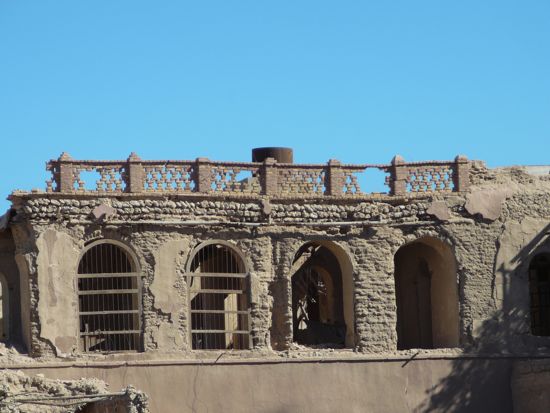
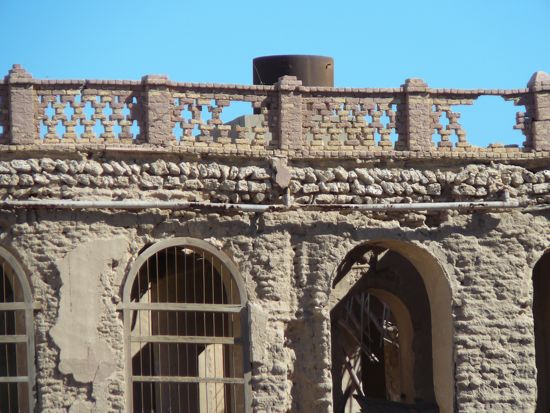
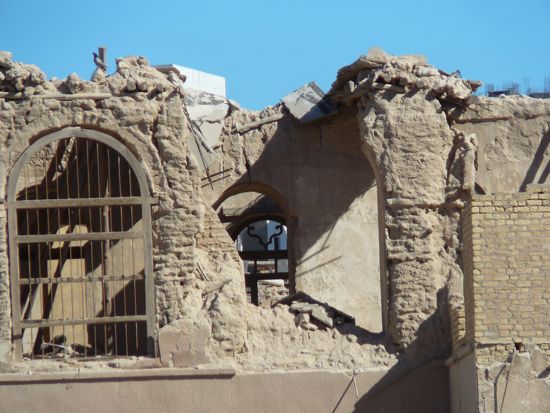
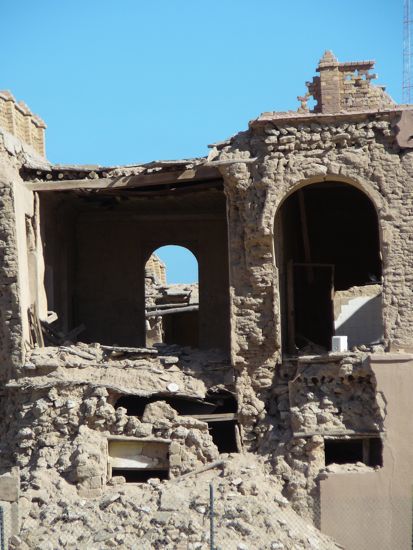
I wanted you to see the beautiful arches and the elegant details against the brilliant blue sky before I show you the entire building, in context, with all the cars parked nearby, the towers in the background – it all somehow diminishes the building in context:
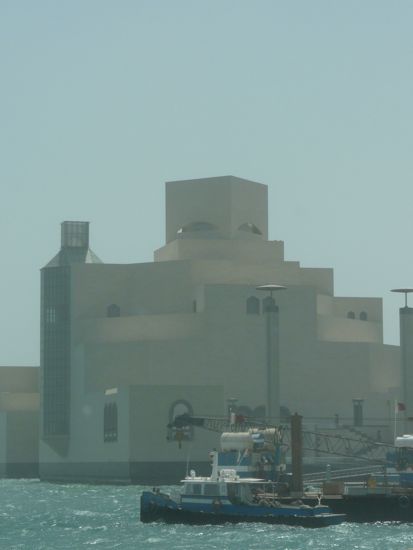
Doha Museum of Islamic Art Photo for Ansam
Ansam, you asked if I had any photos of the Doha museum of Islamic Art from another angle. I found this one, but there was sand blowing that day. 
State Blocks Diwaniyas on State Land
I can understand the state not wanting to allow the people to build on public land, land reserved to preserve right of way, land reserved for parks, land to protect the ability to see around a corner. We watched all the illegal diwaniyas come down in our area, carted away on trucks, to be replaced with outdoor diwaniyas, which are lovely – but what to do when the temperatures start going up again?
Many of our friends have diwaniyyas – one – or more (!) built into their homes. An outdoor diwaniya is a luxury if you have the space for it. It looks to me like more homes are being built with a permanent diwayiya designed to match the house.
My real question is – How does this differ from the chalets? Are the chalets not also built on state property? Is there a bureau from which you get a permit? Is there any contractual understanding, like the land is deeded to you for 99 years before you put up an expensive chalet? Or do you build, knowing the government can reclaim that land at any time?
State succeeds in blocking diwaniyas bill
Al Watan staff
KUWAIT: The Parliament rejected a controversial draft law on Wednesday that called for regulating the construction of private diwaniyas on State property.
After a discussion, the proposal was overruled by a vote of 34 against and 26 in favor.
A number of MPs had presented the proposal, which was aimed at allowing the construction of private diwaniyas on State property adjacent to owners” homes provided that a license is obtained from the Ministry of Finance in exchange of an annual fee of no more than 0.250 Kuwaiti dinars per square meter.
Moreover, the Parliament also rejected a proposal to form a committee to investigate violations committed by the team tasked with removing all structures that have been illegally built on State property.
This proposal was voted down by 35 of the 61 legislators who were present at the session.
Earlier, the Parliament”s Finance and Economic Affairs Committee had rejected the draft law regulating the construction of private diwaniyas on State land, saying that it will have a negative impact regardless of the traditions related to these forms of gathering places.
It said the construction of these structures on State property will increase security, administrative and financial burdens on the State.
This issue was first discussed during Tuesday”s Parliament session, but a lack of order in the Abdullah AlـSalem Hall led to an adjournment of the session.
The Kuwaiti government had opposed the bill since the beginning, saying it bears many implementation difficulties and encourages encroachments on State property in a disorganized fashion.
Last updated on Thursday 13/11/2008
All in One Day
Life is funny, in Kuwait, you are just getting up, brushing your teeth, getting ready to head for work, knowing tonight is date night and tomorrow you sleep in. I’m in my jammies, lying in bed with my computer, watching old Law and Order’s on TNT (sometimes the Olympics just get boring) and winding down, getting ready to call it a day.
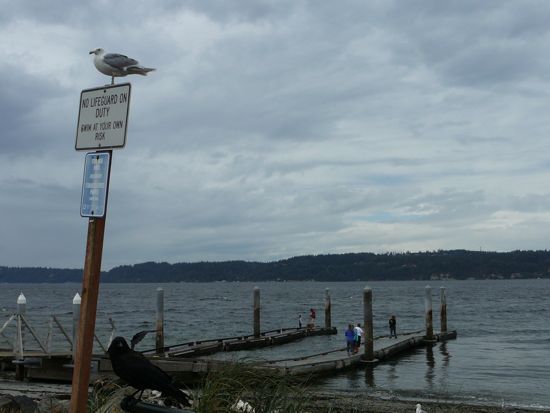
And what a day! My long time Army-wife friend and I went out playing – picked up lunch at Ivar’s and took it over to the park to eat, where we found a whole flock of new friends:

This guy was persistent – after we ate our fish, we threw him the fries:

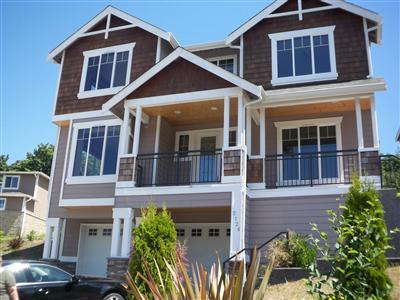
We looked at a house for sale – great bones, significant view, lousy location:
The day was warm, but there was a persistent wind, and at one point, we drove home from the crowded malls in a driving rain. Everywhere, for the next three hours, people were saying “this is October weather, not August weather!”
A great night for Chinese food. T&T’s Seafood is SO Chinese that there aren’t that many things on the menu I am comfortable ordering, and I fly close to the edge of the envelope when exploring Chinese food. I ordered Hot and Sour Soup, Green Beans with shaved meat, and Prawns with Honeyed Pecans. I sat with all the other take-out people waiting for their orders – it’s truly that kind of night. Everyone is talking about the weather. They don’t do a lot of delivery in Seattle; mostly you have to go pick it up yourself:

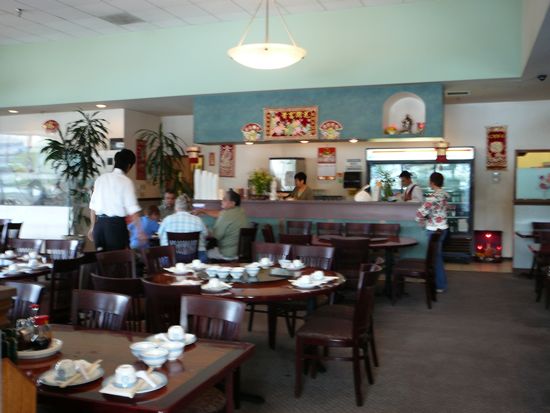
It was pouring when I went in – clearing when I came out:
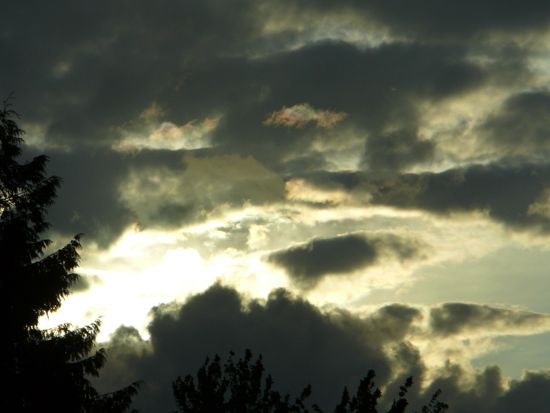
Heading toward the coast:

After dinner, I drove down to surfside to take a sunset photo with these wonderful clouds:
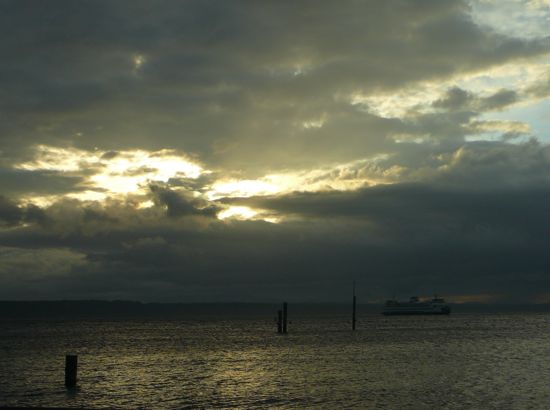
More Three Cups of Tea
The timing couldn’t be better. Thank you, Phantom Man, for sending a link to this New York Times article on Three Cups of Tea, from the July 13th New York Times.
By NICHOLAS D. KRISTOF
Published: July 13, 2008
Since 9/11, Westerners have tried two approaches to fight terrorism in Pakistan, President Bush’s and Greg Mortenson’s.
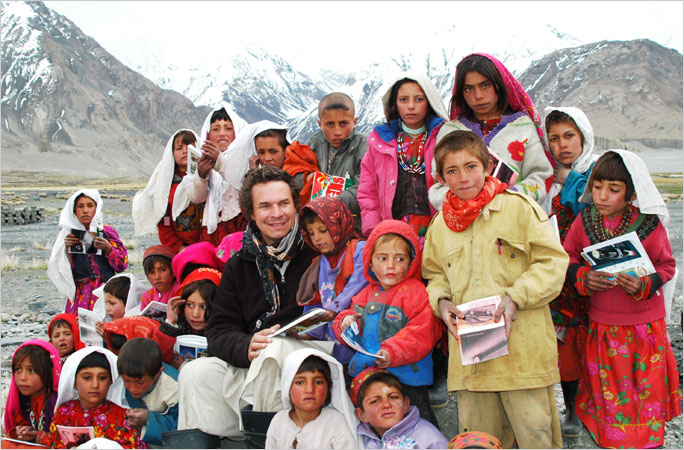
Greg Mortenson with Sitara “Star” schoolchildren. Photo: Fred R. Conrad/The New York Times
Mr. Bush has focused on military force and provided more than $10 billion — an extraordinary sum in the foreign-aid world — to the highly unpopular government of President Pervez Musharraf. This approach has failed: the backlash has radicalized Pakistan’s tribal areas so that they now nurture terrorists in ways that they never did before 9/11.
Mr. Mortenson, a frumpy, genial man from Montana, takes a diametrically opposite approach, and he has spent less than one-ten-thousandth as much as the Bush administration. He builds schools in isolated parts of Pakistan and Afghanistan, working closely with Muslim clerics and even praying with them at times.
The only thing that Mr. Mortenson blows up are boulders that fall onto remote roads and block access to his schools.
Mr. Mortenson has become a legend in the region, his picture sometimes dangling like a talisman from rearview mirrors, and his work has struck a chord in America as well. His superb book about his schools, “Three Cups of Tea,” came out in 2006 and initially wasn’t reviewed by most major newspapers. Yet propelled by word of mouth, the book became a publishing sensation: it has spent the last 74 weeks on the paperback best-seller list, regularly in the No. 1 spot.
Now Mr. Mortenson is fending off several dozen film offers. “My concern is that a movie might endanger the well-being of our students,” he explains.
Mr. Mortenson found his calling in 1993 after he failed in an attempt to climb K2, a Himalayan peak, and stumbled weakly into a poor Muslim village. The peasants nursed him back to health, and he promised to repay them by building the village a school.
Scrounging the money was a nightmare — his 580 fund-raising letters to prominent people generated one check, from Tom Brokaw — and Mr. Mortenson ended up selling his beloved climbing equipment and car. But when the school was built, he kept going. Now his aid group, the Central Asia Institute, has 74 schools in operation. His focus is educating girls.
To get a school, villagers must provide the land and the labor to assure a local “buy-in,” and so far the Taliban have not bothered his schools. One anti-American mob rampaged through Baharak, Afghanistan, attacking aid groups — but stopped at the school that local people had just built with Mr. Mortenson. “This is our school,” the mob leaders decided, and they left it intact.
You can read the entire article in the New York Times by clicking on the blue type.
Things We Love About Robin’s House
We had reservationsin Nkwali, the jumping off place for most of the Robin Pope Safaris, but we had to change the reservations by a couple weeks, and that meant a total reversal of the reservation. We started off in Tena Tena, then we went to Nsefu, then we ended up in Nkwali. We have always loved Nkwali, loved the cabins there, but this time we were happier than happy – they put us in Robin’s House.
Robin’s House is where Robin and Jo Pope lived before they built a gorgeous house on the other side of the camp.
It is perfect for two couples, or two couples and children. It is perfect in so many ways that I had to make a list of all the things I loved about being there.
* Space – spacious bedrooms, spacious, private bathrooms on each side of the house with a spacious common living/sitting/dining room in the center.
* Indoor/ outdoor living – the windows have screens on them to keep out critters, but indoors or outdoors, it all feels a part of a whole.
* Wrap around windows – a view anywhere you look
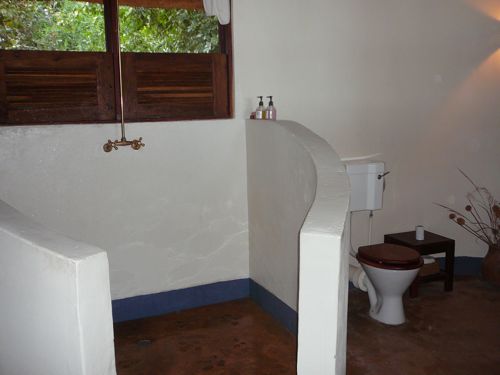
* Huge walk in shower, with animal prints molded into the painted cement floor. Love the whimsy.
* High, airy ceilings, with ceiling fans
* natural materials, canvas colored curtains, a neutral palette with beam accents
* great big soft fluffy bath towels
* all our favorite drinks stocked in the refrigerator, and a liquor bar, which we barely touched, that had Amarula, which I love.
* electricity! We could recharge our own camera batteries without going to the camp itself
* being taken care of by a hostess, a cook, a dedicated guide and Thomas and Amos, who took care of us without over-taking-care of us – they gave us plenty of privacy when we needed it, and were there when we needed them.
* variety of seating for people of different heights
* Tribal Textiles accents – pillows, covers, etc – in rooms
* a book case! With books! and games!
* multiple views of hippos, and hippo sounds at night
* grand, comfy beds with good sheets, good pillows and good mattresses
* kikoys provided for our use
* shaded porch with a variety of seating options
* a hammock with a view
* insect repellant – with a good smell and nice texture, and it really seemed to work
* ditto shower gel and shampoo and conditioner provided
* a drying rack for swimming towels, washed clothes, etc.
Our last day there, LawAndOrder Man and EnviroGirl had to leave for their 32 hour return to the USA, flying Mfuwe – Lusaka – Johannisburg – Dakar – Atlanta – Pensacola – imagine. And they had to work the next day. It was such a sad parting, and we were all glad to have had the last days together in this beautiful, very private location.
Photos:
This is the wing of the house where AdventureMan and I stayed

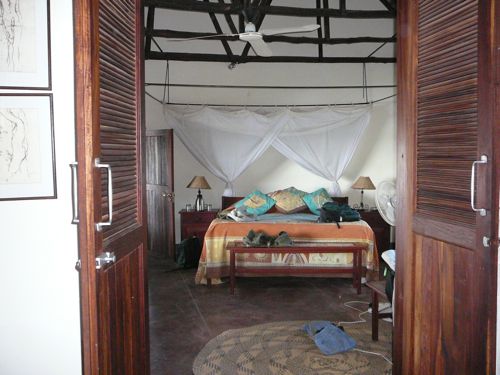
This was our room (sigh!)
And this is the shower we loved
This was the living room/sitting room where we would gather

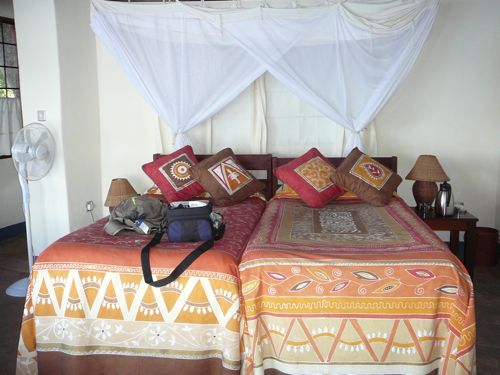
This was the second bedroom – there were additional beds for kids
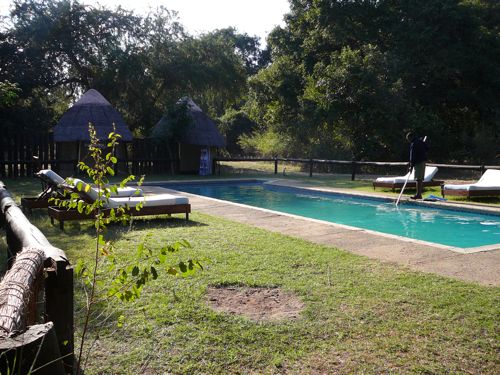
This is the pool. Other guests from the camp could use it, but no one did while we were there. It was separate from the house but very close.
These spaces for outdoor sitting were outside the other wing, where our son and his bride slept


They served our meals privately, too. What wonderful luxury privacy is
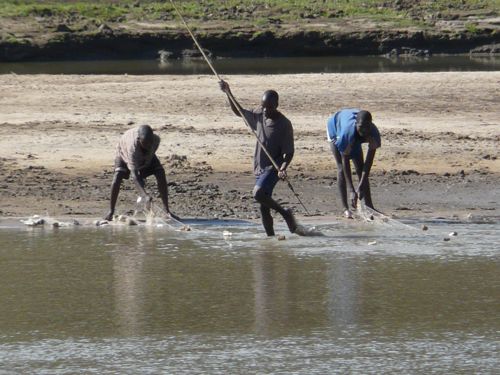
You know, the little Alaska girl is still alive and well inside me, and I am always fascinated with fishing techniques. This was right across the river from Robin’s House, and they caught quite a few fish.
Robin and Jo Pope have expertise, and also VISION. Problems, to them, are opportunities. Need to get tourists to the camps? Invest in an airline. Need to get them to the national park across a river? Build your own pontoon bridge – it gives Zambia additional park revenue, provides additional employment, and gives tourists a thrilling experience. When they solve a problem, everyone wins.
We crossed several times on this boat, and once, in pitch dark, got caught on a tree snagging us from under the water. It took about 15 minutes to maneuver us off, and to get across, but it is not like this ferry is on a schedule. It goes back and forth when vehicles are going into or coming out of the park.

How the boat is pulled across the river

We had some fabulous game drives; I will only bore you with this one. The hippo ponds are covered with nile cabbage, and I just loved this hippo with his nile cabbage blanket

BBC 9-11 Third Tower
I am not much on conspiracy theories. This is on today’s BBC – a slow Saturday, I don’t imagine it will get a lot of attention.
9/11 third tower mystery ‘solved’ |
|
|
|
The final mystery of 9/11 will soon be solved, according to US experts investigating the collapse of the third tower at the World Trade Center.
The 47-storey third tower, known as Tower Seven, collapsed seven hours after the twin towers.
Investigators are expected to say ordinary fires on several different floors caused the collapse.
Conspiracy theorists have argued that the third tower was brought down in a controlled demolition.
Unlike the twin towers, Tower Seven was not hit by a plane.
The National Institute of Standards and Technology, based near Washington DC, is expected to conclude in its long-awaited report this month that ordinary fires caused the building to collapse.
That would make it the first and only steel skyscraper in the world to collapse because of fire.
The National Institute of Standards and Technology’s lead investigator, Dr Shyam Sunder, spoke to BBC Two’s “The Conspiracy Files”:
“Our working hypothesis now actually suggests that it was normal building fires that were growing and spreading throughout the multiple floors that may have caused the ultimate collapse of the buildings.”
‘Smoking gun’
However, a group of architects, engineers and scientists say the official explanation that fires caused the collapse is impossible. Architects and Engineers for 9/11 Truth argue there must have been a controlled demolition.
 |
The founder of the group, Richard Gage, says the collapse of the third tower is an obvious example of a controlled demolition using explosives.
“Building Seven is the smoking gun of 9/11… A sixth grader can look at this building falling at virtually freefall speed, symmetrically and smoothly, and see that it is not a natural process.
“Buildings that fall in natural processes fall to the path of least resistance”, says Gage, “they don’t go straight down through themselves.”
Conspiracy theories
There are a number of facts that have encouraged conspiracy theories about Tower Seven.
- Although its collapse potentially made architectural history, all of the thousands of tonnes of steel from the skyscraper were taken away to be melted down.
- The third tower was occupied by the Secret Service, the CIA, the Department of Defence and the Office of Emergency Management, which would co-ordinate any response to a disaster or a terrorist attack.
- The destruction of the third tower was never mentioned in the 9/11 Commission Report. The first official inquiry into Tower Seven by the Federal Emergency Management Agency was unable to be definitive about what caused its collapse.
- In May 2002 FEMA concluded that the building collapsed because intense fires had burned for hours, fed by thousands of gallons of diesel stored in the building. But it said this had “only a low probability of occurrence” and more work was needed.
But now nearly seven years after 9/11 the definitive official explanation of what happened to Tower Seven is finally about to be published in America.
The National Institute of Standards and Technology has spent more than two years investigating Tower Seven but lead investigator Dr Shyam Sunder rejects criticism that it has been slow.
My comment:
If you go to the BBC News Link (this if filed under Conspiracies) you can watch a video of the third tower going down. It looks pretty controlled to me, too.
Sacred Spaces in Kuwait
As I was on my way home from picking up milk and vegetables, I passed another local mosque undergoing renovation. Or at least, that is my best guess; it has been gutted and partially destroyed. I am guessing it is about to be reconstructed, but I don’t know for sure. I am only guessing because I have seen it happen to other mosques since we arrived.
And it got me thinking, and I am going to ask a question, but I will tell you before I ask it, that if you asked me the same question about Christian spaces, I would have to ask an expert; it is not a question I can answer about my own culture.
Do Moslems have sacred spaces? How are they made sacred? Is there a ceremony? If you are going to destroy parts of a building on a sacred space, does it have to be de-consecrated (made no-longer-sacred) while it is undergoing renovation? If a mosque is destroyed/no longer used is there a ceremony that makes it no longer a holy spot?
I know that in my religion, churches are consecrated, made officially holy, and that there is a ceremony. I know that in some places, churches that are no longer needed are deconsecrated, not made UNholy, but made not a sacred place of worship any more, and they become restaurants, housing, etc.
In my specific branch of Christianity, which is Episcopalian, there is a service for blessing a new house, which I love, and it is called a House Blessing. The priest comes, usually at dusk, you can have friends there, you carry candles and he blesses every room in the house. When we buy and move into a new house, we always have it blessed. The priest tells me that it is really a mis-nomer, it is not the house being blessed, but those who live within in. To me, that is a distinction that hardly matters, all I know is that I feel more secure in a house that has been blessed.
And no, there is no un-blessing ceremony when we leave a house. The blessing does not create a holy space, a place of worship, a sacred place, but only blesses a humble dwelling.
No, I don’t understand exactly how this all works.
I remember travelling in Syria with an archaeology group one time, and we went to see the site of St. Simeon the Stylite. In my cynical heart, I was not wild about the visit – a saint who sat atop a huge rock for several years to show his devotion to God? When I got there, however, my heart changed – it felt like a holy place. It felt like Saint Simeon had done a holy act, demonstrating his faith so . . . faithfully. If you know Syria, you know how bitterly cold it can be in winter, and how bone-breakingly hot it can be in summer. The pure grit and devotion it took to stay atop the pillar of stone was an amazingly faithful act. It felt like a sacred place, a holy place, to me.
So my question is not just for the Moslem readers, but also for Christian readers – what makes a space holy? Does it need a ceremony to be holy? Does it need a ceremony if it will no longer be used for sacred purposes?
Night and Day, Doha, The Pearl
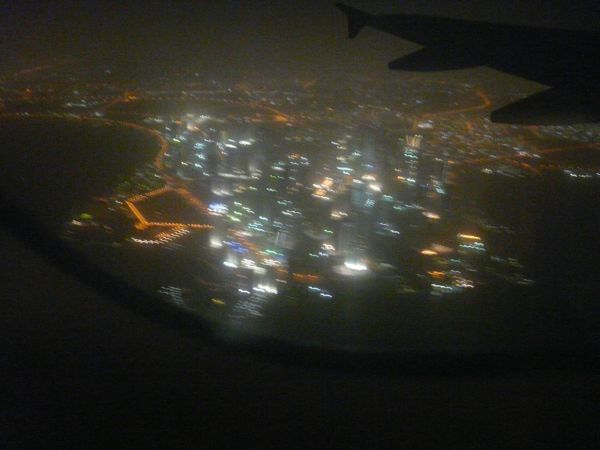
Visiting Doha, AdventureMan took me out to see the new Pearl going up. AdventureMan cracks up – “It’s NOT reclaimed land” he cackles, “they are demolishing old buildings at an incredible rate, and using all that rubble to build this new crop of hotels and residences!”
We watched it when it was just cranes and sandbars.
They’ve come a long way in an amazingly short time. This is the Doha Pearl (they are having the same kind of dusty weather that we are having in Kuwait)
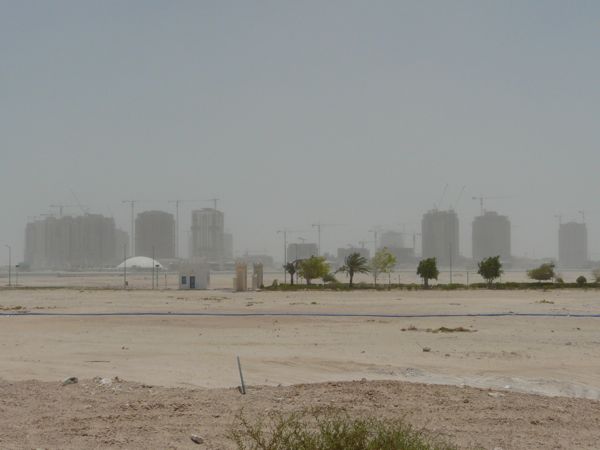
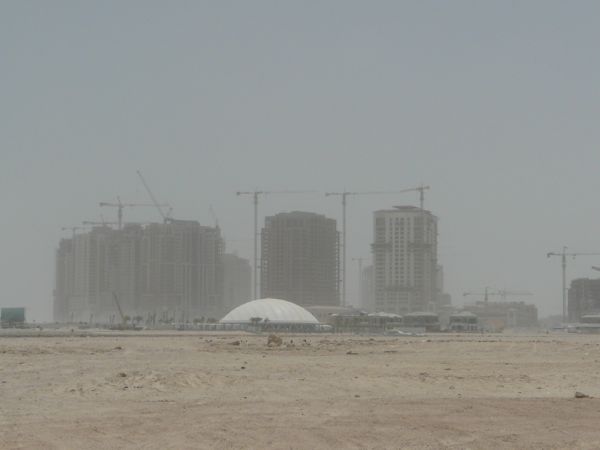
The window is a little cloudy, but you can see it is all lights, camera, action at the building of The Pearl, even at night:
Sky Walk – I Couldn’t Do it
Today on Good Morning America, they hit the 3rd of America’s Seven Natural Wonders. It is the Grand Canyon, and they broadcast from the new skywalk that they built cantilevered out over the Canyon. It has a glass floor, and you walk out 4,000 feet above the bottom of the canyon.
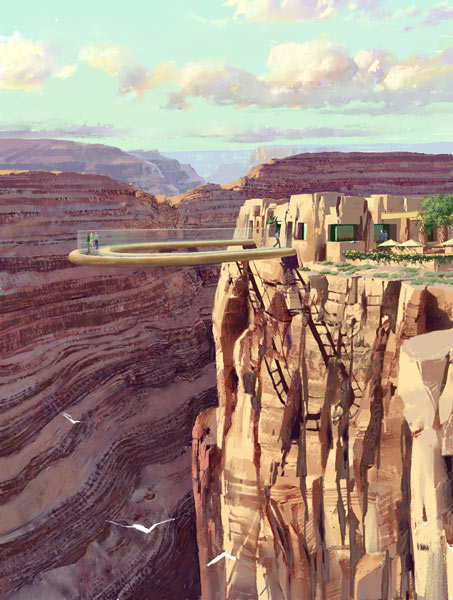
I almost threw up.
Just looking at it makes my blood pressure jump; my heart is beating fast and my palms start to sweat.
I have a mild case of fear-of-heights. (Acrophobia) I feel unbalanced looking down, I feel like I could fall right over.
AdventureMan, thank God, has the same sensitivity, so he doesn’t tease me. I know we will visit this skywalk one day, and I wonder if he will be able to force himself to walk out on it. I already know I won’t be doing it. It’s just too stressful for me. . . . Even watching it on Good Morning America, I feel all stressed out!
Recent Comments
ExpatAlien on What Country am I Living … intlxpatr on Yellowstone: Old Faithful to C… Michelle on Yellowstone: Old Faithful to C… Cathy on No Grown-Ups in Charge intlxpatr on Waiting for Snow Wikipedia Donate Button

Amazina


Early Voting in Florida


 Here There and Everywhere