More Mubarakiya Sights
It seems to be heating up quickly. The months when perusing the souks in daylight hours are coming to an end. We are trying to make the most of it while we can. A few more quick snaps from the Mubarakiyya Market on a quiet Friday:
Vegetable market public art I hadn’t spotted before:

Traditional clothing-seller:

Bath supplies:

Foodstuffs:

Those of you who live here walk right by these stalls all the time, and never notice that they are disappearing. I have been perusing old books about Kuwait, even some not so old, and Kuwait is changing so rapidly that even books only 10 years old or so have become outdated by the rapid passage of time.
For those of you not in Kuwait, there are malls. There are SO many modern malls. As in other countries, some are more upscale than others, but they are malls. In most, you are not supposed to take photos. In most, you will see the same stores you will see in any other country. Mubarakiyya is special because it is still an active market in the old style.
Kuwait Plumbing/Bathrooms
This is one of those “sometimes you don’t even know what you don’t know” kind of posts.
We were sitting around after book club, and the topic turned to oddities in our housing. I mentioned that sometimes, my bathrooms just STINK and I don’t know why. People were quick to explain that when they put plumbing in, they don’t exhaust the sewer gases the same way as in Europe and America, and sometimes the gases back up and make a bad smell.

I know that my bathroom sometimes smells like someone has just dumped a diaper pail, sometimes I can smell hair dye, and sometimes I can smell men’s perfume! Sometimes it smells like the sea at low tide – none of these smells has anything to do with me, and I have wondered why my bathroom smells that way. We keep candles and perfumes in our bathrooms, so that when the stench is overwhelming, we can burn or spray it away.
The management’s suggestion, when we complained, was to run a lot of water, that made the smell go away. Run a lot of water? In a country like Kuwait where there is no rain this year, and water is precious?
“If only they would air condition the bathrooms!” one friend added and suddenly the light went on in my head! I had always thought it was me! I do my hair and make up in the bathroom, and often I end up sweating and wondering what I did to make me so HOT (not as the like “she’s so HOT!” sense, in the sweat-rolling-down-my-forehead sense.)
When I got home, I checked out all my bathrooms. My friend was absolutely right, there is no air conditioning in the bathrooms. We love our bathrooms, they are about the size of a small bedroom in the US, or a spacious walk-in closet, they have windows, they have beautiful tiling, they are nice!
And no, there is no air conditioning in the bathrooms. I have lived here for two years and never figured that out.
(No, that is not my bathroom in the photo. I love bathrooms, and found that photo HERE at Tessera Tile where they have glass tiles and I am dreaming of doing a bathroom with glass tiles and glass brick.)
Deemaland
You know, I always visit my commenters to make sure they are not someone marketing drugs or enlargements or some kind of objectionable filth, and also because I often find a blog I haven’t seen before, and I really like.
I found one like that yesterday – Deemaland. When you go there, the first thing you see is this:
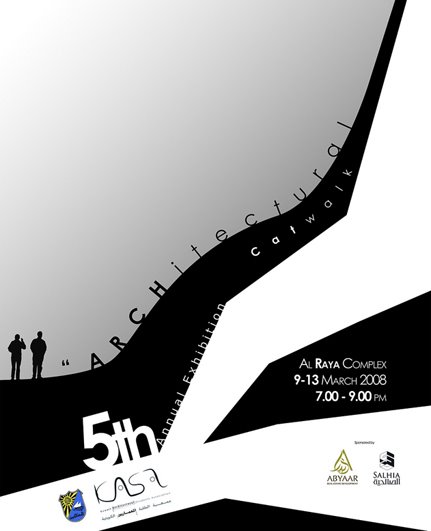
Oh my friends, is that gorgeous, or what?
Then, she tells us about an exhibit:
9-13 Mar. 2008
Event: “Architectural Catwalk”
5th Annual Exhibition of Architecture
Host: Kuwait Architectural Student Association [KASA]
Type: Exhibition of the students work.
Location: Al-Raya Complex, Sharq district, Kuwait City.
(the exhibition is in the Ground floor of the mall side)
Only on HER blog, even the information looks artistic.
This woman has an EYE. She publicizes events that otherwise might go unnoticed. Go visit Deema’s starkly beautiful blog. Also, take a look at her gorgeous Flicker photos.
EcoTerrorists in Seattle?
Hunt is on: Who torched the Street of Dreams?
By Steve Miletich
Seattle Times staff reporter

ELLEN M. BANNER / The Seattle Times
An aerial view of efforts Monday to put out fires in four Street of Dreams homes in Snohomish County. The homes were part of what’s called a “rural cluster development” and were built to higher environmental standards. The home on the left was a Craftsman known as Copper Falls, and the one on the right was the Greenleaf Retreat.
Working with few clues, federal investigators face a daunting task as they try to determine whether a shadowy group of radical environmentalists torched three multimillion-dollar homes along a Street of Dreams in Snohomish County on Monday.
Although a spray-painted banner left at the scene contained the initials of the Earth Liberation Front, it took nearly a decade of groundwork in a previous case before investigators cracked a Pacific Northwest cell of the ELF responsible for more than a dozen arsons beginning in 1996.
The homes gutted in Monday’s inferno had drawn tens of thousands of people last summer who paid to gawk at their architecture, interiors and sheer size.
The fires left law-enforcement officials questioning whether they were timed to coincide with jury deliberations in the federal trial of an alleged ELF member accused of helping set the 2001 fire that gutted the UW Center for Urban Horticulture.
“I guess you could say we’re not surprised,” said Mark Bartlett, a senior federal prosecutor involved in the UW-related trial.
The pre-dawn fires in the Maltby area of Snohomish County destroyed the three homes and damaged a fourth, and investigators were looking into the possibility that an attempt was made to torch a fifth house. None of the homes was occupied, and no one was injured in the three-alarm fire that shot flames 100 feet into the air.
The FBI is investigating the fires as a possible “domestic terrorism act,” said FBI spokesman Fred Gutt in Seattle. The Snohomish County sheriff’s Office and the federal Bureau of Alcohol, Firearms, Tobacco and Explosives also are participating as part of the Joint Terrorism Task Force.
You can read the entire article HERE
Kuwait Towers 29
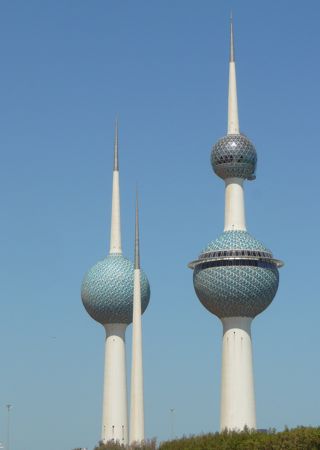
In today’s Kuwait Times is a notice that today, the Towers turn 29 years old, and in honor of that milestone Mushari Al-Sanousi announces that to commemorate its success and celebrate the occasion, a 30% discount will be offered at the Towers Restaurant to all diners today, March 30th.
History of Architecture in Old Kuwait City (5)
One last quote from this wonderful book by Saleh Abdulghani Al-Muttawa, because it summarizes his ideas on what makes house practical for the weather and customs of this region:
Cultural Response
. . .the major critical cultural and customs problems which concern housing are;
1. Privacy for female inhabitants
2. Separation between female and male guests, and separation between guests, in general, and house members.
3. Future family expansion
. . . The approach to solving those critical problems are as follows:
1. To assure privacy for family members, and especially female members. The family part of the house has been pushed all the way to the back; in other words, it is on the north side far away from the street. It is difficult, or impossible, for anyone passing by the house to be able to look through and see the inside, especially with all those trees and plants placed in front of the house. Another conservative step has been taken by separating the family entrance from the guest’s entrance, and placing the family entrance close to the driveway and the garage for easy and private access. All that gave the female members of the family more free and secured mobility inside the house.
2. The prototype design provides a separate quarter for the guests, “Dewania.” The “Dewania” is placed on the southern side of the house away from the family entrance, to provide privacy for both family members and guests. The “dewania” is actually divided into two “dewanias,” female “dewania” and male “dewania.” For more seclusion and privacy of both sexes, the entrance of the female “dewania” is placed on the west side and the entrance of the male “dewania” is placed on the east side. Both entrances are close to the main road to make it more convenient and easy for the guests to come in and out. Each “dewania” has its own bath. There is only one dining room, because most of the time only men stay for dining. (Women have to go home to cook for their families.) If it happens that both sexes stay for dining, women can be accomodated in their “dewania.” A collapsible partition is placed in between the two “dewanias.” In big events like wedding parties or feasts, the partition can be collapsed, so the space would be large enough for a sizable number of people.
In a post last week, How decisions are made in Kuwait we had a long discussion about diwaniyas in the comments section. What I like about al-Muttawa’s concept is that collapsible wall in between the female and male diwaniyya. It could allow the females to listen in on major political discussions – what? You think we aren’t interested? You are wrong! – and participate.
“How can they participate while separated?” my western friends will be asking.
There are emmisaries. When sitting with the women, in Saudi Arabia, I wondered at first how my husband and I would both know when it is time to go. In western society, we have a meeting of the eyes and my husband will give an almost imperceptible nod and I know it is time to begin to make our farewells. As the hour got later and later, and still later, I finally asked one of the women how I would know when my husband wanted to leave.
“You want to leave?” she gasped in horror!
“No, No!” I assured her, “I just don’t know how I will know when my husband wants to leave!”
“Your husband will send for you! The children will tell you!” she laughed, and I stopped worrying. The children were running back and forth from room to room, reporting on the happenings in the men’s diwayya, where a holy man was discussing morality and requirements of morality.
This was one of my favorite places in Saudi Arabia, the house of friends. In the women’s majlis, there was only a TV, and seating around all the walls. There was nothing on the walls, nothing, not a picture, not a calligraphy, nothing, but the furniture was strong and comfortable, and the hospitality never-ending. When dinner time came, we went to an adjacent entirely bare room, bare except for the lavish dinner laid on the floor, where we all sat and ate, and one huge cupboard, full of mattresses. The dining room became one of the sleeping rooms when all the guests departed.
I didn’t get a tour of the house; I only know what I saw from my entrance through the family entrance into the female part of the house, my brief glimpse of the kitchen area – large and utilitarian. What I remember most clearly was the love and joy in the family, and that all the walls were totally devoid of anything decorative.
+ + + + + +
When I came to live in Kuwait, the real estate people showed me 20 villas and one apartment. The villas, each and every one, were HUGE! Most of them were three or four floors, more than one had an elevator, and several had their own swimming pools.
Most of the houses had a large kitchen – separate from the house, outside! Alongside it were the quarters for the maids, the drivers, the guard, etc. Most of the houses had at least five bedrooms, at least two diwaniyyas.
In the newer areas, there was barely two feet between houses, so windows on the sides of the houses were non-existent, or heavily curtained over, making those rooms very dark. In the older houses, the bathrooms were small and the spaces were divided strangely, by western ways of thinking.
Mostly, though, the villas were lovely, full of luxurious materials and beautiful touches. As I would walk though, sounds bounced off the thick cinderblock walls and the marble floors.
AdventureMan works long hours. I would think of me and the Qatteri Cat bouncing around in the huge house like two little peas in a big bowl, and where would I find him if he hid out for a while? The villas were just too much space for our little family, and we opted for the apartment, although the apartment is bigger than many homes in the United States. AdventureMan and the Qatteri Cat still look at me accusingly from time to time; they always enjoyed an hour or two together in the garden on Friday mornings, and now we have no garden. . . all we have (I can’t even keep a straight face as I write this) is that glorious 24-hour-a-day 180° view of the Arabian Gulf. 😉
+ + + + + + +
If I ever see this book for sale, I will come back here and update. If YOU see it for sale, please come back here and let us know!
History of Architecture in Old Kuwait City (4)
This is my favorite section from The History of Architecture in Old Kuwait City by Saleh Abdulghani Al-Mutawa, Architect. It is quoted from the section called Social Customs, starting on page 206:
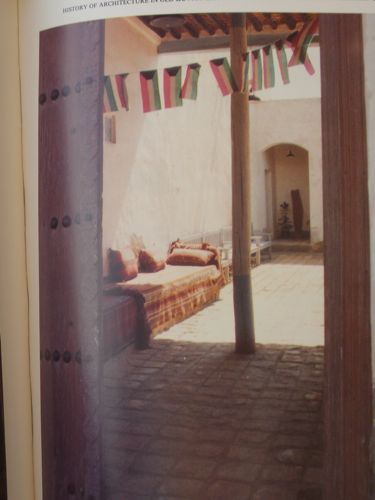
Kuwait is a small nation, with population of one million, that actually has a large influence on people’s behavior; it makes the whole country like one unified family. In the neighborhoods, it is customary to see houses left open and without any security measures, always ready for visitors, which reflects the strength of the relations between neighbors, and the confidence they enjoy. The most distinctive customs are:
1. Large families; average size is eight members. The young generation is trying to minimize the family size. They live in rather large houses, seven to ten bedrooms, which is considered to be an average size house. The house provides privacy for the boys, when they grow up and have their own families.
2. Large family groups, either under one roof or in clustered dwellings, is noticable throughout Kuwait neighborhoods. That reflect the willingness of families and relatives to cooperate and help each other.
3. Newly married sons tend to stay in their parent’s house and share the cooking and dining, so houses have rather large kitchens and dining rooms.
4. Families and relatives visit each other on Fridays and stay for lunch, which is the main meal of the day. The number of visitors varies from 20 – 50 persons, depending on the size of the families. Men and women visit in separate rooms, since separation of males and females is part of the custom. (The author notes that he is talking about old habits and traditions that were prevailing in the old city.)
5.All houses have what is called “Dewania” which is a guest room. In well designed houses, two “Dewanias” were furnished, one for males and one for females, since separation between males and females is mandatory as far as the customs are concerned. The “Dewania” has its separate entrance from the rest of the house, which is to provide privacy for the inhabitants and prevent sudden interactions with guests. It is considered bad for a female to be seen by a male guest, and vice versa. In poorly designed houses, the “Dewanias” don’t have proper privacy and seclusion. The men have the habit of visiting the neighborhood “Dewanias” at night for socialization and discussion of daily matters. In the past the “Dewanias” were the only news sources for the people. Different “Dewanias” are known by the last name of the owners. Hot tea and Arabian coffee are served on a regular basis and in big events like celebrations, “Eads”, wedding parties, and so forth, big feasts held for families, friends and neighbors.
6. “Chay Aldaha”, or afternoon tea at which it is customary for women to visit each other and gossip. Hot tea and cookies are served for refreshment. “Chay Aldaha” is held in the female “Dewania” to ensure privacy for female guests and to prevent sudden embarrassing interactions with male inhabitants.
7. Women are dressed in conservative clothes when they go out; the face and the two hands are the only parts of the body which are exposed. (The author makes a note that he is talking about old habits and traditions which were prevailing in the city) Privacy for women inside the house is an important factor. They should not be seen from the outside while they are doing their daily housework, and should not be in the way when male guests are visiting in the house.
As you can see, the winds of change have blown through Kuwait creating many, many changes. This book captures a slice of time in Kuwait history, and a wealth of information you don’t even know you know. The ways Kuwaitis lived for generations have changed, just in the last 20 years. I was particularly taken with the author’s mention – several times – that women should not be seen tending to their daily housework – how many Kuwaiti women do you know who are doing housework?
There is a current controversy regarding removal of diwaniyyas constructed on public grounds – if this is an old and accepted tradition, perhaps some adjustment can be made, particularly where the diwaniyyas are not impeding public transport or walking paths? Perhaps some can be “grandfathered”, i.e. exceptions made because of historical location?
Meanwhile, my Kuwaiti friends, sorry for boring you with these descriptions of your family dwellings; you already know all this, but the rest of the world does not, and I wanted to share this with those who follow this blog because they find you exotic and fascinating. 🙂 You really need to add this book to your libraries, as a record of a way of life that seems to be slipping all to quickly into the past.
History of Architecture in Old Kuwait City (3)
I am quoting so much from Saleh Abdulghani Al-Mutawa. Architect, that you may think you don’t need to run out and buy the book but I assure you, I am only sharing with you a few of the gems I found within. The author has done so much research with such loving attention that the book is full of treasure, every page offers something worthy.
The Year of Demolish
It is a sad memorial in Kuwait’s history. In Rajab 1289 A.H. (i.e. in the middle of the nineteenth century), heavy rains accompanied by severe winds hit the old Kuwait city, and demolished most of the mud houses. Sea waves went high and hit and wrecked ships. It was a disaster for Kuwaitis.
A second natural disaster took place in Kuwait on 30 November 1954 when heavy rains fell and demolished houses and forced 18,000 Kuwaitis to seek refuge in newly built schools. Houses built of mud and a little cement were severely affected, while houses built of rock were not affected.
My Kuwait friends – tonight, instead of going out in your cars, stay home! Sit with your grandparents and ask them about the house they grew up in. Ask them about the meals they cooked. Ask them about the heavy rains, so heavy that they could destroy houses and force 18,000 Kuwaitis to abandon their homes and go stay in schools. These are amazing stories – learn your stories from your grandparents . . . and then come tell us all the stories in your own blogs. If you don’t have a blog, or if you want to share here, you are welcome.
Some of my Kuwait friends ask why I care more about these things than the Kuwaitis. First – my Kuwaiti friends care. In my country, we call these people “the silent majority.” Every now and then the majority energizes and asserts itself. Kuwaitis care. Change is happening, it happens slowly. Keep the faith.
Second – I live here. I may not be Kuwaiti, but I care about the places where I live. If God has placed me here, I trust that he has his reasons, and it is my obligation to him to learn as much as I can and to serve – wherever he may place me. He placed me in Kuwait.
Tomorrow I will print my very favorite part of this book – where it describes family living. Meanwhile, run out and buy your own copy. There is so much I am not covering. This book is a part of your heritage.
History of Architecture in Old Kuwait City (2)
I love this book. It is such a treasure. For those of you who have ever wondered about the construction of old Gulf dwellings, this book is a MUST have – so much detail, so much to help us understand what we are seeing.
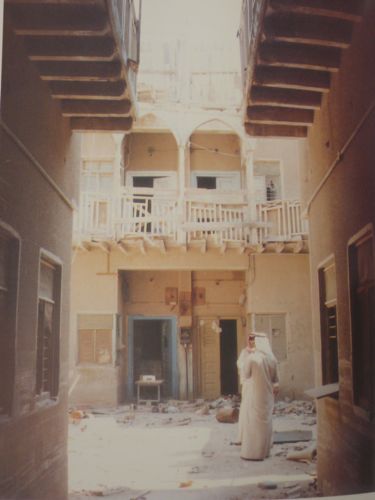
More from author Saleh Abdulghani Al-Mutawa, Architect:
House design and location specified unity existing in the Kuwaiti society. In old times, the poor livednear the rich, where no differences between them. The only difference was that the houses of the rich were vast. Ordinary Kuwaiti house, occupied by the majority of Kuwaitis, consisted of a vast courtyard, surrounded by many rooms, and a hallway secured privacy to the family by separating the house from the street. In that architectural design, the courtyard ventilated the house to find it cool at night and after sunset. This was due to the exchange of radiation between the floor of the courtyard and the outer space. At night the house became cool and sleep was comfortable. During summer, the majority of Kuwaitis prefer to sleep in the courtyard or on the roof. Usually, there is a room on the roof used to store mattresses in or sometimes for napping. A small bath is usually located beside that room. . .
Walls were built of rock and mud, and decorated internally with white gypsum. Ceilings consisted of rows of jandal (trunks), basajeel (bamboo) and manqour (straw mats), covered with a 30cm or a 40cm layer of mud. In winter, when rain was heavy, that layer should be attended to and maintained by adding more mud. Houses of the rich used gypsum for protection. When wood was used in fixing the ceilings, thejandal was only 4 m long, and for the wide rooms they used square pieces of wood of 6m. The floor was covered with mud, then with tiles which was imported from neighboring countries. To let the water flow from the roofs, they used the wooded marazims (gutters) which extended from the roofs to the outside. In the houses there were wells for supplying the underground water, and there were pools to store water in.
As regards the houses of the rich, they were divided into a number of courtyards, each serving a certain purpose. There was a courtyard used to include a Diwaniya for male guests, consisting of a large room annexed with other buildings needed to accomodate the servants or for other purposes.
The other courtyard was located for family female members, including a number of rooms and bathrooms. A third courtyard was used as a kitchen, including the kitchen, storage room for fuel and a store room for the different kinds of food. There were more courtyards for the animals: goats, cows, horses. Kuwaiti houses also had a “baqadeer” (wind tower) which was a natural air-conditioner, not one Kuwaiti house was without it.
5,000 Real Estate Deeds Missing
The Kuwait Times website seems to be down so I can’t link directly to them, but this is at the top of the crime news on yesterday’s page 5:
5,000 Real Estate Deeds Missing
Kuwait: An owner of a real estate office registered a complaint with the Khaitan police claiming that 5,000 real estate deeds were stolen from his office’s locked-up drawers. However, both the owner and the police were baffled because the thieves could have carried off furniture and other valuable items, but preferred to steal the deeds instead. The case was handed over to special detectives who immediately launched an investigation.
This seems to me like the deeds were the target of the break-in. Aren’t deeds registered somewhere? So like even if these paper copies are stolen, can’t they be replaced? What would somebody gain by stealing these deeds? Can they claim the properties? Can they claim the properties were transferred to them? Can they hid transfers that someone doesn’t want disclosed? This sounds like a great mystery to me!
Recent Comments
ExpatAlien on What Country am I Living … intlxpatr on Yellowstone: Old Faithful to C… Michelle on Yellowstone: Old Faithful to C… Cathy on No Grown-Ups in Charge intlxpatr on Waiting for Snow Wikipedia Donate Button

Amazina


Early Voting in Florida


 Here There and Everywhere
