Doha Museum of Islamic Art, Take 4
I can’t let friends or family come to Doha without a trip to the serene beauty of the Doha Museum of Islamic Art. Little Diamond was content to view the exhibits at her own speed, so I visited a few of my favorite friends:
I never tire of spending time with Iznik Tiles

There is an Iranian piece that bowls me over with its beauty

And I just have this thing for light fixtures. This is a mosque lamp, and I think it is Turkish

But oh, look at the interior of the museum itself:
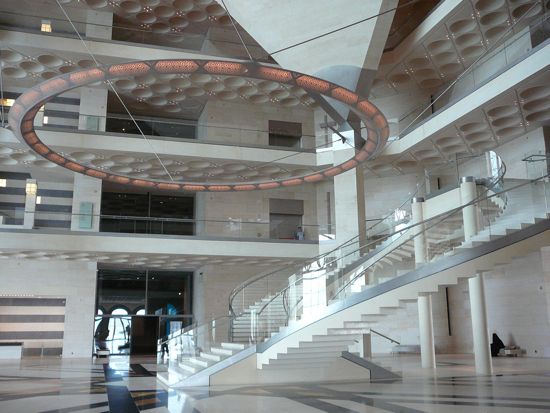
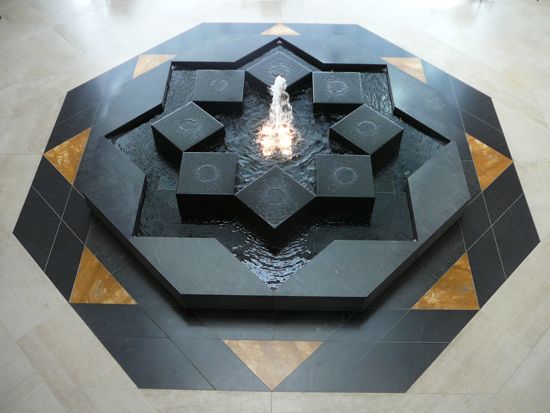
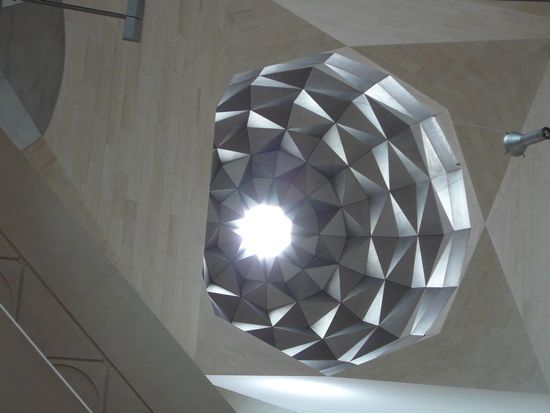
There is a breathtaking view of the Corniche Skyline from the spot where, on the map, they say the coffee shop should be. It really needs a coffee shop there. The restrooms are immaculate, the gift shop has lovely items, the exhibits are lush and beautiful, but you need a place to sit and think about what you’ve seen, compare notes, recharge so you can go back and take another look at something you are wondering about. It really, really needs that coffee shop.
A Small Adventure in Qatar
Here is one reason I love AdventureMan. He loves to go exploring, and Friday mornings after church are our favorite time. I am showing him some new routes, because the street patterns have changed, and where the pigeon mosque used to be, and he notices that the GATE IS OPEN!
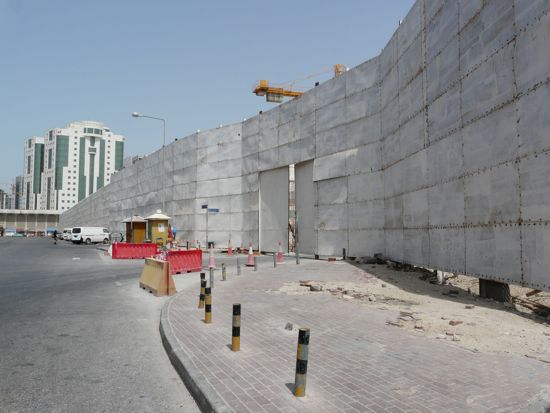
So here is what I love. The gate is open. There is no sign saying No Entry. To AdventureMan – and to me – that means that it is not forbidden, which means that it is allowed, right?
There is no guard on duty – it’s Friday. Maybe they are praying.

And the pigeon mosque is still there! I was so afraid they were tearing it down. I don’t know what the real name of this mosque is. There used to be parking behind it where all the Pakistani drivers parked their decorated delivery trucks, and those of us visiting the souks in that area parked there, too. Now, there is almost NO parking available unless you get there at like 6 in the morning. (Actually, if you get there around 0830 on Saturday morning, you can find a parking place.) We call it the pigeon mosque because all the pigeons gather on the roof there. The mosque has been totally gutted and is being renovated.
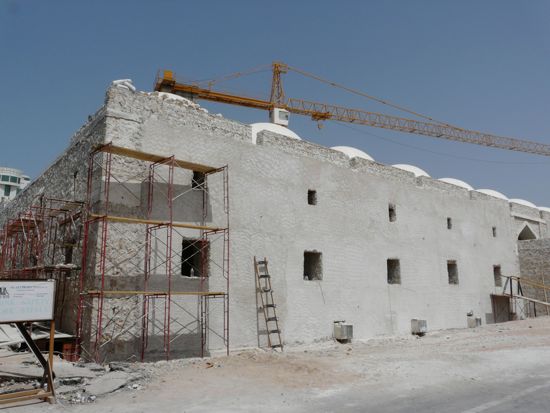
The rest of what used to be a place filled with cheap junky stores is gone. Demolished and carted away. It’s just a big empty space. No clue yet as to what is going in.
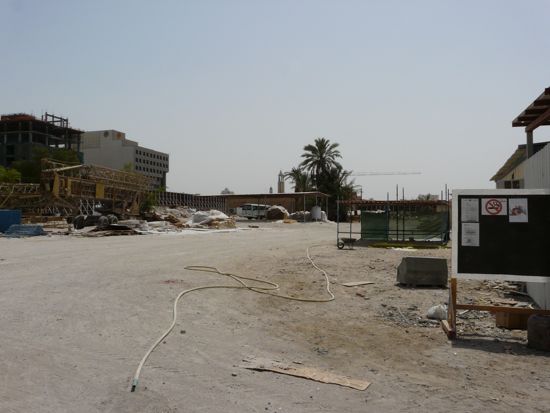
We will have to wait for another day when the gate is open – inviting us to come in. 🙂
The Next Five Years in American House Trends
Consumers stay at home more, and housewares industry takes note
By Amy Hoak, MarketWatch
CHICAGO (MarketWatch) — As the recession takes a toll on most businesses, the housewares industry is actually expecting to see some benefit as more consumers eat, entertain and generally spend more time at home in order to save money.
In a presentation earlier this week, Mirabile pointed out several home trends he’s expecting for 2010. Below are five trends he predicts for the kitchen and beyond:
The live-in kitchen. Consumers spend three to four hours in the kitchen every day, not only cooking there but using it as a place to entertain, work, craft and spend leisure time, Mirabile said. The kitchen is being reinvented as a second living room, he said, as appliances are camouflaged and functional objects are hidden or minimized, allowing people to create ambiance in the room.
Living within our means. The recession is changing long-held opinions on how we spend our money. Consumers are looking for quality and durability in products — a shift away from disposable consumption, he said. They’re canning food more and growing their own herbs, they’re brown bagging lunches and they’re shopping in bulk at warehouse clubs or stocking up during grocery store sales to save money.
The green kitchen. Americans continue to make their lives more environmentally friendly, but they’re increasingly confused and frustrated about what is really “green,” Mirabile said. While they want products to be eco-friendly, they’re not going to pay much of a premium for it either — they expect retailers and manufacturers to deliver green products at competitive prices.
The wellness kitchen. Buying local food and/or growing your own often means it will be fresher and free from pesticides and preservatives — in short, more nutritious, he said. Today’s consumers are also interested in purifying their water and air.
Cooking for fun. We’re a nation of foodies, Mirabile said, quoting a Nielsen survey that found one in every five households has a “budding gourmet chef.” It’s not just women spending more time in the kitchen, either; “gastrosexuals” are men who consider cooking more of a hobby than a household chore, and use kitchen skills to impress friends and prospective partners. The popularity of the Food Network has helped to inspire a new love with food and cooking, and he expects consumers to continue to search for new recipes, techniques and cooking tools.
Amy Hoak is a MarketWatch reporter based in Chicago.
Kuwait imposes fee on public toilets?
LOL – there are public toilets in Kuwait? Where? Women always memorize which buildings have public restrooms, but aren’t those owned by the buildings? And holy smokes, what do we do if we don’t have small change left after all our shopping??? Men are more . . . umm. . . err. . . flexible, but women need privacy, i.e. restrooms!
TRAIN your cleaners! Give them proper supplies! Hold their supervisors responsible for their inspection and maintenance of standards! This is called ACCOUNTABILITY.
Charging for use of public restrooms will impose, at the very least, inconvenience for women, and most likely, embarrassment for those who don’t have the money, at the very worst times, like when you have seven children with you and three of them need to use the toilets. Charging fees for usage? Bad idea.
Municipality to impose fees on public toilets
Staff Writer From this morning’s Al Watan
KUWAIT: Kuwait is seriously mulling over the notion of imposing nominal fees for using public toilets.
Mohammad AlـAmri, the Convener of the Cleansing Committee at Kuwait Municipality, stated that the fee is aimed at providing better sanitary services along the lines that are implemented in certain neighboring countries. The official also noted that the current cleaning contracts are scheduled to expire in November 2010.
In a related development, the outgoing Minister of State for Municipal Affairs and Minister of Public Works Dr Fadhil Safar disclosed that Kuwait Municipality is currently working on a proposal to implement a new mechanism in keeping track with the performance of cleaning companies to ensure that the garbage is disposed off at the assigned dumpsites. He added that the system has been already implemented in the Kuwait City Governorate and is expected to be applied in all other governorates soon.
Last updated on Thursday 26/3/2009
“Praying on land not owned by the mosque is legally invalid”
From today’s Al Watan:
Furor over mosque demolition a ”political ploy”
Staff Writer
KUWAIT: The newest attempt to demolish a mosque located on stateـowned property gave raise to several concerns from the populace.
Prominent Shiite cleric in Kuwait Mohammed Baqir AlـMahri stated that praying on land not owned by the mosque is legally invalid.
He also condemned demands for the prosecution of the Chairman of the State Property Violation Committee, Mohammed AlـBader, who, he said, “must be honored for honoring the law and meeting the request of the Ministry of Awqaf for the removal of all mosques in violation.”
He went on to state that all the turmoil surrounding the removal of the mosque was “a ploy to gain votes,” in case of the dissolution of the council.
Member of the Municipal Council and the Chairman of the Development and Reform Commission Khalifa AlـKhorafi agreed with AlـMahri”s views and stated that Kuwait is suffering from a major crisis that reeks of a general lack of confidence and faith in most matters that concern the state.
He warned against hasty decisions and explained that the mosque was not a heritage monument and that it was mainly used as a storage space.
He pointed out that before the demolition of the mosque the council had ensured the availability of another mosque in the same area and that the permission of many preachers and scholars was taken long before the attempt to demolish the holy structure. He went on to state that all had agreed that it was illegal to pray in the mosque, a fact agreed to by Dr. Ajil AlـNashmi.
Meanwhile, lawyer Nawaf Sari praised the act of MPs against the demolition of the mosque and referred to it as a “glorious stand.” He said that there was no justification for the elimination of the mosque and that people should protect Islamic and religious beliefs whenever possible. He also demanded the persecution of Mohammed AlـBader and blamed him for the deterioration of the political system in the country.
I don’t understand. How can this be an issue? An old, run-down mosque was erected – illegally – on public property. Before the mosque was demolished, authorities informed and had consensus from the local clerics, and the mosque was only used for storage? What is furor about? Why is tearing down an old mosque an attack on Islamic beliefs? I see mosques torn down around Kuwait all the time – usually just before a newer, bigger mosque takes its place. In this case, they insured sufficient mosques were available before they demolished this one.
Pecha Kucha Night at the Dar al-Athar al-Islamiyyah
Thank you, Little Diamond for sharing news of an upcoming event in Kuwait that sounds like a pretty cool evening, full of creatives sharing a small part of their vision. It sound like an evening full of energy, to me. Thought you might want to go, too! 🙂
Dear All,
I would like to invite you to Kuwait’s first Pecha Kucha Night at the
Dar al-Athar al-Islamiyyah
Date: Wednesday, 11 March 2009
Time: 7:00 pm
Place: Al-Maidan Cultural Centre ‘Abdullah al-Salem School, Maidan Hawalli, Near al Sha’ab Leisure Park.
Pecha Kucha Night, devised by Astrid Klein and Mark Dytham (Klein
Dytham architecture), was conceived in 2003 as a place for young
designers to meet, network, and show their work in public. Pecha Kucha
Night is a not-for profit event, conceived, inspired, and performed
solely to strengthen creativity whether it be famous or famous-to-be
talents.
But as we all know, give a mike to a designer (especially an
architect) and you’ll be trapped for hours. The key to Pecha Kucha
Night is its patented system for avoiding this fate. Each presenter is
allowed 20 images, each shown for 20 seconds each – giving 6 minutes
40 seconds of fame before the next presenter is up. This keeps
presentations concise, the interest level up, and gives more people the chance to show.
Pecha Kucha (which is Japanese for the sound of conversation) has
tapped into a demand for a forum in which creative work can be easily
and informally shown, without having to rent a gallery or chat up a
magazine editor. This is a demand that seems to be global – as Pecha
Kucha Night, without any pushing, has spread virally to over 160 cities across the world.
It comes to Kuwait for the first time on 11th of March.
Speakers for PKN #1 will include:
Lubna Saif Abbas: LB o J?zzaz
Ghadah Alkandari: Artist
Adlah Al-Sharhan: Chef
Maha Al-Asaker: Photographer
Mai al-Nakib: Kuwait University
Thomas Modeen: smArchitecture
Abdulaziz al-Humaidhi: Najeeb Al-Humaidhi Consultants
Khalid al-Hamad: American University of Kuwait
Waleed Shaalan: BrainStorm
Amera al-Awadhi: Amar International Real Estate Co.
Fatma al-Hamad: Amar International Real Estate Co.
Warmest regards,
Asseel al-Ragam
Asseel al-Ragam PhD
Assistant Professor
Department of Architecture
Kuwait University
Office: +965 24987595
Cell: +965 99761150
alragam@gmail.com
Dewey: The Small-Town Library Cat Who Touched the World
I’ll admit it, I was looking for a quick read, and after resisting this book for months, I picked it up. As much as I love cats, I am not that much into cute, nor am I particularly sentimental, and I don’t like having my emotions manipulated. Just one look at the adorable cat on the cover told me it was going to be one of those slick, fairly superficial feel-good kind of books.

See what I mean? Just look at that cover. Look how that cat just looks right into your eyes. This book is going to suck you in.
This book was a surprise. Yes, it was touching. Yes, it was about a tiny little kitten who almost died, stuffed in a below freezing book-return box in an northern Iowa country library in the middle of one of the coldest nights of the year, and yes, he ends up living in the library for almost 20 years and brightening the life of the people who come into the library. Yes, Dewey is adorable, and funny, and loveable. Yes, the book is an easy read.
It is also, surprisingly, an uncomfortable read. It is not overly sentimentalized. It is also the story of a woman, Vicky Myron, who grew up on one of the northern Iowa farms, and she tells us about the quality of a life that is no longer available in America, how the safe, secure, intertwined family life of rural Iowa has greatly disappeared. The hard times we are working our way through in 2009 is an echo of hard times suffered in rural America, as small farms are gobbled up by the more efficient super-farms, owned by conglomerates, not by families.
She tells us about her physical struggles with a disastrous childbirth, and its two year aftermath, and she tells us about how her marriage to a lovable alcoholic died, almost without her being aware it was dying. She doesn’t spare herself, as she discusses her problems, as a single mother, on welfare, trying to get a college education and raising her daughter, who couldn’t wait to move away from her. She talks about her challenges remodeling an old cement reading library into a modern, airy information resources center serving the town and the surrounding community, at the same time she is working on her Masters in Library Science. She describes her challenges dealing with the town bureaucracy. It is not always comfortable, or feel-good reading. It takes the book out of the superficial, and gives you something to think about.
Intertwined in all of this is Dewey Readmore Books, the cat who comes to live in the Spencer, Iowa, library, and who is eventually featured on TV shows around the world. He responds to requests that he pose, that he perform, he seems to know who needs a little love and is quick to give it – he is a great main character. For me, some of it was also uncomfortable, kind of a stretch – like that the cat would be in the window waving to her every morning when she came to work. Well . . . maybe . . . I’ve almost always had cats in my life, and few have every shown such consistent loyalty. Cats are . . . well, cats. It’s the way God made them. 😉
What I love is that this book is about libraries, and the amazing (mostly) women who run them. These librarians have had a huge influence on my life, and the life of AdventureMan, challenging us to explore outside our boundaries and supporting our aspirations, recommending new ideas and new ways of serving their communities. Librarians are part of the backbone of America.
I read this book in just a few hours. It just isn’t that complicated or challenging; it is an easy read. It has been a #1 New York Times bestseller, and copies of the book are still selling strongly. It currently ranks #105 in all time book sales on Amazon.com – can you imagine how many books that must be? The book is sweet, but #1? I can only imagine so many people are buying and reading it because it looks like 1) a Feel-Good book and 2) an easy read.
The Doha Museum of Islamic Arts – first visit
It’s Friday afternoon, and I can hardly believe it. We are here. Now THIS is my idea of a romantic getaway – please! Keep your chocolates (although I do love chocolate!) and your roses, keep your long lingering dinners and fabulous wine, but take me someplace where I have really wanted to go, and I will be your slave forever. You da man, AdventureMan. You know how to win my heart. 🙂
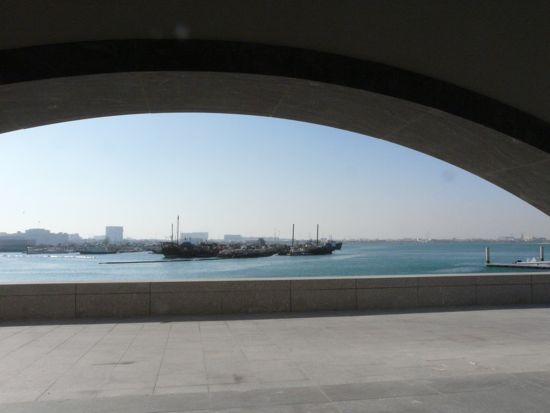

It is a glorious day and the museum has just opened. There is a huge parking lot and little carts ferrying the older people and women with small children to the entrance, but it is a nice walk, not a hard walk. Families are streaming in, and (gasp!) admission is FREE! You have to go get a ticket; I guess maybe that is how they keep track of admission statistics, but this beautiful museum, floating out over the gulf, all white and clean and gorgeous, filled with priceless objects of art, it’s free? Amazing.
We decide to start with the Beyond Borders exhibit, a special collection of art that integrates Jewish, Christian and Islamic traditions in an art collection. There are so many pieces that make me gasp in awe. I see one, and I can’t resist, the camera is out of my bag, I see others snapping photos with cell phones, but I know the rules . . . hmmm. But there is nothing posted here saying “no photos!” I ask the guard if I am allowed to take photos and he tells me “You are welcome, madame, all through the museum, you may take photos.”
I am in total shock. All through the museum? I can take photos?
Here is the piece that moved me so much that I gathered up the courage to ask. It is a Madonna, painted in Aleppo, Syria, I believe, and it has an Quranic sura written in her halo:
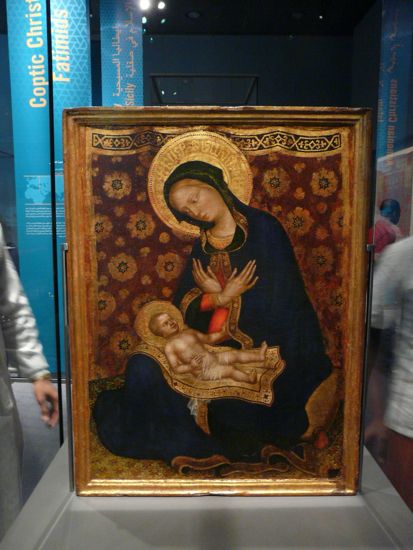
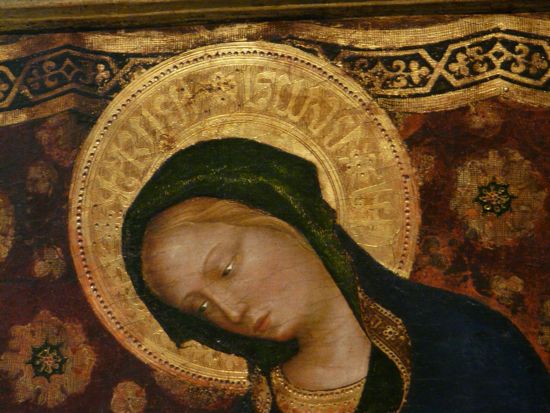
The museum is my oyster, and my battery is dead. I didn’t bring another. Some things happen for the best, and I tuck my camera back in my purse and AdventureMan and I try to absorb what the Doha Museum of Islamic Art has to offer.
It is an impossible task. There is SO much. Not everything is well documented, and then there are sections which are amazing. There is so much to learn, and so much beauty in this museum.
If I had to choose my favorite thing of all, it would be some tiles from Kashan. In an earlier post, commenter Daggero mentioned that the word for tile used in Kuwait is “kashi” and now I know that it comes from these tiles, made in Kashan around the 1300’s (Gregorian calendar) which were famed for their intricacy, their interlocking designs, and their high quality. There are also Iznik tiles in the museum, which are thought to be greatly influenced by these tiles from Kashan.
I had no idea, but the tiles just blow me away. I would love to create some tiled rooms back in my Seattle house, with reproductions of some of these amazing star shaped tiles. For me, that was the highlight of this trip. I know there will have to be many more – this museum is filled with treasures. Free – for all the people. And yes – the gift shop is awesome!
The Demise of Tanureen
As we were sitting outside, having one of our very best days in Kuwait, eating lunch at Tanureen, we got some very sad news. Our kind old Egyptian waiter told us there is a strong possibility Tanureen will close in May, the land may be used (sigh) for another mall. (Here’s the first review of Tanureen.)
What a great pity. We have enjoyed so many happy hours at Tanureen, so many good meals. It’s one of the treasures of Kuwait, only in Fehaheel.
Here is what we were eating, out in the breezy warm sunlight. Sorry that it is already half eaten by the time I got around to taking photos:
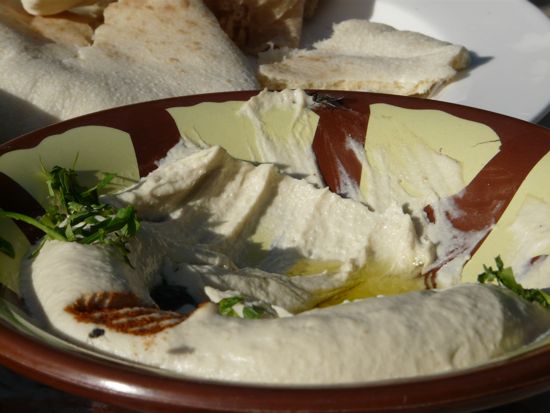
Hummos
Muttabel
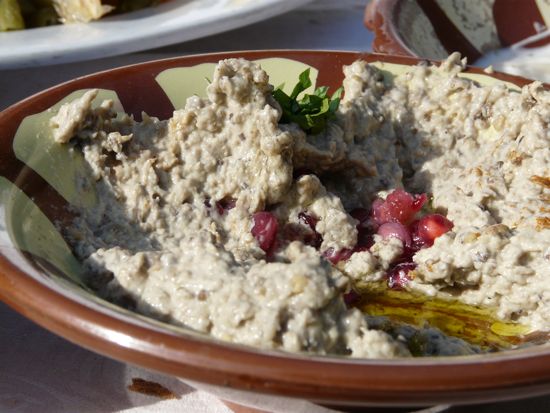

My favorite, baba ghanoosh, especially with pomegranate seeds

Pan-sauteed Hammour

Grilled Shrimp
One of our funniest memories of going to Tanureen was taking Little Diamond, who asked the waiter how the Tanureen salad differed from the Garden Salad. “They are same-same” he replied. Little Diamond’s little eyebrows came together in a frown. “But one is priced at KD 1.500 and the other at KD 1.750?” she continued. “Same-Same!” said the waiter, this time with a little impatience. She ordered one, and we have always wondered what the difference REALLY is, if any.
The weather is perfect for dining out. Go quickly, before the heat sets in, before the Tanureen is no more.
Architecture in Kuwait
Fascinating article in today’s
Arab Times on architectural transitions in Kuwait from a talk given by Salah Abdullah, an expert in the analysis of architectural history, at the Aware Center. This is just an interesting excerpt, but you can read the entire article by clicking on the blue type above.
Old Kuwait
Eng Abdullah also explained the architecture of old Kuwait and how a number of elements have influenced Kuwait in making its buildings and architectural layout what it is today. “In the past city development in Kuwait was completely spontaneous and simply divided. In this it has been similar to many old cities, like London. But what dominated was the Arabic and Islamic culture which is the mainstay of interior designs of many Kuwaiti homes. Building materials were usually taken from nature — sea rock, mud, limestone and gypsum. The shape of old Kuwaiti architecture came to suit the environment and circumstances. Houses were adjacent in a manner that indicated the unity and corporation of the people and streets were usually narrow. Mosques were placed very close to houses, to allow the elderly to walk without trouble.
Construction in the past depended on Kuwaitis themselves. The engineer called ‘ustad’ at that time supervised the buildings and the laborers. They carried rocks, prepared mud bricks and started building. This process was called ‘collective vernacular architecture’. At that time three critical customs were kept in mind when constructing the houses. These included the privacy of women, segregation of guests — male and female — and future family expansion. Therefore to tackle these problems, the family part of the house where women rested was pushed to the back, far away from the street, so it was impossible for anyone passing by to see inside. The family entrance was also separated from the guest entrance. There was also a separate entrance for male and female guests. “The Diwaniya which persists until today also dominated the architectural buildings of the past. Diwaniyas for women were built on the west side of the house and male Diwaniyas on the east side,” explained Eng Abdullah.
I remember moving to Kuwait, I was shown 21 villas, and most of them had a kitchen outside. I was puzzled, then a friend told me that Kuwaitis don’t like the smell of food hanging around inside. What happens is . . . you forget. You get used to things, and after a while, it is like “oh yeh, the kitchen is outside” and you forget that it’s different. Recently, having dinner with Kuwaiti friends, they told us that their kitchen is inside, but they have a separate oven outside for cooking fish, because of the smell. I’ll have to remember that when they come to visit me in Seattle! Don’t cook fish, Intlxpatr! The smell goes all over the house!
Recent Comments
ExpatAlien on What Country am I Living … intlxpatr on Yellowstone: Old Faithful to C… Michelle on Yellowstone: Old Faithful to C… Cathy on No Grown-Ups in Charge intlxpatr on Waiting for Snow Wikipedia Donate Button

Amazina


Early Voting in Florida


 Here There and Everywhere