My house guest and I are sitting at my computer, looking at airfares.
“So what do I do?” he asked me.
“This is your decision to make,” I answered. “Only you know what is most important to you.”
“I am looking for a recommendation,” he tells me.
“If it were me, I would take that early flight. It is cheaper, and by leaving at six a.m. you know it is likely to leave on time and arrive on time. Also, I would have booked it about four months ago. It’s summer. The flights are flying full. There are no cheaper tickets left.”
“Month-es?” he asked incredulously. “Month-es?” he repeated.
We decided to wait and book later, after he had given it some thought. He didn’t like my recommendation; he didn’t like the earliness of the flight I recommended, and I had known he wouldn’t.
I think the idea of booking a flight four months in advance was a double-whammy.
Today’s Gospel reading from The Lectionary brings up so many questions! Jesus gives a parable, a story to help explain what he is saying, but what, exactly, is the parable saying?
Luke 19:11-27
11 As they were listening to this, he went on to tell a parable, because he was near Jerusalem, and because they supposed that the kingdom of God was to appear immediately. 12 So he said, ‘A nobleman went to a distant country to get royal power for himself and then return. 13 He summoned ten of his slaves, and gave them ten pounds,* and said to them, “Do business with these until I come back.” 14 But the citizens of his country hated him and sent a delegation after him, saying, “We do not want this man to rule over us.” 15 When he returned, having received royal power, he ordered these slaves, to whom he had given the money, to be summoned so that he might find out what they had gained by trading. 16 The first came forward and said, “Lord, your pound has made ten more pounds.” 17 He said to him, “Well done, good slave! Because you have been trustworthy in a very small thing, take charge of ten cities.” 18 Then the second came, saying, “Lord, your pound has made five pounds.” 19 He said to him, “And you, rule over five cities.” 20 Then the other came, saying, “Lord, here is your pound. I wrapped it up in a piece of cloth, 21 for I was afraid of you, because you are a harsh man; you take what you did not deposit, and reap what you did not sow.” 22 He said to him, “I will judge you by your own words, you wicked slave! You knew, did you, that I was a harsh man, taking what I did not deposit and reaping what I did not sow? 23 Why then did you not put my money into the bank? Then when I returned, I could have collected it with interest.” 24 He said to the bystanders, “Take the pound from him and give it to the one who has ten pounds.” 25 (And they said to him, “Lord, he has ten pounds!”) 26 “I tell you, to all those who have, more will be given; but from those who have nothing, even what they have will be taken away. 27 But as for these enemies of mine who did not want me to be king over them—bring them here and slaughter them in my presence.” ’
We know, by his own words, this was a harsh man and we know many of his citizens – not slaves – did not want him to rule over them. Why did Jesus use this man to illustrate his point? What about the other seven slaves who were given the money; how did they invest or protect the money? When I look at this parable, I am not so sure I would want to be one who was given more to administer over; the master is harsh. Perhaps those who protected the talent and kept their heads down fared better in the long run under this harsh man’s rule? What if one had taken the money and used it to make the lives of the people better – provided medical care or built a safe-haven for abused women? I shudder to think what the harsh ruler might have done with a slave who used the funds for the good of the people.
They sign up for Hunger Games and get domestic drudgery and uber-control:
From Associated Press via Huffpost
PARIS (AP) — When three British schoolgirls trundled across the Syrian border; when a pregnant 14-year-old ran away from her Alpine home for the second time; when a sheltered girl from the south of France booked her first trip abroad — they were going to a place of no return.
Only two of the approximately 600 Western girls and young women who have joined extremists in Syria are known to have made it out of the war zone. By comparison, as many as 30 percent of the male foreign fighters have left or are on their way out, according to figures from European governments that monitor the returns.
In interviews, court documents and public records, The Associated Press has compiled a detailed picture of European girls and young women who join extremists such as the Islamic State group — a decision that is far more final than most may realize.
The girls are married off almost immediately, either in Turkey or just after crossing into Syria. With an estimated 20,000 foreign fighters — among them 5,000 Europeans — in Syria, there is no shortage of men looking for wives. That number is expected to double by the end of the year. Once among the jihadis, the women are not permitted to travel without a male chaperone or a group of other women and must remain fully covered outside, according to material published by Islamic State and researchers who follow the group. Otherwise, they risk a lashing or worse.
European women who blog about their lives under Islamic State tend to be chipper about the experience, but reading between the lines of an e-book of travel advice shows a life that will be radically circumscribed, with limited electricity, lack of even the most basic medicine, and practically no autonomy. Women do not fight, researchers say, despite the Hunger Games-like promises of recruiters.
“The lives of those teenage girls are very much controlled,” said Sara Khan, a British Muslim whose group Inspire campaigns against the dangers of extremist recruiters. “I don’t think that discussion ever comes up. It’s so romanticized, the idea of this utopia. I don’t even think those young girls have necessarily considered that there’s no way back now.”
The two exceptions to the rule of no return are perhaps most revealing in the very paucity of details about their journey — driving home how murky life is behind the Islamic State curtain.
Sterlina Petalo is a Dutch teenager who converted to Islam, and came to be known by the name Aicha. She traveled to Syria in 2014 to marry a Dutch jihadi fighter there and managed to return months later — apparently making her way to the border with Turkey, where her mother reportedly picked her up and brought her back to the Netherlands. Back home, she was immediately arrested on suspicion of joining a terror organization.
Her family, lawyers and prosecutors refuse to discuss the case. She was released from custody last November and has not been formally charged.
The second woman known to have made it out of the grip of Islamic State reconsidered after just a few weeks. The 25-year-old Briton, whom police have not named, had taken her toddler son all the way to Raqqa, the group’s stronghold, when she decided she had made a mistake and called home. She made her way back into Turkey and her father met her there. How she was able to travel the 250 kilometers (150 miles) from Raqqa to the Turkish border city of Gaziantep is not clear. Back in Britain, she was detained and is now free on bail pending formal charges.
Without knowing how the two escaped, it is difficult to say whether other girls and women could follow their path out of Syria, said Joana Cook, a researcher at King’s College London who studies the links between women and jihad.
“There are clearly many human smugglers working within Syria right now, helping Syrian civilians escape the violence, and I wonder if there is a similar, perhaps even growing market, for those trying to escape after joining ISIL,” Cook told The Associated Press in an email, using one of the acronyms for the Islamic State group. “There is great disillusionment for many who have traveled to Syria to join ISIL and you’ll find many stories of those who went abroad noting ‘this isn’t what we signed up for.'”
The question is whether the girls understood from the beginning how limited their choices would be once they crossed the frontier.
The case of a 15-year-old Avignon girl exemplifies such doubts. The girl hid her second Facebook account and Islamic veil from her moderate Muslim family, thereby managing to join a jihadi network, according to the family’s lawyer. Once within a unit of the al-Qaida offshoot Nusra Front, she was not permitted to leave, according to her brother, who went into Syria to fetch her and was turned away by the extremists. A French boy who joined the group around the same time was allowed to go home.
“I think they understand the premise of that, but not that they understand it in reality,” said Melanie Smith, another researcher at King’s College ICSR.
The networks that bring the women into Syria are increasingly organized around the extremists’ dream of building a nation of multinational jihadis, meaning European girls are particularly prized. Each new Facebook post, each new cheerleading Twitter account — and they pop up by the hour — helps them subvert government efforts to prevent young people from radicalizing and leaving.
The doggedness of jihadi methods for recruiting girls can be seen in the case of Amelia, a 14-year-old girl from France’s Alpine Isere region.
Amelia was first contacted on Facebook by a French fighter on Jan. 14, 2014 and within a month agreed to go to Syria and marry the man, who identified himself as “Tony Toxiko.” After she was turned back by airport border police in Lyon on her first attempt, “Tony Toxiko” persuaded another French adolescent girl to join him in Syria.
Amelia, meanwhile, ran away from home to Belgium, where an imam performed a religious ceremony that wed her to a different man, an Algerian jihadi. She returned to France homesick and pregnant, just long enough to speak to investigators building a case against a middleman who helped her run away. This winter, Amelia managed to deceive her family and left again — making it to Syria with the Algerian fighter, who is more than twice her age.
“It’s particularly difficult for these families. For them, radicalization is happening on the Internet and outside the family sphere,” said Sebastien Pietrasanta, a French lawmaker working on a program to de-radicalize young people. “For a girl of 14, I believe we can clearly save her from herself and save her from these barbarians.”
A French journalist got dangerously close to jihadi recruitment methods by creating a fake Facebook account that attracted a marriage proposal from a fighter in Syria.
Under the pseudonym Melodie, the journalist shared a video on the account, almost immediately getting a message from a man identified as Bilel, who asked how she’d liked the montage of him showing off in a 4X4 and with his weapons.
“I passed myself off as a 20-something, not stupid but a little lost, who suddenly found a huge response from a man in Syria,” said the journalist, who wrote a book “In the Skin of a Jihadist” under a pseudonym.
Bilel’s doubts about her began to grow as her reluctance to join him became clear. She ended up getting threats that she said would likely frighten a bewildered young woman into submission. As it was, the journalist, who never met Bilal in person, remains under constant police protection a year later.
“We’ll find you, we have the best operators here, you don’t know what you’re getting into, you’re messing with a terrorist group, you and your family will pay,” the woman said, recounting the litany of threats she received after returning to France. “If they were speaking to a 20-year-old, it would be very hard for her.”
___
Associated Press writer Mike Corder in Amsterdam contributed.
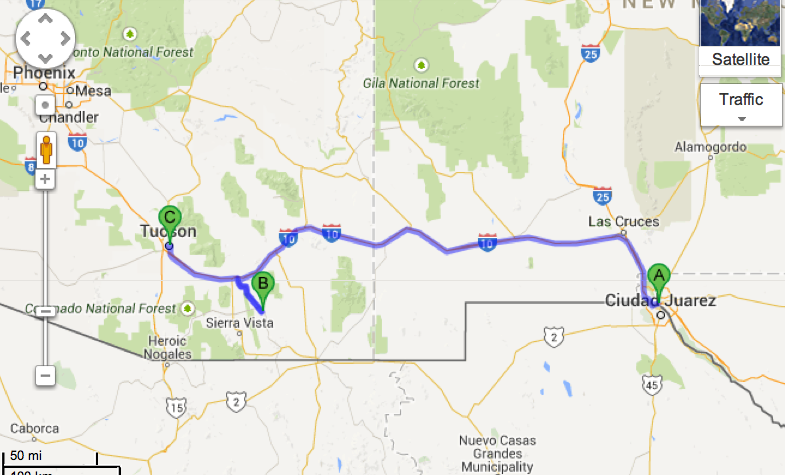
The sky is blue and the air is sparkling clean as day dawns in El Paso, TX, which we made a stop on our journey in honor of a series we are totally addicted to called The Bridge. I understand it has been cancelled, but it’s premise was that there was a lot of horrible crime in Juarez because law enforcement authorities on both sides had given incentives to keep the ugliest crimes on the Mexican side of The Bridge, and US drug enforcement personnel at the highest levels protected drug flow into our country through tunnels and trucking. Fascinating, although in truth, sometimes AdventureMan and I looked at each other and asked “What just happened?”
We have a short driving day today, but a stop at Tombstone, the site of the shoot-out at the OK Corral. Well, not really the OK Corral but the alley next to it. We read Mary Doria Russel’s book Doc, about Doc Holliday, and then Epitaph, her book about Wyatt Earp, and they made it so real, we wanted to visit just to pay tribute to Mary Doria Russel’s research and wonderfully readable books, which take legendary characters and makes them fully human.
Up early, to catch the sunrise reflecting off the windows of El Paso:
We feel so safe, the parking lot is full of Homeland Security personnel vehicles. Although it is a Sunday morning, many are eating breakfast and heading out to guard the border:
It is a totally different day from the rainy mess we drove through all day from San Antonio to El Paso. The sky is so blue and the air is so clear and we are thoroughly enjoying this day:
As we leave Texas, AdventureMan points out that the underside of the overpasses are painted in Southwestern colors, and there are graphic designs on the pillars. The Highways are beautiful! Someone put a little extra thought into making them memorable.
There is a cross gleaming high on a bare mountain, and I am trying to imagine how they got it up there, and how they engineered it so it would be stable and stay there:
Welcome to New Mexico!
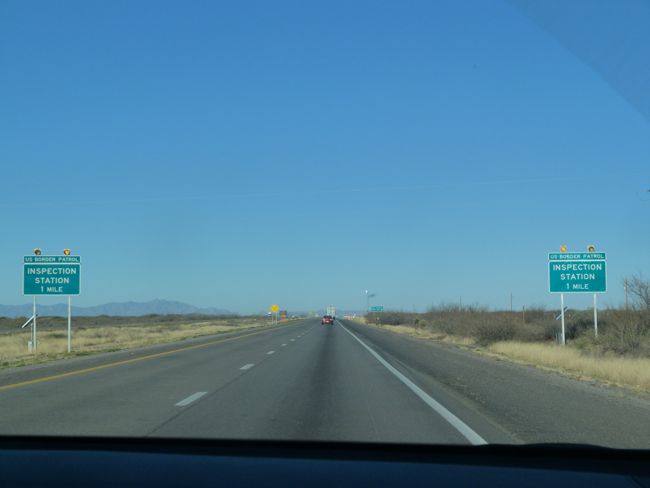
As we are paralleling the border, there is another security stop:
We really wanted to buy something at this shop, but the baskets were all made in Pakistan! We have Pakistani baskets! I finally left with just a CD of new-age sort of Indian mystical music, soulful flutes, shaking bones, you know the kind, to put us in the Southwest frame of mind. It’s one of the few things we bought for ourselves on the trip.
I’ve never seen this before in the United States. We used to go through checks like this in Germany, in Doha, in Kuwait, but not in the United States. This trip, we went through several, all across our southern border.
All the trucks, and all the cars, pulled over to go through security checks, dogs sniffing the cars, men going through an entire truck here and there, or having a family stand to one side as they thoroughly inspect the car.
I love our retired military id’s.
The sign on the left tells us they have caught more than 7,000 illegal immigrants so far this year, and have confiscated more than 12,000 something. . . dollars worth of goods? Individual goods, like cars? I know if you get caught doing something illegal, you lose your property, even if it is a car or a house.
This is a difficult post to write. I’m a patriot. We served our country many years, Cold Warriors. We believe in the United States of America.
What I saw on our southernmost border on the Rio Grande makes me uncomfortable. We have put a lot of money into making sure illegal aliens don’t get through.
I can see a lot of good reasons for good border security. And having said that, what I saw stepped right over the line of “good border security” and teetered precariously on “oppressive.”
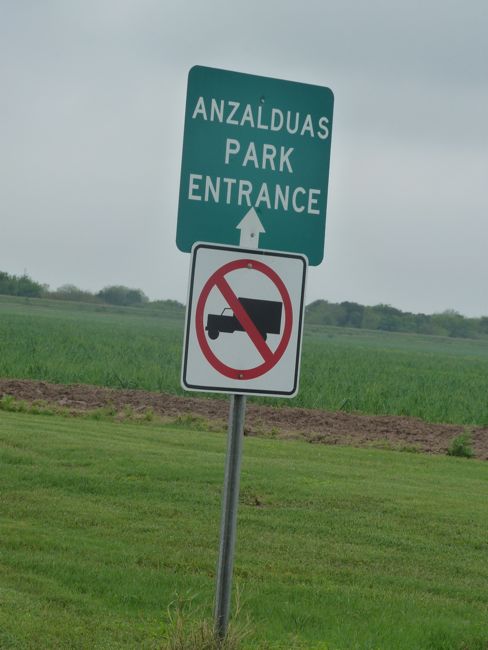
One of the Benson-Rio Grande Valley Park employees told us that if we want to see the Rio Grande, go to (some restaurant that has a view of the Rio Grande) or to this County Park called Anzalduas Park, and he told us how to get there. We drove and drove, couldn’t find it, but there was a cop parked on the road, so we asked him and he told us we were almost there.
As we reached Anzalduas Park (which is right under the Anzalduas Bridge, which goes over into Mexico; no, we didn’t have our passports, so we didn’t cross, maybe next time) and approached the park, it was a very odd park. It’s all excavated out, with a very very bare landscape, and some steep climbs. At the gate are some really heavy duty sliding guard gates. It’s not a very welcoming park.
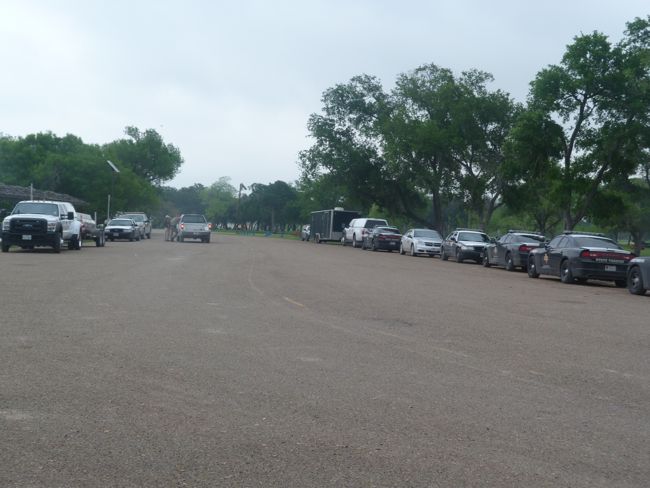
We got down into the park, drove down to the boat landing, and there were about twenty cars parked there, and they were all security vehicles. There was a big party going on, it was a Friday and some families and children were playing and the loudspeaker was all in Spanish. I couldn’t see any Homeland Security guards, only the cars, maybe the guards were sitting inside. Maybe they were at the party 🙂
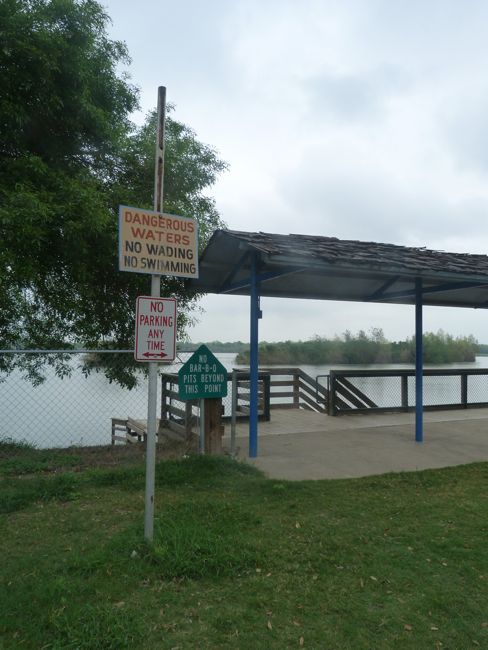
The Park employee at Benson – Rio GRande Valley Park had told us that on weekends, across the Rio Grande, is a swim club, and the Mexicans are swimming all the time, just feet away from the American side, but there are all these signs saying the waters are dangerous. The waters seemed very calm, but sometimes there are dangers that are not so obvious.
That’s just a lot of cars providing border security in this park.
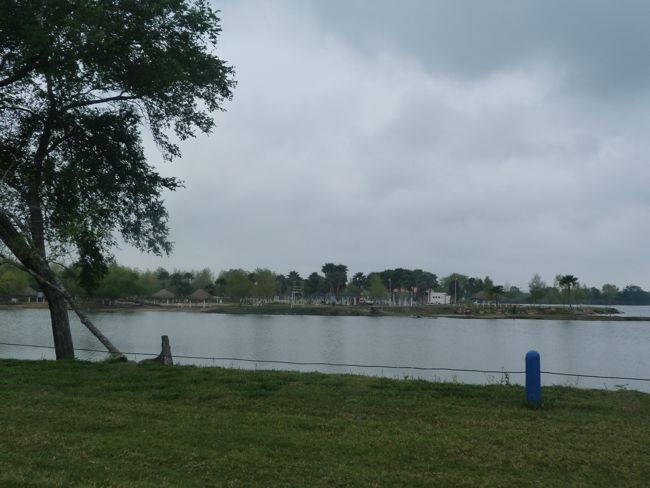
You can see the Mexican side swimming club; just yards across a very narrow Rio Grande:
Here is another view of those heavy gates that bar the park in off hours.
We had been told this is a very popular park, full of people all the time. I am glad to hear it, glad that people are not intimidated, and use this beautiful little park for parties and celebrations, just as we use parks all over the USA.
When I lived in Kuwait and Qatar, I was appalled by the way rapes were treated, it was like this huge wave of abductions and violations, and nothing was done. As it turns out, things are changing a lot slower in my own country than I thought. This new film, The Hunting Ground, is by the same person who documented violence and rape in the US military, spurring then Secretary of Defense Leon Panetta, a truly decent man, to put the fear of God into the military leaders who were covering up the many rapes and blaming the victims. We have the same problem on college campuses.
There is only one cure. We have to raise our sons to respect women. We have to continue raising the bar for equality in our country until women have equal access to jobs, health treatment, legal proceedings, etc. Films like The Hunting Ground are painful, and at the same time, help us to face, and to overcome our societal short comings.
I love it that this film is “giving voice to those who have no voices;” that these courageous women speaking out have bravely named their rapists and described their circumstances. It can’t be comfortable, but it is their right. I am proud that they are not intimidated by fear of the ‘blame the victim’ mentality they have endured on their college campuses. When did colleges and universities begin placing money-making and winning teams before the well-being of their students?
New film gives chilling account of sexual assault on college campuses
Sexual assaults on college campuses have reached alarming levels and the issue has drawn the attention of Congress and even President Obama himself. The latest research indicates that one in five college women will be sexually assaulted and as many as 90% of reported assaults are acquaintance rapes. It is believed that more than 100,000 college students will be sexually assaulted during the current school year. Nowhere is the deck stacked more against sexual assault victims than in college athletics. In just the last few years alone there have been cases at Florida State, Michigan, Oregon, Vanderbilt andMissouri.
All of this is a backdrop to a harrowing new film that premiers in theaters on Friday in New York City and Los Angeles. The Hunting Ground is a jarring exposé that shines a bright light on the epidemic number of sexual assaults taking place on college campuses each year.
The Hunting Ground features a group of survivors who faced harsh retaliation and harassment for reporting that they had been raped. The film focuses on institutional cover-ups and the brutal backlash against survivors at campuses such as Harvard, Yale,Dartmouth, the University of North Carolina at Chapel Hill, USC and the University ofCalifornia-Berkeley, among others.
Some of the most vexing stories featured in the film involve women who were assaulted by athletes. While The Hunting Ground isn’t all about sports, the most dramatic moment in the film occurs two-thirds of the way through when the woman who accused former Florida State quarterback Jameis Winston—who after a strong showing in last week’s Combine is projected by many to be the No. 1 pick in this spring’s NFL draft—appears and tells her story publicly for the first time. The woman, who is named in the film but SI.com has chosen to protect her identity, is shown on camera and gives her life-changing account of what she says happened the night in December 2012 she left a Tallahassee bar with Winston.
Photo: Getty Images
A high school honor student who planned to attend medical school, the woman is articulate and attractive. She looks like the girl next door, a person you would trust to babysit your children. It is uncomfortable to watch—yet impossible to look away—when she describes being beneath Winston on his bathroom floor, repeatedly telling him “no” before being physically overpowered.
“We’re grateful it’s the first time people will get to hear [her] story,” said The Hunting Ground director Kirby Dick. “It’s her first-hand testimony. Up to this point it hasn’t been in a public space.”
The woman’s parents also appear in the film. Her father talks about driving to Tallahassee Memorial Hospital with his wife to be with their daughter hours after the incident.
There is nothing easy about retelling these stories for the world to see. But the attorney for the woman who says she was raped by Winston, John Clune, said his client decided to break her silence in the film because she felt it was the right venue to tell her story.
“The film was a once-in-a-lifetime opportunity,” Clune said. “The work by these filmmakers is nothing less than groundbreaking. It took tremendous courage, but our client and all of the incredibly brave women in the film have advanced the cause of rape survivors everywhere.”
The Hunting Ground also examines a sexual assault accusation against a Notre Damefootball player in 2010. Tom Seeberg, whose daughter committed suicide after she says she was sexually assaulted by a Fighting Irish starter, tells a heartbreaking account of school officials thwarting the investigation into his daughter’s complaint. A former Notre Dame police officer reveals that he and his colleagues were not allowed to approach or question an athlete on athletic properties.
The film also mentions rape cases involving football players at Missouri and Vanderbilt, as well as basketball players at Oregon.
The testimonials of rape survivors are wrapped between raw footage that is both gut-wrenching and disturbing. A small mob of unruly fraternity pledges at Yale are captured on film outside a freshman dorm for women, chanting: “No means yes. Yes means anal.” All the while a guy with a bullhorn is shouting: “Louder.”
In another scene we see drunken frat boys spilling out of a house where there is a sign out front that says: “THANKS FOR YOUR DAUGHTERS.” It’s enough to outrage any parent with a daughter heading off to college.
The film is directed by Dick and produced by Amy Ziering, the team behind the Oscar-nominated film The Invisible War, which revealed systemic sexual assaults and cover-ups within the U.S. military. That movie prompted Secretary of Defense Leon Panetta to announce significant policy changes and inspired the passage of the Military Justice Improvement Act.
Dick and Ziering started looking into the situation on college campuses shortly after the release of The Invisible War. “We were astonished that the problem was as serious in higher education as it was in the military,” Dick said.
Full disclosure: I appear in The Hunting Ground as an expert. Two of the cases in the film—Lizzy Seeberg’s alleged assault at Notre Dame and running back Derrick Washington’s sexual assault of a student at the University of Missouri—are featured in my book The System: The Glory and Scandal of Big-Time College Football, which I wrote with 60 Minutes correspondent Armen Keteyian.
Some of my research is also featured in the film, including the statistic that student-athletes are responsible for 19% of the reported sexual assaults on campus, despite the fact that they comprise just 3.3% of the male student population. Those figures arose from a first-of-its-kind study I conducted with researchers at the University of Massachusetts in the mid-90s when we were granted access to judicial affairs records and police reports at colleges across the country.
Photo: Don Juan Moore/Getty Images
Over the past 20 years I have researched hundreds of cases of sexual assault involving athletes. During that time I’ve interviewed countless sexual assault victims. The thing I found most telling was what prosecutor Willie Meggs did not say in the film. Meggs was asked if he thought a rape took place in Winston’s apartment. It was a perfect opportunity for the man who chose not to prosecute Winston to say no. Instead, he said something “bad” happened in that apartment that night. He just didn’t have sufficient evidence to prove it.
That’s not unusual. That’s typical. Only about 20% of rapes reported to the police in the U.S. are prosecuted. Yet at least 92% of reported sexual assault claims are found to be true. The problem is that date rape cases are very difficult to prove beyond a reasonable doubt, especially when alcohol is involved and the incident occurs in the perpetrator’s apartment, dorm or hotel room. The doubts raised by those factors are amplified when the accused is a star athlete.
The greatest achievement of The Hunting Ground is that it empowers rape victims to team up with each other and come forward. It’s fair to say that for the first time in many years, women like Jameis Winston’s alleged victim have powerful allies.
By the time the NFL draft takes place in May, the film will be in theaters around the country, the name of Winston’s accuser will be everywhere and more details about the night in question will likely come out. All of this brings to mind the legal maxim caveat emptor, which essentially is a warning that means let the buyer beware.
Jason Licht, the general manager for the Tampa Bay Buccaneers, ultimately has to decide whether to use the first pick on Winston. He’s on record saying: “This is the most important pick, potentially, in the history of the franchise.”
Memo to Licht: Watch The Hunting Ground.
The ramifications in this instance are equally big for the NFL, whose image took a beating over the last year after Ray Rice was caught on tape knocking out his then-fiancé in an elevator. The controversy erupted after Commissioner Roger Goodell imposed a two-game suspension without bothering to obtain and watch the video.
Memo to the Commissioner: Watch The Hunting Ground.
No matter what happens with Winston, the film succeeds in its main goal: to shine a light on sexual assault on college campuses. It’s an important issue that isn’t going away, and if something drastic isn’t done immediately, it will only get worse.
Jeff Benedict is a lawyer and has written five books on athletes and violence against women, including Public Heroes, Private Felons: Athletes and Violence Against Women, and Out of Bounds: Inside the NBA’s Culture of Rape, Violence and Crime.
In the category of ‘you can run, but you can’t hide’ is the fact that hundreds, thousands of rape kits have gone untested in police departments all over the United States. Too expensive, or so they say, to process them all, but the force of public opinion is relentless, and the result is that some of these kits are finally producing results and convictions that, at long last, give the rape victims some satisfaction.
I worked with one of the very first Rape Crisis Lines, back in the beginning when it was all new, in, of course, California. We worked with the victims, but we also worked with emergency workers and with police. It was a team. Most of the police I worked with were merciful and compassionate, but there are other places where the police culture is harsh, and rape victims are not well-treated. There are still those people who believe that somehow a victim asked for it in some way.
I learned some surprising things as I worked with the victims. I learned how strong and how smart victims (they’re not all women) can be. They did what they had to do to stay alive, and they memorized everything they could to be able to tell the police. Many made it a point to leave DNA in the car, or to save the rapist’s DNA. It was less about the physical violation than finding oneself in a position of utter powerlessness, and not knowing if you were going to survive. I didn’t pity the victims; I admired their courage and resilience.
JUAN A. LOZANO, Associated Press
HOUSTON (AP) — Evidence from more than 6,600 rape kits that went untested for years in Houston have turned up 850 hits in the FBI’s nationwide database of DNA profiles, marking a major step in the city’s $6 million effort to address the backlog, officials announced Monday.
Charges have been filed against 29 people, six of whom have been convicted, since the city launched an effort in 2013 to test 6,663 rape kits — some of which dated back nearly three decades. Testing was completed in the fall, and the results have now been uploaded to a database used by investigators nationwide to compare DNA profiles of possible suspects, Mayor Annise Parker said.
“This milestone is of special importance to rape survivors and their families and friends because it means their cases are receiving the attention they should have years ago,” Parker said at a news conference, where she joined local law enforcement officials to announce the results.
Police are continuing to review the matches to see if charges can be filed in other cases. In the cases where prosecutors have won convictions, defendants have received sentences ranging from 2 to 45 years in prison. One case was dismissed after the victim decided not to pursue the case.
Rape kits include biological samples and physical evidence gathered from sexual assault victims that are later processed to see if they match a suspect’s DNA. Testing results are uploaded to the FBI’s Combined DNA Index System, or CODIS.
Harris County District Attorney Devon Anderson said there were some cases where suspects committed other crimes while rape kits that could have identified them sat untested.
“Now that the testing of these kits is complete, we know that it’s up to us to finish the job and to seek justice for these victims. The ball is in our court and we will do our best to put the people who are responsible for these heinous crimes behind bars for as long as possible,” she said.
Experts say Houston’s backlog — and similar backlogs in other U.S. cities — are due in part to the high cost of testing which can run from $500 to $1,000 per kit, though advocates argue that the lack of testing signals that sex crimes haven’t always been law enforcement priorities.
More than 12,000 kits went untested for years in Memphis, Tennessee, which is facing a lawsuit from rape victims as it tries to test the kits. In Detroit, prosecutors discovered more than 11,000 rape kits in an abandoned police warehouse in 2009, and Cleveland prosecutors have sent their entire 4,700-kit backlog for testing.
“This is not a Houston problem. It’s not a Texas problem. It’s a nationwide issue that built up over years and years,” Parker said.
The good news is that Saudi women know better. They don’t buy this line any more than we do. They visit America, they go to school in America. And oh yes, they DRIVE in America. The second part of the good news is that the younger generation buys this line a whole lot less than our parent’s generation, and change is coming. It’s coming faster than this historian thinks.
Saudi Historian Says U.S. Women Drive Because They Don’t Care If They’re Raped
Saleh al-Saadoon claimed in a recent TV interview that women can be raped when a car breaks down, but unlike other countries, Saudi Arabia protects its women from that risk by not allowing them to drive in the first place, according to a translation posted online by the Middle East Media Research Institute.
“They don’t care if they are raped on the roadside, but we do,” al-Saadoon said on Saudi Rotana Khalijiyya TV.
“Hold on. Who told you they don’t care about getting raped on the roadside?” asked the host, a woman who is not named in the transcript.
“It’s no big deal for them beyond the damage to their morale,” al-Saadoon replied. “In our case, however, the problem is of a social and religious nature.”
Two other guests on the show — a man and a woman — appeared to be in shock over his comments. Al-Saadoon said they were out of touch.
“They should listen to me and get used to what society thinks,” al-Saadoon said.
Since the rape argument didn’t seem to be convincing anyone, al-Saadoon tried another approach, claiming that women are treated “like queens” in Saudi Arabia because they are driven around by the men of the family and male chauffeurs. That led the host to ask if he wasn’t afraid that women might be raped by their chauffeurs.
Al-Saadoon agreed.
“There is a solution, but the government officials and the clerics refuse to hear of it,” he said. “The solution is to bring in female foreign chauffeurs to drive our wives.”
That caused the female host to laugh and cover her face with her palm.
“Female foreign chauffeurs?” she said. “Seriously?”
Today, on AOL News, a report on the ravaging of two villages in Nigeria by Boko Haram, with satellite images showing the carnage and destruction as survivors tally more than 2,000 dead. The craven Nigerian Army claims the losses are more like 200.
Meanwhile, of the almost 300 girls kidnapped a year ago by Boko Haram, 219 are still missing. Those who returned, returned by escaping. No one rescued them. The remainder are likely “married” to their captors, slaves to the household and many of them are probably pregnant. To be pregnant by a Boko Haram soldier creates a severe social problem if they are ever freed or rescued – the family cannot marry off an impure daughter. The children of these unions face a desolate future, wherever they are.
The world watches when terrorists wreak havoc in Paris, thousands crush the cretins who kill in the name of God, but no-one lifts a finger to help these small villages in Northeast Nigeria, beset by destructive vermin.
JOHANNESBURG (AP) — Large areas of Nigerian towns attacked by Islamic extremists were razed to the ground in a widespread campaign of destruction, according to satellite images released Thursday by Amnesty International.
Amnesty International said the detailed images of Baga and Doron Baga, taken before and after the attack earlier this month, show that more than 3,700 structures were damaged or completely destroyed.
The images were taken Jan. 2 and Jan. 7, Amnesty International said. Boko Haram fighters seized a military base in Baga on Jan. 3 and, according to witnesses, killed hundreds of civilians in the ensuing days.
Daniel Eyre, Nigeria researcher for the human rights group, said in a statement that the assault on the two towns was the largest and most destructive of all the Boko Haram assaults analyzed by Amnesty International.
The group said interviews with witnesses as well as local government officials and human rights activists suggest hundreds of civilians were shot; last week, the human rights group noted reports of as many as 2,000 dead. The Nigerian military has cited a figure of 150 dead, including slain militants.
Nigeria’s home-grown Boko Haram group drew international condemnation when its fighters kidnapped 276 schoolgirls from a boarding school in northeast Chibok town last year. Dozens escaped but 219 remain missing.