Sunset Dolphin Cruise with Olin Marler in Destin
We did this same cruise with the same house guests two years ago, and . . . we never get tired of it. We don’t do it that often, and it is always fresh and relaxing.
We booked with Olin Marler Charters out of Destin. Fortuitously, we had a Groupon. It was so easy, buy the tickets online, call for a reservation, be at the dock at 5 p.m. for boarding.
Yes, it can be a crowd. Yes, you always have to know where you want to be and head directly there so you will have a good view, although people do wander. Yes, you have to hope that people who take young children aboard will be responsible and watch them like hawks. Other than that, these cruises are fun and easy.
There are other cruises. The others that we saw were all very crowded, people packed like sardines on little barge-like boats. We like a boat with a couple levels and lots of places where you can take photographs without having to crawl over anyone – or having people crawl over us! – to get a photo. This is our second time with Olin Marler, and I expect it will not be our last – it’s just so much fun.
We saw lots of dolphins. Dolphins are not so easy to photograph as they surface and dive, oh aaargh. If you want to see dolphins from our last trip, click on the blue hypertext in the first paragraph.
Also lots of seagulls and lots of sunset 🙂 Great times with special old friends from Germany, our sons have been best of friends for years, too.
This is the boat they took us out on, the yellow one:

Sunset is nearing:

Can’t get a good shot of the dolphins so might as well see if I can get something interesting with the seagulls and sunset:
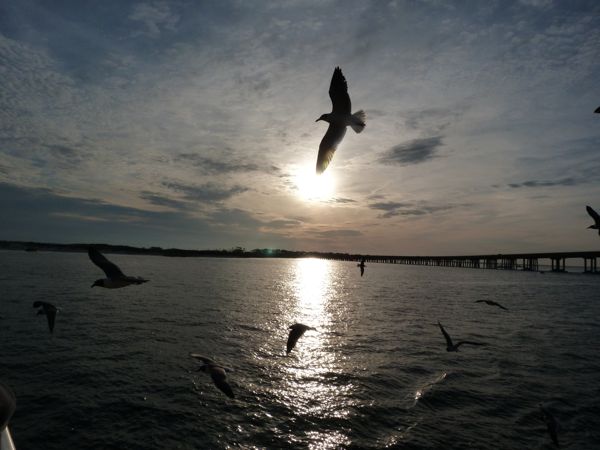
When the sun actually sets, it gets cold quickly. We had a very warm day, maybe 80 degrees F. and it dropped almost immediately by 30 degrees. Fortunately, we knew this happens and came prepared this time 🙂

Great way to end a day, followed by dinner with the same good friends.
Stranger in a Stranger Land
. . . . And the land I am talking about is utility bills, water and sewage bills to be specific.

This month we got a very low water-related utilities bill. I say this in relative terms, for about a year, we have been paying huge bills, bills which, to my perception, seemed out of proportion with the water we have been using. AdventureMan called the utilities company and they explained that the averages are measured in certain winter months, and then you are charged for that usage.
So this time, I called, because I didn’t understand the explanation. A very patient, very kind customer service representative explained it again to me. They send notices, she explained, saying they are about to monitor the water usage, and your sewage will be charged accordingly. “We can measure how much water you are receiving,” she explained, “but we don’t really know what is going down the pipes as sewage or waste water (laundry, etc) or going into the ground, which is not sewage. So we measure intake during three – four winter months when people are NOT watering, and guesstimate (my word, not hers, this is a sort of paraphrase, even with the quotes) what your sewage rate is.”
It’s still a little vague to me, but just clear enough for me to understand that just when we should have been NOT watering the year before, we installed a large new planted area and watered generously while the plants settled in. We watered generously during the exact time we were to be not watering at all and using water conservatively.
For a year, I have been calling in plumbers and asking them to look for a leak, fixing every kind of water problem I could find, not understanding how we were being charged so much.
We saw a program on 60 minutes, a follow up to the “Lost Boys” segment they did years ago on groups of Sudanese men who came to the US as the Janjaweed marauded through there villages, killing, raping, destroying everything in sight. It showed their disorientation as they learned how things are done here; I feel their pain. I can identify with their confusion. My next monster to tackle is COX cablevision; they keep raising my rates, it is all totally arbitrary, and I want to find an alternative. Our son – and many others – have explained different avenues, but until you actually do it, it seems complicated. I like to understand what I am doing, and I am not ready to just throw up my hands and give up; I insist on understanding! There must be some rationality (except for Cox’s mendacious billing) and we will prevail!
But for now, through no understanding on our part, we did not water during the measuring months this last year, and now have a very reasonable water bill. Ahhhhhhh. Life is sweet.
It’s Your Fault if You Assume You Are Safe: Indian Officials
Horrifying. Disgusting. At the very least, if you are an official and tourists are gang raped in your area, keep your mouth shut. If you must say something, tell the visitors how sorry you are this happened to them. Never, never, never suggest that they should have ASKED if they were safe, NEVER blame the victim for being in the wrong place at the wrong time. You just look really, really ignorant.
These crimes will keep happening as long as there is such a preference for male children that there are not enough mates for the males once they mature. They will keep happening as long as men are not taught, as children, that women are to be equally respected.
Swiss Gang Rape Victim, Husband Partially To Blame For Attack, Indian Officials Suggest
The Huffington Post | By Cavan Sieczkowski
Posted: 03/18/2013 12:13 pm EDT
Officials in India suggested that a Swiss tourist and her husband are partially to blame for an alleged attack and gang rape in a remote wooded area in Madhya Pradesh last week. They said the couple did not inquire about the safety of the region.
On Friday, a Swiss woman and her husband pitched a tent in a forest in Madhya Pradesh while on a three-month cycling excursion, according to the Associated Press. Around 9:30 p.m. a group of men attacked the couple, beat up the husband, tied him to a tree, gang raped the wife and robbed the pair, police said.
During a press conference on Sunday, police spokesperson Avnesh Kumar Budholiya suggested the tourists are partially to blame for the assault because they chose to travel that area without speaking to local police, the Independent reports.
“No one stops there,” Budholiya said. “Why did they choose that place? They were in the wrong place at the wrong time. They would have passed a police station on the way to the area they camped. They should have stopped and asked about places to sleep.”
Another official also appeared to place blame on the victim and her husband.
“The rape of the Swiss national is unfortunate but foreign travelers should inform the police about their movement so they can be provided with adequate protection,” said Umashankar Gupta, the Home Minister of Madhya Pradesh, according to The Times. “They often don’t follow the state’s rules.”
Madhya Pradesh reportedly has one of the highest rates of crimes against women in the country, a fact the Swiss tourists were unaware of, according to the Times of India.
“They apparently lost track and took a wrong turn and decided to halt for the night by the side of a village brook little realizing that the district with 85:100 men to women ratio is not the safest place for women,” a senior official from the region told the newspaper.
Six men have been arrested in connection with the most recent reported gang rape, CNN reports. The victim, who was hospitalized after the attack, claims four of the men raped her. The other two reportedly robbed her and her husband. All six appeared in court Monday.
The most recent attack comes just three months after a 23-year-old woman was gang raped and beaten on a public bus by five men in New Delhi. The defense lawyer for three of the accused placed some of the blame on the now-deceased victim, saying a “respected lady” does not get raped.
Blaming a female victim of a sex crime is common in India because of a woman’s role in society, according to the Sydney Morning Herald.
“This is the mentality which most Indian men are suffering from unfortunately,” Ranjana Kumari, director for the New Delhi-based Centre for Social Research, told the newspaper. “That is the mindset that has been perpetrating this crime because they justify it indirectly, you asked for it so it is your responsibility.”
START with Sea of Poppies, by Amitav Ghosh

I recently wrote a book review on River of Smoke, by Amitav Ghosh, which held me spellbound, so riveting that I had to order Sea of Poppies, which is actually the first volume of the trilogy. I had heard a review of River of Smoke on NPR and although it was written as the second volume in a trilogy, it can be read as a stand-alond.
Yes. Yes, it can be read as a stand-alone, but it is so much easier, I can state with authority, if you read them in order. Once I started Sea of Poppies, I also discovered an extensive glossary in the back, several pages, a list of the words, annotated with suggested origins, and it adds so much color to an already brilliantly colored novel. Much of both novels uses words from many cultures, and words that have been formed by another culture’s understanding of the words (some hilarious). If you like Captain Jack Sparrow, you’re going to love the polyglot language spoken by ship’s crews from many nations trying to communicate with one another. It can be intimidating, but if you sort of say the words out loud the way they are written at the beginning, you begin to find the rhythm and the gist of the communication, just as if you were a new recruit to the sea-going vessels of the early 1800’s. I loved it because it captured the difficulties encountered trying to say the simplest things, and the clever ways people in all cultures manage to get around it, and make themselves understood.
Sea of Poppies starts in a small Indian village, with one of the very small poppy gardens, planted on an advance from an opium factory representative, thrust upon the small farmer, with the result that most small Indian farmers converted their entire allotment from subsistence foods to poppies. Ghosh walks us through an opium processing factory, which is a little like walking through the circles of hell. We meet many of the characters we will follow in River of Smoke, and learn how this diverse group bonded into one sort of super-family through their adventures – and misadventures – together.
It is an entirely engrossing work. Sea of Poppies was short listed for the Man Booker award, and was listed as a “Best Book of the Year” by the San Francisco Chronicle, Chicago Tribune, Washington Post and The Economist. The theme is the opium trade, leading to the Opium Wars, with China, and is a chilling indictment of how business interests manipulate a population’s perceptions of national interests to justify . . . well, just about anything, in the name of profit.
The theme is woven through human stories so interesting, so textured, so compelling, that you hardly realize you are reading history and learning about the trade, cultures, travel, clothing, traditions, religions, food, and motivations as you avidly turn the pages.
I can hardly wait for the third volume. Get started now, so you’ll be ready for it when it comes out!
Kuwait Independence / Kuwait Liberation Congratulations
LOL, I actually congratulated Kuwaitis about a month ago when I thought I had missed the date and . . . I did! I missed it by a month! I was too soon!
So now it is really here – February 25 – 26. Congratulations, and we wish you well. We wish you resolution to your challenges of leadership and infrastructure issues. If you’ve noticed; it’s not like these are challenges unique to Kuwait; the flip-side of democracy can be logjams and stalemates, and then, suddenly, it can all shift and flow. We wish you some shift and flow after years of logjam.

New Laws To Stop Reports of BAD Food
This is absolutely frightening. We know there are consequences for ignoring humane rules for our meat and food processing. We KNOW the absolute dangers of Mad-Cow Disease; I will never be able to donate blood because I was exposed to the possibility of Mad Cow in the 1980’s. How on earth are we allowing our legislators to pass these BAD laws???

Ag-Gag Laws Help Agribusiness Hide Health Risks in Your Food
By M. Joy Hayes, Ph.D., The Motley Fool
Posted 5:00AM 02/14/13
In 2008, an undercover investigation led by the Humane Society led to the largest beef recall in history — removing meat that may have been tainted with mad cow disease from school cafeterias around the country.
Now there’s a business-backed movement afoot seeking to prohibit investigations like these.
The so-called “ag-gag” laws are designed to prevent anyone other than regulators or law enforcement officers from investigating dangerous or illegal agricultural practices that lead to mad cow disease, salmonella or Listeria poisoning, and other food-borne illnesses.
Ag-gag laws have been proposed by politicians in Arkansas, Indiana, Nebraska, New Hampshire, and Wyoming. And Iowa, Kansas, Missouri, Montana, North Dakota, and Utah already have such laws in place.
Why should this concern consumers? Due to funding limitations, regulators are only able to inspect a small percentage of the food we consume. As a result, we rely a great deal on journalists and activists to conduct additional investigations that prevent dangerous food from making it to market.
“Downer” Cows Dragged to Slaughter and Served to Children
We don’t have to look far to see how laws discouraging undercover investigation can limit consumer access to food safety information.
The 2008 massive beef recall came about from a Humane Society undercover investigation that provided a video of “downer” cows — animals too weak or sick to walk — being dragged to slaughter at Hallmark Meat, a supplier to the National School Lunch Program. This led to a recall because a cow’s inability to stand or walk is a possible indicator of mad cow disease.
Last year, activist group Compassion Over Killing released disturbing video footage from another National School Lunch Program supplier, Central Valley Meat. It shows cows, before slaughter, covered in feces, writhing on the ground in blood, and projectile-vomiting from the stress of being repeatedly struck by a bolt gun (a weapon that pierces the skull to stun or “euthanize” the animals).
Before the footage was released, Central Valley Meat also served as a supplier for McDonald’s (MCD) and Costco (COST). Both have since cut ties with the company.
Keeping You in the Dark
Let’s take a look at how 2013’s ag-gag bills may undermine investigations that expose unsafe and inhumane agricultural practices.
Arkansas’ SB 13 proposes outlawing animal investigations conducted by anyone other than a certified law enforcement officer, thus prohibiting journalists and activists from investigating possible food safety violations regulators may have missed.
Arkansas’ SB 14, would make it illegal for whistleblowers or undercover investigators to gather photographic or recorded sound evidence of illegal or unsafe agricultural practices with the intention to “cause harm to the livestock or poultry operation.” In other words, the proposed law would prohibit whistleblowers from releasing information that would make a company look bad and drive away customers.
Indiana’s SB 373 and Wyoming’s HB 0126 would also prevent whistleblowers from exposing food safety issues by making it illegal to take video or pictures without written consent of the property owner or representative of the property owner.
Nebraska’s LB 204 proposes making it illegal for journalists and activists to pose as employees to conduct undercover investigations. It suggests prohibiting job candidates from misrepresenting themselves during the hiring process when they have an intention of damaging or interfering with the operations of the business. Strikingly, the bill proposes felony charges in cases where the “violation” results in “economic damage” of $10,000 or more. That means that undercover employees who reveal safety issues costing a company more than $10,000 in lost sales could face devastating legal penalties.
New Hampshire’s HB 110 simply calls for requiring people with evidence of animal cruelty to turn it over to law enforcement. While nothing in the bill prohibits outside investigation of animal cruelty, some worry that this law would undermine investigations into animal cruelty by forcing journalists and activists to reveal their sources too early in the investigation.
Agricultural business advocates might argue that these undercover investigations unfairly put businesses’ reputations at risk by allowing individuals who aren’t trained to evaluate agricultural safety practices to gather and disperse misleading information, and that these ag-gag laws simply protect the ability of businesses to guard their reputations from unfair accusations.
After reviewing the behavior prohibited by the proposed ag-gag laws, are you concerned about their potential to undermine consumer safety? Or do you think they represent a legitimate corporate attempt to protect agricultural businesses against potential economic harm?
Motley Fool Contributor M. Joy Hayes, Ph.D., is the Principal at ethics consulting firm Courageous Ethics. She owns shares of McDonald’s. Follow @JoyofEthics on Twitter. The Motley Fool recommends Costco Wholesale and McDonald’s. The Motley Fool owns shares of Costco Wholesale and McDonald’s.
Ansar Din Runs Away From Mali in Disarray After French Air Strikes
Last year, we were honored to have a member of the Algerian Seal team at our table for dinner. Together with the French, they got the job done clearing the rats out of Mali in short time.
From today’s BBC News:
 :
:
Three weeks of French targeted air strikes in northern Mali have left Islamist militants “in disarray”, France’s defence minister has said.
Jean-Yves Le Drian said the jihadists had now scattered, marking a “turning-point” in France’s intervention.
His comments come as the French troops continue to secure Kidal, the last town occupied by militants.
France is preparing to hand over towns it has captured to an African force, which has begun to deploy to Mali.
So far about 2,000 African soldiers, mainly from Chad and Niger, are thought to be on the ground.
It will be the job of the African Union-backed force, the International Support Mission to Mali (Afisma), to root out the al-Qaeda-linked insurgents that have fled into the desert and mountains further north.
Meanwhile, at least two Malian soldiers have been killed when their vehicle hit a landmine south-west of Gao.
‘Tactical withdrawal’
Mr Le Drian said that some militants in Mali and been on a “military adventure and have returned home”.
Others had made a “tactical withdrawal to the Adrar des Ifoghas”, the mountainous region east of Kidal covering some 250,000 sq km (96,525 sq miles), he said.
Although this was now a turning-point for France, he said it did not mean that “the military risks and the fighting has ended”.
He also said he backed the idea of sending a UN peacekeeping force to Mali.
The BBC’s Christian Fraser in Paris says the UN Security Council had previously been uncomfortable about deploying a force under a UN mandate, but support is growing.
Envoys believe it would easier to monitor and prevent human rights abuses if the UN could pick and choose which national contingents to use, he says.
A French army spokesman in Bamako, Lieutenant-Colonel Emmanuel Dosseur, told the BBC French Service that France’s special forces were in Kidal, but the majority of troops were still at the airport.
A heavy sandstorm that had hampered operations on Wednesday was starting to clear, and troops may soon be able to continue their deployment, he said.
Haminy Maiga, who heads the regional assembly in Kidal, said he had witnessed no fighting as French forces entered and two helicopters were patrolling overhead.
Correspondents say the bigger problem is how to manage the concerns of the separatist Tuareg fighters in Kidal – the only city in the north to have a majority ethnic Tuareg population.
Chad’s army is full of experienced desert fighters needed to fight the militants
The secular National Movement for the Liberation of Azawad (MNLA) said its fighters would support the French but would not allow the return of the Malian army, which it accused of “crimes against the civilian population”.
Human rights groups have accused the Malian army of targeting ethnic Tuareg and Arab civilians.
The Tuareg rebels launched the insurgency in October 2011 before falling out with the Islamist militants.
The Islamist fighters extended their control of the vast north of Mali in April 2012, in the wake of a military coup.
An MNLA spokesman told the BBC that its fighters had entered Kidal on Saturday and found no Islamist militants there.
Kidal was until recently under the control of the Ansar Dine Islamist group, which has strong ties to al-Qaeda in the Islamic Maghreb (AQIM).
The Islamic Movement of Azawad (IMA), which recently split from Ansar Dine, had said that it was in control of Kidal.
The IMA, which has Tuareg fighters amongst its members, has also said it rejects “extremism and terrorism” and wants a peaceful solution.
France – the former colonial power in Mali – launched a military operation this month after the Islamist militants appeared to be threatening the south.
The Death of Bees by Lisa O’Donnell
Death of Bees was another powerful recommendation by National Public Radio.

I believe in a greater power, in a God who sends things my way and that I am meant to be paying attention. Several books have been recommended to me lately which I didn’t choose, or might have avoided had I known how painfully they dealt with poor parenting and children in the depths of horrific poverty.
Here is what the lead into the book says:
Today Is Christmas Eve,
Today is my birthday,
Today I am fifteen,
Today I buried my parents
in the back yard.
Neither of them were beloved.
Oh my goodness! I am sucked in immediately. And immediately I am overcome by the grinding nature of poverty, the enormous amount of energy it takes just to be fed, to have a roof over your head, to function in the bureaucracy that seeks to ameliorate the burdens of poverty.
I am horrified by the lives of innocent children in the hands of people who should never have responsibility for anyone, even themselves, their decision making skills are so non-existent. There are parents who have no idea what self-sacrifice GOOD parenting requires, who raise children who are often trying to survive their own parents.
The Death of Bees has redemption. It has two sisters who love one another and are smarter than the average child. It has a neighbor who notices, not in a snoopy or intrusive way, but in a kind, helping and ultimately sacrificial way. It has moments of black humor, when the neighbor’s dog keeps digging at the parental graves in the backyard and bringing bones inside just at the worst moments.
Ultimately, it is a tale of survival, in spite of the parents, in spite of the system, in spite of betrayals by family and friends. There is a glimmer of hope that life may be different for these sisters, if they can survive their upbringing and overcome their childhood.
Now, go read the book 🙂
Saudi Arabian Court Refuses to Charge Saudi Blogger
Raif Badawi: Court refuses to charge Saudi blogger
By Sebastian Usher
Arab affairs editor, BBC News
It is unclear what Mr Badawi’s fate will be now the court has refused to charge him
A court in Saudi Arabia has found that a liberal blogger accused of apostasy has no case to answer.
The court had the power to sentence Raif Badawi to death had it found him guilty.
But it refused to charge him, referring his case back to a lower court.
Mr Badawi, the young co-founder of a website called the Liberal Saudi Network, was arrested last year and accused of insulting Islam and showing disobedience.
His lawyer, Waleed Abu Alkhair, says he became a target for Saudi authorities after declaring 7 May last year a “day for Saudi liberals” – in order to have more open discussion about social and religious issues.
The evidence against him included the fact that he pressed the ‘Like’ button on a Facebook page for Arab Christians”
His wife, Ensaf, has stood by him but told the BBC of the personal cost of the case, with friends and family distancing themselves or even turning against them.
She now lives in Lebanon, but says she has received threatening messages.
“Two or three days after Raif’s hearing, I started to receive phone calls from unknown people, saying ‘we are going to kill your husband’. But I didn’t respond to them.”
This was after a judge in a lower court recommended that Mr Badawi should be tried for apostasy – for which he could have faced the death penalty – if the higher court had backed the charges.
The evidence against him included the fact that he pressed the “Like” button on a Facebook page for Arab Christians.
It is unclear what happens next, but sources close to Mr Badawi say he believes he will now be shuttled between various courts to keep him in prison without attracting the further international criticism that a guilty verdict might bring.
Mr Badawi’s case is not unique. It highlights the constant push and pull between reformist and deeply conservative forces in Saudi Arabia.
A prominent writer, Turki al-Hamad, is currently under a form of house arrest for recent tweets criticising Islamists – he, too, could be charged with apostasy.
Another writer and blogger, Hamza Kashgari, was extradited from Malaysia to Saudi Arabia almost a year ago on similar charges. He has repented in court, but remains in jail.
Recent Comments
ExpatAlien on What Country am I Living … intlxpatr on Yellowstone: Old Faithful to C… Michelle on Yellowstone: Old Faithful to C… Cathy on No Grown-Ups in Charge intlxpatr on Waiting for Snow Wikipedia Donate Button

Amazina


Early Voting in Florida


 Here There and Everywhere