Obama and US Politics Today
LOL! This week’s New Yorker Magazine cover:

Online at the New Yorker you will also find this hilarious article by Andy Borowitz:
JANUARY 15, 2013
REPUBLICANS ACCUSE OBAMA OF USING POSITION AS PRESIDENT TO LEAD COUNTRY
POSTED BY ANDY BOROWITZ
Read more: http://www.newyorker.com/online/blogs/borowitzreport/2013/01/republicans-accuse-obama-of-using-position-as-president-to-lead-country.html#ixzz2IRa0GZf7
WASHINGTON (The Borowitz Report)—Responding to reports that President Obama is considering signing as many as nineteen executive orders on gun control, Republicans in Congress unleashed a blistering attack on him today, accusing Mr. Obama of “cynically and systematically using his position as President to lead the country.”
Spearheading the offensive was Rep. Steve Stockman (R-Texas), who charged the President with the “wanton exploitation of powers that are legally granted to him under the U.S. Constitution.”
Calling him the “Law Professor-in-Chief,” Rep. Stockman accused Mr. Obama of “manipulating a little-known section of the Constitution,” Article II, which outlines the power of the President.
“President Obama looks down the list of all of the powers that are legally his and he’s like a kid in a candy store,” Rep. Stockman said. “It’s nauseating.”
The Texas congressman said that if Mr. Obama persists in executing the office of the Presidency as defined by the Constitution, he could face “impeachment and/or deportation.”
Noting that the President has not yet signed the executive orders on gun control, Rep. Stockman said that he hoped his stern words would serve as a wake-up call to Mr. Obama: “Mr. President, there’s still time for you to get in line. But if you continue to fulfill the duties of President of the United States that are expressly permitted in the Constitution, you are playing with fire.”
Satanists Plan Rally For Rick Scott
Don’tcha just love Florida? You elect a governor who barely escapes conviction of multiple counts of fraud against the government, who slashes funds to education and environment, and states Florida will not participate in Obamacare (he’s had to back off that one), and now, he is backed by Satanists, LLLOOLLLL! Found this article on AOL/Huffpost:
Florida Governor Rick Scott, who suffers dismal approval ratings, has at least garnered favor with one unlikely group — Satanists.
On January 25, the members of the Satanic Temple will gather on the steps of Scott’s office in Tallahassee as a show of solidarity with the Governor, whom they believe “has shown unwavering fortitude and progressive resolve in his defense of religious liberty,” according to a press release.
Specifically, they’re referring to Scott’s recent approval of Senate Bill 98 that permits school districts to allow students to read inspirational messages of their choosing at assemblies and sporting events. It went into effect on July 12.
“The Satanic Temple embraces the free expression of religion, and Satanists are happy to show their support of Rick Scott who — particularly with SB 98 — has reaffirmed our American freedom to practice our faith openly, allowing our Satanic children the freedom to pray in school,” the release continues.
The bill dictates that school officials are not permitted to mediate, approve, or participate in these “inspirational messages,” which expand upon the two minutes of silence for quiet prayer or mediation previously observed in Florida public schools.
Although the word “prayer” was axed from early drafts of the bill, the legislation was largely seen as a way to sneak religion back into schools.
Backers of the bill, who likely didn’t have the Satanic Temple in mind, might be surprised at the group’s tenets, which include a dedication to American patriotism, the golden rule, compassion, as well as family values, according to their web site.
The groups states that while they support separation of church and state in that it protects freedom of religion, they also note that “secular authority devoid of religious guidance is an abomination, and secular authorities should not be inhibited from receiving religious guidance regarding issues of serious moral and society-wide spiritual import.”
So where does Satan come in? The temple believes he is “God’s proxy” on Earth and represents the central role of knowledge and wisdom in life.
“Satan was the force of design that urged humanity toward refined pleasures of the Arts and Sciences,” according the web site. “It was He who first brought the fruit of knowledge to Humankind that thereafter we might live not as naked brutes in the wild, but develop our cultural splendor into ever more aesthetically and technologically advanced heights.”
Their gathering in Tallahassee will be a “satanic coming out,” temple spokesperson Lucien Greaves told the Miami Helard’s Naked Politics blog. “This is not a hoax. This is for real.” More than 100 members are expected to attend the 1 p.m. rally.
Not-So-Friendly Downtown Pensacola
When I first moved to Pensacola – a mere three years ago – one of the things I loved was how inviting downtown was. When we go downtown for lunch, or to the market, or to the symphony, it’s not like all the big cities where they gouge you for parking and then moan that no-one wants to come downtown. No, parking was free, and ample. It was a joy to go downtown.
Today, I was down picking up a friend to go to lunch. I got a shock:


This breaks my heart. I parked illegally, in a loading zone, while I waited for my friend.
If this is a downtown improvement, it is not one I fine user-friendly. Pensacola is trying to encourage people to come downtown, and has been successful. Why shoot the golden goose, getting greedy, putting in pay kiosks?? Why not give the customers a break? BOOOOOOOO and HISSSSSS to the Downtown Improvement Board.
The Power of Kindness to Change Lives
This week AdventureMan and I have been blessed, greatly blessed. We have met some wonderful people and heard some amazing things. Two stories in particular have shaken the earth for me.
“How It Happened for Me”
The first story is about a friend we met from the newest country on earth, South Sudan. A group of us were sitting together when one woman turned to this man from the South Sudan and asked “How did you find Jesus?”
This was not a religious gathering, so it is an unusual question on a social evening. But this quiet, modest man responded “I will tell you. It is a long story. It starts when I was only five months, not a baby, five months in my mother’s womb.”
He told us of a life with no security. His parents and family fled to the forest, and were on the run continually most of his life – until recently. He told of a life trying to find safe places, sometimes being separated from his parents.

He told of a priest who, when he and his brothers and sisters were very young, taught them to say “God bless Mother and God bless Father and God bless my brothers and sisters and watch over us always.” He was kind to the children, and taught them that God loves them, that God is kind. He said they did not know who this God was, but he and his brothers and sisters said this prayer every night, to keep his family safe. He said they learned other simple prayers. There would be rare times when someone would teach them a letter, or some numbers, drawing in the sand, or the floor of the forest, simple, quick lessons.
“So I don’t know all the stories you do,” he said. “I don’t even know the bible very well, we never had educated priests, just simple men who taught us simple prayers. Only later did we become more educated.”
As we listened, we had huge lumps in our throats. I could hear Jesus’ voice saying that we must believe as little children, and this man had the pure simple faith of a child, a memory from his earliest years, as he prayed for his family to be safe in a world where life was continual chaos and a struggle to survive.
“When I understood about God,” he went on, “there wasn’t even a church or a pastor-man who could baptize me; I had to believe for many years before I could become a Christian.”
As a footnote, he told us that somehow, most of his village managed to survive, helping one another. His entire family made it through, his parents are still alive. The village children little by little gained education, becoming doctors, lawyers, professionals of all kinds. His village now has a church, a simple church, not always staffed, but a church. The war is ended. For him, the simplicity of peace is all he ever wanted.
We will never forget his, and his story. We have met an extraordinary human being.
Today, we went to a lunch, invited by a friend, to raise funds for public education. LOL, this is what I used to do; I worked for an education foundation and raised money for public education. I love this kind of thing. I knew just what to expect – lots of success stories, stellar achievements, and a gentle pitch.
Whoa! Wrong! Darling kids – check. Recognition of important guests – check. Gentle pitch – no way! They got right to business; you will see this form, please take your pens RIGHT NOW and fill it out and give what you can, education funds seem to get cut more every year and we are trying to do more with less and less. Give NOW. CHECK!
The final speaker was a local businessman and patron-of-just-about-everything, a man who also brought baseball to Pensacola. He talked about his own public education. He talked about his speech impediment, and his deafness, he talked about his short stature and his inability to sit still and concentrate. He talked about teachers who identified him and instead of treating him as an obstacle, made him believe they were glad to have him in their class. He talked about teachers who gave him special assignments, who taught him math by having him calculate baseball averages. He knew their names, these saints who kept him in school, no matter how discouraged he might be.
He graduated with a 1.9 grade point, and had no intention of going to college, but ended up astonishing everyone by doing well on the ACT test and having a guidance counselor who found him just exactly the right environment where he could flourish on the college level.
Important people usually enjoy telling you the great things they have done. This man focused on his disabilities, his humiliations and his weaknesses, and how the kindness of educators had pulled him out of a very dark place and set him on the road for the success he is today.
I am willing to bet that the education foundation gained a lot of donors today. We were caught by surprise. We can defend against the powerful and successful, but when the heart speaks from vulnerability and failure, our hearts respond. This man is a success, but he gives credit to those who looked at him with caring eyes, with caring hearts, who lifted him and helped him on his way to the incredible (wealthy) success he is today, with a flourishing business and innumerable local charities who are grateful for his support.
What a week! And it’s only Tuesday! I wonder what the rest of the week will bring?
Election Day Fun
No more same old, same old. Today, Pensacola had a group of up-and-coming leaders from twelve African countries in town studying Grassroots Democracy and the US Elections. There is nothing like questions from non-US citizens to keep you on your toes and even give you a good laugh as you try to explain the eccentricities of our electoral system. This group, brought to Pensacola by the Gulf Coast Citizens Diplomacy Council, asked some great, probing questions.

Their questions were thoughtful and open-ended. At the end of the session, one delegate from Uganda summarized his observation that although we are deeply polarized in this election, we have confidence in our civil servants and the bureaucracy. While the leaders at the top may change, and while policies MIGHT change, they have to go through processes to change. It’s not like one leader or the other comes in and overnight, everything is changed, everything is done a different way.
AdventureMan says he loves that we live in a country where power is transferred peacefully – no coup. No revolution. We might have ugly elections, but they are peaceful, and when one triumphs, thousands of people supporting the losing side are not killed.
Had not thought about it that way. 🙂
These visitors are in Pensacola at just the right time for them to observe our biggest election. They have questions about everything, from the signs in our front yards to voter fraud and deceptive wording on proposed amendments. They talked today with the Supervisor of Elections, with elected officials, and with normal, everyday citizens. Tonight they will attend some of the parties around town, as the votes are counted. It is a very special experience for us, to see ourselves as others might see us, as we hold our elections.
By Secret Ballot
I hear people talking back and forth; feeling one another out. Most assume their friends will vote Republican; it’s Republican country up here in the westernmost part of Florida. Yards are littered with Romney – Ryan signs, with a few timid Obama signs here and here in a yard or on a car fender.

My Dad taught us, when we were very young, that the only appropriate answer when asked how one would vote is “I am voting by secret ballot.” He taught us how precious the right is to cast your vote and to know that no one can intimidate you into voting for someone else, because we vote by secret ballot. No husband can command his wife, no father can command his family, no minister can command his church. We each vote our individual conscience.
So we have the luxury of worrying whether we will vote the right candidates into office. We can only do the best we can with the information we have. I don’t want opinions, I want to see where a candidate stands on the issues that are important to me. And, in the end, I trust in the Lord:
Psalm 20
Now this I know:
The Lord gives victory to his anointed.
He answers him from his heavenly sanctuary
with the victorious power of his right hand.
7 Some trust in chariots and some in horses,
but we trust in the name of the Lord our God.
8 They are brought to their knees and fall,
but we rise up and stand firm.
9 Lord, give victory to the king!
Answer us when we call!
When I hear people moaning in the locker room, or jeering in the parking lot, I walk right by. It’s not my problem. I vote my conscience, and I leave the outcome in the Lord’s hands.
Your Vote – The Power of We (Blog Action Day 2012)
This year, in the United States we are going through a vicious process, that of choosing one candidate over another for political office. Many people are so put-off by the mechanics of the process that they opt out of the choosing altogether. Others are just too busy to vote, beset by the needs of family, job, car pool, church, social activities, etc. in spite of the ease with which one can ask for and receive an absentee ballot.
You need only live in a country where people have no meaningful vote to quickly learn the value of your vote. Your vote may be just one, but in a democracy, where just one vote can turn an election – your vote counts. Together, with other voters of your persuasion, your vote counts.
There has never been a country where women have the vote and men don’t. Sadly, the opposite is true; there are still countries where women are not considered fully qualified to vote. Less than 100 years ago, our own country was one of them. Yes, it’s true, we didn’t get the vote until 1920. I reprint the following from a post I wrote several years ago, a post I have never forgotten, because it was so shocking to me when I read the price these women paid that I might freely vote today.
“The doctor admonished the men: ‘Courage in women is often
mistaken for insanity.’”
We may have different preferences for who gets elected; that doesn’t matter to me. What matters to me is the power of we – that we care enough about our country and its policies to exercise our right as citizens, to get out there and vote.
This is reblogged from July 17, 2008:
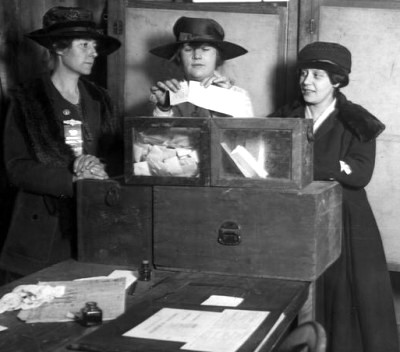
WHY EVERY WOMAN SHOULD VOTE
This is the story of our Grandmothers, and Great-grandmothers, as they
lived only 90 years ago. It was not until 1920 that women were granted
the right to go to the polls and vote.
Thus unfolded the ‘Night of Terror’ on Nov. 15, 1917, when the warden at
the Occoquan Workhouse in Virginia ordered his guards to teach a lesson
to the suffragists imprisoned there because they dared to picket Woodrow
Wilson’s White House for the right to vote. The women were innocent and
defenseless. And by the end of the night they were barely alive. Forty
prison guards wielding clubs and their warden’s blessing went on a
rampage against the 33 women wrongly convicted of ‘obstructing sidewalk
traffic.’
They beat Lucy Burn, chained her hands to the cell bars above her head
and left her hanging for the night, bleeding and gasping for air. They
hurled Dora Lewis into a dark cell, smashed her head against an iron bed
and knocked her out cold. Her cell mate, Alice Cosu, thought Lewis was
dead and suffered a heart attack. Additional affidavits describe the
guards grabbing, dragging, beating, choking, slamming, pinching,
twisting and kicking the women.
For weeks, the women’s only water came from an open pail. Their
food–all of it colorless slop–was infested with worms. When one of the
leaders, Alice Paul, embarked on a hunger strike, they tied her to a
chair, forced a tube down her throat and poured liquid into her until
she vomited. She was tortured like this for weeks until word was
smuggled out to the press.
So, refresh my memory. Some women won’t vote this year because–why,
exactly? We have carpool duties? We have to get to work? Our vote
doesn’t matter? It’s raining?
Last week, I went to a sparsely attended screening of HBO’s new movie
‘Iron Jawed Angels.’ It is a graphic depiction of the battle these women
waged so that I could pull the curtain at the polling booth and have my
say. I am ashamed to say I needed the reminder.
All these years later, voter registration is still my passion. But the
actual act of voting had become less personal for me, more rote.
Frankly, voting often felt more like an obligation than a privilege.
Sometimes it was inconvenient.
My friend Wendy, who is my age and studied women’s history, saw the HBO
movie , too. When she stopped by my desk to talk about it, she looked
angry. She was–with herself. ‘One thought kept coming back to me as I
watched that movie,’ she said. ‘What would those women think of the way
I use–or don’t use–my right to vote? All of us take it for granted
now, not just younger women, but those of us who did seek to learn.’ The
right to vote, she said, had become valuable to her ‘all over again.’
HBO released the movie on video and DVD. I wish all history, social
studies and government teachers would include the movie in their
curriculum. I want it shown on Bunco night, too, and anywhere else women
gather. I realize this isn’t our usual idea of socializing, but we are
not voting in the numbers that we should be, and I think a little shock
therapy is in order.
It is jarring to watch Woodrow Wilson and his cronies try to persuade a
psychiatrist to declare Alice Paul insane so that she could be
permanently institutionalized. And it is inspiring to watch the doctor
refuse. Alice Paul was strong, he said, and brave. That didn’t make her
crazy. The doctor admonished the men: ‘Courage in women is often
mistaken for insanity.’
Please, if you are so inclined, pass this on to all the women you know.
We need to get out and vote and use this right that was fought so hard
for by these very courageous women. Whether you vote democratic,
republican or independent party – remember to vote.
History is being made.
Wil Saudi Arabia Curb the Morals Police?
This is a tiny little article in the Qatar Gulf Times:
New curbs on Saudi moral police: reports
AFP/Riyadh
Saudi Arabia will curb the powers of its religious police, a newspaper report said yesterday.
“The new system will set a mechanism for the field work of the committee’s men which hands over some of their specialisations to other state bodies, such as arrests and interrogations,” Al Hayat daily quoted religious police chief Sheikh Abdullatiff Abdel Aziz al-Sheikh as saying.
Agents of the body known as the Commission for the Promotion of Virtue and Prevention of Vice will also be banned from carrying out “searches without prior approval from the governor”, he said.
Okaz daily also reported that the religious police agents will be prohibited from “standing at the entrances of shopping malls to prevent the entry of any person”, referring to attempts by agents to ban women who do not comply with the Islamic dress code and unmarried couples from entering malls.
Sheikh was appointed in January as the new chief of the religious police. Two weeks into his post, he banned volunteers from serving in the commission which enforces the kingdom’s Islamic rules.
In April he went further, prohibiting the religious police from “harassing people” and threatening “decisive measures against violators”.
In June, Sheikh came out strongly against one of his men who ordered a woman to leave a mall because she was wearing nail polish.
The woman had defied the orders as she filmed her argument with the policeman and posted it on YouTube.
Feast of Saint Michael and All the Angels
Underneath our daily readings in The Lectionary, there are readings for special days, feast days of the saints, written by James Kiefer. Today’s is very long and full of information, so I will only tempt you by printing the beginning, and you can read the entire article by clicking on the blue type here.

On the Feast of Michael and all Angels, popularly called Michaelmas, we give thanks for the many ways in which God’s loving care watches over us, both directly and indirectly, and we are reminded that the richness and variety of God’s creation far exceeds our knowledge of it.
The Holy Scriptures often speak of created intelligences other than humans who worship God in heaven and act as His messengers and agents on earth. We are not told much about them, and it is not clear how much of what we are told is figurative. Jesus speaks of them as rejoicing over penitent sinners (Lk 15:10). Elsewhere, in a statement that has been variously understood (Mt 18:10), He warns against misleading a child, because their angels behold the face of God. (Acts 12:15 may refer to a related idea.)
In the Hebrew Scriptures, it is occasionally reported that someone saw a man who spoke to him with authority, and who he then realized was no mere man, but a messenger of God. Thus we have a belief in super-human rational created beings, either resembling men in appearance or taking human appearance when they are to communicate with us. They are referred to as “messengers of God,” or simply as “messengers.” The word for a messenger in Hebrew is malach, in Greek, angelos, from which we get our word “angel” [Digression: angelion means “message, news” and euangelion means “good news = goodspell = gospel,” from which we get our word “evangelist” used to mean a preacher of the Good News of salvation, and, more narrowly, one of the four Gospel-writers: Matthew, Mark, Luke, and John.]
By the time of Christ, Jewish popular belief included many specifics about angels, with names for many of them. There were thought to be four archangels, named Michael, Gabriel, Raphael, and Uriel. An alternative tradition has seven archangels (see Tobit 12:15 and 1 Enoch 20). Sometimes each archangel is associated with one of the seven planets of the Ptolemaic system (the moon, Mercury, Venus, the Sun, Mars, Jupiter, Saturn). Michael is associated with Saturn and Uriel with the Sun. The other pairings I forget, but I believe that you will find a list in the long narrative poem called “The Golden Legend,” by Henry Wadsworth Longfellow. (I believe that a pairing is also offered in the opening chapters of the Proof of the Apostolic Preaching, by Irenaeus of Lyons, but I have not the work at hand.)
Michael (the name means “Who is like God?”) is said to be the captain of the heavenly armies. He is mentioned in the Scriptures in Daniel 10:13,31; 12:1 (where he is said to be the prince of the people of Israel); in Jude 9 (where he is said to have disputed with the devil about the body of Moses); and in Revelation 12:7 (where he is said to have led the heavenly armies against those of the great dragon). He is generally pictured in full armor, carrying a lance, and with his foot on the neck of a dragon. (Pictures of the Martyr George are often similar, but only Michael has wings.)
Gabriel (the name means “God is my champion”) is thought of as the special bearer of messages from God to men. He appears in Daniel 8:16; 9:21 as an explainer of some of Daniel’s visions. According to the first chapter of Luke, he announced the forthcoming births of John the Baptist and of our Lord to Zachariah and the Virgin Mary respectively.
Raphael (the name means “God heals”) is mentioned in the Apocrypha, in the book of Tobit, where, disguised as a man, he accompanies the young man Tobias on a quest, enables him to accomplish it, and gives him a remedy for the blindness of his aged father.
Uriel (the name means “God is my light” — compare with “Uriah”, which means “the LORD is my light”) is mentioned in 4 Esdras.
Teachers’ Expectations Evoke Life-Changing Achievement
Yes, this is a long article from National Public Radio, but it’s important. I want you to read it, and if you have the time, go to the website – you can click on the blue type above – and listen to it yourself, because it is life changing for us, and for how we treat our children, too.
Do it at a time when you have time to listen. It caught me by surprise, but I was so enthralled, I stayed for the entire segment. Children with the greatest challenges can succeed, if they are nurtured and mentored. Any child can be a success; there are no losers. This is powerful stuff. 🙂
by ALIX SPIEGEL
In my Morning Edition story today, I look at expectations — specifically, how teacher expectations can affect the performance of the children they teach.
The first psychologist to systematically study this was a Harvard professor named Robert Rosenthal, who in 1964 did a wonderful experiment at an elementary school south of San Francisco.
The idea was to figure out what would happen if teachers were told that certain kids in their class were destined to succeed, so Rosenthal took a normal IQ test and dressed it up as a different test.
“It was a standardized IQ test, Flanagan’s Test of General Ability,” he says. “But the cover we put on it, we had printed on every test booklet, said ‘Harvard Test of Inflected Acquisition.’ ”
Rosenthal told the teachers that this very special test from Harvard had the very special ability to predict which kids were about to be very special — that is, which kids were about to experience a dramatic growth in their IQ.
After the kids took the test, he then chose from every class several children totally at random. There was nothing at all to distinguish these kids from the other kids, but he told their teachers that the test predicted the kids were on the verge of an intense intellectual bloom.
As he followed the children over the next two years, Rosenthal discovered that the teachers’ expectations of these kids really did affect the students. “If teachers had been led to expect greater gains in IQ, then increasingly, those kids gained more IQ,” he says.
But just how do expectations influence IQ?
As Rosenthal did more research, he found that expectations affect teachers’ moment-to-moment interactions with the children they teach in a thousand almost invisible ways. Teachers give the students that they expect to succeed more time to answer questions, more specific feedback, and more approval: They consistently touch, nod and smile at those kids more.
“It’s not magic, it’s not mental telepathy,” Rosenthal says. “It’s very likely these thousands of different ways of treating people in small ways every day.”
So since expectations can change the performance of kids, how do we get teachers to have the right expectations? Is it possible to change bad expectations? That was the question that brought me to the Curry School of Education at the University of Virginia, where I met Robert Pianta.
Pianta, dean of the Curry School, has studied teachers for years, and one of the first things he told me when we sat down together was that it is truly hard for teachers to control their expectations.
“It’s really tough for anybody to police their own beliefs,” he said. “But think about being in a classroom with 25 kids. The demands on their thinking are so great.”
Still, people have tried. The traditional way, Pianta says, has been to sit teachers down and try to change their expectations through talking to them.
“For the most part, we’ve tried to convince them that the beliefs they have are wrong,” he says. “And we’ve done most of that convincing using information.”
But Pianta has a different idea of how to go about changing teachers’ expectations. He says it’s not effective to try to change their thoughts; the key is to train teachers in an entirely new set of behaviors.
For years, Pianta and his colleagues at the Curry School have been collecting videotapes of teachers teaching. By analyzing these videos in minute ways, they’ve developed a good idea of which teaching behaviors are most effective. They can also see, Pianta tells me, how teacher expectations affect both their behaviors and classroom dynamics.
Pianta gives one very specific example: the belief that boys are disruptive and need to be managed.
“Say I’m a teacher and I ask a question in class, and a boy jumps up, sort of vociferously … ‘I know the answer! I know the answer! I know the answer!’ ” Pianta says.
“If I believe boys are disruptive and my job is control the classroom, then I’m going to respond with, ‘Johnny! You’re out of line here! We need you to sit down right now.’ ”
This, Pianta says, will likely make the boy frustrated and emotionally disengaged. He will then be likely to escalate his behavior, which will simply confirm the teacher’s beliefs about him, and the teacher and kid are stuck in an unproductive loop.
But if the teacher doesn’t carry those beliefs into the classroom, then the teacher is unlikely to see that behavior as threatening.
Instead it’s: ” ‘Johnny, tell me more about what you think is going on … But also, I want you to sit down quietly now as you tell that to me,’ ” Pianta says.
“Those two responses,” he says, “are dictated almost entirely by two different interpretations of the same behavior that are driven by two different sets of beliefs.”
To see if teachers’ beliefs would be changed by giving them a new set of teaching behaviors, Pianta and his colleagues recently did a study.
They took a group of teachers, assessed their beliefs about children, then gave a portion of them a standard pedagogy course, which included information about appropriate beliefs and expectations. Another portion got intense behavioral training, which taught them a whole new set of skills based on those appropriate beliefs and expectations.
For this training, the teachers videotaped their classes over a period of months and worked with personal coaches who watched those videos, then gave them recommendations about different behaviors to try.
After that intensive training, Pianta and his colleagues analyzed the beliefs of the teachers again. What he found was that the beliefs of the trained teachers had shifted way more than the beliefs of teachers given a standard informational course.
This is why Pianta thinks that to change beliefs, the best thing to do is change behaviors.
“It’s far more powerful to work from the outside in than the inside out if you want to change expectations,” he says.
In other words, if you want to change a mind, simply talking to it might not be enough.
7 Ways Teachers Can Change Their Expectations
Researcher Robert Pianta offered these suggestions for teachers who want to change their behavior toward problem students:
Watch how each student interacts. How do they prefer to engage? What do they seem to like to do? Observe so you can understand all they are capable of.
Listen. Try to understand what motivates them, what their goals are and how they view you, their classmates and the activities you assign them.
Engage. Talk with students about their individual interests. Don’t offer advice or opinions – just listen.
Experiment: Change how you react to challenging behaviors. Rather than responding quickly in the moment, take a breath. Realize that their behavior might just be a way of reaching out to you.
Meet: Each week, spend time with students outside of your role as “teacher.” Let the students choose a game or other nonacademic activity they’d like to do with you. Your job is to NOT teach but watch, listen and narrate what you see, focusing on students’ interests and what they do well. This type of activity is really important for students with whom you often feel in conflict or who you avoid.
Reach out: Know what your students like to do outside of school. Make it a project for them to tell you about it using some medium in which they feel comfortable: music, video, writing, etc. Find both individual and group time for them to share this with you. Watch and listen to how skilled, motivated and interested they can be. Now think about school through their eyes.
Reflect: Think back on your own best and worst teachers, bosses or supervisors. List five words for each that describe how you felt in your interactions with them. How did the best and the worst make you feel? What specifically did they do or say that made you feel that way? Now think about how your students would describe you. Jot down how they might describe you and why. How do your expectations or beliefs shape how they look at you? Are there parallels in your beliefs and their responses to you?
Recent Comments
ExpatAlien on What Country am I Living … intlxpatr on Yellowstone: Old Faithful to C… Michelle on Yellowstone: Old Faithful to C… Cathy on No Grown-Ups in Charge intlxpatr on Waiting for Snow Wikipedia Donate Button

Amazina


Early Voting in Florida


 Here There and Everywhere