Local Man Acquitted of Abusing American Woman
Man cleared of abusing expat woman
By Nour Abuzant
From The Gulf Times Court RoundUp
A Doha court acquitted a man, for lack of evidence, of the charge of abusing an American woman on July 15, 2008.
According to the chargesheet, the 36-year-old accused entered the woman’s bedroom at night and “fondled” her while she was sleeping next to her husband.
The woman, 34, told interrogators that the accused local was a family friend and he had unsuccessfully tried to start a relationship with her.
The judges were told that the husband confronted the intruder, “who injured himself while fleeing the scene.”
The Nepali security guard at the compound where the alleged incident took place said that he saw a man trying to enter the compound and he tried to prevent him from entering the building.
However, the guard failed to identify the man at a police parade stating “it was too dark to recognise anybody.”
The defendant’s lawyer said his client had tried to call the woman on July 14 as he was a close friend of the family.
Explaining the “non guilty” verdict, the court of first instance said neither the American couple nor the security guard could recognise, beyond any reasonable doubt, the intruder. “Also no fingerprints were taken from the scene.”
The court said that the circumstantial evidence was insufficient to convict the accused.
‘Glimmer of Hope’ in Doha Abduction Case
‘Glimmer of hope’ in custody battle
From the Qatar Gulf Times
British mother Rebecca Jones has described the decision by a Qatari judge to bring her son to court as a “glimmer of hope” in her ongoing battle to regain custody of Adam, saying that the judge’s decision that the boy’s attendance is necessary feels like her first victory in the case.
“I’m thrilled that Adam will be given the opportunity to tell the court how he wants to come home to his Mummy, Daddy and little sister, and that the court will have the chance to see how he is suffering,” she told Gulf Times yesterday.
Jones, who claimed that her son was kidnapped when she was “tricked” into visiting the country in October last year, is particularly worried about the mental and physical state of her son, saying that he had been ill in recent weeks because of the stress surrounding the current situation.
However, the most recent ruling in the case has given her some hope that she may be reunited with him on a permanent basis in the not too distant future.
Earlier this week a judge ruled that Jones’ appeal will be held on February 11, and that both Adam and his 77-year-old grandmother who was originally awarded custody of him, should attend the court hearing.
Jones is also fighting a court case to increase her visitation rights with her son, something that will be decided on February 3.
She is hoping to be awarded more time with Adam, as well as the ability to spend time with him outside of the house in which he is currently living.
“He seems to be ill because of stress and has been physically sick recently,” she claimed, adding “he is very upset and very nervous on each visit – the second I walk through the door he asks me when he can come home.”
Another major concern for Jones is the educational aspect of her son’s life as it will shortly be the fifth month that he has gone without attending school.
But for now, Jones is just looking forward to the court hearing in which her son will finally be given a voice. “I truly believe that the court will do the right thing,” she added.
Qatar Traffic Department says NO New Traffic Fines
Traffic fine rumours squashed
Web posted at: 1/12/2010 5:13:28
Source ::: The Peninsula / BY MOHAMMED IQBAL
BY MOHAMMED IQBAL
DOHA: As rumours continue to circulate about a steep hike in traffic fines, a senior official of the Traffic Department has clarified that such reports are totally baseless and there is no change in the traffic law.
Over the past month, e-mail messages have been circulating about a new “traffic violations law” with a detailed list of new fines for different violations. Though the messages appear to be a fraud at the very first look, they have been widely circulated, causing confusion among the public.
“The Traffic Department is dealing with all violations as per the current traffic law, without any change or amendment,” said Brigadier Mohammed Saad Al Kharji, Director of the Traffic Department, while denying the reports spreading through mobile phones and the Internet.
The email message about the “New traffic violations law — October 2009” gives a comparative list of the “new” and “existing” fines. Anyone who is aware of the current law would immediately realise that the message is fake, since many of the existing fines mentioned in it are incorrect.
For instance, it says that the “fine for using a mobile phone while driving” has been raised from QR3,000 to QR10,000, whereas the existing fine for this violation is QR500. Similar is the case with most of the other violations.
Only a naïve person would believe this message when it says that the fines for most violations have been raised from QR10,000 to an incredible QR50,000.
Despite all this, the message has been circulating fast as people forward it to others without thinking much about the content. The Peninsula has received a number of calls from people seeking a clarification on this matter.
A resident said he had seen the same message displayed prominently at a work site in the Industrial Area a few weeks ago.
An expert from the Traffic Department told The Peninsula yesterday that he had been receiving a number of queries from people about the issue.
“It is surprising that people go by such rumours. Anyone would know that if there is a major change in the traffic law it would be announced through the media by senior officials,” he added.
It has been pointed out that many residents don’t have easy access to authentic information about the traffic law since an official English version of the law is still not available.
3 Months for Killing, One Year for Stealing
These articles are in today’s Gulf Times, under Court Roundup.
Jail term, fine for death crash
A local motorist has been sentenced to three-month’s imprisonment for reckless driving that led to the death of a 56-year-Pakistani pedestrian.
The Doha court of first instance imposed on the 26-year-old motorist a fine of QR20,000.
The fatal accident took place in the Old Airport area on September 27, 2008. According to the traffic report, “the accident occurred because the motorist was speeding.”
A traffic official told the court that the motorist was driving at 80kmph on a busy street.
Family members of the deceased can claim blood money in a civil court.
Man sentenced for stealing
A Sri Lankan driver has been sentenced to a year-imprisonment for stealing items including two gas cylinders and a vacuum cleaner from the labour camp of a private company. Four of the co-accused were sentenced in absentia to five years in jail.
The theft took place on July 21, 2008 in New Rayan area, the charge-sheet said.
Two Egyptians, who witnessed the incident, testified that they saw five men loading the items, estimated to cost QR4,000, on to a pickup from a store inside the camp.
The Egyptians said they captured three of the workers while the others drove away in the pick-up.
The police arrested all the accused and four of them were deported on an administrative order before the commencement of the trial.
Community Police Graduate
Community policing is necessary when we neglect to police ourselves. . . if, for example, we find ourselves throwing a tissue out of our car window as we drive along, littering the pristine streets of Doha. If we bully someone because we want that parking spot he is driving into, if we disrupt the peace and quality of life of others by our behavior.
I notice, in this story from the Gulf Times, that women are a part of this program, and that they are wearing uniforms, and hijab, and that those uniforms are very modest and also that they are wearing pants. Please see the previous article.
I commend Qatar for this visionary program, helping the community police itself, and for including women from the very first class.
46 take part in community policing basic course
Graduates with officials at the convocation ceremony

The Police Training Institute (PTI) recently held a ceremony to mark the graduation of participants in the first batch of the Community Policing Basic Course, under the auspices of Minister of State for Interior Affairs HE Sheikh Abdullah bin Nasser bin Khalifa al-Thani.
Some 46 students from various security departments took part in the course, which lasted seven weeks, said a spokesperson.
The ceremony was attended by the chairman on the Central Municipal Council, HE Nasser al-Kaabi; director of the PTI, Brigadier Mohamed Hassan Youssef al-Saei as well as other ministry officials.
Brigadier al-Saei explained that the course has been conducted to “enhance the role and mechanisms of community policing,” as well as helping to create partnerships with various social institutions to help with national security.
The PTI director added that the graduates of this course will be able to translate the Ministry of Interior’s aims and strategies to encourage understanding between various communities and to help the police to be able to prevent crimes before they are committed.
Brigadier Rashid Shaheen al-Atheeque, chairman of the steering committee of community policing, said: “The graduation of the first course of community policing is one of the stages of qualifying the national cadres at the Ministry of Interior to work in the national project.”
“Qatar is currently witnessing progress in all aspects of development in economic and social fields – this increases the role of all sectors in the country to face all kinds of challenges brought with this development,” he said, adding: “These factors require the improvement of capabilities to keep pace with development.”
Brigadier al-Atheeq explained that the ministry had pursued the initiative of community policing to help reduce crime throughout all institutions, and said that they had pursued the objective with the co-operation of the Supreme Council for Family Affairs as well as other ministries and companies, working towards the National Vision 2030.
He explained that the concept will initially be employed in the North Security Department from April 2010, with plans to apply it across the board from 2011.
Representing the director of the Ummul Qura Independent School for Boys, teacher Areezah al-Yami described the noticeable benefits of introducing the community policing programme in the school over the past year.
New Qatar Traffic Violations and Fines
Update: LLOOLL, I went to QatarLiving.com and discovered that these “new” laws came out in 2007. These are great laws, deterrents to bad driving and aggressive driving, but the laws mean nothing without enforcement. Do I still see many many children sitting in the front seat? Are people driving while talking on their mobile phones? And not a word about one of the worst offenses these days – texting.
A recent study showed texting is even more dangerous while driving than talking on a mobile phone:
The crash risk attributable to texting is substantial. One possible explanation is that drivers who text tend to decrease their minimum following distance and also experience delayed reaction time. For example, in the Drews et al. study, drivers’ median reaction time increased by 30% when they were texting and 9% when they talked on the phone, compared with their performance in a driving-only condition.
Notwithstanding the safety risk of texting while driving, previous research by Drews and colleagues at the University of Utah — not to mention crash data and widespread legislation — makes clear that using a phone while driving is dangerous.
(To check my source, just click on the blue type, above)
We were talking about people who were saying “Qatar is the most dangerous place to drive in the world” and wondering where this is coming from? Most of us have driven in more dangerous places, but this is the new quote floating around, with no foundation, no statistics, no studies, at least not any I can find with a simple Google.
The topic of new laws came up next over Christmas dinner. New laws? New fines?
“I never saw a word about this in the paper,” I said, peevishly.
“Oh, didn’t I tell you?” said AdventureMan.
People who have been married a long time will understand the urge to kill . . .
Someone else jumped in,
“I think the different companies are passing it around. The Education Foundation has it. Some of the universities have it. That’s the way it is in Qatar, news of new laws filters out.”
LLLOOOLLL. News of new laws “filters out?”
I found it online HERE, at Team BPH and it looks exactly like the copy AdventureMan brought home yesterday, but there is no attribution. Who put this out? There is no kind of official marking on it at all.
IF ENFORCED, these laws would have a serious effect on Qatar traffic.
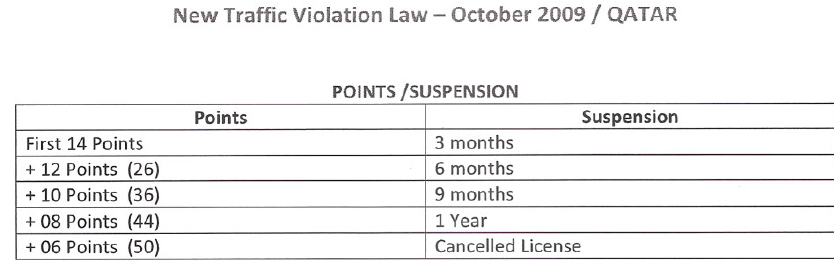

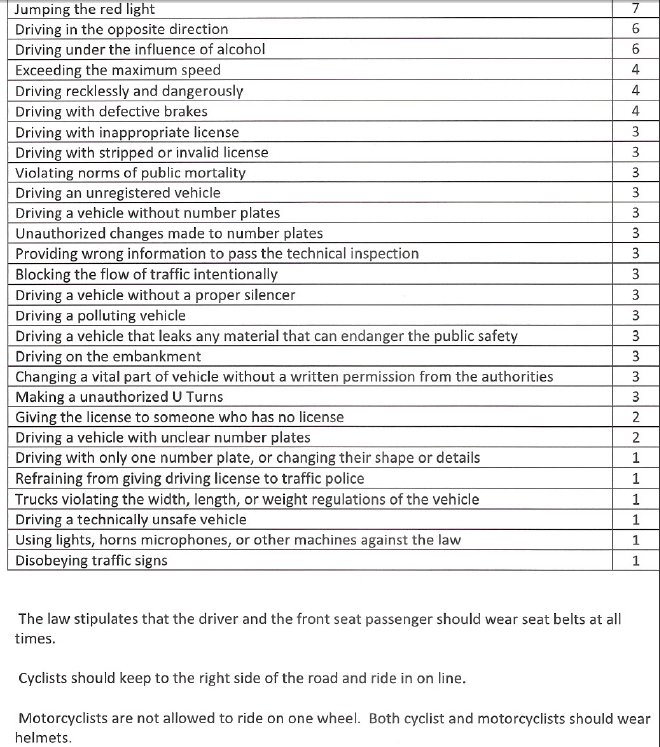
In theory, these went into effect in November 2009, just last month. Who issued these? Has there been any coverage in the newspapers? TV? How can people be held accountable for violating laws of which they are not aware? Or is this something one of the companies printed up, anticipating new laws?
Three Market Trends for 2010
From The Peninsula Business Section
Three market trends to watch for in ’10
Web posted at: 12/27/2009 11:51:49
Source ::: LAT-WP
Washington: In case you missed it, Treasury Secretary Timothy F Geithner this week promised America that there won’t be another financial crisis in 2010.
“We’re not going to have a second wave of financial crisis,” Geithner said in an interview with National Public Radio. “We’ll do what is necessary to prevent that. We cannot afford to let the country live again with a risk that we’re going to have another series of events like we had last year.”
Well, there it is. And you wonder why the stock market is at 14-month highs? Anyone who has deep-seated doubts about the financial system’s health may view Geithner’s explicit guarantee as a sign of dangerous government hubris, or simple naivete.
But his promise does address what is for some investors the pre-eminent question about 2010: Can the world avoid another calamity on the scale of what fueled the markets’ meltdown from September 2008 to March 2009?
To put it another way: Your financial planning for the new year would be a lot easier if you knew that the chance of another collapse was remote even if markets were likely to be volatile.
The strongest evidence against a second collapse is that the credit crisis has eased dramatically. That may not be evident in banks’ lending. But by many key barometers, including new issuance of corporate bonds and the rates banks charge each other for short-term loans, credit has begun to flow again worldwide.
If we assume that Geithner is right about the absence of another mega-crisis in 2010, I think there are three important financial trends that either got under way or accelerated in 2009 that also will be critical for investors and savers in the new year:
The Great Deleveraging rolls on. Many Americans piled on excessive debts in the 1980s, 1990s and first half of this decade. On that much, everyone agrees. Now, that total household debt load of $14 trillion is being worked down — voluntarily, as people pay off credit cards, for example, or involuntarily, as banks force foreclosures. Consumer credit excluding mortgages fell for a ninth straight month in October, a record stretch of declines, according to Federal Reserve data.
But debt reduction has a “long, long way to go,” says Ian Shepherdson, chief US economist at High Frequency Economics in Valhalla, New York. The question is whether it can proceed without tipping the economy back into recession.
One ticking time bomb: a jump in 2010 in the number of homeowners with so-called option ARM loans who will see their loan rates reset at higher levels.
An obvious implication of consumers’ need to reduce debt is that people will save more and consume less than before. That will be a continuing drag on the economic recovery. I know we’ve all heard that a million times, but that doesn’t make it less true.
The upshot: no imminent rate relief for savers who now are lucky to earn 1 percent or 2 percent on their cash.
Corporate earnings keep improving. Expectations of a profit recovery helped stoke the stock market’s turnaround in March. Wall Street has been pleasantly surprised since then.
Starting with the current quarter, earnings are forecast to begin rising, albeit from extremely depressed year-earlier levels.
Sales have edged up for many companies this year as the global economy has begun to rebound. But a big part of the profit-recovery story has stemmed from companies’ slashing of their payrolls, driving the US unemployment rate above 10 percent for the first time since 1982.
Many investors keep looking for a middle ground on risk-taking. That means cash probably will keep pouring into bonds — at least until some people discover, to their surprise, that it’s possible to lose money in fixed-income securities, too.
Small investors usually are prone to chasing hot stock markets. Not this year. Even as the US stock market has continued to rally Americans have shunned domestic stock mutual funds. Each week since late August more cash has been pulled from them than has flowed in via new purchases, according to the Investment Company Institute’s data.
Mixed Forecast
Interesting article from today’s Peninsula Business Section on rising mortgage trends in the United States. The views are so mixed; is the economy recovering? Are there going to be buyers for all those houses on the market? Will they find a way to forestall the next round of foreclosures as ARMs come due and new rates kick in?
US mortgages on upward trend
Web posted at: 12/27/2009 11:52:57
Source ::: LAT-WP
WASHINGTON: After hitting an all-time low in early December, the average rate on a 30-year, fixed-rate mortgage rose to 5.05 percent this week and could climb to 6 percent by the end of 2010, if not sooner, according to giant mortgage financier Freddie Mac.
The results are noteworthy because rates have not topped 5 percent since the last week of October, when they reached 5.03 percent, based on the results of this closely watched survey, which polls lenders during the first three days of every week.
Many firms regularly track interest rates and come up with slightly different numbers because they survey different lenders at different times of the day or week. But several have reported the upward trend in recent weeks. They attribute it in part to the effects of the holiday season, when demand for buying and refinancing homes dies down and financial markets coast through the end of the year.
“However, this is also a glimpse of what we’re going to see in 2010,” said Greg McBride, a senior financial analyst at Bankrate.com, a personal finance Web site.
The key catalyst for interest rates going forward will be the end of a Federal Reserve program that buys a sizable chunk of mortgage-backed securities issued by firms such as Fannie Mae and Freddie Mac. That program succeeded in immediately pushing mortgage rates well below the 6 percent mark when it was announced last year.
But the Fed has committed to winding down the program by March. The central bank is betting that by gradually tapering its purchases, private buyers of mortgage-backed securities, who have largely been absent from the market, will return and rates won’t rise much.
But Amy Crews Cutts, deputy chief economist at Freddie Mac, said interest rates are bound to rise to six percent by the end of 2010 because private buyers will demand a higher rate of return on the securities than the Fed did. Lenders may have to raise the rates they charge to consumers in order to make that happen.
“Extraordinary resources have been put into keeping the rates down and supporting the mortgage markets and it’s hard to imagine that the rates can go much lower than they are,” Crews Cutts said. “Anything we get at or below five percent is a gift at this point.”
This week’s Freddie Mac survey found that the 5.05 percent average on 30-year fixed-rate loans (with an average 0.7 point) was up from 4.94 percent the previous week but down from 5.14 percent at the same time last year. The all-time weekly low since the firm started tracking the numbers in 1971 was in the first week of December, when rates fell to 4.71 percent.
Many borrowers have not been able to secure the best rates because they lack the stellar credit scores and hefty down payments that many lenders now demand. Some who have tried to refinance have not been able to qualify because their home prices have plummeted to the point where they now owe more on their mortgages than their homes are worth.
But anyone who can secure a loan should not wait much longer, especially if they are looking to refinance, McBride said. Homeowners are more sensitive to interest rates when they refinance than when they buy a home. “The difference between 5 percent and 5.5 percent could mean the difference between refinancing or not,” he said.
But the interest rate is less critical to people who want to buy a home, McBride said. In that case, price and affordability should trump interest rates.
Recent Comments
intlxpatr on Shampoo Ginger tigerbutterya0c5ff1d… on Shampoo Ginger intlxpatr on British Soldier Kidnapped, Esc… John on British Soldier Kidnapped, Esc… intlxpatr on British Soldier Kidnapped, Esc… Wikipedia Donate Button

Amazina


Early Voting in Florida


