Prison Security Inspectors Attacked by Somali Women
I don’t know why this makes me laugh, but it does. Like if you are visiting a prison, don’t you just take it for granted that your bags, your person may be inspected? Why would you object – unless you are trying to smuggle something in to the person you are visiting? And can’t you figure out that if you ATTACK a security person, you are likely to get arrested? I don’t know why, I guess that life throws you curves and this is a situation that jumped from zero to 100 on the intensity scale in a very short time. You have to wonder – well, I have to wonder – what the participants were thinking?
Staff Writer
Al Watan
Kuwait: Security authorities in the Central Prison arrested two Somali women after they assaulted four female Kuwaiti inspectors and refused to submit to search while they were passing through Gate B in the prison.
The incident started when one of the female inspectors asked the two Somali women to submit to search procedures. However, the two women refused and attacked the inspector. Although the other female inspectors tried to save their colleague, they were also assaulted by the two Somali women. The prison authorities interfered and arrested the two women. The injured inspectors were taken to hospital to receive medical services, in addition to issuing a medical report that described their injuries.
William Dalrymple: The Age of Kali
Having read and loved In Xanadu: A Quest by William Dalrymple, and having received recommendations by friends who say they read ALL of William Dalrymple, I started on this second book, The Age of Kali. I didn’t like it, not one bit. I am proud to say I read it all the way to the end, because often if I don’t like a book, I will say to myself “I don’t need this!” and toss it, but I didn’t, I stuck with it. I am proud because it isn’t easy to stick with a book you don’t like, and I didn’t like this book.

In Xanadu, Dalrymple was wryly funny, hilariously funny, and most of the humor was directed at himself. In The Age of Kali, there is nothing funny.
The Age of Kali is a series of interviews and adventures in India and Pakistan. The author did these interviews and took notes (some are published in slightly different forms as magazine articles) over a period of ten years and then strung them all together to form this book. There is little or no linkage from one to the other. They are grouped geographically.
Here is what I like and admire – this man achieves the most amazing interviews, many times just by asking the right person at the right time. He insinuates himself, asks easy questions, and then sticks in a hard question. He doesn’t seem to flinch from putting himself in danger, and he doesn’t stand on respect when asking his questions. I admire that he went difficult places, interviewed difficult people, and wrote the interviews up without fawning over the celebrity status of his interviewee.
What I don’t like is that he doesn’t seem to like anybody very much. There are no funny anecdotes. By the end of the first interview, I began to get an impression that he doesn’t like India very much (and I believe that is NOT true, as he lives part-time in Delhi) and that India is not a place I want to visit. He interviews corrupt politicians, descendants of the moghuls, Benazir Bhutto – and her mother, Imran Khan (the cricket player) and many others. In each and every interview, he maintains a distance that tells us he doesn’t like these characters very much.
Here are some quotes from early in the book:
These days Bihar was much more famous for its violence, corruption and endemic caste-warfare. Indeed, things were now so bad that the criminals and the politicians of the state were said to be virtually interchangeable: no fewer than thirty-three of Bihar’s State Assembly MLAs had criminal records, and a figure like Dular Chand Yadav, who had a hundred cases of dacoity and fifty murder cases pending against him, could also be addressed as the Honorable Member for Barth.
As he interviews Bihar politician Laloo Prasad Yadav:
I asked Laloo about his childhood. He proved only too willing to talk about it. He lolled back against the side of the plane, his legs stretched over two seats.
‘My father was a small farmer,’ he began, scratching his balls with the unembarrassed thoroughness of a true yokel.
OK, that was funny. I had to read it aloud to AdventureMan. One of the things that still unnerves me living here is that the men are always touching themselves – something so totally forbidden in my culture as to be simply unthinkable.
In his section about Pakistan:
These people – the Pathans – have never been conquered, at least not since the time of Alexander the Great. They have seen off centuries of invaders – Persians, Arabs, Turks, Moghuls, Sikhs, British, Russians – and they retain the mixture of arrogance and suspicion that this history has produced in their character. History has also left them with a curious political status. Although most Pathans are technically within Pakistan, the writ of Pakistan law does not carry in to the heartland of their territories.
These segregated areas are in effect private tribal states, out of the control of the Pakistan government. They are an inheritance from the days of the Raj: the British were quite happy to let the Pathans act as a buffer zone on the edge of the Empire, and they did not try to extend their authority in to the hills. Where the British led, the modern Pakistani authorities have followed. Beyond the checkpoints on the edge of the Peshawar, tribal law – based on the institutions of the tribal council and the blood feud – rules unchallenged and unchanged since its origins long before the birth of Christ.
When I read this, I think of recent headlines about the problems Pakistan is having maintaining order, fighting the status of “failed-nation”, and the chaotic administration of tribal “justice.” The old ways have endured – but as we learned in Three Cups of Tea, there are villages where villagers are eager to have modern schools, eager to educate their daughters, and they, too, are victims of the fanatics who burn the schools and throw acid on women attending school.
The author is told, time and time again by Indian citizens, that India has entered The Age of Kali, “the lowest possible throw, an epoch of strife, corruption, darkness and disintegration.” The book reflects the darkness, corruption and disintegration the author found. I only wish there were some moments of relief, of lightness, hope or humor to encourage the reader on his/her way, but the documentation of this lowest throw was relentless.
Kuwait imposes fee on public toilets?
LOL – there are public toilets in Kuwait? Where? Women always memorize which buildings have public restrooms, but aren’t those owned by the buildings? And holy smokes, what do we do if we don’t have small change left after all our shopping??? Men are more . . . umm. . . err. . . flexible, but women need privacy, i.e. restrooms!
TRAIN your cleaners! Give them proper supplies! Hold their supervisors responsible for their inspection and maintenance of standards! This is called ACCOUNTABILITY.
Charging for use of public restrooms will impose, at the very least, inconvenience for women, and most likely, embarrassment for those who don’t have the money, at the very worst times, like when you have seven children with you and three of them need to use the toilets. Charging fees for usage? Bad idea.
Municipality to impose fees on public toilets
Staff Writer From this morning’s Al Watan
KUWAIT: Kuwait is seriously mulling over the notion of imposing nominal fees for using public toilets.
Mohammad AlـAmri, the Convener of the Cleansing Committee at Kuwait Municipality, stated that the fee is aimed at providing better sanitary services along the lines that are implemented in certain neighboring countries. The official also noted that the current cleaning contracts are scheduled to expire in November 2010.
In a related development, the outgoing Minister of State for Municipal Affairs and Minister of Public Works Dr Fadhil Safar disclosed that Kuwait Municipality is currently working on a proposal to implement a new mechanism in keeping track with the performance of cleaning companies to ensure that the garbage is disposed off at the assigned dumpsites. He added that the system has been already implemented in the Kuwait City Governorate and is expected to be applied in all other governorates soon.
Last updated on Thursday 26/3/2009
A Modern Parable
Thank you, Anita!
A MODERN PARABLE . .
A Japanese company ( Toyota ) and an American company (Ford) decided to have a canoe race on the Missouri River. Both teams practiced long and hard to reach their peak performance before the race.
On the big day, the Japanese won by a mile.
The Americans, very discouraged and depressed, decided to investigate the reason for the crushing defeat. A management team made up of senior management was formed to investigate and recommend appropriate action.
Their conclusion was the Japanese had 8 people rowing and 1 person steering, while the American team had 8 people steering and 1 person rowing.
Feeling a deeper study was in order, American management hired a consulting company and paid them a large amount of money for a second opinion.
They advised, of course, that too many people were steering the boat, while not enough people were rowing.
Not sure of how to utilize that information, but wanting to prevent another loss to the Japanese, the rowing team’s management structure was totally reorganized to 4 steering supervisors, 3 area steering superintendents, and 1 assistant superintendent steering manager.
They also implemented a new performance system that would give the 1 person rowing the boat greater incentive to work harder. It was called the ‘Rowing Team Quality First Program,’ with meetings, dinners, and free pens for the rower There was discussion of getting new paddles, canoes, and other equipment, extra vacation days for practices and bonuses.
The next year the Japanese won by two miles.
Humiliated, the American management laid off the rower for poor performance, halted development of a new canoe, sold the paddles, and cancelled all capital investments for new equipment. The money saved was distributed to the Senior Executives as bonuses and the next year’s racing team was out-sourced to India.
Sadly, The End.
Here’s something else to think about:
Ford has spent the last thirty years moving all its factories out of the US, claiming they can’t make money paying American wages.
TOYOTA has spent the last thirty years building more than a dozen plants inside the US. The last quarter’s results:
TOYOTA makes 4 billion in profits while Ford racked up 9 billion in losses.
Ford folks are still scratching their heads.
Closed Circuit TV in all Kuwait Schools
From today’s Al Watan:
CCTV cameras to be in place next school year
Staff Writer
KUWAIT: Former Minister of Education and Minister of Higher Education Dr. Nouriya AlـSubaih has confirmed that the ministry is finalizing the installation of CCTV cameras on school campuses and is expected to be fully and completely implemented by the beginning of the next school year.
AlـSubaih”s statement came during a press conference organized by the Teachers Society for its 38th Educational Conference, which was held under the title ”Excellent Training, Future in the Making”.
The minister stressed that all steps are being taken to provide students with a proper and adequate education and that their safety and security are equally prioritized.
She made reference to the recent abuse incidents in local schools and pointed out that contrary to popular belief, school incidents have taken place in the past with the only difference being that they were never reported to police and the press “because they were dealt with and tackled by the school management then.”
She recalled how when she was herself a teacher school problems were dealt with privately and discretely due to the sensitive nature of the problems.
AlـSubaih further pointed out that acquiring the correct specifications and right CCTV cameras to do the job adequately and comprehensively “requires careful consideration to check the right models types, otherwise we would have gone to the local market,” adding that there were some models which the ministry had acquired but due to poor quality was later decided to be dropped.
For his part, Teachers Union Director Ayed AlـSahli said that teachers play an essential role in education and upbringing and that “the idea of training fits perfectly with the requirements of this noble profession to ensure that teachers make the children they teach more useful and productive.
“There is a need for training while teaching and great consideration is being put into the latest training programs with an eye to the future, so that teachers” skills and abilities are enhanced adequately,” he remarked.
Last updated on Tuesday 24/3/2009
Don’t Call, Text, or Sign on to Internet . . .
until you arrive”

From today’s Kuwait Times
‘Avoid cell talk, SMS, life you save maybe your own’
KUWAIT, March 15, (KUNA): Ninety percent of road accidents are coupled with lack of attention while driving, Assistant Undersecretary for Traffic Affairs at the Ministry of Interior Major General Mahmoud Al-Dousari said Sunday.
His remarks came on the occasion of hoisting flags of Gulf Cooperation Council (GCC) countries, announcing the commencement of the unified GCC traffic week; themed “Don’t Call Until You Arrive”. The ceremony was attended by traffic directors and their deputies of all six governorates, as well as a host of senior officials in Kuwait and the Gulf. This year’s theme aim at conveying an awareness message, cautioning from the use of mobile phones while driving, and depending on other means such as hands’ free and Bluetooth in order to stay focused on road and steer clear of accidents, Al-Dousari noted, pointing out that more studies had proven the theory suggesting the association of lack of attention with using mobile phones while driving.
The issue was not limited to speaking on phone, it went beyond that to include text messaging, or even logging on to the Internet while driving; which would turn them into major distracters, Al-Dousari said, adding that consequences of such behavior would eventually lead to tragic endings.
Al-Dousari advised that the best way to remain focused on road was to divert all incoming calls to voice mail, as well as receiving and sending SMS messages after pulling off the road. Some 18,773 violations were registered since the law that prohibited the use of mobile phones while driving was implemented last year, he noted.
“The Traffic Week aims to raise awareness, as it includes a host of various educational programs. It is not a week of firmness, stake out and issuing tickets like some might think,” Al-Dousari said, pointing out that injuries resulting from accidents had significantly decreased in the past two years. There are strict orders to deport any expatriate who commits serious traffic violations such as reckless driving, driving on the wrong side of the road, speeding, violating the red signal and assaulting security men, Al-Dousari concluded.

General al-Dousari, how many expatriates have you exported for serious traffic violations?
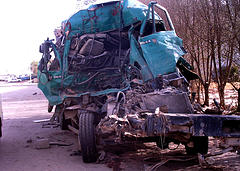
If you want to see fewer people on mobile phones, texting, signing on the the internet, running red lights, weaving while overspeeding, and assaulting security men, enforce your laws, enforce them all the time, and enforce them equally against every offender. If you enforce your laws, equally, against all offenders, traffic violations will decrease, traffic deaths will decrease, and all our lives, and those of our children, will be much safer.
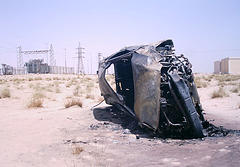
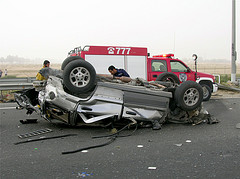
These photos are from a Flikr search for car wreck/Kuwait and, unfortunately, it is just a random selection among many. many. many.
Painful Sight
Everytime I go to Fehaheel – not all that often, but maybe two times a month – I see water overflowing from two manholes. Sometimes, it is a LOT of water. It makes a terrible hazard along Gulf Road, where traffic is chaotic at best, and worse – in a dry and thirsty land, it is a terrible thing to waste water.

Sometimes the water stinks like sewage. It makes me wonder where this water is coming from? It also makes me nervous because if it is sewage water, it comes up, it dries on the ground, a wind comes along and blows it on to my salad as I sit outside with AdventureMan having lunch – and I haven’t a clue what I have just ingested. Not good!
This isn’t something that happens rarely. It happens often, often enough that I think it is every time I am in Fehaheel. This isn’t just bad for the environment, it is also very bad for our health. Whatever is going wrong here needs a permanent fix.
Requiring New Contracts
This is from today’s Al Watan, and is pertinent to the labor issues we have been discussing on Here, There and Everywhere. Bad surprises happen from top to bottom.
This applies to everyone – the contract you think you are signing when you come to Kuwait may not be what really happens. It depends a lot on the company, on how you are recruited, etc. For example, if you are recruited by a US company doing business with the government here, things are fairly straight-forward. Read your contract carefully before you sign. If you are recruited by one of the manpower agencies – be very very very careful.
Expat workers protest job contract fraud
Ricky Laxa
Staff Writer
KUWAIT: Embassies in Kuwait have been receiving many complaints from expatriate workers of being forced by employers to sign new job contracts with salaries that are far lesser than what they had initially agreed upon back in their countries before arriving in Kuwait. A number of Filipino workers, who recently arrived in Kuwait, have resorted to the Philippines Overseas Labor Office to file complaints against the agency that was responsible for their employment in Kuwait.
In an exclusive interview with Al Watan Daily on Thursday the complainants provided copies of contracts and other documents, which have been signed by the employer and the employees in the Philippines, in addition to another set of contracts, which indicate that their salaries have been reduced by more than half with totally different job descriptions.
A complainant said she has been asked to settle the amount of 40,000 Philippine pesos (335 Kuwaiti dinars) as placement fees. This amount does not include other expenses like medical checkـup, health insurance and other expenses. She added that most of the fees have been overpriced on receipts that are handwritten on ordinary sheets of paper “The receipts issued are not official ones as required by the Philippines” government, and the concerned authorities have ignored their malpractices,” she said. An embassy official indicated that most of these placement agencies are registered under Filipino representatives, who are usually the owners” wives, girlfriends or Filipino nationals who had previously worked in Kuwait and these are the people who make the manipulation of contracts an easy task.
Al Watan Daily managed to acquire some original copies of the contracts, which have been signed by the employers and the employees. In one of the job contracts, a salary of KD 200 has been signed by both parties with the job description cited as ”Receptionist” and in another contract bearing the same name the salary has been slashed to KD 100 with the job description cited as “Cashier.”
“Two hours prior to our departure, we were asked to sign letters of undertaking stating that we have agreed to the alterations on the contracts. We refused to sign the new contract s yet for some of us, we had no choice but to agree to the amount,” added another complainant.
Al Watan Daily spoke to the agency”s representative who was asked by the Philippines labor official to meet the complainants and resolve the cases. The representative initially denied the allegations but fearing being exposed she admitted to the change in contracts.
She stated that the employer called a few hours before the scheduled flights and she was told to reduce the salaries under the pretext of the global economic crisis, which the labor official ignored and dismissed.
Al Watan Daily also found out that the license of the said agency to recruit workers from the Philippines has been suspended for unknown reasons. “Our company is employing fifty medical staff at the end of the month and we have signed agreements with other big companies,” said the representative.
A settlement has been reached between the complainants and the employer in the presence of the labor official on Thursday and some of the complainants have agreed to accept KD 150 instead of KD 200. Other workers opted to be repatriated without a refund of the placement fees that were paid to the Philippine agency.
“How many more agencies such as this will continue to mislead and cheat overseas workers? Agencies are literally taking undue advantage of the poor situation that these people are faced with back in their countries. Most of them leave their countries after paying huge amounts just to be able to finance the requirements needed to work abroad. These agencies should not be allowed to recruit locally and internationally. Strict legal measures must be taken against those who violate the terms and conditions drawn in the original contracts,” stressed an embassy official.
Informed sources also told Al Watan Daily that an alarming number of Western nationals also experience similar situations. In a lecture concerning employees and employers” rights that was held recently by a local organization, a relatively large number of Western nationals raised questions on the alteration of articles drafted in contracts.
“My contract stipulates specified allowances for house rent and education fees for my children. I agreed to sign the contract and came to Kuwait with my family only to find out that education fees for my children will not be provided,” complained a British national who attended the lecture.
He also said that school fees allowance is an important factor, which made him agree to sign the contract knowing that the salary he agreed on will not be sufficient to finance the education of his children. The company eventually agreed to provide half of the amount.
Meanwhile, an American teacher complained that the accommodation provided by the school is being relocated to a remote area and that traveling between the two places is very time consuming. She was also said that she would be given her own flat only to find out that she would have to share with another teacher.
“These conditions were not mentioned in the contract and we were informed that the situation is temporary but it has been a year since. I am definitely not renewing my contract,” stressed the teacher. Similarly, a South American manager of a spa complained about extra working hours being imposed on her, in addition to a 24ـhour onـcall policy. Her contract clearly stipulates nine working hours and a day off per week. During an orientation, she was handed over a company handbook, which defines her job functions. Rules require her to manage the spa and administer treatments as well. She recently resigned from work.
When you read articles like these, you can understand how some employer/employee relationships are doomed from the start. A family asks an agency for a maid, and when she arrives, having been told she will earn far less than she expected, she will not be a receptionist or a cashier, but a housecleaner / cook / nanny, and her working conditions are not covered nor guaranteed by labor law, she shows up sullen and angry. The family, expecting someone who is happy to be earning a good salary, (and who often paid those fees that the maid is also being charged for) are dismayed at this ill-tempered and sullen employee, and the employee is resentful and depressed at being tricked and in servitude. It’s not a great start for a good relationship.
The same is true for higher level professional positions. Once hired, some employers here seem to think that the employee is a human resource – on call. It’s like they think the contract implies some kind of ownership. When people complain, salaries are late, conditions worsen and the employee is STUCK. Worst case, you have a travel ban placed against you and you can’t even get out of Kuwait.
About 85 – 90% of the population of Kuwait is from somewhere else. You have few rights. This is a true story – a western employee driving on a ring road – a fast road – hit a man who ran across the road. The western employee had to go to jail while they waited to find out if the man hit would survive. The man survived, and was discovered to be here in Kuwait illegally, and was deported. The western man was allowed out of jail, but when his contract ended, could not leave the country because a travel ban was posted against him. He could not be brought to trial because the witness against him – the man who had run in front of his car – could not be found. He could not be found because he had been deported. It took forever for this poor man to leave Kuwait, and it was pressure brought by the newspapers publishing his story that finally got the case . . . resolved? dropped? There is no explanation. Maybe someone had to cross an official’s palm, who knows?
It doesn’t matter who you are, or where you are from, it doesn’t matter if you are a maid, a cashier, a waiter, an accountant, a teacher, a consultant; if you are an expat worker, the law and the enforcement of the law, at the current time in Kuwait, is not your friend.
Wild Blue Yonder
Today was the Kuwait show of military might. No sandstorm, thanks be to God. Somehow, I had thought yesterday was Wednesday and thought how sad it was it would have had to be cancelled. When I woke up today and realized it was Wednesday, I could hardly wait.
Just the sound of the roaring jets gives me a grin. I once lived near a huge airbase, and we lived with the sound day and night. It never bothered me. I always knew these were men and women who sacrificed their lives to serve their country in a profession that looks a lot more glamorous than it is. Flying can be exciting, but it can also be very tedious. You are away from your family for long hours. It gets old. They persevere.
The young men and women chosen to fly these fighter planes have to have superior physical condition and reflexes. Think about you and the car your daddy gave you – it may be expensive, but it didn’t cost billions. These planes do. It’s an amazing responsibility, a privilege and an honor to be selected.
Bu Yousef, tell your friend he was supposed to waggle his wings when he flew by so I would know which one he was! 😉
Macaholic, it was a little hazy, but the attack helicopters are for you. 🙂




‘Kuwait could deport 11,000 expats’
From today’s Arab Times
‘Kuwait could deport 11,000 expats’
KUWAIT CITY, March 10: Kuwait will deport 11,000 expatriate workers after the issuance of a decision to close files of sponsors involved in human trafficking and establishment of illusory companies, reports Al-Qabas daily quoting a reliable source from the Ministry of Social Affairs and Labor. According to the source, the ministry has prepared a comprehensive report about the human trafficking cases in Kuwait, ahead of the US State Department Trafficking in Persons (TIP) Report, which will be released by the middle of this year.
The report states that Kuwait is bent on clearing its name over human trafficking accusations. It highlighted negative comments about Kuwait, which include the absence of a law to incriminate those involved in human trafficking and incompetence of personnel in charge of human trafficking victims. This has prompted the ministry to coordinate with its justice counterpart and other relevant government authorities to lay down a draft bill to curb human trafficking and people smuggling. The draft bill has been finalized and referred to the Cabinet, which will pave the way for its submission to the National Assembly for voting. Both ministries are also exerting efforts to establish a higher authority to support the expatriate workers.
Despite claims that Kuwait has taken positive steps to remove its name from the TIP watch list, Kuwait received a letter from the charge d’ affaires of the American Embassy in Kuwait mid-last year, warning that the country might retain its ranking in the watch list if it fails to take the necessary measures to curb human trafficking, and provide training to the Ministry of Social Affairs and Labor employees on how to deal with the victims of human trafficking.
The reports also mentioned the establishment of a shelter in Kheitan for expatriates who run away from their sponsors, indicating several international and Arab delegations visited and praised the center, but they all demanded for more procedures. In response to such demands, the Ministry of Social Affairs and Labor asked its education counterpart to provide more schools as temporary shelters for the expatriate workers, as well as its finance counterpart to allocate the required budget for the construction of shelters in various governorates.
Meanwhile, the report has also underscored the fact that the employees assigned at the shelter have undergone various training courses at Johns Hopkins University in the US, in addition to a workshop conducted under the supervision of the International Organization for Migration (IOM), which was held in Bahrain several months ago. The report has also confirmed that the human trafficking victims have been provided with the necessary services, such as psychological and medical services, through an integrated team, consisting of representatives from the concerned ministries.
Recent Comments
Kitchen on Isiais: Winding Down intlxpatr on Shampoo Ginger tigerbutterya0c5ff1d… on Shampoo Ginger intlxpatr on British Soldier Kidnapped, Esc… John on British Soldier Kidnapped, Esc… Wikipedia Donate Button

Amazina


Early Voting in Florida


