Kuwait Times on Morality Police
Wooo HOOOO on you, Jamie Etheridge; you bring grammar, tone and content to the Kuwait Times
Kuwait’s illegal morality police
Published Date: January 02, 2009
By Jamie Etheridge
Two female students were attacked by two youths this past week in Hawally, reportedly for not wearing the hijab. The girls were standing outside their school when two bearded young men jumped from an SUV, whacked them with a stick and then jumped back into their truck and took off. The incident sparked outrage and triggered discussions across Kuwait about the self-proclaimed morality police encouraged by a radical Islamist cleric Mubarak Al-Bathali.
In late December, Al-Bathali announced that he had established a voluntary committee for the “Promotion of Virtue and the Prevention of Vice” along the lines of the dreaded Saudi mutaween. The mutaween are a sort of religious police that patrol the streets in the villages and cities of Saudi Arabia, ensuring that women are covered from head to toe, that men go to the mosque to pray and that unmarried men and women do not mix in public. They also enforce other important moral strictures, like no mixed dancing or playing rock and roll music.
Al-Bathali said that his ‘vice’ squad will patrol the Sulaibikhat area first and then slowly spread out to other areas. It’s not clear who was behind the attacks in Hawally. Some have argued that it might have been just a couple of youths having fun and playing a trick on the girls by whacking them like the mutaween in Saudi do.
Let’s hope it was a bad joke by bored teens. God help us if random groups of men suddenly start forming ‘morality’ patrols and beating women on the streets of Kuwait. A Kuwaiti mutaween would create a host of problems.
First, the morality police would be trying to enforce a brand of radical Islam and ideology many in Kuwait – both citizens and expats – do not follow. Many Muslim women in this country do not wear hijab and there are no laws that require them to do so – despite the best efforts of the fundamentalists in parliament.
Second, Kuwaitis are highly protective of their female family members and few are likely to accept strange men whacking their mothers, sisters, daughters, wives and aunts in public areas. Following the 1990-1991 Iraqi invasion and occupation, some radical Islamists tried to establish a religious police and had begun even stationing ‘officers’ outside the Co-ops in Jabriya, Surra and elsewhere.
These mullahs carried short sticks and would strike women coming out of the Co-ops who they deemed to be dressed inappropriately. The women, of course, immediately called their male relatives who then rushed to the Co-ops and attacked the mullahs for attacking the women. The resulting chaos led to the banning of the self proclaimed morality cops.
Third, an ad hoc security force running loose around the country poses a real and present danger to the forces of the Interior Minister and by extension, the stability and security of Kuwait as a whole.
Nearly 20 years later, the radicals have reemerged and wider popularity – as evidenced by the fundamentalists victory in parliamentary polls – has encouraged them to reassert their plans for greater social control.
Success for the mullahs will mean failure for Kuwait’s experiment with democracy. Unlike the rest of the Gulf Arab states, Kuwait isn’t just beginning this experiment. For nearly half a century, this diminutive Muslim country has balanced tribal mores and religious identity with the Islamic and democratic ideals of freedom, dignity and self respect. Allowing roving bands of self appointed religious police to patrol the streets of Kuwait will undermine all of the country’s efforts toward balancing tradition
and modernity.
Hopeful Signs
You know me a little bit by now. You know what makes my heart sing. I believe things really can get better, if we all just commit to being a part of that process, and taking steps, even small steps, in the right direction.
So you will understand why this makes my heart sing:
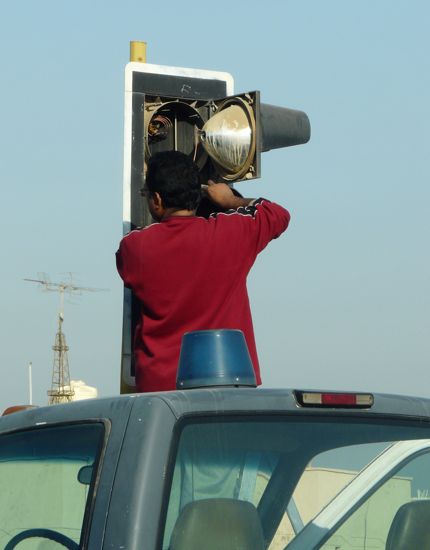
Wooo HOOOO, Kuwait! Clean! Fresh! Visible! Woooo HOOOOOOOO!
And – just seconds later – THIS:

Light at night! Clear! Visible!
Wooo HOOOO, Kuwait!
Some bureaucrat somewhere made a decision, and followed through on that decision, to make sure it was carried out, this being Kuwait. That one seemingly small decision, that small step in the right direction, could save lives.
God bless the bureaucracy, God bless the people that make the effort to keep us safe, who take their jobs seriously. I don’t take this lightly, not in my own country, not in any country I live in. Public policy is created by US, making small steps for the greater good.
Vigilante Volunteers
“Helping out the Ministry of Interior”
From today’s Kuwait Times
Kuwaiti activist establishes voluntary religious police
Published Date: December 27, 2008
KUWAIT: Islamist activist Mubarak Al-Bathali announced that he has established a voluntary Kuwaiti Committee for the Promotion of Virtue and the Prevention of Vice, like the Saudi Mutaween or religious police.
Al-Bathali said the Kuwait committee would begin its religious tasks in the Sulaibikhat area before spreading to other areas of the country. He explained that he was inspired to adopt the idea after a number of devout young people complained to him about seeing inappropriate and immoral behavior in Kuwait’s streets.
He emphasized that the committee members would focus only on advising people to avoid irreligious and immoral behavior and would never implement harsh or violent treatment on anyone.
Among the types of treatment which Al-Bathali protested against was the alleged drinking of alcohol, banned in Kuwait, at Christmas parties in the country. He reiterated that those who wished to drink alcohol should go outside Kuwait to do so.
Al-Bathali emphasized that the committee’s work would not conflict with the Ministry of Interior’s, saying that on the contrary it would help the MoI to uphold public morality and values.
From today’s Arab Times:
WE DON’T WANT YOUR HELP GUARDING PUBLIC MORALITY! responds MOI
Interior Ministry hits out at new ‘guardians of freedom’
KUWAIT, Dec 26, (KUNA): “Kuwait is an institutional state governed by law”, a statement by the Ministry of Interior said on Friday. The statement came in response to a press statement published on the front page of a local daily earlier today. The press statement talked about a group that allocated itself as “guardian” of people’s personal freedoms guaranteed by law, the ministry statement noted. The statement stressed that the ministry was the only directorate tasked with implementing and preserving the law in the country through imposing security and order, as well as safeguarding public morals. “The Kuwaiti society is a conservative, Arab and Muslim one that maintains refined morals and abides by its customs and traditions,” it pointed out.
“The ministry will counter such ‘radical’ calls with firmness,” the statement said, adding that the ministry would not allow anyone, whether individuals or groups, to interfere in the public’s personal freedoms, describing the calls as a “loud” infringement of the law as it also defied the state’s constitutional institutions. The statement concluded by saying that the ministry would take needed legal and security procedures to counter these calls and maintain the nation’s safety under the leadership of His Highness the Amir Sheikh Sabah Al-Ahmad Al-Jaber Al-Sabah.
Meanwhile, the Citizenship and Passport Affairs Department at the Ministry of Interior has announced that citizenship will not be granted to Kuwaiti children born abroad, if they hold any other nationality, reports Al-Rai daily. The department said since Kuwait doesn’t accept dual citizenship, children born abroad, especially in western countries where citizenship is given on birth, will not be granted Kuwaiti citizenship if they accept another country’s citizenship. It applies even on children of diplomats and “the department will not grant citizenship to such children unless they give up their previous citizenship.”
It is easy to discover nationality from birth certificates, say sources. In another development, Iraqi authorities have extended invitation to Kuwait officials to visit Baghdad to locate the whereabouts of their compatriots captured during the August 1990 Iraqi invasion, reports Arrouaih daily quoting reliable Kuwaiti Foreign Ministry sources as saying. Sources added the step demonstrates the serious determination of Iraqis to see to an amicable resolution of the issues and to put to end the lingering suffering of many families who lost their loved ones during the war.
PS. I don’t want your help, either, morality volunteers, guarding my morality. My morality is between me and God. I obey the laws of the country I live in – the laws of the country, not your idea of what the laws should be. “Volunteers” guarding morality are vigilantes, pure and simple.
Jailed for Headscarf?
It’s a good think I read this article all the way through before I published it. I thought it was about a woman getting arrested for wearing hijab. She was not arrested for wearing hijab. Read the last sentence in the article. She was turned away from the courtroom for wearing hijab – that’s bad enough. She was arrested when she swore at the bailiff (an officer of the court who preserves a dignified atmosphere in the courtroom, or tries to.)
I suspect this policy is more a gang thing – prohibiting headgear that would cause an outbreak of violence in the court – but that it was enforced in ignorance and protest against this Muslim-American woman. They released her quickly once threatened with investigation.
Sikhs won the right to wear their headgear while serving in the US military, as a religious right. I am betting Muslim women can win the right to wear hijab – it just needs to be tested in the courts. I do not think they can win the right to wear niqab, or other face coverings into the court – it isn’t a religious requirement, and the safety of the court can’t be protected if you don’t know who you are letting into the courtroom.
ATLANTA (Dec. 17) – A Muslim woman arrested for refusing to take off her head scarf at a courthouse security checkpoint said Wednesday that she felt her human and civil rights were violated.
‘Stripped of My … Human Rights’
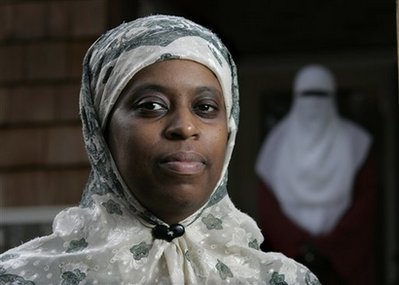
A Georgia judge ordered Lisa Valentine, above at her home in Douglasville, to serve 10 days in jail for refusing to take her head scarf off in court Tuesday. The Muslim, who had violated a policy that prohibits any headgear, was released Wednesday after an advocacy group called for a federal probe into the matter.
A judge ordered Lisa Valentine, 40, to serve 10 days in jail for contempt of court, said police in Douglasville, a city of about 20,000 people on Atlanta’s west suburban outskirts.
Valentine violated a court policy that prohibits people from wearing any headgear in court, police said after they arrested her Tuesday.
Kelley Jackson, a spokeswoman for Georgia Attorney General Thurbert Baker, said state law doesn’t permit or prohibit head scarfs.
“It’s at the discretion of the judge and the sheriffs and is up to the security officers in the court house to enforce their decision,” she said.
Valentine, who recently moved to Georgia from New Haven, Conn., said the incident reminded her of stories she’d heard of the civil rights-era South.
“I just felt stripped of my civil, my human rights,” she said Wednesday from her home. She said she was unexpectedly released after the Washington-based Council on American-Islamic Relations urged federal authorities to investigate the incident as well as others in Georgia.
The group cited a report that the same judge removed a woman and her 14-year-old daughter from the courtroom last week because they were wearing Muslim head scarves.
Jail officials declined to say why she was freed and municipal Court Judge Keith Rollins said that “it would not be appropriate” for him to comment on the case.
Last year, a judge in Valdosta in southern Georgia barred a Muslim woman from entering a courtroom because she would not remove her head scarf. There have been similar cases in other states, including Michigan, where a Muslim woman in Detroit filed a federal lawsuit in February 2007 after a judge dismissed her small-claims court case when she refused to remove a head and face veil.
Valentine’s husband, Omar Hall, said his wife was accompanying her nephew to a traffic citation hearing when officials stopped her at the metal detector and told her she would not be allowed in the courtroom with the head scarf, known as a hijab.
Hall said Valentine, an insurance underwriter, told the bailiff that she had been in courtrooms before with the scarf on and that removing it would be a religious violation. When she turned to leave and uttered an expletive, Hall said a bailiff handcuffed her and took her before the judge.
Associated Press writer Kate Brumback in Atlanta contributed to this report.
Anonymouse
While visiting another blog, I learned a new trick. I know most you you already know how to do these things, but some of us who were not born into these new technologies take a little longer to learn all the tricks you take for granted.
From my blogging friend in Damascus, Souvenirs and Scars, I learned about Anonymouse where you can go to access websites that may be blocked in the country where you live. Pretty cool, huh? I am betting that there are others I don’t know about – how on earth do any of these countries think they can block the free flow of information? That bell can’t be un-rung!
Criminal Justice
One of the great thrills in life is for a moment when you see that your life has had meaning – and many of those come when your children turn out OK. My husband and I wept together at our son’s graduation from high school – not that there was ever any doubt, but it just felt like maybe we had done something right.
Then came graduation from college, and later from law school. We wept for joy. We didn’t weep at all when he chose a sweet, thoughtful and beautiful bride – we danced for joy, and we are still dancing.
We had another of those life moments when we were able to observe our son in court, functioning as a responsible adult. What a thrill.
At the same time, I realized I have never been in a court before. It was sentencing day, and an entire parade of sad sacks paraded before us. These were men who have done bad things – sometimes violent things. None of them looked evil; they all looks shrunken and pathetic in their prison jumpsuits and chained feet. Each one had to answer to the judge – he had already been tried and convicted, and this was the day the prisoner would find out what the penalty would be.
The judge took his time, and also spent time educating those in the courtroom. One question he asked over and over – under what circumstances were you arrested for this crime?
Every prisoner was arrested when being stopped for some traffic infraction. When a crime is committed, even after a sentence is served, many times the prisoners are on probation. If they live without any violations for the probation time, they are free and clear. If they disregard some rule of probation, then the probation is withdrawn, and they have to go back to jail. A warrant is issued for their arrest. The warrant is entered into a computer, and, when the system works, every state in the United States has a record of that warrant.
Each and every prisoner was caught breaking another law, and then imprisoned on earlier violations when run through the computer. Each one had a history of making bad decisions. Not evil decisions – just momentary bad decisions – running red lights, speeding, weaving, having fake license plates on the car . . . each one had a pattern of living as if the laws of the land pertained to everyone else – but not to him.
One man, who was going back to prison because while on probation he had used drugs again, had his wife testify on his behalf. She cried, and said it was her fault, that they had a fight and because of the fight, he had used again. The judge was furious, said that unless she held a gun at his head and forced him to use, it had been his choice and his alone. He would serve his full sentence. This judge is big on personal responsibility, personal accountability.
Some of them were going away (going to prison) for a long time. In the midst of the joy of seeing our son doing good work was a lot of sadness at the waste of lives, as people are warehoused in prison.
But what else can you do with people who persist in breaking the law? How many times can you give them the benefit of the doubt? How many times can you show mercy before they do something truly awful? Is there any alternative to prison that can truly help people to learn to make better decisions and choices?
At one time, as part of my work, I had to go into prisons and deal with prisoners. Many of the people I dealt with were pretty scary. One had stabbed his wife’s girlfriend – like 97 times. I will never forget, at this time of year, hearing the prisoners singing Christmas carols, punctuated by the sound of the heavy gates crashing shut.
It still gives me shivers.
Kuwait Stock Exchange Closing Poll
This is from today’s Al Watan. I think investors all over the world have confused saving with investing. When you know your family is going to need the money, for something like a vacation, a new washing machine, a car – you save. When you have the luxury of a little extra that you can afford to lose, you invest. Smart investors will investigate the investment carefully. If the market goes down, but the company whose shares you bought is still solvent and strong, you hang on – after all, it you didn’t invest anything you can’t afford to lose, right?
Lawmakers alarmed by bourse closure
Attorney lauds court order, says action was necessary
Ghenwah Jabouri
and agencies
KUWAIT: A number of MPs have criticized a Court of First Instance order to halt trading on the Kuwait Stock Exchange (KSE), saying that the court”s move is “the most dangerous decision” ever taken in relation to Kuwait”s economy and bourse.
They explained that closing the bourse has cemented a lack of confidence and will drive the index down further once trading resumes, while rhetorically asking who would bear the consequences of such an eventuality.
They also stressed the need to benefit from the experiences of other countries to strengthen the Kuwaiti stock market.
The MPs also called on the government to take measures to limit damages resulting from the closure of the KSE.
In an exclusive statement to Al Watan Daily, attorney Labid AlـAbdal said the global financial crisis is finding its effects on many strong markets around the globe and that the situation requires Kuwait and other GCC countries to draw up a serious plan to protect its markets.
“Kuwait should choose safe investments and strengthen its reserves of gold at the Central Bank of Kuwait,” he added.
He stressed that most of Kuwait”s active financial and commercial companies are directly and indirectly linked to the international economy and that they will need well supported banking systems to maintain safe credit transactions and protected debt recovery.
“Given the mentioned circumstances, closing the local stock market in Kuwait is a necessity to prevent further losses by registered companies and to protect the citizens from losing any more assets,” he explained.
Kuwait must select very protective measures, especially after the fall of the oil price and the lack of trust in the international financial system,” AlـAbdal concluded.
Last updated on Friday 14/11/2008
What do you think? Do you think closing the Kuwait exchange prevented further losses, or do you think closing the exchange fed the fear that is feeding the rapid decline? Or do you have another opinion totally?
Kuwait Activists Reject MPs” Hijab Ruling
Activists reject MPs” hijab ruling
”Wearing of veil is not prerequisite for ministerial post”
KUWIAT: Political activists have expressed their great disappointment at the Parliament”s Legislative Committee”s decision which stated that the positions held by Minister of Education and Minister of Higher Education Nouriya AlـSubaih and Minister of State for Housing Affairs and Minister of State for Development Affairs Moudi AlـHomoud as female ministers were unconstitutional.
In a symposium entitled “Who protects personal freedom,” eminent activist Najla AlـNaqi said that the committee should have paid attention to more serious issues rather than focusing on marginal issues such as wearing the veil. She urged the committee to reconsider its decision.
Sheikha Dr. Maymouna AlـSabah made the Constitution a point of departure for her argument, stating that it did not distinguish between genders when it came to the qualification of a voter and never mentioned any preference of one over the other. She demanded for the appointment of more female ministers since it is the only way for them to reach the Parliament.
Historian Ghanima AlـFahaid outlined the role of Kuwaiti women and their contribution to society in different fields including defending the State from invaders. She reminded the audience of the brilliant work of both ministers and that they tirelessly endeavor to serve the community in every possible way.
Kuwait University lecturer Dr. Layla AlـSabaan regarded the decisions as regrettable at a time when women should be encouraged and commended for their work. She stressed that the Kuwaiti society believes in equal opportunities for all regardless of gender and that personal freedom should be respected as long as it doesn”t jeopardize the culture and traditions of the society.
Journalists Society consultant Dr. Ayed AlـManna discussed the legality of female ministers, highlighting that gender equality in a country like Kuwait is extremely important. He added that Kuwait is a liberal society in many ways, pointing out that the Constitution does not specifically say that women must wear veils as a perquisite to taking up their ministerial posts.
Meanwhile, political activist Najat AlـHashshash questioned the nature and background of the decision asking if this ruling applied to all female staff working in the Parliament or ministers only.
Last updated on Friday 24/10/2008
“Where You From?”
AdventureMan calls, full of chat, wanting to tell me what he is seeing at the airport. Normally, it’s a good time for a chat, but today, I’m having none of it.
“I just called the police again.” I told him.
(I can hear him thinking “Oh oh.”)
First I dialed the neighborhood police number, and nobody answered – again.
We have accidents in front of our house all the time. Sometimes I can see everyone with their phones out and I don’t call. This time, I called. No answer. I dialed 777. Thank God, they have WOMEN who answer, women who speak a little English, and I speak a little Arabic, and together we figure things out. They are smart, they are competent and they are sweetly polite, not officiously bureaucratic.
I tell her about the accident, tell her the neighborhood.
Two minutes later, my phone rings. He doesn’t speak English.
“Bolice?” I ask.
“Bolice” he affirms, and says my neighborhood.
I start telling him, in Arabic, the block, the street and the cross street. See? I’ve gotten so smart!
“Where you from?” he asks in amazement, and I can hear him grinning.
“I’m from (the neighborhood)” I answer.
He leaves the phone, and he is yelling and everyone is laughing in the background. Someone else comes.
“Where you from?” he asks. He just wants to hear me talk.
I tell him – in Arabic – the block, the street and tell him “CAR CRASH! TOO MUCH TRAFFIC. NEED BOLICE!” He is laughing. He calls someone else.
This guy speaks English.
“Car crash?” he asks.
“Yes!” I respond, glad to be on topic.
“Why you call me?” he asks.
(I didn’t call him. I called 777 {the emergency number here.} They called me!)
“Car crash.” I repeat. “Too many cars” (I say this in Arabic) Need BOLICE!”
He is laughing.
“Where you from?” he asks.
I say I am from the neighborhood.
“You in car?” he asks.
“No, I see from my house.”
“Come to station.” he says.
“No, BOLICE COME HERE!” I say, and tell him again the street, block and cross street – in Arabic.
He laughs and hangs up.
Forty five minutes later, traffic is still snarled up, no one is managing traffic, there are any number of near accidents as a result, and it is just a mess. No BOLICE.
For my non-Kuwaiti readers, the law in Kuwait is that when there is an accident, you cannot move your cars, not even out of the way, until the police have come. Until they come, everything stays as it is except for an ambulance can come and take away someone who is hurt.
Rejected Suitor Rapes Kuwaiti Woman
Al Watan staff
KUWAIT: A young Kuwaiti woman has filed a case against a man who raped her after she rejected his marriage proposal. The woman explained that the young man who asked to marry her had been found out to be a liar. Among other things, he lied about his nationality, claiming to be Kuwaiti when he was not. He also claimed to have huge sums of money when in fact he was not as well off as he initially claimed. After being rejected, the man reportedly waited outside her house and kidnapped her as she walked towards her car. He then drove her to a remote area and raped her.
What incredible courage this young woman has going public. What backing she must have from her family. This is, unfortunately, not a rare occurance. What on earth are these men thinking? Is he trying to ruin her chances of marrying anyone else? Is this rape a punishment?
Recent Comments
intlxpatr on Shampoo Ginger tigerbutterya0c5ff1d… on Shampoo Ginger intlxpatr on British Soldier Kidnapped, Esc… John on British Soldier Kidnapped, Esc… intlxpatr on British Soldier Kidnapped, Esc… Wikipedia Donate Button

Amazina


Early Voting in Florida


 Here There and Everywhere