Khadra and The Swallows of Kabul
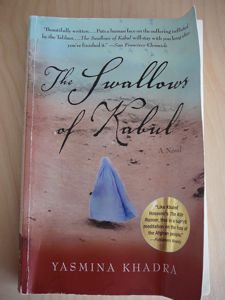
While waiting for our luggage to be offloaded, we were passing time, visiting with our greeter / expediter, asking about his family, his life in Zambia.
“How does this work, travelling with your son and your daughter-in-law?” he asked us. “Do you like her?”
Nothing on earth could disguise the delight on our faces as we both said “Yes!” We truly adore her.
When our son was only seven years old, a Christian speaker passing through said that if you have children, it is likely that their mates have also been born, so to start praying now for the unknown mate your child would choose, and we did.
When our son called us from university, and told us there was someone he wanted us to meet at graduation, and graduation was still months away, we knew, we just knew, that this might be THE ONE.
We were so delighted when we met her, we liked her immediately. What parent isn’t happy to see his/her son/daughter happy, and choosing well?
“But!” our meeter/greeter added, “how do you like her family?”
And we laughed again! We love her family! Her father is smart and very funny, and her mother is kind and practical, and we all share the same values on family and friends and living our lives. She comes from a large rowdy family that gathers when they can, and so do we.
And YOU are thinking “what does all this have to do with The Swallows of Kabul?” but I am getting there.
On the trip, we all had books for our quiet time, and I could see EnviroGirl deeply engrossed in this book. When I asked her, she said she had gotten it from her father’s wife, a woman with whom I often talk books, and that she (EnviroGirl) was trying to finish it so that she could leave it with me.
And thank goodness that she did! I couldn’t put it down!
First, you think it is written by Yasmina Khadra, but that is a pseudonym. The real author, Mohammed Moulessehoul, was Algerian army officer, and he used the pseudonym to avoid having to submit the manuscript for approval by military authorities. That got my attention right away.
The book is about Taleban era Afghanistan, and starts out with utter hopelessness, describing the deterioration in life brought about by the arbitrary imposition of religious rule, as interpreted by men who have memorized the Qur’an, but have a poor understanding of what they have memorized. Women lead a dismal, limited life, at the mercy of men who treat them as detestable if they are seen in public, even totally cloaked.
His language is beautiful, poetic and compelling, even describing despair and desolation.
We meet two couples, Atiq, a jailer, and his wife, Musarrat, who risked her own life to save his life back when he was seriously wounded and left for dead, and Mohsen, former member of a moderately successful merchant family, married to the love of his life, Zunaira, who is beautiful, educated and from a wealthy background. These men love their wives, and have a strong, genuine connection to them. Their ability to maintain that connection, and to stay connected to their own values, withers in the dry, dusty context of fundamentalist rule.
Their lives and relationships have been changing gradually, increasingly limited and undignified under the stress of Taleban rule, and the novel follows a rapid spiral of deterioration and folly. The steady decline of their lives speeds when Mohsen makes a terrible impulsive decision, has to live with the consequences, and confesses to his wife.
Atiq, too, faces dismal consequences. Even though we know he is limited, he becomes a sympathetic character. His hardness of heart covers a genuine grief that his wife is dying, and he can do nothing to stop it, nor to alleviate her pain.
We all face hard times. In our family, when someone lashes out unjustly, we often ask “is it something I have done, or am I just the nearest dog to kick?” It always gets a laugh, and it puts things back in perspective, puts us on the same side. Sometimes we can’t always vent our frustrations against those people or events creating the frustration, so we take it out on those we love – and who love us. It’s not right, it’s not fair or just, but it is very human, and once you get that out on the table, it is easier to discuss the real issue.
When Zunaira ends up in jail, Atiq’s world is shattered as if by an earthquake – the earth moves under his feet, all his understanding of life is shaken.
“As he cleans up, he cautiously lifts his eyes to the roof beam looming over the cell like a bird of evil augury, and his gaze lingers on the anemic little lightbulb, growing steadily dimmer in its ceiling socket. Screwing his courage to the sticking point, he walks back to the lone occupied cell, and there, in the very middle of the cage, the magical vision: the prisoner has removed her burqa! She’s sitting cross-legged on the floor. Her elbows are on her knees, her hands are joined under her chin. She’s praying. Atiq is thunderstruck. Never before has he seen such splendor. With her godess’s profile, her long hair spread across her back, and her enormous eyes, like horizons, the condemned woman is beautiful beyond imagination. She’s like a dawn, gathering brightness in the heart of this poisonour, squalid, fatal dungeon.
Except for his wife’s, Atiq hasn’t seen a woman’s face for many years. He’s even learned to live without such sights. For him, women are only ghosts, voiceless, charmless ghosts that pass practically unnoticed along the streets; flocks of infirm swallows – blue, yellow, often faded, several seasons behind – that make a mournful sound when they come into the proximity of men.
And all at once, a veil falls and a miracle appears. Atiq can’t get over it. A complete, solid woman? A genuine tangible woman’s face, also complete, right here in front of him? He’s been cut off from such a forbidden sight for so long that he believed it had been banished even from people’s imaginations. . . ”
Atiq has a friend, Mirza, who thrives under Taleban rule, as a soldier, and also running illegal businesses highly profitable under the current regime. He encourages Atiq to abandon his cancer-striken wife, to get rid of her and to find a fresh, young wife. He offers Atiq shady business opportunities, and tells him a wise man bends with the wind. Ignorance and chaos benefit Mirza, and he has no wish to see the good old days return.
In spite of the bleakness, the desolation, the crushing arbitrariness and inhumanity, there is hope, love, and compassion in a thin, steady stream throughout the book.
Once I started reading, I had to finish. It was a great book for the long trip back to Kuwait, one I am eager to pass along to the next avid reader.
Committee To Make You Live the Way I Think You Should
From yesterday’s Kuwait Times Editorials is a must read by columnist Shamael Al-Sharikh, one of their most insightful political commenters.
In her column, Dichotomy, she discusses SANPFKS (Committee to Study all Negative Phenomena Foreign to Kuwaiti Society). I have only excerpted the following, to intrigue you enough to click on the blue type above and read the whole article. It is a worthy read, from beginning to end.
Well, unlike these MPs who did not react to the creation of the SANPFKS (the name starts to grow on you, doesn’t it!), I am quite invested in the success of this committee, and as a patriotic Kuwaiti citizen, I will do my utmost to cooperate with the SANPFKS to ensure its success and imminent continuation. There are many things that are foreign to Kuwaiti society and that need to be eradicated from it so we can go back to our roots. Below is a list of issues that the SANPFKS can study, report on, and subsequently eradicate:
1. Bearded men: A post-1991 phenomenon that is clearly the result of influence from other Arab countries. The result is that most Kuwaiti men have become severely unattractive, unapproachable, and mind-numbingly narrow-minded. This phenomenon should be studied extensively and recommendations should be given on how to go back to real Kuwait, where men only wore mustaches.
2. The niqab: same as above. The result is that many Kuwaiti women suffer from the incorrigible heat under layers of black cloth, when in the past, all Kuwaiti women wore an open single layer abbaya, faces uncovered. This phenomenon should be studied extensively, especially in light of the fact that women are not required to cover their face in Mecca during Hajj, making it ridiculous that they cover their face in Kuwait.
This article, from start to finish SANPFKS (Committee to Study all Negative Phenomena Foreign to Kuwaiti Society)
It is followed today by an answering column from Fouad Al-Obaid called “You Must Be Kidding!” where he captures the absurd situation of a country rushing headlong into chaos while the newly-elected ministers discuss mixing of men and women at a hospital party and Star Search instead of using their energies to focus on policies to get Kuwait’s infrastructure moving once again and economic policies to encourage development.
These two columnists make the Kuwait Times worth reading.
Kuwait Driving Laws Enforced in Hawali
AdventureMan and I have a running disagreement. I say more people are pulling over to make calls, or using headsets. He says he sees people using mobile phones all the time. (He would not agree to a spot survey of the cars around us, but we also noticed fewer children in the front seats, very cool.)
I think traffic is improving in Kuwait. I see more people using seatbelts, fewer people weaving around while trying to talk on cell phones, and more people using turn signals. I see less endangering behaviors.
Am I being too optimistic here?
From the Arab Times:
250 citations issued: Hawalli police launched an intensive campaign and issued 250 citations to motorists for not wearing seatbelts and another 50 for using mobile phones while driving, reports Arrouiah daily.
Female Ministers Must Wear Hijab?
This is from yesterday’s Arab Times. I have two questions – first, I have no objection to hijab, and I thought it was every individual’s choice to wear or not to wear. Is it the law to wear hijab?
second, I’ve been told that in Kuwait, women did not wear hijab – it is neither cultural nor traditional. Where is this insistence on hijab coming from?
Don’t allow female ministers in Parliament without ‘hijab’: MP
KUWAIT CITY : The government and Parliament should strictly adhere to the Islamic teachings in granting women their political rights, says MP Mohammad Hayef Al-Mutairi to Al-Watan Arabic daily.
Urging both authorities to enforce the Elections Law based on the Islamic teachings, Al-Mutairi said the government should ensure the two female ministers – Education and Higher Education Nuriya Al-Subaih and State Minister for Housing Affairs and Administrative Development Mudhi Al-Humoud – will abide by the Islamic teachings in carrying out their duties in their respective ministries.
According to Article 17/2005 of the law and as stated in the Holy Quran, Al-Mutairi stressed women should always wear ‘hijab’ (veil). He also asked the government to be objective in implementing the law, which should be enforced among its members first to serve as an example to the people. Al-Mutairi added the executive and legislative authorities should not allow Al-Subaih and Al-Humoud to enter the Parliament without ‘hijab.’
Heavy Heart: Police Dog Auction
In today’s Kuwait Times is an ad from the Ministry of Interior offering “28 Trained Police Dogs” for Auction on June 3rd.
Everyone knows there are clandestine dog fights here, where animals are goaded to fight until deeply injured and killed. This is not a dog-friendly culture. Dogs starve here all the time, are hit, beaten, abandoned, stoned, maimed, tortured by children and adults.
The thought of who might buy these dogs and the purposes they might be put to makes my heart heavy. Worse. It makes my stomach heave.
Working dogs do what they are trained to do. The work hard. They served Kuwait! They deserve a good retirement.
Woman Receives Allowance
Sometimes, it’s a little article that has a huge impact. This little article, about a recent court decision in Kuwait, has potential for such an impact;
This is from today’s Arab Times:
Court orders allowance for woman
KUWAIT CITY : The Constitutional Court Wednesday received a petition filed by a Kuwaiti woman, requesting the court to declare the second paragraph of Item No. 2 and fifth paragraph of Item No. 3 of Cabinet decision No. 142 /1992 unconstitutional.
The court then declared the two paragraphs unconstitutional.
In her lawsuit submitted by her lawyer, Attorney Khaled Al-Hamdan, the woman said she was appointed as a lawyer at the Fatwa and Legislation Department in December 2000 and was promoted to ‘Lawyer A’ in December 2006.
The woman was surprised when she learnt her male colleagues were receiving housing allowance of KD 200 for the bachelors and KD 300 for those who are married. She then filed a case as she has not received any housing allowance since she joined the department.
The session was presided over by Judge Rashid Al-Hammad.
By Moamen Al-Masri
Special to the Arab Times
Pretty cool, huh? Wooo Hoooo on Judge Rashid Al-Hammad! Woooo Hooooo on Lawyer “A”, who fought for her rights – and WON. Wooo Hoooo, Kuwait!
Not Your Kuwait Driver’s License
Earlier this year, I wrote about getting my Kuwait Driver’s License never thinking I would be going through the process again this year here in Seattle. I know it sounds crazy, but it just didn’t occur to me that the license might expire. It isn’t a good thing to find out when you are about to pick up a rental car and your license is declined because it expired.
So I needed to go get a new license first thing this morning. I know how crowded the driver’s license place is early in the morning, so I didn’t go first thing. When I got there, there were about 15 people in front of me.
They have this system. You go in and they have a big list of services and fees posted. Then you go to a machine and press a button for the service you need, and you get a number. I waited five minutes.
The woman asked how she could help and I told her I needed to renew my expired driver’s license. She asked why it had expired and I told her I live in Kuwait, and she said “oh! other country” and put in that code. She asked about you, she asked how I liked living in Kuwait, she was worried about my safety – I get that a lot. I tell them about Kuwait, about how nice it is, how I have lots of good friends, and that it is a nice place to live. I tell them I feel safe (I don’t tell them about the driving!) and that if anything were to happen, I believe I have friends who would protect me. I could see a lot of this was news to her, and she was happy to hear it.
She asked me if I was restricted in my dress, and I laughed and said “well, I dress modestly, so it isn’t really a problem.” She stopped and thought a little and said “I dress modestly, too.”
All of that conversation, plus my paying for a new license and taking an eye test, took five minutes. I had to take five steps over to where my photo was taken, and 30 seconds later my temporary license, photo and all, was in my hands. My permanent license will be sent to me within a week.
How sweet is that?
It was SO orderly. No one pushing in front of anyone, waving papers, insisting on going first. Everyone takes a number, everyone gets the same courteous service and it is FAST. I was in and out in less than fifteen minutes, and that includes the waiting time and the conversation. I love systems and processes!

How We See Things in Kuwait
AdventureMan and I have an ongoing discussion over the cell phone ban while driving in Kuwait. I see people pulled over to the side of the road, at traffic circles, along the major north/south routes, pulled over in complicated neighborhoods. I love to see them – many are using their hands to help understand the directions, waving left, then straight, then left again – it warms my heart.
AdventureMan, on the other hand, he who loves the efficiency of being able to do two things at the same time, drive and do business or talk to me, says he sees people all the time using their cell phones while they are driving.
So I think we are seeing what we want to see.
He kids me, as I track diwaniyyas, where they used to be, those still being dismantled. Friends are telling me that they can now see around dangerous corners where someone had built an illegal little cabin for their driver to sleep in, trees and foliage have been cut back, neighborhoods have a new look. I find it exciting – obeying the law can be tough, it can be inconvenient, and the temptation in all of us is to say “it’s a great law for them, but it doesn’t apply to me.”
AdventureMan scowls when he has to obey a law that he doesn’t think should apply to him. I say scowling is OK, as long as you do it. There are times I am tempted to skirt the law, but this blog keeps me honest – how does it look if I’m always talking about law and order, and then I choose to break the law, too? Having a child keeps you honest – when you face temptation, you know those little eyes are watching you, and it gives you that little extra boost to make the right choice.
Pearls mentioned she thinks people are sticking closer to the speed limits with the new fines in force, and that the roads are much more enjoyable these days. I agree, with one exception, and that is when traffic slows on the major north/south roads, there are still those idiots who use the emergency lanes to get to the front of the line. We need some BIG fines for those guys.
Last but not least, my Co-op seems to be enforcing the no parking in the handicapped section once again, thanks be to God. The poor manager, I keep going in and telling him that “big strong men” should not be using those spots. He keeps thinking I want the spot and I laugh and say no, I am a strong woman and I can walk, but what about the heavily pregnant woman with her five children, or the old man with his walker or cane, or the one with emphysema.
Finally, I suggested that he have grocery packers assigned to watch, and to run out and insist on assisting anyone who parks there, a special service for the handicapped. Sometimes you can accomplish with kindness what you can’t hope to accomplish with signs and harsh words. Whatever he has chosen to do, it appears to be working, people are not parking in the handicapped spots. 🙂
No Release, No Travel, reports Darwish
In today’s Kuwait Times, Badria Darwish informs us that:
“the Ministry of Electricity and Water (MEW) has decided to ask all expatriates before exiting the country – whether on holiday or permanently – to obtain a certificate of clearance from the ministry. The certificate is only valid for one month. If the expat doesn’t have it, he will be returning from the airport the same day . . . “
On page 2, a news article confirms her report.
“The Ministry of Electricity and Water announced it is in the process of issuing a legislation. It said it instructed the Assistant Undersecretary Jassim Al-Linqawi, in charge of consumer affairs at the ministry, to coordinate with the Interior Ministry to enforce the legislation. The legislation, it added, will mandate all expatriates planning to proceed on vacation to obtain a clearance document from the Ministry of Electricity and Water that they are clear of all pending bills. All expatriates having arrears will not be permitted to travel either through the airport or the various surface borders around the country. The legislation is expected to be enforced soon . . .
The Ministry of Electricity also instructed the Interior Ministry to empower their employees, who collect electricity dues, to force their way into the residences of all those residences of al those residents who refuse to let them check the electricity meters. . . . “
Oh! Those pesky expats, running red lights and neglecting to pay their electricity and water bills. Yeh. Right.
This does present the bureaucracy with a fascinating challenge. First, to immediately construct a way in which all consumers can receive bills, like through a postal system. Second, to collect the accurate information for each customer, making sure that “no one is above the law.” Third, to bill consumers in a way that they know that they have been billed, and to have a follow up procedure – you know, like warnings, and a way to turn off the service? Fourth, a way to follow all this by computer – accurately. Oh, yes, and co-ordinating between the MEW and the MOI. And have it ready to be enforced “soon.”
Expats Run More Red Lights
This is from today’s Kuwait Times.
KUWAIT: The Interior Ministry defended a new policy of deporting expatriates who run red lights by arguing that “the highest percentage of traffic violations are committed by expats, adding that this constitutes a hazard on the lives of motorists,” reported Al-Jarida.
The ministry in a statement said it had the legal right according to the Foreigners Residency law to deport expats for such offenses. And added that the ministry used this right as it is its administrative right according to the law. (sic)
I am blown away that they can say this with a straight face.
Recent Comments
ExpatAlien on What Country am I Living … intlxpatr on Yellowstone: Old Faithful to C… Michelle on Yellowstone: Old Faithful to C… Cathy on No Grown-Ups in Charge intlxpatr on Waiting for Snow Wikipedia Donate Button

Amazina


Early Voting in Florida


 Here There and Everywhere