Saving the Lives of Malnourished Children
I received this e-mail this morning:
Hi there,
My organization, International Medical Corps, has the ability to save the lives
of malnourished children around the world and we just received some very
exciting news. We have been nominated to be one of the Top 25 in American
Express’ Projects, “Saving the Lives of Malnourished Children.” Our project was
chosen out of 1,190 projects and is now eligible to receive up to $1.5 million
to help feed hungry children. Because your blog, here there and Everywhere, has
a loyal following, I thought this would be an issue you would want to share with
your readers. I’ve put together this microsite explaining everything.
http://internationalmedicalcorps.smnr.us/
If you could post about this on your blog it would really help to spread the
message and potentially could save many lives. At the minimum, please vote for
“Saving the Lives of Malnourished Children.” Please let me know either way.
Thanks.
Chessia
—
Chessia Kelley, International Medical Corps
ckelley@imcworldwide.org
http://imcworldwide.org
I googled the organization and it is legitimate. Here is what Wikipedia has to say:
International Medical Corps (known also as IMC) is a global humanitarian nonprofit organization established by volunteer doctors and nurses. The organization provides disaster relief, delivers health care to underserved regions, builds clinics, and trains local health care workers with the goal of creating self-reliant, self-sustaining medical services and infrastructure in places where that had previously been lacking.
IMC’s focuses include primary and secondary health care, prevention and treatment of infectious diseases such as malaria, cholera, dysentery, and HIV/AIDS, supplemental food for malnourished children, clean water and hygiene education, mental health and psychosocial care, and microfinance programs that allow people to earn their own income.
International Medical Corps is a founding member of the ONE Campaign and a member of the Clinton Global Initiative.
Sharks and Underwear
Two things happened yesterday that caught my attention – and I wonder if everyone knows about these things except for me, or if others are also caught by surprise.
First, on the way to go shopping, my good friend told me that shark is no longer available in the fish souks. We don’t eat a lot of shark, but we often buy it to fill in a good bouillabaisse (if you are superstitious and believe there must be seven different fish in your bouillabaisse) or to cook up to feed the feral cats in the neighborhood. Even the heads make a big hit with the local cats. 🙂
“No, a recent religious decision says that shark is ‘haram’, ” she said, as I gaped in disbelief. “Their skin has no scales.”
“But the Kuwaitis eat shrimp!” I responded, “and shrimp are also haram according to some Muslims. Who is going to tell Kuwaitis not to eat shrimp?”
“I don’t make the rules,” she responded. “I am just letting you know. The fishman said that because sharks have no scales and something about the male sexual organ, I don’t know, but now they can’t sell shark anymore.”
She paused, thoughtfully.
“What will the poor people do?” she asked. “Most of the people who buy shark can’t afford anything better.”
Later, our marketing accomplished, our goods safely in cupboards and refrigerators, I read the news. This is from yesterday’s Kuwait Times:
Shops Banned from Displaying Lingerie
Kuwait: The Minister of Commerce and Trade and Minister of State for National Assembly Affairs Ahmad Baqer last week issued decision No. 430/2008 which bans any display of women’s underwear in shop windows or at the front of shops.
It is permissible, however, to display such garments inside outlets.
The decision also banned any unclothed display of mannequins used for modeling underwear in order to protect the moral well being of passersby, with legal penalties to be taken against shops which violate the new regulations.
I’m sorry if this offends you, but it just made me laugh. Even Saudi Arabia, the most traditional of the traditional, allows underwear to be displayed. Even Qatar, more conservative than Kuwait, allows underwear to be displayed. Some of my very favorite images are those of abaya’d, veiled, ladies looking at a particularly luscious set of fabulous under-garments.
Changes are occurring in Kuwait, small changes, incremental changes, and little by little, as they aggregate, the face of Kuwait is changing.
Building 7 Collapse Solved, No Mystery
Feds Say They’ve Solved 9/11 Mystery
By DEVLIN BARRETT, AP
GAITHERSBURG, Md. (Aug. 21) – Federal investigators said Thursday they have solved a mystery of the Sept. 11, 2001, attacks: the collapse of World Trade Center building 7, a source of long-running conspiracy theories.
The 47-story trapezoid-shaped building sat north of the World Trade Center towers, across Vesey Street in lower Manhattan. On Sept. 11, it was set on fire by falling debris from the burning towers, but skeptics have long argued that fire and debris alone should not have brought down such a big steel-and-concrete structure.
Federal investigators said Thursday they have resolved a lingering question from the Sept. 11, 2001, terror attacks: What caused World Trade Center 7 to collapse? They determined the building, which sat north of the World Trade Center towers, was brought down by fire started by debris from the twin towers.
Scientists with the National Institute of Standards and Technology say their three-year investigation of the collapse determined the demise of WTC 7 was actually the first time in the world a fire caused the total failure of a skyscraper.
“The reason for the collapse of World Trade Center 7 is no longer a mystery,” said Dr. Shyam Sunder, the lead investigator on the NIST team.
Investigators also concluded that the collapse of the nearby towers broke the city water main, leaving the sprinkler system in the bottom half of the building without water.
The building has been the subject of a wide range of conspiracy theories for the last seven years, partly because the collapse occurred about seven hours after the twin towers came down. That fueled suspicion that someone intentionally blew up the building in a controlled demolition.
Critics like Mike Berger of the group 9/11 Truth said he wasn’t buying the government’s explanation.
“Their explanation simply isn’t sufficient. We’re being lied to,” he said, arguing that there is other evidence suggesting explosives were used on the building.
Sunder said his team investigated the possibility that an explosion inside the building brought it down, but found there was no large boom or other noise that would have occurred with such a detonation. Investigators also created a giant computer model of the collapse, based partly on news footage from CBS News, that they say shows internal column failure brought down the building.
Investigators also ruled out the possibility that the collapse was caused by fires from a substantial amount of diesel fuel that was stored in the building, most of it for generators for the city’s emergency operations command center.
The 77-page report concluded that the fatal blow to the building came when the 13th floor collapsed, weakening a critical steel support column that led to catastrophic failure.
“When this critical column buckled due to lack of floor supports, it was the first domino in the chain,” said Sunder.
The NIST investigators issued more than a dozen building recommendations as a result of their inquiry, most of which repeat earlier recommendations from their investigation into the collapse of the two large towers.
In both instances, investigators concluded that extreme heat caused some steel beams to lose strength, causing further failures throughout the buildings until the entire structure succumbed.
The recommendations include building skyscrapers with stronger connections and framing systems to resist the effects of thermal expansion, and structural systems designed to prevent damage to one part of a building from spreading to other parts.
A spokeswoman for the leaseholder of the World Trade Center, developer Larry Silverstein, praised the government’s work.
“Hopefully this thorough report puts to rest the various 9/11 conspiracy theories, which dishonor the men and women who lost their lives on that terrible day,” said Silverstein spokeswoman Dara McQuillen.
In discussing the findings, the investigator Sunder acknowledged that some may still not be convinced, but insisted the science behind their findings is “incredibly conclusive.”
“The public should really recognize the science is really behind what we have said,” he said, adding: “The obvious stares you in the face.”
Copyright 2008 The Associated Press. The information contained in the AP news report may not be published, broadcast, rewritten or otherwise distributed without the prior written authority of The Associated Press. Active hyperlinks have been inserted by AOL.
Safat Down?
I was just checking the Kuwait Blogs and I got a message that Safat is corrupted. Is anyone else getting the same view?
We take their service for granted, don’t we, these guys who volunteer their own time to keep Safat running. We are so lucky to have an aggregator in Kuwait so comprehensive and reliable.
Superlative Day: Gone Fishing
I’ve had some great and memorable days in my life, and this is one of them. My good friend said “Hey, you want to go fishing Friday?” and I said “Yes!” I had to go get a one-day fishing license, and I could add crab for a mere 50 cents, so I did.
We met up at 6:30 a.m. and were on the water by 7 a.m. on one of the hottest day’s in Seattle’s summer. As we left the marina, we passed an Eagle. (We thought of you, AdventureMan!)

AdventureMan must have heard us talking about him, because as the sun rises, he calls from Kuwait, eating Felafel sandwiches and ice cream as we watch the sun rise:

And set the crab traps – this is what an empty crab trap looks like. We put turkey legs and old fish heads in the bait box to attract the crabs:

It is a gorgeous morning. As my friends dig out the fishing polls, I admire the mountains and the sparkles on the waters of Puget Sound:

My friend has baited my hook and hands the rod to me. I lower the weight to the bottom, pull it up just a little and – an immediate nibble:
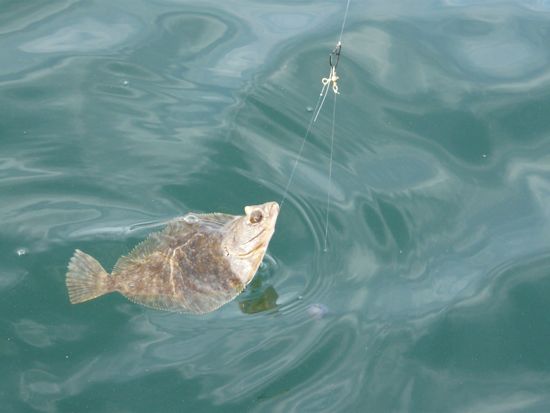
He’s a good size and he’s a keeper. My friend grabs my camera to take my photo with my first fish of the day, I hold the fish up – and just as she is snapping the shot, the fish does a little flip right off the hook and back into the water!
It doesn’t matter – the fish are biting and we are hauling them in. Some are too small; we take them off the hooks and throw them back, telling them to have a good life, grow big and we will see them again, we hope!
After about an hour of superlative fishing, we go back to check the crab pots. They are HEAVY with crab!
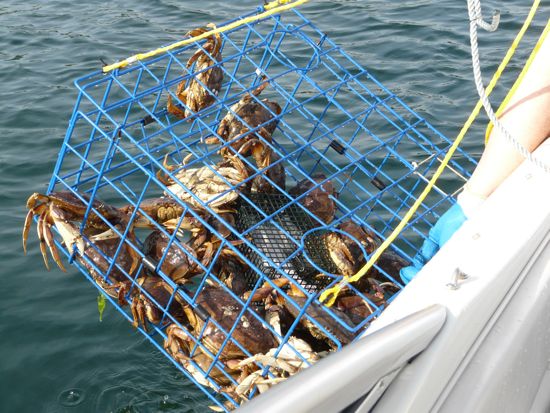
You can’t keep any female crab, or any male under a certain size, so any crab you think you might want to keep, you have to measure. You get a HUGE fine if you are caught with undersize crab. As we bring in the crab and the fish, my friend notes them down on our licence records, which have to be sent in to the state at the end of the season, listing fish we have caught, crab we have caught, and how many we threw back.

We catch a couple rock crab – those you don’t have to measure, and you can keep. Most of what we catch is the sweet and delectable Dungeness Crab – my very favorite after Alaska King Crab.


We had just decided to quit for the day – it was getting really, really HOT for Seattle, like 90°F/33°C (and there is an advisory for hot weather, and air stagnation) and we have nearly our limit for crab, and a respectable amount of fish, and we are happy, happy fisherpeople! Just as I am about to raise my line, I get a big bite, and catch the last fish!
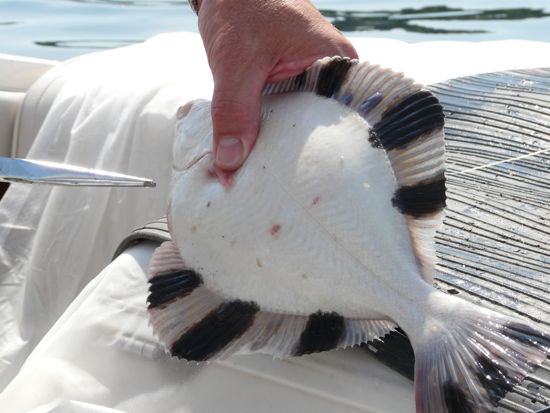
Here is our bucket, full of fish. The cooler is full of crab. What a great day to be alive.

Geraldine Brooks: March
Geraldine Brooks knocks my socks off. If she writes a book, fiction or non-fiction, I will buy it and read it. The first one I read by her was Nine Parts Desire: The Hidden World of Islamic Women, and the second most memorable book was her Year of Wonders, a book about how the plague comes to a 17th century English village and how the villagers cope with it – how some survive. She has a knack for keen observations, and for writing so as to place you squarely in the scene she is describing.
So when she came out with a new book extrapolating from the experiences protrayed in Louisa May Alcott’s classic favorite Little Women, why didn’t I rush to buy it? March is described by Publisher’s Weekly as “the Civil War experiences of Mr. March, the absent father in Louisa May Alcott’s Little Women.”

Didn’t you love Little Women when you read it? What’s not to love? Those wonderful sisters, their saintly mother, working together, suffering together, prevailing through sheer grit and determination – we can read that book over and over again, loving it every time.
Geraldine Brooks takes us with Mr. March into the grim realities of the American Civil War, the “war to free the slaves,” the war to keep the United States united, or the war between the states. This is not the idealized world of Little Women, this is not the memory we have of the nice letters he writes home from the field, this is the reality of war and all it’s ugliness. As the book opens, Mr. March is fleeing a massacre, struggling to survive, he is surrounded by the dead and seriously wounded, bullets are flying past him and he has to cross a deep, rushing river. A man grabs him who can’t swim, and he has to push him away to gasp for air. The man drowns, March survives, feeling deep guilt. When he finally finds a group of his men, drying out by the side of the river, he sits down and writes to his girls about the sweet breeze in the air. Not a word about the horrors he has witnessed, not his personal despair about having failed a wounded comrade.
As we experience the horrors of this war with Mr. March, we experience with him the brutality, cruelty, and crudity of all conflict. There are no good guys. There is no “just cause,” just winners and losers, and it’s very hard to tell what they are fighting for. Seeing this war from the point of view of the combatants, we realize that no-one will remain untouched; that this experience will resonate through the rest of their lives.
Geraldine Brooks knows how to grab us and keep us gripped. Every chapter reveals a new facet – how March and Marnee met and married, how they built a life together, how, in their idealism, they lost everything. Most discouraging of all is how, below the surface, they understand themselves and one another and their relationship so little.
I dare you to read this book. It isn’t an easy book, and at the same time, it is a book with timeless qualities, and a book that will get you thinking and keep you thinking for a long time. Isn’t that the definition of a good book?
Summer Sunday at the Pike Place Market
We have a great favorite tradition – hit the early service, 0800 – what my friend calls “speed church”, the one hour service instead of the longer family services – and then head straight for the Pike Place Market. Things get started there slowly on a summer Sunday morning, and we even found a free parking space – totally amazing.
First stop is breakfast at Campagne. We don’t have reservations, but they find a place for us:


The sun breaks forth and the market is teeming with people by the time we are finishing up:

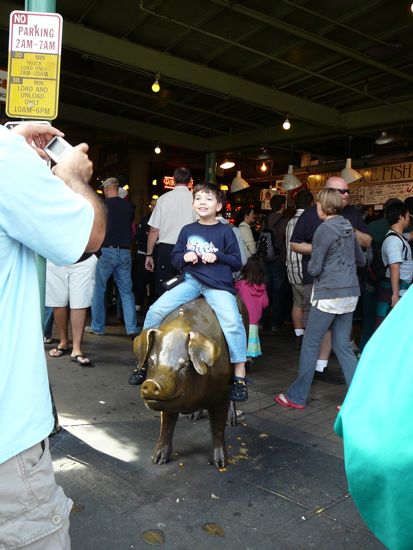
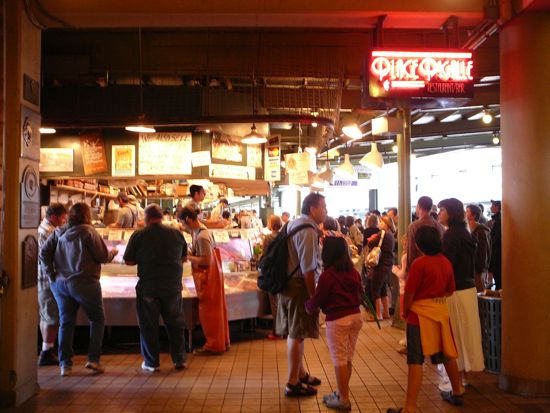

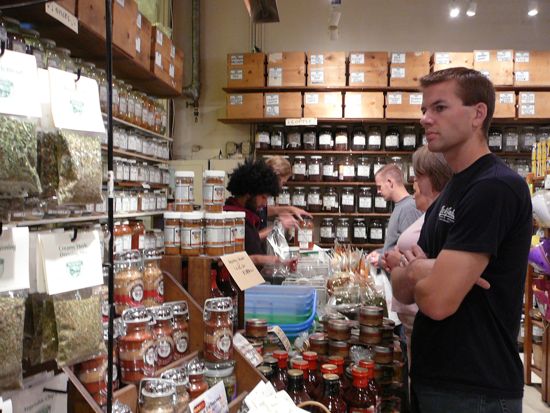

In the 1970’s, the market was a little run-down and shabby, and many business people wanted to raze it and use the space for office buildings. Seattle residents said “NO!” and instead, the market was revitalized. It is one of the major tourist destinations in the city, and a lively spot every day of the week.
A long time ago, before the big Seattle fire, my family lived just up the street from this market.
It’s The Law
There is something about Oregon I love. I don’t know if this is true anywhere else in the country, but in Oregon, you are not allowed to pump your own gas. So when it is cold and rainy and foggy and drizzly, you can sit in your warm car and someone else fills up your tank.

Just like Kuwait!
I asked the very nice young man who filled my tank if people ever tip him, and he said “Some people do!” with a big smile. I was happy to tip him for filling my tank.

(I asked him if I could take his photo for my blog, and he said “sure” it was fine. )
Wooo Hoooo, Oregon!
Combination of Events
Yesterday I visited our house. We have been seriously blessed with good renters, people who are good hearted, and take care of the house. We have a good property manager; when something needs to be done – a new roof, a new furnace, a new fence – he has people who can handle the job, and the job gets done well.
The house still has it’s original refrigerator from when it was built. I think it needs a new one – before an emergency happens and our renters lose their food. I measure, take stock of how the house is doing, and then . . . I have to go buy a refrigerator.
For me, this is stressful. A refrigerator is something that is supposed to last for a while. I go to Consumer Reports and I read about all the refrigerators. Here is what is interesting – the top rated model, in terms of keeping things cold or frozen, in terms of energy use, etc. has thirteen consumer reviews, and most of them are negative! Most needed repairs, and most of the repairs had to do with the ice maker and the cold water on the door thingie (to use the technical term)
So I visited three stores, looked at refrigerators. At two of the stores, you had three choices – white, stainless steel or black. I am not a black-appliance person, I am not a person who wants black in my kitchen. Neither, I discovered, am I a white-appliance person. And the stainless steel just makes me tired; it is a fad that is already passing. So what to do?
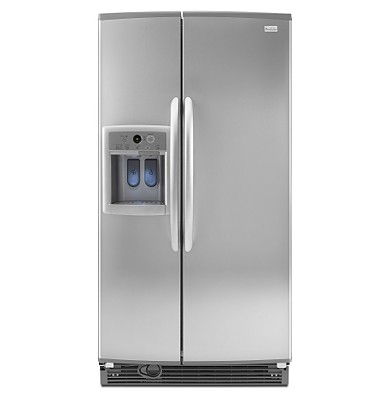
I went to the third store and there is more choice. I find the top rated model, which is on sale, and then ask the salesman if he has the same model WITHOUT the cold water and ice dispenser on the door, and he does! And it is on sale! And WITHOUT the fancy extras – it is exactly the same price as the ones WITH the fancy extras!
How funny is that?
I went ahead and ordered the one without all the water dispensers. It does have an ice cube maker, that is fine with me. Then, it took me longer to pay for it and arrange for delivery than it took me to research and decide which model to buy.
The salesman was very good, he knew his stuff. This wasn’t his fault. The problem is that I am an anomaly. My billing address is not the same as the address to which the refrigerator will be delivered. I have several different phone numbers, one of which is only active when I am in the USA, one of which rings in Kuwait, and I don’t want people calling in the middle of the night, oh, what to do?
I don’t exactly know what time is a good time for delivery for the renter; that is always handled by the property manager. I don’t have his phone number with me. GROAN!
When I finally get back to my Mother’s place, I am exhausted. A soft rain starts falling around 4 pm and from then on, I keep falling asleep. I am probably still jet lagging, yes, I know, it’s been a week but my body still has a time zone all its own.
I know it is too early to go to sleep so I make myself stay awake, I try to read, but at 9 pm, I totally give up. It’s the exhaustion, and it is the soothing sound of the steadily falling light rain. I keep my window open; I love the fresh air, and I love to hear the birds, and oh, the sound of rain! This morning, yes, 4 a.m. and I am wide awake. It is a GORGEOUS, sunny day, the clouds and rain have gone, and I had better start packing for the next leg of this journey while I have all this energy.
Seattle OKs Bag Fee
From the Seattle Post Intelligencer:
City OKs 20-cent fee on plastic, paper bags
Council also outlaws foam food and drink containers
By KATHY MULADY
P-I REPORTER
Move over, baseball caps and T-shirts.
Logo-emblazoned cloth grocery bags could soon become the most popular company freebie in the Puget Sound region.
Seattle became on Monday one of the first major American cities to discourage the use of paper and plastic shopping bags by requiring grocery, drug and convenience stores to charge 20 cents per bag. In a related action, the City Council also banned plastic foam food and drink containers.
Both laws will go into effect Jan. 1.
People can avoid the fees by bringing their own reusable bags when they shop. The city of Seattle will launch a 90-day education effort to help people figure out the best ways to use cloth bags, and remember to take them when they go shopping. The city also plans to provide residents with a couple of free bags.
One of my favorite stores, Trader Joe’s, has been selling reusable bags forever. They now have a display with many sizes and designs to choose from:
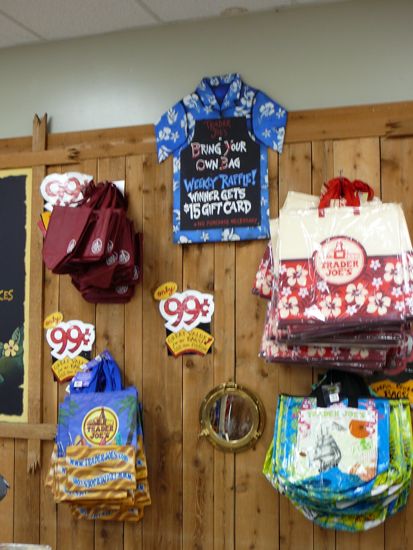
I’m really trying hard. I have a friend who is so conscientious about recycling, she always carries her own bags, and her actions have influenced me greatly. She believes even one person makes a difference, and I believe her – I can see that her behavior has already changed mine! I am trying to carry my own reusable bags now, too.
Especially for my Kuwait/Gulf/Middle East readers, I got a big grin when I saw this in the prepared food section:

A ready-to-go lunch, with felafel, hummous, tabouli and a little bit of flat bread.
Recent Comments
intlxpatr on Shampoo Ginger tigerbutterya0c5ff1d… on Shampoo Ginger intlxpatr on British Soldier Kidnapped, Esc… John on British Soldier Kidnapped, Esc… intlxpatr on British Soldier Kidnapped, Esc… Wikipedia Donate Button

Amazina


Early Voting in Florida


 Here There and Everywhere