Out in the Great Wide Open: Montana and Wyoming Day 1

Our first major trip since the beginning of COVID had an ambiguous start. AdventureMan and I over prepare, we always do. So the day before we are scheduled to leave for Montana, Wyoming and Idaho, we are actually pretty relaxed. We are all packed – actually packed, and then re-evaluated when the weather suddenly turned from the high 90’s to much lower, and we scrambled to add some cold weather gear to the mix. We are enjoying some down time when AdventureMan calls from his office to mine – “Hey, we just got a letter from Viking you need to look at.”
AdventureMan is a big picture kind of guy. He gets right away that our trip in May 2022 is being cancelled. I capture the details – that we either apply the money we have paid in full to a future trip or we call immediately to tell them we want a full refund. This is the second time we have had this particular trip cancel and we look at each other and agree that two cancellations are enough.
There is an incentive to putting the money forward – a 10% reduction in the cost of the trip. We already have another trip booked with them, but for less money, so we wanted to keep it clean. We needed to call right away, because the deadline was during the middle of this trip which we are about to take, and our lack of internet connections in the remote locations we seek could prevent us from getting our refund. AdventureMan got right on it, the representative answered, encouraged us to book the trip again (we declined) and worked it out so that our refund will arrive shortly.
Crisis averted. Don’t you hate it when things happen at the last minute?
The following morning we were up at 0345 and Patrick, our taxi driver, arrived exactly on the dot of 4:15. For me, it was a scramble. Morning feeding of the two indoor cats and the one outdoor cat is my responsibility, plus getting dressed. I scrambled. I was finished just in time, we got to the airport, checked in and went through security. No problems, except I forgot I had my Fitbit on and had to be searched.
One other problem. For this trip I had really tried to manage with a carry on bag, which preparing for two weeks is problematic. I had really thought things through, had clothes with multiple purposes, got it all in the one bag and my purse – and then they wouldn’t let me take the bag on board, they valet’ed it. I have a large handbag, large enough for my computer and meds and rental car paperwork, so all was well, but it was annoying to follow all the rules and then not to be able to take it with me. We call this a first world problem – in the greater scheme of things, it was small stuff.
Our first flight was to Charlotte, and there was some passenger having a problem about wearing the masks over both mouth and nose, and about whether the female flight attendant had the authority to require full coverage. No problem, they had a big male flight safety monitor who explained his choices to him – cover, or get off the flight.
The Federal Aviation Administration has had more than 4200 reports of unruly passengers since the beginning of 2021. More than 3000 of these reports were due to refusals to wear masks, in spite of clear guidance from every airline that this is a mandate.
We were close to where the flight attendants were chatting during take-off, laughing that a man would refuse to believe a woman had the authority to instruct him to wear a mask. Welcome to 2021.
In Charlotte, we had just enough time to stop at the Farmer’s Market and pick us sandwiches and chips for the next leg of the flight. There were huge lines at all the other places, for Biscuits and Eggs, for McDonalds, for Starbucks. The second flight also departed on time. We don’t take these blessings for granted.

We arrived in Bozeman on time, 50 degrees F. outside and raining. We were delighted. There have been forest fires sending waves of particulate matter towards Bozeman for weeks, and now the winds have shifted, and the rain has helped tamp down the pollution. Again, we feel blessed.
AdventureMan had to wait for his bag so I went to pick up the rental car. Things got weird. Not in a hard way, just in an unusual way. There was no one at my rental agency’s counter, but there was a sign to check in with another rental agency. There was no line, so I checked in. The guy offered me an upgrade for a pittance to a Rav4, a car we really like anyway. Then he handed me the keys and told me how to return it when we were done.
“Wait!” I said. “Don’t we have to sign a rental contract and talk about filling the tank and stuff?”
“Our printer isn’t working,” he stated, and I didn’t believe him for a heartbeat. “I can send you an e-mail copy if you wish” and yes, I so wished. I had my own copy of the initial agreement, but it was for a different kind of car. I’m glad I had it with me because the entire two weeks we drove this rental car, I never received a copy of the new rental agreement. A couple hours after I returned the car, I received the updated rental agreement.
But the car was a beautiful turquoise blue, and close enough to the cars we drive to be easy, even better than AdventureMan’s 2010 version. It was an easy drive to our hotel, the Spring Hill Inn, which had our room waiting for us, a large, serene and quiet room, close to everything. Then off to the nearby Walmart, our usual Bozeman outfitter, for what we call car foods, and insect repellant (which we never had to use) and other small items of convenience.


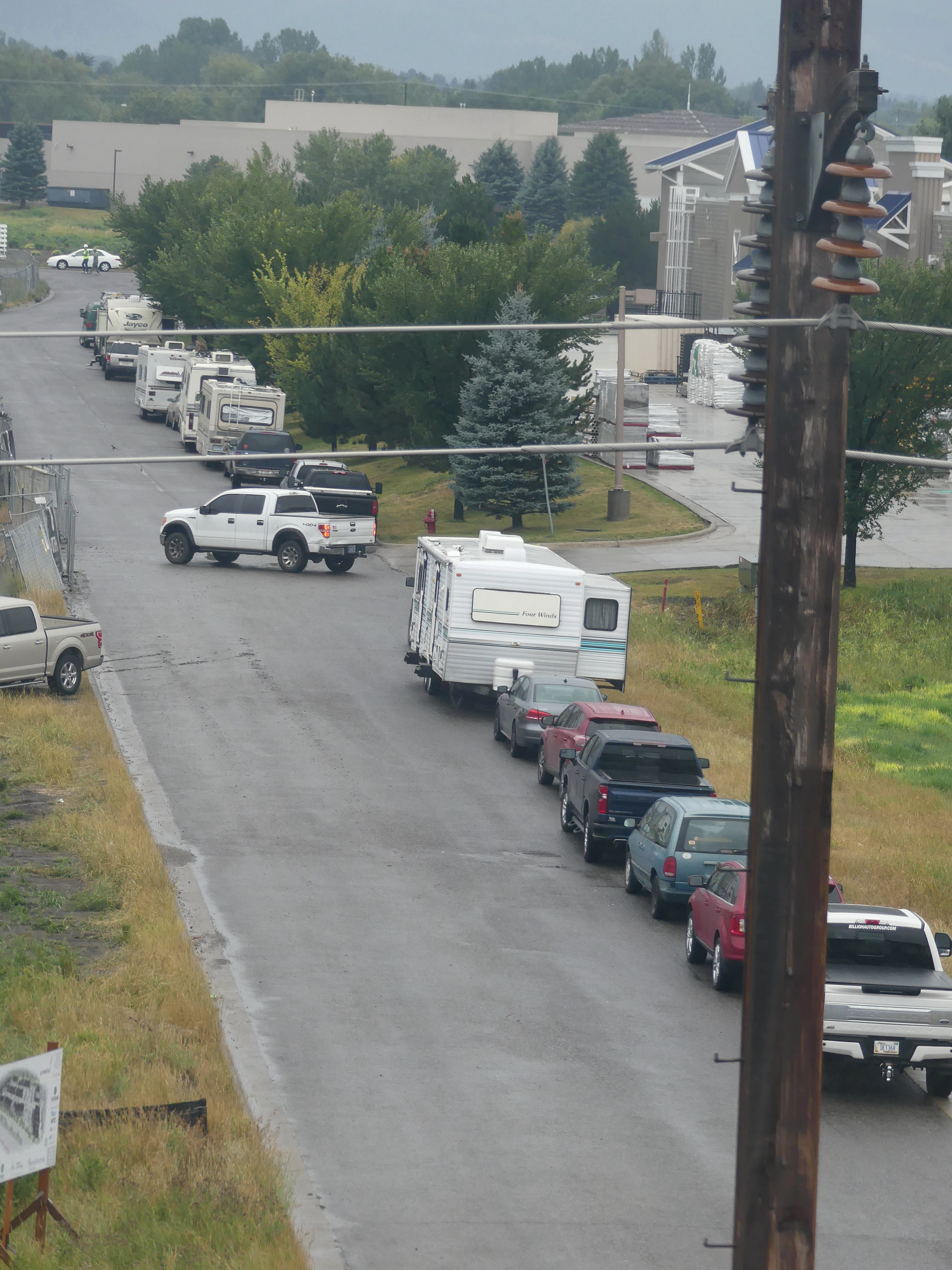
There is a lot of construction going on in Bozeman, and we are told by many we talk with that the problem is trying to find an affordable place to live in Bozeman. Outside our window, we can see new housing going up, and we can also see the solution the construction workers have found to deal with the housing affordability problem.


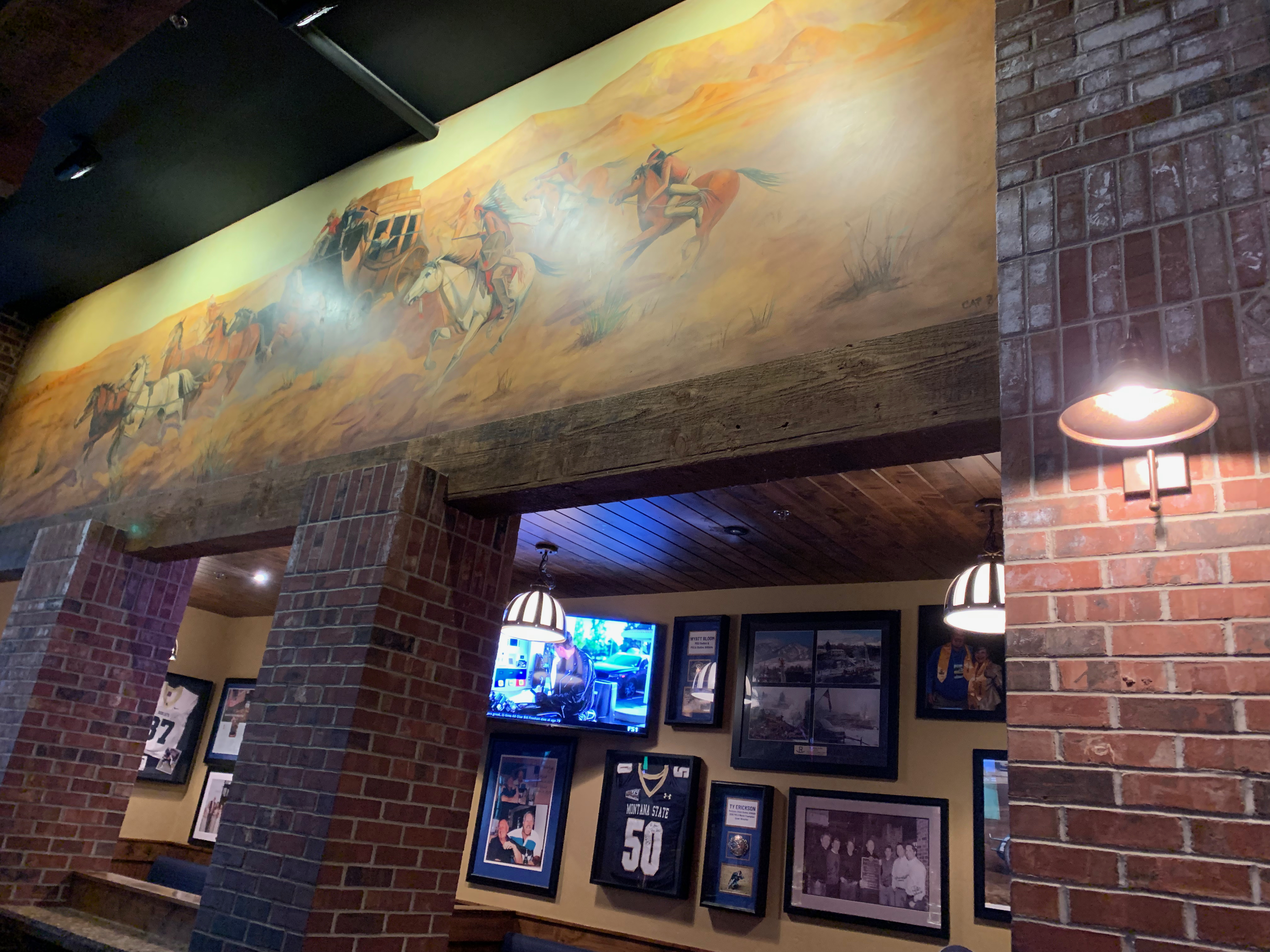
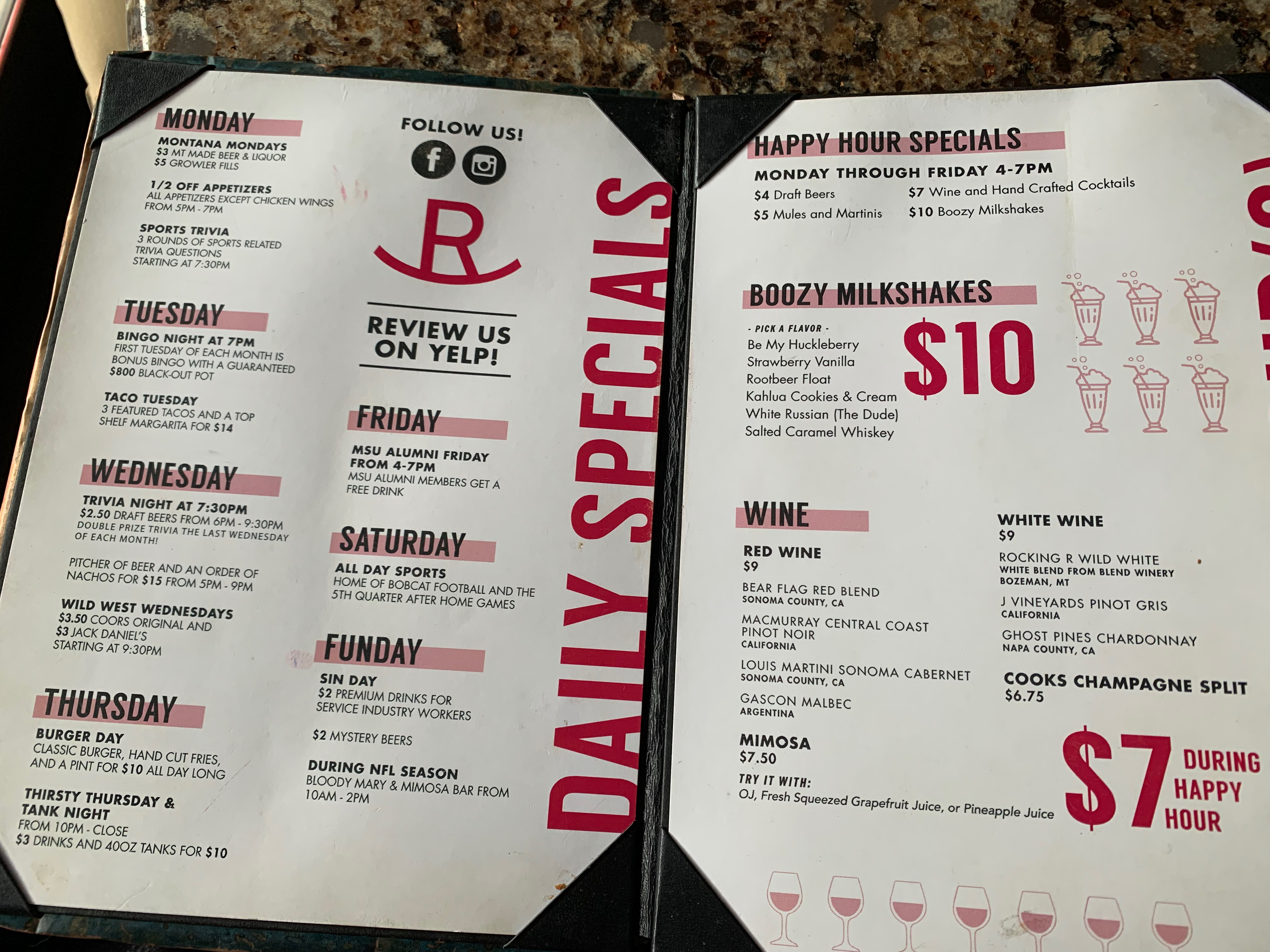
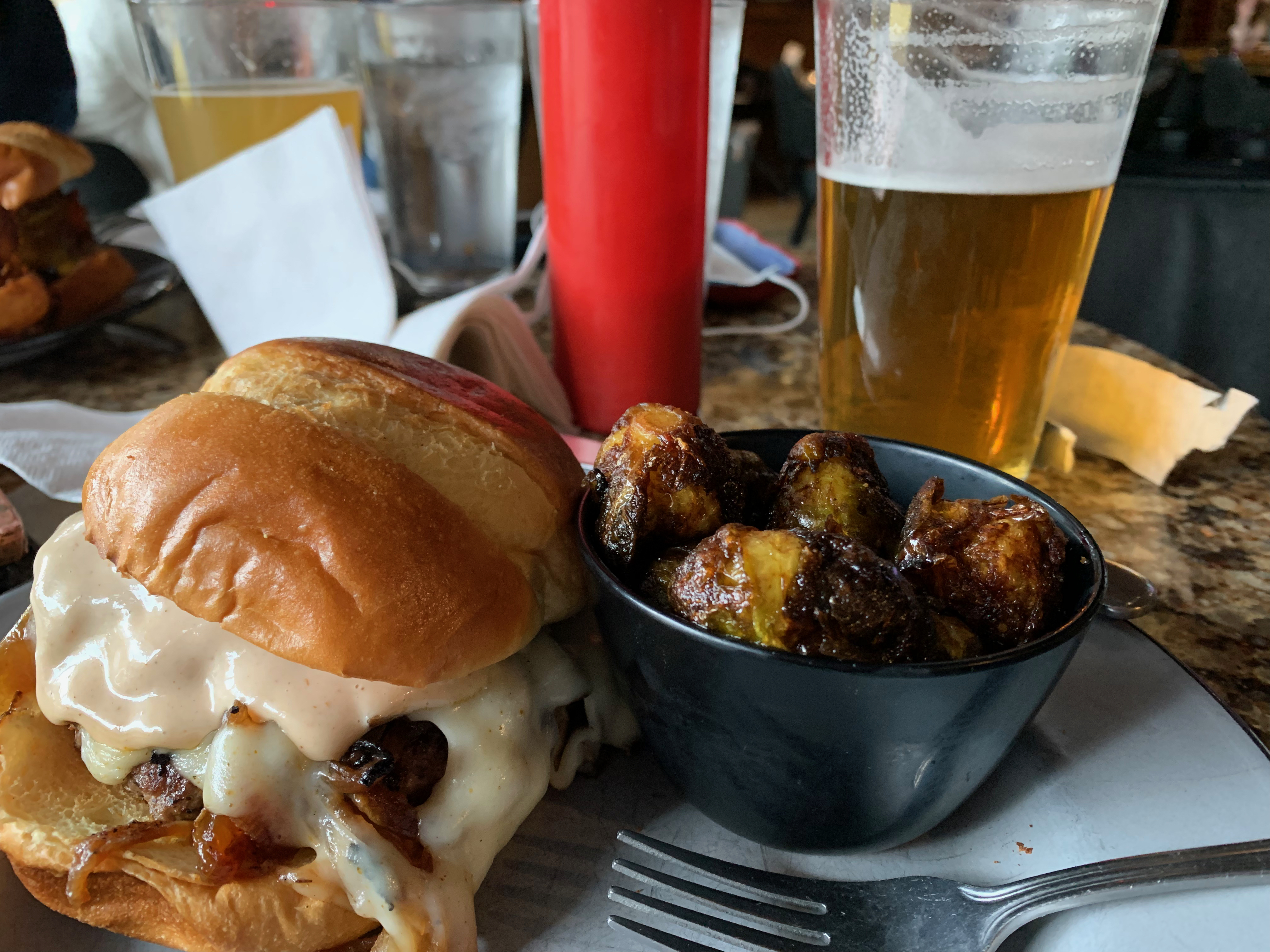
We parked downtown when we found a place that looked wonderful and had a smoker out front, but it turned out to be a fine food purveyor, not a restaurant. We asked her for a recommendation, and she said ‘You have to go to the Rocking R” so we did. The Rocking R is actually a bar, a great cowboy bar, and the restaurant is called Hail Mary. We both had elk burgers – hey, we’re in Bozeman – and they were delicious. I think mine was called something like the Outlaw, and my beer was a Maverick Mary; it tasted good and because I don’t drink much, half a beer and I was buzzed. I also had roasted shaved brussel sprouts to salve my conscience. We had a great time. We are happy just to be back in Bozeman.




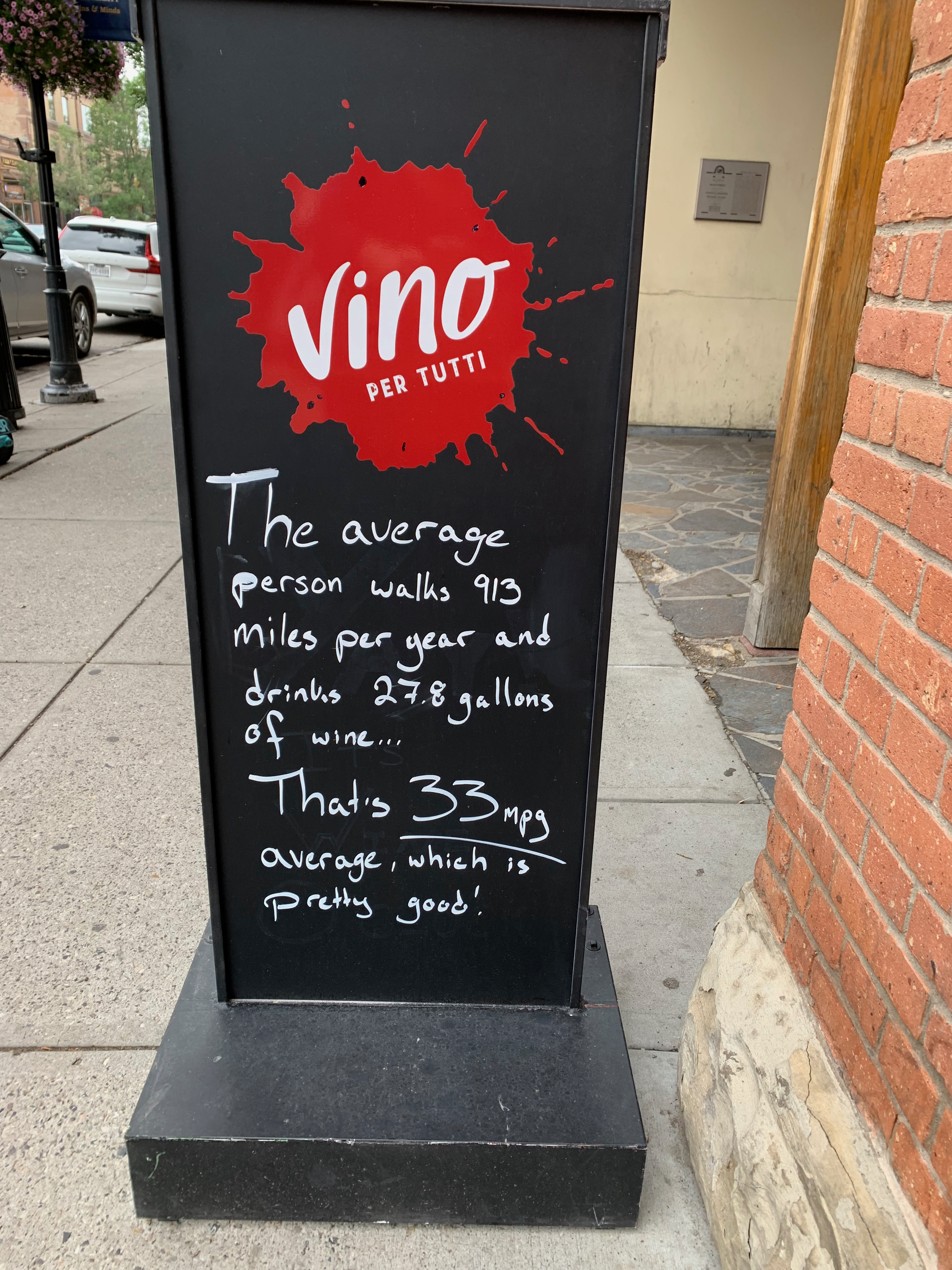
We had time to take a walk along the main street – woo hooo, lots of fun stores, a rug store for AdventureMan and a book store for me.


We couldn’t ask for a better first day. No delays, no negative events. Hardest part of the day was trying to keep myself awake until 8 p.m.
Before the Blog: Arrival in Kuwait
After three years in Doha, AdventureMan transferred to Kuwait to take on a new position. I followed, spending a couple months dealing with a variety of authorities to get permission to take my cat, known as the Qatari cat in the blog, his real name was Pete.

When our Morgaine died, AdventureMan said “No more cats!” but six months later, on a plane back from our son’s wedding, I told him I needed a cat. He worked long, hard hours, and loved what he was doing. I loved that he loved what he was doing, and I was lonely in our huge house, just me, rattling around like a little pea in a big pod. Because he loves me, he agreed, and as soon as we got back to Doha, I went to the vet and found Pete. I brought him home. Pete didn’t love me to start with – he loved AdventureMan. When AdventureMan would leave for work, Pete would howl in anguish. Slowly, slowly while he came to find me an acceptable substitute, he always loved AdventureMan the best.
So I was trying to do everything I could to guarantee Pete would travel with us to Kuwait. Travel was complicated by an outbreak of Bird Flu. While it didn’t affect people traveling on Qatar Air with falcons (birds!) it seemed to complicate travel for cats. AdventureMan came back a few days ahead and I told him of my frustration – I had a veterinary certificate, I had been assured by the airlines that Pete would travel with us but every person gave me a different answer. He got involved, and the day before we travelled, he got a firm “yes.”
We’ve lived in the MIddle East for years. We know “yes” isn’t always yes. We got to the airport early, to check in, to make sure everything went smoothly. It didn’t. The woman at the check-in desk said “No,” Pete couldn’t travel because of the bird flu. I said “we have him on the reservation!” and the woman said “He’s just a cat. Don’t you know they have many cats in Kuwait?” AdventureMan got involved, invoked the name of the high poohbah he had dealt with and got permission from. After many a phone call, and almost at the very last minute, Pete was allowed to fly.

I use this image of Magic Kingdom because flying into Kuwait from Doha was flying into a whole new world. You might think all Gulf Arab countries are alike, but you would be very wrong. Kuwait and Qatar have many interrelationships, many of the same families, but the culture was very different.
AdventureMan had reserved a limo – not what you are thinking. Not a big fancy car, but a sort of beat-up big car that could handle all our luggage and the cat, and would be waiting for us. Coming into Kuwait, getting a residence visa, getting to the limo was easy. What happened next was unexpected, and part of why we chose this kind of life.
The beloved Emir of Kuwait had died, and we arrived on the day of the coronation of his son. Important people from all over the Gulf and from many other countries were attending this event. It didn’t affect our arrival at the Kuwait Airport, because there is a special VIP terminal for important people. Getting out of the airport, however, was unbelievably complicated as cavalcade after cavalcade of important people stopped traffic so they could be rushed to the events surrounding the coronation. Just as we were about to turn onto the road to Fintas, where we were to live, we were cut off by a big sand-colored official SUV with six men hanging on the outside in desert fatigue uniforms carrying automatic rifles. These were not friendly looking guys, in fact it was a little bit terrifying.
And this was part of the magic of Kuwait, the contrasts and the unpredictability. First rule, you never never mess with the police (and there seemed to be several different kinds of police.)
When I had flown to Kuwait to look at housing, they showed me one apartment and many many villas. The villas were huge, two or three had their own indoor swimming pools, two had elevators. I chose the apartment, which had more square footage than the house we live in now.
I loved living in this eyrie, with it’s huge view over the Arab Gulf.

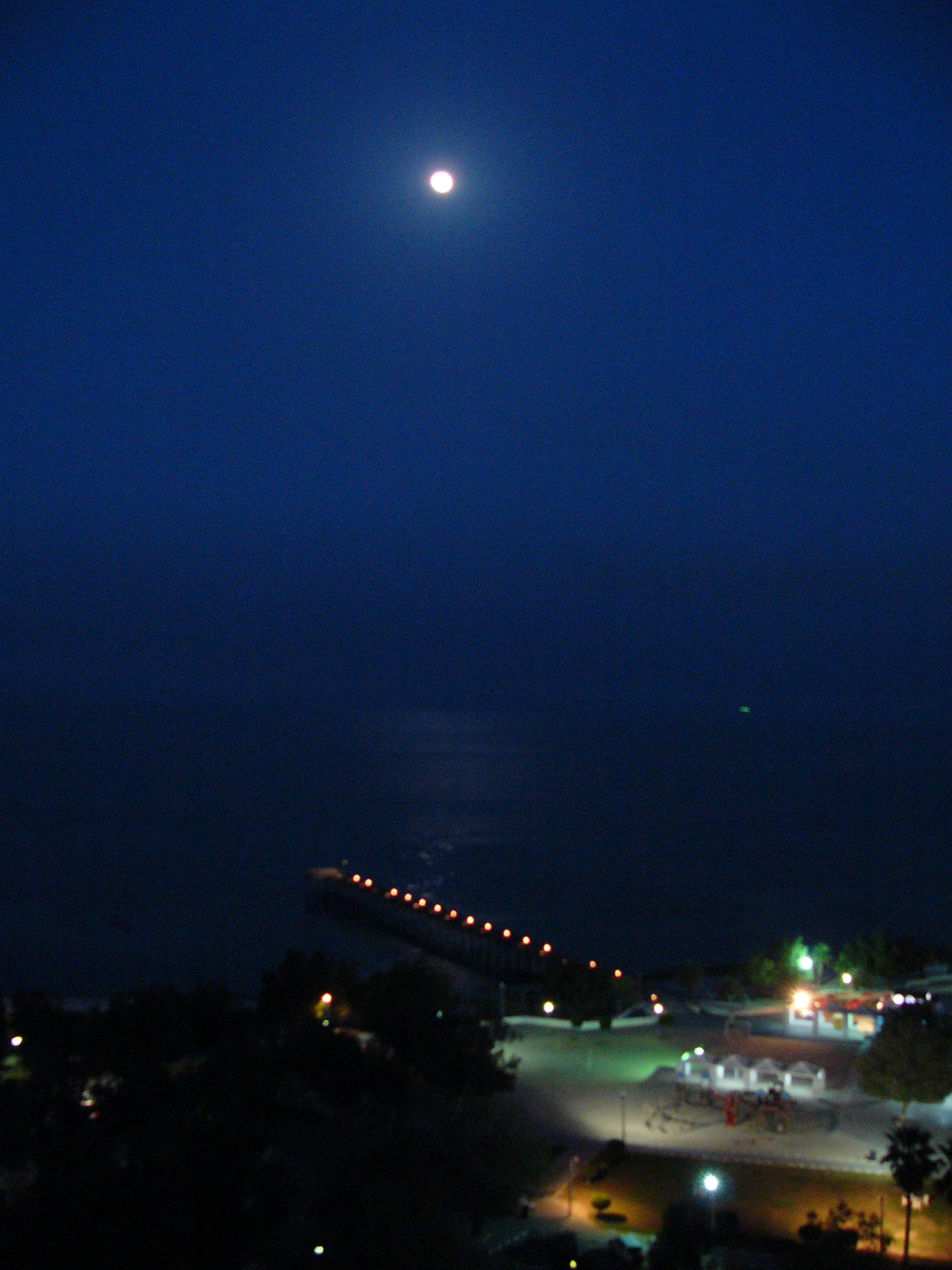
Scenes in Al Fintas

AdventureMan would never go out on our balcony. We would watch other high rises going up and know that the concrete was poured at night, but it was still very hot, the concrete often had more sand than was good, and many of these buildings are built at sea level. Like the collapsing buildings in Miami, we often had salt water in our underground parking garage. I had thought I could care for the apartment on my own, but the seals on the windows could not keep out the sand, and every day the tile floors were gritty with it. I couldn’t keep up. I was lucky to find a wonderful woman to help me; she also helped me understand many of the realities for expat-labor in Kuwait.

Some of the labor practices were horrifying. Kuwait and very modern laws and standards. Kuwait also has a system called “Wasta” which sort of translates to “who you know/who has influence” and depending on your “wasta” the standards may or may not have been maintained. Also, the fine, ever-present air-born sand creates engineering and maintenance difficulties that we can barely imagine.

We came to admire the laborers very much. They had a hard life. Most were sending everything they could back to families in their own countries, mostly to feed their families and to educate their children. Some were badly treated, some did not have jobs. You get used to thinking in a different way. We had regular beggers, men who waited outside our favorite restaurants knowing we would give them our bag full of food on our way back to the car. There were, of course, scammers, but most who asked for food or money were grateful, in a dignified way, for anything we could share. These men are building a fish trap – there is a way in, but no way out. It was fascinating to watch it being built.
In the late 1960’s, early 1970’s, Kuwait monitored their best male students, and sent these young men to study in different countries. Many went to the US and UK, and being young men, found themselves the kind of adventerous wives who would dare to marry a dashing foreigner and go to live with them in their country. (That is a topic for a whole other blog entry!)
I was fortunate to be friends with many of these women, who in turn introduced me to Kuwaiti women. These were all very fine women, a lot of fun, educated and skilled and sophisticated. It thrilled my heart to be an aging woman who still had so much to learn, and was blessed with these spirited mentors.
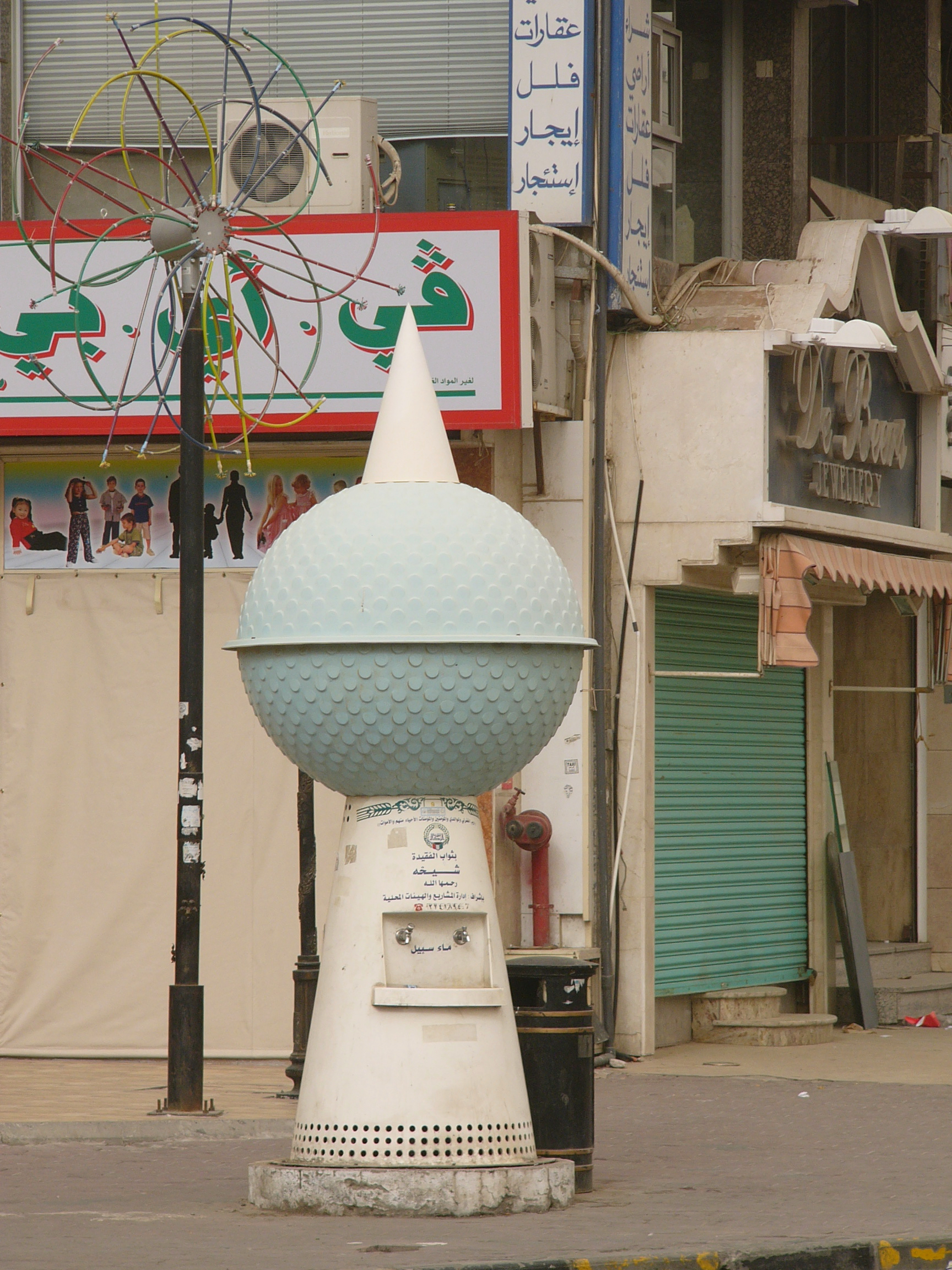
Below is a refrigerated water supply tower, put on the street by a generous and religious person to bless those who do not have access to cool water. You see them everywhere. I hope our country never becomes so desertified that we need to install these. I always loved that they are so joyful, so exuberantly creative. They are not only functional, they came in many different sizes, styles and shapes, and they always made me smile. This is what I call giving cheerfully!
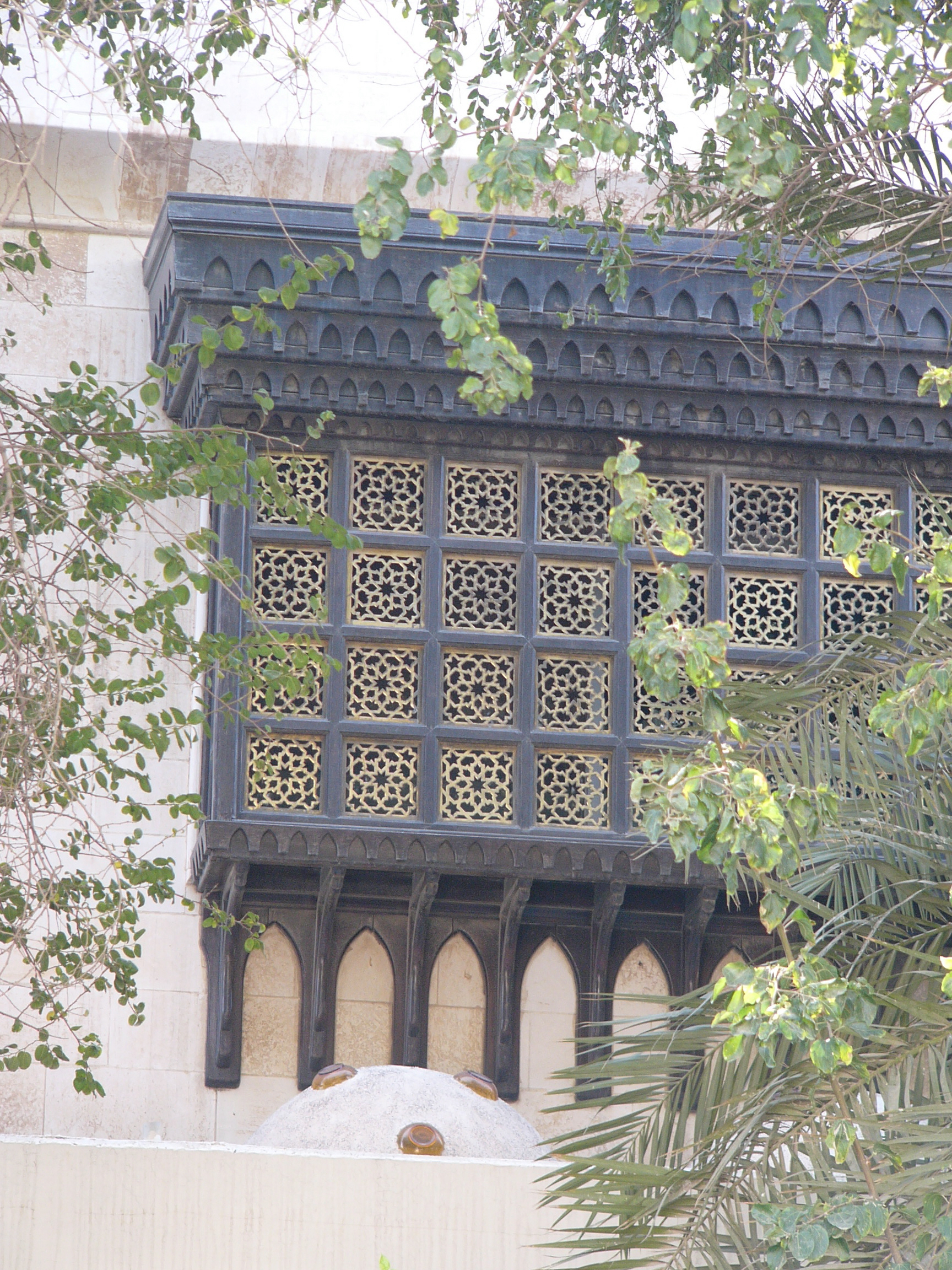
Kuwait was often beautiful. Below is a window called meshrabiyya, it provides light; it also provides privacy for the viewer. Many buildings in Kuwait incorporate homages to earlier architectural traditions.
“Regrets, I have a few . . . ” Mostly I don’t wear a lot of jewelry, mostly just earrings I pick up on my travels. My son was getting married; I offered to help the bride with bridesmaids gifts and a Kuwaiti woman guided me to the old gold souk where a jeweler made these necklaces for me, raw emeralds and pearls. I did not get one for myself. I wish I had! You could find real treasures, original and nothing less than 18K and real gems. The workmanship was exquisite.

One of the great joys for us was the Magreb (sunset) call to prayer. Everywhere in Kuwait there were mosques on almost every block. At sunset, each would have a call to prayer. They started seconds apart, so there was a sort of lovely cacaphony of sound, voices raised praising God and reminding everyone to worship and praise. We would watch the light change as the sun set and listen to this marvelous sound.

So many mosques! So like Pensacola! Some were small and simple, some larger and ornate and a few gigantic mosques. I think of Kuwait early in the morning when one church, I think the downtown Presbyterian church, has a carillon concert. It’s not the call to prayer, but it’s the same idea, calling our hearts to be thankful for our creation.
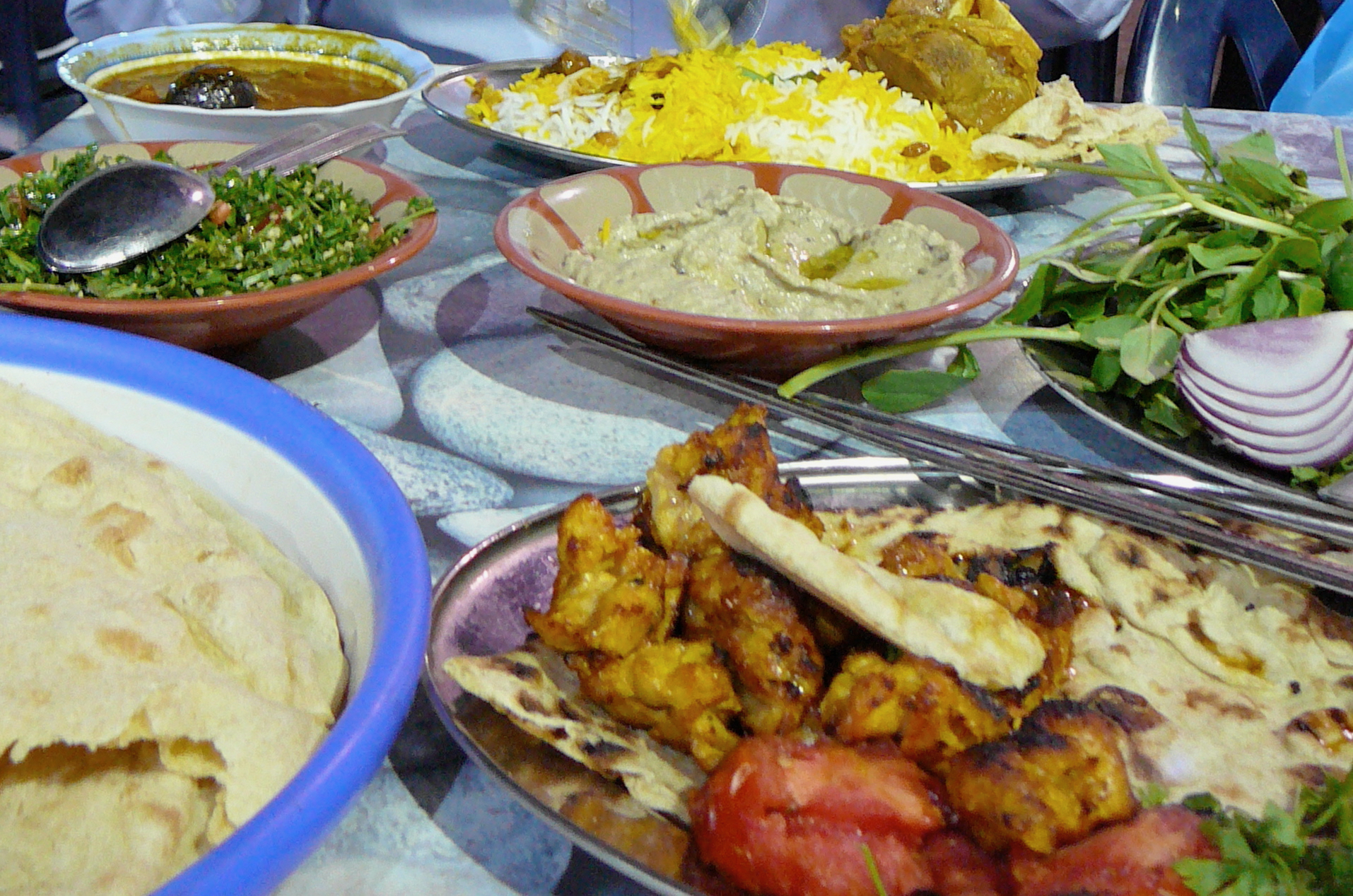
And now, my favorite haunt in Kuwait, the Mubarakiyya. Mubarak is blessing, and the Mubarakiyya was a blessing to me. This is where we would go for the best dates (the dates you eat, and entire street of date vendors), cottons and fabrics for our stitching and clothing (no Macy’s in Kuwait), and for some of the best eating in Kuwait. The stalls and kitchens were miniscule, most had outdoor seating, and the food was FRESH. Our friend Mohammed said that the reason the tea was so good (the large brass pot sitting on a heater at our table) was that they never washed the pot, so it had an aged tannin flavor, LOL. We would eat Kuwaiti shrimp, mezze, and oh, the freshly baked bread. We would take our visiting experts to this souk, a place they might never otherwise experience, and thrill their hearts with the sights and sounds and smells.



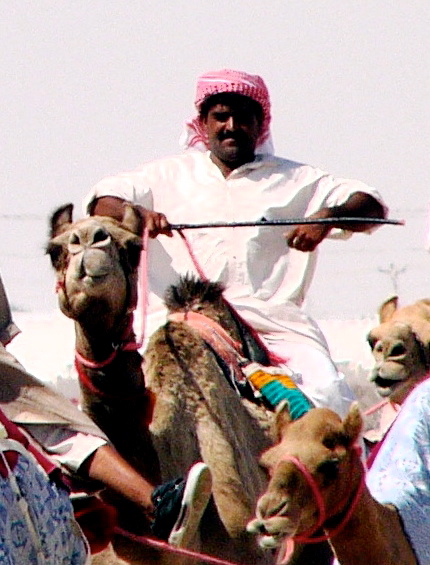
I didn’t always have a great view, and driving home one night alone in the middle of a sandstorm is one of lifes most adrenalin filled moments. You can’t see, and you can’t breathe.

I will end this with a big smile. Near the Kuwaiti airport was a store that sold electric palm trees. AdventureMan told me that he’s always wanted one and threatened to buy one to bring back and put in our yard in Edmonds, or Pensacola. Horrified, I just let it slide, and it never happened . . .

Tales from Before the Blog
Tonight we were eating Indian food, and talking about some of the truly great Indian restaurants where we had eaten in Doha. Our two favorite had separate veg and meat sections, and one, The Garden, even had them on two separate floors. The other, the Welcome, was a wonderful place, a place I would never dare to take my mother but a place we often went with friends. Once, we took another couple we liked, and we started with chots and dosas, and then ordered entrees. When the bill came, AdventureMan picked up and the other man objected – but only momentarily; AdventureMan showed him the total bill was 44 Qatari Dinar – somewhere around ten dollars.
Both The Welcome restaurant and the Garden were torn down to make way for a grand new walking street going down to the Souq al Waqif. We never saw prices like that again, or that kind of Indian-comfort-food-at-low-prices.
One story led to another.
“Take Her! Take Her!”
AdventureMan preceded me to Doha; I stayed behind and packed out, found new renters for our apartment, sold my car and arranged for my diabetic cat to fly with me to Doha.
When I got to Doha, I showed the veterinary papers showing Morgaine had the veterinary papers in order, but, as it turned out, I had not requested permission from the Qatar Department of Animal Health to bring in my cat, so I would have to leave her until I got permission. I discussed this politely with the customs official, a young soldier, and then I started pulling out my packets of syringes and vials of insulin, and I explained to him that she needed X amount of insulin injected at such and such a time, two times a day.
He looked at me in utter horror and said “Take her! Take her!” and I didn’t wait a single second but got everything back in my bag and walked out as fast as I could with my unpermitted cat. Things were easier then; there were always men with carts eager to take all your bags, so all I had to do was grab the cat and run.

“She’ll Have to Sign a Waiver”
No sooner had I arrived in Doha than a car showed up at my villa, a car I hadn’t requested nor chosen, but I guess the car I was meant to have. I had to learn to think in a whole new way. It was a really good thing I had the car because Operation Enduring Freedom was breaking out, and I knew I might not see my husband again for a while. He took an hour off the day after I arrived to show me where two grocery stores were; the one near us for the basics, and the French Carrefour, across town, but worth the drive.
But the company was horrified I wasn’t leaving. “We’ll pay your passage!” they said. “You can go anywhere! You don’t want to stay here, war is breaking out.”
I had just gotten to Doha. I was settling in. I had my abaya and scarf from our time in Saudi Arabia, and I knew the way to the airport; I could walk if I had to. My niece, Little Diamond, was coming to stay with me. We both spoke some Arabic, she spoke more than I did. I wasn’t afraid, and I didn’t want to leave.
“She’ll have to sign a waiver,” they told AdventureMan. I signed the waiver.

There were some dangers. While the USA and allies were gearing up to help the Kuwaitis take back Kuwait from the Iraqis, not everyone was on board. We learned to alter our body language, to walk and speak quietly, not to draw any attention to ourselves. We did our shopping calmly and efficiently. Even so, on occasion there was an occasional shop clerk who might ignore me and refuse to wait on me, but those occasions were rare, and the occasions of great hospitality from local citizens were many.

The day the war started, my sweet cat died. She had problems breathing early in the day, so I took her to the vet. Going to the Vet in Doha was not like any going-to-the-vet I’ve ever experienced before; you go, you sign in, you sit, if there is a chair left, and you wait your turn. It doesn’t matter how sick your animal is. It was chaos. Many people got very emotional and wanted to be taken out of turn. When I got to see the vet, who was always very kind, he gave her a shot and said “Now she will feel better.” I told him I thought she was close to the end, and he said maybe or maybe not. I took her home.
About three hours later she came and lay next to me quietly and I knew she was saying goodbye. She started gasping again, so I put her n her cage and drove as quickly as I could to the vet, but it was Friday afternoon, the day everything closes for mid-day prayer, he was closed, and could not be reached. By the time I got home, she was dead.
So the war is starting, my cat has died and I am not in a rational place. AdventureMan called and my niece talked to him. I think she told him the cat had died and I thought there was a chance it might just be a fit and she might come back to life, which was true. AdventureMan came home, I don’t know how he did it, but he did, and we drove out to the desert and buried our cat. He brought me back home and went back to the base and I didn’t see him for a while, except on television; as the CNN reporter stood in front of a sign at the press center on base, my husband sauntered behind him and gave me a wave. We still laugh about how he took a break to bury our cat just when war was about to break out, but managed to get back in time for the opening. He showed up when it mattered.
Welcome to Doha.
Rest in Peace, Donald Rumsfeld

You can admire a man without agreeing with him. Donald Rumsfeld gave me one of my favorite quotes:
Reports that say that something hasn’t happened are always interesting to me, because as we know, there are known knowns; there are things we know we know. We also know there are known unknowns; that is to say we know there are some things we do not know. But there are also unknown unknowns—the ones we don’t know we don’t know. And if one looks throughout the history of our country and other free countries, it is the latter category that tends to be the difficult ones.
I always thought he said “it is the latter category that bites us in the butt,” but maybe that was the unofficial version.
A Day Like No Other
I headed for the Y this morning, surprised I was awake and eager – I’d been up late the night before following the senatorial elections in Georgia, finally giving up when I couldn’t stay awake any longer. When I got to the Y, I found all the lanes filled, more than filled, and people waiting. In a state with one of the highest COVID rates in the nation and one of the highest death rates, and a state rated #50 in all 50 states in the health care for the elderly (aaack, I choke even to write this word, which seems to apply to me, but I do not feel “elderly”) I cannot stay in a place where a lot of unmasked people are breathing heavily as they exercise. I came home and walked a mile, then went on with my day.
I fell in love with a beautiful heron.

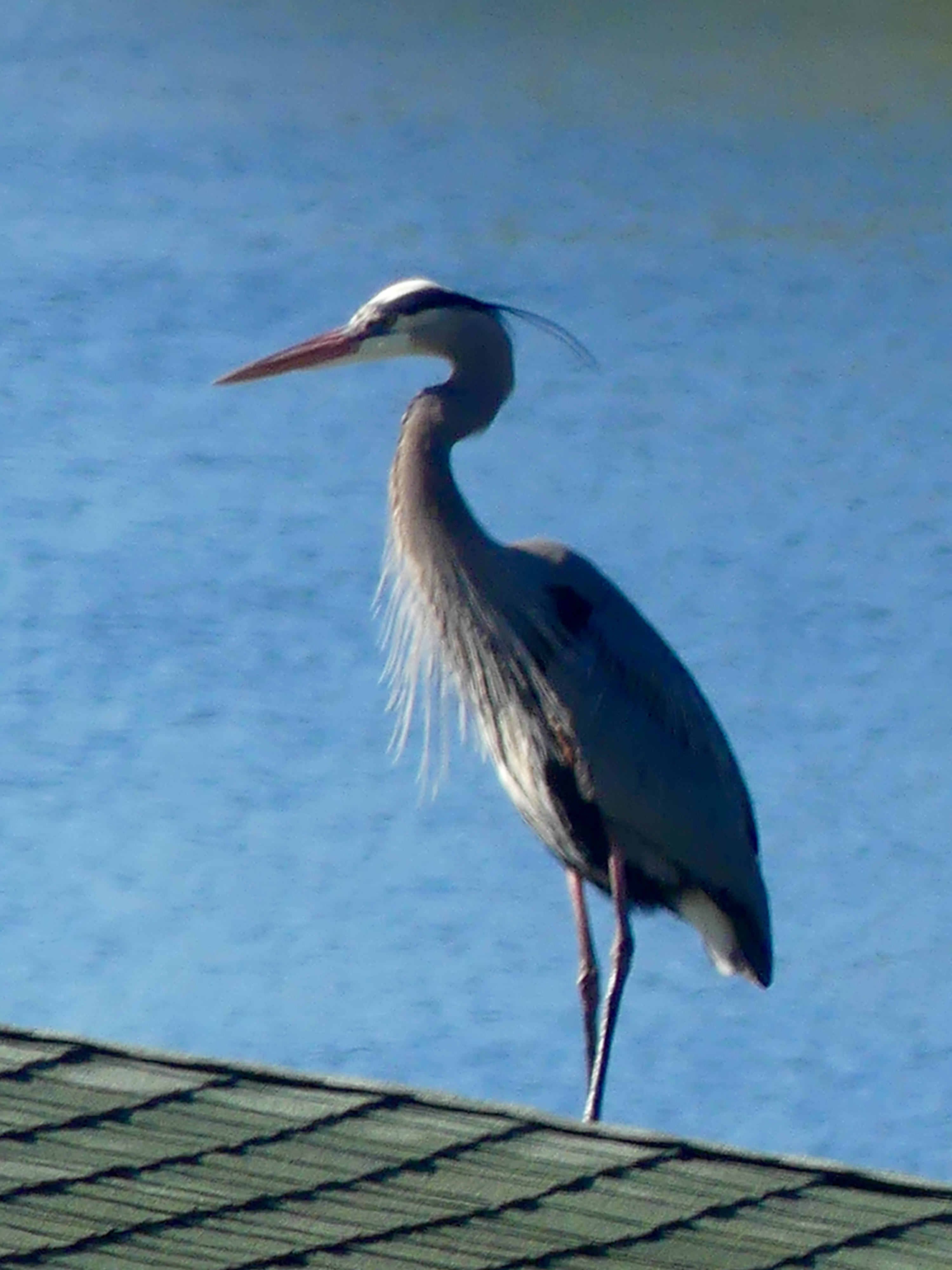

And his friends:

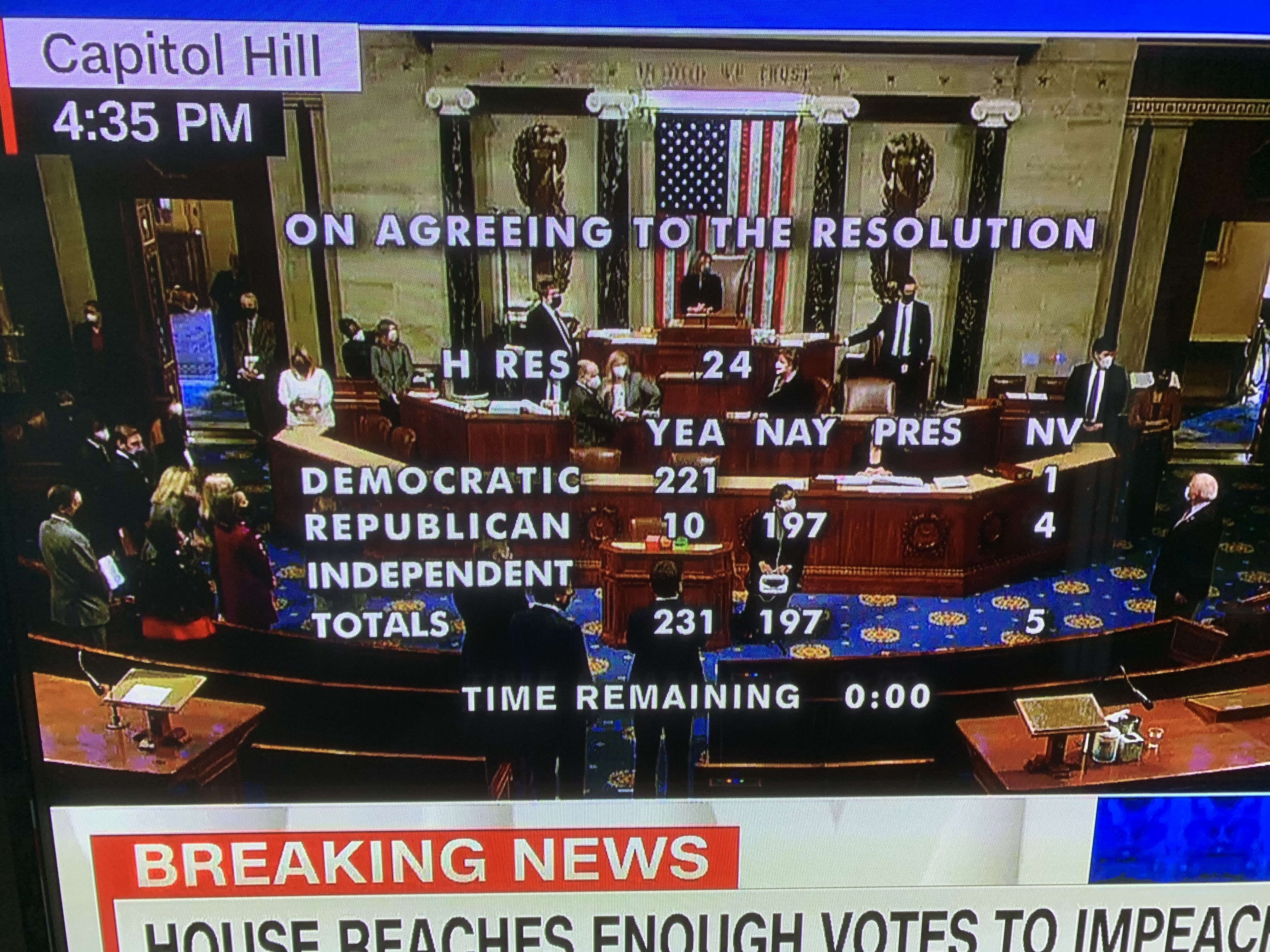
What a day it was. Two Democrats elected in Georgia, swinging the Senate to a 50-50 split, with Kamala Harris as the tie-breaker. As I see it, it is a challenge and a win-win. If this country is going to heal, we have to work together. We have to try to see things from the other’s point of view, and we have to find ways to compromise to achieve the greater good. We have so much work to do just to remedy the great slough of the last four years, work in the fields of justice, environment, health care, infrastructure, diplomatic relations, oh my, so much work to do in so many areas. It’s going to take all of us working together.
So as we are eating lunch and Mitch McConnell is on CNN making an astonishing speech supporting accepting the electoral college votes for Joe Biden, so astonishing it caught our full attention, and then all hell broke loose. There was a rallying speech by our Fearless Leader, who assured his followers once again that the election had been stolen and he was going to march with them (he didn’t) to the Capital where the senators and congresspeople were meeting, and they were to show how strong they were, and not be weak.
We watched in horror as this mob headed to the Capitol and knocked over the barriers and FOUGHT WITH THE POLICE. these followers of the Fearless one who calls himself the Law and Order President. Oh the shame of it! We watched as they broke windows, and lookie-lou’d, phone cameras in every hand documenting their invasion. We watched a sole policeman trying to staunch the mob as they headed for the law-makers chambers. The horror. The shame. I think all America was watching these hooligans with utter horror.

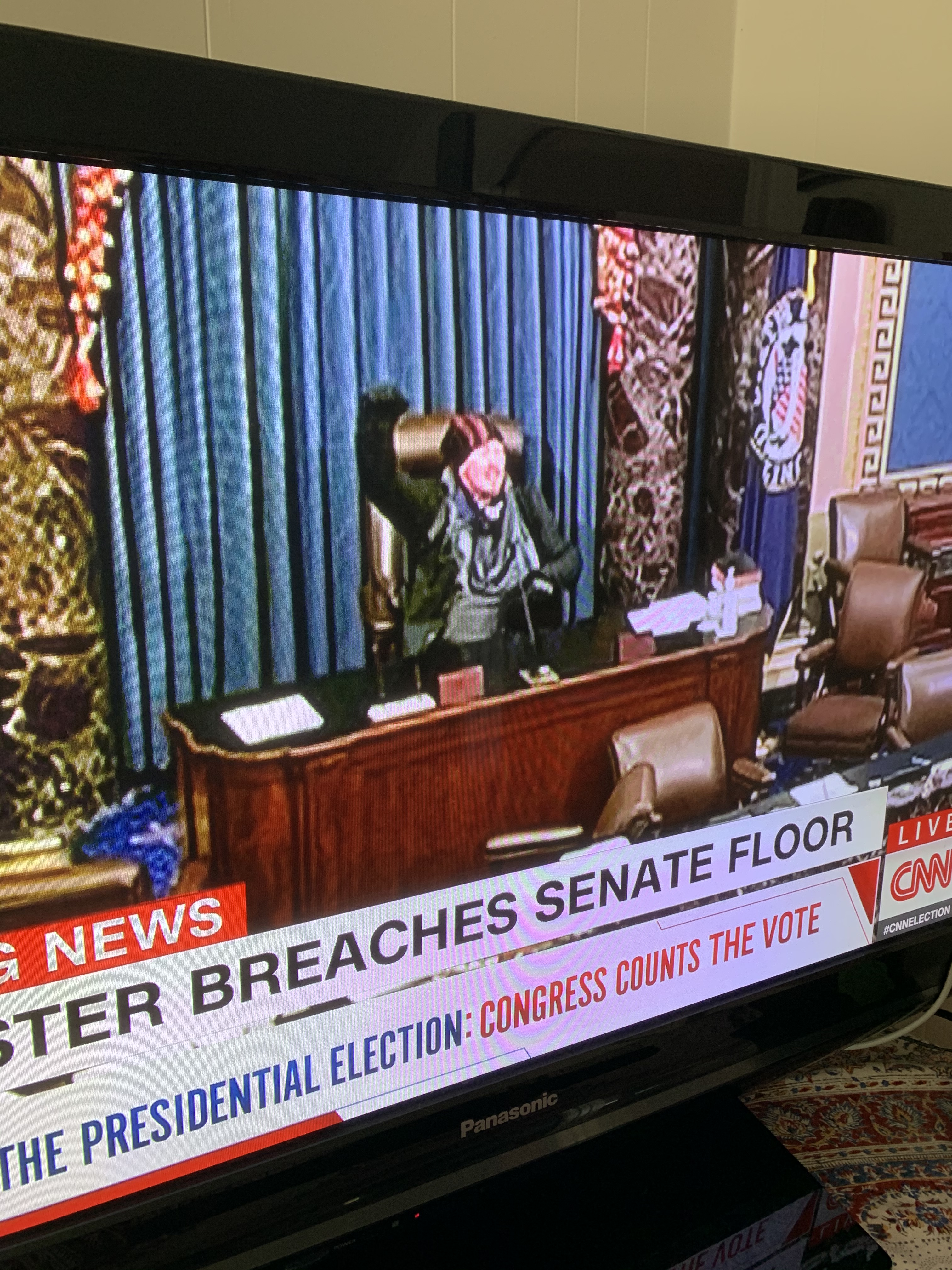

Not the brightest bulbs in the chandeliers; the US government offices are littered with cameras and state-of-the art facial recognition sortware. For the rest of their lives they will be instantly recognized as yahoos and insurrectionists in their FBI files accessible to every sheriff’s office and police department in America. What utter fools.
What did they think they were going to be able to accomplish? I suspect it was not a question of thinking; they were part of a mob and just sort of mindlessly participated not even realizing what they were doing. The last thing they would accomplish was overturning the will of the people, those voters who defeated the sitting president by more than 7 million votes.
As I write this, the Senate and House are meeting again to verify the electoral college votes and probably will agree to research better, more efficient ways to secure the vote in the future, maybe find more standardized ways to provide equal access to voting to all Americans, and to think of ways to more efficiently tally the vote. Joe Biden is safe. He will be inaugurated January 20th. And Kamala Harris will be one of the most important Vice-Presidents in history, providing the tie breaking vote when Democrats and Republicans fail to agree, but even better, working in the background to find ways to get lawmakers to craft legislation that will serve the people of both parties. I believe this.
At the end of this extraordinary day, I looked out and saw this:

Is that not beautiful?
I believe that out of the most horrendous circumstances, great good can come. I have seen this in my own life. People can change. Lives can change. We have choices, and sometimes it takes a good shaking up to show us how we can make better choices. I have hope that today has opened eyes, and opened hearts, and that it has opened a possibility that we can find a way to work together to accomplish great things.
Nancy Pelosi is talking about today being a day of Epiphany, a time of change and healing. My Moslem friends would say “insh’allah.” God willing.
Elizabeth Peratrovich
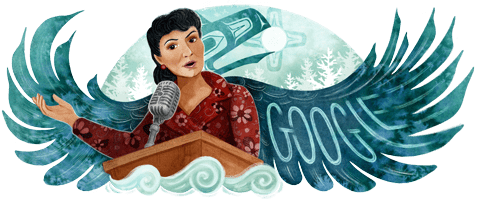
Sometimes I can get a little paranoid, and today was one of those times. Look at that gorgeous Google doodle for today. I spend a certain amount of time looking at Alaskan legend as a source of art images for my quilting, so when I saw the Google doodle, I thought it was one of those targeted things.
Not so.
As it turns out, it is a doodle honoring an Alaskan Tlingit woman, Elizabeth Peratrovich. I’ve taken the following from Wikipedia (to which I donate, so I am comfortable sharing what they have to say. I love that it is updated to show today’s doodle.) This woman was something special:
Elizabeth Jean Peratrovich (Tlingit name: Kaaxgal.aat; July 4, 1911 – December 1, 1958) was an American civil rights activist and member of the Tlingit nation who worked for equality on behalf of Alaska Natives.[1] In the 1940s, her advocacy was credited as being instrumental in the passing of Alaska’s Anti-Discrimination Act of 1945, the first state or territorial anti-discrimination law enacted in the United States in the 20th century. In 1988, the Alaska Legislature established February 16 as Elizabeth Peratrovich Day “for her courageous, unceasing efforts to eliminate discrimination and bring about equal rights in Alaska” (Alaska Statutes 44.12.065).[2] In March 2019, her obituary was added to The New York Times as part of their “Overlooked No More” series.[3]
Early life and education
Elizabeth Peratrovich, whose name at birth was Kaaxgal.aat[4], was born on July 4, 1911, in Petersburg, Alaska,[5] as a member of the Lukaax̱.ádi clan in the Raven moiety of the Tlingit nation. When she was young, she was adopted by Andrew and Jean Wanamaker (née Williams), who gave her the name “Elizabeth Jean”.[6][7] Andrew was a fisherman and Presbyterian lay minister. The Wanamakers raised Elizabeth in Petersburg, Klawock, and Ketchikan, Alaska. Elizabeth graduated from Ketchikan High School, and then attended Sheldon Jackson College in Sitka, and the Western College of Education in Bellingham, Washington (now part of Western Washington University).[a] In 1931, Elizabeth married Roy Peratrovich (1908-1989), who was also Tlingit, as well as of Serbian ancestry.[9]
Activism
In 1941, while living in Juneau, Alaska, Elizabeth and Roy Peratrovich encountered discrimination in their attempts to secure housing and gain access to public facilities. They petitioned the territorial governor, Ernest Gruening, to prohibit public places from posting the “No dogs or Natives allowed” signs that were common in Alaska during this time.[citation needed]
The Anti-Discrimination Act was proposed by the Alaska Native Brotherhood and the Alaska Native Sisterhood, but the first attempt to pass this legislation failed in 1943.[citation needed] However, in 1945, Roy and Elizabeth Peratrovich became the Presidents of the Alaska Native Brotherhood and the Alaska Native Sisterhood, respectively, and lobbied the territory’s legislators and Governor Gruening to pass the act.[citation needed]
Before the territorial Senate voted on the bill in 1945, Elizabeth Peratrovich, representing the Alaskan Native Sisterhood, was the last to testify, and her impassioned speech was considered decisive.[10] Responding to territorial senator Allen Shattuck of Juneau, who had earlier asked “Who are these people, barely out of savagery, who want to associate with us whites, with 5,000 years of recorded civilization behind us?,” she stated:[11]
I would not have expected that I, who am barely out of savagery, would have to remind gentlemen with five thousand years of recorded civilization behind them, of our Bill of Rights.[12]
Fran Ulmer, who represented Juneau in the Alaska House of Representatives (and who later became lieutenant governor of Alaska), in 1992 said the following about Peratrovich’s testimony:
She talked about herself, her friends, her children, and the cruel treatment that consigned Alaska Natives to a second-class existence. She described to the Senate what it means to be unable to buy a house in a decent neighborhood because Natives aren’t allowed to live there. She described how children feel when they are refused entrance into movie theaters, or see signs in shop windows that read “No dogs or Natives allowed.”[12]
The Senate voted 11-5 for House Resolution 14, providing “…full and equal accommodations, facilities, and privileges to all citizens in places of public accommodations within the jurisdiction of the Territory of Alaska; to provide penalties for violation.”[11] The bill was signed into law by Governor Gruening in 1945, nearly 20 years before the US Congress passed the Civil Rights Act of 1964. Acts of the territorial legislature required final approval from the U.S. Congress, which affirmed it (Bob Bartlett, Alaskan delegate, was known for his efficiency in passing legislation). Alaska thus became the first territory or state to end “Jim Crow” since 18 states banned discrimination in public accommodations in the three decades following the Civil War; not until 1955 would two more states, New Mexico and Montana, follow suit.[13]
The Peratrovich family papers, including correspondence, personal papers, and news clippings related to the civil rights work done by Elizabeth and Roy Peratrovich, are currently held at the Smithsonian National Museum of the American Indian.[14]
Personal facts
On December 15, 1931, Elizabeth married Roy Peratrovich (1908–1989), also a Tlingit, of mixed native and Serbian descent who worked in a cannery.[citation needed] They lived in Klawock, where Roy was elected to four terms as mayor.[citation needed]
Looking for greater opportunities for work and their children, they moved to Juneau, where they found more extensive social and racial discrimination against Alaska Natives. They had three children: daughter Loretta, and sons Roy, Jr. and Frank.[11]
The Peratrovich family later moved to Antigonish, Nova Scotia, Canada, where Roy pursued an economics degree at St. Francis Xavier University.[citation needed] From there they moved to Denver, Colorado, where Roy studied at the University of Denver.[citation needed] In the 1950s, the Peratroviches moved to Oklahoma, and then back to Alaska.[citation needed]
Elizabeth Peratrovich died after battling breast cancer on December 1, 1958, at the age of 47.[15] She is buried at Evergreen Cemetery, Juneau, Alaska, alongside her husband Roy.[citation needed]
Her son, Roy Peratrovich, Jr., became a noted civil engineer in Alaska. He designed the Brotherhood Bridge in Juneau, which carries the Glacier Highway over the Mendenhall River.[16]
Legacy and honors
- On February 6, 1988, the Alaska Legislature established February 16 (the day in 1945 on which the Anti-Discrimination Act was signed) as “Elizabeth Peratrovich Day,” in order to honor her contributions: “for her courageous, unceasing efforts to eliminate discrimination and bring about equal rights in Alaska” (Alaska Statutes 44.12.065).[17]
- The Elizabeth Peratrovich Award was established in her honor by the Alaska Native Sisterhood.[citation needed]
- In 1992, Gallery B of the Alaska House of Representatives chamber in the Alaska State Capitol was renamed in her honor.[12] Of the four galleries located in the respective two chambers, the Peratrovich Gallery is the only one named for someone other than a former legislator (the other House gallery was named for Warren A. Taylor; the Senate galleries were named for former Senators Cliff Groh and Robert H. Ziegler).
- In 2003, a park[18] in downtown Anchorage was named for Elizabeth and Roy Peratrovich. It encompasses the lawn surrounding Anchorage’s former city hall, with a small amphitheater in which concerts and other performances are held.[19]
- In 2009, a documentary about Peratrovich’s groundbreaking civil rights advocacy premiered on October 22 at the Alaska Federation of Natives convention in Anchorage. Entitled For the Rights of All: Ending Jim Crow in Alaska, the film was scheduled to air as a PBS documentary film in November 2009. The film was produced by Blueberry Productions, Inc. and was primarily written by Jeffry Lloyd Silverman of Anchorage.[20]
- In 2017, the theater in Ketchikan’s Southeast Alaska Discovery Center was named in honor of Elizabeth Peratrovich, and a companion exhibit exploring her role in the struggle for Alaska Native civil rights was unveiled.[21]
- In 2018, Elizabeth Peratrovich was chosen by the National Women’s History Project as one of its honorees for Women’s History Month in the United States.[22]
- On October 5, 2019, United States Mint Chief Administrative Officer Patrick Hernandez announced that Peratrovich would appear on the reverse of the 2020 Native American $1 Coin, making her the first Alaska Native to be featured on U.S. currency.[23][24][25]
- In December 2019, a 4-story apartment building called Elizabeth Place, named after Peratrovich, opened in downtown Anchorage.
- In July 2020, a new mural was unveiled in honor of Peratrovich in Petersburg Alaska.[26]
- On December 30, 2020, a Google Doodle in the United States and Canada honored Elizabeth Peratrovich. The Doodle was drawn by Tlingit artist Micheala Goade.[27]
Be Still My Heart

The Dow Jones Industrial average just went over 30,000 for the first time, ever, skyrocketing on the prospect of a peaceful transition, some predictability taking place of our four years of chaos, and some civility.
I am watching Joe Biden intruduce his new cabinet nomineees. Everyone is masked, and between each speaker an aide is wiping down the surfaces on th podium.
The words they speak thrill my heart:
Service
Diplomacy
Foreign Policy/ National Security / Allies
Respect
Opportunity
Telling Truth to Power
Unite America; Belief in America’s Ideals – Democracy, Rule of Law
Commitment
Reflecting the best of our nation
Truth, Facts, Science
There are women at the table. There are brown people at the table. There are humble, talented white men at the table. My heart sings. They are warriors, looking realistically at the challenges ahead and ready to do whatever they need to do to rebuild the American dream for ALL citizens.
These are people who work quietly, persistently and modestly in service to their country, and are willing to put in the hard work to achieve hard-gained successes.
I’m excited. I dream of a better tomorrow.
I Can’t Look

Today is election day in the United States of America, following four of the nastiest years in our history.
I try to be objective.
We served our country, AdventureMan and I, for many years, most of them outside the United States, sometimes in dangerous circumstances, not always agreeing with the official policies of our country but always, always, supporting them, as we were sworn to do. That is the nature of the “dark” bureaucracy. We serve our country, and we obey the laws.

To see the bureaucracy derided, dismissed and destroyed breaks my heart. To see all the painstaking hard work taken over years and years of persistent policy making tossed aside, along with our faithful allies, enrages me.
Oops. Enraged?
One of the things we learn along the road is not to take things personally. We learn to suffer disappointment and watch for opportunities to get back on track. Anger doesn’t help. Name-calling doesn’t help. Confrontation may be useful, but you have to choose your timing, and your battles.
I was raised to be competitive. I have had to dial it back. I learned that focusing on the win all the time drove bad decisions, and an unhealthy attitude – in me, I am not judging anyone else here, I just learned that to be effective in my own life, I had to lay competitiveness aside.
Tonight we will learn the design of our next four years. I can’t help it; I am emotionally involved. I spent the day NOT watching the news, not watching for signs and portents. I took care of business, I quilted, I went to the dentist, all great diversions. I prayed, frequently, throughout the day as I have been praying for four years. I try not to give God advice, I try to remember always to keep in mind “Thy will be done” and yet . . . I have my private opinion of how things would work out best.
Tonight, once the polls close, I will watch.
Whatever happens in the next few hours, or days, or even weeks – or months – I will try to stay level, stay focused, stay the course. No matter how bad it has been, there have been minor celebrations along the way, and I can persevere, I know I can. It would be nice, however (God? are you there? are you listening?) to have a break, to have some normality restored, and to begin to have a longer news cycle, and rest between crises, and even, God willing, some peace on earth, good will toward mankind.
Florida Breaks All Records for COVID Cases
First, to those of you who know me and are far away, we are well.
My Mother died of COVID in Seattle, in April. It was a shock. Although she was 96, she was mentally fit, very sharp, and her mother lived to 104. We all expected Mom to break her Mom’s record.
We don’t live in the biggest hot-spot, the Miami/Dade County area far to the south and east of Pensacola. No, we are in the eighth worst hit part of Florida, and part of the 18 greatest concerns for COVID according to the study out yesterday.
No one I know here has gotten sick. Almost everyone I know has the luxury of staying home, working from home, not needing to interface with the public unnecessarily. It is stunning, however, to think that one person in ten in this area has or has had the virus.
These graphs are not from the Florida Department of Health website. The person hired to design that website designed a great, comprehensive website to transparently share information. She was fired. She says she was fired for not agreeing to manipulate the information to make things look not so bad in Florida. Our governor is a total toady to President Trump, who is doing nothing to provide leadership to our country in fighting this pandemic, not providing comfort to those who suffer from it.


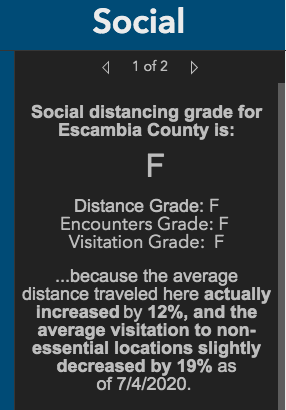
These snapshots are from her new website, which has much more accurate presentations of the situation in Florida than the official site. She, and others, gather information which may be obscure, but is available to the public, and publishes it. Her website is Florida Covid Action. She is a hero.
I live in a county where I have friends who support Trump and believe that the Democrats are over-hyping the problems for political reasons, so that Trump will lose his bid for re-election. They also believe masks are unnecessary. They don’t see any reason to socially distance. They perceive restrictions on their behavior as violations of their First Amendment rights.
So Trump has mandated our schools to open as normal – that means in August. The schools must offer an in-school option, which has many teachers frightened and/or furious. They also offer a remote school-day option, 6 hours in front of a computer, and an independent option, where a student completes a curriculum on his or her own. Those who attend school will not be required to mask or to social distance.
My grandchildren are 7 and 10. Their parents face having to choose the least bad of the three proposals. Parents all around the state are debating what to do. Many parents work, and child care is almost impossible to find and very costly. Many parents will have to send their children to school or leave them unattended and unsupervised at home.

The pediatric cases are for my county, Escambia County. The highest rate of transmission is among those 15 – 24. They’ve closed the bars, but the rate remains high, and rising. The rate of transmission among children is also rising.
I am outraged. We have handled this contagion worse that a third world country. We know masks work. We know social distancing, plus masks, plus conscientious hand-washing can flatten this curve, bring the number of cases down, and expect a rational re-opening. Nothing we have done, especially in Florida, has been rational. God help us. Lord, have mercy on us.
Recent Comments
ExpatAlien on What Country am I Living … intlxpatr on Yellowstone: Old Faithful to C… Michelle on Yellowstone: Old Faithful to C… Cathy on No Grown-Ups in Charge intlxpatr on Waiting for Snow Wikipedia Donate Button

Amazina


Early Voting in Florida


 Here There and Everywhere
