Hold Your Calls, Save Your Life
Actually – not a bad slogan. Pithy, personal, memorable.
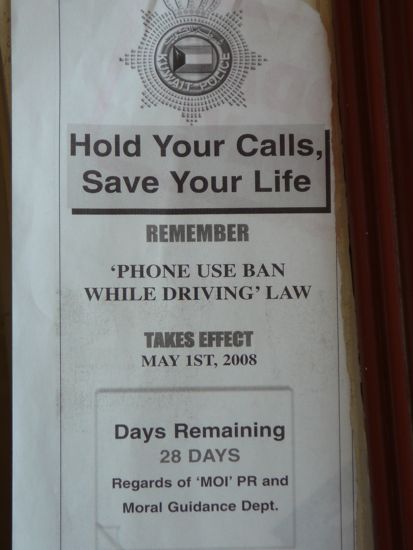
Found this in yesterday’s Kuwait Times. Was it also in the Arabic language newspapers? Doesn’t say anything about the fine . . . . the newspaper announcement leads us to believe they are serious. The fine of 5KD (about $20) remains laughable. Nonetheless – if you use a mobile phone while driving, you will become a CRIMINAL after May 1! 😉
No one is going to hate this law more than AdventureMan. Sometimes he calls me when he is driving just to see if I will hang up on him. He tries to talk me into talking with him. I have always said I don’t want to hear his last words being “Oh ____!”
Big Plans, No Action
Hmmm, let’s see . . . plans drawn up, billions allocated for renovation and restoration and blah blah blah and nothing happens. Good ol’ Kuwait? Nope! The tragic quagmire of post-Katrina New Orleans. You can read the entire article at The New York Times.
By ADAM NOSSITER
Published: April 1, 2008
NEW ORLEANS — In March 2007, city officials finally unveiled their plan to redevelop New Orleans and begin to move out of the post-Hurricane Katrina morass. It was billed as the plan to end all plans, with Paris-like streetscape renderings and promises of parks, playgrounds and “cranes on the skyline” within months.
But a year after a celebratory City Hall kickoff, there have been no cranes and no Parisian boulevards. A modest paved walking path behind a derelict old market building is held up as a marquee accomplishment of the yet-to-be-realized plan.
There has been nothing to signal a transformation in the sea of blight and abandonment that still defines much of the city. Weary and bewildered residents, forced to bring back the hard-hit city on their own, have searched the plan’s 17 “target recovery zones” for any sign that the city’s promises should not be consigned to the municipal filing cabinet, along with their predecessors. On their one-year anniversary, the designated “zones” have hardly budged.
“To my knowledge, I don’t think they’ve done anything to any of them,” said Cynthia Nolan, standing near a still-padlocked, derelict library in the once-flooded Broadmoor section, which is in the plan.
“I haven’t seen anything they’ve done to even initiate anything,” said Ms. Nolan, a manager in a state motor vehicles office who has painstakingly raised her house here nearly four feet. “It’s too long. A year later, and they still haven’t initiated anything they decided to do?”
The library still bears the cross-hatch markings made by emergency teams in the days immediately after Hurricane Katrina, to indicate whether any bodies were inside (there were none).
The city official in charge of the recovery effort, Edward J. Blakely, said the public’s frustration was understandable, but he suggested that bureaucratic hurdles had made moving faster impossible. Mr. Blakely said crucial federal money had only recently become available, the process of designing reconstruction projects within the 17 zones was time-consuming, and ethics constraints on free spending were acute, given a local history of corruption.
Bullying and 19 Minutes; Jodi Picoult
When my blogging friend Chirp makes a recommendation, I have learned to order the book and read it. She reads books that make you think! The latest book is Jodi Picoult’s 19 Minutes, a book about a kid who is sensitive and kind and funny, and plays by the rules – he is good at sharing, and listening and all the things we try to teach our children to be good at.

He gets bullied. From the time he starts school, he is bullied physically and mentally and emotionally. He does the right thing – he reports it. The schools do nothing, or so little that it only makes things worse for him. Pushed too far, one day snaps, he goes ballistic. He walks into the school and shoots 19 of his classmates.
One problem is access to weapons. Literally, physically teenagers have not yet developed the judgement areas of the brain. I am guessing in males it takes even longer, and I only guess that because of all the traffic fatalities and physical damage adolescent boys inflict upon themselves – and their victims. Maybe it is that fatal combination of poor judgement and testosterone that pushes them too far. Access to weapons – guns, knives, fast cars – makes them even more lethal.
Before I wrote this review, however, I had to do a lot of thinking. This book is about bullying, and even as adults we come across bullies. Our household helpers are terrified of the police – those who are here to protect us. The police use their position to try to bully phone numbers out of pretty Kuwaiti girls, and to exact sexual favors from the Asian domestics. Not all police are bullies, but if a person has that tendency, the position allows him/her to use that power wrongly.
And bullying doesn’t stop with graduation from high school. We are seeing the same kinds of behavior at universities – Virginia Tech – and in the workplace – “going postal” and GMAC just to name two. People who are bullied sometimes turn, they go out in a blaze of glory.
I’ve been bullied. People who are raised to have good manners are often victims of those who are willing to overstep the boundaries. We make excuses for them – we say they are oblivious. I am beginning to think that many a bully is NOT oblivious, but has learned to push to get his or her own way.
With men, the bullying is more physical, and it’s all about jockying for position – number one in the pecking order, the next promotion, the boss’s golf partner, etc. If you think women are gossips – you oughta hear the men! When I hear men “bantering” it’s all about who’s got the “biggest.” Or maybe, the devil whispers in my ear, it’s about who can make you THINK his is the biggest.
With women, in my experience, most of the bullies are physically bigger. They are women who – literally – throw their weight around. They are women who will interrupt anyone and override their suggestion with a loud voice. They are women who have temper tantrums, and hurt feelings, who go from person to person forming alliances that dissolve with the next disagreement. That’s the sad truth – a bully wants his or her own way – all the time. Once you go against them, you have to watch your back.
Picoult has done her homework. Bullies are often likeable enough people! A bully carries his/own burden, however – and that is a desperate need for popularity. You can see this in animal behavior; once a creature has achieved dominance, it takes enormous energy to maintain that position, so much energy that the rest of your life shrinks as your focus must be on maintaining dominance.
The UK, Canada, and the US all have websites about bullying, trying to put a stop to it in the schools. What do they define as bullying?
People calling you names
Making things up to get you into trouble
Hitting, pinching, biting, pushing and shoving
Taking things away from you
Damaging your belongings
Stealing your money
Taking your friends away from you
Posting insulting messages on the internet or by IM (cyberbullying)
Spreading rumours
Threats and intimidation
Making silent or abusive phone calls
Sending you offensive phone texts
Bullies can also frighten you so that you don’t want to go to school, so that you pretend to be ill to avoid them
What can people with manners do against a bully?
In general, the first thing to do is tell an adult – it doesn’t have to be your parents. Additonal suggestions suggest creating your own support network – create a wide network of friends. Join interest groups, in our out of school.
When our son was bullied in school, he worked hard and earned a black belt in karate, and then went on to earn further degrees, and to teach karate – while still in high school. Just knowing that he had a lethal skill made him walk differently, made the bullies afraid to target him. He went to a magnet school, where there was a high degree of chaos, and he sought out and made friends with the biggest people he could find. He used his head. He made it through. Of all his accomplishments, one of the things that made us most proud of him was his ability to stick it out and to prevail.
I worked in a high school. My office was a safe haven for many kids, kids who found high school dynamics pure hell. Most of them were emotionally years ahead of the crowds roaming the hallways, the cruel kids, for whom high school will probably be the highlight of their lives.
“You’re going to love being an adult,” I would tell them. “Hang in there. For them, this may be as good as it gets, but your life is going to get better and better.”
Geeks don’t always get a lot of respect. The two guys that graduated high school at the bottom of the class with my son already had a flourishing computer networking business going. If you haven’t noticed, most of the people who are making it big financially are people who have learned how to use their heads.
I have learned something else. You can beat a bully at his or her own game. Bullies usually rely on instilling fear in others, but rarely do they do their homework.
Choose your battles. Bullying hurts everyone. If you see someone being bullied and you can do something about it then and there, stand up for the person being bullied. All you have to do is say “that’s not funny, just stop.” Many times bullies are so shocked at being challenged, they will stop! If your judgement tells you it would be unsafe to say anything, quickly tell an adult, a supervisor, a manager, what you have seen.
If a bully is trying to push through something you believe is wrong, you can quietly discuss things one on one with others, and make a plan. You can call for a vote! You can quietly stand up to a bully. You can tell a bully “it’s my turn to talk” and they have to shut up! (When you do this, you have to be very careful to listen when the bully is speaking so that everyone knows it really IS your turn to talk.) You can use a little gentle humor – bullies usually only like humor when it is aimed at someone else. They haven’t a clue what to do when it is aimed at them!
If it is annoying, but not something worth fighting over, let the bully get his or her own way. They usually end up shooting themselves in the foot, self-destructing. The adult bully ends up driving people away, and then wondering why he/she has no friends?
Living your own life well is your best revenge!
Thank you, Chirp, for another book that really made me think!
Minarets
You’d think I would pick up on things sooner, but here’s the problem. When you don’t know something, you often don’t even know you don’t know. In a recent post on an Al Ahmadi minaret one of my commenters asked if I couldn’t tell it was a Shiite minaret. At first, I thought he was being funny, but it nagged at me, so I started asking around.
It turns out almost everone except me can tell the difference. Most say, as I would, “oh you just kind of know, it looks more Iranian” but occasionally someone will say something concrete, like “if it has a green roof on the minaret, it is Shiite” or “if the windows look like keyholes, it is Shiite.”
Who would know? Not me! But I am learning.
So, help me out here. This mosque near City Center on 5th ring. Definitely Shiite?

This mosque is in Qurain – I love the very purpleness of it. Is this a Sunni mosque? I ask because the windows look kind of like keyholes.

Now – services. I’m an Episcopalian, a sub-sect of Christianity, and I can walk into almost any Anglican/ Lutheran/ Catholic church in the world and even if it is in another language, I have a pretty good idea what is going on, because we are liturgical, we follow a pattern of worship, and the three services are very similar, with very subtle difference. In fact so subtle I probably couldn’t even tell you what the differences are. Islamic services are also considered liturgical – having a set pattern of worship.
So if you were Sunni or Shiia, and walked into a service, could you tell a Sunni service from a Shiia service? Are there differences?
I am sorry to be so ignorant; help me be less so!
Ordered to Learn English
This is from BBC News: Americas. If I were living in the USA, I might think that is a good thing. Living here in Kuwait, speaking some Arabic, pretty laughably, I shudder to think what could happen here. . .. guess I’ll have to stay out of the Kuwait courts, insh’allah.
Judge orders men to learn English
A judge in the US state of Pennsylvania has ordered three Spanish-speaking men to learn English or go to jail.
The trio, who pleaded guilty to conspiracy to commit robbery, were told they could remain on parole if they studied English and got full-time jobs.
Judge Peter Olszewski said the unusual sentence was supposed to help the men. They will serve their full jail terms if they fail an English test in a year.
Lawyers for the three said they had not yet decided whether they would appeal.
You can read the rest of the news article HERE.
So I am curious. If you are Kuwaiti, what do you think about the fact that about 50% of your population (the not Kuwaiti part) doesn’t speak Arabic, the native tongue in Kuwait.
If you are an expat, if you had to learn Arabic, would you continue to work here?
Home Schooling Muslims in America
The New York Times has this fascinating article:
LODI, Calif. — Like dozens of other Pakistani-American girls here, Hajra Bibi stopped attending the local public school when she reached puberty, and began studying at home.
Her family wanted her to clean and cook for her male relatives, and had also worried that other American children would mock both her Muslim religion and her traditional clothes.
“Some men don’t like it when you wear American clothes — they don’t think it is a good thing for girls,” said Miss Bibi, 17, now studying at the 12th-grade level in this agricultural center some 70 miles east of San Francisco. “You have to be respectable.”
Across the United States, Muslims who find that a public school education clashes with their religious or cultural traditions have turned to home schooling. That choice is intended partly as a way to build a solid Muslim identity away from the prejudices that their children, boys and girls alike, can face in schoolyards. But in some cases, as in Ms. Bibi’s, the intent is also to isolate their adolescent and teenage daughters from the corrupting influences that they see in much of American life.
About 40 percent of the Pakistani and other Southeast Asian girls of high school age who are enrolled in the district here are home-schooled, though broader statistics on the number of Muslim children being home-schooled, and how well they do academically, are elusive. Even estimates on the number of all American children being taught at home swing broadly, from one million to two million.
No matter what the faith, parents who make the choice are often inspired by a belief that public schools are havens for social ills like drugs and that they can do better with their children at home.
“I don’t want the behavior,” said Aya Ismael, a Muslim mother home-schooling four children near San Jose. “Little girls are walking around dressing like hoochies, cursing and swearing and showing disrespect toward their elders. In Islam we believe in respect and dignity and honor.”
Still, the subject of home schooling is a contentious one in various Muslim communities, with opponents arguing that Muslim children are better off staying in the system and, if need be, fighting for their rights.
Robina Asghar, a Muslim who does social work in Stockton, Calif., says the fact that her son was repeatedly branded a “terrorist” in school hallways sharpened his interest in civil rights and inspired a dream to become a lawyer. He now attends a Catholic high school.
“My son had a hard time in school, but every time something happened it was a learning moment for him,” Mrs. Asghar said. “He learned how to cope. A lot of people were discriminated against in this country, but the only thing that brings change is education.”
Many parents, however, would rather their children learn in a less difficult environment, and opt to keep them home.
You can read the rest of the article HERE
Kuwait Driver’s License

“oh, I can’t,” I was telling my friend, “I have to go get my driver’s license today.”
“I had a funny thing happen,” she responded. “When I went, I didn’t understand the guy too well and he said something like ‘how long do you want it for?’ and I said ‘three years’ and I got one for three years!”
“You’re kidding!” I said. “I’ve been having to go every year!”
It doesn’t make sense, but you just never know in Kuwait. Every year for two years now I have had to go get my eyes tested and get a new license. But you never know, maybe her company has some other agreement, and she gets a three year license. Some things you just can’t worry too much about or it will drive you crazy.
So I went and took the 30 second eye test and later that same day my husband brought home my new driver’s license – good for TEN years.
If I had known I was going to get a ten year driver’s license, I sure would have made sure they used a better photo than the one my sponsor provided them. AAAARRRRGGGHHH.
Peacekeeping in Dharfur
From the New York Times
Peacekeeping in Darfur Hits More Obstacles
By LYDIA POLGREEN
Published: March 24, 2008
ABU SUROUJ, Sudan — As Darfur smolders in the aftermath of a new government offensive, a long-sought peacekeeping force, expected to be the world’s largest, is in danger of failing even as it begins its mission because of bureaucratic delays, stonewalling by Sudan’s government and reluctance from troop-contributing countries to send peacekeeping forces into an active conflict.
The force, a joint mission of the African Union and the United Nations, officially took over from an overstretched and exhausted African Union force in Darfur on Jan. 1. It now has just over 9,000 of an expected 26,000 soldiers and police officers and will not fully deploy until the end of the year, United Nations officials said.
Even the troops that are in place, the old African Union force and two new battalions, lack essential equipment, like sufficient armored personnel carriers and helicopters, to carry out even the most rudimentary of peacekeeping tasks. Some even had to buy their own paint to turn their green helmets United Nations blue, peacekeepers here said.
The peacekeepers’ work is more essential than ever. At least 30,000 people were displaced last month as the government and its allied militias fought to retake territory held by rebel groups fighting in the region, according to United Nations human rights officials.
For weeks after the attacks, many of the displaced were hiding in the bush nearby or living in the open along the volatile border between Sudan and Chad, inaccessible to aid workers. Most wanted to return to their scorched villages and rebuild but did not feel safe from roaming bandits and militias.
A week spent this month with the peacekeeping troops based here at the headquarters of Sector West, a wind-blown outpost at the heart of the recent violence, revealed a force struggling mightily to do better than its much-maligned predecessor, but with little new manpower or equipment.
Despite this, the force is managing to project a greater sense of security for the tens of thousands of vulnerable civilians in the vast territory it covers, mounting night patrols in displaced people’s camps and sending long-range patrols to the areas hardest hit by fighting. But these small gains are fragile, and if more troops do not arrive soon, the force will be written off as being as ineffective and compromised as the one before.
You can read the rest of the article HERE
A Long Way Gone: Ishmael Beah
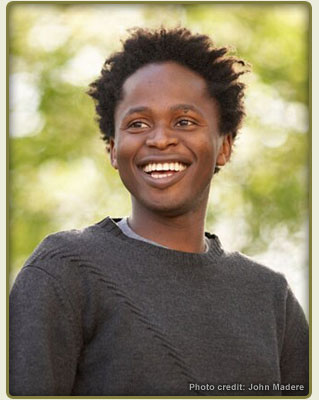

Back when I wrote an update on Dharfur, my blogging friend Chirp recommended a book, A Long Way Gone; Memoirs of a Boy Soldier by Ishmael Beah. I ordered it that very day, and read it this last week.
It is a truly heartbreaking autobiographical book about a young mischievous boy growing up in Sierra Leone, leading a relatively simple and carefree life in his village with his family. It is very African. He talks about the games he and his friends play, his fascination with rap music and the simple joys of the life he is leading.
Then the rebels come. The invade the villages, hopped up on dope, their dead eyes with no pity, raping, killing, chopping off limbs, stealing all the village food and burning the village behind them, often with people locked inside their huts.
Ishmael escapes once with friends, eventually returning to the village to find his entire family gone. Most of the book has to do with what he has to do to survive. Many villages are very afraid of groups of boys, even boys as young as these are – in their early adolescence – and will hurt them. At the very least, most of the villages hurry them along. At one point Ishmael is hiding out in the jungle forest on his own, hiding from lions, giant feral pigs, sleeping up in trees and looking for the rare fruit or grass that he can eat without getting sick.
Finally, after meeting up with some other boys and continuing to try to find his family, a village takes him in, a village run by the state soldiers. As they are attacked by rebels, the boys are forced to make a choice – go out on their own again (where the rebels will also try to recruit them, and if they refuse, will kill them) or agree to be soldiers. These are kids 12, 13, 14 carrying AK 47’s. As part of their training they are given drugs on a regular basis which keep them hopped up, full of energy, and not sleeping for days. The young boys learn to kill without pity. He becomes the very people he was fleeing.
This is a book about redemption. At the center where the boy soldiers are taken, they are constantly told “none of this was your fault.” It is a very African approach, a very human and loving approach to redemption of lives that might have been totally lost to the horrors they have witnessed and inflicted. The author is now nearly 30, and sounds – unlikely as it might be – happy.
Thank you, Chirp, for recommending this wonderful book.
Election Fever
I have a very dear friend who will say “I don’t have a dog in that fight” and that is the way I feel about your upcoming elections. You (Kuwait, Kuwait leadership, Kuwait people) are in our prayers for a fair election, and that you elect good leadership. You know what a mess it has been; it would be nice to elect people who can work with the government to get things done.
So I don’t have a clue who those people would be, but I know YOU do.
Here is what tickles me, what I can’t resist commenting on from this morning’s Kuwait Times:
ELECTION FEVER GRIPS STATE
Tribes, groups move to chose candidates • Eligible voters rise to 361,000 including 200,000 women
Holy Smokes! Almost FORTY THOUSAND more women voters than men voters??? Woooo HOOOOOO, Kuwaiti women!
Recent Comments
intlxpatr on Shampoo Ginger tigerbutterya0c5ff1d… on Shampoo Ginger intlxpatr on British Soldier Kidnapped, Esc… John on British Soldier Kidnapped, Esc… intlxpatr on British Soldier Kidnapped, Esc… Wikipedia Donate Button

Amazina


Early Voting in Florida


 Here There and Everywhere